
All Topics  
Bacteriophage


   Email Print
   Bookmark   Link


Bacteriophage


A bacteriophage (from 'bacteria' and GreekGreek language

Greek has a documented history of 3,500 years, the longest of any single language within the Indo-European family....
 phagein, 'to eat') is any one of a number of viruses that infectInfection

An infection is the detrimental colonization of a host organism by a foreign species....
 bacteria. The term is commonly used in its shortened form, phage.

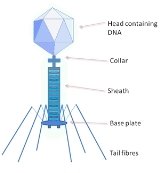
Typically, bacteriophages consist of an outer proteinProtein

Proteins are large organic compounds made of amino acids arranged in a linear chain and joined by peptide bonds....
 hull enclosing genetic materialGenetic material

Genetic material is used to store the genetic information of an organic life form....
. The genetic material can be ssRNA (single stranded RNA), dsRNA, ssDNA, or dsDNADNA

Deoxyribonucleic acid is a nucleic acid that contains the genetic instructions for the biological development of a cellu...
 between 5 and 500 kilo base pairs long with either circular or linear arrangement. Bacteriophages are much smaller than the bacteria they destroy - usually between 20 and 200 nmNanometre

A nanometre is a unit of length in the metric system, equal to one billionth of a metre ....
 in size.

Phages are estimated to be the most widely distributed and diverse entities in the biosphereBiosphere

The biosphere is the outermost part of the planet's shell — including air, land, surface rocks and water — with...
. Phages are ubiquitous and can be found in all reservoirs populated by bacteriaFacts About Bacteria

Bacteria are a major group of living organisms....
l hosts, such as soil or the intestines of animals. One of the densest natural sources for phages and other viruses is sea water, where up to 9×10⁸ virionsVirus Overview

A virus is a microscopic particle that can infect the cells of a biological organism....
 per milliliter have been found in microbial mats at the surface, and up to 70% of marine bacteria may be infected by phages.

They have been used for over 60 years as an alternative to antibiotics in the former Soviet UnionSoviet Union

The Union of Soviet Socialist Republics , more commonly known as the Soviet Union, was a Communist state that existed...
 and Eastern Europe. They are seen as a possible therapy against multi drug resistant strains of many bacteria.

Classification of phages

The dsDNA tailed phages, or Caudovirales, account for 95% of all the phages reported in the scientific literature, and possibly make up the majority of phages on the planet. However, there are other phages that occur abundantly in the biosphere, phages with different virions, genomes and lifestyles. Phages are classified by the International Committee on Taxonomy of VirusesInternational Committee on Taxonomy of Viruses

The International Committee on Taxonomy of Viruses is a committee which authorises and organises the taxonomic classificatio...
 (ICTV) according to morphology and nucleic acid.

CaudoviralesCaudovirales

The Caudovirales are an order of viruses, comprising the bacteriophages that have tails....
>
ICTV classification of phages
Order Family Morphology Nucleic acid
MyoviridaeMyoviridae Overview

T4-like viruses'P1-like viruses...
Non-enveloped, contractile tail Linear dsDNA
SiphoviridaeSiphoviridae

?-like viruses'T1-like viruses'T5-like viruses...
Non-enveloped, long non-contractile tail Linear dsDNA
PodoviridaePodoviridae

T7-like viruses'f29-like viruses...
Non-enveloped, short noncontractile tail Linear dsDNA
Tectiviridae Non-enveloped, isometric Linear dsDNA
Corticoviridae Non-enveloped, isometric Circular dsDNA
LipothrixviridaeLipothrixviridae

The Lipothrixviridae or Lipothrixvirus family consists of a family of viruses that infect archaea bacteria....
Enveloped, rod-shaped Linear dsDNA
Plasmaviridae Enveloped, pleomorphic Circular dsDNA
Rudiviridae Non-enveloped, rod-shaped Linear dsDNA
Fuselloviridae Non-enveloped, lemon-shaped Circular dsDNA
InoviridaeInoviridae

Inovirus'PlectrovirusThe Inoviridae are a family of bacteriophages, including the following genera:...
Non-enveloped, filamentous Circular ssDNA
MicroviridaeMicroviridae Summary

Microvirus'Spiromicrovirus'Bdellomicrovirus...
Non-enveloped, isometric Circular ssDNA
LeviviridaeLeviviridae

Levivirus'AllolevivirusThe Leviviridae are a family of viruses, including the following genera:...
Non-enveloped, isometric Linear ssRNA
Cystoviridae Enveloped, spherical Segmented dsRNA

History

Since ancient times, there have been documented reports of river water having the ability to cure infectious diseases, such as leprosyLeprosy

Leprosy, also known as Hansen's disease, is an infectious disease caused by the Mycobacterium leprae bacterium tha...
. In 1896, Ernest Hanbury HankinErnest Hanbury Hankin

Ernest Hanbury Hankin , was a British bacteriologist, aeronautical theorist and naturalist....
 reported that something in the waters of the Ganges and Jumna rivers in IndiaIndia

India , officially the Republic of India, is a country in South Asia....
 had marked antibacterial action against choleraCholera Summary

Cholera is a water-borne disease caused by the bacterium Vibrio cholerae, which is typically ingested by drinking conta...
 and could pass through a very fine porcelain filter. In 1915, BritishUnited Kingdom

The United Kingdom of Great Britain and Northern Ireland is a country and sovereign state that lies off the northwest coast...
 bacteriologist Frederick TwortFrederick Twort

Frederick William Twort was an English bacteriologist....
, superintendent of the Brown Institution of London, discovered a small agent that infected and killed bacteria. He considered the agent either 1) a stage in the life cycleLife cycle

Life cycle refers to:* Biological life cycle...
 of the bacteria, 2) an enzymeEnzyme Summary

Enzymes are proteins that accelerate, or catalyze, chemical reactions....
 produced by the bacteria themselves or 3) a virus that grew on and destroyed the bacteria. Twort's work was interrupted by the onset of World War IWorld War I

World War I, also known as the First World War, the Great War and "The War to End All Wars" was a global m...
 and shortage of funding. Independently, French-Canadian microbiologistMicrobiology

Microbiology is the study of microorganisms, which are unicellular or cell-cluster microscopic organisms....
 Félix d'HérelleFélix d'Herelle

Flix d'Herelle was a French-Canadian microbiologist, one of the discoverers of bacteriophages, and inventor of phage therapy...
, working at the Pasteur InstitutePasteur Institute

The Pasteur Institute is a French non-profit private foundation dedicated to the study of biology, microorganisms, diseases ...
 in ParisParis

native_name = Ville de Paris|common_name = Paris...
, announced on September 3, 1917 that he had discovered "an invisible, antagonistic microbe of the dysenteryFacts About Dysentery

Dysentery is an illness involving severe diarrhea that is often associated with blood in the feces....
 bacillus". For d’Hérelle, there was no question as to the nature of his discovery: "In a flash I had understood: what caused my clear spots was in fact an invisible microbe ... a virus parasitic on bacteria." D'Hérelle called the virus a bacteriophage or bacteria-eater (from the Greek phagein meaning to eat). He also recorded a dramatic account of a man suffering from dysentery who was restored to good health by the bacteriophages. In 1926 in the Pulitzer-prizewinning novel ArrowsmithArrowsmith (novel)

Arrowsmith is a novel by American author and playwright Sinclair Lewis that was published in 1925....
, Sinclair Lewis fictionalized the application of bacteriophages as a therapeutic agent. Also in the 1920s the Eliava InstituteFacts About George Eliava Institute

George Eliava Institute of Bacteriophage, Microbiology and Virology ....
 was opened in Tbilisi, Georgia to research this new science and put it into practice. In 2006 the UK Ministry of Defence took responsibility for a G8-funded Global Partnership Priority Eliava Project as a retrospective study to explore the potential of bacteriophages for the 21st century.

Replication

Bacteriophages may have a lytic cycleLytic cycle

The lytic cycle is one of the two cycles of viral reproduction, the other being the lysogenic cycle....
 or a lysogenic cycle, but a few viruses are capable of carrying out both. With lytic phages such as the T4 phage, bacterial cells are broken open (lysed) and destroyed after immediate replication of the virion. As soon as the cell is destroyed, the new bacteriophages viruses can find new hosts. Lytic phages are the kind suitable for phage therapy.

In contrast, the lysogenic cycle does not result in immediate lysing of the host cell. Those phages able to undergo lysogeny are known as temperate phages. Their viral genome will integrate with host DNA and replicate along with it fairly harmlessly, or may even become established as a plasmidPlasmid

A plasmid is a DNA molecule separate from the chromosomal DNA and capable of autonomous replication....
. The virus remains dormant until host conditions deteriorate, perhaps due to depletion of nutrients, then the endogenousFacts About Endogenous

The word endogenous means 'arising from within'. Compare exogenous. ...
 phages (known as prophages) become active. At this point they initiate the reproductive cycle resulting in lysis of the host cell. As the lysogenic cycle allows the host cell to continue to survive and reproduce, the virus is reproduced in all of the cell’s offspring.

Sometimes prophages may provide benefits to the host bacterium while they are dormant by adding new functions to the bacterial genomeGenome Summary

In biology the genome of an organism is its whole hereditary information and is encoded in the DNA ....
 in a phenomenon called lysogenic conversionLysogenic conversion

Lysogenic conversion is when a temperate phage induces a change in the phenotype of the bacteria infected that is not part o...
. A famous example is the conversion of a harmless strain of Vibrio choleraeVibrio cholerae

Vibrio Cholerae is a gram negative bacterium with a curved-rod shape that causes cholera in humans....
by a phage into a highly virulent one, which causes choleraCholera

Cholera is a water-borne disease caused by the bacterium Vibrio cholerae, which is typically ingested by drinking conta...
. This is why temperate phages are not suitable for phage therapy.

Attachment and penetration


To enter a host cell, bacteriophages attach to specific receptors on the surface of bacteria, including lipopolysaccharideLipopolysaccharide

A lipopolysaccharide is any of a class of large molecules consisting of a lipid and a polysaccharide joined by a covalent bo...
s, teichoic acidTeichoic acid

Teichoic acids are polymers of glycerol or ribitol linked via phosphodiester bonds....
s, proteinProtein

Proteins are large organic compounds made of amino acids arranged in a linear chain and joined by peptide bonds....
s or even flagella. This specificity means that a bacteriophage can only infect certain bacteria bearing receptors that they can bind to, which in turn determines the phage's host range. As phage virions do not move independently, they must rely on random encounters with the right receptors when in solution (blood, lymphatic circulation, irrigation, soil water etc.).

ComplexVirus

A virus is a microscopic particle that can infect the cells of a biological organism....
 bacteriophages use a syringe-like motion to inject their genetic material into the cell. After making contact with the appropriate receptor, the tail fibers bring the base plate closer to the surface of the cell. Once attached completely, the tail contracts, possibly with the help of ATPAdenosine triphosphate

Adenosine 5'-triphosphate , discovered in 1929 by Karl Lohmann, is a multifunctional nucleotide primarily known in biochemis...
 present in the tail (Prescott, 1993), injecting genetic material through the bacterial membrane.

Synthesis of proteins and nucleic acid

Within minutes, bacterial ribosomeRibosome

A ribosome is an organelle composed of ribosomal RNA and ribosomal proteins ....
s start translating viral mRNA into protein. For RNA-based phages, RNA replicaseRNA replicase

RNA replicase is a polymerase enzyme that catalyzes the self-replication of single-stranded RNA. ...
 is synthesized early in the process. Proteins modify the bacterial RNA polymeraseRNA polymerase Summary

RNA polymerase is an enzyme responsible for making RNA from a DNA template....
 so that it preferentially transcribes viral mRNA. The host’s normal synthesis of proteins and nucleic acids is disrupted, and it is forced to manufacture viral products instead. These products go on to become part of new virions within the cell, helper proteins which help assemble the new virions, or proteins involved in cell lysisLysis Summary

Lysis refers to the death of a cell by bursting, often by viral or osmotic mechanisms that compromise the integrity of the c...
.
Walter FiersWalter Fiers

Walter Fiers is a Belgian molecular biologist....
 was the first to establish the complete nucleotide sequence of a gene (1972) and of the viral genome of Bacteriophage MS2Bacteriophage MS2

The bacteriophage MS2. MS2 phage is an icosahedral bacteriophage with a diameter of 27-34nm and an isoelectric point of 3.9...
 (1976).

Virion assembly

In the case of the T4 phage, the construction of new virus particles involves the assistance of helper proteins. The base plates are assembled first, with the tails being built upon them afterwards. The head capsids, constructed separately, will spontaneously assemble with the tails. The DNA is packed efficiently within the heads. The whole process takes about 15 minutes.

Release of virions

Phages may be released via cell lysis or by host cell secretion. In the case of the T4 phage, in just over twenty minutes after injection upwards of three hundred phages will be released via lysis within a certain timescale. This is achieved by an enzyme called endolysinEndolysin

At the end of the bacteriophage replication cycle, bacteriophages have to release their newly formed progeny....
 which attacks and breaks down the peptidoglycanPeptidoglycan

Peptidoglycan, also known as murein, is a polymer consisting of sugars and amino acids that forms a homogeneous layer ...
. In contrast, "lysogenic" phages do not kill the host but rather become long-term parasites and make the host cell continually secrete more new virus particles. The new virions bud off the plasma membrane, taking a portion of it with them to become enveloped viruses possessing a viral envelopeVirus

A virus is a microscopic particle that can infect the cells of a biological organism....
. All released virions are capable of infecting a new bacterium.

Phage therapy

Phages were discovered to be anti-bacterial agents and put to use as such soon after they were discovered, with varying success. However, antibioticAntibiotic

An antibiotic is a drug that kills or slows the growth of bacteria....
s were discovered some years later and marketed widely, popular because of their broad spectrum; also easier to manufacture in bulk, store and prescribe. Hence development of phage therapy was largely abandoned in the WestWest

West is most commonly a noun, adjective, or adverb indicating direction or geography....
, but continued throughout 1940s in the former Soviet UnionSoviet Union

The Union of Soviet Socialist Republics , more commonly known as the Soviet Union, was a Communist state that existed...
 for treating bacterial infections, with widespread use including the soldiers in the Red Army - much of the literature being in Russian or Georgian, and unavailable for many years in the West.
This has continued after the war, with widespread use continuing in GeorgiaGeorgia (country)

Georgia , known officially from 1990 to 1995 as the Republic of Georgia, is a country in Eurasia to the east of the Bl...
  and elsewhere in Eastern Europe. There is anecdotal evidence there, but no completed clinical trials in the US or Western Europe.

Bacteriophage in the environment

Some time ago it was detected that phages are much more abundant in the water column of freshwater and marine habitats than previously thought and that they can cause significant mortality of bacterioplanktonBacterioplankton Summary

Bacterioplankton refers to the bacterial component of the plankton that drifts in the water column....
. Methods in phage community ecology have been developed to assess phage-induced mortality of bacterioplankton and its role for food web process and biogeochemical cycles, to genetically fingerprint phage communities or populations and estimate viral biodiversityBiodiversity

Biodiversity or biological diversity is the diversity of life....
 by metagenomicsMetagenomics

Metagenomics is the study of genomes recovered from environmental samples as opposed to from clonal cultures....
. The release of lysisLysis

Lysis refers to the death of a cell by bursting, often by viral or osmotic mechanisms that compromise the integrity of the c...
 products by phages converts organic carbon from particulate (cells) to dissolved forms (lysis products), which makes organic carbon more bio-available and thus acts as a catalyst of geochemical nutrient cycles. Phages are not only the most abundant biological entities but probably also the most diverse ones. The majority of the sequence data obtained from phage communities has no equivalent in data bases. These data and other detailed analyses indicate that phage-specific genes and ecological traits are much more frequent than previously thought. In order to reveal the meaning of this genetic and ecological versatility, studies have to be performed with communities and at spatiotemporal scales relevant for microorganisms.

Bacteriophages have also been used in hydrologicalHydrology

Hydrology is the study of the movement, distribution, and quality of water throughout the Earth, and thus addresses both th...
 tracing and modelling in riverRiver

A river is a large natural waterway....
 systems especially where surface water and groundwaterGroundwater Overview

Groundwater is water located beneath the ground surface in soil pore spaces and in the fractures of geologic formations....
 interactions occur. The use of phage is preferred to the more conventional dyeDye Overview

A dye can generally be described as a colored substance that has an affinity to the to which it is being applied....
 marker because they are significantly less adsorbed when passing through ground-waters and they are readily detected at very low concentrations.

Bacteriophages and food fermentation

A broad number of food products, commodity chemicals, and biotechnologyBiotechnology Summary

Biotechnology is technology based on biology, especially when used in agriculture, food science, and medicine....
 products are manufactured industrially by large-scale bacterial fermentationFermentation

Fermentation may mean:* Fermentation , the process of fermentation used for food....
 of various organic substrates. Because enormous amounts of bacteria are being cultivated each day in large fermentation vats, the risk that bacteriophage contamination rapidly brings fermentations to a halt and cause economical setbacks is a serious threat in these industries. The relationship between bacteriophages and their bacterial hosts is very important in the context of the food fermentation industry. Sources of phage contamination, measures to control their propagationPropagation Overview

The word propagation can mean:;General...
 and disseminationDissemination

Dissemination is the scattering or spreading widely, as though sowing seed, or extensive promulgation of knowledge, informat...
, and biotechnological defense strategies developed to restrain phages are of interest. The dairy fermentation industry has openly acknowledged the problem of phage and has been working with academia and starter culture companies to develop defense strategies and systems to curtail the propagation and evolution of phages for decades.

Other areas of use

In August, 2006 the United States Food and Drug Administration (FDA) approved using bacteriophages on cheese to kill the Listeria monocytogenesListeria monocytogenes

Listeria monocytogenes is a Gram-positive bacterium, in the division Firmicutes, named for Joseph Lister....
bacteria, giving them GRAS status (Generally Recognized As Safe). In July 2007, the same bacteriophages were approved for use on all food products.Government agencies in the West have for several years been looking to Georgia and the Former Soviet Union for help with exploiting phages for counteracting bioweapons and toxins e.g. Anthrax, Botulism. There are many developments with this amongst research groups in the US. Other uses include spray application in horticulture for protecting plants and vegetable produce from decay and the spread of bacterial disease. Other applications for bacteriophages are as a biocide for environmental surfaces e.g. hospitals - and as a preventative treatment for catheters and medical devices prior to use in clinical settings. The technology now exists for phages to be applied to dry surfaces e.g. uniforms, curtains - even sutures for surgery. Clinical trials reported in the Lancet show success in veterinary treatment of pet dogs with otitis. Phage displayPhage display Summary

Phage display is a test to screen for protein interactions by integrating multiple genes from a gene bank into phages....
 is a different use of phages. It is a powerful yet simple technique involving a library of phages with a variable peptide linked to a surface protein. Each phage's genome encodes the variant of the protein displayed on its surface (hence the name), providing a link between the peptide variant and its encoding gene. Variant phages from the library can be selected through their binding affinity to an immobilized molecule (e.g. Botulism toxin to neutralize it). The bound selected phages can be multiplied by re-infecting a susceptible bacterial strain, thus allowing them to retrieve the peptides encoded in them for further study.

See also

  • RNA viruses
  • DNA viruses
  • Phage ecologyPhage ecology

    Bacteriophage are the viruses of bacteria, and phage ecology is the study of the interaction of bacteriophage with their env...
  • Phage monographsPhage monographs

    Bacteriophage are viruses of bacteria. The history of this discipline is captured, in part, in the books published on the topic....
     (a comprehensive listing of phage and phage-associated monographs, 1921-present)
  • Phage scientific meetingsPhage meetings

    Bacteriophage are viruses of bacteria. They are likely the most numerous "organisms" on Earth and contributed greatly to the devel...
  • BacterivoreBacterivore

    Bacterivores are free-living, generally heterotrophic organisms, exclusively microscopic, which obtain energy and nutrients ...


External links