


Deutsche Bahn

Encyclopedia
Deutsche Bahn AG is the German
national railway company, a private joint stock company (AG
). Headquartered in Berlin
, it came into existence in 1994 as the successor to the former state railways of Germany
, the Deutsche Bundesbahn
of West Germany
and the Deutsche Reichsbahn
of East Germany. It also gained ownership of former railway assets in West Berlin
held by the VdeR.
DB is organized as a business group and has over 500 subsidiaries. It describes itself as the second-largest transport company in the world after Deutsche Post
AG and is the largest railway operator and infrastructure owner in Europe. About two billion passengers are carried each year.
DBAG has taken over the abbreviation and logo DB from the West German state railway Deutsche Bundesbahn, although it has modernised the logo. Erik Spiekermann
designed the new corporate font DB type.
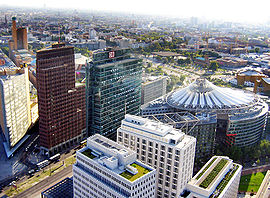
Originally DBAG was headquartered in Frankfurt am Main but moved to Potsdamer Platz
in central Berlin in 1996, where it occupies a 26-story office tower designed by Helmut Jahn
at the eastern end of the Sony Center
and named BahnTower. As the lease was to expire in 2010, DB had announced plans to relocate to Berlin Hauptbahnhof
, and in 2007 a proposal for a new headquarters by 3XN Architects
won an architectural competition also including Foster + Partners
, Dominique Perrault
and Auer + Weber
. However, these plans have been put on hold and the BahnTower leased for at least three more years. A move to Hamburg
was briefly considered in 2005, but these plans were abandoned after political pressure.
AG), DB Netz AG (operating the railway system), and DB Station & Service AG (operating the stations). This new organisational scheme was introduced not least to implement European Community directive 91/440/EEC
that demands access to railway systems free of discrimination.
In December 2007, DB reorganised again, bringing all passenger services into its DB Bahn
arm, logistics under DB Schenker
and infrastructure and operations under DB Netze
.
, DB Bahn
, DB Netze
and DB Schenker
. These subsidiaries are companies in their own right, although most of them are 100% owned by DBAG.
, Intercity
and Regionalbahn
trains, and many commuter-oriented urban Stadtschnellbahn (generally abbreviated as S-Bahn) networks within Germany. The group also handles the information and customer service side of the operation.
This group is divided into three business areas: DB Fernverkehr
, DB Regio
and DB Stadtverkehr.
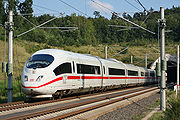
DB Fernverkehr operates all InterCityExpress and InterCity trains in Germany as well as several EuroCity trains throughout Europe. Unlike its sister companies DB Regio and Railion (formerly DB Cargo), DB Fernverkehr still holds a de-facto monopoly in its segment of the market as it operates hundreds of trains per day, while all competitors' long-distance services (Veolia Verkehr
most notably) combined amount to no more than 10-15 trains per day.
or their Landkreise. Competition for those state-sponsored services is somewhat more fierce than for long-distance services. Consequently, DB Regio has lost a considerable number of routes to its competitors. Some states have awarded long-term contracts to DB Regio (usually 10 to 15 years), which has sparked harsh criticism from anti-trust groups.
In January 2008 it was announced that, subject to regulatory approval, DB Regio would be taking over Laing Rail in the United Kingdom. This would mean that DB Regio would own Chiltern Railways
and be joint operators of London Overground
(with MTR Corporation
) and Wrexham & Shropshire (with Renaissance Trains
). In February 2009, DB Regio was shortlisted to run the Tyne and Wear Metro
in Sunderland
and Newcastle upon Tyne
, UK. DB Regio took over the running of the Tyne and Wear Metro on 1 April 2010.
and Hamburg S-Bahn
s and numerous bus companies (see Bahnbus). The two S-Bahn networks handle over 500 million passengers annually.
AG. Its business areas including DB Netze Fahrweg, DB Netze Energie, DB Netze Personenbahnhöfe, DB ProjektBau
and DB Station&Service
. A further business area known as DB Dienstleistungen covers six different areas of operations: DB Fahrzeuginstandhaltung, DB Systel, DB Services
, DB Fuhrpark, DB Kommunikationstechnik and DB Sicherheit.
is the freight logistics subsidiary of DB and one of the leading globally integrated logistics service providers. DB Schenker combines all the logistic activities of DB, employing over 88,000 staff spread across some 2,000 locations in about 130 countries. Currently it is
Its two business areas are DB Schenker Rail (formerly Railion
) and DB Schenker Logistics. Other subsidiaries include Bax Global
, Transfesa
and the former EWS, now DB Schenker Rail (UK) Ltd.
DB Schenker Rail has its head office in Mainz
, and is the holding company for the five (at 1 January 2009) national subsidiaries Railion Deutschland, Railion Nederland, Railion Danmark, Railion Italy and Railion Schweiz.
. Arriva runs bus and rail companies in 12 European countries. The merger was approved by the European Commission in August 2010, subject to DB divesting some Arriva services in Germany. The merger became effective on 27 August 2010.
and also has interests in Eastern Europe.
It is possible to obtain train times for any journey in Europe from Deutsche Bahn's website.
Trans-Eurasia Logistics
is a joint venture
with Russian Railways
(RZD) that operates container
freight trains between Germany and China via Russia.

Dr Werner Müller
is the current director of the supervisory board (also at Degussa and Ruhrkohle AG).
Previous chairmen of the board were
, Emirates Airline
, China Airlines
, TAM Airlines and Lufthansa
, Deutsche Bahn operates the AiRail Service
between Frankfurt International Airport
and Cologne
/ Bonn
, Düsseldorf
, Freiburg
, Hamburg
, Hanover
, Mannheim
, Munich
, Nuremberg
, and Stuttgart
. DB has the IATA designator 2A.
The Social-Democrat
Minister Wolfgang Tiefensee
was to present a bill before the council of ministers which envisaged selling 25% of DB, beginning in 2008. At term, the state should retain control by owning a 51% stake. Deutsche Bahn AG is evaluated at €45 billion. However, the railways are evaluated at €200 billion.
In October 2007, the train drivers
' strike was another problem for the privatisation plans. The drivers' union GDL
refused to accept the labour contracts between DB and other unions, claiming a 31% pay rise for its members. The strike was the first nationwide railway strike since 1992.
Germany
Germany , officially the Federal Republic of Germany , is a federal parliamentary republic in Europe. The country consists of 16 states while the capital and largest city is Berlin. Germany covers an area of 357,021 km2 and has a largely temperate seasonal climate...
national railway company, a private joint stock company (AG
Aktiengesellschaft
Aktiengesellschaft is a German term that refers to a corporation that is limited by shares, i.e. owned by shareholders, and may be traded on a stock market. The term is used in Germany, Austria and Switzerland...
). Headquartered in Berlin
Berlin
Berlin is the capital city of Germany and is one of the 16 states of Germany. With a population of 3.45 million people, Berlin is Germany's largest city. It is the second most populous city proper and the seventh most populous urban area in the European Union...
, it came into existence in 1994 as the successor to the former state railways of Germany
Germany
Germany , officially the Federal Republic of Germany , is a federal parliamentary republic in Europe. The country consists of 16 states while the capital and largest city is Berlin. Germany covers an area of 357,021 km2 and has a largely temperate seasonal climate...
, the Deutsche Bundesbahn
Deutsche Bundesbahn
The Deutsche Bundesbahn or DB was formed as the state railway of the newly established Federal Republic of Germany on September 7, 1949 as a successor of the Deutsche Reichsbahn-Gesellschaft '...
of West Germany
West Germany
West Germany is the common English, but not official, name for the Federal Republic of Germany or FRG in the period between its creation in May 1949 to German reunification on 3 October 1990....
and the Deutsche Reichsbahn
Deutsche Reichsbahn of the GDR
The Deutsche Reichsbahn or DR was the operating name of state owned railways in the German Democratic Republic ....
of East Germany. It also gained ownership of former railway assets in West Berlin
West Berlin
West Berlin was a political exclave that existed between 1949 and 1990. It comprised the western regions of Berlin, which were bordered by East Berlin and parts of East Germany. West Berlin consisted of the American, British, and French occupation sectors, which had been established in 1945...
held by the VdeR.
DB is organized as a business group and has over 500 subsidiaries. It describes itself as the second-largest transport company in the world after Deutsche Post
Deutsche Post
Deutsche Post AG, operating under the trade name Deutsche Post DHL, is the world's largest logistics group. With its headquarters in Bonn, the corporation has 467,088 employees in more than 220 countries and territories worldwide and generated revenue of € 51.48 billion in 2010...
AG and is the largest railway operator and infrastructure owner in Europe. About two billion passengers are carried each year.
DBAG has taken over the abbreviation and logo DB from the West German state railway Deutsche Bundesbahn, although it has modernised the logo. Erik Spiekermann
Erik Spiekermann
Erik Spiekermann is a German typographer and designer. He is a professor at the University of the Arts Bremen....
designed the new corporate font DB type.
Originally DBAG was headquartered in Frankfurt am Main but moved to Potsdamer Platz
Potsdamer Platz
Potsdamer Platz is an important public square and traffic intersection in the centre of Berlin, Germany, lying about one kilometre south of the Brandenburg Gate and the Reichstag , and close to the southeast corner of the Tiergarten park...
in central Berlin in 1996, where it occupies a 26-story office tower designed by Helmut Jahn
Helmut Jahn
Helmut Jahn is a German-American architect, well known for designs such as the US$800 million Sony Center on the Potsdamer Platz, Berlin, the Messeturm in Frankfurt and the One Liberty Place, formerly the tallest building in Philadelphia, Pennsylvania, and Suvarnabhumi Airport, an international...
at the eastern end of the Sony Center
Sony Center
The Sony Center is a Sony-sponsored building complex located at the Potsdamer Platz in Berlin, Germany. It opened in 2000.-History:The site was originally a bustling city centre in the early 20th century. Most of the buildings were destroyed or damaged during World War II...
and named BahnTower. As the lease was to expire in 2010, DB had announced plans to relocate to Berlin Hauptbahnhof
Berlin Hauptbahnhof
' , is the main railway station in Berlin, Germany. It began full operation two days after a ceremonial opening on 26 May 2006. It is located on the site of the historic Lehrter Bahnhof, and until it opened as a main line station, it was a stop on the Berlin S-Bahn suburban railway temporarily...
, and in 2007 a proposal for a new headquarters by 3XN Architects
3XN
3XN is a Danish architectural practice with head office in Copenhagen.-History:The company was founded in Århus in 1986 as Nielsen, Nielsen & Nielsen by Kim Herforth Nielsen, Lars Frank Nielsen og Hans Peter Svendler Nielsen. The latter left the company, which is today led by a partner group of...
won an architectural competition also including Foster + Partners
Foster and Partners
Foster + Partners is an architectural firm based in London. The practice is led by its founder and Chairman, Norman Foster, and has constructed many high-profile glass-and-steel buildings....
, Dominique Perrault
Dominique Perrault
Dominique Perrault is a French architect. He became world known for the design of the French National Library, distinguished with the Mies van der Rohe Prize in 1996....
and Auer + Weber
Auer+Weber+Assoziierte
Auer+Weber+Assoziierte is a German architecture firm, founded and headquartered in Stuttgart and Munich, Germany in 1980. The founders are Fritz Auer , and Carlo Weber Auer+Weber+Assoziierte is a German architecture firm, founded and headquartered in Stuttgart and Munich, Germany in 1980. The...
. However, these plans have been put on hold and the BahnTower leased for at least three more years. A move to Hamburg
Hamburg
-History:The first historic name for the city was, according to Claudius Ptolemy's reports, Treva.But the city takes its modern name, Hamburg, from the first permanent building on the site, a castle whose construction was ordered by the Emperor Charlemagne in AD 808...
was briefly considered in 2005, but these plans were abandoned after political pressure.
History
While the railway network in Germany dates back to 1835 when the first tracks were laid on a 6 km (3.7 mi) route between Nuremberg and Fürth, Deutsche Bahn has been a relatively recent development in German railway history. Founded in January 1994 as a joint stock company, Deutsche Bahn was designed to operate the railways of both the former East and West Germany after unification in November 1989 as a single uniform privately-run company. There are three main development periods in this unified German railway: formation, early years (1994–1999), and 1999 to the present1999 to present
The second step of the Bahnreform (Railway reform) was carried out in 1999. All rolling track, personnel and real assets were divided between the holding company and the five principal subsidiaries of DBAG: DB Reise & Touristik AG (long distance passenger service, later renamed DB Fernverkehr AG), DB Regio AG (regional passenger services, in the course of the reform under charge of the federal states), DB Cargo AG (freight services, later changed to RailionRailion
DB Schenker Rail is a European railway cargo carrier. The company was formed from the freight operating section of the Deutsche Bahn DB Cargo with the addition of various European rail freight operating companies.In December 2007 Railion became part of the DB Schenker logistics group, itself a...
AG), DB Netz AG (operating the railway system), and DB Station & Service AG (operating the stations). This new organisational scheme was introduced not least to implement European Community directive 91/440/EEC
EU Directive 91/440
The EU Directive 91/440 is European Union legislation that sets out a framework and requirements for railways in the EU to allow open access operations on railway lines by companies other than those that own the rail infrastructure...
that demands access to railway systems free of discrimination.
In December 2007, DB reorganised again, bringing all passenger services into its DB Bahn
DB Bahn
DB Bahn is the arm of the German national rail company Deutsche Bahn responsible for passenger services. It was formed in December 2007 along with DB Schenker, the logistic arm, and DB Netze, the infrastructure arm....
arm, logistics under DB Schenker
DB Schenker
DB Schenker is a logistics company, a wholly owned subsidiary of Deutsche Bahn AG. The company, created by reorganisation and rebranding of various Deutsche Bahn subsidiaries, comprises a logistics division encompassing air, land and sea freight, and a rail division made up from a variety of...
and infrastructure and operations under DB Netze
DB Netze
DB Netze is an arm of the German national rail company Deutsche Bahn responsible for the railway infrastructure and operations...
.
Corporate subdivisions
The DB group (Deutsche Bahn AG) is divided into four main operations groups: ArrivaArriva
Arriva plc is a multinational public transport company owned by Deutsche Bahn and headquartered in Sunderland, United Kingdom. It has bus, coach, train, tram and waterbus operations in 12 countries across Europe, employs more than 47,500 people and services over 1.5 billion passenger journeys each...
, DB Bahn
DB Bahn
DB Bahn is the arm of the German national rail company Deutsche Bahn responsible for passenger services. It was formed in December 2007 along with DB Schenker, the logistic arm, and DB Netze, the infrastructure arm....
, DB Netze
DB Netze
DB Netze is an arm of the German national rail company Deutsche Bahn responsible for the railway infrastructure and operations...
and DB Schenker
DB Schenker
DB Schenker is a logistics company, a wholly owned subsidiary of Deutsche Bahn AG. The company, created by reorganisation and rebranding of various Deutsche Bahn subsidiaries, comprises a logistics division encompassing air, land and sea freight, and a rail division made up from a variety of...
. These subsidiaries are companies in their own right, although most of them are 100% owned by DBAG.
DB Bahn
DB Bahn is the group that manages passenger travel within Germany. Originally called Reise & Touristik, this group is responsible for the managing, ticketing, servicing and running of all German Intercity-Express, EuroCityEuroCity
EuroCity, abbreviated EC, denotes an international train service within the European inter-city rail network. In contrast to trains with the "IC" label, "EC" trains are international trains that meet certain criteria. The EuroCity label replaces the older Trans Europ Express name for...
, Intercity
Intercity (Deutsche Bahn)
Intercity is the second-highest train classification in Germany, after the ICE. Intercity services are loco-hauled express services, usually over long-distances. There are Intercity routes throughout Germany, and routes generally operate with a two-hour frequency, with multiple routes giving a more...
and Regionalbahn
RegionalBahn
The Regionalbahn is a type of local passenger train in Germany.-Service:Regionalbahn trains usually call at all stations on a given line, with the exception of RB trains within S-Bahn networks, these may only call at selected stations...
trains, and many commuter-oriented urban Stadtschnellbahn (generally abbreviated as S-Bahn) networks within Germany. The group also handles the information and customer service side of the operation.
This group is divided into three business areas: DB Fernverkehr
DB Fernverkehr
DB Fernverkehr AG is a semi-independent division of Deutsche Bahn that operates long-distance passenger trains in Germany. It was founded in 1999 in the second stage of the privatisation of German Federal Railways under the name of DB Reise&Touristik and renamed in 2003.DB Fernverkehr operates all...
, DB Regio
DB Regio
DB Regio AG is a subsidiary of Deutsche Bahn which operates short and medium distance passenger train services in Germany, and operates light and heavy rail infrastructure in the United Kingdom.-Germany:...
and DB Stadtverkehr.
DB Fernverkehr
DB Fernverkehr AG is a semi-independent division of Deutsche Bahn that operates long-distance passenger trains in Germany. It was founded in 1999 in the second stage of the privatisation of German Federal Railways under the name of DB Reise&Touristik and renamed in 2003.DB Fernverkehr operates all InterCityExpress and InterCity trains in Germany as well as several EuroCity trains throughout Europe. Unlike its sister companies DB Regio and Railion (formerly DB Cargo), DB Fernverkehr still holds a de-facto monopoly in its segment of the market as it operates hundreds of trains per day, while all competitors' long-distance services (Veolia Verkehr
Veolia Verkehr
Veolia Verkehr GmbH is a private operator of passenger buses and trains in Germany. On April 3, 2006, Connex Verkehr GmbH was renamed Veolia Verkehr GmbH, but the sister companies kept their current names....
most notably) combined amount to no more than 10-15 trains per day.
DB Regio
DB Regio AG is the subsidiary of Deutsche Bahn that operates passenger trains on short and medium distances in Germany. Unlike its long-distance counterpart, DB Fernverkehr, it does not operate trains on its own account. Traffic is ordered and paid for by the BundesländerStates of Germany
Germany is made up of sixteen which are partly sovereign constituent states of the Federal Republic of Germany. Land literally translates as "country", and constitutionally speaking, they are constituent countries...
or their Landkreise. Competition for those state-sponsored services is somewhat more fierce than for long-distance services. Consequently, DB Regio has lost a considerable number of routes to its competitors. Some states have awarded long-term contracts to DB Regio (usually 10 to 15 years), which has sparked harsh criticism from anti-trust groups.
In January 2008 it was announced that, subject to regulatory approval, DB Regio would be taking over Laing Rail in the United Kingdom. This would mean that DB Regio would own Chiltern Railways
Chiltern Railways
Chiltern Railways is a British train operating company. It was set up at the privatisation of British Rail in 1996, and operates local passenger trains from Marylebone station in London to Aylesbury and main-line trains on the Chiltern Main Line to Birmingham Snow Hill with its associated branches...
and be joint operators of London Overground
London Overground
London Overground is a suburban rail network in London and Hertfordshire. It has been operated by London Overground Rail Operations since 2007 as part of the National Rail network, under the franchise control and branding of Transport for London...
(with MTR Corporation
MTR Corporation
MTR Corporation Limited is a company listed on the Hong Kong Exchange and included in the Hang Seng Index. MTR owns and runs the Hong Kong MTR metro system, and is also a major property developer and landlord in Hong Kong...
) and Wrexham & Shropshire (with Renaissance Trains
Renaissance Trains
Renaissance Trains is a company formed in 1997 with the purpose of promoting and investing in "open access" passenger and freight rail businesses in the United Kingdom, as well as promoting and investing in rail industry innovation. Its shareholders are John Nelson, Peter Wilkinson, Mike Jones and...
). In February 2009, DB Regio was shortlisted to run the Tyne and Wear Metro
Tyne and Wear Metro
The Tyne and Wear Metro, also known as the Metro, is a light rail system in North East England, serving Newcastle upon Tyne, Gateshead, South Tyneside, North Tyneside and Sunderland. It opened in 1980 and in 2007–2008 provided 40 million public journeys on its network of nearly...
in Sunderland
City of Sunderland
The City of Sunderland is a local government district of Tyne and Wear, in North East England, with the status of a city and metropolitan borough...
and Newcastle upon Tyne
Newcastle upon Tyne
Newcastle upon Tyne is a city and metropolitan borough of Tyne and Wear, in North East England. Historically a part of Northumberland, it is situated on the north bank of the River Tyne...
, UK. DB Regio took over the running of the Tyne and Wear Metro on 1 April 2010.
DB Stadtverkehr
DB Stadtverkehr is responsible for commuter services of the BerlinBerlin S-Bahn
The Berlin S-Bahn is a rapid transit system in and around Berlin, the capital city of Germany. It consists of 15 lines and is integrated with the mostly underground U-Bahn to form the backbone of Berlin's rapid transport system...
and Hamburg S-Bahn
Hamburg S-Bahn
The Hamburg S-Bahn is a railway network for public rapid mass transit in the Hamburg Metropolitan Region. Together the S-Bahn, the Hamburg U-Bahn, the AKN railway and the regional railway form the backbone of railway public transport in the city and the surrounding area...
s and numerous bus companies (see Bahnbus). The two S-Bahn networks handle over 500 million passengers annually.
DB Netze
Since the end of 2007 DB Netze has been responsible for infrastructure and operations, taking over from DB NetzDB Netz
DB Netz AG is a 100%-owned subsidiary of Deutsche Bahn is a railway infrastructure provider, which owns and operates a majority of the German railway system . The company was established in the course of the second stage of the German rail reform as a subsidiary of Deutsche Bahn...
AG. Its business areas including DB Netze Fahrweg, DB Netze Energie, DB Netze Personenbahnhöfe, DB ProjektBau
DB ProjektBau
DB ProjektBau GmbH is a German company that carries out and supports large-scale railway projects for Germany's national rail carrier, Deutsche Bahn . It was created on 1 January 2003 as a subsidiary of the DB.- External links :**...
and DB Station&Service
DB Station&Service
DB Station&Service is a subsidiary of Deutsche Bahn AG, responsible for managing over 5,000 stations on the German railway network....
. A further business area known as DB Dienstleistungen covers six different areas of operations: DB Fahrzeuginstandhaltung, DB Systel, DB Services
DB Services
DB Services is a subsidiary organisation of Deutsche Bahn AG consisting of six regional companies which are responsible for the maintenance of the buildings of the railway infrastructure DB Services is a subsidiary organisation of Deutsche Bahn AG consisting of six regional companies which are...
, DB Fuhrpark, DB Kommunikationstechnik and DB Sicherheit.
DB Schenker
DB SchenkerDB Schenker
DB Schenker is a logistics company, a wholly owned subsidiary of Deutsche Bahn AG. The company, created by reorganisation and rebranding of various Deutsche Bahn subsidiaries, comprises a logistics division encompassing air, land and sea freight, and a rail division made up from a variety of...
is the freight logistics subsidiary of DB and one of the leading globally integrated logistics service providers. DB Schenker combines all the logistic activities of DB, employing over 88,000 staff spread across some 2,000 locations in about 130 countries. Currently it is
- No. 1 in Europe in rail freight
- No. 1 in Europe in combined transport
- No. 1 in Europe in land transportation
- No. 2 worldwide in air freight
- No. 3 worldwide in ocean freight
- No. 6 in global contract logistics
Its two business areas are DB Schenker Rail (formerly Railion
Railion
DB Schenker Rail is a European railway cargo carrier. The company was formed from the freight operating section of the Deutsche Bahn DB Cargo with the addition of various European rail freight operating companies.In December 2007 Railion became part of the DB Schenker logistics group, itself a...
) and DB Schenker Logistics. Other subsidiaries include Bax Global
BAX Global
BAX Global is an international shipping company that is headquartered in Irvine, California, and has other major offices in Australia, Singapore, London, the Netherlands and Toledo, Ohio. The company which was founded in 1971 also operates an airline...
, Transfesa
Transfesa
Transfesa is a transport company based in Madrid, Spain.-Company description:Transfesa it is a transport and logistics service provider and European intermodal operator....
and the former EWS, now DB Schenker Rail (UK) Ltd.
DB Schenker Rail
Formerly known as Railion, this company is the largest rail freight distribution company within Europe. Currently the company has over 100,000 shipments daily throughout Europe. This company employs 28,000 people.DB Schenker Rail has its head office in Mainz
Mainz
Mainz under the Holy Roman Empire, and previously was a Roman fort city which commanded the west bank of the Rhine and formed part of the northernmost frontier of the Roman Empire...
, and is the holding company for the five (at 1 January 2009) national subsidiaries Railion Deutschland, Railion Nederland, Railion Danmark, Railion Italy and Railion Schweiz.
Arriva
Deutsche Bahn placed a bid in May 2010 for the UK-based transport company ArrivaArriva
Arriva plc is a multinational public transport company owned by Deutsche Bahn and headquartered in Sunderland, United Kingdom. It has bus, coach, train, tram and waterbus operations in 12 countries across Europe, employs more than 47,500 people and services over 1.5 billion passenger journeys each...
. Arriva runs bus and rail companies in 12 European countries. The merger was approved by the European Commission in August 2010, subject to DB divesting some Arriva services in Germany. The merger became effective on 27 August 2010.
Foreign firms
DB also has interests abroad, owning rail freight company EWS in the UK, which also operates the British Royal TrainBritish Royal Train
The Royal Train is a set of railway carriages dedicated for the use of the British Monarch, other members of the Royal Family, and their staff. The train enables members of the Royal Family to carry out busy schedules over an extended period, in a secure environment which minimises disruption and...
and also has interests in Eastern Europe.
It is possible to obtain train times for any journey in Europe from Deutsche Bahn's website.
Trans-Eurasia Logistics
Trans-Eurasia Logistics
Trans-Eurasia Logistics is a joint venture between German and Russian rail companies Deutsche Bahn and RZD, operating container freight trains between Germany and China via Russia. The first such train arrived in Hamburg from Xiangtan on October 6, 2008, taking 17 days to make the trip...
is a joint venture
Joint venture
A joint venture is a business agreement in which parties agree to develop, for a finite time, a new entity and new assets by contributing equity. They exercise control over the enterprise and consequently share revenues, expenses and assets...
with Russian Railways
Russian Railways
The Russian Railways , is the government owned national rail carrier of the Russian Federation, headquartered in Moscow. The Russian Railways operate over of common carrier routes as well as a few hundred kilometers of industrial routes, making it the second largest network in the world exceeded...
(RZD) that operates container
Containerization
Containerization is a system of freight transport based on a range of steel intermodal containers...
freight trains between Germany and China via Russia.
Members of the board
- Dr. Richard Lutz (Finance & Controlling)
- Ulrich Weber (Human resources)
- Dr. Volker Kefer (Technics, Railway interconnection and Services)
- Dr. Karl-Friedrich Rausch (Transportations and LogisticsPassenger traffic)
- Ulrich Homburg (Passenger transport)
- Dr. Volker Kefer (Infrastructure and services)
Dr Werner Müller
Werner Müller
Werner Müller is a Swiss sprint canoer who competed in the early 1950s. He finished 16th in the K-2 10000 m event at the 1952 Summer Olympics in Helsinki.-References:*...
is the current director of the supervisory board (also at Degussa and Ruhrkohle AG).
Previous chairmen of the board were
- Heinz DürrHeinz DürrHeinz Dürr is a German entrepreneur and stockholder of the Stuttgart-based Dürr AG.Dürr was born in Stuttgart and was educated at a National Political Institutes of Education He was chairman of the board at AEG from 1980 to 1990. From 1991 on, he was president of Deutsche Bundesbahn and...
, 1994–1997, became director of the supervisory board afterwards. - Johannes LudewigJohannes LudewigJohannes Ludewig is a German manager and former secretary of state.He has been director of Community of European Railway and Infrastructure Companies since 2002.-References:...
, July 9, 1997-September 30, 1999
Codeshare with airlines
In conjunction with American AirlinesAmerican Airlines
American Airlines, Inc. is the world's fourth-largest airline in passenger miles transported and operating revenues. American Airlines is a subsidiary of the AMR Corporation and is headquartered in Fort Worth, Texas adjacent to its largest hub at Dallas/Fort Worth International Airport...
, Emirates Airline
Emirates Airline
Emirates is the airline based in the Emirate of Dubai part of the United Arab Emirates . Based at Dubai International Airport it is the largest airline in the Middle East, operating over 2,400 flights per week, from its hub at Terminal 3, to 111 cities in 62 countries across six continents...
, China Airlines
China Airlines
China Airlines is both the flag carrier and the largest airline of Republic of China . Although not directly state-owned, the airline is owned by China Airlines Group, which is owned by the China Aviation Development Foundation...
, TAM Airlines and Lufthansa
Lufthansa
Deutsche Lufthansa AG is the flag carrier of Germany and the largest airline in Europe in terms of overall passengers carried. The name of the company is derived from Luft , and Hansa .The airline is the world's fourth-largest airline in terms of overall passengers carried, operating...
, Deutsche Bahn operates the AiRail Service
AiRail Service
AIRail Service is offered by Deutsche Bahn AG in cooperation with Lufthansa, American Airlines and Emirates. It is one example of several a dedicated air-rail alliances currently operating worldwide....
between Frankfurt International Airport
Frankfurt International Airport
Frankfurt am Main Airport , or simply Frankfurt Airport, known in German as Flughafen Frankfurt am Main or Rhein-Main-Flughafen, is a major international airport located in Frankfurt, Germany, southwest of the city centre....
and Cologne
Cologne
Cologne is Germany's fourth-largest city , and is the largest city both in the Germany Federal State of North Rhine-Westphalia and within the Rhine-Ruhr Metropolitan Area, one of the major European metropolitan areas with more than ten million inhabitants.Cologne is located on both sides of the...
/ Bonn
Bonn
Bonn is the 19th largest city in Germany. Located in the Cologne/Bonn Region, about 25 kilometres south of Cologne on the river Rhine in the State of North Rhine-Westphalia, it was the capital of West Germany from 1949 to 1990 and the official seat of government of united Germany from 1990 to 1999....
, Düsseldorf
Düsseldorf
Düsseldorf is the capital city of the German state of North Rhine-Westphalia and centre of the Rhine-Ruhr metropolitan region.Düsseldorf is an important international business and financial centre and renowned for its fashion and trade fairs. Located centrally within the European Megalopolis, the...
, Freiburg
Freiburg
Freiburg im Breisgau is a city in Baden-Württemberg, Germany. In the extreme south-west of the country, it straddles the Dreisam river, at the foot of the Schlossberg. Historically, the city has acted as the hub of the Breisgau region on the western edge of the Black Forest in the Upper Rhine Plain...
, Hamburg
Hamburg
-History:The first historic name for the city was, according to Claudius Ptolemy's reports, Treva.But the city takes its modern name, Hamburg, from the first permanent building on the site, a castle whose construction was ordered by the Emperor Charlemagne in AD 808...
, Hanover
Hanover
Hanover or Hannover, on the river Leine, is the capital of the federal state of Lower Saxony , Germany and was once by personal union the family seat of the Hanoverian Kings of Great Britain, under their title as the dukes of Brunswick-Lüneburg...
, Mannheim
Mannheim
Mannheim is a city in southwestern Germany. With about 315,000 inhabitants, Mannheim is the second-largest city in the Bundesland of Baden-Württemberg, following the capital city of Stuttgart....
, Munich
Munich
Munich The city's motto is "" . Before 2006, it was "Weltstadt mit Herz" . Its native name, , is derived from the Old High German Munichen, meaning "by the monks' place". The city's name derives from the monks of the Benedictine order who founded the city; hence the monk depicted on the city's coat...
, Nuremberg
Nuremberg
Nuremberg[p] is a city in the German state of Bavaria, in the administrative region of Middle Franconia. Situated on the Pegnitz river and the Rhine–Main–Danube Canal, it is located about north of Munich and is Franconia's largest city. The population is 505,664...
, and Stuttgart
Stuttgart
Stuttgart is the capital of the state of Baden-Württemberg in southern Germany. The sixth-largest city in Germany, Stuttgart has a population of 600,038 while the metropolitan area has a population of 5.3 million ....
. DB has the IATA designator 2A.
Privatisation project
The planned privatisation is the subject of highly controversial political discussion in Germany. Whereas the government claims the need for fresh capital and efficiency improvements in favour of the privatisation, opponents fear a deterioration of service in many less economic sectors. The main question is whether privatisation should be carried out with the railway system (integrated model) or without (split model). A political trade-off is likely, with the split model as basis, but DB having the right to operate the railway system for 15 years. An open question is the matter of compensation for investments into the system during this time.The Social-Democrat
Social Democratic Party of Germany
The Social Democratic Party of Germany is a social-democratic political party in Germany...
Minister Wolfgang Tiefensee
Wolfgang Tiefensee
Wolfgang Tiefensee is a German SPD politician. He was the Federal Minister for Transport, Building and Urban Development in the grand coalition cabinet led by Angela Merkel since November 22, 2005....
was to present a bill before the council of ministers which envisaged selling 25% of DB, beginning in 2008. At term, the state should retain control by owning a 51% stake. Deutsche Bahn AG is evaluated at €45 billion. However, the railways are evaluated at €200 billion.
In October 2007, the train drivers
Railroad engineer
A railroad engineer, locomotive engineer, train operator, train driver or engine driver is a person who drives a train on a railroad...
' strike was another problem for the privatisation plans. The drivers' union GDL
Gewerkschaft Deutscher Lokomotivführer
The Gewerkschaft Deutscher Lokomotivführer is a German trade union present in train companies. It has a membership of 34,000 , concentrated in the former East Germany.-2007 strike:...
refused to accept the labour contracts between DB and other unions, claiming a 31% pay rise for its members. The strike was the first nationwide railway strike since 1992.
Rolling stock
See also
- DB FernverkehrDB FernverkehrDB Fernverkehr AG is a semi-independent division of Deutsche Bahn that operates long-distance passenger trains in Germany. It was founded in 1999 in the second stage of the privatisation of German Federal Railways under the name of DB Reise&Touristik and renamed in 2003.DB Fernverkehr operates all...
- DB RegioDB RegioDB Regio AG is a subsidiary of Deutsche Bahn which operates short and medium distance passenger train services in Germany, and operates light and heavy rail infrastructure in the United Kingdom.-Germany:...
- DB NachtZugDB NachtZugCity Night Line is a category of night trains in Europe. They were originally operated by the former railway company CityNightLine AG...
- Bahn TVBahn TVBahn TV was a television channel owned by the Deutsche Bahn , the national railway company of Germany, dedicated to rail transport topics. Started in the beginnings of 2001, it was closed on 31 December 2010...
- Railway electrification systemRailway electrification systemA railway electrification system supplies electrical energy to railway locomotives and multiple units as well as trams so that they can operate without having an on-board prime mover. There are several different electrification systems in use throughout the world...
- Transport in GermanyTransport in GermanyAs a densely populated country in a central location in Europe and with a developed economy, Germany has a dense and modern transportation infrastructure....
- Rail transport in GermanyRail transport in Germany, Germany had a railway network of 41,315 km. 19,857 km are electrified. The total track length was 76,473 km. Germany is a member of the International Union of Railways . The UIC Country Code for Germany is 80.-Overview:...