


Deoxyribose

Encyclopedia
Deoxyribose, more, precisely 2-deoxyribose, is a monosaccharide
with idealized formula H-(C=O)-(CH2)-(CHOH)3-H. Its name indicates that it is a deoxy sugar
, meaning that it is derived from the sugar
ribose
by loss of an oxygen
atom. Since the pentose sugars arabinose
and ribose only differ by the stereochemistry at C2', 2-deoxyribose and 2-deoxyarabinose are equivalent, although the latter term is rarely used because ribose, not arabinose, is the precursor to deoxyribose.
groups are on the same side in the Fischer projection
. The term "2-deoxyribose" may refer to either of two enantiomer
s: the biologically important D-2-deoxyribose and to the rarely encountered mirror image L-2-deoxyribose
. D-2-Deoxyribose is a precursor to the nucleic acid
DNA
. 2-Deoxyribose is an aldopentose, that is, a monosaccharide with five carbon
atom
s and having an aldehyde
functional group
.
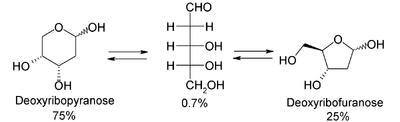
In aqueous solution, deoxyribose primarily exists as a mixture of three structures: the linear form H-(C=O)-(CH2)-(CHOH)3-H and two ring forms, deoxyribofuranose ("C3'-endo"), with a five-membered ring, and deoxyribopyranose ("C2'-endo"), with a six-membered ring. The latter form is predominant (whereas the C3'-endo form is favored for ribose).
(deoxyribonucleic acid) molecule, which is the main repository of genetic
information in life, consists of a long chain of deoxyribose-containing units called nucleotides, linked via phosphate
groups. In the standard nucleic acid nomenclature
, a DNA nucleotide consists of a deoxyribose molecule with an organic base
(usually adenine
, thymine
, guanine
or cytosine
) attached to the 1' ribose carbon. The 5' hydroxyl of each deoxyribose unit is replaced by a phosphate (forming a nucleotide
) that is attached to the 3' carbon of the deoxyribose in the preceding unit.
The backbone of RNA
and DNA are structurally similar, but RNA is single stranded and, of course, it is built from ribose not deoxyribose. The absence of the 2' hydroxyl group in deoxyribose is apparently responsible for the increased mechanical flexibility of DNA compared to RNA, which allows it to assume the double-helix conformation, and also (in the eukaryote
s) to be compactly coiled within the small cell nucleus
. The double-stranded DNA molecules are also typically much longer than RNA molecules.
Other biologically important derivatives of deoxyribose include mono-, di-, and triphosphates, as well as 3'-5' cyclic monophosphates.
by enzymes called ribonucleotide reductase
s. These enzymes catalyse the deoxygenation process.
Monosaccharide
Monosaccharides are the most basic units of biologically important carbohydrates. They are the simplest form of sugar and are usually colorless, water-soluble, crystalline solids. Some monosaccharides have a sweet taste. Examples of monosaccharides include glucose , fructose , galactose, xylose...
with idealized formula H-(C=O)-(CH2)-(CHOH)3-H. Its name indicates that it is a deoxy sugar
Deoxy sugar
Deoxy sugars are sugars that have had a hydroxyl group replaced with a hydrogen atom.Examples include:* Deoxyribose * Fucose* Rhamnose-External links:*...
, meaning that it is derived from the sugar
Sugar
Sugar is a class of edible crystalline carbohydrates, mainly sucrose, lactose, and fructose, characterized by a sweet flavor.Sucrose in its refined form primarily comes from sugar cane and sugar beet...
ribose
Ribose
Ribose is an organic compound with the formula C5H10O5; specifically, a monosaccharide with linear form H––4–H, which has all the hydroxyl groups on the same side in the Fischer projection....
by loss of an oxygen
Oxygen
Oxygen is the element with atomic number 8 and represented by the symbol O. Its name derives from the Greek roots ὀξύς and -γενής , because at the time of naming, it was mistakenly thought that all acids required oxygen in their composition...
atom. Since the pentose sugars arabinose
Arabinose
Arabinose is an aldopentose – a monosaccharide containing five carbon atoms, and including an aldehyde functional group.For biosynthetic reasons, most saccharides are almost always more abundant in nature as the "D"-form, or structurally analogous to D-glyceraldehyde.For sugars, the D/L...
and ribose only differ by the stereochemistry at C2', 2-deoxyribose and 2-deoxyarabinose are equivalent, although the latter term is rarely used because ribose, not arabinose, is the precursor to deoxyribose.
Structure
Several isomers exist with the formula H-(C=O)-(CH2)-(CHOH)3-H, but in deoxyribose all the hydroxylHydroxyl
A hydroxyl is a chemical group containing an oxygen atom covalently bonded with a hydrogen atom. In inorganic chemistry, the hydroxyl group is known as the hydroxide ion, and scientists and reference works generally use these different terms though they refer to the same chemical structure in...
groups are on the same side in the Fischer projection
Fischer projection
The Fischer projection, devised by Hermann Emil Fischer in 1891, is a two-dimensional representation of a three-dimensional organic molecule by projection. Fischer projections were originally proposed for the depiction of carbohydrates and used by chemists, particularly in organic chemistry and...
. The term "2-deoxyribose" may refer to either of two enantiomer
Enantiomer
In chemistry, an enantiomer is one of two stereoisomers that are mirror images of each other that are non-superposable , much as one's left and right hands are the same except for opposite orientation. It can be clearly understood if you try to place your hands one over the other without...
s: the biologically important D-2-deoxyribose and to the rarely encountered mirror image L-2-deoxyribose
L-Deoxyribose
L-Deoxyribose is an organic compound with formula C5H10O4. It is a synthetic monosaccharide, a stereoisomer of the natural compound D-deoxyribose....
. D-2-Deoxyribose is a precursor to the nucleic acid
Nucleic acid
Nucleic acids are biological molecules essential for life, and include DNA and RNA . Together with proteins, nucleic acids make up the most important macromolecules; each is found in abundance in all living things, where they function in encoding, transmitting and expressing genetic information...
DNA
DNA
Deoxyribonucleic acid is a nucleic acid that contains the genetic instructions used in the development and functioning of all known living organisms . The DNA segments that carry this genetic information are called genes, but other DNA sequences have structural purposes, or are involved in...
. 2-Deoxyribose is an aldopentose, that is, a monosaccharide with five carbon
Carbon
Carbon is the chemical element with symbol C and atomic number 6. As a member of group 14 on the periodic table, it is nonmetallic and tetravalent—making four electrons available to form covalent chemical bonds...
atom
Atom
The atom is a basic unit of matter that consists of a dense central nucleus surrounded by a cloud of negatively charged electrons. The atomic nucleus contains a mix of positively charged protons and electrically neutral neutrons...
s and having an aldehyde
Aldehyde
An aldehyde is an organic compound containing a formyl group. This functional group, with the structure R-CHO, consists of a carbonyl center bonded to hydrogen and an R group....
functional group
Functional group
In organic chemistry, functional groups are specific groups of atoms within molecules that are responsible for the characteristic chemical reactions of those molecules. The same functional group will undergo the same or similar chemical reaction regardless of the size of the molecule it is a part of...
.
In aqueous solution, deoxyribose primarily exists as a mixture of three structures: the linear form H-(C=O)-(CH2)-(CHOH)3-H and two ring forms, deoxyribofuranose ("C3'-endo"), with a five-membered ring, and deoxyribopyranose ("C2'-endo"), with a six-membered ring. The latter form is predominant (whereas the C3'-endo form is favored for ribose).
Biological importance
As a component of DNA, 2-deoxyribose derivatives have an important role in biology. The DNADNA
Deoxyribonucleic acid is a nucleic acid that contains the genetic instructions used in the development and functioning of all known living organisms . The DNA segments that carry this genetic information are called genes, but other DNA sequences have structural purposes, or are involved in...
(deoxyribonucleic acid) molecule, which is the main repository of genetic
Genetics
Genetics , a discipline of biology, is the science of genes, heredity, and variation in living organisms....
information in life, consists of a long chain of deoxyribose-containing units called nucleotides, linked via phosphate
Phosphate
A phosphate, an inorganic chemical, is a salt of phosphoric acid. In organic chemistry, a phosphate, or organophosphate, is an ester of phosphoric acid. Organic phosphates are important in biochemistry and biogeochemistry or ecology. Inorganic phosphates are mined to obtain phosphorus for use in...
groups. In the standard nucleic acid nomenclature
Nucleic acid nomenclature
Molecular biologists use several shorthand terms when referring to nucleic acid molecules, such as DNA and RNA, collectively referred to as nucleic acid nomenclature....
, a DNA nucleotide consists of a deoxyribose molecule with an organic base
Base (chemistry)
For the term in genetics, see base A base in chemistry is a substance that can accept hydrogen ions or more generally, donate electron pairs. A soluble base is referred to as an alkali if it contains and releases hydroxide ions quantitatively...
(usually adenine
Adenine
Adenine is a nucleobase with a variety of roles in biochemistry including cellular respiration, in the form of both the energy-rich adenosine triphosphate and the cofactors nicotinamide adenine dinucleotide and flavin adenine dinucleotide , and protein synthesis, as a chemical component of DNA...
, thymine
Thymine
Thymine is one of the four nucleobases in the nucleic acid of DNA that are represented by the letters G–C–A–T. The others are adenine, guanine, and cytosine. Thymine is also known as 5-methyluracil, a pyrimidine nucleobase. As the name suggests, thymine may be derived by methylation of uracil at...
, guanine
Guanine
Guanine is one of the four main nucleobases found in the nucleic acids DNA and RNA, the others being adenine, cytosine, and thymine . In DNA, guanine is paired with cytosine. With the formula C5H5N5O, guanine is a derivative of purine, consisting of a fused pyrimidine-imidazole ring system with...
or cytosine
Cytosine
Cytosine is one of the four main bases found in DNA and RNA, along with adenine, guanine, and thymine . It is a pyrimidine derivative, with a heterocyclic aromatic ring and two substituents attached . The nucleoside of cytosine is cytidine...
) attached to the 1' ribose carbon. The 5' hydroxyl of each deoxyribose unit is replaced by a phosphate (forming a nucleotide
Nucleotide
Nucleotides are molecules that, when joined together, make up the structural units of RNA and DNA. In addition, nucleotides participate in cellular signaling , and are incorporated into important cofactors of enzymatic reactions...
) that is attached to the 3' carbon of the deoxyribose in the preceding unit.
The backbone of RNA
RNA
Ribonucleic acid , or RNA, is one of the three major macromolecules that are essential for all known forms of life....
and DNA are structurally similar, but RNA is single stranded and, of course, it is built from ribose not deoxyribose. The absence of the 2' hydroxyl group in deoxyribose is apparently responsible for the increased mechanical flexibility of DNA compared to RNA, which allows it to assume the double-helix conformation, and also (in the eukaryote
Eukaryote
A eukaryote is an organism whose cells contain complex structures enclosed within membranes. Eukaryotes may more formally be referred to as the taxon Eukarya or Eukaryota. The defining membrane-bound structure that sets eukaryotic cells apart from prokaryotic cells is the nucleus, or nuclear...
s) to be compactly coiled within the small cell nucleus
Cell nucleus
In cell biology, the nucleus is a membrane-enclosed organelle found in eukaryotic cells. It contains most of the cell's genetic material, organized as multiple long linear DNA molecules in complex with a large variety of proteins, such as histones, to form chromosomes. The genes within these...
. The double-stranded DNA molecules are also typically much longer than RNA molecules.
Other biologically important derivatives of deoxyribose include mono-, di-, and triphosphates, as well as 3'-5' cyclic monophosphates.
Biosynthesis
Deoxyribose is generated from ribose 5-phosphateRibose 5-phosphate
Ribose 5-phosphate is both a product and an intermediate of the pentose phosphate pathway. The last step of the oxidative reactions in the pentose phosphate pathway is the production of ribulose-5-phosphate. Depending on the body's state, ribulose-5-phosphate can reversibly isomerize to...
by enzymes called ribonucleotide reductase
Ribonucleotide reductase
Ribonucleotide reductase is an enzyme that catalyzes the formation of deoxyribonucleotides from ribonucleotides. Deoxyribonucleotides in turn are used in the synthesis of DNA. The reaction catalyzed by RNR is strictly conserved in all living organisms...
s. These enzymes catalyse the deoxygenation process.