
All Topics  
Hydroxyl


   Email Print
   Bookmark   Link


Hydroxyl


Hydroxyl in chemistry
Chemistry

Chemistry is the science concerned with the composition, structure, and properties of matter, as well as the changes it undergoes during chemical reactions....
 stands for a molecule consisting of an oxygen
Oxygen

Oxygen no O2 produced; 2) O2 produced, but absorbed in oceans & seabed rock; 3) O2 starts to gas out of the oceans, but is absorbed by land surfaces and formation of ozone layer; 4-5) O2 sinks filled and the gas accumulates]]...
 atom and a hydrogen
Hydrogen

Hydrogen is the chemical element with atomic number 1. It is represented by the chemical symbol H. At standard temperature and pressure, hydrogen is a colorless, odorless, nonmetallic, tasteless, highly combustion and explosive Diatomic molecule gas with the molecular formula H2....
 atom connected by a covalent bond
Covalent bond

A covalent bond is a form of chemical bonding that is characterized by the sharing of pairs of electrons between atoms, or between atoms and other covalent bonds....
. The neutral form is a hydroxyl radical
Radical (chemistry)

In chemistry, radicals are atoms, molecules or ions with unpaired electrons on an otherwise open shell configuration. These unpaired electrons are usually highly chemical reaction, so radicals are likely to take part in chemical reactions....
 and the hydroxyl anion is called a hydroxide
Hydroxide

In chemistry, hydroxide is the name for the Diatomic molecule anion OH-, consisting of oxygen and hydrogen atoms, usually derived from the Dissociation of a base ....
. When the oxygen atom is linked to a larger molecule the hydroxyl group is a functional group
Functional group

In organic chemistry, functional groups are specific groups of atoms within molecules that are responsible for the characteristic chemical reactions of those molecules....
 (OH) . Hydroxide (HOŻ or ŻOH anion) is a polyatomic ion with a charge of negative one. Hydroxide anion is a base and is used to make solutions or compounds basic.

term hydroxyl group is used to describe the functional group
Functional group

In organic chemistry, functional groups are specific groups of atoms within molecules that are responsible for the characteristic chemical reactions of those molecules....
 –OH when it is a substituent
Substituent

In organic chemistry, a substituent is an atom or group of atoms substituted in place of a hydrogen atom on the parent chain of a hydrocarbon. The suffix -yl is used when naming organic compounds that contain a substituent....
 in an organic compound
Organic compound

An organic compound is any member of a large class of chemical compounds whose molecules contain carbon. For historical reasons discussed below, a few types of compounds such as carbonates, simple oxides of carbon and cyanides, as well as the allotropes of carbon, are considered Inorganic compound....
.


Discussion
Ask a question about 'Hydroxyl'
Start a new discussion about 'Hydroxyl'
Answer questions from other users
Full Discussion Forum


Encyclopedia


Hydroxyl in chemistry
Chemistry

Chemistry is the science concerned with the composition, structure, and properties of matter, as well as the changes it undergoes during chemical reactions....
 stands for a molecule consisting of an oxygen
Oxygen

Oxygen no O2 produced; 2) O2 produced, but absorbed in oceans & seabed rock; 3) O2 starts to gas out of the oceans, but is absorbed by land surfaces and formation of ozone layer; 4-5) O2 sinks filled and the gas accumulates]]...
 atom and a hydrogen
Hydrogen

Hydrogen is the chemical element with atomic number 1. It is represented by the chemical symbol H. At standard temperature and pressure, hydrogen is a colorless, odorless, nonmetallic, tasteless, highly combustion and explosive Diatomic molecule gas with the molecular formula H2....
 atom connected by a covalent bond
Covalent bond

A covalent bond is a form of chemical bonding that is characterized by the sharing of pairs of electrons between atoms, or between atoms and other covalent bonds....
. The neutral form is a hydroxyl radical
Radical (chemistry)

In chemistry, radicals are atoms, molecules or ions with unpaired electrons on an otherwise open shell configuration. These unpaired electrons are usually highly chemical reaction, so radicals are likely to take part in chemical reactions....
 and the hydroxyl anion is called a hydroxide
Hydroxide

In chemistry, hydroxide is the name for the Diatomic molecule anion OH-, consisting of oxygen and hydrogen atoms, usually derived from the Dissociation of a base ....
. When the oxygen atom is linked to a larger molecule the hydroxyl group is a functional group
Functional group

In organic chemistry, functional groups are specific groups of atoms within molecules that are responsible for the characteristic chemical reactions of those molecules....
 (OH) . Hydroxide (HOŻ or ŻOH anion) is a polyatomic ion with a charge of negative one. Hydroxide anion is a base and is used to make solutions or compounds basic.

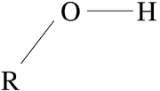
Hydroxyl group

The term hydroxyl group is used to describe the functional group
Functional group

In organic chemistry, functional groups are specific groups of atoms within molecules that are responsible for the characteristic chemical reactions of those molecules....
 –OH when it is a substituent
Substituent

In organic chemistry, a substituent is an atom or group of atoms substituted in place of a hydrogen atom on the parent chain of a hydrocarbon. The suffix -yl is used when naming organic compounds that contain a substituent....
 in an organic compound
Organic compound

An organic compound is any member of a large class of chemical compounds whose molecules contain carbon. For historical reasons discussed below, a few types of compounds such as carbonates, simple oxides of carbon and cyanides, as well as the allotropes of carbon, are considered Inorganic compound....
. Organic molecules containing a hydroxyl group are known as alcohol
Alcohol

In chemistry, an alcohol is any organic compound in which a hydroxyl Functional group is bound to a carbon atom of an alkyl or substituted alkyl group....
s (the simplest of which have the formula CnH2n+1
Alkyl

An alkyl is a univalent Radical consisting of carbon and hydrogen atoms, arranged in a chain. The Alkyls form homologous series with the general formula CnH2n+1....
OH).

Hydroxyl radical

The hydroxyl radical, ·OH, is the neutral form of the hydroxide ion. Hydroxyl radicals are highly reactive and, as a consequence, short-lived; however, they form an important part of radical chemistry
Radical (chemistry)

In chemistry, radicals are atoms, molecules or ions with unpaired electrons on an otherwise open shell configuration. These unpaired electrons are usually highly chemical reaction, so radicals are likely to take part in chemical reactions....
.

Hydroxyl free radicals cause oxidative cells, particularly erythrocytes (or red blood cells). These free radicals cause damage to DNA, lipids, and proteins. Glucose-6 phosphate dehydroganase (G6PD) is an enzyme the body produces to destroy OH-, before it starts damaging the cells. People with G6PD deficiency are protected against malaria because the plasmodium (the parasites that cause malaria) cannot survive in the damaged blood cells. On the other hand, people with G6PD deficiency are prone to jaundice and kidney disease.

See also

  • Hydronium
    Hydronium

    In chemistry, hydronium is the common name for the aqueous cation hydrogen3oxygen+ derived from protonation of water. It is the simplest type of an oxonium ion....
  • Oxide
    Oxide

    An oxide is a chemical compound contaning at least one oxygen atom as well as at least one other element. Most of the Earth's crust consists of oxides....
  • Hydroxy
    Hydroxy

    'Hydroxy' can refer to:* In chemical nomenclature, the prefix "hydroxy-" shows the presence of a hydroxyl functional group * An abbreviation for the medication hydroxyzine, which is commonly sold under the brand names Atarax, Ucerax, Serecid, and Vistaril....