
In
organic chemistryOrganic chemistry is a subdiscipline within chemistry involving the scientific study of the structure, properties, composition, reactions, and preparation of carbon-based compounds, hydrocarbons, and their derivatives...
,
functional groups are specific groups of
atomThe atom is a basic unit of matter that consists of a dense central nucleus surrounded by a cloud of negatively charged electrons. The atomic nucleus contains a mix of positively charged protons and electrically neutral neutrons...
s within
moleculeA molecule is an electrically neutral group of at least two atoms held together by covalent chemical bonds. Molecules are distinguished from ions by their electrical charge...
s that are responsible for the characteristic
chemical reactionA chemical reaction is a process that leads to the transformation of one set of chemical substances to another. Chemical reactions can be either spontaneous, requiring no input of energy, or non-spontaneous, typically following the input of some type of energy, such as heat, light or electricity...
s of those molecules. The same functional group will undergo the same or similar chemical reaction(s) regardless of the size of the molecule it is a part of. However, its relative reactivity can be modified by nearby functional groups.
The word
moiety (ˈmɔɪəti) is often used synonymously to "functional group," but, according to the
IUPACThe International Union of Pure and Applied Chemistry is an international federation of National Adhering Organizations that represents chemists in individual countries. It is a member of the International Council for Science . The international headquarters of IUPAC is located in Zürich,...
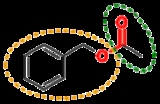
definition, a moiety is a part of a molecule that may include either whole functional groups or a parts of functional groups as substructures. For example, an
esterEsters are chemical compounds derived by reacting an oxoacid with a hydroxyl compound such as an alcohol or phenol. Esters are usually derived from an inorganic acid or organic acid in which at least one -OH group is replaced by an -O-alkyl group, and most commonly from carboxylic acids and...
(RCOOR') has an ester functional group (COOR) and is composed of an alkoxy moiety (-OR') and an acyl moiety (RCO-), or, equivalently, it may be divided into carboxylate (RCOO-) and alkyl (-R') moieties. Each moiety may contain additional functional groups, for example, methyl para-hydroxybenzoate contains a
phenolPhenol, also known as carbolic acid, phenic acid, is an organic compound with the chemical formula C6H5OH. It is a white crystalline solid. The molecule consists of a phenyl , bonded to a hydroxyl group. It is produced on a large scale as a precursor to many materials and useful compounds...
functional group within the acyl moiety.
Combining the names of functional groups with the names of the parent
alkaneAlkanes are chemical compounds that consist only of hydrogen and carbon atoms and are bonded exclusively by single bonds without any cycles...
s generates a powerful
systematic nomenclatureA systematic name is a name given in a systematic way to one unique group, organism, object or chemical substance, out of a specific population or collection...
for naming
organic compoundAn organic compound is any member of a large class of gaseous, liquid, or solid chemical compounds whose molecules contain carbon. For historical reasons discussed below, a few types of carbon-containing compounds such as carbides, carbonates, simple oxides of carbon, and cyanides, as well as the...
s.
The atoms of functional groups are linked to each other and to the rest of the molecule by
covalent bondA covalent bond is a form of chemical bonding that is characterized by the sharing of pairs of electrons between atoms. The stable balance of attractive and repulsive forces between atoms when they share electrons is known as covalent bonding....
s. When the group of covalently bound atoms bears a
net chargeAn ion is an atom or molecule in which the total number of electrons is not equal to the total number of protons, giving it a net positive or negative electrical charge. The name was given by physicist Michael Faraday for the substances that allow a current to pass between electrodes in a...
, the group is referred to more properly as a
polyatomic ionA polyatomic ion, also known as a molecular ion, is a charged species composed of two or more atoms covalently bonded or of a metal complex that can be considered as acting as a single unit in the context of acid and base chemistry or in the formation of salts. The prefix "poly-" means "many," in...
or a complex ion. Any subgroup of atoms of a compound also may be called a
radical, and if a covalent bond is broken
homolyticallyIn general it means breakdown to equal pieces There are separate meanings for the word in chemistry and biology.-Homolysis in chemistry:...
, the resulting fragment radicals are referred as free radicals.
The first
carbonCarbon is the chemical element with symbol C and atomic number 6. As a member of group 14 on the periodic table, it is nonmetallic and tetravalent—making four electrons available to form covalent chemical bonds...
atom after the carbon that attaches to the functional group is called the
alpha carbonThe alpha carbon in organic chemistry refers to the first carbon that attaches to a functional group . By extension, the second carbon is the beta carbon, and so on....
; the second, beta carbon, the third, gamma carbon, etc. If there is another functional group at a carbon, it may be named with the Greek letter, e.g., the gamma-amine in gamma-aminobutanoic acid is on the third carbon of the carbon chain attached to the carboxylic acid group.
Synthetic chemistry
Organic reactions are facilitated and controlled by the functional groups of the reactants. In general, alkyls are unreactive and difficult to get to react selectively at the desired positions, with few exceptions. In contrast, unsaturated carbon functional groups, and carbon-oxygen and carbon-nitrogen functional groups have a more diverse array of reactions that are also selective. It may be necessary to create a functional group in the molecule to make it react. For example, to synthesize iso-octane (the 8-carbon ideal
gasolineGasoline , or petrol , is a toxic, translucent, petroleum-derived liquid that is primarily used as a fuel in internal combustion engines. It consists mostly of organic compounds obtained by the fractional distillation of petroleum, enhanced with a variety of additives. Some gasolines also contain...
) from the unfunctionalized alkane isobutane (a 4-carbon gas), isobutane is first
dehydrogenatedDehydrogenation is a chemical reaction that involves the elimination of hydrogen . It is the reverse process of hydrogenation. Dehydrogenation reactions may be either large scale industrial processes or smaller scale laboratory procedures....
into isobutene. This contains the
alkeneIn organic chemistry, an alkene, olefin, or olefine is an unsaturated chemical compound containing at least one carbon-to-carbon double bond...
functional group and can now dimerize with another isobutene to give iso-octene, which is then catalytically
hydrogenatedHydrogenation, to treat with hydrogen, also a form of chemical reduction, is a chemical reaction between molecular hydrogen and another compound or element, usually in the presence of a catalyst. The process is commonly employed to reduce or saturate organic compounds. Hydrogenation typically...
to iso-octane using pressured
hydrogenHydrogen is the chemical element with atomic number 1. It is represented by the symbol H. With an average atomic weight of , hydrogen is the lightest and most abundant chemical element, constituting roughly 75% of the Universe's chemical elemental mass. Stars in the main sequence are mainly...
gas.
Crystallography
The
International Union of CrystallographyThe International Union of Crystallography is a member of the International Council for Science and exists to serve the world community of crystallographers....
in its
Crystallographic Information FileCrystallographic Information File is a standard text file format for representing crystallographic information, promulgated by the International Union of Crystallography . CIF was developed by the IUCr Working Party on Crystallographic Information in an effort sponsored by the IUCr Commission on...
dictionary defines "moiety" to represent discrete non-bonded components. Thus, would contain 3 moieties (2 Na
+ and one SO
42-). The dictionary defines "chemical formula moiety": "Formula with each discrete bonded residue or ion shown as a separate moiety".
Functionalization
Functionalization is the addition of functional groups onto the surface of a material by chemical synthesis methods. The functional group added can be subjected to ordinary synthesis methods to attach virtually any kind of organic compound onto the surface.
Functionalization is employed for surface modification of industrial materials in order to achieve desired surface properties such as water repellent coatings for automobile windshields and non-biofouling, hydrophilic coatings for contact lenses. In addition, functional groups are used to covalently link functional molecules to the surface of chemical and biochemical devices such as microarrays and
microelectromechanical systemsMicroelectromechanical systems is the technology of very small mechanical devices driven by electricity; it merges at the nano-scale into nanoelectromechanical systems and nanotechnology...
.
Catalysts can be attached to a material that has been functionalized. For example, silica is functionalized with an alkyl silicone, wherein the alkyl contains an amine functional group. A ligand such as an
EDTAEthylenediaminetetraacetic acid, widely abbreviated as EDTA , is a polyamino carboxylic acid and a colourless, water-soluble solid. Its conjugate base is named ethylenediaminetetraacetate. It is widely used to dissolve limescale. Its usefulness arises because of its role as a hexadentate ligand...
fragment is synthesized onto the amine, and a metal cation is complexed into the EDTA fragment. The EDTA is not adsorbed onto the surface, but connected by a permanent chemical bond.
Functional groups are also used to covalently link molecules such as fluorescent dyes, nanoparticles, proteins, DNA, and other compounds of interest for a variety of applications such as sensing and basic chemical research.
Table of common functional groups
The following is a list of common functional groups. In the formulas, the symbols R and R' usually denote an attached hydrogen, or a
hydrocarbonIn organic chemistry, a hydrocarbon is an organic compound consisting entirely of hydrogen and carbon. Hydrocarbons from which one hydrogen atom has been removed are functional groups, called hydrocarbyls....
side chainIn organic chemistry and biochemistry, a side chain is a chemical group that is attached to a core part of the molecule called "main chain" or backbone. The placeholder R is often used as a generic placeholder for alkyl group side chains in chemical structure diagrams. To indicate other non-carbon...
of any length, but may sometimes refer to any group of atoms.
Hydrocarbons
Functional groups, called hydrocarbyls, that contain only carbon and hydrogen, but vary in the number and order of π bonds. Each one differs in type (and scope) of reactivity.
| Chemical class |
Group |
Formula |
Structural Formula |
Prefix |
Suffix |
Example |
| Alkane Alkanes are chemical compounds that consist only of hydrogen and carbon atoms and are bonded exclusively by single bonds without any cycles... |
Alkyl Alkanes are chemical compounds that consist only of hydrogen and carbon atoms and are bonded exclusively by single bonds without any cycles...
|
RH |
|
alkyl- |
-ane |
EthaneEthane is a chemical compound with chemical formula C2H6. It is the only two-carbon alkane that is an aliphatic hydrocarbon. At standard temperature and pressure, ethane is a colorless, odorless gas....
|
AlkeneIn organic chemistry, an alkene, olefin, or olefine is an unsaturated chemical compound containing at least one carbon-to-carbon double bond... |
AlkenylIn organic chemistry, an alkene, olefin, or olefine is an unsaturated chemical compound containing at least one carbon-to-carbon double bond...
|
R2C=CR2 |
|
alkenyl- |
-ene |
EthyleneEthylene is a gaseous organic compound with the formula . It is the simplest alkene . Because it contains a carbon-carbon double bond, ethylene is classified as an unsaturated hydrocarbon. Ethylene is widely used in industry and is also a plant hormone...
(Ethene) |
| Alkyne Alkynes are hydrocarbons that have a triple bond between two carbon atoms, with the formula CnH2n-2. Alkynes are traditionally known as acetylenes, although the name acetylene also refers specifically to C2H2, known formally as ethyne using IUPAC nomenclature... |
Alkynyl Alkynes are hydrocarbons that have a triple bond between two carbon atoms, with the formula CnH2n-2. Alkynes are traditionally known as acetylenes, although the name acetylene also refers specifically to C2H2, known formally as ethyne using IUPAC nomenclature...
|
RC≡CR' |
|
alkynyl- |
-yne |
AcetyleneAcetylene is the chemical compound with the formula C2H2. It is a hydrocarbon and the simplest alkyne. This colorless gas is widely used as a fuel and a chemical building block. It is unstable in pure form and thus is usually handled as a solution.As an alkyne, acetylene is unsaturated because...
(Ethyne) |
| Benzene derivative Benzene is an organic chemical compound. It is composed of 6 carbon atoms in a ring, with 1 hydrogen atom attached to each carbon atom, with the molecular formula C6H6....
|
Phenyl |
RC6H5 RPh |
|
phenyl- |
-benzene |
CumeneCumene is the common name for isopropylbenzene, an organic compound that is an aromatic hydrocarbon. It is a constituent of crude oil and refined fuels. It is a flammable colorless liquid that has a boiling point of 152 °C...
(2-phenylpropane) |
Toluene derivativeToluene, formerly known as toluol, is a clear, water-insoluble liquid with the typical smell of paint thinners. It is a mono-substituted benzene derivative, i.e., one in which a single hydrogen atom from the benzene molecule has been replaced by a univalent group, in this case CH3.It is an aromatic...
|
BenzylIn organic chemistry, benzyl is the term used to describe the substituent or molecular fragment possessing the structure C6H5CH2-. Benzyl features a benzene ring attached to a CH2 group.-Nomenclature:...
|
RCH2C6H5 RBn |
|
benzyl- |
1-(substituent)toluene |
Benzyl bromideBenzyl bromide, or α-bromotoluene, is an organic compound consisting of a benzene ring substituted with a bromomethyl group. It can be prepared by the bromination of toluene at room temperature in air, using manganese oxide as a heterogeneous catalyst...
(α-Bromotoluene) |
There are also a large number of branched or ring alkanes that have specific names, e.g., tert-butyl, bornyl, cyclohexyl, etc.
Hydrocarbons may form charged structures: positively charged
carbocationA carbocation is an ion with a positively-charged carbon atom. The charged carbon atom in a carbocation is a "sextet", i.e. it has only six electrons in its outer valence shell instead of the eight valence electrons that ensures maximum stability . Therefore carbocations are often reactive,...
s or negative
carbanionA carbanion is an anion in which carbon has an unshared pair of electrons and bears a negative charge usually with three substituents for a total of eight valence electrons. The carbanion exists in a trigonal pyramidal geometry. Formally a carbanion is the conjugate base of a carbon acid.where B...
s. Carbocations are often named -um. Examples are tropylium and triphenylmethyl cations and the
cyclopentadienylIn organic chemistry, cyclopentadienyl is a cyclic group of atoms with the formula C5H5. Cyclopentadienyl are closely related to cyclopentadiene. Cyclopentadienyl have five carbon atoms bonded together in a pentagonal planar ring, all five of which are bonded to individual hydrogen atoms...
anion.
Groups containing halogens
Haloalkanes are a class of molecule that is defined by a carbon-
halogenThe halogens or halogen elements are a series of nonmetal elements from Group 17 IUPAC Style of the periodic table, comprising fluorine , chlorine , bromine , iodine , and astatine...
bond. This bond can be relatively weak (in the case of an iodoalkane) or quite stable (as in the case of a fluoroalkane). In general, with the exception of fluorinated compounds, haloalkanes readily undergo
nucleophilic substitutionIn organic and inorganic chemistry, nucleophilic substitution is a fundamental class of reactions in which an electron nucleophile selectively bonds with or attacks the positive or partially positive charge of an atom or a group of atoms called the leaving group; the positive or partially positive...
reactions or
elimination reactionAn elimination reaction is a type of organic reaction in which two substituents are removed from a molecule in either a one or two-step mechanism...
s. The substitution on the carbon, the acidity of an adjacent proton, the solvent conditions, etc. all can influence the outcome of the reactivity.
| Chemical class |
Group |
Formula |
Structural Formula |
Prefix |
Suffix |
Example |
| haloalkane The haloalkanes are a group of chemical compounds derived from alkanes containing one or more halogens. They are a subset of the general class of halocarbons, although the distinction is not often made. Haloalkanes are widely used commercially and, consequently, are known under many chemical and... |
haloThe halogens or halogen elements are a series of nonmetal elements from Group 17 IUPAC Style of the periodic table, comprising fluorine , chlorine , bromine , iodine , and astatine...
|
RX |
|
halo- |
alkyl halide |
ChloroethaneChloroethane or monochloroethane, commonly known by its old name ethyl chloride, is a chemical compound with chemical formula , once widely used in producing tetraethyllead, a gasoline additive...
(Ethyl chloride) |
| fluoroalkane |
fluoroFluorine is the chemical element with atomic number 9, represented by the symbol F. It is the lightest element of the halogen column of the periodic table and has a single stable isotope, fluorine-19. At standard pressure and temperature, fluorine is a pale yellow gas composed of diatomic...
|
RF |
|
fluoro- |
alkyl fluoride |
FluoromethaneFluoromethane, also known as methyl fluoride, Freon 41, Halocarbon-41 and HFC-41, is a non-toxic, liquefiable, and flammable gas at standard temperature and pressure. It is made of carbon, hydrogen, and fluorine. The name stems from the fact that it is methane plus fluorine, minus a hydrogen...
(Methyl fluoride) |
| chloroalkane |
chloroChlorine is the chemical element with atomic number 17 and symbol Cl. It is the second lightest halogen, found in the periodic table in group 17. The element forms diatomic molecules under standard conditions, called dichlorine...
|
RCl |
|
chloro- |
alkyl chloride |
ChloromethaneChloromethane, also called methyl chloride, R-40 or HCC 40, is a chemical compound of the group of organic compounds called haloalkanes. It was once widely used as a refrigerant. It is a colorless extremely flammable gas with a minorly sweet odor, which is, however, detected at possibly toxic levels...
(Methyl chloride) |
| bromoalkane |
bromoBromine ") is a chemical element with the symbol Br, an atomic number of 35, and an atomic mass of 79.904. It is in the halogen element group. The element was isolated independently by two chemists, Carl Jacob Löwig and Antoine Jerome Balard, in 1825–1826...
|
RBr |
|
bromo- |
alkyl bromide |
Bromomethane (Methyl bromide) |
| iodoalkane |
iodoIodine is a chemical element with the symbol I and atomic number 53. The name is pronounced , , or . The name is from the , meaning violet or purple, due to the color of elemental iodine vapor....
|
RI |
|
iodo- |
alkyl iodide |
IodomethaneMethyl iodide, also called iodomethane, and commonly abbreviated "MeI", is the chemical compound with the formula CH3I. It is a dense, colorless, volatile liquid. In terms of chemical structure, it is related to methane by replacement of one hydrogen atom by an atom of iodine. It is naturally...
(Methyl iodide) |
Groups containing oxygen
Compounds that contain C-O bonds each possess differing reactivity based upon the location and
hybridizationIn chemistry, hybridisation is the concept of mixing atomic orbitals to form new hybrid orbitals suitable for the qualitative description of atomic bonding properties. Hybridised orbitals are very useful in the explanation of the shape of molecular orbitals for molecules. It is an integral part...
of the C-O bond, owing to the electron-withdrawing effect of sp hybridized oxygen (carbonyl groups) and the donating effects of sp
2 hybridized oxygen (alcohol groups).
| Chemical class |
Group |
Formula |
Structural Formula |
Prefix |
Suffix |
Example |
AlcoholIn chemistry, an alcohol is an organic compound in which the hydroxy functional group is bound to a carbon atom. In particular, this carbon center should be saturated, having single bonds to three other atoms.... |
HydroxylA hydroxyl is a chemical group containing an oxygen atom covalently bonded with a hydrogen atom. In inorganic chemistry, the hydroxyl group is known as the hydroxide ion, and scientists and reference works generally use these different terms though they refer to the same chemical structure in...
|
ROH |
|
hydroxy- |
-ol |
MethanolMethanol, also known as methyl alcohol, wood alcohol, wood naphtha or wood spirits, is a chemical with the formula CH3OH . It is the simplest alcohol, and is a light, volatile, colorless, flammable liquid with a distinctive odor very similar to, but slightly sweeter than, ethanol...
|
| Ketone In organic chemistry, a ketone is an organic compound with the structure RCR', where R and R' can be a variety of atoms and groups of atoms. It features a carbonyl group bonded to two other carbon atoms. Many ketones are known and many are of great importance in industry and in biology... |
Carbonyl In organic chemistry, a carbonyl group is a functional group composed of a carbon atom double-bonded to an oxygen atom: C=O. It is common to several classes of organic compounds, as part of many larger functional groups....
|
RCOR' |
|
-oyl- (-COR') or oxo- (=O) |
-one |
ButanoneButanone, also known as methyl ethyl ketone or MEK, is an organic compound with the formula CH3CCH2CH3. This colorless liquid ketone has a sharp, sweet odor reminiscent of butterscotch and acetone. It is produced industrially on a large scale, and also occurs in trace amounts in nature...
(Methyl ethyl ketone) |
| Aldehyde An aldehyde is an organic compound containing a formyl group. This functional group, with the structure R-CHO, consists of a carbonyl center bonded to hydrogen and an R group.... |
Aldehyde An aldehyde is an organic compound containing a formyl group. This functional group, with the structure R-CHO, consists of a carbonyl center bonded to hydrogen and an R group....
|
RCHO |
|
formyl- (-COH) or oxo- (=O) |
-al |
Ethanal (AcetaldehydeAcetaldehyde is an organic chemical compound with the formula CH3CHO or MeCHO. It is one of the most important aldehydes, occurring widely in nature and being produced on a large scale industrially. Acetaldehyde occurs naturally in coffee, bread, and ripe fruit, and is produced by plants as part... ) |
| Acyl halide An acyl halide is a chemical compound derived from an oxoacid by replacing a hydroxyl group with a halide group.... |
Haloformyl |
RCOX |
|
carbonofluoridoyl- carbonochloridoyl- carbonobromidoyl- carbonoiodidoyl- |
-oyl halide |
Acetyl chlorideAcetyl chloride, CH3COCl, also known as ethanoyl chloride or acyl chloride, is an acid chloride derived from acetic acid. It belongs to the class of organic compounds called acyl halides. It is a colorless liquid. Acetyl chloride does not exist in nature, because contact with water would hydrolyze...
(Ethanoyl chloride) |
| Carbonate A carbonate ester is a functional group in organic chemistry consisting of a carbonyl group flanked by two alkoxy groups. The general structure of these carbonates is R1OOR2 and they are related to esters R1OR and ethers R1OR2 and also to the inorganic carbonates.Carbonate esters are used as...
|
Carbonate ester A carbonate ester is a functional group in organic chemistry consisting of a carbonyl group flanked by two alkoxy groups. The general structure of these carbonates is R1OOR2 and they are related to esters R1OR and ethers R1OR2 and also to the inorganic carbonates.Carbonate esters are used as...
|
ROCOOR |
|
(alkoxycarbonyl)oxy- |
alkyl carbonate |
TriphosgeneTriphosgene is a chemical compound that is used as a safer substitute for phosgene, because at room temperature it is a solid crystal, as opposed to phosgene which is a gas. Triphosgene crystals decompose at around 130 °C, although, the decomposition temperature of impure samples can be much lower...
(Di(trichloromethyl) carbonate) |
| Carboxylate Carboxylic acids are organic acids characterized by the presence of at least one carboxyl group. The general formula of a carboxylic acid is R-COOH, where R is some monovalent functional group...
|
Carboxylate |
RCOO− |
|
carboxy- |
-oate |
Sodium acetateSodium acetate, CH3COONa, also abbreviated NaOAc, also sodium ethanoate, is the sodium salt of acetic acid. This colourless salt has a wide range of uses.-Industrial:...
(Sodium ethanoate) |
| Carboxylic acid Carboxylic acids are organic acids characterized by the presence of at least one carboxyl group. The general formula of a carboxylic acid is R-COOH, where R is some monovalent functional group...
|
Carboxyl |
RCOOH |
|
carboxy- |
-oic acid |
Acetic acidAcetic acid is an organic compound with the chemical formula CH3CO2H . It is a colourless liquid that when undiluted is also called glacial acetic acid. Acetic acid is the main component of vinegar , and has a distinctive sour taste and pungent smell...
(Ethanoic acid) |
EsterEsters are chemical compounds derived by reacting an oxoacid with a hydroxyl compound such as an alcohol or phenol. Esters are usually derived from an inorganic acid or organic acid in which at least one -OH group is replaced by an -O-alkyl group, and most commonly from carboxylic acids and... |
EsterEsters are chemical compounds derived by reacting an oxoacid with a hydroxyl compound such as an alcohol or phenol. Esters are usually derived from an inorganic acid or organic acid in which at least one -OH group is replaced by an -O-alkyl group, and most commonly from carboxylic acids and...
|
RCOOR' |
|
alkanoyloxy- or alkoxycarbonyl |
alkyl alkanoate |
Ethyl butyrateEthyl butyrate, also known as ethyl butanoate, or butyric ether, is an ester with the chemical formula CH3CH2CH2COOCH2CH3. It is soluble in propylene glycol, paraffin oil, and kerosene. It has a fruity odor, similar to pineapple.-Uses:...
(Ethyl butanoate) |
| Hydroperoxide Organic peroxides are organic compounds containing the peroxide functional group . If the R' is hydrogen, the compound is called an organic hydroperoxide. Peresters have general structure RCOOR. The O-O bond easily breaks and forms free radicals of the form RO·...
|
Hydroperoxy Organic peroxides are organic compounds containing the peroxide functional group . If the R' is hydrogen, the compound is called an organic hydroperoxide. Peresters have general structure RCOOR. The O-O bond easily breaks and forms free radicals of the form RO·...
|
ROOH |
|
hydroperoxy- |
alkyl hydroperoxide |
Methyl ethyl ketone peroxideMethyl ethyl ketone peroxide is an organic peroxide, a high explosive similar to acetone peroxide. MEKP is a colorless, oily liquid whereas acetone peroxide is a white powder at STP; MEKP is slightly less sensitive to shock and temperature, and more stable in storage.Dilute solutions of 30 to 60%...
|
| Peroxide Organic peroxides are organic compounds containing the peroxide functional group . If the R' is hydrogen, the compound is called an organic hydroperoxide. Peresters have general structure RCOOR. The O-O bond easily breaks and forms free radicals of the form RO·...
|
Peroxy Organic peroxides are organic compounds containing the peroxide functional group . If the R' is hydrogen, the compound is called an organic hydroperoxide. Peresters have general structure RCOOR. The O-O bond easily breaks and forms free radicals of the form RO·...
|
ROOR |
|
peroxy- |
alkyl peroxide |
Di-tert-butyl peroxide |
EtherEthers are a class of organic compounds that contain an ether group — an oxygen atom connected to two alkyl or aryl groups — of general formula R–O–R'. A typical example is the solvent and anesthetic diethyl ether, commonly referred to simply as "ether"... |
EtherEthers are a class of organic compounds that contain an ether group — an oxygen atom connected to two alkyl or aryl groups — of general formula R–O–R'. A typical example is the solvent and anesthetic diethyl ether, commonly referred to simply as "ether"...
|
ROR' |
|
alkoxy- |
alkyl ether |
Diethyl etherDiethyl ether, also known as ethyl ether, simply ether, or ethoxyethane, is an organic compound in the ether class with the formula . It is a colorless, highly volatile flammable liquid with a characteristic odor...
(Ethoxyethane) |
| Hemiacetal Hemiacetals and hemiketals are compounds that are derived from aldehydes and ketones respectively. The Greek word hèmi means half... |
Hemiacetal Hemiacetals and hemiketals are compounds that are derived from aldehydes and ketones respectively. The Greek word hèmi means half...
|
RCH(OR')(OH) |
|
alkoxy -ol |
-al alkyl hemiacetal |
|
| Hemiketal |
Hemiketal |
RC(ORʺ)(OH)R' |
|
alkoxy -ol |
-one alkyl hemiketal |
|
AcetalAn acetal is a molecule with two single-bonded oxygen atoms attached to the same carbon atom.Traditional usages distinguish ketals from acetals... |
AcetalAn acetal is a molecule with two single-bonded oxygen atoms attached to the same carbon atom.Traditional usages distinguish ketals from acetals...
|
RCH(OR')(OR") |
|
dialkoxy- |
-al dialkyl acetal |
|
Ketal (or AcetalAn acetal is a molecule with two single-bonded oxygen atoms attached to the same carbon atom.Traditional usages distinguish ketals from acetals... ) |
|
|
dialkoxy- |
-one dialkyl ketal |
|
| Orthoester In organic chemistry, an orthoester is a functional group containing three alkoxy groups attached to one carbon atom, i.e. with the general formula RC3. The name can also refer to any organic compound that contains this functional group. An example of an orthoester is ethyl orthoacetate, CH3C3,... |
Orthoester In organic chemistry, an orthoester is a functional group containing three alkoxy groups attached to one carbon atom, i.e. with the general formula RC3. The name can also refer to any organic compound that contains this functional group. An example of an orthoester is ethyl orthoacetate, CH3C3,...
|
|
|
trialkoxy- |
|
|
| Orthocarbonate ester |
Orthocarbonate ester |
|
|
tetralkoxy- |
tetraalkyl orthocarbonate |
|
Groups containing nitrogen
Compounds that contain nitrogen in this category may contain C-O bonds, such as in the case of
amideIn chemistry, an amide is an organic compound that contains the functional group consisting of a carbonyl group linked to a nitrogen atom . The term refers both to a class of compounds and a functional group within those compounds. The term amide also refers to deprotonated form of ammonia or an...
s.
| Chemical class |
Group |
Formula |
Structural Formula |
Prefix |
Suffix |
Example |
| Amide In chemistry, an amide is an organic compound that contains the functional group consisting of a carbonyl group linked to a nitrogen atom . The term refers both to a class of compounds and a functional group within those compounds. The term amide also refers to deprotonated form of ammonia or an... |
Carboxamide In organic chemistry carboxamides are functional groups with the general structure R-CO-NH2 with R as an organic substituent.Two amino acids, asparagine and glutamine, have a carboxamide group in them....
|
RCONR2 |
|
carboxamido- or carbamoyl- |
-amide |
AcetamideAcetamide is an organic compound with the formula CH3CONH2. It is the simplest amide derived from acetic acid. It finds some use as a plasticizer and as an industrial solvent...
(Ethanamide) |
AmineAmines are organic compounds and functional groups that contain a basic nitrogen atom with a lone pair. Amines are derivatives of ammonia, wherein one or more hydrogen atoms have been replaced by a substituent such as an alkyl or aryl group. Important amines include amino acids, biogenic amines,... s |
Primary amineAmines are organic compounds and functional groups that contain a basic nitrogen atom with a lone pair. Amines are derivatives of ammonia, wherein one or more hydrogen atoms have been replaced by a substituent such as an alkyl or aryl group. Important amines include amino acids, biogenic amines,...
|
RNH2 |
|
amino- |
-amine |
MethylamineMethylamine is the organic compound with a formula of CH3NH2. This colourless gas is a derivative of ammonia, but with one H atom replaced by a methyl group. It is the simplest primary amine. It is sold as a solution in methanol, ethanol, THF, and water, or as the anhydrous gas in pressurized...
(Methanamine) |
Secondary amineAmines are organic compounds and functional groups that contain a basic nitrogen atom with a lone pair. Amines are derivatives of ammonia, wherein one or more hydrogen atoms have been replaced by a substituent such as an alkyl or aryl group. Important amines include amino acids, biogenic amines,...
|
R2NH |
|
amino- |
-amine |
DimethylamineDimethylamine is an organic compound with the formula 2NH. This secondary amine is a colorless, flammable liquified gas with an ammonia-like odor. Dimethylamine is generally encountered as a solution in water at concentrations up to around 40%...
|
Tertiary amineAmines are organic compounds and functional groups that contain a basic nitrogen atom with a lone pair. Amines are derivatives of ammonia, wherein one or more hydrogen atoms have been replaced by a substituent such as an alkyl or aryl group. Important amines include amino acids, biogenic amines,...
|
R3N |
|
amino- |
-amine |
TrimethylamineTrimethylamine is an organic compound with the formula N3. This colorless, hygroscopic, and flammable tertiary amine has a strong "fishy" odor in low concentrations and an ammonia-like odor at higher concentrations...
|
| 4° ammonium ion Quaternary ammonium cations, also known as quats, are positively charged polyatomic ions of the structure NR4+, R being an alkyl group or an aryl group. Unlike the ammonium ion and the primary, secondary, or tertiary ammonium cations, the quaternary ammonium cations are permanently charged,...
|
R4N+ |
|
ammonio- |
-ammonium |
CholineCholine is a water-soluble essential nutrient. It is usually grouped within the B-complex vitamins. Choline generally refers to the various quaternary ammonium salts containing the N,N,N-trimethylethanolammonium cation....
|
| Imine An imine is a functional group or chemical compound containing a carbon–nitrogen double bond, with the nitrogen attached to a hydrogen atom or an organic group. If this group is not a hydrogen atom, then the compound is known as a Schiff base...
|
Primary ketimine An imine is a functional group or chemical compound containing a carbon–nitrogen double bond, with the nitrogen attached to a hydrogen atom or an organic group. If this group is not a hydrogen atom, then the compound is known as a Schiff base...
|
RC(=NH)R' |
|
imino- |
-imine |
|
| Secondary ketimine An imine is a functional group or chemical compound containing a carbon–nitrogen double bond, with the nitrogen attached to a hydrogen atom or an organic group. If this group is not a hydrogen atom, then the compound is known as a Schiff base...
|
RC(=NR)R' |
|
imino- |
-imine |
|
| Primary aldimine An imine is a functional group or chemical compound containing a carbon–nitrogen double bond, with the nitrogen attached to a hydrogen atom or an organic group. If this group is not a hydrogen atom, then the compound is known as a Schiff base...
|
RC(=NH)H |
|
imino- |
-imine |
|
| Secondary aldimine An imine is a functional group or chemical compound containing a carbon–nitrogen double bond, with the nitrogen attached to a hydrogen atom or an organic group. If this group is not a hydrogen atom, then the compound is known as a Schiff base...
|
RC(=NR')H |
|
imino- |
-imine |
|
ImideIn organic chemistry, an imide is a functional group consisting of two carbonyl groups bound to nitrogen. These compounds are structurally related to acid anhydrides. The relationship between esters and amides and between imides and anhydrides is analogous, the amine-derived groups are less reactive... |
ImideIn organic chemistry, an imide is a functional group consisting of two carbonyl groups bound to nitrogen. These compounds are structurally related to acid anhydrides. The relationship between esters and amides and between imides and anhydrides is analogous, the amine-derived groups are less reactive...
|
(RCO)2NR' |
|
imido- |
-imide |
AzideAzide is the anion with the formula N3−. It is the conjugate base of hydrazoic acid. N3− is a linear anion that is isoelectronic with CO2 and N2O. Per valence bond theory, azide can be described by several resonance structures, an important one being N−=N+=N−...
|
AzideAzide is the anion with the formula N3−. It is the conjugate base of hydrazoic acid. N3− is a linear anion that is isoelectronic with CO2 and N2O. Per valence bond theory, azide can be described by several resonance structures, an important one being N−=N+=N−...
|
RN3 |
|
azido- |
alkyl azide |
Phenyl azidePhenylazide is an organic compound with the formula C6H5N3. It is one of the prototypical organic azides. It has a pungent odor. The structure consists of a linear azide substituent bound to a phenyl group...
(Azidobenzene) |
| Azo compound Azo compounds are compounds bearing the functional group R-N=N-R', in which R and R' can be either aryl or alkyl. IUPAC defines azo compounds as: "Derivatives of diazene , HN=NH, wherein both hydrogens are substituted by hydrocarbyl groups, e.g. PhN=NPh azobenzene or diphenyldiazene." The more...
|
Azo (Diimide)Azo compounds are compounds bearing the functional group R-N=N-R', in which R and R' can be either aryl or alkyl. IUPAC defines azo compounds as: "Derivatives of diazene , HN=NH, wherein both hydrogens are substituted by hydrocarbyl groups, e.g. PhN=NPh azobenzene or diphenyldiazene." The more...
|
RN2R' |
|
azo- |
-diazene |
Methyl orangeMethyl orange is a pH indicator frequently used in titrations.It is often used in titrations because of its clear and distinct colour change. Because it changes colour at the pH of a mid-strength acid, it is usually used in titrations for acids...
(p-dimethylamino-azobenzenesulfonic acid) |
CyanateThe cyanate ion is an anion with the chemical formula written as [OCN]− or [NCO]−. In aqueous solution it acts as a base, forming isocyanic acid, HNCO. The cyanate ion is an ambidentate ligand, forming complexes with a metal ion in which either the nitrogen or oxygen atom may be the electron-pair... s |
CyanateThe cyanate ion is an anion with the chemical formula written as [OCN]− or [NCO]−. In aqueous solution it acts as a base, forming isocyanic acid, HNCO. The cyanate ion is an ambidentate ligand, forming complexes with a metal ion in which either the nitrogen or oxygen atom may be the electron-pair... |
ROCN |
|
cyanato- |
alkyl cyanate |
Methyl cyanate |
| Isocyanate Isocyanate is the functional group of elements –N=C=O , not to be confused with the cyanate functional group which is arranged as –O–C≡N or with isocyanide, R-N≡C. Any organic compound which contains an isocyanate group may also be referred to in brief as an isocyanate. An isocyanate may have more... |
RNCO |
|
isocyanato- |
alkyl isocyanate |
Methyl isocyanateMethyl isocyanate is an organic compound with the molecular formula CH3NCO. Synonyms are isocyanatomethane, methyl carbylamine, and MIC. Methyl isocyanate is an intermediate chemical in the production of carbamate pesticides . It has also been used in the production of rubbers and adhesives...
|
NitrateThe nitrate ion is a polyatomic ion with the molecular formula NO and a molecular mass of 62.0049 g/mol. It is the conjugate base of nitric acid, consisting of one central nitrogen atom surrounded by three identically-bonded oxygen atoms in a trigonal planar arrangement. The nitrate ion carries a... |
NitrateThe nitrate ion is a polyatomic ion with the molecular formula NO and a molecular mass of 62.0049 g/mol. It is the conjugate base of nitric acid, consisting of one central nitrogen atom surrounded by three identically-bonded oxygen atoms in a trigonal planar arrangement. The nitrate ion carries a...
|
RONO2 |
|
nitrooxy-, nitroxy- |
alkyl nitrate |
Amyl nitrateAmyl nitrate is the chemical compound with the formula CH34ONO2. This molecule consists of the 5-carbon amyl group attached to a nitrate functional group. It is the ester of amyl alcohol and nitric acid.-Applications:...
(1-nitrooxypentane) |
| Nitrile A nitrile is any organic compound that has a -C≡N functional group. The prefix cyano- is used interchangeably with the term nitrile in industrial literature. Nitriles are found in many useful compounds, one example being super glue .Inorganic compounds containing the -C≡N group are not called...
|
Nitrile A nitrile is any organic compound that has a -C≡N functional group. The prefix cyano- is used interchangeably with the term nitrile in industrial literature. Nitriles are found in many useful compounds, one example being super glue .Inorganic compounds containing the -C≡N group are not called...
|
RCN |
|
cyano- |
alkanenitrile alkyl cyanide |
BenzonitrileBenzonitrile is the chemical compound with the formula C6H5CN, abbreviated PhCN. This aromatic organic compound is colourless, with a sweet almond odour. It is prepared by the dehydration of benzamide, or by the reaction of sodium cyanide with bromobenzene....
(Phenyl cyanide) |
| Isonitrile |
RNC |
|
isocyano- |
alkaneisonitrile alkyl isocyanide |
Methyl isocyanideMethyl isocyanide or Isocyanomethane is an organic compound and a member of the isocyanide family. This colorless liquid is structurally similar to the isomeric methyl cyanide , but its reactivity is very different...
|
| Nitrite The nitrite ion has the chemical formula NO2−. The anion is symmetric with equal N-O bond lengths and a O-N-O bond angle of ca. 120°. On protonation the unstable weak acid nitrous acid is produced. Nitrite can be oxidised or reduced, with product somewhat dependent on the oxidizing/reducing agent... |
Nitrosooxy The nitrite ion has the chemical formula NO2−. The anion is symmetric with equal N-O bond lengths and a O-N-O bond angle of ca. 120°. On protonation the unstable weak acid nitrous acid is produced. Nitrite can be oxidised or reduced, with product somewhat dependent on the oxidizing/reducing agent...
|
RONO |
|
nitrosooxy- |
alkyl nitrite |
Isoamyl nitrite (3-methyl-1-nitrosooxybutane) |
| Nitro compound Nitro compounds are organic compounds that contain one or more nitro functional groups . They are often highly explosive, especially when the compound contains more than one nitro group and is impure. The nitro group is one of the most common explosophores used globally...
|
Nitro |
RNO2 |
|
nitro- |
|
NitromethaneNitromethane is an organic compound with the chemical formula . It is the simplest organic nitro compound. It is a slightly viscous, highly polar liquid commonly used as a solvent in a variety of industrial applications such as in extractions, as a reaction medium, and as a cleaning solvent...
|
| Nitroso compound Nitroso refers to a functional group in organic chemistry which has the general formula RNO. Nitroso compounds are a class of organic compounds containing the nitroso functional group, R−N=O....
|
Nitroso Nitroso refers to a functional group in organic chemistry which has the general formula RNO. Nitroso compounds are a class of organic compounds containing the nitroso functional group, R−N=O.... |
RNO |
|
nitroso- |
|
NitrosobenzeneNitrosobenzene is the organic compound with the formula C6H5NO. The compound can be viewed as hybrid of singlet O2 and azobenzene. This diamagnetic species exists in equilibrium with its dimer.-Preparation:...
|
Pyridine derivativePyridine is a basic heterocyclic organic compound with the chemical formula C5H5N. It is structurally related to benzene, with one C-H group replaced by a nitrogen atom...
|
PyridylPyridine is a basic heterocyclic organic compound with the chemical formula C5H5N. It is structurally related to benzene, with one C-H group replaced by a nitrogen atom...
|
RC5H4N |
|
4-pyridyl (pyridin-4-yl)
3-pyridyl (pyridin-3-yl)
2-pyridyl (pyridin-2-yl) |
-pyridine |
NicotineNicotine is an alkaloid found in the nightshade family of plants that constitutes approximately 0.6–3.0% of the dry weight of tobacco, with biosynthesis taking place in the roots and accumulation occurring in the leaves...
|
Groups containing sulphur
Compounds that contain sulfur exhibit unique chemistry due to their ability to form more bonds than oxygen, their lighter analogue on the periodic table. Substitutive nomenclature (marked as prefix in table) is preferred over functional class nomenclature (marked as suffix in table) for sulfides, disulfides, sulfoxides and sulfones.
| Chemical class |
Group |
Formula |
Structural Formula |
Prefix |
Suffix |
Example |
| Thiol In organic chemistry, a thiol is an organosulfur compound that contains a carbon-bonded sulfhydryl group...
|
Sulfhydryl In organic chemistry, a thiol is an organosulfur compound that contains a carbon-bonded sulfhydryl group...
|
RSH |
|
sulfanyl- (-SH) |
-thiol |
EthanethiolEthanethiol is an organic compound with the formula CH3CH2SH. It consists of an ethyl group, CH3CH2, attached to a thiol group, SH. Its structure parallels that of ethanol, but with S instead of O. The presence of S leads to many different properties, most notably the infamous odour of EtSH...
|
| Sulfide A sulfide is an anion of sulfur in its lowest oxidation state of 2-. Sulfide is also a slightly archaic term for thioethers, a common type of organosulfur compound that are well known for their bad odors.- Properties :...
(ThioetherA thioether is a functional group in organosulfur chemistry with the connectivity C-S-C as shown on right. Like many other sulfur-containing compounds, volatile thioethers have foul odors. A thioether is similar to an ether except that it contains a sulfur atom in place of the oxygen... ) |
Sulfide A sulfide is an anion of sulfur in its lowest oxidation state of 2-. Sulfide is also a slightly archaic term for thioethers, a common type of organosulfur compound that are well known for their bad odors.- Properties :...
|
RSR' |
|
substituent sulfanyl- (-SR') |
di(substituent) sulfide |
(Methylsulfanyl)methane (prefix) or Dimethyl sulfideDimethyl sulfide or methylthiomethane is an organosulfur compound with the formula 2S. Dimethyl sulfide is a water-insoluble flammable liquid that boils at and has a characteristic disagreeable odor. It is a component of the smell produced from cooking of certain vegetables, notably maize,... (suffix) |
DisulfideIn chemistry, a disulfide bond is a covalent bond, usually derived by the coupling of two thiol groups. The linkage is also called an SS-bond or disulfide bridge. The overall connectivity is therefore R-S-S-R. The terminology is widely used in biochemistry... |
DisulfideIn chemistry, a disulfide usually refers to the structural unit composed of a linked pair of sulfur atoms. Disulfide usually refer to a chemical compound that contains a disulfide bond, such as diphenyl disulfide, C6H5S-SC6H5....
|
RSSR' |
|
substituent disulfanyl- (-SSR') |
di(substituent) disulfide |
(Methyldisulfanyl)methane (prefix) or Dimethyl disulfideDimethyl disulfide is an organic chemical compound with the molecular formula CH3SSCH3 which is the simplest disulfide. It is a flammable liquid with an unpleasant odor.DMDS can be produced by the reaction of methanethiol with sulfur:-Uses:... (suffix) |
| Sulfoxide A sulfoxide is a chemical compound containing a sulfinyl functional group attached to two carbon atoms. Sulfoxides can be considered as oxidized sulfides...
|
Sulfinyl A sulfoxide is a chemical compound containing a sulfinyl functional group attached to two carbon atoms. Sulfoxides can be considered as oxidized sulfides...
|
RSOR' |
|
-sulfinyl- (-SOR') |
di(substituent) sulfoxide |
(Methanesulfinyl)methane (prefix) or Dimethyl sulfoxideDimethyl sulfoxide is an organosulfur compound with the formula 2SO. This colorless liquid is an important polar aprotic solvent that dissolves both polar and nonpolar compounds and is miscible in a wide range of organic solvents as well as water... (suffix) |
| Sulfone A sulfone is a chemical compound containing a sulfonyl functional group attached to two carbon atoms. The central hexavalent sulfur atom is double bonded to each of two oxygen atoms and has a single bond to each of two carbon atoms, usually in two separate hydrocarbon substituents.-IUPAC name and...
|
Sulfonyl A sulfone is a chemical compound containing a sulfonyl functional group attached to two carbon atoms. The central hexavalent sulfur atom is double bonded to each of two oxygen atoms and has a single bond to each of two carbon atoms, usually in two separate hydrocarbon substituents.-IUPAC name and...
|
RSO2R' |
|
-sulfonyl- (-SO2R') |
di(substituent) sulfone |
(Methanesulfonyl)methane (prefix) or Dimethyl sulfone (suffix) |
| Sulfinic acid |
Sulfino |
RSO2H |
 |
sulfino- (-SO2H) |
-sulfinic acid |
2-Aminoethanesulfinic acid |
| Sulfonic acid |
Sulfo |
RSO3H |
|
sulfo- (-SO3H) |
-sulfonic acid |
Benzenesulfonic acidBenzenesulfonic acid is an organosulfur compound with the formula C6H5SO3H. It is the simplest aromatic sulfonic acid. It forms colorless deliquescent sheet crystals or a white waxy solid that is soluble in water and ethanol, slightly soluble in benzene and insoluble in carbon disulfide and diethyl...
|
ThiocyanateThiocyanate is the anion [SCN]−. It is the conjugate base of thiocyanic acid. Common derivatives include the colourless salts potassium thiocyanate and sodium thiocyanate. Organic compounds containing the functional group SCN are also called thiocyanates...
|
ThiocyanateThiocyanate is the anion [SCN]−. It is the conjugate base of thiocyanic acid. Common derivatives include the colourless salts potassium thiocyanate and sodium thiocyanate. Organic compounds containing the functional group SCN are also called thiocyanates... |
RSCN |
|
thiocyanato- (-SCN) |
substituent thiocyanate |
Phenyl thiocyanate |
| Isothiocyanate Isothiocyanate is the chemical group –N=C=S, formed by substituting sulfur for oxygen in the isocyanate group. Many natural isothiocyanates from plants are produced by enzymatic conversion of metabolites called glucosinolates. These natural isothiocyanates, such as allyl isothiocyanate, are also... |
RNCS |
|
isothiocyanato- (-NCS) |
substituent isothiocyanate |
Allyl isothiocyanateAllyl isothiocyanate is the organosulfur compound with the formula CH2CHCH2NCS. This colorless oil is responsible for the pungent taste of mustard, horseradish, and wasabi. This pungency and the lachrymatory effect of AITC is mediated through the TRPA1 and TRPV1 ion channels...
|
| Thione |
Carbonothioyl |
RCSR' |
|
-thioyl- (-CSR') or sulfanylidene- (=S) |
-thione |
Diphenylmethanethione (ThiobenzophenoneThiobenzophenone is an organosulfur compound with the formula 2CS. It is the prototypical thioketone. Unlike other thioketones that tend to dimerize to form rings and polymers, thiobenzophenone is quite stable, although it photoxidizes in air to form benzophenone and sulfur... ) |
| Thial A thial or thioaldehyde is a functional group in organic chemistry which is similar to an aldehyde, RCH, in which a sulfur atom replaces the oxygen atom of the aldehyde . Thioaldehydes are even more reactive than the thioketones...
|
Carbonothioyl |
RCSH |
|
methanethioyl- (-CSH) or sulfanylidene- (=S) |
-thial |
|
Groups containing phosphorus
Compounds that contain phosphorus exhibit unique chemistry due to their ability to form more bonds than nitrogen, their lighter analogues on the periodic table.
| Chemical class |
Group |
Formula |
Structural Formula |
Prefix |
Suffix |
Example |
PhosphinePhosphine is the compound with the chemical formula PH3. It is a colorless, flammable, toxic gas. Pure phosphine is odourless, but technical grade samples have a highly unpleasant odor like garlic or rotting fish, due to the presence of substituted phosphine and diphosphine...
(Phosphane) |
Phosphino |
R3P |
|
phosphanyl- |
-phosphane |
Methylpropylphosphane |
| Phosphonic acid |
Phosphono |
RP(=O)(OH)2 |
|
phosphono- |
substituent phosphonic acid |
Benzylphosphonic acid |
PhosphateA phosphate, an inorganic chemical, is a salt of phosphoric acid. In organic chemistry, a phosphate, or organophosphate, is an ester of phosphoric acid. Organic phosphates are important in biochemistry and biogeochemistry or ecology. Inorganic phosphates are mined to obtain phosphorus for use in...
|
Phosphate |
ROP(=O)(OH)2 |
|
phosphonooxy- or O-phosphono- (phospho-) |
substituent phosphate |
Glyceraldehyde 3-phosphateGlyceraldehyde 3-phosphate, also known as triose phosphate or 3-phosphoglyceraldehyde and abbreviated as G3P, GADP, GAP, TP, GALP or PGAL, is a chemical compound that occurs as an intermediate in several central metabolic pathways of all organisms... (suffix) |
O-Phosphonocholine (prefix) (PhosphocholinePhosphocholine is an intermediate in the synthesis of phosphatidylcholine in tissues. Phosphocholine is made in a reaction, catalyzed by choline kinase, that converts ATP + Choline into Phosphocholine and ADP... ) |
| Phosphodiester |
PhosphateA phosphate, an inorganic chemical, is a salt of phosphoric acid. In organic chemistry, a phosphate, or organophosphate, is an ester of phosphoric acid. Organic phosphates are important in biochemistry and biogeochemistry or ecology. Inorganic phosphates are mined to obtain phosphorus for use in...
|
HOPO(OR)2 |
|
[(alkoxy)hydroxyphosphoryl]oxy- or O-[(alkoxy)hydroxyphosphoryl]- |
di(substituent) hydrogen phosphate or phosphoric acid di(substituent) ester |
DNADeoxyribonucleic acid is a nucleic acid that contains the genetic instructions used in the development and functioning of all known living organisms . The DNA segments that carry this genetic information are called genes, but other DNA sequences have structural purposes, or are involved in...
|
O‑[(2‑Guanidinoethoxy)hydroxyphosphoryl]‑‑serine (prefix) (LombricineLombricine is a phosphagen that is unique to earthworms. Structurally, it is a phosphodiester of the guanidine, 2-guanidinoethanol , and D-serine , which is then further phosphorylated by lombricine kinase to phospholombricine.... ) |
External links