
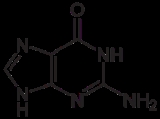
Guanine is one of the four main
nucleobaseNucleobases are a group of nitrogen-based molecules that are required to form nucleotides, the basic building blocks of DNA and RNA. Nucleobases provide the molecular structure necessary for the hydrogen bonding of complementary DNA and RNA strands, and are key components in the formation of stable...
s found in the
nucleic acidNucleic acids are biological molecules essential for life, and include DNA and RNA . Together with proteins, nucleic acids make up the most important macromolecules; each is found in abundance in all living things, where they function in encoding, transmitting and expressing genetic information...
s
DNADeoxyribonucleic acid is a nucleic acid that contains the genetic instructions used in the development and functioning of all known living organisms . The DNA segments that carry this genetic information are called genes, but other DNA sequences have structural purposes, or are involved in...
and
RNARibonucleic acid , or RNA, is one of the three major macromolecules that are essential for all known forms of life....
, the others being
adenineAdenine is a nucleobase with a variety of roles in biochemistry including cellular respiration, in the form of both the energy-rich adenosine triphosphate and the cofactors nicotinamide adenine dinucleotide and flavin adenine dinucleotide , and protein synthesis, as a chemical component of DNA...
,
cytosineCytosine is one of the four main bases found in DNA and RNA, along with adenine, guanine, and thymine . It is a pyrimidine derivative, with a heterocyclic aromatic ring and two substituents attached . The nucleoside of cytosine is cytidine...
, and
thymineThymine is one of the four nucleobases in the nucleic acid of DNA that are represented by the letters G–C–A–T. The others are adenine, guanine, and cytosine. Thymine is also known as 5-methyluracil, a pyrimidine nucleobase. As the name suggests, thymine may be derived by methylation of uracil at...
(
uracilUracil is one of the four nucleobases in the nucleic acid of RNA that are represented by the letters A, G, C and U. The others are adenine, cytosine, and guanine. In RNA, uracil binds to adenine via two hydrogen bonds. In DNA, the uracil nucleobase is replaced by thymine.Uracil is a common and...
in RNA). In
DNADeoxyribonucleic acid is a nucleic acid that contains the genetic instructions used in the development and functioning of all known living organisms . The DNA segments that carry this genetic information are called genes, but other DNA sequences have structural purposes, or are involved in...
, guanine is paired with cytosine. With the formula C
5H
5N
5O, guanine is a derivative of
purineA purine is a heterocyclic aromatic organic compound, consisting of a pyrimidine ring fused to an imidazole ring. Purines, including substituted purines and their tautomers, are the most widely distributed kind of nitrogen-containing heterocycle in nature....
, consisting of a fused
pyrimidinePyrimidine is a heterocyclic aromatic organic compound similar to benzene and pyridine, containing two nitrogen atoms at positions 1 and 3 of the six-member ring...
-
imidazoleImidazole is an organic compound with the formula C3H4N2. This aromatic heterocyclic is a diazole and is classified as an alkaloid. Imidazole refers to the parent compound, whereas imidazoles are a class of heterocycles with similar ring structure, but varying substituents...
ring system with conjugated double bonds. Being unsaturated, the bicyclic molecule is planar. The guanine
nucleosideNucleosides are glycosylamines consisting of a nucleobase bound to a ribose or deoxyribose sugar via a beta-glycosidic linkage...
is called
guanosineGuanosine is a purine nucleoside comprising guanine attached to a ribose ring via a β-N9-glycosidic bond. Guanosine can be phosphorylated to become guanosine monophosphate , cyclic guanosine monophosphate , guanosine diphosphate , and guanosine triphosphate...
.
Basic principles
Guanine, along with adenine and cytosine, is present in both DNA and RNA, whereas thymine is usually seen only in DNA, and uracil only in RNA. Guanine has two
tautomerTautomers are isomers of organic compounds that readily interconvert by a chemical reaction called tautomerization. This reaction commonly results in the formal migration of a hydrogen atom or proton, accompanied by a switch of a single bond and adjacent double bond...
ic forms,
the major keto form (see figures) and rare enol formIn organic chemistry, keto-enol tautomerism refers to a chemical equilibrium between a keto form and an enol . The enol and keto forms are said to be tautomers of each other...
.
It binds to cytosine through three
hydrogen bondA hydrogen bond is the attractive interaction of a hydrogen atom with an electronegative atom, such as nitrogen, oxygen or fluorine, that comes from another molecule or chemical group. The hydrogen must be covalently bonded to another electronegative atom to create the bond...
s. In cytosine, the amino group acts as the hydrogen donor and the C-2 carbonyl and the N-3 amine as the hydrogen-bond acceptors. Guanine has a group at C-6 that acts as the hydrogen acceptor, while the group at N-1 and the amino group at C-2 act as the hydrogen donors.
The first isolation of guanine was reported in 1844 from the excreta of sea birds, known as
guanoGuano is the excrement of seabirds, cave dwelling bats, and seals. Guano manure is an effective fertilizer due to its high levels of phosphorus and nitrogen and also its lack of odor. It was an important source of nitrates for gunpowder...
, which was used as a source of fertilizer. About fifty years later, Fischer determined the structure and also showed that
uric acidUric acid is a heterocyclic compound of carbon, nitrogen, oxygen, and hydrogen with the formula C5H4N4O3. It forms ions and salts known as urates and acid urates such as ammonium acid urate. Uric acid is created when the body breaks down purine nucleotides. High blood concentrations of uric acid...
can be converted to guanine.
Guanine can be hydrolyzed with strong acid to
glycineGlycine is an organic compound with the formula NH2CH2COOH. Having a hydrogen substituent as its 'side chain', glycine is the smallest of the 20 amino acids commonly found in proteins. Its codons are GGU, GGC, GGA, GGG cf. the genetic code.Glycine is a colourless, sweet-tasting crystalline solid...
,
ammoniaAmmonia is a compound of nitrogen and hydrogen with the formula . It is a colourless gas with a characteristic pungent odour. Ammonia contributes significantly to the nutritional needs of terrestrial organisms by serving as a precursor to food and fertilizers. Ammonia, either directly or...
,
carbon dioxideCarbon dioxide is a naturally occurring chemical compound composed of two oxygen atoms covalently bonded to a single carbon atom...
, and
carbon monoxideCarbon monoxide , also called carbonous oxide, is a colorless, odorless, and tasteless gas that is slightly lighter than air. It is highly toxic to humans and animals in higher quantities, although it is also produced in normal animal metabolism in low quantities, and is thought to have some normal...
. Guanine is first deaminated to
xanthineXanthine , is a purine base found in most human body tissues and fluids and in other organisms. A number of stimulants are derived from xanthine, including caffeine and theobromine....
. Guanine oxidizes more readily than adenine, the other purine-derivative base in DNA. Its high melting point of 350°C reflects the intermolecular hydrogen bonding between the oxo and amino groups in the molecules in the crystal. Because of this intermolecular bonding, guanine is relatively insoluble in water, but it is soluble in dilute acids and bases.
Syntheses
Trace amounts of guanine form by the
polymerizationIn polymer chemistry, polymerization is a process of reacting monomer molecules together in a chemical reaction to form three-dimensional networks or polymer chains...
of
ammonium cyanideAmmonium cyanide is an unstable inorganic compound with the formula NH4CN.-Uses:Ammonium cyanide is generally used in organic synthesis. Being unstable, it is not shipped or sold commercially.-Preparation:...
. Two experiments conducted by Levy et al. showed that heating 10 mol·L
−1 at 80 °C for 24 hours gave a yield of 0.0007%, while using 0.1 mol·L
−1 frozen at -20 °C for 25 years gave a 0.0035% yield. These results indicate guanine could arise in frozen regions of the primitive earth. In 1984, Yuasa reported a 0.00017% yield of guanine after the electrical discharge of , , , and 50 mL of water, followed by a subsequent acid hydrolysis. However, it is unknown whether the presence of guanine was not simply a resultant contaminant of the reaction.
- 10NH3 + 2CH4 + 4C2H6 + 2H2O → 2C5H8N5O (guanine) + 25H2
A Fischer-Tropsch synthesis can also be used to form guanine, along with
adenineAdenine is a nucleobase with a variety of roles in biochemistry including cellular respiration, in the form of both the energy-rich adenosine triphosphate and the cofactors nicotinamide adenine dinucleotide and flavin adenine dinucleotide , and protein synthesis, as a chemical component of DNA...
,
uracilUracil is one of the four nucleobases in the nucleic acid of RNA that are represented by the letters A, G, C and U. The others are adenine, cytosine, and guanine. In RNA, uracil binds to adenine via two hydrogen bonds. In DNA, the uracil nucleobase is replaced by thymine.Uracil is a common and...
, and
thymineThymine is one of the four nucleobases in the nucleic acid of DNA that are represented by the letters G–C–A–T. The others are adenine, guanine, and cytosine. Thymine is also known as 5-methyluracil, a pyrimidine nucleobase. As the name suggests, thymine may be derived by methylation of uracil at...
. Heating an equimolar gas mixture of CO, H
2, and NH
3 to 700 °C for 15 to 24 minutes, followed by quick cooling and then sustainted reheating to 100 to 200 °C for 16 to 44 hours with an alumina catalyst, yielded guanine and uracil:
- 10CO + H2 + 10NH3 → 2C5H8N5O (guanine) + 8H2O
Another possible abiotic route was explored by quenching a 90% N
2–10%CO–H
2O gas mixture high-temperature plasma
Traube's synthesis involves heating 2,4,5-triamino-1,6-dihydro-6-oxypyrimidine (as the sulfate) with
formic acidFormic acid is the simplest carboxylic acid. Its chemical formula is HCOOH or HCO2H. It is an important intermediate in chemical synthesis and occurs naturally, most notably in the venom of bee and ant stings. In fact, its name comes from the Latin word for ant, formica, referring to its early...
for several hours.
Other uses
Guanine etymologically comes via the Quichua word "huanu" for dung from the Spanish loan word "
guanoGuano is the excrement of seabirds, cave dwelling bats, and seals. Guano manure is an effective fertilizer due to its high levels of phosphorus and nitrogen and also its lack of odor. It was an important source of nitrates for gunpowder...
". As the
Oxford English DictionaryThe Oxford English Dictionary , published by the Oxford University Press, is the self-styled premier dictionary of the English language. Two fully bound print editions of the OED have been published under its current name, in 1928 and 1989. The first edition was published in twelve volumes , and...
notes, guanine is "A white amorphous substance obtained abundantly from guano, forming a constituent of the excrement of birds".
In 1656 in Paris, François Jaquin (a rosary maker) extracted from scales of some fishes the so-called pearl essence, crystalline guanine forming
G-quadruplexIn molecular biology, G-quadruplexes are nucleic acid sequences that are rich in guanine and are capable of forming a four-stranded structure...
es. In the cosmetics industry, crystalline guanine is used as an additive to various products (e.g.,
shampooShampoo is a hair care product used for the removal of oils, dirt, skin particles, dandruff, environmental pollutants and other contaminant particles that gradually build up in hair...
s), where it provides a pearly
iridescentIridescence is generally known as the property of certain surfaces which appear to change color as the angle of view or the angle of illumination changes...
effect. It is also used in metallic paints and simulated pearls and plastics. It provides shimmering luster to eye shadow and
nail polishNail polish, or nail varnish, is a lacquer applied to human fingernails or toenails to decorate and/or protect the nail plate.-History:...
. Facial treatments using the droppings, or guano, from Japanese nightingales is currently in favor in New York, reportedly because the guanine in the
droppingUguisu no fun , which literally means “nightingale feces” in Japanese, refers to the excrement produced by a particular nightingale called the Japanese bush warbler . The droppings have been used in facials since ancient Japanese times. Recently, the product has been used in the Western world...
s produces a clear, "bright" skin tone that some people find desirable to attain. Guanine crystals are rhombic platelets composed of multiple transparent layers, but they have a high index of refraction that partially reflects and transmits light from layer to layer, thus producing a pearly luster. It can be applied by spray, painting, or dipping. It may irritate the eyes. Its alternatives are
micaThe mica group of sheet silicate minerals includes several closely related materials having highly perfect basal cleavage. All are monoclinic, with a tendency towards pseudohexagonal crystals, and are similar in chemical composition...
, faux pearl (from ground shells), and
aluminiumAluminium or aluminum is a silvery white member of the boron group of chemical elements. It has the symbol Al, and its atomic number is 13. It is not soluble in water under normal circumstances....
and
bronzeBronze is a metal alloy consisting primarily of copper, usually with tin as the main additive. It is hard and brittle, and it was particularly significant in antiquity, so much so that the Bronze Age was named after the metal...
particles.
Spiders and scorpions convert ammonia, as a product of protein metabolism in the cells, to guanine as it can be excreted with minimal water loss.
Guanine is found in
integumentary systemThe integumentary system is the organ system that protects the body from damage, comprising the skin and its appendages...
of many fish such as
sturgeonSturgeon is the common name used for some 26 species of fish in the family Acipenseridae, including the genera Acipenser, Huso, Scaphirhynchus and Pseudoscaphirhynchus. The term includes over 20 species commonly referred to as sturgeon and several closely related species that have distinct common...
. It is also present in the reflective deposits of the
eyeEyes are organs that detect light and convert it into electro-chemical impulses in neurons. The simplest photoreceptors in conscious vision connect light to movement...
s of deep-sea fish and some
reptileReptiles are members of a class of air-breathing, ectothermic vertebrates which are characterized by laying shelled eggs , and having skin covered in scales and/or scutes. They are tetrapods, either having four limbs or being descended from four-limbed ancestors...
s such as
crocodileA crocodile is any species belonging to the family Crocodylidae . The term can also be used more loosely to include all extant members of the order Crocodilia: i.e...
s.
On August 8, 2011, a report, based on
NASAThe National Aeronautics and Space Administration is the agency of the United States government that is responsible for the nation's civilian space program and for aeronautics and aerospace research...
studies with meteorites found on
EarthEarth is the third planet from the Sun, and the densest and fifth-largest of the eight planets in the Solar System. It is also the largest of the Solar System's four terrestrial planets...
, was published suggesting building blocks of
DNADeoxyribonucleic acid is a nucleic acid that contains the genetic instructions used in the development and functioning of all known living organisms . The DNA segments that carry this genetic information are called genes, but other DNA sequences have structural purposes, or are involved in...
and
RNARibonucleic acid , or RNA, is one of the three major macromolecules that are essential for all known forms of life....
(guanine,
adenineAdenine is a nucleobase with a variety of roles in biochemistry including cellular respiration, in the form of both the energy-rich adenosine triphosphate and the cofactors nicotinamide adenine dinucleotide and flavin adenine dinucleotide , and protein synthesis, as a chemical component of DNA...
and related organic molecules) may have been formed extraterrestrially in
outer spaceOuter space is the void that exists between celestial bodies, including the Earth. It is not completely empty, but consists of a hard vacuum containing a low density of particles: predominantly a plasma of hydrogen and helium, as well as electromagnetic radiation, magnetic fields, and neutrinos....
.
External links