
All Topics  
Enantiomer


   Email Print
   Bookmark   Link


Enantiomer


In chemistry
Chemistry

Chemistry is the science concerned with the composition, structure, and properties of matter, as well as the changes it undergoes during chemical reactions....
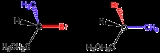
, an enantiomer (; from the Greek ????t???, opposite, and µ????, part or portion) is one of two stereoisomers that are non-superposable complete mirror image
Mirror Image

"Mirror Image" is an episode of the television series The Twilight Zone ....
s of each other, much as one's left and right hands
Chirality (chemistry)

The term chiral is used to describe an object that is non-Superposition on its mirror image.Human hands are perhaps the most universally recognized example of chirality: The left hand is a non-superposable mirror image of the right hand; no matter how the two hands are oriented, it is impossible for all the major features of both hands...
 are "the same" but opposite. Enantiopure compounds refer to a sample having within the limits of detection, molecules of only one chirality
Chirality

Chirality, or "handedness", is a property of asymmetry important in several branches of science.An object or a system is chiral if it cannot be wikt:superposed on its mirror image....
.

Enantiomers have, when present in a symmetric environment, identical chemical and physical properties except for their ability to rotate plane
Plane (mathematics)

In mathematics, a plane is a curvature surface. Planes can arise as subspaces of some higher dimensional space, as with the walls of a room, or they may enjoy an independent existence in their own right, as in the setting of Euclidean geometry....
-polarized light (+/-) by equal amounts but in opposite directions.


Discussion
Ask a question about 'Enantiomer'
Start a new discussion about 'Enantiomer'
Answer questions from other users
Full Discussion Forum


Encyclopedia


In chemistry
Chemistry

Chemistry is the science concerned with the composition, structure, and properties of matter, as well as the changes it undergoes during chemical reactions....
, an enantiomer (; from the Greek ????t???, opposite, and µ????, part or portion) is one of two stereoisomers that are non-superposable complete mirror image
Mirror Image

"Mirror Image" is an episode of the television series The Twilight Zone ....
s of each other, much as one's left and right hands
Chirality (chemistry)

The term chiral is used to describe an object that is non-Superposition on its mirror image.Human hands are perhaps the most universally recognized example of chirality: The left hand is a non-superposable mirror image of the right hand; no matter how the two hands are oriented, it is impossible for all the major features of both hands...
 are "the same" but opposite. Enantiopure compounds refer to a sample having within the limits of detection, molecules of only one chirality
Chirality

Chirality, or "handedness", is a property of asymmetry important in several branches of science.An object or a system is chiral if it cannot be wikt:superposed on its mirror image....
.

Enantiomers have, when present in a symmetric environment, identical chemical and physical properties except for their ability to rotate plane
Plane (mathematics)

In mathematics, a plane is a curvature surface. Planes can arise as subspaces of some higher dimensional space, as with the walls of a room, or they may enjoy an independent existence in their own right, as in the setting of Euclidean geometry....
-polarized light (+/-) by equal amounts but in opposite directions. A mixture of equal parts of an optically active isomer and its enantiomer is termed racemic
Racemic

In chemistry, a racemic mixture, or racemate, is one that has equal Amount of substance of left- and right-handed enantiomer of a Chirality molecule....
 and has a net rotation of plane-polarized light of zero.

Enantiomers of each other often do have different chemical properties related to other substances that are also enantiomers. Since many molecules in the bodies of living beings are enantiomers themselves, there is often a marked difference in the effects of two symmetrical enantiomers on living beings, including human beings.

Enantioselective preparations

There are two main strategies for the preparation of enantiopure compounds. The first is known as chiral resolution. This method involves preparing the compound in racemic
Racemic

In chemistry, a racemic mixture, or racemate, is one that has equal Amount of substance of left- and right-handed enantiomer of a Chirality molecule....
 form, and separating it into its isomers. In his pioneering work, Louis Pasteur
Louis Pasteur

Louis Pasteur was a France chemist and microbiologist best known for his remarkable breakthroughs in the causes and prevention of disease. His experiments supported the germ theory of disease, also reducing mortality from puerperal fever , and he created the first vaccine for rabies....
 was able to isolate the isomers of tartaric acid
Tartaric acid

Tartaric acid is a white crystalline organic acid. It occurs naturally in many plants, particularly grapes, bananas, and tamarinds, and is one of the main acids found in wine....
 because they crystallize from solution as crystals each with a different symmetry. A less common method is by enantiomer self-disproportionation
Enantiomer self-disproportionation

Enantiomer self-disproportionation is a process in stereochemistry describing the separation of a non-racemic mixture of enantiomers in an enantioenriched Fraction and a more racemic fraction as a result of the formation of heterochiral or homochirality aggregates....
.

The second strategy is asymmetric synthesis: the use of various techniques to prepare the desired compound in high enantiomeric excess
Enantiomeric excess

The enantiomeric excess of a substance is a measure of how pure it is. In this case, the impurity is the undesired enantiomer .Definition...
. Techniques encompassed include the use of chiral starting materials (chiral pool synthesis
Chiral pool synthesis

Chiral pool synthesis is a strategy that aims to improve the efficiency of chiral synthesis. It starts the organic synthesis of a complex enantiopure chemical compound from a stock of readily available enantiopure substances....
), the use of chiral auxiliaries and chiral catalysts, and the application of asymmetric induction
Asymmetric induction

Asymmetric induction in stereochemistry describes the preferential formation in a chemical reaction of one enantiomer or diastereoisomer over the other as a result of the influence of a optical isomerism feature present in the Substrate , reagent, catalyst or environment....
. The use of enzymes (biocatalysis
Biocatalysis

Biocatalysis can be defined as utilization of natural catalysts, such as protein enzymes, to perform chemical transformations on organic compounds....
) may also produce the desired compound.

Enantioconvergent synthesis is the synthesis of one enantiomer from a racemic precursor molecule utilizing both enantiomers. Thus, the two enantiomers of the reactant produce a single enantiomer of product.

Enantiopure medications

Advances in industrial chemical processes have made it economical for pharmaceutical manufacturers to take drugs that were originally marketed in racemic form and market the individual enantiomers, each of which may have unique properties. For some drugs, such as zopiclone
Zopiclone

Zopiclone , sold as Imovane, Zimovane and Zopinox in Europe and Canada, and as the eszopiclone analogue Lunesta in the United States, is a novel hypnotic agent used in the treatment of insomnia....
, only one enantiomer (eszopiclone
Eszopiclone

Eszopiclone, marketed by Sepracor under the brand-name Lunesta, is a nonbenzodiazepine hypnotic agent used as a treatment for insomnia. Eszopiclone is the active stereoisomer of zopiclone, and belongs to the class of drugs known as cyclopyrrolones....
) is active; the FDA has allowed such once-generic drugs to be patented and marketed under another name . In other cases, such as ibuprofen
Ibuprofen

Ibuprofen is a non-steroidal anti-inflammatory drug originally marketed as Brufen, and since then under various other trademarks , most notably Nurofen, Advil and Motrin....
, it is not economically feasible to isolate a single enantiomer from a racemic mixture or to synthesize just the active one, and therefore a racemic mixture is marketed, with an essentially doubled recommended dose.

Examples of racemic mixtures and the corresponding single-enantiomer products that have been marketed include:
  • Amphetamine
    Amphetamine

    Amphetamine and related drugs such as methamphetamine are a group of drugs that act by increasing levels of norepinephrine, serotonin, and dopamine in the brain....
     (Benzedrine; street amphetamine is also racemic) and dextroamphetamine
    Dextroamphetamine

    Dextroamphetamine is a psychostimulant which is known to produce increased wakefulness and focus in association with decreased fatigue and appetite....
     (Dexedrine)
  • Bupivacaine
    Bupivacaine

    Bupivacaine is a local anaesthetic drug belonging to the amino amide group. AstraZeneca commonly markets it under various trade names, including Marcain, Marcaine, Sensorcaine and Vivacaine....
     (Marcain) and levobupivacaine
    Levobupivacaine

    Levobupivacaine is a local anaesthetic drug belonging to the amino amide group. It is the S-enantiomer of bupivacaine. Levobupivacaine hydrochloride is commonly marketed by AstraZeneca under the trade name Chirocaine....
     (Chirocaine)
  • Cetirizine
    Cetirizine

    Cetirizine hydrochloride , an antihistamine, is a major metabolite of hydroxyzine, and a racemic histamine H1 receptor inverse agonist used in the treatment of allergies, hay fever, angioedema, and urticaria....
     (Zyrtec / Reactine) and levocetirizine
    Levocetirizine

    Levocetirizine is a third generation non-sedative antihistamine, developed from the second generation antihistamine cetirizine. Chemically, levocetirizine is the active enantiomer of cetirizine....
     (Xyzal)
  • Citalopram
    Citalopram

    Citalopram is an antidepressant Medication used to treat Major depressive disorder associated with mood disorders. It is also used on occasion in the treatment of body dysmorphic disorder and anxiety....
     (Celexa / Cipramil) and escitalopram
    Escitalopram

    Escitalopram is the pure enantiomer of racemic citalopram and is a selective serotonin reuptake inhibitor . Escitalopram is used in the treatment of Major depressive disorder and anxiety....
     (Lexapro / Cipralex)
  • Methylphenidate
    Methylphenidate

    Methylphenidate is the most commonly medical prescription psychostimulant and is indicated in the treatment of attention-deficit hyperactivity disorder and narcolepsy, although off-label uses include treating lethargy, depression, neural insult and obesity....
     (Ritalin) and dexmethylphenidate
    Dexmethylphenidate

    Dexmethylphenidate is a pharmaceutical drug used to treat Attention Deficit Hyperactivity Disorder. It is a psychostimulant dopamine reuptake inhibitor that affects the central nervous system....
     (Focalin)
  • Modafinil
    Modafinil

    Modafinil is a stimulant drug manufactured by Cephalon, and is approved by the U.S. Food and Drug Administration for the treatment of narcolepsy, shift work sleep disorder, and excessive daytime sleepiness associated with obstructive sleep apnea....
     (Provigil) and armodafinil
    Armodafinil

    Armodafinil is a stimulant-like drug produced by the pharmaceutical company Cephalon, which was approved by the Food and Drug Administration on June 15, 2007....
     (Nuvigil)
  • Ofloxacin
    Ofloxacin

    Ofloxacin is a fluoroquinolone antibiotic. Ofloxacin is the racemate mixture of the Chirality compound. The biologically active enantiomer is sold separately under the name of levofloxacin....
     (Floxin) and levofloxacin
    Levofloxacin

    'Levofloxacin', sold under the brand names Iquix, Levaquin, Oftaquix, Quixin and Tavanic, is a synthetic Chemotherapeutic_agent agent used to treat severe and life threatening bacterial infections....
     (Levaquin)
  • Omeprazole
    Omeprazole

    Omeprazole is a proton pump inhibitor used in the treatment of dyspepsia, peptic ulcer , gastroesophageal reflux disease and Zollinger-Ellison syndrome....
     (Prilosec) and esomeprazole
    Esomeprazole

    Esomeprazole is a proton pump inhibitor developed and marketed by AstraZeneca which is used in the treatment of dyspepsia, peptic ulcer , gastroesophageal reflux disease and Zollinger-Ellison syndrome....
     (Nexium)
  • Salbutamol
    Salbutamol

    Salbutamol or albuterol is a short-acting beta2-adrenergic receptor agonist used for the relief of bronchospasm in conditions such as asthma and chronic obstructive pulmonary disease....
     (Ventolin) and levalbuterol
    Levalbuterol

    Levosalbutamol or levalbuterol , trade name Xopenex, is the R-enantiomer of the short-acting beta2-adrenergic receptor agonist Salbutamol....
     (Xopenex)
  • Zopiclone
    Zopiclone

    Zopiclone , sold as Imovane, Zimovane and Zopinox in Europe and Canada, and as the eszopiclone analogue Lunesta in the United States, is a novel hypnotic agent used in the treatment of insomnia....
     (Imovane) and eszopiclone
    Eszopiclone

    Eszopiclone, marketed by Sepracor under the brand-name Lunesta, is a nonbenzodiazepine hypnotic agent used as a treatment for insomnia. Eszopiclone is the active stereoisomer of zopiclone, and belongs to the class of drugs known as cyclopyrrolones....
     (Lunesta)


Thalidomide
Thalidomide

Thalidomide is a sedative-hypnotic, and multiple myeloma medication. The drug is a potent Teratology in rabbits and primates including humans: this means that severe birth defects may result if the drug is taken during pregnancy....
 is an example of a racemic drug, in which one enantiomer produces a desirable antiemetic
Antiemetic

An antiemetic is a medication that is effective against vomiting and nausea. Anti-emetics are typically used to treat motion sickness and the Adverse effect of opioid analgesics, general anaesthetics and chemotherapy directed against cancer....
 effect, whereas the other is toxic and produces a teratogenic side-effect. However, the enantiomers are converted into each other in vivo
In vivo

In vivo means that which takes place inside an organism. In science, in vivo refers to experimentation done in or on the living tissue of a whole, living organism as opposed to a partial or dead one or a in vitro....
, so a single-enantiomer form of the drug would not prevent the side effects associated with the other enantiomer (though it might reduce them, depending on the rate of in vivo conversion.)

See also

  • Stereochemistry
    Stereochemistry

    Stereochemistry, a subdiscipline of chemistry, involves the study of the relative spatial arrangement of atoms within molecules. An important branch of stereochemistry is the study of chirality molecules ....
  • Dynamic stereochemistry
    Dynamic stereochemistry

    In chemistry, dynamic stereochemistry studies the effect of stereochemistry on the reaction rate of a chemical reaction. Stereochemistry is involved in:...
  • Chirality (chemistry)
    Chirality (chemistry)

    The term chiral is used to describe an object that is non-Superposition on its mirror image.Human hands are perhaps the most universally recognized example of chirality: The left hand is a non-superposable mirror image of the right hand; no matter how the two hands are oriented, it is impossible for all the major features of both hands...
  • Diastereomers
  • Stereogenic
  • Atropisomerism