


Denmark national football team

Encyclopedia
The Denmark national football team represents Denmark
in association football and is controlled by the Danish Football Association
(DBU), the governing body for the football clubs which are organized under DBU. Denmark's home ground is Parken Stadium in Østerbro and their head coach is Morten Olsen.
Denmark was the winners of football at the Intercalated Games
in 1906 and silver in the Olympics of 1908 and 1912. However, as amateurs who prohibited their internationals from becoming professionals at foreign clubs, Denmark did not qualify for the World Cup until 1986, although they won another Olympic silver in 1960.
Since 1983, the team has continuously been visible as a solidly competitive side, with the triumph in the 1992 European Championships in Sweden as its most prominent victory, beating the European champions from Netherlands
in the semifinal, and the World champions from Germany
in the final. They also managed to win the 1995 Confederations Cup, defeating Argentina
in the final. Their best FIFA World Cup
result was achieved in 1998, where they narrowly lost a well played quarter-final against Brazil
.
, and has teams at various youth levels for both men and women, most prominently the U21 national team
. Historically, the A-level team competed in the Olympics until and including the 1988 tournament, whereafter Olympic games count as U21 national games. In addition to the A-level team and youth teams, Denmark also have a special league national team named Ligalandsholdet
, with the best Danish footballers from the Nordic leagues. Ligalandsholdet was created in 1983, and has ever since (except in 2005), each year been playing some unofficial games for the national team, in the winter break of the Nordic leagues. Sometimes the media also refer to Ligalandsholdet as Denmark's B-team, as the best Danish footballers selected for the A-team often play in leagues outside of the Nordic countries. As such, the national team coach also at several times, outlined the purpose of having unofficial matches played by Ligalandsholdet, to be an opportunity of testing new potential upcoming Danish players for the A-team.
and the 1904 Olympics
, but then received a special invitation for the 1906 Olympics
, to compete against 1 Greek club team (Athens
) and 2 club teams from the Ottoman Empire (Smyrna
and Thessaloniki
). The team to represent Denmark was compiled of players from the Copenhagen Football Association
(KBU), and they managed to win the event, and thereby an unofficial gold medal. Two years later, in the first official football tournament at the 1908 Olympics
, Denmark won a silver medal. At the next 1912 Olympics
the team again managed to win a silver medal, which was followed by a golden era from April 1914 until April 1920, with Denmark ranked most of the time as nr.1 in the world by the elo ranking
.
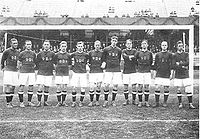 Although Denmark figured fairly prominently in the pre-World Cup
era, international success would elude them for years from the first World Cup in 1930 and forward. Despite the country's ability to produce outstanding football talents, DBU
only had ambition (or economy) to let the national team play friendly matches and the regional tournament Nordic Championship
, during the time from October 1920 until June 1948. When DBU decided to increase the ambitions a bit, and allowed the national team to start contesting the Olympics again, this promptly resulted in a bronze medal at the 1948 Olympics
. After the team only reached the quarter-final at the 1952 Olympics
, DBU however decided not to contest the next 1956 Olympics
. As football remained an amateur pastime, most of the best Danish footballers moved abroad to make a living, and due to DBU enforcing the rule, to bar all professionals from the national team, it started to become difficult to assemble a highly competitive team.
Denmark experienced their next revival at the 1960 Olympics
, with a third set of Olympic silver medals. This was followed by another notable performance in the Euro 1964
, where Denmark managed to achieve an impressive fourth place. The fourth place, was however by many people considered as being more the result of a comparatively easy draw, rather than a result of a well playing team. In order for Denmark to qualify for the semifinal, they only had to beat nations like Malta
, Albania
and Luxembourg
. At the semifinal, Denmark received a clear 0–3 defeat against Soviet Union, and then finally also lost the bronze match to Hungary
.
The strict rule of only allowing amateurism at the national team, was finally abolished by DBU
in May 1971, as they had acknowledged this change was needed, in order to build a highly competitive team. In February 1978, when DBU also decided to allow professional football to be introduced in the Danish leagues, the way was at the same time paved for the national team, to sign its first sponsorship with the well-known Danish brewery Carlsberg. The new sponsorship enabled DBU, to hire Sepp Piontek from Germany
in July 1979, as the first full-time professional coach of the national football team. The full transition of the national team from amateurism to professionalism had now been accomplished, and indeed, this would soon lead to a vast improvement in the performances of the team.
qualifiers, Denmark finished with 8 points from as many games, including a 3–1 win against eventual World Cup champions Italy
, but Denmark failed to qualify for the final tournament despite the impressive result. Qualification for the Euro 1984
saw the team beat England
at Wembley Stadium when Allan Simonsen
converted a penalty kick
for a 1–0 win. Denmark qualified for their first international tournament since 1964, and the team was dubbed "Danish Dynamite" in a competition for the official Danish Euro 1984 song. Denmark's participation ended in the semi-final when the team lost on penalties
to Spain
, most remembered for Preben Elkjær's penalty miss, his shorts torn apart. Following the strong performance at the finals, the name of "Danish Dynamite" became a mainstay for the following decade of Danish national team football under coach Piontek.
Denmark made their first World Cup appearance in the 1986 FIFA World Cup
, and with the attacking duo of Michael Laudrup
and Preben Elkjær the team surprised the world, sweeping the group, including a 6–1 thrashing of Uruguay
. In the second round Denmark once again faced Spain, and once more Denmark lost out. The team received a trashing of their own, losing 5–1, including four goals by Emilio Butragueño
. The first Spanish goal was caused by a miss-timed backpass by Jesper Olsen
to Butragueño, an unfortunate action subsequently coined as "a real Jesper Olsen" (en rigtig Jesper Olsen). The phrase would live on for 13 years, and was repeated by the Danish TV commentators in 1999, when an identical backpass was carried out by Jesper Grønkjær
to Filippo Inzaghi
, at his debut game for the national team.
After the glory days of 1986, the success of the team continued, as it first qualified for the Euro 1988
tournament, and then had a nearby qualification for the 1988 Olympics
. In the qualification group for the Olympics, the job to coach Denmark in these particular games, had for the first time been given to Richard Møller Nielsen
, and he proofed his skills, as Denmark initially managed to secure a spot for the final tournament -ahead of West Germany. But following the discovery that Dane Per Frimann
was not eligible for the teams 2–0 win over Poland
, Denmark was penalised the points of the win, and subsequently did not have enough points to qualify. After this disappointing news had arrived, Denmark had to pin all its hope and faith, for a successful performance at the Euro 1988, instead. The straight opposite however happened, as Denmark's participation ended in early defeat, after Denmark lost all the group games to Spain, Germany
, and Italy
. A period of transition with faltering results, had now started, and as Denmark subsequently also failed to qualify for the 1990 FIFA World Cup
, Sepp Piontek decided to stop as coach for the national team in April 1990, where he was replaced by his assistant coach Richard Møller Nielsen.
in Sweden. Denmark started out with a secure home victory against Faroe Islands
, but the following results in the qualification were an away draw against Northern Ireland
and a 2–0 home loss against Yugoslavia
. Due to the bad start, and a strong disagreement with the coach about the new defensive team tactics, the two best Danish footballers at the time, Michael Laudrup
and Brian Laudrup
, decided to quit playing for the team in November 1990. When the coach subsequently also decided to dismiss quality players like Jan Mølby
and Jan Heintze
from the team, due to disciplinary problems, several newspapers started to demand that Richard Møller Nielsen should step down, as the team was clearly falling apart under his influence. Despite this strong criticism, the team managed to win the rest of their five games in the group, including a 2–1 away win against Yugoslavia. This strong comeback was however not enough to qualify, as the team still had to settle with a second place in the group, behind Yugoslavia.
What initially appeared to be a failed qualification, would however soon turn out, to become Denmark's finest hour in the international competitions. Due to international sanctions resulting from the Yugoslav wars
, UEFA announced on 31 May 1992 – only 10 days before the competition commenced – that Yugoslavia
were to be excluded from the competition and their place given to Denmark, who entered as the second-placed team in its qualifying group.
Contrary to popular belief, the team however did not enter the tournament completely unprepared, after having rallied home from seaside vacations. The majority of players were already assembled to play a friendly match against the CIS
, when Denmark officially got the spot at the tournament. Relying heavily on goalkeeper Peter Schmeichel
and his defense, as well as creative spark Brian Laudrup – having fortunately decided to make a comeback for the national team in April 1992 – the Danish team created one of the biggest surprises in the event's history, as they went on to win the European Championship trophy, under coach Richard Møller Nielsen
's defensive playing style. Advancing from the group stage ahead of England
and France
, Denmark beat the Dutch
defending Euro 1988
champions on penalties in the semifinal, and with the 2–0 win against reigning 1990 FIFA World Cup
champions Germany
in the final, Denmark had won its first international trophy.
, but then managed to win the 1995 Confederations Cup
, beating Copa América
champions Argentina
2–0 in the final. As defending champions at the Euro 1996
, Denmark was not able to continue its previous success, but disappointed with a lacklustre performance, causing an early elimination already in the group stage. Result wise the tournament was not a complete disaster, as the team had achieved a respectable win against Turkey
, a draw against Portugal
and only a defeat to Croatia
. The reason why both the coach and team faced strong criticism after the tournament, was mainly because of the defensive and boring playing style. As controversy previously had occurred in fall 1995, over DBU's decision to prolong the contract with Richard Møller Nielsen, there was a strained relationship to the press already ahead of the Euro 1996 tournament; and facing a new wave of criticism, the coach decided in a mutual agreement with DBU, to terminate his contract already by the end of June 1996.
The new coach to be assigned, was the sympathetic Swede
, Bo "Bosse" Johansson, who gave the team a more offensive strategy, and the 1998 FIFA World Cup
saw the revival of the Danish team, starring both Laudrup brothers in their last international campaign. After beating Saudi Arabia
1–0, drawing with South Africa
and losing 2–1 to later champions France
in mediocre games, the Danish team qualified to the knockout stages as second in the group. In the next game however, Denmark played some of the best football of the entire tournament, beating Nigeria
4–1 in a fantastic game. In the quarterfinal against Brazil
, the Danes went out with a beautiful 2–3 defeat to the later silver medalists, in a very close and emotional game. Next challenge then was, to qualify the team for the Euro 2000
, for the first time without the Laudrup brothers. When this goal indeed was achieved by "Bosse", he received a lot of praise. But when the team showed up for the final tournament, and disappointed big time with 3 lost games in the group stage, "Bosse" was heavily criticized for having selected too many players for the squad, with injury problems and poor form. Facing the strong criticism after the teams disappointing performance in the Euro 2000 tournament, "Bosse" decided not to prolong his contract.
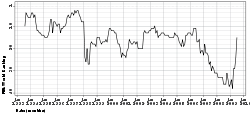 The new coach, starting for Denmark in July 2000, turned out to be the former national team captain from the successful team of the 1980s, Morten Olsen
, and the team was quickly dubbed the "Olsen Gang
", a reference to the series of Danish movies based around the main character Egon Olsen and his genius (criminal) plans. The nickname was also sometimes used for the Danish team -as an alternative to the more commonly used "Danish Dynamite"-, already back in those days when Olsen played as a captain. In the era with Olsen as a coach, his great experience from among others Ajax Amsterdam
was transferred to the national team, as Denmark's tactics shifted from the preferred 4–4–2 formation practised by Bo Johansson, to an even more attacking style, with an emphasis on the speedy wingers available to him at the time, namely Jesper Grønkjær
and Dennis Rommedahl
. Based on that, the preferred starting formation with Olsen as coach, has always been either a 4–3–3 or a 4–2–3–1. He even poses an outspoken opposition to the 4–4–2 system, as he announced the desire to leave his position as national coach, in case he was asked to play with this system as a standard. To support the development of players for the new tactical 4–3–3 system used by Olsen, all the national youth teams also changed their formation into the same 4–3–3 system. Another change Olsen brought to the national team, was to stress the importance of only using fit players, who were granted regular playing time at their club team. A principle that he however later has been forced to compromise with at several times, as the player material available in such a relatively small nation, doesn't always provide many realistic substitute options.
Denmark qualified both for the 2002 FIFA World Cup
and the Euro 2004
, but despite impressive results in the group stage in both tournaments, especially the 2–0 win against reigning World Cup winners France
in 2002, Denmark didn't manage to advance any further, and in both tournaments got clearly defeated with a score of 0–3 in the first round after the group stage. At the World Cup 2002 Denmark were defeated by England
at round 16, and at Euro 2004 the defeat took place in the quarterfinal against the Czech Republic
. The Euro 2004 will also be remembered for an incident in the game with Italy
, where Italian star Francesco Totti
was caught on camera spitting on Danish player Christian Poulsen
; and then subsequently the joint elimination of Italy by Denmark and Sweden
in the last group stage match, when the two teams drew 2–2 following a Swedish goal in the 89th minute, making for the exact and famous result that would see the Italians eliminated.
For the 2006 World Cup qualification, Denmark was paired with, among others, 2002 World Cup bronze winners Turkey
and Euro 2004 champions Greece
competing for only one guaranteed spot at the final tournament. Following a poor start of the qualification, Denmark were trailing both Turkey and surprise leaders Ukraine
. Denmark needed Turkey to lose points in the final games in order for Denmark to clinch the 2nd place of the group and one last chance to qualify via two play-off games. Indeed, had Turkey lost points to Albania
in their last game, Denmark would have gone through, but instead they had to settle for 3rd place in the group and a longer summer break. After failing to qualify for the 2006 FIFA World Cup
, coach Olsen considered leaving the job, having received several offers from club teams, but decided to stay and extended his contract until after the 2010 FIFA World Cup
, spurred on by his and the team's popularity among the Danish population.
When the next attempt to qualify for the Euro 2008
also failed -after among other things to have received an administrative defeat against Sweden at home turf, due to a spectator's intrusion on the field-, the team got heavily criticized, with many Danes asking for the departure of Morten Olsen as a coach. This suggestion was however refused by DBU and the majority of coaches in the Danish Superliga
, who still had trust in Olsen being the best coach for Denmark. In the qualification group for the 2010 FIFA World Cup
, the trust in Olsen was immediately paid back. Despite a difficult group with both Portugal
and Sweden
as higher ranked opponents, Denmark managed to qualify for the 2010 FIFA World Cup
by winning the group, after among other things, getting two victories against Sweden and one victory plus a draw against Portugal. After having celebrated the successful World Cup 2010 qualification, the contract with Morten Olsen as coach was extended for two more years, until the Euro 2012
.
At the 2010 World Cup, Denmark was grouped with Japan
, Cameroon
and the Netherlands
. Denmark lost the first match 2–0 to Netherlands, but then had a vital 2–1 victory against Cameroon, which enabled further advancement in case of victory over Japan, in the last third match. The game against Japan however ended with a 3–1 defeat, and thereby Denmark didn't reach their declared goal of advancement to round 16. Apparently the biggest reason for the lack of success, was however this time, that Denmark in both the preface -and during the 3 games at the tournament- had struggled with a lot of injuries hitting their best players.
When measuring the performance of the national team by winning share and earned points, Olsen's reign of the Danish national team from July 2000 until December 2010, has so far been the second most successful in the era of full time professional coaches, which began in 1979. As of December 2010, Morten Olsen
has a winning share of 51.3%, and with three points for a victory and one for a draw, Olsen has an average of 1.81 points per game. In comparison, Richard Møller Nielsen
still have the best record among the professional coaches of the Denmark national football team, with a 54.8% winning share and an average of 1.89 points per game. This kind of statistic of course only provide an overall indication of the performance, as it doesn't take the difficulty of the opponents into account -and/or the number of "difficult games". For a more accurate evaluation of the performance of the national team under the guidance of various coaches, one should also compare the development in the teams position at the official FIFA ranking
or Elo ranking
, where the merits of qualification and results in the final European Championship and World Cup tournament get the highest weight. Beside of the success of Olsen to qualify Denmark for the World Cup in 2002 and 2010, and the European Championship in 2004, he also gained several great results in the friendly games. In example, a friendly 4–1 win over England
in 2005; being the worst loss for the English team since 1980, and a repetition of the friendly 3–2 win achieved by Denmark on English ground at Old Trafford
in 2003.
. The goal of the roligan movement is calm, yet cheerful, support during the matches, as rolig means calm in the Danish language
. The roligans have since developed an image of easy-going nature and rabid support, and are often considered amongst the world's best national team fans, along with the Tartan Army
of Scotland. They were collectively given the FIFA FairPlay Award at the 1984 European Championships. Just before the 1986 World Cup, the roligan movement was organized in order to support the national team at the tournament.
The good reputation of the Danish supporters was however sullied by the 2008 UEFA qualifier fan attack, happening in June 2007 at the Euro 2008 qualifying game against Sweden
, when an enraged Danish supporter invaded the pitch and tried to attack the referee, following his decision to hand out a red card for Christian Poulsen
and a penalty kick to Sweden at the last minute of the game. The attacking fan was stopped by some of the Danish football players on the field, before he reached the referee, but due to the episode the game was immediately canceled by the referee, and UEFA subsequently decided to award a 0–3 defeat for Denmark, as a punishment.
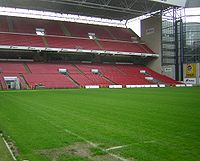 First home game of the Denmark national football team, was a 2–1 friendly win over England
at 25 May 1910, taking place with 12,000 spectators at the stadium "KBs baner" (located in the area "Granen", where Forum Copenhagen
later was build). As the facilities were considered too small, a new stadium in Copenhagen
was built with the name Idrætsparken
, that since its opening 25 May 1911 hosted all the home games of the football club KB
and most of the home games of the national team. During the first 82 years of the national team, from October 1908 until November 1990, Denmark played a total number of 254 A-level home games, of which 232 were played in Idrætsparken. According to the official statistics, the home games at Idrætsparken result wise ended with 125 victories, 41 draws and 66 lost games; and the stadium reached a record of 51,600 spectators for the 1–2 game against Sweden
in June 1957. In regards of the first era from 1908–1990, only 22 home games were played at other stadiums than Idrætsparken; of which 11 took place at NRGi Park (then known as Atletion) in Århus, followed by Aalborg Stadion
in Aalborg
with 6 games, and the remaining 5 games hosted by four other stadiums. Whenever another stadium than Idrætsparken was used for a home game, it was however only for some of the less important friendly games or Olympic qualifiers. While only Idrætsparken was used to host the games related to big important tournaments, like the Nordic championship
, European Championship
and World Cup
. When a major rebuilt of Idrætsparken began in December 1990, the subsequent two official Euro 1992 qualification games, were however moved to Odense Stadium
in Odense
.
On September 9 in 1992, the rebuilt Idrætsparken, now called Parken
, became the biggest venue in Denmark with 42,358 seats, and was opened with a friendly 1–2 defeat against Germany
. This first game in Parken had a visit of 40,500 spectators; while the current stadium record at 42,099 spectators was reached the 8 October 2005, for a World Cup qualifying game against Greece
.
The capacity of the stadium was later reduced to 38,009 seats, after the upper part of the D-side was converted from 4,000 extra seats into office and VIP areas, in June 2009. Despite this decrease in capacity, the stadium is today still the biggest venue in Denmark by far; as the next biggest venue Brøndby Stadium
only has a capacity of 26,000 seats. During the time from September 1992 until May 2006, Parken was the sole stadium of all the men's senior national team matches. However, meagre spectator support at some of the friendly matches at Parken, which for the years in 2000–2005 attracted an acceptable average of 23,862 per game, but down to 9,598 for the friendly 3–1 win over Israel
in April 2002; caused the decision by DBU, to start moving many of the friendly matches to other stadiums around the country. These other stadiums had less spectator capacity than Parken, but just about enough, to cover the Danes somewhat lower interest for the friendly games.
At 27 May 2006, Parken's 13-year monopoly on national team matches got broken for the first time, when Denmark played a friendly game at the NRGi Park stadium in Århus, against the World Cup 2006 participants Paraguay
. This particular game got outsold within a short while, with almost 19,000 of the 20,227 tickets being sold within the first hour of sale, and was support-wise a big success with a total audience of 20,047 spectators. When the two next friendly games were played at some other new venues, August 16 at Fionia Park
in Odense with Poland
as opponent, and September 1 at Brøndby Stadium
with Portugal
as opponent, the number of spectators however dropped to a disappointing level. The match against Poland only attracted 11,088 spectators, while the match against Portugal only attracted 13,186 spectators; and the match against Portugal was in particular deemed as a support-wise failure, as it featured a higher ranked opponent, which spectators normally would have a high interest to watch. The main reasons why Brøndby Stadium failed to attract a high number of spectators, were generally thought to be a combination of the poor rainy weather, and the fact that this stadium is located on the outskirts of Copenhagen; and as such does not attract a new demographic audience compared to Parken, due to the travel distances being more or less the same for the majority of the population.
Currently, while most of the friendly games continue to be played at some of the smaller stadiums in Denmark, it has been decided to continue playing all of the qualifying games for the European Championships and World Cup, only at Parken Stadium. Those friendly games, which are believed to create a high interest from spectators, will also continue to be played at Parken. In example, the friendly game against Germany in August 2010, took place at Parken Stadium, due to the general expectation of many spectators having a desire to watch the game. After the weak performance of Denmark at the World Cup 2010, the friendly game however only managed to draw a total number of 19,071 spectators.
During the last 18 years, from September 1992 until October 2010, Denmark played a total of 73 A-level games at Parken Stadium; of which 46 were won, 16 got drawed, and only 11 were lost.
The first 3 Olympic football events were only unofficial tournaments, with a few nations represented by a club team. Starting from 1908, the Olympic football tournament became an official event, with representation of the official national football teams.
After the Olympics 1988, the football event was changed into a tournament, with participation only for the U21 national teams.
* Denmark score always listed first
for a week-long training camp preluding the upcoming game. Friendly games are typically played on a Wednesday evening. World Cup qualifiers are played on both Saturday and Wednesday evenings; while Euro qualifiers now take place on both a Friday and Tuesday evening when playing two games in a row, or on a Friday/Saturday/Tuesday at rounds with only one game scheduled.
Currently, the payments for participation in games outside the big tournaments are regulated by a collective agreement -to be renegotiated after a certain number of years-, while all payments for participation of players in a final tournament squad are regulated by the 1998 agreement between DBU and Spillerforeningen. The 1998 agreement has outlined, that whenever the team manage to qualify for a World Cup or European Championship, the selected players for the final tournament shall receive 50% of DBU's revenues from the event, and 65% of DBU's revenues from the sale of merchandise and license agreements. In top of that, the sponsors of the team also pay a relatively high qualification bonus, each time the team qualify for a final tournament. This additional qualification bonus is shared between the group of players being selected for the final 18-man squad, to one or several of the qualification matches played, with the exact distribution normally decided according to the number of times the player was selected.
Each of the 23 selected players for the 2002 World Cup received DKK 498,000 (equal to €66,800) from the event revenues, plus DKK 122,900 (equal to €16,500) from the sale of merchandise and license agreements, plus an unknown qualification bonus from the sponsors, plus the standard payment from DBU each time they got selected for the final 18-man squad to a qualification match. In comparison, each of the 23 selected players for the 2010 World cup received DKK 635,000 (equal to €85,100) from the event revenues, plus DKK 98,900 (equal to €13,200) from the sale of merchandise and license agreements, plus a qualification bonus from the sponsors at DKK 2,800,000 (equal to €375,000) to be shared between the players -corresponding to an amount of €2,080 per time the player got selected for the final 18-man squad to a qualification match. Beside of the qualification bonus, the players also received this standard payment from DBU, each time they were selected for the 18-man squad to a qualification match:
Based on Denmark's results and number of spectators at home games, the standard qualification match payment, to a player selected for all Denmark's qualification matches, hereby equals a total amount of DKK 235,898 (or €31,600) for the 6 qualification matches in the 2008–09 season, and a total amount of DKK 170,788 (or €22,900) for the 4 qualification matches in the 2009–10 season. Finally the players could also add a seasonal payment named "regular bonus" from the sponsors, with a total of DKK 4,350,000 (equal to €583,100) to be shared each season by the squad of 18 players selected for a match; meaning that a player who got selected for all matches of the national team from August 1 to July 31, would receive an additional amount of DKK 241,700 (equal to €32,400) in both the 2008–09 season and 2009–10 season.
The last amount of a players income generated by the national team, is the standard payment received for each friendly match:
Based on Denmark's results and number of spectators at home games, the standard payment to a player selected for all Denmark's friendly matches, hereby equals a total amount of DKK 41,426 (or €5,500) for the 3 friendly matches in the 2008–09 season, and a total amount of DKK 88,773 (or €11,900) for the 7 friendly matches in the 2009–10 season.
When all these payments are added together for a player, under the assumption that he was selected for all matches in each season, and the final 2010 World Cup squad, then he would have received a total payment from DBU at €69,500 in the 2008–09 season, and a total payment from DBU at €186,300 in the 2009–10 season.
s), at all games played outside the major tournaments. For games at major tournaments, such as the FIFA World Cup
or the UEFA European Football Championship
, the team is required to play with permanent squad numbers throughout the tournament.
Numbers are traditionally associated with a certain position on the field, but there are no set rules. Furthermore, established players will tend to use the same number whenever they play. Christian Poulsen
, for example, retains the Denmark number 2 no matter what position he plays in. However, when Poulsen does not play, another player will be number 2.
against Sweden
and Finland
which will play on 11 and 15 November 2011, respectively.
Caps and goals as of 11 October 2011.
|-
! colspan="1" bgcolor="#B0D3FB" align="left"|
! colspan="2" bgcolor="#B0D3FB" align="left"|
! colspan="1" bgcolor="#B0D3FB" align="left"|
! colspan="1" bgcolor="#B0D3FB" align="left"|
! colspan="1" bgcolor="#B0D3FB" align="left"|
! colspan="1" bgcolor="#B0D3FB" align="left"|
! colspan="1" bgcolor="#B0D3FB" align="left"|
|-
|-
! colspan="1" bgcolor="#B0D3FB" align="left"|
! colspan="2" bgcolor="#B0D3FB" align="left"|
! colspan="1" bgcolor="#B0D3FB" align="left"|
! colspan="1" bgcolor="#B0D3FB" align="left"|
! colspan="1" bgcolor="#B0D3FB" align="left"|
! colspan="1" bgcolor="#B0D3FB" align="left"|
! colspan="1" bgcolor="#B0D3FB" align="left"|
|-
|-
! colspan="1" bgcolor="#B0D3FB" align="left"|
! colspan="2" bgcolor="#B0D3FB" align="left"|
! colspan="1" bgcolor="#B0D3FB" align="left"|
! colspan="1" bgcolor="#B0D3FB" align="left"|
! colspan="1" bgcolor="#B0D3FB" align="left"|
! colspan="1" bgcolor="#B0D3FB" align="left"|
! colspan="1" bgcolor="#B0D3FB" align="left"|
|-
|-
! colspan="2" bgcolor="#B0D3FB" align="left"|
! colspan="1" bgcolor="#B0D3FB" align="left"|
! colspan="1" bgcolor="#B0D3FB" align="left"|
! colspan="1" bgcolor="#B0D3FB" align="left"|
! colspan="1" bgcolor="#B0D3FB" align="left"|
! colspan="1" bgcolor="#B0D3FB" align="left"|
! colspan="1" bgcolor="#B0D3FB" align="left"|
|-
|-
! colspan="2" bgcolor="#B0D3FB" align="left"|
! colspan="1" bgcolor="#B0D3FB" align="left"|
! colspan="1" bgcolor="#B0D3FB" align="left"|
! colspan="1" bgcolor="#B0D3FB" align="left"|
! colspan="1" bgcolor="#B0D3FB" align="left"|
! colspan="1" bgcolor="#B0D3FB" align="left"|
! colspan="1" bgcolor="#B0D3FB" align="left"|
|-
|-
! colspan="2" bgcolor="#B0D3FB" align="left"|
! colspan="1" bgcolor="#B0D3FB" align="left"|
! colspan="1" bgcolor="#B0D3FB" align="left"|
! colspan="1" bgcolor="#B0D3FB" align="left"|
! colspan="1" bgcolor="#B0D3FB" align="left"|
! colspan="1" bgcolor="#B0D3FB" align="left"|
! colspan="1" bgcolor="#B0D3FB" align="left"|
|-
UEFA European Championship:
FIFA World Cup:
, Henning Jensen
, Allan Simonsen
, Preben Elkjær
, Michael Laudrup
, Brian Laudrup
, Peter Schmeichel
, and Jon Dahl Tomasson
. The winner of the award was decided by a public vote arranged by the broadcasting channel TV2
, which ended with Michael Laudrup as a clear winner, with 58% of the votes.
, DBU
, and a Hall of Fame member), each year have the job to award one or two new members for the Hall of Fame. The award will be handed out at the official Danish Football Awards, which is a yearly DBU event, broadcasted by TV2 in November. Beside of receiving the award, all Hall of Fame members are also invited to leave a footprint in bronze, to decorate the entrance hall at "Fodboldens hus" -the DBU headquarters in Brøndby
.
Hall of Fame members:
(Nov.1956-Dec.1961) and Poul Petersen
(Jan.1962-Dec.1966) as managers for a roling period of several years, they were granted the responsibility to coach the physical training and decide the team tactics before and during the game, but had no influence upon the selection of players for the national team -which was a job for the special appointed selection committee: "UdtagelsesKomitéen".
For the years in 1967–1969, the management of the team more or less became a sole responsibility for "UdtagelsesKomitéen", following a new approach. In this new approach, the job to select players continued to be the responsibility for "UdtagelsesKomitéen", but the chairman of the committee was now also appointed to be the "tactical manager" of the national team, as DBU realised the need of having a special tactical manager assigned, to get influence upon both the selection of players and the related tactics before and during the game. The appointed tactical manager, however didn't have the responsibility to train the team, as a special physical coach was selected for that part of the job. In 1970, the approach with two managers assigned was however abandoned again, when DBU realised the need to assign only one manager with the sole responsibility of the team.
For the years in 1970–1979, the job to select players was however not yet a sole responsibility of the manager alone, but only a shared responsibility, as this continued to be a matter for "UdtagelsesKomitéen" to decide. When a selection of players had to be made, it was decided by a vote in the committee, with the appointed manager being granted an influence of 3 votes, and the four members of the committee being granted 1 vote each. This special selection procedure continued until July 1979, where it was decided to hand out the sole responsibility of all manager related areas, to the manager himself, with the assignment of Sepp Piontek as the first full time professional manager of the national football team.
The box below, list all assigned football managers for the national team, since the first official game in October 1908.
During the years from 1911 to 1961, a total of 169 games were played without an assigned manager.
Denmark
Denmark is a Scandinavian country in Northern Europe. The countries of Denmark and Greenland, as well as the Faroe Islands, constitute the Kingdom of Denmark . It is the southernmost of the Nordic countries, southwest of Sweden and south of Norway, and bordered to the south by Germany. Denmark...
in association football and is controlled by the Danish Football Association
Danish Football Association
The Danish Football Association is the governing body of football in Denmark. It is the organization of the Danish football clubs and runs the professional Danish football leagues and the men's and women's national teams. It is based in the city of Brøndby and is a founding member of both FIFA...
(DBU), the governing body for the football clubs which are organized under DBU. Denmark's home ground is Parken Stadium in Østerbro and their head coach is Morten Olsen.
Denmark was the winners of football at the Intercalated Games
Intercalated Games
The Intercalated Olympic Games were to be a series of International Olympic Games half-way between what we now call Games of the Olympiad. This proposed series of games, intercalated in the Olympic Games cycle, was to always be held in Athens, and were to have equal status with the international...
in 1906 and silver in the Olympics of 1908 and 1912. However, as amateurs who prohibited their internationals from becoming professionals at foreign clubs, Denmark did not qualify for the World Cup until 1986, although they won another Olympic silver in 1960.
Since 1983, the team has continuously been visible as a solidly competitive side, with the triumph in the 1992 European Championships in Sweden as its most prominent victory, beating the European champions from Netherlands
Netherlands national football team
The Netherlands National Football Team represents the Netherlands in association football and is controlled by the Royal Dutch Football Association , the governing body for football in the Netherlands...
in the semifinal, and the World champions from Germany
Germany national football team
The Germany national football team is the football team that has represented Germany in international competition since 1908. It is governed by the German Football Association , which was founded in 1900....
in the final. They also managed to win the 1995 Confederations Cup, defeating Argentina
Argentina national football team
The Argentina national football team represents Argentina in association football and is controlled by the Argentine Football Association , the governing body for football in Argentina. Argentina's home stadium is Estadio Monumental Antonio Vespucio Liberti and their head coach is Alejandro...
in the final. Their best FIFA World Cup
FIFA World Cup
The FIFA World Cup, often simply the World Cup, is an international association football competition contested by the senior men's national teams of the members of Fédération Internationale de Football Association , the sport's global governing body...
result was achieved in 1998, where they narrowly lost a well played quarter-final against Brazil
Brazil national football team
The Brazil national football team represents Brazil in international men's football and is controlled by the Brazilian Football Confederation , the governing body for football in Brazil. They are a member of the International Federation of Association Football since 1923 and also a member of the...
.
Teams
Apart from the men's senior A-level team, Denmark competes with a women's national teamDenmark women's national football team
The Denmark women's national football team represents Denmark in international women's football. The team is controlled by the Danish Football Association .-World Cup:*1970 : Winner *1971 : Winner...
, and has teams at various youth levels for both men and women, most prominently the U21 national team
Denmark national under-21 football team
The Denmark national under-21 football team has played since 1976 and is controlled by the Danish Football Association. Before 1976, the age limit was 23 years.-U-21 European Championship:*1978 – Quarterfinals*1980 to 1984 – Did not qualify...
. Historically, the A-level team competed in the Olympics until and including the 1988 tournament, whereafter Olympic games count as U21 national games. In addition to the A-level team and youth teams, Denmark also have a special league national team named Ligalandsholdet
Denmark League XI national football team
The Denmark League XI national football team is an unofficial national football team run by the Danish Football Association.The team generally consists of Danish players playing in the Danish Superliga, or other leagues if the clubs there agree to release them...
, with the best Danish footballers from the Nordic leagues. Ligalandsholdet was created in 1983, and has ever since (except in 2005), each year been playing some unofficial games for the national team, in the winter break of the Nordic leagues. Sometimes the media also refer to Ligalandsholdet as Denmark's B-team, as the best Danish footballers selected for the A-team often play in leagues outside of the Nordic countries. As such, the national team coach also at several times, outlined the purpose of having unofficial matches played by Ligalandsholdet, to be an opportunity of testing new potential upcoming Danish players for the A-team.
Amateur years
The first three editions of the Olympic football event in 1900–1906 had an unofficial status, as the event was not yet open for national football teams to compete, and only had limited participation of three or four club teams from a few nations. Denmark had no club team invited in the 1900 OlympicsFootball at the 1900 Summer Olympics
At the 1900 Summer Olympics, a football tournament was contested for the first time. Only two demonstration matches were held between the three club sides, and no medals were awarded...
and the 1904 Olympics
Football at the 1904 Summer Olympics
At the 1904 Summer Olympics, a football event was contested. Only three club teams competed. No medals were awarded at the time, but the IOC subsequently awarded gold, silver, and bronze medals and upgrade the status of the contests to an official event....
, but then received a special invitation for the 1906 Olympics
Football at the 1906 Summer Olympics
At the 1906 Summer Olympics, called "Intercalated Games", in Athens, an unofficial football event was contested. Only four teams competed, three of them clubs from Greece and the Ottoman Empire...
, to compete against 1 Greek club team (Athens
Athens
Athens , is the capital and largest city of Greece. Athens dominates the Attica region and is one of the world's oldest cities, as its recorded history spans around 3,400 years. Classical Athens was a powerful city-state...
) and 2 club teams from the Ottoman Empire (Smyrna
Izmir
Izmir is a large metropolis in the western extremity of Anatolia. The metropolitan area in the entire Izmir Province had a population of 3.35 million as of 2010, making the city third most populous in Turkey...
and Thessaloniki
Thessaloniki
Thessaloniki , historically also known as Thessalonica, Salonika or Salonica, is the second-largest city in Greece and the capital of the region of Central Macedonia as well as the capital of the Decentralized Administration of Macedonia and Thrace...
). The team to represent Denmark was compiled of players from the Copenhagen Football Association
Copenhagen Football Association
DBU Copenhagen is a local football association in Copenhagen, Denmark. DBU Copenhagen is a member of the Union of Local Football Associations in Denmark under the Danish Football Association and Danmarks Idræts-Forbund...
(KBU), and they managed to win the event, and thereby an unofficial gold medal. Two years later, in the first official football tournament at the 1908 Olympics
Football at the 1908 Summer Olympics
Bohemia were forced to withdraw before the tournament started after losing their FIFA membership.-Semi-finals:-Bronze medal match:The French were so shocked by their humiliating 17-1 defeat against Denmark that they declined to play for the bronze medal; therefore, the Netherlands played Sweden for...
, Denmark won a silver medal. At the next 1912 Olympics
Football at the 1912 Summer Olympics
Football at the 1912 Summer Olympics was one of the 102 events at the 1912 Summer Olympics in Stockholm, Sweden. It was the fourth time football was on the Olympic schedule. The tournament was contested between 11 nations, all of them from Europe, with Great Britain winning the gold medals...
the team again managed to win a silver medal, which was followed by a golden era from April 1914 until April 1920, with Denmark ranked most of the time as nr.1 in the world by the elo ranking
World Football Elo Ratings
The World Football Elo Ratings is a ranking system for men's national teams in association football. The method used to rank teams is based upon the Elo rating system method but modified to take various football-specific variables into account...
.
FIFA World Cup
The FIFA World Cup, often simply the World Cup, is an international association football competition contested by the senior men's national teams of the members of Fédération Internationale de Football Association , the sport's global governing body...
era, international success would elude them for years from the first World Cup in 1930 and forward. Despite the country's ability to produce outstanding football talents, DBU
Danish Football Association
The Danish Football Association is the governing body of football in Denmark. It is the organization of the Danish football clubs and runs the professional Danish football leagues and the men's and women's national teams. It is based in the city of Brøndby and is a founding member of both FIFA...
only had ambition (or economy) to let the national team play friendly matches and the regional tournament Nordic Championship
Nordic Football Championship
The Nordic Football Championship was an international football competition contested by the men's national football teams of the Nordic countries...
, during the time from October 1920 until June 1948. When DBU decided to increase the ambitions a bit, and allowed the national team to start contesting the Olympics again, this promptly resulted in a bronze medal at the 1948 Olympics
Football at the 1948 Summer Olympics
The 1948 Olympic Games title was won by Sweden, managed by Englishman George Raynor.-Summary:Sweden, whose Football Association forbade professionalism within domestic football, ran out as winners and only used 12 players throughout the entire tournament but there were exceptional performances put...
. After the team only reached the quarter-final at the 1952 Olympics
Football at the 1952 Summer Olympics
The 1952 Olympic football tournament signalled the arrival of the 'Golden Team'; the 'Magical Magyars': Hungary. Ferenc Puskás, the great Hungarian known as the 'Galloping Major' for his military title, said of the 1952 competition: "It was during the Olympics that our football first started to...
, DBU however decided not to contest the next 1956 Olympics
Football at the 1956 Summer Olympics
The 1956 Olympic Games football tournament with just 11 competing nations suffered from cancellations. It was an undistinguished tournament that featured mis-matches and walkovers.-Background:...
. As football remained an amateur pastime, most of the best Danish footballers moved abroad to make a living, and due to DBU enforcing the rule, to bar all professionals from the national team, it started to become difficult to assemble a highly competitive team.
Denmark experienced their next revival at the 1960 Olympics
Football at the 1960 Summer Olympics
The football tournament at the 1960 Summer Olympics was held from 26 August to 10 September in 1960 throughout Italy.-Venues:-Medalists:-Group A:---------------------Group B:---------------------Group C:--------...
, with a third set of Olympic silver medals. This was followed by another notable performance in the Euro 1964
1964 UEFA European Football Championship
-Semi-finals:-----Third place play-off:-Final:-Goalscorers of the final tournament:There were 13 goals scored in 4 games, for an average of 3.25 goals per game.2 goals Ferenc Bene Dezső Novák Jesús María Pereda...
, where Denmark managed to achieve an impressive fourth place. The fourth place, was however by many people considered as being more the result of a comparatively easy draw, rather than a result of a well playing team. In order for Denmark to qualify for the semifinal, they only had to beat nations like Malta
Malta national football team
The Malta national football team is the national football team of Malta and is controlled by the Malta Football Association. Malta played its first international game in February 1957, and began competing for qualification to major tournaments in 1962. The side's first competitive victory came in...
, Albania
Albania national football team
The Albania national association football team is the national association football team of Albania and is controlled by the Football Association of Albania...
and Luxembourg
Luxembourg national football team
The Luxembourg national football team is the national football team of Luxembourg, and is controlled by the Luxembourg Football Federation. The team play most of their home matches at the Stade Josy Barthel, in Luxembourg.- History :...
. At the semifinal, Denmark received a clear 0–3 defeat against Soviet Union, and then finally also lost the bronze match to Hungary
Hungary national football team
The Hungary national football team represents Hungary in international football and is controlled by the Hungarian Football Federation....
.
The strict rule of only allowing amateurism at the national team, was finally abolished by DBU
Danish Football Association
The Danish Football Association is the governing body of football in Denmark. It is the organization of the Danish football clubs and runs the professional Danish football leagues and the men's and women's national teams. It is based in the city of Brøndby and is a founding member of both FIFA...
in May 1971, as they had acknowledged this change was needed, in order to build a highly competitive team. In February 1978, when DBU also decided to allow professional football to be introduced in the Danish leagues, the way was at the same time paved for the national team, to sign its first sponsorship with the well-known Danish brewery Carlsberg. The new sponsorship enabled DBU, to hire Sepp Piontek from Germany
Germany
Germany , officially the Federal Republic of Germany , is a federal parliamentary republic in Europe. The country consists of 16 states while the capital and largest city is Berlin. Germany covers an area of 357,021 km2 and has a largely temperate seasonal climate...
in July 1979, as the first full-time professional coach of the national football team. The full transition of the national team from amateurism to professionalism had now been accomplished, and indeed, this would soon lead to a vast improvement in the performances of the team.
Danish Dynamite (1980–1990)
In the 1982 FIFA World Cup1982 FIFA World Cup
The 1982 FIFA World Cup, the 12th FIFA World Cup, was held in Spain from 13 June to 11 July. The tournament was won by Italy, after defeating West Germany 3–1 in the final.-Host selection:...
qualifiers, Denmark finished with 8 points from as many games, including a 3–1 win against eventual World Cup champions Italy
Italy national football team
The Italy National Football Team , represents Italy in association football and is controlled by the Italian Football Federation , the governing body for football in Italy. Italy is the second most successful national team in the history of the World Cup having won four titles , just one fewer than...
, but Denmark failed to qualify for the final tournament despite the impressive result. Qualification for the Euro 1984
1984 UEFA European Football Championship
The 1984 UEFA European Football Championship final tournament was held in France. West Germany also bid for the hosting of this event. It was the seventh European Football Championship, held every four years and endorsed by UEFA...
saw the team beat England
England national football team
The England national football team represents England in association football and is controlled by the Football Association, the governing body for football in England. England is the joint oldest national football team in the world, alongside Scotland, whom they played in the world's first...
at Wembley Stadium when Allan Simonsen
Allan Simonsen
Allan Rodenkam Simonsen is a former Danish footballer and manager. He most prominently played for German team Borussia Mönchengladbach, winning the 1975 and 1979 UEFA Cups, as well as for Barcelona from Spain, winning the 1982 Cup WInners' Cup...
converted a penalty kick
Penalty kick
A penalty kick is a type of direct free kick in association football, taken from twelve yards out from goal and with only the goalkeeper of the defending team between the penalty taker and the goal.Penalty kicks are performed during normal play...
for a 1–0 win. Denmark qualified for their first international tournament since 1964, and the team was dubbed "Danish Dynamite" in a competition for the official Danish Euro 1984 song. Denmark's participation ended in the semi-final when the team lost on penalties
Penalty shootout (football)
A penalty shoot-out, referred to as kicks from the penalty mark in the Laws of the Game, is the FIFA official term for a method used in association football to decide which team progresses to the next stage of a tournament following a tied game...
to Spain
Spain national football team
The Spain national football team represents Spain in international association football and is controlled by the Royal Spanish Football Federation, the governing body for football in Spain. The current head coach is Vicente del Bosque...
, most remembered for Preben Elkjær's penalty miss, his shorts torn apart. Following the strong performance at the finals, the name of "Danish Dynamite" became a mainstay for the following decade of Danish national team football under coach Piontek.
Denmark made their first World Cup appearance in the 1986 FIFA World Cup
1986 FIFA World Cup
The 1986 FIFA World Cup, the 13th FIFA World Cup, was held in Mexico from 31 May to 29 June. The tournament was the second to feature a 24-team format. Colombia had been originally chosen to host the competition by FIFA but, largely due to economic reasons, was not able to do so and officially...
, and with the attacking duo of Michael Laudrup
Michael Laudrup
Michael Laudrup is a retired Danish footballer, who works as a manager and last coached La Liga side RCD Mallorca. He is widely regarded as one of the greatest players in the history of football. His most prominent run of football came with Spanish club Barcelona, with whom he won four straight La...
and Preben Elkjær the team surprised the world, sweeping the group, including a 6–1 thrashing of Uruguay
Uruguay national football team
The Uruguayan national football team represents Uruguay in international association football and is controlled by the Uruguayan Football Association, the governing body for football in Uruguay. The current head coach is Óscar Tabárez...
. In the second round Denmark once again faced Spain, and once more Denmark lost out. The team received a trashing of their own, losing 5–1, including four goals by Emilio Butragueño
Emilio Butragueño
Emilio Butragueño Santos is a retired Spanish footballer who played as a striker.He was best known for his spell with Real Madrid...
. The first Spanish goal was caused by a miss-timed backpass by Jesper Olsen
Jesper Olsen
Jesper Olsen is a Danish former footballer who most notably played for Ajax of the Netherlands and Manchester United of England. Olsen was a regular left winger for the Danish national team, scoring five goals in 43 matches...
to Butragueño, an unfortunate action subsequently coined as "a real Jesper Olsen" (en rigtig Jesper Olsen). The phrase would live on for 13 years, and was repeated by the Danish TV commentators in 1999, when an identical backpass was carried out by Jesper Grønkjær
Jesper Grønkjær
Jesper Grønkjær is a former Danish professional football player. A pacey winger, he was able to play on the right or left wing and as a second striker. Grønkjær played a total 400 league games for a number of European clubs, most notably winning the 1999 Dutch Cup with Ajax Amsterdam and playing...
to Filippo Inzaghi
Filippo Inzaghi
Filippo Inzaghi, Ufficiale OMRI commonly known as Pippo, is a World Cup and UEFA Champions League-winning Italian footballer who plays for Serie A club Milan....
, at his debut game for the national team.
After the glory days of 1986, the success of the team continued, as it first qualified for the Euro 1988
1988 UEFA European Football Championship
The 1988 UEFA European Football Championship final tournament was held in West Germany. West Germany won the right to host the tournament with five votes ahead of a joint bid from Norway, Sweden and Denmark, who gained 1 vote, and a bid from England. It was the eighth European Football...
tournament, and then had a nearby qualification for the 1988 Olympics
Football at the 1988 Summer Olympics
Final results for the football competition at the 1988 Summer Olympics. The tournament was held from September 17, 1988 to October 1, 1988.-Medal summary:...
. In the qualification group for the Olympics, the job to coach Denmark in these particular games, had for the first time been given to Richard Møller Nielsen
Richard Møller Nielsen
Richard Møller Nielsen , nicknamed Ricardo, is a Danish former football player and football manager. His greatest triumph came when he coached the Danish national football team which surprisingly won the 1992 European Championship tournament. In 1995, he was knighted as Knight 1st Degree of the...
, and he proofed his skills, as Denmark initially managed to secure a spot for the final tournament -ahead of West Germany. But following the discovery that Dane Per Frimann
Per Frimann
Per Frimann Hansen is a Danish former football player. He most notably played as a midfielder for Belgian club RSC Anderlecht, with whom he won three Belgian Jupiler League championships, as well as the 1983 UEFA Cup...
was not eligible for the teams 2–0 win over Poland
Poland national football team
The Poland national football team represents Poland in association football and is controlled by the Polish Football Association, the governing body for football in Poland...
, Denmark was penalised the points of the win, and subsequently did not have enough points to qualify. After this disappointing news had arrived, Denmark had to pin all its hope and faith, for a successful performance at the Euro 1988, instead. The straight opposite however happened, as Denmark's participation ended in early defeat, after Denmark lost all the group games to Spain, Germany
Germany national football team
The Germany national football team is the football team that has represented Germany in international competition since 1908. It is governed by the German Football Association , which was founded in 1900....
, and Italy
Italy national football team
The Italy National Football Team , represents Italy in association football and is controlled by the Italian Football Federation , the governing body for football in Italy. Italy is the second most successful national team in the history of the World Cup having won four titles , just one fewer than...
. A period of transition with faltering results, had now started, and as Denmark subsequently also failed to qualify for the 1990 FIFA World Cup
1990 FIFA World Cup
The 1990 FIFA World Cup was the 14th FIFA World Cup, the quadrennial international football world championship tournament. It was held from 8 June to 8 July 1990 in Italy, the second country to host the event twice. Teams representing 116 national football associations from all six populated...
, Sepp Piontek decided to stop as coach for the national team in April 1990, where he was replaced by his assistant coach Richard Møller Nielsen.
1992 European Championship Victory
The first goal for the newly appointed coach, was to qualify for the Euro 19921992 UEFA European Football Championship
The 1992 UEFA European Football Championship final tournament was hosted by Sweden between 10 and 26 June 1992. It was the ninth European Football Championship, which is held every four years and supported by UEFA. Eight national teams contested the championship, which was won by Denmark, one of...
in Sweden. Denmark started out with a secure home victory against Faroe Islands
Faroe Islands national football team
The Faroe Islands national football team represents the Faroe Islands in association football and is controlled by the Faroe Islands Football Association, the governing body for football in the Faroe Islands. The Faroe Islands became a member of FIFA in 1988 and UEFA in 1990 and are the third...
, but the following results in the qualification were an away draw against Northern Ireland
Northern Ireland national football team
The Northern Ireland national football team represents Northern Ireland in international association football. Before 1921 all of Ireland was represented by a single side, the Ireland national football team, organised by the Irish Football Association...
and a 2–0 home loss against Yugoslavia
Yugoslavia national football team
The Yugoslavia national football team represented the Kingdom of Yugoslavia and the Socialist Federal Republic of Yugoslavia in association football. It enjoyed a modicum of success in international competition. In 1992, during the Yugoslav wars, the team was suspended from international...
. Due to the bad start, and a strong disagreement with the coach about the new defensive team tactics, the two best Danish footballers at the time, Michael Laudrup
Michael Laudrup
Michael Laudrup is a retired Danish footballer, who works as a manager and last coached La Liga side RCD Mallorca. He is widely regarded as one of the greatest players in the history of football. His most prominent run of football came with Spanish club Barcelona, with whom he won four straight La...
and Brian Laudrup
Brian Laudrup
Brian Laudrup is a Danish former football player and current football commentator, pundit and analyst on TV3+. Along with former international goalkeeper Lars Høgh, Laudrup manages a football academy for marginalized youth...
, decided to quit playing for the team in November 1990. When the coach subsequently also decided to dismiss quality players like Jan Mølby
Jan Mølby
Jan Mølby is a Danish former international footballer who spent much of his professional football career at English club Liverpool.- Club career :...
and Jan Heintze
Jan Heintze
Jan Heintze is a retired Danish professional football player, a left-sided defensive midfielder and defender who started and ended his career in the Netherlands with PSV Eindhoven, where he was a part of the PSV team which won the 1988 European Cup...
from the team, due to disciplinary problems, several newspapers started to demand that Richard Møller Nielsen should step down, as the team was clearly falling apart under his influence. Despite this strong criticism, the team managed to win the rest of their five games in the group, including a 2–1 away win against Yugoslavia. This strong comeback was however not enough to qualify, as the team still had to settle with a second place in the group, behind Yugoslavia.
What initially appeared to be a failed qualification, would however soon turn out, to become Denmark's finest hour in the international competitions. Due to international sanctions resulting from the Yugoslav wars
Yugoslav wars
The Yugoslav Wars were a series of wars, fought throughout the former Yugoslavia between 1991 and 1995. The wars were complex: characterized by bitter ethnic conflicts among the peoples of the former Yugoslavia, mostly between Serbs on the one side and Croats and Bosniaks on the other; but also...
, UEFA announced on 31 May 1992 – only 10 days before the competition commenced – that Yugoslavia
Yugoslavia national football team
The Yugoslavia national football team represented the Kingdom of Yugoslavia and the Socialist Federal Republic of Yugoslavia in association football. It enjoyed a modicum of success in international competition. In 1992, during the Yugoslav wars, the team was suspended from international...
were to be excluded from the competition and their place given to Denmark, who entered as the second-placed team in its qualifying group.
Contrary to popular belief, the team however did not enter the tournament completely unprepared, after having rallied home from seaside vacations. The majority of players were already assembled to play a friendly match against the CIS
CIS national football team
The CIS national football team represented the Commonwealth of Independent States, a regional confederation formed by 12 of the 15 newly formed sovereign states that emerged out of the break-up of the Soviet Union between 1990 and early 1992...
, when Denmark officially got the spot at the tournament. Relying heavily on goalkeeper Peter Schmeichel
Peter Schmeichel
Peter Bolesław Schmeichel MBE is a retired Danish professional footballer who played as a goalkeeper, and was voted the "World's Best Goalkeeper" in 1992 and 1993...
and his defense, as well as creative spark Brian Laudrup – having fortunately decided to make a comeback for the national team in April 1992 – the Danish team created one of the biggest surprises in the event's history, as they went on to win the European Championship trophy, under coach Richard Møller Nielsen
Richard Møller Nielsen
Richard Møller Nielsen , nicknamed Ricardo, is a Danish former football player and football manager. His greatest triumph came when he coached the Danish national football team which surprisingly won the 1992 European Championship tournament. In 1995, he was knighted as Knight 1st Degree of the...
's defensive playing style. Advancing from the group stage ahead of England
England national football team
The England national football team represents England in association football and is controlled by the Football Association, the governing body for football in England. England is the joint oldest national football team in the world, alongside Scotland, whom they played in the world's first...
and France
France national football team
The France national football team represents the nation of France in international football. It is fielded by the French Football Federation , the governing body of football in France, and competes as a member of UEFA, which encompasses the countries of Europe...
, Denmark beat the Dutch
Netherlands national football team
The Netherlands National Football Team represents the Netherlands in association football and is controlled by the Royal Dutch Football Association , the governing body for football in the Netherlands...
defending Euro 1988
1988 UEFA European Football Championship
The 1988 UEFA European Football Championship final tournament was held in West Germany. West Germany won the right to host the tournament with five votes ahead of a joint bid from Norway, Sweden and Denmark, who gained 1 vote, and a bid from England. It was the eighth European Football...
champions on penalties in the semifinal, and with the 2–0 win against reigning 1990 FIFA World Cup
1990 FIFA World Cup
The 1990 FIFA World Cup was the 14th FIFA World Cup, the quadrennial international football world championship tournament. It was held from 8 June to 8 July 1990 in Italy, the second country to host the event twice. Teams representing 116 national football associations from all six populated...
champions Germany
Germany national football team
The Germany national football team is the football team that has represented Germany in international competition since 1908. It is governed by the German Football Association , which was founded in 1900....
in the final, Denmark had won its first international trophy.
Decline and Revival (1993–2000)
In August 1993, one year after the Euro 1992 win, Michael Laudrup decided to settle his ongoing dispute with Richard Møller Nielsen about the team tactics, and made a comeback for the national team. The following years Denmark saw mixed results, as they first failed to qualify for the 1994 FIFA World Cup1994 FIFA World Cup
The 1994 FIFA World Cup, the 15th staging of the FIFA World Cup, was held in nine cities across the United States from June 17 to July 17, 1994. The United States was chosen as the host by FIFA on July 4, 1988...
, but then managed to win the 1995 Confederations Cup
1995 King Fahd Cup
-Group B:---------Third place play-off:-Final:-Goalscorers:3 goals Luis García2 goals Gabriel Batistuta Peter Rasmussen Daniel Amokachi1 goal José Chamot Ariel Ortega Sebastián Rambert Brian Laudrup Michael Laudrup...
, beating Copa América
Copa América
The Copa América —previously known as South American Championship—is an international football competition contested between the men's national teams of CONMEBOL, the sport's continental governing body...
champions Argentina
Argentina national football team
The Argentina national football team represents Argentina in association football and is controlled by the Argentine Football Association , the governing body for football in Argentina. Argentina's home stadium is Estadio Monumental Antonio Vespucio Liberti and their head coach is Alejandro...
2–0 in the final. As defending champions at the Euro 1996
1996 UEFA European Football Championship
The 1996 UEFA European Football Championship was hosted by England, who won the right to host the tournament ahead of bids from Austria, Portugal and the Netherlands. It was the tenth European Football Championship, which is held every four years and endorsed by UEFA. It was the first to use the...
, Denmark was not able to continue its previous success, but disappointed with a lacklustre performance, causing an early elimination already in the group stage. Result wise the tournament was not a complete disaster, as the team had achieved a respectable win against Turkey
Turkey national football team
The Turkey national football team represents Turkey in association football and is controlled by the Turkish Football Federation, the governing body for football in Turkey. They are affiliated with UEFA...
, a draw against Portugal
Portugal national football team
The Portugal national football team represents Portugal in association football and is controlled by the Portuguese Football Federation, the governing body for football in Portugal. Portugal's home ground is Estádio Nacional in Oeiras, and their head coach is Paulo Bento...
and only a defeat to Croatia
Croatia national football team
The Croatia national football team represents Croatia in international football. The team is controlled by the Croatian Football Federation, the governing body for football in the country, and has been managed since 2006 by former player Slaven Bilić...
. The reason why both the coach and team faced strong criticism after the tournament, was mainly because of the defensive and boring playing style. As controversy previously had occurred in fall 1995, over DBU's decision to prolong the contract with Richard Møller Nielsen, there was a strained relationship to the press already ahead of the Euro 1996 tournament; and facing a new wave of criticism, the coach decided in a mutual agreement with DBU, to terminate his contract already by the end of June 1996.
The new coach to be assigned, was the sympathetic Swede
Sweden
Sweden , officially the Kingdom of Sweden , is a Nordic country on the Scandinavian Peninsula in Northern Europe. Sweden borders with Norway and Finland and is connected to Denmark by a bridge-tunnel across the Öresund....
, Bo "Bosse" Johansson, who gave the team a more offensive strategy, and the 1998 FIFA World Cup
1998 FIFA World Cup
The 1998 FIFA World Cup, the 16th FIFA World Cup, was held in France from 10 June to 12 July 1998. France was chosen as host nation by FIFA on 2 July 1992. The tournament was won by France, who beat Brazil 3-0 in the final...
saw the revival of the Danish team, starring both Laudrup brothers in their last international campaign. After beating Saudi Arabia
Saudi Arabia national football team
Saudi Arabia national football team is the national team of Saudi Arabia and is controlled by the Saudi Arabia Football Federation...
1–0, drawing with South Africa
South Africa national football team
The South Africa national football team represents South Africa in association football and is controlled by the South African Football Association, the governing body for football in South Africa. South Africa's home ground is Soccer City, known as FNB Stadium due to a naming rights deal, in...
and losing 2–1 to later champions France
France national football team
The France national football team represents the nation of France in international football. It is fielded by the French Football Federation , the governing body of football in France, and competes as a member of UEFA, which encompasses the countries of Europe...
in mediocre games, the Danish team qualified to the knockout stages as second in the group. In the next game however, Denmark played some of the best football of the entire tournament, beating Nigeria
Nigeria national football team
The Nigeria national football team, nicknamed the Super Eagles or Green Eagles, is the national team of Nigeria and is controlled by the Nigeria Football Federation . The team has ranked as high as 5th in the FIFA World Rankings, in April 1994...
4–1 in a fantastic game. In the quarterfinal against Brazil
Brazil national football team
The Brazil national football team represents Brazil in international men's football and is controlled by the Brazilian Football Confederation , the governing body for football in Brazil. They are a member of the International Federation of Association Football since 1923 and also a member of the...
, the Danes went out with a beautiful 2–3 defeat to the later silver medalists, in a very close and emotional game. Next challenge then was, to qualify the team for the Euro 2000
2000 UEFA European Football Championship
The 2000 UEFA European Football Championship, or Euro 2000, was the 11th UEFA European Football Championship, which is held every four years and organized by UEFA, association football's governing body in Europe....
, for the first time without the Laudrup brothers. When this goal indeed was achieved by "Bosse", he received a lot of praise. But when the team showed up for the final tournament, and disappointed big time with 3 lost games in the group stage, "Bosse" was heavily criticized for having selected too many players for the squad, with injury problems and poor form. Facing the strong criticism after the teams disappointing performance in the Euro 2000 tournament, "Bosse" decided not to prolong his contract.
The Olsen Gang (2000–2014)
Morten Olsen
Morten Per Olsen is a Danish football manager and former football player. He has been the head coach of the Danish national team since 2000, guiding Denmark to the 2002 FIFA World Cup, 2004 European Championship and 2010 FIFA World Cup...
, and the team was quickly dubbed the "Olsen Gang
Olsen Gang
The Olsen Gang is a fictional Danish criminal gang in the movies of the same name. The gang's leader is the criminal genius and habitual offender Egon Olsen. The other members of the gang are Benny and Kjeld . The gang members are harmless and never use violence...
", a reference to the series of Danish movies based around the main character Egon Olsen and his genius (criminal) plans. The nickname was also sometimes used for the Danish team -as an alternative to the more commonly used "Danish Dynamite"-, already back in those days when Olsen played as a captain. In the era with Olsen as a coach, his great experience from among others Ajax Amsterdam
Ajax Amsterdam
Amsterdamsche Football Club Ajax , also referred to as AFC Ajax, Ajax Amsterdam or simply Ajax , is a professional football club from Amsterdam, Netherlands...
was transferred to the national team, as Denmark's tactics shifted from the preferred 4–4–2 formation practised by Bo Johansson, to an even more attacking style, with an emphasis on the speedy wingers available to him at the time, namely Jesper Grønkjær
Jesper Grønkjær
Jesper Grønkjær is a former Danish professional football player. A pacey winger, he was able to play on the right or left wing and as a second striker. Grønkjær played a total 400 league games for a number of European clubs, most notably winning the 1999 Dutch Cup with Ajax Amsterdam and playing...
and Dennis Rommedahl
Dennis Rommedahl
Dennis Rommedahl is a Danish footballer, who currently plays as a right winger for Brøndby IF. He has played 112 matches and scored 21 goals for the Danish national side. Rommedahl was selected for the Danish squads at the 2002 World Cup, Euro 2004 and the 2010 World Cup...
. Based on that, the preferred starting formation with Olsen as coach, has always been either a 4–3–3 or a 4–2–3–1. He even poses an outspoken opposition to the 4–4–2 system, as he announced the desire to leave his position as national coach, in case he was asked to play with this system as a standard. To support the development of players for the new tactical 4–3–3 system used by Olsen, all the national youth teams also changed their formation into the same 4–3–3 system. Another change Olsen brought to the national team, was to stress the importance of only using fit players, who were granted regular playing time at their club team. A principle that he however later has been forced to compromise with at several times, as the player material available in such a relatively small nation, doesn't always provide many realistic substitute options.
Denmark qualified both for the 2002 FIFA World Cup
2002 FIFA World Cup
The 2002 FIFA World Cup was the 17th staging of the FIFA World Cup, held in South Korea and Japan from 31 May to 30 June. It was also the first World Cup held in Asia, and the last in which the golden goal rule was implemented. Brazil won the tournament for a record fifth time, beating Germany 2–0...
and the Euro 2004
2004 UEFA European Football Championship
The 2004 UEFA European Football Championship, better known as Euro 2004, was the 12th European Football Championship, a quadrennial football tournament for European national teams. It was hosted in Portugal, for the first time, between 12 June and 4 July 2004, following its selection by UEFA, in...
, but despite impressive results in the group stage in both tournaments, especially the 2–0 win against reigning World Cup winners France
France national football team
The France national football team represents the nation of France in international football. It is fielded by the French Football Federation , the governing body of football in France, and competes as a member of UEFA, which encompasses the countries of Europe...
in 2002, Denmark didn't manage to advance any further, and in both tournaments got clearly defeated with a score of 0–3 in the first round after the group stage. At the World Cup 2002 Denmark were defeated by England
England national football team
The England national football team represents England in association football and is controlled by the Football Association, the governing body for football in England. England is the joint oldest national football team in the world, alongside Scotland, whom they played in the world's first...
at round 16, and at Euro 2004 the defeat took place in the quarterfinal against the Czech Republic
Czech Republic national football team
The Czech Republic national football team represents the Czech Republic in association football and is controlled by the Football Association of the Czech Republic, the governing body for football in the Czech Republic. Their current head coach is Michal Bílek...
. The Euro 2004 will also be remembered for an incident in the game with Italy
Italy national football team
The Italy National Football Team , represents Italy in association football and is controlled by the Italian Football Federation , the governing body for football in Italy. Italy is the second most successful national team in the history of the World Cup having won four titles , just one fewer than...
, where Italian star Francesco Totti
Francesco Totti
Francesco Totti, Ufficiale OMRI, is an Italian footballer who is the captain of Serie A club Roma. His primary position is that of a trequartista, though he has also been successfully utilized as a lone striker. Totti has spent his entire career at Roma, is the number-one goalscorer and the most...
was caught on camera spitting on Danish player Christian Poulsen
Christian Poulsen
Christian Bjørnshøj Poulsen is a Danish footballer who plays for Evian in Ligue 1. He has played for a number of European clubs, winning the Danish Superliga championship with F.C...
; and then subsequently the joint elimination of Italy by Denmark and Sweden
Sweden national football team
The Swedish national football team represents Sweden in association football and is controlled by the Swedish Football Association, the governing body for Football in Sweden. Sweden's home ground is Råsunda Stadium in Stockholms län and their head coach is Erik Hamrén. Sweden made their first...
in the last group stage match, when the two teams drew 2–2 following a Swedish goal in the 89th minute, making for the exact and famous result that would see the Italians eliminated.
For the 2006 World Cup qualification, Denmark was paired with, among others, 2002 World Cup bronze winners Turkey
Turkey national football team
The Turkey national football team represents Turkey in association football and is controlled by the Turkish Football Federation, the governing body for football in Turkey. They are affiliated with UEFA...
and Euro 2004 champions Greece
Greece national football team
The Greece national football team represents Greece in association football and is controlled by the Hellenic Football Federation, the governing body for football in Greece. Greece's home ground is Karaiskakis Stadium in Piraeus and their head coach is Fernando Santos...
competing for only one guaranteed spot at the final tournament. Following a poor start of the qualification, Denmark were trailing both Turkey and surprise leaders Ukraine
Ukraine national football team
The Ukraine national football team is the national football team of Ukraine and is controlled by the Football Federation of Ukraine. After Ukrainian Independence and breakaway from the Soviet Union, they played their first match against Hungary on 29 April 1992...
. Denmark needed Turkey to lose points in the final games in order for Denmark to clinch the 2nd place of the group and one last chance to qualify via two play-off games. Indeed, had Turkey lost points to Albania
Albania national football team
The Albania national association football team is the national association football team of Albania and is controlled by the Football Association of Albania...
in their last game, Denmark would have gone through, but instead they had to settle for 3rd place in the group and a longer summer break. After failing to qualify for the 2006 FIFA World Cup
2006 FIFA World Cup
The 2006 FIFA World Cup was the 18th FIFA World Cup, the quadrennial international football world championship tournament. It was held from 9 June to 9 July 2006 in Germany, which won the right to host the event in July 2000. Teams representing 198 national football associations from all six...
, coach Olsen considered leaving the job, having received several offers from club teams, but decided to stay and extended his contract until after the 2010 FIFA World Cup
2010 FIFA World Cup
The 2010 FIFA World Cup was the 19th FIFA World Cup, the world championship for men's national association football teams. It took place in South Africa from 11 June to 11 July 2010...
, spurred on by his and the team's popularity among the Danish population.
When the next attempt to qualify for the Euro 2008
2008 UEFA European Football Championship
The 2008 UEFA European Football Championship, commonly referred to as Euro 2008, was the 13th UEFA European Football Championship, a quadrennial football tournament contested by European nations. It took place in Austria and Switzerland from 7 to 29 June 2008...
also failed -after among other things to have received an administrative defeat against Sweden at home turf, due to a spectator's intrusion on the field-, the team got heavily criticized, with many Danes asking for the departure of Morten Olsen as a coach. This suggestion was however refused by DBU and the majority of coaches in the Danish Superliga
Danish Superliga
The Danish Superliga is the current Danish football championship tournament, and administered by the Danish Football Association. It is the highest association football league in Denmark and is currently contested by 12 teams each year, with 2 teams to be relegated, which proves to be one of the...
, who still had trust in Olsen being the best coach for Denmark. In the qualification group for the 2010 FIFA World Cup
2010 FIFA World Cup qualification (UEFA)
The European zone of qualification for the 2010 FIFA World Cup saw 53 teams competing for 13 places at the finals. The qualification process started on 20 August 2008, after UEFA Euro 2008, and ended on 18 November 2009. The qualification process saw the first competitive matches of...
, the trust in Olsen was immediately paid back. Despite a difficult group with both Portugal
Portugal national football team
The Portugal national football team represents Portugal in association football and is controlled by the Portuguese Football Federation, the governing body for football in Portugal. Portugal's home ground is Estádio Nacional in Oeiras, and their head coach is Paulo Bento...
and Sweden
Sweden national football team
The Swedish national football team represents Sweden in association football and is controlled by the Swedish Football Association, the governing body for Football in Sweden. Sweden's home ground is Råsunda Stadium in Stockholms län and their head coach is Erik Hamrén. Sweden made their first...
as higher ranked opponents, Denmark managed to qualify for the 2010 FIFA World Cup
2010 FIFA World Cup
The 2010 FIFA World Cup was the 19th FIFA World Cup, the world championship for men's national association football teams. It took place in South Africa from 11 June to 11 July 2010...
by winning the group, after among other things, getting two victories against Sweden and one victory plus a draw against Portugal. After having celebrated the successful World Cup 2010 qualification, the contract with Morten Olsen as coach was extended for two more years, until the Euro 2012
2012 UEFA European Football Championship
The 2012 UEFA European Football Championship, commonly referred to as Euro 2012, will be the 14th European Championship for national football teams sanctioned by UEFA. The final tournament will be hosted by Poland and Ukraine between 8 June and 1 July 2012...
.
At the 2010 World Cup, Denmark was grouped with Japan
Japan national football team
The Japan national football team represents Japan in association football and is operated by the Japan Football Association, the governing body for association football in Japan...
, Cameroon
Cameroon national football team
The Cameroon national football team, nicknamed Les Lions Indomptables , is controlled by the Fédération Camerounaise de Football and is Africa's most successful side in FIFA world cup; having qualified for the FIFA World Cup six times – in 1982, 1990, 1994, 1998, 2002 and 2010– more than any...
and the Netherlands
Netherlands national football team
The Netherlands National Football Team represents the Netherlands in association football and is controlled by the Royal Dutch Football Association , the governing body for football in the Netherlands...
. Denmark lost the first match 2–0 to Netherlands, but then had a vital 2–1 victory against Cameroon, which enabled further advancement in case of victory over Japan, in the last third match. The game against Japan however ended with a 3–1 defeat, and thereby Denmark didn't reach their declared goal of advancement to round 16. Apparently the biggest reason for the lack of success, was however this time, that Denmark in both the preface -and during the 3 games at the tournament- had struggled with a lot of injuries hitting their best players.
When measuring the performance of the national team by winning share and earned points, Olsen's reign of the Danish national team from July 2000 until December 2010, has so far been the second most successful in the era of full time professional coaches, which began in 1979. As of December 2010, Morten Olsen
Morten Olsen
Morten Per Olsen is a Danish football manager and former football player. He has been the head coach of the Danish national team since 2000, guiding Denmark to the 2002 FIFA World Cup, 2004 European Championship and 2010 FIFA World Cup...
has a winning share of 51.3%, and with three points for a victory and one for a draw, Olsen has an average of 1.81 points per game. In comparison, Richard Møller Nielsen
Richard Møller Nielsen
Richard Møller Nielsen , nicknamed Ricardo, is a Danish former football player and football manager. His greatest triumph came when he coached the Danish national football team which surprisingly won the 1992 European Championship tournament. In 1995, he was knighted as Knight 1st Degree of the...
still have the best record among the professional coaches of the Denmark national football team, with a 54.8% winning share and an average of 1.89 points per game. This kind of statistic of course only provide an overall indication of the performance, as it doesn't take the difficulty of the opponents into account -and/or the number of "difficult games". For a more accurate evaluation of the performance of the national team under the guidance of various coaches, one should also compare the development in the teams position at the official FIFA ranking
FIFA World Rankings
The FIFA World Rankings is a ranking system for men's national teams in association football, currently led by Spain. The teams of the member nations of FIFA , football's world governing body, are ranked based on their game results with the most successful teams being ranked highest...
or Elo ranking
World Football Elo Ratings
The World Football Elo Ratings is a ranking system for men's national teams in association football. The method used to rank teams is based upon the Elo rating system method but modified to take various football-specific variables into account...
, where the merits of qualification and results in the final European Championship and World Cup tournament get the highest weight. Beside of the success of Olsen to qualify Denmark for the World Cup in 2002 and 2010, and the European Championship in 2004, he also gained several great results in the friendly games. In example, a friendly 4–1 win over England
England national football team
The England national football team represents England in association football and is controlled by the Football Association, the governing body for football in England. England is the joint oldest national football team in the world, alongside Scotland, whom they played in the world's first...
in 2005; being the worst loss for the English team since 1980, and a repetition of the friendly 3–2 win achieved by Denmark on English ground at Old Trafford
Old Trafford (football)
Old Trafford is a football stadium in Old Trafford, Greater Manchester, England, and the home of Manchester United. With a capacity of 75,811, Old Trafford is the second-largest football stadium in England after Wembley, the third-largest in the United Kingdom and the eleventh-largest in Europe...
in 2003.
Supporters
Apart from the national team, Denmark is equally famous for its traveling fans, known as roligans. The movement emerged during the 1980s as the declared opposition to hooliganismFootball hooliganism
Football hooliganism, sometimes referred to by the British media as the English Disease, is unruly and destructive behaviour—such as brawls, vandalism and intimidation—by association football club fans...
. The goal of the roligan movement is calm, yet cheerful, support during the matches, as rolig means calm in the Danish language
Danish language
Danish is a North Germanic language spoken by around six million people, principally in the country of Denmark. It is also spoken by 50,000 Germans of Danish ethnicity in the northern parts of Schleswig-Holstein, Germany, where it holds the status of minority language...
. The roligans have since developed an image of easy-going nature and rabid support, and are often considered amongst the world's best national team fans, along with the Tartan Army
Tartan Army
The Tartan Army is a name given to fans of the Scotland national football team. They have won awards from several organisations for their friendly behaviour and charitable work...
of Scotland. They were collectively given the FIFA FairPlay Award at the 1984 European Championships. Just before the 1986 World Cup, the roligan movement was organized in order to support the national team at the tournament.
The good reputation of the Danish supporters was however sullied by the 2008 UEFA qualifier fan attack, happening in June 2007 at the Euro 2008 qualifying game against Sweden
Sweden national football team
The Swedish national football team represents Sweden in association football and is controlled by the Swedish Football Association, the governing body for Football in Sweden. Sweden's home ground is Råsunda Stadium in Stockholms län and their head coach is Erik Hamrén. Sweden made their first...
, when an enraged Danish supporter invaded the pitch and tried to attack the referee, following his decision to hand out a red card for Christian Poulsen
Christian Poulsen
Christian Bjørnshøj Poulsen is a Danish footballer who plays for Evian in Ligue 1. He has played for a number of European clubs, winning the Danish Superliga championship with F.C...
and a penalty kick to Sweden at the last minute of the game. The attacking fan was stopped by some of the Danish football players on the field, before he reached the referee, but due to the episode the game was immediately canceled by the referee, and UEFA subsequently decided to award a 0–3 defeat for Denmark, as a punishment.
Stadium
England national football team
The England national football team represents England in association football and is controlled by the Football Association, the governing body for football in England. England is the joint oldest national football team in the world, alongside Scotland, whom they played in the world's first...
at 25 May 1910, taking place with 12,000 spectators at the stadium "KBs baner" (located in the area "Granen", where Forum Copenhagen
Forum Copenhagen
Forum Copenhagen in Frederiksberg in Central Copenhagen, Denmark, is a large, rentable faire building, which hosts a large variety of concerts, markets and exhibitions, among other things. The venue can hold 10,000 people....
later was build). As the facilities were considered too small, a new stadium in Copenhagen
Copenhagen
Copenhagen is the capital and largest city of Denmark, with an urban population of 1,199,224 and a metropolitan population of 1,930,260 . With the completion of the transnational Øresund Bridge in 2000, Copenhagen has become the centre of the increasingly integrating Øresund Region...
was built with the name Idrætsparken
Idrætsparken
Københavns Idrætspark, in daily use Idrætsparken, also known as Parken, was a multi-purpose stadium in Copenhagen, Denmark. It was initially used as the stadium of Denmark national football team and Kjøbenhavns Boldklub. It was replaced by the Parken Stadium in 1992. The capacity of the stadium was...
, that since its opening 25 May 1911 hosted all the home games of the football club KB
Kjøbenhavns Boldklub
Kjøbenhavns Boldklub or KB is a Danish sports club based in Copenhagen. The club was founded April 26, 1876 on the grassy fields in outer Copenhagen which later became Fælledparken. Football and cricket has been played in KB since 1879, making KB the oldest football club on Continental Europe and...
and most of the home games of the national team. During the first 82 years of the national team, from October 1908 until November 1990, Denmark played a total number of 254 A-level home games, of which 232 were played in Idrætsparken. According to the official statistics, the home games at Idrætsparken result wise ended with 125 victories, 41 draws and 66 lost games; and the stadium reached a record of 51,600 spectators for the 1–2 game against Sweden
Sweden national football team
The Swedish national football team represents Sweden in association football and is controlled by the Swedish Football Association, the governing body for Football in Sweden. Sweden's home ground is Råsunda Stadium in Stockholms län and their head coach is Erik Hamrén. Sweden made their first...
in June 1957. In regards of the first era from 1908–1990, only 22 home games were played at other stadiums than Idrætsparken; of which 11 took place at NRGi Park (then known as Atletion) in Århus, followed by Aalborg Stadion
Aalborg Stadion
Energi Nord Arena is a football stadium located in the Aalborg Stadion stadium complex. It is the home ground of AaB. It has a capacity of 13,797 of which 8,997 is seated...
in Aalborg
Aalborg
-Transport:On the north side of the Limfjord is Nørresundby, which is connected to Aalborg by a road bridge Limfjordsbroen, an iron railway bridge Jernbanebroen over Limfjorden, as well as a motorway tunnel running under the Limfjord Limfjordstunnelen....
with 6 games, and the remaining 5 games hosted by four other stadiums. Whenever another stadium than Idrætsparken was used for a home game, it was however only for some of the less important friendly games or Olympic qualifiers. While only Idrætsparken was used to host the games related to big important tournaments, like the Nordic championship
Nordic Football Championship
The Nordic Football Championship was an international football competition contested by the men's national football teams of the Nordic countries...
, European Championship
UEFA European Football Championship
The UEFA European Football Championship is the main football competition of the men's national football teams governed by UEFA . Held every four years since 1960, in the even-numbered year between World Cup tournaments, it was originally called the UEFA European Nations Cup, changing to the current...
and World Cup
FIFA World Cup
The FIFA World Cup, often simply the World Cup, is an international association football competition contested by the senior men's national teams of the members of Fédération Internationale de Football Association , the sport's global governing body...
. When a major rebuilt of Idrætsparken began in December 1990, the subsequent two official Euro 1992 qualification games, were however moved to Odense Stadium
Fionia Park
TRE-FOR Park is a football stadium and the home ground of Odense BK. It has a capacity of 15,633.Until 3 May 2010, the stadium was known as Fionia Park.The stadium consists of 4 stands:*Two long-side stands:...
in Odense
Odense
The city of Odense is the third largest city in Denmark.Odense City has a population of 167,615 and is the main city of the island of Funen...
.
On September 9 in 1992, the rebuilt Idrætsparken, now called Parken
Parken Stadium
Parken Stadium is a football stadium in the Indre Østerbro district of Copenhagen, Denmark, built from 1990–1992. It currently has a capacity of 38,065 for football games, and is the home ground of F.C. Københaven and the Danish national football team...
, became the biggest venue in Denmark with 42,358 seats, and was opened with a friendly 1–2 defeat against Germany
Germany national football team
The Germany national football team is the football team that has represented Germany in international competition since 1908. It is governed by the German Football Association , which was founded in 1900....
. This first game in Parken had a visit of 40,500 spectators; while the current stadium record at 42,099 spectators was reached the 8 October 2005, for a World Cup qualifying game against Greece
Greece national football team
The Greece national football team represents Greece in association football and is controlled by the Hellenic Football Federation, the governing body for football in Greece. Greece's home ground is Karaiskakis Stadium in Piraeus and their head coach is Fernando Santos...
.
The capacity of the stadium was later reduced to 38,009 seats, after the upper part of the D-side was converted from 4,000 extra seats into office and VIP areas, in June 2009. Despite this decrease in capacity, the stadium is today still the biggest venue in Denmark by far; as the next biggest venue Brøndby Stadium
Brøndby Stadium
Brøndby Stadium is the homeground of football club Brøndby IF, situated in the Greater Copenhagen area. It is referred to as Vilfort Park among Brøndby supporters, named after club legend Kim Vilfort.-History:...
only has a capacity of 26,000 seats. During the time from September 1992 until May 2006, Parken was the sole stadium of all the men's senior national team matches. However, meagre spectator support at some of the friendly matches at Parken, which for the years in 2000–2005 attracted an acceptable average of 23,862 per game, but down to 9,598 for the friendly 3–1 win over Israel
Israel national football team
The Israel national football team is the national football team of Israel, controlled by the Israel Football Association .Israel National Football is the direct successor of the Eretz Yisrael National Team during British Mandate...
in April 2002; caused the decision by DBU, to start moving many of the friendly matches to other stadiums around the country. These other stadiums had less spectator capacity than Parken, but just about enough, to cover the Danes somewhat lower interest for the friendly games.
At 27 May 2006, Parken's 13-year monopoly on national team matches got broken for the first time, when Denmark played a friendly game at the NRGi Park stadium in Århus, against the World Cup 2006 participants Paraguay
Paraguay national football team
The Paraguay national football team is controlled by the Paraguayan Football Association and represents Paraguay in men's international football competitions. The team has reached the second round of the World Cup on four occasions . The 2010 trip also featured their first appearance in the...
. This particular game got outsold within a short while, with almost 19,000 of the 20,227 tickets being sold within the first hour of sale, and was support-wise a big success with a total audience of 20,047 spectators. When the two next friendly games were played at some other new venues, August 16 at Fionia Park
Fionia Park
TRE-FOR Park is a football stadium and the home ground of Odense BK. It has a capacity of 15,633.Until 3 May 2010, the stadium was known as Fionia Park.The stadium consists of 4 stands:*Two long-side stands:...
in Odense with Poland
Poland national football team
The Poland national football team represents Poland in association football and is controlled by the Polish Football Association, the governing body for football in Poland...
as opponent, and September 1 at Brøndby Stadium
Brøndby Stadium
Brøndby Stadium is the homeground of football club Brøndby IF, situated in the Greater Copenhagen area. It is referred to as Vilfort Park among Brøndby supporters, named after club legend Kim Vilfort.-History:...
with Portugal
Portugal national football team
The Portugal national football team represents Portugal in association football and is controlled by the Portuguese Football Federation, the governing body for football in Portugal. Portugal's home ground is Estádio Nacional in Oeiras, and their head coach is Paulo Bento...
as opponent, the number of spectators however dropped to a disappointing level. The match against Poland only attracted 11,088 spectators, while the match against Portugal only attracted 13,186 spectators; and the match against Portugal was in particular deemed as a support-wise failure, as it featured a higher ranked opponent, which spectators normally would have a high interest to watch. The main reasons why Brøndby Stadium failed to attract a high number of spectators, were generally thought to be a combination of the poor rainy weather, and the fact that this stadium is located on the outskirts of Copenhagen; and as such does not attract a new demographic audience compared to Parken, due to the travel distances being more or less the same for the majority of the population.
Currently, while most of the friendly games continue to be played at some of the smaller stadiums in Denmark, it has been decided to continue playing all of the qualifying games for the European Championships and World Cup, only at Parken Stadium. Those friendly games, which are believed to create a high interest from spectators, will also continue to be played at Parken. In example, the friendly game against Germany in August 2010, took place at Parken Stadium, due to the general expectation of many spectators having a desire to watch the game. After the weak performance of Denmark at the World Cup 2010, the friendly game however only managed to draw a total number of 19,071 spectators.
During the last 18 years, from September 1992 until October 2010, Denmark played a total of 73 A-level games at Parken Stadium; of which 46 were won, 16 got drawed, and only 11 were lost.
World Cup
| Location and Year | Round | Position | GP | W | D* | L | GS | GA |
|---|---|---|---|---|---|---|---|---|
 1930 19301930 FIFA World Cup The 1930 FIFA World Cup was the inaugural FIFA World Cup, the world championship for men's national association football teams. It took place in Uruguay from 13 July to 30 July 1930... |
Did not enter | |||||||
 1934 19341934 FIFA World Cup The 1934 FIFA World Cup was the second FIFA World Cup, the world championship for men's national association football teams. It took place in Italy from 27 May to 10 June 1934.... |
Did not enter | |||||||
 1938 19381938 FIFA World Cup The 1938 FIFA World Cup was the third staging of the World Cup, and was held in France from 4 June to 19 June. Italy retained the championship, beating Hungary 4–2 in the final.-Host selection:... |
Did not enter | |||||||
 1950 19501950 FIFA World Cup The 1950 FIFA World Cup, held in Brazil from 24 June to 16 July, was the fourth FIFA World Cup. It was the first World Cup since 1938, the planned 1942 and 1946 competitions having been canceled owing to World War II... |
Did not enter | |||||||
 1954 19541954 FIFA World Cup The 1954 FIFA World Cup, the fifth staging of the FIFA World Cup, was held in Switzerland from 16 June to 4 July. Switzerland was chosen as hosts in July 1946. The tournament set a number of all-time records for goal-scoring, including the highest average goals scored per game... |
Did not enter | |||||||
 1958 19581958 FIFA World Cup The 1958 FIFA World Cup, the sixth staging of the World Cup, was hosted by Sweden from 8 June to 29 June. The tournament was won by Brazil, who beat Sweden 5–2 in the final for their first title. To date, this marks the only occasion that a World Cup staged in Europe was not won by a European... |
Did not qualify | |||||||
 1962 19621962 FIFA World Cup The 1962 FIFA World Cup, the seventh staging of the World Cup, was held in Chile from 30 May to 17 June. It was won by Brazil, who retained the championship by beating Czechoslovakia 3–1 in the final... |
Did not qualify | |||||||
 1966 19661966 FIFA World Cup The 1966 FIFA World Cup, the eighth staging of the World Cup, was held in England from 11 July to 30 July. England beat West Germany 4–2 in the final, winning the World Cup for the first time, so becoming the first host to win the tournament since Italy in 1934.-Host selection:England was chosen as... |
Did not qualify | |||||||
 1970 19701970 FIFA World Cup The 1970 FIFA World Cup, the ninth staging of the World Cup, was held in Mexico, from 31 May to 21 June. The 1970 tournament was the first World Cup hosted in North America, and the first held outside South America and Europe. In a match-up of two-time World Cup champions, the final was won by... |
Did not qualify | |||||||
 1974 19741974 FIFA World Cup The 1974 FIFA World Cup, the tenth staging of the World Cup, was held in West Germany from 13 June to 7 July. The tournament marked the first time that the current trophy, the FIFA World Cup Trophy, created by the Italian sculptor Silvio Gazzaniga, was awarded... |
Did not qualify | |||||||
 1978 19781978 FIFA World Cup The 1978 FIFA World Cup, the 11th staging of the FIFA World Cup, was held in Argentina between 1 June and 25 June. The 1978 World Cup was won by Argentina who beat the Netherlands 3–1 after extra time in the final. This win was the first World Cup title for Argentina, who became the fifth... |
Did not qualify | |||||||
 1982 19821982 FIFA World Cup The 1982 FIFA World Cup, the 12th FIFA World Cup, was held in Spain from 13 June to 11 July. The tournament was won by Italy, after defeating West Germany 3–1 in the final.-Host selection:... |
Did not qualify | |||||||
| 1986 1986 FIFA World Cup The 1986 FIFA World Cup, the 13th FIFA World Cup, was held in Mexico from 31 May to 29 June. The tournament was the second to feature a 24-team format. Colombia had been originally chosen to host the competition by FIFA but, largely due to economic reasons, was not able to do so and officially... |
Round of 16 | 9 | 4 | 3 | 0 | 1 | 10 | 6 |
 1990 19901990 FIFA World Cup The 1990 FIFA World Cup was the 14th FIFA World Cup, the quadrennial international football world championship tournament. It was held from 8 June to 8 July 1990 in Italy, the second country to host the event twice. Teams representing 116 national football associations from all six populated... |
Did not qualify | |||||||
 1994 19941994 FIFA World Cup The 1994 FIFA World Cup, the 15th staging of the FIFA World Cup, was held in nine cities across the United States from June 17 to July 17, 1994. The United States was chosen as the host by FIFA on July 4, 1988... |
Did not qualify | |||||||
| 1998 1998 FIFA World Cup The 1998 FIFA World Cup, the 16th FIFA World Cup, was held in France from 10 June to 12 July 1998. France was chosen as host nation by FIFA on 2 July 1992. The tournament was won by France, who beat Brazil 3-0 in the final... |
Quarter-finals | 5 | 5 | 2 | 1 | 2 | 9 | 7 |
  2002 20022002 FIFA World Cup The 2002 FIFA World Cup was the 17th staging of the FIFA World Cup, held in South Korea and Japan from 31 May to 30 June. It was also the first World Cup held in Asia, and the last in which the golden goal rule was implemented. Brazil won the tournament for a record fifth time, beating Germany 2–0... |
Round of 16 | 10 | 4 | 2 | 1 | 1 | 5 | 5 |
 2006 20062006 FIFA World Cup The 2006 FIFA World Cup was the 18th FIFA World Cup, the quadrennial international football world championship tournament. It was held from 9 June to 9 July 2006 in Germany, which won the right to host the event in July 2000. Teams representing 198 national football associations from all six... |
Did not qualify | |||||||
 2010 20102010 FIFA World Cup The 2010 FIFA World Cup was the 19th FIFA World Cup, the world championship for men's national association football teams. It took place in South Africa from 11 June to 11 July 2010... |
Round 1 | 24 | 3 | 1 | 0 | 2 | 3 | 6 |
| 2014 2014 FIFA World Cup The 2014 FIFA World Cup will be the 20th FIFA World Cup, an international association football tournament that will take place in Brazil from 12 June to 13 July 2014.... |
||||||||
 2018 20182018 FIFA World Cup The bidding process for the 2018 and 2022 FIFA World Cups was the process by which the locations for the 2018 and 2022 FIFA World Cups were selected. The process began officially in March 2009; eleven bids from thirteen countries were received, including one which was withdrawn and one that was... |
||||||||
 2022 20222022 FIFA World Cup The 2022 FIFA World Cup will be the 22nd FIFA World Cup, an international association football tournament that is scheduled to take place in 2022 in Qatar. The competition is scheduled to take place in June and July, although proposals have been made for a winter season. The tournament will involve... |
||||||||
| Total | 4/19 | |||||||
| 16 | 8 | 2 | 6 | 27 | 24 |
| List of FIFA World Cup matches | |||
|---|---|---|---|
| Year | Round | Score | Result |
| 1986 1986 FIFA World Cup The 1986 FIFA World Cup, the 13th FIFA World Cup, was held in Mexico from 31 May to 29 June. The tournament was the second to feature a 24-team format. Colombia had been originally chosen to host the competition by FIFA but, largely due to economic reasons, was not able to do so and officially... |
Round 1 | 1 – 0 | Win |
| Round 1 | 6 – 1 | Win | |
| Round 1 | 2 – 0 | Win | |
| Round 2 | 1 – 5 | Loss | |
| 1998 1998 FIFA World Cup The 1998 FIFA World Cup, the 16th FIFA World Cup, was held in France from 10 June to 12 July 1998. France was chosen as host nation by FIFA on 2 July 1992. The tournament was won by France, who beat Brazil 3-0 in the final... |
Round 1 | 1 – 0 | Win |
| Round 1 | 1 – 1 | Draw | |
| Round 1 | 1 – 2 | Loss | |
| Round 2 | 4 – 1 | Win | |
| Round 3 | 2 – 3 | Loss | |
| 2002 2002 FIFA World Cup The 2002 FIFA World Cup was the 17th staging of the FIFA World Cup, held in South Korea and Japan from 31 May to 30 June. It was also the first World Cup held in Asia, and the last in which the golden goal rule was implemented. Brazil won the tournament for a record fifth time, beating Germany 2–0... |
Round 1 | 2 – 1 | Win |
| Round 1 | 1 – 1 | Draw | |
| Round 1 | 2 – 0 | Win | |
| Round 2 | 0 – 3 | Loss | |
| 2010 2010 FIFA World Cup The 2010 FIFA World Cup was the 19th FIFA World Cup, the world championship for men's national association football teams. It took place in South Africa from 11 June to 11 July 2010... |
Round 1 | 0 – 2 | Loss |
| Round 1 | 2 – 1 | Win | |
| Round 1 | 1 – 3 | Loss |
Summer Olympics (unofficial)
| Year | Round | GP | W | D* | L | GS | GA |
|---|---|---|---|---|---|---|---|
| 1900 Football at the 1900 Summer Olympics At the 1900 Summer Olympics, a football tournament was contested for the first time. Only two demonstration matches were held between the three club sides, and no medals were awarded... |
Was not invited | ||||||
| 1904 Football at the 1904 Summer Olympics At the 1904 Summer Olympics, a football event was contested. Only three club teams competed. No medals were awarded at the time, but the IOC subsequently awarded gold, silver, and bronze medals and upgrade the status of the contests to an official event.... |
Was not invited | ||||||
| 1906 Football at the 1906 Summer Olympics At the 1906 Summer Olympics, called "Intercalated Games", in Athens, an unofficial football event was contested. Only four teams competed, three of them clubs from Greece and the Ottoman Empire... |
Gold | 2 | 2 | 0 | 0 | 14 | 1 |
| Total | 1/3 | 2 | 2 | 0 | 0 | 14 | 1 |
The first 3 Olympic football events were only unofficial tournaments, with a few nations represented by a club team. Starting from 1908, the Olympic football tournament became an official event, with representation of the official national football teams.
Summer Olympics (official)
| Year | Round | GP | W | D* | L | GS | GA |
|---|---|---|---|---|---|---|---|
| 1908 Football at the 1908 Summer Olympics Bohemia were forced to withdraw before the tournament started after losing their FIFA membership.-Semi-finals:-Bronze medal match:The French were so shocked by their humiliating 17-1 defeat against Denmark that they declined to play for the bronze medal; therefore, the Netherlands played Sweden for... |
Silver | 3 | 2 | 0 | 1 | 26 | 3 |
| 1912 Football at the 1912 Summer Olympics Football at the 1912 Summer Olympics was one of the 102 events at the 1912 Summer Olympics in Stockholm, Sweden. It was the fourth time football was on the Olympic schedule. The tournament was contested between 11 nations, all of them from Europe, with Great Britain winning the gold medals... |
Silver | 3 | 2 | 0 | 1 | 13 | 5 |
| 1920 Football at the 1920 Summer Olympics The football at the 1920 Summer Olympics, was one of the 154 events at the 1920 Summer Olympics, held in Antwerp. It was the fifth time football was on the Olympic schedule. The tournament was contested by 14 teams, with host country Belgium winning the gold medals... |
First round | 1 | 0 | 0 | 1 | 0 | 1 |
| 1924 Football at the 1924 Summer Olympics At the 1924 Summer Olympics held in Paris, Uruguay dominated the Football tournament winning the Gold.-Amateur Status:In 1921, the Belgium Football Association first allowed for payments to players for time lost from work; in the months that followed four other Associations permitted similar... |
Did not enter | ||||||
| 1928 Football at the 1928 Summer Olympics Football at the 1928 Summer Olympics tournament, won by Uruguay against Argentina, would be the precursor to the first FIFA World Cup held in 1930 in Uruguay.-Medalists:-Background:... |
Did not enter | ||||||
| 1936 Football at the 1936 Summer Olympics The 1936 Olympic football tournament, won by Italy, has come to share an affinity with the political backdrop against which it was being played; in terms of the history of football, however, the tournament suffered as a reaction to the development of the FIFA World Cup.The introduction of the first... |
Did not enter | ||||||
| 1948 Football at the 1948 Summer Olympics The 1948 Olympic Games title was won by Sweden, managed by Englishman George Raynor.-Summary:Sweden, whose Football Association forbade professionalism within domestic football, ran out as winners and only used 12 players throughout the entire tournament but there were exceptional performances put... |
Bronze | 4 | 3 | 0 | 1 | 15 | 11 |
| 1952 Football at the 1952 Summer Olympics The 1952 Olympic football tournament signalled the arrival of the 'Golden Team'; the 'Magical Magyars': Hungary. Ferenc Puskás, the great Hungarian known as the 'Galloping Major' for his military title, said of the 1952 competition: "It was during the Olympics that our football first started to... |
Quarter-final | 3 | 2 | 0 | 1 | 7 | 6 |
| 1956 Football at the 1956 Summer Olympics The 1956 Olympic Games football tournament with just 11 competing nations suffered from cancellations. It was an undistinguished tournament that featured mis-matches and walkovers.-Background:... |
Did not enter | ||||||
| 1960 Football at the 1960 Summer Olympics The football tournament at the 1960 Summer Olympics was held from 26 August to 10 September in 1960 throughout Italy.-Venues:-Medalists:-Group A:---------------------Group B:---------------------Group C:--------... |
Silver | 5 | 4 | 0 | 1 | 11 | 7 |
| 1964 Football at the 1964 Summer Olympics The football competition at the 1964 Summer Olympics started on October 11 and ended on October 23. Only one event, the men's tournament, was contested... |
Did not qualify | ||||||
| 1968 Football at the 1968 Summer Olympics Final results for the football competition at the 1968 Summer Olympics.-Medalists:-Group A:-------------------------Group B:-------------------------Group C:Ghana replaced Morocco, who refused to play Israel.----... |
Did not enter | ||||||
| 1972 Football at the 1972 Summer Olympics Final results for the Football competition at the 1972 Summer Olympics held in Munich, Augsburg, Ingolstadt, Nürnberg, Passau, and Regensburg.-Medalists:-Group A: ---- -----------------Group B: ---- ----------------... |
Second round | 6 | 3 | 1 | 2 | 11 | 7 |
| 1976 Football at the 1976 Summer Olympics Final results for the Football competition at the 1976 Summer Olympics held in Montreal, Toronto, Ottawa, and Sherbrooke. Groups A, C and D had only three teams instead of four, as Nigeria, Ghana and Zambia national teams adhered to African-led boycott of the Games against the participation of New... |
Did not qualify | ||||||
| 1980 Football at the 1980 Summer Olympics thumb|right|Official Programme of the match [[USSR]] vs [[Venezuela]]The football tournament at the 1980 Summer Olympics started on July 20 and ended on August 2. Only one event, the men's tournament, was contested... |
Did not enter | ||||||
| 1984 Football at the 1984 Summer Olympics The football tournament at the 1984 Summer Olympics started on July 29 and ended on August 11. It featured only a men's tournament, as women's football had yet to become an Olympic event. It was the first Olympic football competition in which professionals were allowed... |
Did not qualify | ||||||
| 1988 Football at the 1988 Summer Olympics Final results for the football competition at the 1988 Summer Olympics. The tournament was held from September 17, 1988 to October 1, 1988.-Medal summary:... |
Did not qualify | ||||||
| Total | 7/17 | 25 | 16 | 1 | 8 | 83 | 40 |
After the Olympics 1988, the football event was changed into a tournament, with participation only for the U21 national teams.
European Championship
| UEFA European Championship record UEFA European Football Championship The UEFA European Football Championship is the main football competition of the men's national football teams governed by UEFA . Held every four years since 1960, in the even-numbered year between World Cup tournaments, it was originally called the UEFA European Nations Cup, changing to the current... |
||||||||
|---|---|---|---|---|---|---|---|---|
| Year | Round | Position | GP | W | D* | L | GS | GA |
| 1960 | Did not qualify | |||||||
 1964 1964 |
Fourth Place | 4th | 2 | 0 | 0 | 2 | 1 | 6 |
| 1968 to 1980 | Did not qualify | |||||||
| 1984 |
Semi Final | 3rd | 4 | 2 | 1 | 1 | 9 | 4 |
| 1988 |
Group Stage | 7th | 3 | 0 | 0 | 3 | 2 | 7 |
| 1992 |
Champions UEFA Euro 1992 Final The final of UEFA Euro 1992 was a football match played on 26 June 1992 at Ullevi Stadium in Gothenburg, Sweden to determine the winner of UEFA Euro 1992.-Match details:... |
1st | 5 | 2 | 2 | 1 | 6 | 4 |
| 1996 |
Group Stage | 9th | 3 | 1 | 1 | 1 | 4 | 4 |
  2000 2000 |
Group Stage | 16th | 3 | 0 | 0 | 3 | 0 | 8 |
 2004 2004 |
Quarter Final | 8th | 4 | 1 | 2 | 1 | 4 | 5 |
 2008 2008 |
Did not qualify | |||||||
  2012 2012 |
Qualified | 0 | 0 | 0 | 0 | 0 | 0 | |
| Total | 8/14 | 24 | 6 | 6 | 12 | 26 | 38 | |
FIFA Confederations Cup
| Location and Year | Round | GP | W | D* | L | GS | GA |
|---|---|---|---|---|---|---|---|
 1992 1992 |
Did not qualify | ||||||
| 1995 |
Champions | 3 | 2 | 1 | 0 | 5 | 1 |
| 1997 1997 FIFA Confederations Cup -Group B:---------------------Knockout stage:-Semi-finals:-----Third place play-off:-Final:-Awards:-Top scorers:7 goals Romário5 goals Vladimír Šmicer4 goals Ronaldo-References:... |
Did not qualify | ||||||
| 1999 1999 FIFA Confederations Cup -Group B:---------------------Knockout stage:-Semi-finals:-----Third place play-off:-Final:-Awards:-Top scorers:6 goals Cuauhtémoc Blanco Marzouq Al-Otaibi Ronaldinho4 goals Alex3 goals José Manuel Abundis Zé Roberto-Notes:... |
Did not qualify | ||||||
| 2001 2001 FIFA Confederations Cup -Group B:---------------------Knockout stage:-Semi-finals:-----Third place play-off:-Final:-Awards:-Top scorers:2 goals Shaun Murphy Éric Carrière Robert Pirès Patrick Vieira Sylvain Wiltord Takayuki Suzuki Hwang Sun-Hong... |
Did not qualify | ||||||
| 2003 2003 FIFA Confederations Cup The 2003 FIFA Confederations Cup football tournament was the sixth FIFA Confederations Cup, held in France in June 2003. France retained the title they had won in 2001, but the tournament was overshadowed by the death of Cameroon player Marc-Vivien Foé, who died of heart failure in his side's... |
Did not qualify | ||||||
| 2005 2005 FIFA Confederations Cup -Group B:---------------------Knockout stage:-Semi-finals:-----Third place playoff:-Final:-Awards:-Goal scorers:5 goals Adriano4 goals Luciano Figueroa John Aloisi Michael Ballack... |
Did not qualify | ||||||
| 2009 2009 FIFA Confederations Cup The 2009 FIFA Confederations Cup was the eighth Confederations Cup, and was held in South Africa from 14 June to 28 June 2009 as a prelude to the 2010 FIFA World Cup. The draw was held on 22 November 2008 at the Sandton Convention Centre in Johannesburg. The opening match was played at Ellis Park... |
Did not qualify | ||||||
| 2013 2013 FIFA Confederations Cup The 2013 FIFA Confederations Cup will be held in Brazil in 2013, as a prelude to the 2014 FIFA World Cup. The tournament is expected to be held from 15–30 June 2013... |
|||||||
| Total | 1/8 | 3 | 2 | 1 | 0 | 5 | 1 |
Results and schedule
The box below, show the results of all A-level matches played within the last 12 months, and the scheduled matches for the nearest future.| Date | Opponent | Result | Score* | Venue | Competition |
|---|---|---|---|---|---|
| 7 Sep 2010 | W | 1–0 |  Parken Stadium Parken StadiumParken Stadium Parken Stadium is a football stadium in the Indre Østerbro district of Copenhagen, Denmark, built from 1990–1992. It currently has a capacity of 38,065 for football games, and is the home ground of F.C. Københaven and the Danish national football team... , Copenhagen Copenhagen Copenhagen is the capital and largest city of Denmark, with an urban population of 1,199,224 and a metropolitan population of 1,930,260 . With the completion of the transnational Øresund Bridge in 2000, Copenhagen has become the centre of the increasingly integrating Øresund Region... , Denmark Denmark Denmark is a Scandinavian country in Northern Europe. The countries of Denmark and Greenland, as well as the Faroe Islands, constitute the Kingdom of Denmark . It is the southernmost of the Nordic countries, southwest of Sweden and south of Norway, and bordered to the south by Germany. Denmark... |
Euro 2012 qualification | |
| 8 Oct 2010 | L | 1–3 | Estádio do Dragão Estádio do Dragão The Estádio do Dragão is a football stadium located in Porto, Portugal, with an all-seated capacity of 50,399. Inaugurated on November 16, 2003, it is the current home ground of F.C. Porto, having replaced the club's old venue, the Estádio das Antas... , Porto Porto Porto , also known as Oporto in English, is the second largest city in Portugal and one of the major urban areas in the Iberian Peninsula. Its administrative limits include a population of 237,559 inhabitants distributed within 15 civil parishes... , Portugal Portugal Portugal , officially the Portuguese Republic is a country situated in southwestern Europe on the Iberian Peninsula. Portugal is the westernmost country of Europe, and is bordered by the Atlantic Ocean to the West and South and by Spain to the North and East. The Atlantic archipelagos of the... |
Euro 2012 qualification | |
| 12 Oct 2010 | W | 2–0 | Parken Stadium Parken Stadium Parken Stadium is a football stadium in the Indre Østerbro district of Copenhagen, Denmark, built from 1990–1992. It currently has a capacity of 38,065 for football games, and is the home ground of F.C. Københaven and the Danish national football team... , Copenhagen Copenhagen Copenhagen is the capital and largest city of Denmark, with an urban population of 1,199,224 and a metropolitan population of 1,930,260 . With the completion of the transnational Øresund Bridge in 2000, Copenhagen has become the centre of the increasingly integrating Øresund Region... , Denmark Denmark Denmark is a Scandinavian country in Northern Europe. The countries of Denmark and Greenland, as well as the Faroe Islands, constitute the Kingdom of Denmark . It is the southernmost of the Nordic countries, southwest of Sweden and south of Norway, and bordered to the south by Germany. Denmark... |
Euro 2012 qualification | |
| 17 Nov 2010 | D | 0–0 | NRGi Park, Århus, Denmark Denmark Denmark is a Scandinavian country in Northern Europe. The countries of Denmark and Greenland, as well as the Faroe Islands, constitute the Kingdom of Denmark . It is the southernmost of the Nordic countries, southwest of Sweden and south of Norway, and bordered to the south by Germany. Denmark... |
International Friendly Exhibition game An exhibition game is a sporting event in which there is no competitive value of any significant kind to any competitor regardless of the outcome of the competition... |
|
| 9 Feb 2011 | L | 1–2 | Parken Stadium Parken Stadium Parken Stadium is a football stadium in the Indre Østerbro district of Copenhagen, Denmark, built from 1990–1992. It currently has a capacity of 38,065 for football games, and is the home ground of F.C. Københaven and the Danish national football team... , Copenhagen Copenhagen Copenhagen is the capital and largest city of Denmark, with an urban population of 1,199,224 and a metropolitan population of 1,930,260 . With the completion of the transnational Øresund Bridge in 2000, Copenhagen has become the centre of the increasingly integrating Øresund Region... , Denmark Denmark Denmark is a Scandinavian country in Northern Europe. The countries of Denmark and Greenland, as well as the Faroe Islands, constitute the Kingdom of Denmark . It is the southernmost of the Nordic countries, southwest of Sweden and south of Norway, and bordered to the south by Germany. Denmark... |
International Friendly Exhibition game An exhibition game is a sporting event in which there is no competitive value of any significant kind to any competitor regardless of the outcome of the competition... |
|
| 26 Mar 2011 | D | 1–1 |  Ullevaal Stadion Ullevaal StadionUllevaal Stadion Ullevaal Stadion is an all-seater football stadium located in Oslo, Norway. It is the home ground of Vålerenga IF and the Norway national football team, and the site of the Norwegian Cup Final. From its opening in 1926 to 2009 it was the home ground of FK Lyn. With a capacity of 25,572, it is the... , Oslo Oslo Oslo is a municipality, as well as the capital and most populous city in Norway. As a municipality , it was established on 1 January 1838. Founded around 1048 by King Harald III of Norway, the city was largely destroyed by fire in 1624. The city was moved under the reign of Denmark–Norway's King... , Norway Norway Norway , officially the Kingdom of Norway, is a Nordic unitary constitutional monarchy whose territory comprises the western portion of the Scandinavian Peninsula, Jan Mayen, and the Arctic archipelago of Svalbard and Bouvet Island. Norway has a total area of and a population of about 4.9 million... |
Euro 2012 qualification | |
| 29 Mar 2011 | W | 2–1 |  Štadión Antona Malatinského Štadión Antona MalatinskéhoŠtadión Antona Malatinského Štadión Antona Malatinského is a football stadium in Trnava, Slovakia.- Usage :It is currently used mostly for football matches of FC Spartak Trnava. The stadium holds 18,448 people. It is named after former famous footballer and coach Anton Malatinský.... , Trnava Trnava Trnava is a city in western Slovakia, 47 km to the north-east of Bratislava, on the Trnávka river. It is the capital of a kraj and of an okres . It was the seat of a Roman Catholic archbishopric . The city has a historic center... , Slovakia Slovakia The Slovak Republic is a landlocked state in Central Europe. It has a population of over five million and an area of about . Slovakia is bordered by the Czech Republic and Austria to the west, Poland to the north, Ukraine to the east and Hungary to the south... |
International Friendly Exhibition game An exhibition game is a sporting event in which there is no competitive value of any significant kind to any competitor regardless of the outcome of the competition... |
|
| 04 Jun 2011 | W | 2–0 |  Laugardalsvöllur LaugardalsvöllurLaugardalsvöllur Laugardalsvöllur is the national stadium of Iceland. It is located in Reykjavík, and seats 9,800 individuals, another 5,627 people can be seated on concrete benches, but due to FIFA restrictions they are rarely used.-Overview:... , Reykjavík Reykjavík Reykjavík is the capital and largest city in Iceland.Its latitude at 64°08' N makes it the world's northernmost capital of a sovereign state. It is located in southwestern Iceland, on the southern shore of Faxaflói Bay... , Iceland Iceland Iceland , described as the Republic of Iceland, is a Nordic and European island country in the North Atlantic Ocean, on the Mid-Atlantic Ridge. Iceland also refers to the main island of the country, which contains almost all the population and almost all the land area. The country has a population... |
Euro 2012 qualification | |
| 10 Aug 2011 | L | 1–2 |  Hampden Park Hampden ParkHampden Park Hampden Park is a football stadium in the Mount Florida area of Glasgow, Scotland. The 52,063 capacity venue serves as the national stadium of football in Scotland... , Glasgow Glasgow Glasgow is the largest city in Scotland and third most populous in the United Kingdom. The city is situated on the River Clyde in the country's west central lowlands... , Scotland Scotland Scotland is a country that is part of the United Kingdom. Occupying the northern third of the island of Great Britain, it shares a border with England to the south and is bounded by the North Sea to the east, the Atlantic Ocean to the north and west, and the North Channel and Irish Sea to the... |
International Friendly Exhibition game An exhibition game is a sporting event in which there is no competitive value of any significant kind to any competitor regardless of the outcome of the competition... |
|
| 6 Sep 2011 | W | 2–0 | Parken Stadium Parken Stadium Parken Stadium is a football stadium in the Indre Østerbro district of Copenhagen, Denmark, built from 1990–1992. It currently has a capacity of 38,065 for football games, and is the home ground of F.C. Københaven and the Danish national football team... , Copenhagen Copenhagen Copenhagen is the capital and largest city of Denmark, with an urban population of 1,199,224 and a metropolitan population of 1,930,260 . With the completion of the transnational Øresund Bridge in 2000, Copenhagen has become the centre of the increasingly integrating Øresund Region... , Denmark Denmark Denmark is a Scandinavian country in Northern Europe. The countries of Denmark and Greenland, as well as the Faroe Islands, constitute the Kingdom of Denmark . It is the southernmost of the Nordic countries, southwest of Sweden and south of Norway, and bordered to the south by Germany. Denmark... |
Euro 2012 qualification | |
| 7 Oct 2011 | W | 4–1 |  GSP Stadium, Nicosia GSP Stadium, NicosiaNicosia Nicosia from , known locally as Lefkosia , is the capital and largest city in Cyprus, as well as its main business center. Nicosia is the only divided capital in the world, with the southern and the northern portions divided by a Green Line... , Cyprus Cyprus Cyprus , officially the Republic of Cyprus , is a Eurasian island country, member of the European Union, in the Eastern Mediterranean, east of Greece, south of Turkey, west of Syria and north of Egypt. It is the third largest island in the Mediterranean Sea.The earliest known human activity on the... |
Euro 2012 qualification | |
| 11 Oct 2011 | W | 2–1 | Parken Stadium Parken Stadium Parken Stadium is a football stadium in the Indre Østerbro district of Copenhagen, Denmark, built from 1990–1992. It currently has a capacity of 38,065 for football games, and is the home ground of F.C. Københaven and the Danish national football team... , Copenhagen Copenhagen Copenhagen is the capital and largest city of Denmark, with an urban population of 1,199,224 and a metropolitan population of 1,930,260 . With the completion of the transnational Øresund Bridge in 2000, Copenhagen has become the centre of the increasingly integrating Øresund Region... , Denmark Denmark Denmark is a Scandinavian country in Northern Europe. The countries of Denmark and Greenland, as well as the Faroe Islands, constitute the Kingdom of Denmark . It is the southernmost of the Nordic countries, southwest of Sweden and south of Norway, and bordered to the south by Germany. Denmark... |
Euro 2012 qualification | |
| 11 Nov 2011 | W | 2–0 | Parken Stadium Parken Stadium Parken Stadium is a football stadium in the Indre Østerbro district of Copenhagen, Denmark, built from 1990–1992. It currently has a capacity of 38,065 for football games, and is the home ground of F.C. Københaven and the Danish national football team... , Copenhagen Copenhagen Copenhagen is the capital and largest city of Denmark, with an urban population of 1,199,224 and a metropolitan population of 1,930,260 . With the completion of the transnational Øresund Bridge in 2000, Copenhagen has become the centre of the increasingly integrating Øresund Region... , Denmark Denmark Denmark is a Scandinavian country in Northern Europe. The countries of Denmark and Greenland, as well as the Faroe Islands, constitute the Kingdom of Denmark . It is the southernmost of the Nordic countries, southwest of Sweden and south of Norway, and bordered to the south by Germany. Denmark... |
International Friendly Exhibition game An exhibition game is a sporting event in which there is no competitive value of any significant kind to any competitor regardless of the outcome of the competition... |
|
| 15 Nov 2011 | W | 2–1 | Blue Water Arena, Esbjerg Esbjerg Esbjerg Municipality is a municipality in Region of Southern Denmark on the west coast of the Jutland peninsula in southwest Denmark. Its mayor is Johnny Søtrup, from the Venstre political party... , Denmark Denmark Denmark is a Scandinavian country in Northern Europe. The countries of Denmark and Greenland, as well as the Faroe Islands, constitute the Kingdom of Denmark . It is the southernmost of the Nordic countries, southwest of Sweden and south of Norway, and bordered to the south by Germany. Denmark... |
International Friendly Exhibition game An exhibition game is a sporting event in which there is no competitive value of any significant kind to any competitor regardless of the outcome of the competition... |
Standings in Group H of the Euro 2012 qualification
| Legend |
|---|
| Group winners and best runner-up among all groups directly qualify for the finals |
| Remaining group runners-up advance to the play-offs |
Players
The players are freely chosen by the national team manager. They are normally assembled, from their respective club teams, at Hotel Marienlyst in ElsinoreElsinore
Helsingør is a city and the municipal seat of Helsingør municipality on the northeast coast of the island of Zealand in eastern Denmark. Helsingør has a population of 46,279 including the southern suburbs of Snekkersten and Espergærde...
for a week-long training camp preluding the upcoming game. Friendly games are typically played on a Wednesday evening. World Cup qualifiers are played on both Saturday and Wednesday evenings; while Euro qualifiers now take place on both a Friday and Tuesday evening when playing two games in a row, or on a Friday/Saturday/Tuesday at rounds with only one game scheduled.
Payment
Each player in the national team receives a set amount of money per game, including bonuses for a game win and qualification for European Championship and World Cup tournaments. Through the years, these money prizes have gone from around €1,340 for a game win in 1987 and around €26,800 for the Euro 1988 participation alone, to around €67,000 for the 1998 World Cup, and up to €107,000 for the 2002 World Cup participations, per player.Currently, the payments for participation in games outside the big tournaments are regulated by a collective agreement -to be renegotiated after a certain number of years-, while all payments for participation of players in a final tournament squad are regulated by the 1998 agreement between DBU and Spillerforeningen. The 1998 agreement has outlined, that whenever the team manage to qualify for a World Cup or European Championship, the selected players for the final tournament shall receive 50% of DBU's revenues from the event, and 65% of DBU's revenues from the sale of merchandise and license agreements. In top of that, the sponsors of the team also pay a relatively high qualification bonus, each time the team qualify for a final tournament. This additional qualification bonus is shared between the group of players being selected for the final 18-man squad, to one or several of the qualification matches played, with the exact distribution normally decided according to the number of times the player was selected.
Each of the 23 selected players for the 2002 World Cup received DKK 498,000 (equal to €66,800) from the event revenues, plus DKK 122,900 (equal to €16,500) from the sale of merchandise and license agreements, plus an unknown qualification bonus from the sponsors, plus the standard payment from DBU each time they got selected for the final 18-man squad to a qualification match. In comparison, each of the 23 selected players for the 2010 World cup received DKK 635,000 (equal to €85,100) from the event revenues, plus DKK 98,900 (equal to €13,200) from the sale of merchandise and license agreements, plus a qualification bonus from the sponsors at DKK 2,800,000 (equal to €375,000) to be shared between the players -corresponding to an amount of €2,080 per time the player got selected for the final 18-man squad to a qualification match. Beside of the qualification bonus, the players also received this standard payment from DBU, each time they were selected for the 18-man squad to a qualification match:
- Starting fee: home games = DKK 1,2 per spectator, away games = DKK 8,290
- Bonus for a draw: home games = DKK 0, away games = DKK 9,475
- Bonus for a win: home games = DKK 17,765, away games = DKK 29,600
Based on Denmark's results and number of spectators at home games, the standard qualification match payment, to a player selected for all Denmark's qualification matches, hereby equals a total amount of DKK 235,898 (or €31,600) for the 6 qualification matches in the 2008–09 season, and a total amount of DKK 170,788 (or €22,900) for the 4 qualification matches in the 2009–10 season. Finally the players could also add a seasonal payment named "regular bonus" from the sponsors, with a total of DKK 4,350,000 (equal to €583,100) to be shared each season by the squad of 18 players selected for a match; meaning that a player who got selected for all matches of the national team from August 1 to July 31, would receive an additional amount of DKK 241,700 (equal to €32,400) in both the 2008–09 season and 2009–10 season.
The last amount of a players income generated by the national team, is the standard payment received for each friendly match:
- Starting fee: home games = DKK 1,0 per spectator, away games = DKK 5,000
- Bonus for a draw: home games = DKK 0, away games = DKK 0
- Bonus for a win: home games = DKK 10,000, away games = DKK 10,000
Based on Denmark's results and number of spectators at home games, the standard payment to a player selected for all Denmark's friendly matches, hereby equals a total amount of DKK 41,426 (or €5,500) for the 3 friendly matches in the 2008–09 season, and a total amount of DKK 88,773 (or €11,900) for the 7 friendly matches in the 2009–10 season.
When all these payments are added together for a player, under the assumption that he was selected for all matches in each season, and the final 2010 World Cup squad, then he would have received a total payment from DBU at €69,500 in the 2008–09 season, and a total payment from DBU at €186,300 in the 2009–10 season.
Player names and numbers
Shirt numbers became quickly associated with a certain position. So to describe someone as 'Denmark's number 9' would be to describe a player as the best choice for centre forward. This terminology continues today, and the team has kept to the tradition of numbering players in the starting squad from 1 to 11 (with 12 upwards for substituteSubstitute (football)
In association football, a substitute is a player who is brought on to the pitch during a match in exchange for an existing player. Substitutions are generally made to replace a player who has become tired or injured, or who is not performing well; there may also be tactical reasons such as...
s), at all games played outside the major tournaments. For games at major tournaments, such as the FIFA World Cup
FIFA World Cup
The FIFA World Cup, often simply the World Cup, is an international association football competition contested by the senior men's national teams of the members of Fédération Internationale de Football Association , the sport's global governing body...
or the UEFA European Football Championship
UEFA European Football Championship
The UEFA European Football Championship is the main football competition of the men's national football teams governed by UEFA . Held every four years since 1960, in the even-numbered year between World Cup tournaments, it was originally called the UEFA European Nations Cup, changing to the current...
, the team is required to play with permanent squad numbers throughout the tournament.
Numbers are traditionally associated with a certain position on the field, but there are no set rules. Furthermore, established players will tend to use the same number whenever they play. Christian Poulsen
Christian Poulsen
Christian Bjørnshøj Poulsen is a Danish footballer who plays for Evian in Ligue 1. He has played for a number of European clubs, winning the Danish Superliga championship with F.C...
, for example, retains the Denmark number 2 no matter what position he plays in. However, when Poulsen does not play, another player will be number 2.
Current squad
The following players were selected by manager Morten Olsen for the Friendly MatchesExhibition game
An exhibition game is a sporting event in which there is no competitive value of any significant kind to any competitor regardless of the outcome of the competition...
against Sweden
Sweden national football team
The Swedish national football team represents Sweden in association football and is controlled by the Swedish Football Association, the governing body for Football in Sweden. Sweden's home ground is Råsunda Stadium in Stockholms län and their head coach is Erik Hamrén. Sweden made their first...
and Finland
Finland national football team
The Finland national football team represents Finland in international football competitions and is controlled by the Football Association of Finland....
which will play on 11 and 15 November 2011, respectively.
Caps and goals as of 11 October 2011.
|-
! colspan="1" bgcolor="#B0D3FB" align="left"|
! colspan="2" bgcolor="#B0D3FB" align="left"|
! colspan="1" bgcolor="#B0D3FB" align="left"|
! colspan="1" bgcolor="#B0D3FB" align="left"|
! colspan="1" bgcolor="#B0D3FB" align="left"|
! colspan="1" bgcolor="#B0D3FB" align="left"|
! colspan="1" bgcolor="#B0D3FB" align="left"|
|-
|-
! colspan="1" bgcolor="#B0D3FB" align="left"|
! colspan="2" bgcolor="#B0D3FB" align="left"|
! colspan="1" bgcolor="#B0D3FB" align="left"|
! colspan="1" bgcolor="#B0D3FB" align="left"|
! colspan="1" bgcolor="#B0D3FB" align="left"|
! colspan="1" bgcolor="#B0D3FB" align="left"|
! colspan="1" bgcolor="#B0D3FB" align="left"|
|-
|-
! colspan="1" bgcolor="#B0D3FB" align="left"|
! colspan="2" bgcolor="#B0D3FB" align="left"|
! colspan="1" bgcolor="#B0D3FB" align="left"|
! colspan="1" bgcolor="#B0D3FB" align="left"|
! colspan="1" bgcolor="#B0D3FB" align="left"|
! colspan="1" bgcolor="#B0D3FB" align="left"|
! colspan="1" bgcolor="#B0D3FB" align="left"|
|-
Recent call-ups
The following list of active players were not called up for the latest match of the national team, but were called up for an A-level match within the last 12 months.|-
! colspan="2" bgcolor="#B0D3FB" align="left"|
! colspan="1" bgcolor="#B0D3FB" align="left"|
! colspan="1" bgcolor="#B0D3FB" align="left"|
! colspan="1" bgcolor="#B0D3FB" align="left"|
! colspan="1" bgcolor="#B0D3FB" align="left"|
! colspan="1" bgcolor="#B0D3FB" align="left"|
! colspan="1" bgcolor="#B0D3FB" align="left"|
|-
|-
! colspan="2" bgcolor="#B0D3FB" align="left"|
! colspan="1" bgcolor="#B0D3FB" align="left"|
! colspan="1" bgcolor="#B0D3FB" align="left"|
! colspan="1" bgcolor="#B0D3FB" align="left"|
! colspan="1" bgcolor="#B0D3FB" align="left"|
! colspan="1" bgcolor="#B0D3FB" align="left"|
! colspan="1" bgcolor="#B0D3FB" align="left"|
|-
|-
! colspan="2" bgcolor="#B0D3FB" align="left"|
! colspan="1" bgcolor="#B0D3FB" align="left"|
! colspan="1" bgcolor="#B0D3FB" align="left"|
! colspan="1" bgcolor="#B0D3FB" align="left"|
! colspan="1" bgcolor="#B0D3FB" align="left"|
! colspan="1" bgcolor="#B0D3FB" align="left"|
! colspan="1" bgcolor="#B0D3FB" align="left"|
|-
Previous squads
Olympics / Confederations Cup:- Olympics 1908 squad
- Olympics 1912 squad
- Olympics 1920 squad
- Olympics 1948 squad
- Olympics 1952 squad
- Olympics 1960 squad
- Olympics 1972 squad
- Confederations Cup 1995 squad
UEFA European Championship:
- Euro 1964 squad
- Euro 1984 squad
- Euro 1988 squad
- Euro 1992 winning squad
- Euro 1996 squad
- Euro 2000 squad
- Euro 2004 squad
FIFA World Cup:
- World Cup 1986 squad
- World Cup 1998 squad
- World Cup 2002 squad
- World Cup 2010 squad
Best players of all time
In November 2006, the Danish Football Association nominated eight Danish national team footballers for the "Best Danish Footballer of All Time" award. The nominated players were Morten OlsenMorten Olsen
Morten Per Olsen is a Danish football manager and former football player. He has been the head coach of the Danish national team since 2000, guiding Denmark to the 2002 FIFA World Cup, 2004 European Championship and 2010 FIFA World Cup...
, Henning Jensen
Henning Jensen
Henning Jensen is a Danish former football player, who played professionally for German club Borussia Mönchengladbach, Spanish club Real Madrid and Dutch club Ajax Amsterdam where he won the domestic league championship in each country...
, Allan Simonsen
Allan Simonsen
Allan Rodenkam Simonsen is a former Danish footballer and manager. He most prominently played for German team Borussia Mönchengladbach, winning the 1975 and 1979 UEFA Cups, as well as for Barcelona from Spain, winning the 1982 Cup WInners' Cup...
, Preben Elkjær
Preben Elkjær Larsen
Preben Elkjær Larsen , known as Elkjær, is a retired Danish professional footballer who played as a striker.Amongst others, he played with Hellas Verona in Italy, helping it to the only major title of its history, the 1985 Serie A...
, Michael Laudrup
Michael Laudrup
Michael Laudrup is a retired Danish footballer, who works as a manager and last coached La Liga side RCD Mallorca. He is widely regarded as one of the greatest players in the history of football. His most prominent run of football came with Spanish club Barcelona, with whom he won four straight La...
, Brian Laudrup
Brian Laudrup
Brian Laudrup is a Danish former football player and current football commentator, pundit and analyst on TV3+. Along with former international goalkeeper Lars Høgh, Laudrup manages a football academy for marginalized youth...
, Peter Schmeichel
Peter Schmeichel
Peter Bolesław Schmeichel MBE is a retired Danish professional footballer who played as a goalkeeper, and was voted the "World's Best Goalkeeper" in 1992 and 1993...
, and Jon Dahl Tomasson
Jon Dahl Tomasson
Jon Dahl Tomasson is a retired Danish footballer and assistant manager at the Dutch football club SBV Excelsior....
. The winner of the award was decided by a public vote arranged by the broadcasting channel TV2
TV 2 (Denmark)
TV 2 is a publicly owned television station in Denmark based in Odense. The station began broadcasting on 1 October 1988, thereby ending the television monopoly previously exercised by the Danmarks Radio ....
, which ended with Michael Laudrup as a clear winner, with 58% of the votes.
Hall of Fame
Denmark's Hall of Fame was established in October 2008, as a special award to celebrate the best footballers, teams and coaches; throughout the history of the national team. A jury with 6 people (representing the newspapers, authors of football books, active players of the national team, TV2TV 2 (Denmark)
TV 2 is a publicly owned television station in Denmark based in Odense. The station began broadcasting on 1 October 1988, thereby ending the television monopoly previously exercised by the Danmarks Radio ....
, DBU
Danish Football Association
The Danish Football Association is the governing body of football in Denmark. It is the organization of the Danish football clubs and runs the professional Danish football leagues and the men's and women's national teams. It is based in the city of Brøndby and is a founding member of both FIFA...
, and a Hall of Fame member), each year have the job to award one or two new members for the Hall of Fame. The award will be handed out at the official Danish Football Awards, which is a yearly DBU event, broadcasted by TV2 in November. Beside of receiving the award, all Hall of Fame members are also invited to leave a footprint in bronze, to decorate the entrance hall at "Fodboldens hus" -the DBU headquarters in Brøndby
Brøndby
Brøndby Kommune is a municipality in the former Copenhagen County on the east coast of the island of Zealand in eastern Denmark. The municipality covers an area of 21 km², and has a total population of 33,831...
.
Hall of Fame members:
- Carl Aage Præst (1945–1949)
- Harald NielsenHarald NielsenHarald Ingemann Nielsen is a Danish former football player, who most notably played professionally for Italian club Bologna F.C. where he was the league top scorer in Bologna's 1964 Serie A championship winning season...
(1959–1960) - Allan SimonsenAllan SimonsenAllan Rodenkam Simonsen is a former Danish footballer and manager. He most prominently played for German team Borussia Mönchengladbach, winning the 1975 and 1979 UEFA Cups, as well as for Barcelona from Spain, winning the 1982 Cup WInners' Cup...
(1972–1986) - Preben Elkjær (1977–1988)
- Danish Dynamite team (1980–1989): Represented with a footprint of Morten OlsenMorten OlsenMorten Per Olsen is a Danish football manager and former football player. He has been the head coach of the Danish national team since 2000, guiding Denmark to the 2002 FIFA World Cup, 2004 European Championship and 2010 FIFA World Cup...
(c, 1970–1989) and Sepp Piontek (coach, 1979–1990). - Euro 1992 team (June 1992): Represented with a footprint of Lars OlsenLars OlsenLars Christian Olsen is a Danish former professional association football player and manager, who currently coaches Faroe Islands national team. He started his coaching career with Randers FC in 2003, guiding them to promotion for the Danish Superliga. He led the team to the 2006 Danish Cup...
(c, 1986–1996) and Richard Møller NielsenRichard Møller NielsenRichard Møller Nielsen , nicknamed Ricardo, is a Danish former football player and football manager. His greatest triumph came when he coached the Danish national football team which surprisingly won the 1992 European Championship tournament. In 1995, he was knighted as Knight 1st Degree of the...
(coach, 1990–1996). - Michael LaudrupMichael LaudrupMichael Laudrup is a retired Danish footballer, who works as a manager and last coached La Liga side RCD Mallorca. He is widely regarded as one of the greatest players in the history of football. His most prominent run of football came with Spanish club Barcelona, with whom he won four straight La...
(1982–1998) - Peter SchmeichelPeter SchmeichelPeter Bolesław Schmeichel MBE is a retired Danish professional footballer who played as a goalkeeper, and was voted the "World's Best Goalkeeper" in 1992 and 1993...
(1987–2001)
Coaching staff
When the national team is assembled and train together ahead of a match, the team is coached by:| Coaching staff | Name |
|---|---|
| National manager | Morten Olsen Morten Olsen Morten Per Olsen is a Danish football manager and former football player. He has been the head coach of the Danish national team since 2000, guiding Denmark to the 2002 FIFA World Cup, 2004 European Championship and 2010 FIFA World Cup... |
| Assistant managers | Peter Bonde Peter Bonde Peter Bonde is a former Danish footballer and is currently the assistant manager of the Danish national team.-External links:* at the Danish FA... & Torben Storm Torben Storm Torben Storm is a Danish former footballer and current coach. He is the coach for the Danish under-15 team and assistant manager of the Danish national team. He played one game for the Denmark under-19 national team in 1964.... |
| Offense coach | Ebbe Sand Ebbe Sand Ebbe Sand is a Danish former professional footballer who most notably played as a striker for FC Schalke 04 in Germany. He was the German Bundesliga top scorer in 2001, and he won the German Cup in 2001 and 2002 with Schalke... |
| Goalkeeper coach | Lars Høgh Lars Høgh Poul Lars Høgh Pedersen is a Danish former football player, who played his entire career as a goalkeeper for Odense BK. He won three Danish football championships and three Danish Cup trophies with OB, and won the Danish Best Goalkeeper of the Year award five times... |
| Physical coach | Jens Bangsbo Jens Bangsbo Jens Bangsbo is a Danish published author on physiology and sports science, and a scholar in those fields,being a professor at University of Copenhagen. He is also a former assistant coach to both Juventus F.C. and the Danish national football team. Presently he works as physical coach for The... |
Former managers
The responsibility and job description for the manager of the Denmark national football team, has changed throughout the history. In the first years from 1908–1918, DBU preferred to assign a manager with the overall responsibility. But this was followed by a long era in 1919–1956, with either no manager or only a caretaker manager assigned. When DBU decided to assign Arne SørensenArne Sørensen
Arne Sørensen was a Danish football player and coach. In his playing career, Sørensen won a total three Danish championships with B 1903 and B 93, before moving abroad to play professionally in French football. He played 30 games and scored four goals as a midfielder for the Denmark national...
(Nov.1956-Dec.1961) and Poul Petersen
Poul Petersen (footballer)
Poul Petersen was a Danish football player and manager.During his career he played for AB, and earned 34 caps for the Denmark national football team from 1946 to 1952. He won a bronze medal in football at the 1948 Summer Olympics, and also participated four years later in 1952...
(Jan.1962-Dec.1966) as managers for a roling period of several years, they were granted the responsibility to coach the physical training and decide the team tactics before and during the game, but had no influence upon the selection of players for the national team -which was a job for the special appointed selection committee: "UdtagelsesKomitéen".
For the years in 1967–1969, the management of the team more or less became a sole responsibility for "UdtagelsesKomitéen", following a new approach. In this new approach, the job to select players continued to be the responsibility for "UdtagelsesKomitéen", but the chairman of the committee was now also appointed to be the "tactical manager" of the national team, as DBU realised the need of having a special tactical manager assigned, to get influence upon both the selection of players and the related tactics before and during the game. The appointed tactical manager, however didn't have the responsibility to train the team, as a special physical coach was selected for that part of the job. In 1970, the approach with two managers assigned was however abandoned again, when DBU realised the need to assign only one manager with the sole responsibility of the team.
For the years in 1970–1979, the job to select players was however not yet a sole responsibility of the manager alone, but only a shared responsibility, as this continued to be a matter for "UdtagelsesKomitéen" to decide. When a selection of players had to be made, it was decided by a vote in the committee, with the appointed manager being granted an influence of 3 votes, and the four members of the committee being granted 1 vote each. This special selection procedure continued until July 1979, where it was decided to hand out the sole responsibility of all manager related areas, to the manager himself, with the assignment of Sepp Piontek as the first full time professional manager of the national football team.
The box below, list all assigned football managers for the national team, since the first official game in October 1908.
During the years from 1911 to 1961, a total of 169 games were played without an assigned manager.
| Manager | Period | Games | Win | Draw | Loss | Win % | Elo ranking World Football Elo Ratings The World Football Elo Ratings is a ranking system for men's national teams in association football. The method used to rank teams is based upon the Elo rating system method but modified to take various football-specific variables into account... |
|
|---|---|---|---|---|---|---|---|---|
 Charles Williams Charles WilliamsCharlie Williams (footballer) Charles Albert "Charlie" Williams was an English football goalkeeper and manager, who was the first goalkeeper known to have scored a goal in a first-class match.- Playing career :... |
Oct.1908–Dec.1910 | 4 | 3 | 0 | 1 | 75.0% | nr.2 | |
| no manager | Jan.1911–Dec.1912 | 5 | 3 | 0 | 2 | 60.0% | nr.2–nr.3 | |
| Axel Andersen Byrval Axel Andersen Byrval Axel Andreas Jacob Andersen Byrval was a Danish amateur football player and manager. He played for Boldklubben Frem, where he was also a cricketer. Byrval was the manager of the Danish national football team for 16 matches in the years 1913–1915 and 1917–1918.-Biography:Born in Copenhagen, Byrval... |
Jan.1913–Dec.1915 Jan.1917–Dec.1918 |
16 | 14 | 1 | 1 | 87.5% | nr.1–nr.2 nr.1–nr.2 |
|
| no manager | Jan.1916–Dec.1916 Jan.1919–Jul.1920 |
10 | 5 | 1 | 4 | 50.0% | nr.1 nr.1–nr.3 |
|
| caretaker manager | Aug.1920 | 1 | 0 | 0 | 1 | 0.0% | nr.4 | |
| no manager | Sep.1920–Dec.1938 | 77 | 35 | 13 | 29 | 45.5% | nr.3–nr.21 | |
| caretaker managers | Jan.1939–Oct.1956 | 18 | 10 | 3 | 5 | 55.6% | nr.16–nr.35 | |
| no manager | Jul.1939–Sep.1956 | 74 | 29 | 11 | 34 | 39.2% | nr.16–nr.35 | |
| Arne Sørensen Arne Sørensen Arne Sørensen was a Danish football player and coach. In his playing career, Sørensen won a total three Danish championships with B 1903 and B 93, before moving abroad to play professionally in French football. He played 30 games and scored four goals as a midfielder for the Denmark national... |
Nov.1956–Dec.1961 | 41 | 20 | 8 | 13 | 48.8% | nr.25–nr.46 | |
| no manager | Jun.1957–Sep.1961 | 3 | 1 | 0 | 2 | 33.3% | nr.25–nr.46 | |
| Poul Petersen Poul Petersen (footballer) Poul Petersen was a Danish football player and manager.During his career he played for AB, and earned 34 caps for the Denmark national football team from 1946 to 1952. He won a bronze medal in football at the 1948 Summer Olympics, and also participated four years later in 1952... |
Jan.1962–Dec.1966 | 47 | 17 | 8 | 22 | 36.2% | nr.28–nr.63 | |
| Erik Hansen (tactical coach) Ernst Netuka (training coach) |
Jan.1967–Dec.1967 | 8 | 4 | 2 | 2 | 50.0% | nr.47–nr.65 | |
| Erik Hansen (tactical coach) Henry From Henry From Henry Petersen From was a Danish football player, who played 31 games as a goalkeeper for the Denmark national football team, with whom he won a silver medal at the 1960 Summer Olympics... (training coach) |
Jan.1968–Jan.1969 | 11 | 4 | 1 | 6 | 36.4% | nr.45–nr.56 | |
| John Hansen (tactical coach) Henry From Henry From Henry Petersen From was a Danish football player, who played 31 games as a goalkeeper for the Denmark national football team, with whom he won a silver medal at the 1960 Summer Olympics... (training coach) |
Feb.1969–Dec.1969 | 9 | 5 | 1 | 3 | 55.6% | nr.36–nr.54 | |
| Rudi Strittich Rudi Strittich Rudi Strittich was an Austrian football coach and former player.-Club career:He debuted for Vorwärts Steyr, and later played for First Vienna FC. While with First Vienna, he went on a tour of the Middle East and upon returning was arrested along with two other players for smuggling narcotics into... |
Jan.1970–Dec.1975 | 61 | 20 | 11 | 30 | 32.8% | nr.40–nr.60 | |
| Kurt "Nikkelaj" Nielsen |
Jan.1976–Jun.1979 | 31 | 13 | 6 | 12 | 41.9% | nr.40–nr.58 | |
| Sepp Piontek |
Jul.1979–Apr.1990 | 115 | 52 | 24 | 39 | 45.2% | nr.2–nr.54 | |
| Richard Møller Nielsen Richard Møller Nielsen Richard Møller Nielsen , nicknamed Ricardo, is a Danish former football player and football manager. His greatest triumph came when he coached the Danish national football team which surprisingly won the 1992 European Championship tournament. In 1995, he was knighted as Knight 1st Degree of the... |
May 1987 – May 1988a May 1990–Jun.1996 |
73 | 40 | 18 | 15 | 54.8% | nr.6–nr.9 nr.4–nr.15 |
|
| Bo Johansson |
Jul.1996–Jun.2000 | 40 | 17 | 9 | 14 | 42.5% | nr.6–nr.25 | |
| Morten Olsen Morten Olsen Morten Per Olsen is a Danish football manager and former football player. He has been the head coach of the Danish national team since 2000, guiding Denmark to the 2002 FIFA World Cup, 2004 European Championship and 2010 FIFA World Cup... |
Jul.2000–Aug.2011b | 119 | 60 | 32 | 27 | 50.4% | nr.6–nr.34 | |
| Total for all games | Oct.1908–Aug.10.2011b | 763 | 352 | 149 | 262 | 46.1% | nr.1–nr.65 | |
a) Nielsen coached 8 games in the 1988 Olympics 1988 Summer Olympics The 1988 Summer Olympics, officially known as the Games of the XXIV Olympiad, were an all international multi-sport events celebrated from September 17 to October 2, 1988 in Seoul, South Korea. They were the second summer Olympic Games to be held in Asia and the first since the 1964 Summer Olympics... qualification, winning 6, drawing 1, and losing 1. b) Accurate up to and including August 10, 2011. |
||||||||
See also
- Copenhagen XI
- Faroe Islands national football teamFaroe Islands national football teamThe Faroe Islands national football team represents the Faroe Islands in association football and is controlled by the Faroe Islands Football Association, the governing body for football in the Faroe Islands. The Faroe Islands became a member of FIFA in 1988 and UEFA in 1990 and are the third...
- Greenland national football teamGreenland national football teamThe Greenland national football team is the national team of Greenland and is controlled by the Football Association of Greenland. Although it has the same status as the Faroe Islands within the Kingdom of Denmark, Greenland is not a member of FIFA nor of any continental confederation and therefore...
- RoliganRoliganThe Roligan movement are Danish football fans, who are well-mannered, yet cheerful, during the match and before and after. This behavior is the opposite of that exhibited by hooligans. The term roligan is a pun based on the word rolig which means "calm" in Danish.The movement was founded during the...
- Sports in DenmarkSports in DenmarkSport in Denmark is diverse. The national sport is Football with the most notable results being qualifying for the European Championships six times in a row and winning the Championship in 1992...
Literature
- Palle "Banks" Jørgensen (2002), "Landsholdets 681 profiler fra 1908 til i dag", TIPS-Bladet, ISBN 87-91264-01-4.