


Danilo Dolci

Encyclopedia
Danilo Dolci was an Italian
social activist, sociologist
, popular educator and poet
. He is best known for his opposition to poverty
, social exclusion
and the Mafia
on Sicily
, and is considered to be one of the protagonists of the non-violence movement in Italy
. He became known as the "Gandhi of Sicily".
In the 1950s and 1960s, Dolci published a series of books (notably, in their English translations, To Feed the Hungry, 1955, and Waste, 1960) that stunned the outside world with their emotional force and the detail with which he depicted the desperate conditions of the Sicilian countryside and the power of the Mafia
. Dolci became almost a cult hero-figure in Northern Europe and the United States. Young people idolised him and committees were formed to raise funds for his work.
In 1958 he was awarded the Lenin Peace Prize
, despite being an explicit non-Communist. He was twice nominated for the Nobel Peace Prize
by the American Friends Service Committee
(AFSC), which in 1947 received the Nobel Peace Prize along with the British Friends Service Council, now called Quaker Peace and Social Witness
, on behalf of all Quakers worldwide. Among those who publicly voiced support for his efforts were Carlo Levi
, Erich Fromm
, Bertrand Russell
, Jean Piaget
, Aldous Huxley
, Jean-Paul Sartre
and Ernst Bloch
. In Sicily, Leonardo Sciascia
advocated many of his ideas. In the United States his proto-Christian idealism was absurdly confused with Communism.
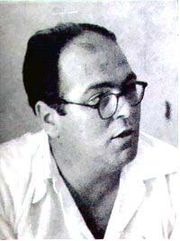 Danilo Dolci was born in the Karstic town of Sežana
(now in Slovenia
), at the time part of the Italian
border region known as Julian March
. His father was an agnostic
Sicilian railway official, while his mother, Meli Kokelj, was a deeply Catholic local Slovene woman. The young Danilo grew up in Mussolini
’s fascist state. As a teenager Dolci saw Italy enter into World War II. He worried his family by tearing down any Fascist war posters he came across.
"I had never heard the phrase 'conscientious objector'," Dolci later said, "and I had no idea there were such persons in the world, but I felt strongly that it was wrong to kill people and I was determined never to do so." He tried to escape from the authorities who suspected him of tearing down the posters, but he was caught while trying to reach Rome and ended up in jail for a short time. He refused to enlist in the army of the Republic of Salò, Mussolini’s puppet state after the Allied invasion in 1943.
Dolci was inspired by the work of the Catholic priest Don Zeno Saltini who had opened an orphanage for 3,000 abandoned children after World War II. It was housed in a former concentration camp in at Fossoli near Modena
in Emilia Romagna, and was called it Nomadelphia: a place where fraternity is law. In 1950 Dolci quit his very promising architecture and engineering studies in Switzerland
at the age of twenty-five, gave up his middle class standard of living and went to work with the poor and unfortunate. Dolci set up a similar commune called Ceffarello.
Don Zeno was being harassed by officials who felt he was a Communist, and even the Vatican
turned against Don Zeno, calling him the "mad priest." The authorities decided to put the orphans into asylums and close down both Nomadelphia and Ceffarello. Dolci had to sit by and watch as government forces took off with many of the commune's children, and had to gather up all his energy in the building of a new Nomadelphia. By 1952, he was ready to move on and work elsewhere.
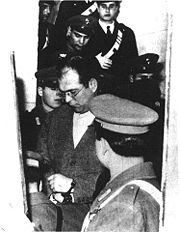 In 1952 Dolci decided to head for "the poorest place I had ever known" — the squalid fishing village of Trappeto
in western Sicily
about 30 km west of Palermo
. During a previous visit to Sicily's Greek archaeological sites he had become acutely aware of the squalid rural poverty. Towns without electricity, running water or sewers, peopled by impoverished citizens barely surviving on the edge of starvation, largely illiterate and unemployed, suspicious of the state and ignored by their Church.
"Coming from the North, I knew I was totally ignorant," Dolci wrote later. "Looking all around me, I saw no streets, just mud and dust... I started working with masons and peasants, who kindly, gently, taught me their trades. That way my spectacles were no longer a barrier. Every day, all day, as the handle of hoe or shovel burned the blisters deeper, I learned more than any book could teach me about this people's struggle to exist..."
In Trappeto Dolci started an orphanage, helped by Vincenzina Mangano, the widow of a fisherman and trade unionist whom he rescued from penury and whose five children he adopted as his own. Later, he moved uphill to nearby Partinico
, where he tried to organise landless peasants into co-operatives. Dolci started using hunger strike
s, sit-down protests and non-violent demonstrations as methods to force the regional and national government to make improvements in the poverty stricken areas of the island. Eventually, he became known as the "Gandhi of Sicily".
Throughout his career in Sicily, Dolci has used this method, with one of his most famous hunger strike being in November, 1955, when he fasted for a week in Partinico to draw attention to the misery and violence in the area and to promote the building of a dam over the Iato River, which roared down in the winter rains and dried up in the nine arid months, that could provide irrigation for the entire valley.
One technique that he innovated was the "strike in reverse" (working without pay), which initiated unauthorized public works projects for the poor. This earned him his first notoriety in 1956, when he gathered a few unemployed men to mend a public road. The police called it obstruction; his helpers walked away; he lay down on the road and was arrested. Skilfully, he drummed up publicity. Famous lawyers offered to defend him free. Famous writers, such as Ignazio Silone
, Alberto Moravia
, Carlo Levi
, among others, protested. The Palermo court acquitted Dolci and his two dozen co-defendants of resisting and insulting the police, but sentenced them to 50 days' imprisonment (time they had already served) and a 20,000 lire (US$32) fine for "having invaded ground that belonged to the government." On his release he resumed the campaign for a big dam on the Iato river.
He actively assisted victims of the earthquake which destroyed much of the Belice
Valley in January 1968. The funds for relief and reconstruction were siphoned off by greedy administrators, and "Belice" has since become an Italian by-word for political corruption.
upon the poor in Sicily
. He did not attack the Mafia at first but he did come up against them at once challenging their monopoly of water supply with the project of the Iato River dam. Later he became too well known in Italy and abroad to be dealt with without too much adverse publicity.
He began his crusade against the Mafia
by claiming that government officials were receiving help in their elections from Cosa Nostra. Rather than making his accusations only in Sicily, he traveled to Rome to participate before the Antimafia Commission
, which was established in 1963, to ensure that his worries about the Mafia in Sicily were heard. His willingness to stand up to the Mafia in his quest to improve the living conditions of Sicilians helped him to gain the confidence of the locals.
Throughout 1963 and 1964, Dolci and his assistant Franco Alasia had been gathering evidence on the links between the Mafia and politicians for the Commission. At a press conference in September 1965, they presented dozen of testimonies of people who had supposedly seen Bernardo Mattarella
and Calogero Volpe meeting with leading mafiosi. Mattarella and Volpe sued Dolci and Alasia for libel.
In the ensuing two-year trial, dozens of witnesses were heard and many documents were considered. When the Court refused to allow new evidence from witnesses, Dolci and Alasia decided that the trial was a travesty. They announced that under these circumstances they would no longer attempt to defend themselves. The remainder of the trial, therefore, took place with Dolci and Alasia absent from the courtroom. Dolci responded by broadcasting his opinions over a private radio station, which was promptly closed.
On June 21, 1967, the Court of Rome sentenced that Mattarella offered reliable evidence of his opposition to the Mafia in the entire course of his political career. The statements collected by the defendants – Dolci and his assistant Alasia – were considered nothing more than "deplorable gossip, malicious rumour or even simple lies." The Court was of the opinion that Mattarella "never had relations with the Mafia environment." The results of the investigation were published in 1966 in the book Chi Gioca Solo (The Man Who Plays Alone).
Dolci made an application for an amnesty, but was sentenced to two years imprisonment for libel along with heavy fines. Alasia received a sentence of one and a half year. They never served the verdict, because of a pardon. It would have been too scandalous to send Dolci to prison and the sentence was cancelled. Mattarella had won the trial but lost a cabinet post in the new government of Aldo Moro
. In appeal the sentences were confirmed in 1973. "To each his own responsibility before today's public opinion and tomorrow's history," Dolci commented the sentence.
in 1958, he founded the Centro studi e iniziative per la piena occupazione (Center of Research and Initiatives for Full Employment) in Partinico
, the village in the Palermo hinterland that became his home.
The centre was one of the most important examples of community development in Italy and especially in the south since the war. It became both a form of self-organisation of local communities and a training school for a generation of socially and politically committed young people, who found their cohesion as a group and attempted to construct a process of social aggregation through the methods and instruments of active non-violence.
Dolci used the Socratic method
, a dialectic method of inquiry, and "popular self-analysis" for empowerment of communities. His pedagogical methods, with their emphasis on social awareness and cultural interaction, won him a worldwide reputation, and a small but ardent following at home that took his ideas, over the years, across Sicily and into mainland Italy.
manufactured in Sicily.
Palermo archbishop Cardinal Ernesto Ruffini
publicly denounced Dolci and Giuseppe Tomasi di Lampedusa
, author of The Leopard
, as well as the Mafia, for "defaming" all Sicilians.
In 1968 Dolci was accused of embezzling funds sent from abroad to help the victims of the earthquake which destroyed much of the Belice
valley. At the same time, some of his followers left to set up their own educational centres accusing him of excessive authoritarianism. Some of Dolci's later initiatives were less successful than others, often bordering on the intangible. His centre sought to produce evidence against a secret NATO submarine base around Maddalena island off Sardinia
on the basis that such an installation required Italian approval and control which in this case was apparently granted covertly to the United States Navy.
The smears succeeded in pushing Dolci out of the spotlight in Italy. The last 20 years of his life he disappeared from public view, although he continued to be revered abroad, winning prizes for his poetry, and working as a guest lecturer at universities.
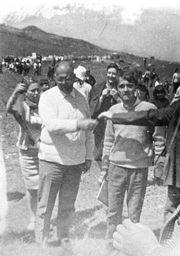 Dolci has been proposed for the Nobel Peace Prize, denounced by the Cardinal Archbishop of Palermo; he has won the support of many Communists and some Jesuits, been threatened by the Mafia, and been prosecuted for obscenity by the Italian government for his book Inchiesta a Palermo (Report from Palermo).
Dolci was a great writer. His books are remarkable accounts of the society he surveys, and their accuracy and insight have helped to give a realistic basis to any schemes for improvement. Above all he has given a voice to the abandoned, forgotten, despairing, nameless, suffering people of Sicily. Unforgettably he enabled peasants and fishermen, mothers and prostitutes, street urchins, outlaws and bandits, police and mafiosi to tell their stories.
He refused to answer to anybody and never joined a political party despite several invitations from the Italian Communist Party
to run for office. "Reality is very complex," he said. "To understand it, men have tried Christianity, liberalism, Gandhiism, socialism. There is some truth in all solutions. We are all mendicants of truth." In the 1970s he rebelled against the state monopoly on broadcasting and set up his own radio station in Partinico in the face of stiff resistance from the police.
Dolci died on December 30, 1997, from heart failure. He was survived by the five adopted children he had with his first wife, Vincenzina, and by two children from his second marriage. His death has triggered a curious mixture of reactions. While the chief Antimafia prosecutor in Palermo, Gian Carlo Caselli, said Dolci was one of the people who gave him the keys to do his job, the national press gave him surprisingly short shrift, describing him as a historical curiosity whose work has long since been forgotten.
According to the obituary in The Independent: "If the world now knows anything about the dark, secretive world of the Sicilian Mafia in the first turbulent years after the Second World War, it is largely thanks to Danilo Dolci." The man who in his youth studied architecture became an architect of social change.
For long, he was practically unknown in his native Slovenia
. In 2007, however, an exhibition on his life and work was organized in his native town of Sežana. In 2010, a book of his poetry was first translated into Slovene. The same year, a bilingual memorial plaque was placed on his native house, and a local educational organization was named after him. His papers are currently housed at the Howard Gotlieb Archival Research Center at Boston University.
Italy
Italy , officially the Italian Republic languages]] under the European Charter for Regional or Minority Languages. In each of these, Italy's official name is as follows:;;;;;;;;), is a unitary parliamentary republic in South-Central Europe. To the north it borders France, Switzerland, Austria and...
social activist, sociologist
Sociology
Sociology is the study of society. It is a social science—a term with which it is sometimes synonymous—which uses various methods of empirical investigation and critical analysis to develop a body of knowledge about human social activity...
, popular educator and poet
Poet
A poet is a person who writes poetry. A poet's work can be literal, meaning that his work is derived from a specific event, or metaphorical, meaning that his work can take on many meanings and forms. Poets have existed since antiquity, in nearly all languages, and have produced works that vary...
. He is best known for his opposition to poverty
Poverty
Poverty is the lack of a certain amount of material possessions or money. Absolute poverty or destitution is inability to afford basic human needs, which commonly includes clean and fresh water, nutrition, health care, education, clothing and shelter. About 1.7 billion people are estimated to live...
, social exclusion
Social exclusion
Social exclusion is a concept used in many parts of the world to characterise contemporary forms of social disadvantage. Dr. Lynn Todman, director of the Institute on Social Exclusion at the Adler School of Professional Psychology, suggests that social exclusion refers to processes in which...
and the Mafia
Mafia
The Mafia is a criminal syndicate that emerged in the mid-nineteenth century in Sicily, Italy. It is a loose association of criminal groups that share a common organizational structure and code of conduct, and whose common enterprise is protection racketeering...
on Sicily
Sicily
Sicily is a region of Italy, and is the largest island in the Mediterranean Sea. Along with the surrounding minor islands, it constitutes an autonomous region of Italy, the Regione Autonoma Siciliana Sicily has a rich and unique culture, especially with regard to the arts, music, literature,...
, and is considered to be one of the protagonists of the non-violence movement in Italy
Italy
Italy , officially the Italian Republic languages]] under the European Charter for Regional or Minority Languages. In each of these, Italy's official name is as follows:;;;;;;;;), is a unitary parliamentary republic in South-Central Europe. To the north it borders France, Switzerland, Austria and...
. He became known as the "Gandhi of Sicily".
In the 1950s and 1960s, Dolci published a series of books (notably, in their English translations, To Feed the Hungry, 1955, and Waste, 1960) that stunned the outside world with their emotional force and the detail with which he depicted the desperate conditions of the Sicilian countryside and the power of the Mafia
Mafia
The Mafia is a criminal syndicate that emerged in the mid-nineteenth century in Sicily, Italy. It is a loose association of criminal groups that share a common organizational structure and code of conduct, and whose common enterprise is protection racketeering...
. Dolci became almost a cult hero-figure in Northern Europe and the United States. Young people idolised him and committees were formed to raise funds for his work.
In 1958 he was awarded the Lenin Peace Prize
Lenin Peace Prize
The International Lenin Peace Prize was the Soviet Union's equivalent to the Nobel Peace Prize, named in honor of Vladimir Lenin. It was awarded by a panel appointed by the Soviet government, to notable individuals whom the panel indicated had "strengthened peace among peoples"...
, despite being an explicit non-Communist. He was twice nominated for the Nobel Peace Prize
Nobel Peace Prize
The Nobel Peace Prize is one of the five Nobel Prizes bequeathed by the Swedish industrialist and inventor Alfred Nobel.-Background:According to Nobel's will, the Peace Prize shall be awarded to the person who...
by the American Friends Service Committee
American Friends Service Committee
The American Friends Service Committee is a Religious Society of Friends affiliated organization which works for peace and social justice in the United States and around the world...
(AFSC), which in 1947 received the Nobel Peace Prize along with the British Friends Service Council, now called Quaker Peace and Social Witness
Quaker Peace and Social Witness
Quaker Peace & Social Witness , previously known as the Friends Service Council, and then as Quaker Peace and Service, is one of the central committees of Britain Yearly Meeting of the Religious Society of Friends - the national organisation of Quakers in Britain. It works to promote British...
, on behalf of all Quakers worldwide. Among those who publicly voiced support for his efforts were Carlo Levi
Carlo Levi
Dr. Carlo Levi was an Italian-Jewish painter, writer, activist, anti-fascist, and doctor.He is best known for his book Cristo si è fermato a Eboli , published in 1945, a memoir of his time spent in exile in Lucania, Italy, after being arrested in connection with his political activism...
, Erich Fromm
Erich Fromm
Erich Seligmann Fromm was a Jewish German-American social psychologist, psychoanalyst, sociologist, humanistic philosopher, and democratic socialist. He was associated with what became known as the Frankfurt School of critical theory.-Life:Erich Fromm was born on March 23, 1900, at Frankfurt am...
, Bertrand Russell
Bertrand Russell
Bertrand Arthur William Russell, 3rd Earl Russell, OM, FRS was a British philosopher, logician, mathematician, historian, and social critic. At various points in his life he considered himself a liberal, a socialist, and a pacifist, but he also admitted that he had never been any of these things...
, Jean Piaget
Jean Piaget
Jean Piaget was a French-speaking Swiss developmental psychologist and philosopher known for his epistemological studies with children. His theory of cognitive development and epistemological view are together called "genetic epistemology"....
, Aldous Huxley
Aldous Huxley
Aldous Leonard Huxley was an English writer and one of the most prominent members of the famous Huxley family. Best known for his novels including Brave New World and a wide-ranging output of essays, Huxley also edited the magazine Oxford Poetry, and published short stories, poetry, travel...
, Jean-Paul Sartre
Jean-Paul Sartre
Jean-Paul Charles Aymard Sartre was a French existentialist philosopher, playwright, novelist, screenwriter, political activist, biographer, and literary critic. He was one of the leading figures in 20th century French philosophy, particularly Marxism, and was one of the key figures in literary...
and Ernst Bloch
Ernst Bloch
Ernst Bloch was a German Marxist philosopher.Bloch was influenced by both Hegel and Marx and, as he always confessed, by novelist Karl May. He was also interested in music and art . He established friendships with Georg Lukács, Bertolt Brecht, Kurt Weill and Theodor W. Adorno...
. In Sicily, Leonardo Sciascia
Leonardo Sciascia
Leonardo Sciascia was an Italian writer, novelist, essayist, playwright and politician. Some of his works have been made into films, including Open Doors and Il giorno della civetta .- Biography :Sciascia was born in Racalmuto, Sicily...
advocated many of his ideas. In the United States his proto-Christian idealism was absurdly confused with Communism.
Early years
Sežana
Sežana is a town and a municipality in the Slovenian Littoral region of Slovenia, near the border with Italy. According to the census of 2008, it has a population of 12,470, of which around 5,332 live in the town of Sežana and the rest in the neighbouring rural areas.Sežana is located about on the...
(now in Slovenia
Slovenia
Slovenia , officially the Republic of Slovenia , is a country in Central and Southeastern Europe touching the Alps and bordering the Mediterranean. Slovenia borders Italy to the west, Croatia to the south and east, Hungary to the northeast, and Austria to the north, and also has a small portion of...
), at the time part of the Italian
Kingdom of Italy (1861–1946)
The Kingdom of Italy was a state forged in 1861 by the unification of Italy under the influence of the Kingdom of Sardinia, which was its legal predecessor state...
border region known as Julian March
Julian March
The Julian March is a former political region of southeastern Europe on what are now the borders between Croatia, Slovenia, and Italy...
. His father was an agnostic
Agnosticism
Agnosticism is the view that the truth value of certain claims—especially claims about the existence or non-existence of any deity, but also other religious and metaphysical claims—is unknown or unknowable....
Sicilian railway official, while his mother, Meli Kokelj, was a deeply Catholic local Slovene woman. The young Danilo grew up in Mussolini
Benito Mussolini
Benito Amilcare Andrea Mussolini was an Italian politician who led the National Fascist Party and is credited with being one of the key figures in the creation of Fascism....
’s fascist state. As a teenager Dolci saw Italy enter into World War II. He worried his family by tearing down any Fascist war posters he came across.
"I had never heard the phrase 'conscientious objector'," Dolci later said, "and I had no idea there were such persons in the world, but I felt strongly that it was wrong to kill people and I was determined never to do so." He tried to escape from the authorities who suspected him of tearing down the posters, but he was caught while trying to reach Rome and ended up in jail for a short time. He refused to enlist in the army of the Republic of Salò, Mussolini’s puppet state after the Allied invasion in 1943.
Dolci was inspired by the work of the Catholic priest Don Zeno Saltini who had opened an orphanage for 3,000 abandoned children after World War II. It was housed in a former concentration camp in at Fossoli near Modena
Modena
Modena is a city and comune on the south side of the Po Valley, in the Province of Modena in the Emilia-Romagna region of Italy....
in Emilia Romagna, and was called it Nomadelphia: a place where fraternity is law. In 1950 Dolci quit his very promising architecture and engineering studies in Switzerland
Switzerland
Switzerland name of one of the Swiss cantons. ; ; ; or ), in its full name the Swiss Confederation , is a federal republic consisting of 26 cantons, with Bern as the seat of the federal authorities. The country is situated in Western Europe,Or Central Europe depending on the definition....
at the age of twenty-five, gave up his middle class standard of living and went to work with the poor and unfortunate. Dolci set up a similar commune called Ceffarello.
Don Zeno was being harassed by officials who felt he was a Communist, and even the Vatican
Holy See
The Holy See is the episcopal jurisdiction of the Catholic Church in Rome, in which its Bishop is commonly known as the Pope. It is the preeminent episcopal see of the Catholic Church, forming the central government of the Church. As such, diplomatically, and in other spheres the Holy See acts and...
turned against Don Zeno, calling him the "mad priest." The authorities decided to put the orphans into asylums and close down both Nomadelphia and Ceffarello. Dolci had to sit by and watch as government forces took off with many of the commune's children, and had to gather up all his energy in the building of a new Nomadelphia. By 1952, he was ready to move on and work elsewhere.
In Sicily
Trappeto
Trappeto is an Italian municipality of 3,123 inhabitants in the province of Palermo, located in the north-west part of Sicily. It is part of the metropolitan area of Palermo....
in western Sicily
Sicily
Sicily is a region of Italy, and is the largest island in the Mediterranean Sea. Along with the surrounding minor islands, it constitutes an autonomous region of Italy, the Regione Autonoma Siciliana Sicily has a rich and unique culture, especially with regard to the arts, music, literature,...
about 30 km west of Palermo
Palermo
Palermo is a city in Southern Italy, the capital of both the autonomous region of Sicily and the Province of Palermo. The city is noted for its history, culture, architecture and gastronomy, playing an important role throughout much of its existence; it is over 2,700 years old...
. During a previous visit to Sicily's Greek archaeological sites he had become acutely aware of the squalid rural poverty. Towns without electricity, running water or sewers, peopled by impoverished citizens barely surviving on the edge of starvation, largely illiterate and unemployed, suspicious of the state and ignored by their Church.
"Coming from the North, I knew I was totally ignorant," Dolci wrote later. "Looking all around me, I saw no streets, just mud and dust... I started working with masons and peasants, who kindly, gently, taught me their trades. That way my spectacles were no longer a barrier. Every day, all day, as the handle of hoe or shovel burned the blisters deeper, I learned more than any book could teach me about this people's struggle to exist..."
In Trappeto Dolci started an orphanage, helped by Vincenzina Mangano, the widow of a fisherman and trade unionist whom he rescued from penury and whose five children he adopted as his own. Later, he moved uphill to nearby Partinico
Partinico
Partinico is a town and comune in the province of Palermo, Sicily, southern Italy...
, where he tried to organise landless peasants into co-operatives. Dolci started using hunger strike
Hunger strike
A hunger strike is a method of non-violent resistance or pressure in which participants fast as an act of political protest, or to provoke feelings of guilt in others, usually with the objective to achieve a specific goal, such as a policy change. Most hunger strikers will take liquids but not...
s, sit-down protests and non-violent demonstrations as methods to force the regional and national government to make improvements in the poverty stricken areas of the island. Eventually, he became known as the "Gandhi of Sicily".
Throughout his career in Sicily, Dolci has used this method, with one of his most famous hunger strike being in November, 1955, when he fasted for a week in Partinico to draw attention to the misery and violence in the area and to promote the building of a dam over the Iato River, which roared down in the winter rains and dried up in the nine arid months, that could provide irrigation for the entire valley.
One technique that he innovated was the "strike in reverse" (working without pay), which initiated unauthorized public works projects for the poor. This earned him his first notoriety in 1956, when he gathered a few unemployed men to mend a public road. The police called it obstruction; his helpers walked away; he lay down on the road and was arrested. Skilfully, he drummed up publicity. Famous lawyers offered to defend him free. Famous writers, such as Ignazio Silone
Ignazio Silone
Ignazio Silone was the pseudonym of Secondino Tranquilli, an Italian author and politician.-Early life and career:...
, Alberto Moravia
Alberto Moravia
Alberto Moravia, born Alberto Pincherle was an Italian novelist and journalist. His novels explored matters of modern sexuality, social alienation, and existentialism....
, Carlo Levi
Carlo Levi
Dr. Carlo Levi was an Italian-Jewish painter, writer, activist, anti-fascist, and doctor.He is best known for his book Cristo si è fermato a Eboli , published in 1945, a memoir of his time spent in exile in Lucania, Italy, after being arrested in connection with his political activism...
, among others, protested. The Palermo court acquitted Dolci and his two dozen co-defendants of resisting and insulting the police, but sentenced them to 50 days' imprisonment (time they had already served) and a 20,000 lire (US$32) fine for "having invaded ground that belonged to the government." On his release he resumed the campaign for a big dam on the Iato river.
He actively assisted victims of the earthquake which destroyed much of the Belice
Belice
The Belice is a river, 77 km in length, of western Sicily. From its main source near Piana degli Albanesi it runs south and west for 45.5 km as the Belice Destra until it is joined on the left by its secondary branch, the 42 km Belice Sinistro , which rises on the slopes of Rocca Busambra...
Valley in January 1968. The funds for relief and reconstruction were siphoned off by greedy administrators, and "Belice" has since become an Italian by-word for political corruption.
Antimafia
Dolci became aware of the stranglehold of the MafiaMafia
The Mafia is a criminal syndicate that emerged in the mid-nineteenth century in Sicily, Italy. It is a loose association of criminal groups that share a common organizational structure and code of conduct, and whose common enterprise is protection racketeering...
upon the poor in Sicily
Sicily
Sicily is a region of Italy, and is the largest island in the Mediterranean Sea. Along with the surrounding minor islands, it constitutes an autonomous region of Italy, the Regione Autonoma Siciliana Sicily has a rich and unique culture, especially with regard to the arts, music, literature,...
. He did not attack the Mafia at first but he did come up against them at once challenging their monopoly of water supply with the project of the Iato River dam. Later he became too well known in Italy and abroad to be dealt with without too much adverse publicity.
He began his crusade against the Mafia
Mafia
The Mafia is a criminal syndicate that emerged in the mid-nineteenth century in Sicily, Italy. It is a loose association of criminal groups that share a common organizational structure and code of conduct, and whose common enterprise is protection racketeering...
by claiming that government officials were receiving help in their elections from Cosa Nostra. Rather than making his accusations only in Sicily, he traveled to Rome to participate before the Antimafia Commission
Antimafia Commission
The Italian Antimafia Commission is a bicameral commission of the Italian Parliament, composed of members from the Chamber of Deputies and the Senate . The Antimafia Commission is a commission of inquiry into, initially, the “phenomenon of the Mafia”...
, which was established in 1963, to ensure that his worries about the Mafia in Sicily were heard. His willingness to stand up to the Mafia in his quest to improve the living conditions of Sicilians helped him to gain the confidence of the locals.
Throughout 1963 and 1964, Dolci and his assistant Franco Alasia had been gathering evidence on the links between the Mafia and politicians for the Commission. At a press conference in September 1965, they presented dozen of testimonies of people who had supposedly seen Bernardo Mattarella
Bernardo Mattarella
Bernardo Mattarella was an Italian politician for the Christian Democrat party . He has been Minister of Italy several times...
and Calogero Volpe meeting with leading mafiosi. Mattarella and Volpe sued Dolci and Alasia for libel.
In the ensuing two-year trial, dozens of witnesses were heard and many documents were considered. When the Court refused to allow new evidence from witnesses, Dolci and Alasia decided that the trial was a travesty. They announced that under these circumstances they would no longer attempt to defend themselves. The remainder of the trial, therefore, took place with Dolci and Alasia absent from the courtroom. Dolci responded by broadcasting his opinions over a private radio station, which was promptly closed.
On June 21, 1967, the Court of Rome sentenced that Mattarella offered reliable evidence of his opposition to the Mafia in the entire course of his political career. The statements collected by the defendants – Dolci and his assistant Alasia – were considered nothing more than "deplorable gossip, malicious rumour or even simple lies." The Court was of the opinion that Mattarella "never had relations with the Mafia environment." The results of the investigation were published in 1966 in the book Chi Gioca Solo (The Man Who Plays Alone).
Dolci made an application for an amnesty, but was sentenced to two years imprisonment for libel along with heavy fines. Alasia received a sentence of one and a half year. They never served the verdict, because of a pardon. It would have been too scandalous to send Dolci to prison and the sentence was cancelled. Mattarella had won the trial but lost a cabinet post in the new government of Aldo Moro
Aldo Moro
Aldo Moro was an Italian politician and the 39th Prime Minister of Italy, from 1963 to 1968, and then from 1974 to 1976. He was one of Italy's longest-serving post-war Prime Ministers, holding power for a combined total of more than six years....
. In appeal the sentences were confirmed in 1973. "To each his own responsibility before today's public opinion and tomorrow's history," Dolci commented the sentence.
Popular educator
Dolci became convinced that the key to progress was through education. With the money he received for the Lenin Peace PrizeLenin Peace Prize
The International Lenin Peace Prize was the Soviet Union's equivalent to the Nobel Peace Prize, named in honor of Vladimir Lenin. It was awarded by a panel appointed by the Soviet government, to notable individuals whom the panel indicated had "strengthened peace among peoples"...
in 1958, he founded the Centro studi e iniziative per la piena occupazione (Center of Research and Initiatives for Full Employment) in Partinico
Partinico
Partinico is a town and comune in the province of Palermo, Sicily, southern Italy...
, the village in the Palermo hinterland that became his home.
The centre was one of the most important examples of community development in Italy and especially in the south since the war. It became both a form of self-organisation of local communities and a training school for a generation of socially and politically committed young people, who found their cohesion as a group and attempted to construct a process of social aggregation through the methods and instruments of active non-violence.
Dolci used the Socratic method
Socratic method
The Socratic method , named after the classical Greek philosopher Socrates, is a form of inquiry and debate between individuals with opposing viewpoints based on asking and answering questions to stimulate critical thinking and to illuminate ideas...
, a dialectic method of inquiry, and "popular self-analysis" for empowerment of communities. His pedagogical methods, with their emphasis on social awareness and cultural interaction, won him a worldwide reputation, and a small but ardent following at home that took his ideas, over the years, across Sicily and into mainland Italy.
Controversy
Dolci’s life and actions stirred ample controversy. He annoyed the authorities which often actively worked against him. Some of the locals that opposed the Iato river dam were not pleased to see the valleys flooded, and gardens and olive trees ruined. The contractors of the works eventually were either in the Mafia or their middlemen. Dolci was often short of, and careless of, money. He was helped out from time to time, predominantly by English families whose fortunes had been made with the sweet Marsala wineMarsala wine
Marsala is a wine produced in the region surrounding the Italian city of Marsala in Sicily. Marsala wine first received Denominazione di Origine Controllata status in 1969....
manufactured in Sicily.
Palermo archbishop Cardinal Ernesto Ruffini
Ernesto Ruffini
Ernesto Ruffini was an Italian Cardinal of the Catholic Church who served as Archbishop of Palermo from 1945 until his death, and was elevated to the cardinalate in 1946 by Pope Pius XII.-Biography:...
publicly denounced Dolci and Giuseppe Tomasi di Lampedusa
Giuseppe Tomasi di Lampedusa
Giuseppe Tomasi di Lampedusa , was a Sicilian writer. He is most famous for his only novel, Il Gattopardo which is set in Sicily during the Risorgimento...
, author of The Leopard
The Leopard
The Leopard is a novel by Giuseppe Tomasi di Lampedusa that chronicles the changes in Sicilian life and society during the Risorgimento...
, as well as the Mafia, for "defaming" all Sicilians.
In 1968 Dolci was accused of embezzling funds sent from abroad to help the victims of the earthquake which destroyed much of the Belice
Belice
The Belice is a river, 77 km in length, of western Sicily. From its main source near Piana degli Albanesi it runs south and west for 45.5 km as the Belice Destra until it is joined on the left by its secondary branch, the 42 km Belice Sinistro , which rises on the slopes of Rocca Busambra...
valley. At the same time, some of his followers left to set up their own educational centres accusing him of excessive authoritarianism. Some of Dolci's later initiatives were less successful than others, often bordering on the intangible. His centre sought to produce evidence against a secret NATO submarine base around Maddalena island off Sardinia
Sardinia
Sardinia is the second-largest island in the Mediterranean Sea . It is an autonomous region of Italy, and the nearest land masses are the French island of Corsica, the Italian Peninsula, Sicily, Tunisia and the Spanish Balearic Islands.The name Sardinia is from the pre-Roman noun *sard[],...
on the basis that such an installation required Italian approval and control which in this case was apparently granted covertly to the United States Navy.
The smears succeeded in pushing Dolci out of the spotlight in Italy. The last 20 years of his life he disappeared from public view, although he continued to be revered abroad, winning prizes for his poetry, and working as a guest lecturer at universities.
Legacy
Dolci was a great writer. His books are remarkable accounts of the society he surveys, and their accuracy and insight have helped to give a realistic basis to any schemes for improvement. Above all he has given a voice to the abandoned, forgotten, despairing, nameless, suffering people of Sicily. Unforgettably he enabled peasants and fishermen, mothers and prostitutes, street urchins, outlaws and bandits, police and mafiosi to tell their stories.
He refused to answer to anybody and never joined a political party despite several invitations from the Italian Communist Party
Italian Communist Party
The Italian Communist Party was a communist political party in Italy.The PCI was founded as Communist Party of Italy on 21 January 1921 in Livorno, by seceding from the Italian Socialist Party . Amadeo Bordiga and Antonio Gramsci led the split. Outlawed during the Fascist regime, the party played...
to run for office. "Reality is very complex," he said. "To understand it, men have tried Christianity, liberalism, Gandhiism, socialism. There is some truth in all solutions. We are all mendicants of truth." In the 1970s he rebelled against the state monopoly on broadcasting and set up his own radio station in Partinico in the face of stiff resistance from the police.
Dolci died on December 30, 1997, from heart failure. He was survived by the five adopted children he had with his first wife, Vincenzina, and by two children from his second marriage. His death has triggered a curious mixture of reactions. While the chief Antimafia prosecutor in Palermo, Gian Carlo Caselli, said Dolci was one of the people who gave him the keys to do his job, the national press gave him surprisingly short shrift, describing him as a historical curiosity whose work has long since been forgotten.
According to the obituary in The Independent: "If the world now knows anything about the dark, secretive world of the Sicilian Mafia in the first turbulent years after the Second World War, it is largely thanks to Danilo Dolci." The man who in his youth studied architecture became an architect of social change.
For long, he was practically unknown in his native Slovenia
Slovenia
Slovenia , officially the Republic of Slovenia , is a country in Central and Southeastern Europe touching the Alps and bordering the Mediterranean. Slovenia borders Italy to the west, Croatia to the south and east, Hungary to the northeast, and Austria to the north, and also has a small portion of...
. In 2007, however, an exhibition on his life and work was organized in his native town of Sežana. In 2010, a book of his poetry was first translated into Slovene. The same year, a bilingual memorial plaque was placed on his native house, and a local educational organization was named after him. His papers are currently housed at the Howard Gotlieb Archival Research Center at Boston University.
Books in English
- To Feed the Hungry (1955/1959), London: McGibbon & Kee.
- Report from Palermo (1959), New York: The Orion Press, Inc.
- Sicilian Lives (1960/1981), New York: Pantheon Books.
- Waste (1964), New York: Monthly Review Press
- The Man Who Plays Alone (1968), New York: Random House
Biographies
- McNeish, JamesJames McNeishSir James Henry Peter McNeish, KNZM , a New Zealand novelist, playwright and biographer, was born in Auckland in 1931 and travelled the world as a young man - working as a deckhand on a Norwegian freighter in 1958, and recording folk music in 21 countries...
(1965). Fire Under the Ashes: The Life of Danilo Dolci, London: Hodder and Stoughton. - Mangione, JerreJerre MangioneJerre Mangione was an American writer and scholar of the Italian-American experience.He was a graduate of Syracuse University and of the Federal Writers' Project....
(1968). A Passion for Sicilians: The World around Danilo Dolci, New York: William Morrow and Co.