

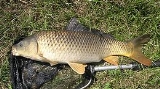
Cypriniformes

Encyclopedia
The Cypriniformes are an order
of ray-finned fish
, including the carp
s, minnow
s, loach
es and relatives. This order contains 5-6 families
, over 320 genera
, and more than 3,250 species, with new species being described every few months or so, and new genera being recognized regularly. They are most diverse in southeastern Asia
, but are entirely absent from Australia
and South America
.
Their closest living relatives are the Characiformes
(characins and allies), the Gymnotiformes
(electric eel
and American knifefishes) and the Siluriformes (catfishes).
, the cypriniformes possess a Weberian apparatus
. However, they differ from most of their relatives in having only a dorsal fin
on their back; most other Ostariophysi have a small fleshy adipose fin behind the dorsal fin. Further differences are the Cypriniformes' kinethmoid and the lack of teeth in the mouth. Instead, they have convergent
structures called pharyngeal teeth
in the throat. While other groups of fish, such as cichlid
s, also possess pharyngeal teeth, the cypriniformes' teeth grind against a chewing pad on the base of the skull, instead of an upper pharyngeal jaw.
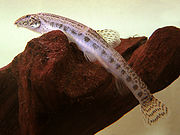 The most notable family placed here is the Cyprinidae (carp
s and minnow
s) which make up two-thirds of the order's diversity. This is one of the largest families of fish, and is widely distributed across Africa
, Eurasia
, and North America
. Most species are strictly freshwater inhabitants, but a considerable number are found in brackish water, such as roach
and bream
. At least one species is found in the sea, the Pacific Redfin, Tribolodon brandtii. Brackish water and marine cyprinids are invariably anadromous, swimming upstream into rivers to spawn. The enigmatic mountain carps are a small group of mountain stream fishes confined to Southeast Asia
. Sometimes separated as family Psilorhynchidae, they seem to be specially-adapted Cyprinidae.
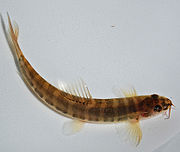
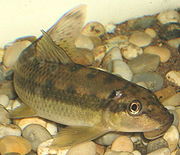
The Balitoridae and Gyrinocheilidae are families of mountain stream fishes feeding on algae and small invertebrate
s. They are found only in tropical and subtropical Asia
. While the former are a speciose group, the latter contain only a handful of species
. The suckers (Catostomidae
) are found in temperate
North America
and eastern Asia. These large fishes are similar to carps in appearance and ecology. The Cobitidae are common across Eurasia
and parts of North Africa
. A mid-sized group like the suckers, they are rather similar to catfish
in appearance and behaviour, feeding primarily off the substrate and equipped with barbels to help them locate food at night or in murky conditions. The Cobitidae, Balitoridae, and Gyrinocheilidae are called loach
es, although it seems that the last do not belong to the lineage of "true" loaches but are related to the suckers.
 Historically these included all the forms now placed in the superorder Ostariophysi
except the catfish, which were placed in the order Siluriformes. By this definition, the Cypriniformes were paraphyletic, so recently the orders Gonorhynchiformes, Characiformes
(characins and allies), and Gymnotiformes
(knifefish
es and electric eel
s) have been separated out to form their own monophyletic orders.
The families
of Cypriniformes are traditionally divided into two superfamilies. Superfamily Cyprinioidea contains the carps and minnows (Cyprinidae) and, according to some, also the mysterious mountain carps as the family Psilorhynchidae. The superfamily Cobitioidea contains hillstream loaches (Balitoridae), suckers (Catostomidae
), true loaches (Cobitidae), and sucking loaches (Gyrinocheilidae) in the traditional system.
Catostomoidea is usually treated as a junior synonym of Cobitioidea. But it seems that it could be split off the Catostomidae and Gyrinocheilidae in a distinct superfamily; the Catostomoidea might be closer relatives of the carps and minnows than of the "true" loach
es. While the Cyprinioidea seem more "primitive" than the loach-like forms, they were apparently successful enough never to shift from the original ecological niche
of the basal Ostariophysi
. Yet, from the ecomorphologically conservative main lineage apparently at least two major radiation
s branched off. These diversified from the lowlands into torrential river habitat
s, acquiring similar habitus
and adaptation
s in the process
.
The mountain carps are highly apomorphic Cyprinidae, perhaps close to true carps (Cyprininae), or maybe to the danionin
s. While some details about the phylogenetic structures of this massively diverse family are known – e.g. that Cultrinae
and Leuciscinae
are rather close relatives and stand apart from Cyprininae – there is no good consensus yet on how the main lineages are interrelated. A systematic list, from the most ancient to the most modern lineages, can thus be given as:
Superfamily Cobitioidea
Superfamily Catostomoidea
Superfamily Cyprinioidea
in the narrow sense (i.e. excluding Gonorynchiformes
). This is evidenced not only by physiological details, but their great distribution, which indicates they had the longest time to spread. The earliest that Cypriniformes might have diverged from Characiphysi (Characiformes
and relatives) is thought to be about the Early Triassic
, about 250 million years ago (mya). However, their divergence probably occurred only with the splitting-up of Pangaea
in the Jurassic
, maybe 160 million years ago. By 110 mya, the plate tectonics
evidence indicates that the Laurasia
n Cypriniformes must have been distinct from their Gondwana
n relatives.
Cypriniformes is thought to have originated in south-east Asia
, where the most diversity of this group is found today. The alternative hypothesis is that they began in South America
, similar to the other otophysans. If this were the case, they would have spread to Asia through Africa or North America
. As the Characiformes began to diversify and spread, they may have out-competed South American basal cypriniforms in Africa, where more advanced cypriniforms survive and coexist with characiforms.
The earliest fossils are already assignable to the living family
Catostomidae; from the Paleocene
of Alberta
, they are roughly 60 million years old. During the Eocene
(55-35 mya), catostomids and cyprinids spread throughout Asia. In the Oligocene
, around 30 mya, advanced cyprinids began to out-compete catostomids wherever they were sympatric, causing a decline of the suckers. Cyprinids reached North America and Europe by about the same time, and Africa in the early Miocene
(some 23-20 mya). The cypriniforms spread to North America through the Bering land bridge
, which formed and disappeared again several times during the many millions of years of cypriniform evolution
.
and koi
are perhaps the most celebrated. The other families are of less commercial importance. The Catostomidae
have some importance in angling
, and some "loach
es" are bred for the international aquarium
fish trade.
Accidentally or deliberately introduced populations of Common Carp
(Cyprinus carpio) and Grass Carp
(Ctenopharyngodon idella) are found on all continent
s except Antarctica. In some cases, these exotic species
have a negative impact on the environment. Carp in particular stir up the riverbed reducing the clarity of the water, making it difficult for plants to grow.
In science, one of the most famous members of the Cypriniformes is the zebrafish (Danio rerio). The zebrafish is one of the most important vertebrate model organisms in biological and biochemical sciences, being used in many kinds of experiments. As, during early development, the zebrafish has a nearly transparent body, it is ideal for studying developmental biology. It is also used for the elucidation of biochemical signaling pathways, among others They are also good pets, but can be shy in bright light and crowded tanks.
 Habitat destruction
, damming of upland rivers, pollution
and in some cases overfishing
for food or pet trade have driven some Cypriniformes to the brink of extinction or even beyond. In particular, Cyprinidae of southwestern North America
have been severely affected; a considerable number went entirely extinct after settlement by Europeans. For example, in 1900 the Thicktail Chub
(Gila crassicauda) was the most common freshwater fish found in California
; 70 years later not a single living individual existed anymore.
 The well-known Red-tailed Black Shark
(Epalzeorhynchos bicolor) from the Mae Klong
river of The Bridge on the River Kwai
fame possibly only survives in captivity. Ironically, while pollution and other forms of overuse by humans have driven it from its native home, it is bred for the aquarium fish trade by the thousands. The Yarqon Bleak (Acanthobrama telavivensis) from the Yarqon River
had to be rescued into captivity from imminent extinction; new populations have apparently been established again successfully from captive stock. Balitoridae and Cobitidae, meanwhile, contain a very large number of species about which essentially nothing is known except how they look like and where they were first found.
Globally extinct Cypriniformes species are:
Order (biology)
In scientific classification used in biology, the order is# a taxonomic rank used in the classification of organisms. Other well-known ranks are life, domain, kingdom, phylum, class, family, genus, and species, with order fitting in between class and family...
of ray-finned fish
Actinopterygii
The Actinopterygii or ray-finned fishes constitute a class or sub-class of the bony fishes.The ray-finned fishes are so called because they possess lepidotrichia or "fin rays", their fins being webs of skin supported by bony or horny spines , as opposed to the fleshy, lobed fins that characterize...
, including the carp
Carp
Carp are various species of oily freshwater fish of the family Cyprinidae, a very large group of fish native to Europe and Asia. The cypriniformes are traditionally grouped with the Characiformes, Siluriformes and Gymnotiformes to create the superorder Ostariophysi, since these groups have certain...
s, minnow
Minnow
Minnow is a general term used to refer to small freshwater and saltwater fish, especially those used as bait fish or for fishing bait. More specifically, it refers to small freshwater fish of the carp family.-True minnows:...
s, loach
Loach
Loach may refer to:* Loaches, fish families in the Cypriniformes:** Cobitidae, the "true" loaches – formerly all loaches were united in this family** Balitoridae, the hillstream loaches – the largest family, closely related to Cobitidae...
es and relatives. This order contains 5-6 families
Family (biology)
In biological classification, family is* a taxonomic rank. Other well-known ranks are life, domain, kingdom, phylum, class, order, genus, and species, with family fitting between order and genus. As for the other well-known ranks, there is the option of an immediately lower rank, indicated by the...
, over 320 genera
Genera
Genera is a commercial operating system and development environment for Lisp machines developed by Symbolics. It is essentially a fork of an earlier operating system originating on the MIT AI Lab's Lisp machines which Symbolics had used in common with LMI and Texas Instruments...
, and more than 3,250 species, with new species being described every few months or so, and new genera being recognized regularly. They are most diverse in southeastern Asia
Asia
Asia is the world's largest and most populous continent, located primarily in the eastern and northern hemispheres. It covers 8.7% of the Earth's total surface area and with approximately 3.879 billion people, it hosts 60% of the world's current human population...
, but are entirely absent from Australia
Australia
Australia , officially the Commonwealth of Australia, is a country in the Southern Hemisphere comprising the mainland of the Australian continent, the island of Tasmania, and numerous smaller islands in the Indian and Pacific Oceans. It is the world's sixth-largest country by total area...
and South America
South America
South America is a continent situated in the Western Hemisphere, mostly in the Southern Hemisphere, with a relatively small portion in the Northern Hemisphere. The continent is also considered a subcontinent of the Americas. It is bordered on the west by the Pacific Ocean and on the north and east...
.
Their closest living relatives are the Characiformes
Characiformes
The Characiformes are an order of ray-finned fish, comprising the characins and their allies. Grouped in 18 recognized families, there are a few thousand different species, including the well-known piranha and tetras.-Taxonomy:...
(characins and allies), the Gymnotiformes
Gymnotiformes
The Gymnotiformes are a group of teleost bony fishes commonly known as the Neotropical or South American knifefishes. They have long bodies and swim using undulations of their elongated anal fin...
(electric eel
Electric eel
The electric eel , is an electric fish, and the only species of the genus Electrophorus. It is capable of generating powerful electric shocks, of up to six hundred volts, which it uses for both hunting and self-defense. It is an apex predator in its South American range...
and American knifefishes) and the Siluriformes (catfishes).
Description
Like other orders of the OstariophysiOstariophysi
Ostariophysi is the second-largest superorder of fish. Members of this superorder are called ostariophysians. This diverse group contains almost 8,000 species, about 28% of known fish species in the world and 68% of freshwater species, and are present on all major continents except Antarctica...
, the cypriniformes possess a Weberian apparatus
Weberian apparatus
The Weberian apparatus is an anatomical structure that connects the swim bladder to the auditory system in fishes belonging to the Superorder Ostariophysi. When it is fully developed in adult fish, the elements of the apparatus are sometimes collectively referred to as the Weberian ossicles...
. However, they differ from most of their relatives in having only a dorsal fin
Dorsal fin
A dorsal fin is a fin located on the backs of various unrelated marine and freshwater vertebrates, including most fishes, marine mammals , and the ichthyosaurs...
on their back; most other Ostariophysi have a small fleshy adipose fin behind the dorsal fin. Further differences are the Cypriniformes' kinethmoid and the lack of teeth in the mouth. Instead, they have convergent
Convergent evolution
Convergent evolution describes the acquisition of the same biological trait in unrelated lineages.The wing is a classic example of convergent evolution in action. Although their last common ancestor did not have wings, both birds and bats do, and are capable of powered flight. The wings are...
structures called pharyngeal teeth
Pharyngeal teeth
Pharyngeal teeth are teeth in the pharyngeal arch of the throat of cyprinids, suckers, and a number of other fish species lacking teeth.Popular aquarium fish such as goldfish and loaches have these structures. Members of the Botia genus such as clown loaches are known to make distinctive clicking...
in the throat. While other groups of fish, such as cichlid
Cichlid
Cichlids are fishes from the family Cichlidae in the order Perciformes. Cichlids are members of a group known as the Labroidei along with the wrasses , damselfish , and surfperches . This family is both large and diverse. At least 1,300 species have been scientifically described, making it one of...
s, also possess pharyngeal teeth, the cypriniformes' teeth grind against a chewing pad on the base of the skull, instead of an upper pharyngeal jaw.
Carp
Carp are various species of oily freshwater fish of the family Cyprinidae, a very large group of fish native to Europe and Asia. The cypriniformes are traditionally grouped with the Characiformes, Siluriformes and Gymnotiformes to create the superorder Ostariophysi, since these groups have certain...
s and minnow
Minnow
Minnow is a general term used to refer to small freshwater and saltwater fish, especially those used as bait fish or for fishing bait. More specifically, it refers to small freshwater fish of the carp family.-True minnows:...
s) which make up two-thirds of the order's diversity. This is one of the largest families of fish, and is widely distributed across Africa
Africa
Africa is the world's second largest and second most populous continent, after Asia. At about 30.2 million km² including adjacent islands, it covers 6% of the Earth's total surface area and 20.4% of the total land area...
, Eurasia
Eurasia
Eurasia is a continent or supercontinent comprising the traditional continents of Europe and Asia ; covering about 52,990,000 km2 or about 10.6% of the Earth's surface located primarily in the eastern and northern hemispheres...
, and North America
North America
North America is a continent wholly within the Northern Hemisphere and almost wholly within the Western Hemisphere. It is also considered a northern subcontinent of the Americas...
. Most species are strictly freshwater inhabitants, but a considerable number are found in brackish water, such as roach
Roach (fish)
The Common Roach is a freshwater and brackish water fish native to most of Europe and western Asia...
and bream
Carp bream
The common bream, freshwater bream, bream, bronze bream or carp bream, Abramis brama, is a European species of freshwater fish in the family Cyprinidae....
. At least one species is found in the sea, the Pacific Redfin, Tribolodon brandtii. Brackish water and marine cyprinids are invariably anadromous, swimming upstream into rivers to spawn. The enigmatic mountain carps are a small group of mountain stream fishes confined to Southeast Asia
Southeast Asia
Southeast Asia, South-East Asia, South East Asia or Southeastern Asia is a subregion of Asia, consisting of the countries that are geographically south of China, east of India, west of New Guinea and north of Australia. The region lies on the intersection of geological plates, with heavy seismic...
. Sometimes separated as family Psilorhynchidae, they seem to be specially-adapted Cyprinidae.
The Balitoridae and Gyrinocheilidae are families of mountain stream fishes feeding on algae and small invertebrate
Invertebrate
An invertebrate is an animal without a backbone. The group includes 97% of all animal species – all animals except those in the chordate subphylum Vertebrata .Invertebrates form a paraphyletic group...
s. They are found only in tropical and subtropical Asia
Asia
Asia is the world's largest and most populous continent, located primarily in the eastern and northern hemispheres. It covers 8.7% of the Earth's total surface area and with approximately 3.879 billion people, it hosts 60% of the world's current human population...
. While the former are a speciose group, the latter contain only a handful of species
Species
In biology, a species is one of the basic units of biological classification and a taxonomic rank. A species is often defined as a group of organisms capable of interbreeding and producing fertile offspring. While in many cases this definition is adequate, more precise or differing measures are...
. The suckers (Catostomidae
Catostomidae
Catostomidae is the sucker family of the order Cypriniformes. There are 80 species in this family of freshwater fishes. Catostomidae are found in North America, east central China, and eastern Siberia...
) are found in temperate
Temperate
In geography, temperate or tepid latitudes of the globe lie between the tropics and the polar circles. The changes in these regions between summer and winter are generally relatively moderate, rather than extreme hot or cold...
North America
North America
North America is a continent wholly within the Northern Hemisphere and almost wholly within the Western Hemisphere. It is also considered a northern subcontinent of the Americas...
and eastern Asia. These large fishes are similar to carps in appearance and ecology. The Cobitidae are common across Eurasia
Eurasia
Eurasia is a continent or supercontinent comprising the traditional continents of Europe and Asia ; covering about 52,990,000 km2 or about 10.6% of the Earth's surface located primarily in the eastern and northern hemispheres...
and parts of North Africa
North Africa
North Africa or Northern Africa is the northernmost region of the African continent, linked by the Sahara to Sub-Saharan Africa. Geopolitically, the United Nations definition of Northern Africa includes eight countries or territories; Algeria, Egypt, Libya, Morocco, South Sudan, Sudan, Tunisia, and...
. A mid-sized group like the suckers, they are rather similar to catfish
Catfish
Catfishes are a diverse group of ray-finned fish. Named for their prominent barbels, which resemble a cat's whiskers, catfish range in size and behavior from the heaviest and longest, the Mekong giant catfish from Southeast Asia and the second longest, the wels catfish of Eurasia, to detritivores...
in appearance and behaviour, feeding primarily off the substrate and equipped with barbels to help them locate food at night or in murky conditions. The Cobitidae, Balitoridae, and Gyrinocheilidae are called loach
Loach
Loach may refer to:* Loaches, fish families in the Cypriniformes:** Cobitidae, the "true" loaches – formerly all loaches were united in this family** Balitoridae, the hillstream loaches – the largest family, closely related to Cobitidae...
es, although it seems that the last do not belong to the lineage of "true" loaches but are related to the suckers.
Systematics and evolution
Ostariophysi
Ostariophysi is the second-largest superorder of fish. Members of this superorder are called ostariophysians. This diverse group contains almost 8,000 species, about 28% of known fish species in the world and 68% of freshwater species, and are present on all major continents except Antarctica...
except the catfish, which were placed in the order Siluriformes. By this definition, the Cypriniformes were paraphyletic, so recently the orders Gonorhynchiformes, Characiformes
Characiformes
The Characiformes are an order of ray-finned fish, comprising the characins and their allies. Grouped in 18 recognized families, there are a few thousand different species, including the well-known piranha and tetras.-Taxonomy:...
(characins and allies), and Gymnotiformes
Gymnotiformes
The Gymnotiformes are a group of teleost bony fishes commonly known as the Neotropical or South American knifefishes. They have long bodies and swim using undulations of their elongated anal fin...
(knifefish
Knifefish
Knifefish may refer to several knife-shaped fishes:* The Neotropical or weakly electric knifefishes, order Gymnotiformes, containing five families:** Family Gymnotidae ** Family Rhamphichthyidae...
es and electric eel
Electric eel
The electric eel , is an electric fish, and the only species of the genus Electrophorus. It is capable of generating powerful electric shocks, of up to six hundred volts, which it uses for both hunting and self-defense. It is an apex predator in its South American range...
s) have been separated out to form their own monophyletic orders.
The families
Family (biology)
In biological classification, family is* a taxonomic rank. Other well-known ranks are life, domain, kingdom, phylum, class, order, genus, and species, with family fitting between order and genus. As for the other well-known ranks, there is the option of an immediately lower rank, indicated by the...
of Cypriniformes are traditionally divided into two superfamilies. Superfamily Cyprinioidea contains the carps and minnows (Cyprinidae) and, according to some, also the mysterious mountain carps as the family Psilorhynchidae. The superfamily Cobitioidea contains hillstream loaches (Balitoridae), suckers (Catostomidae
Catostomidae
Catostomidae is the sucker family of the order Cypriniformes. There are 80 species in this family of freshwater fishes. Catostomidae are found in North America, east central China, and eastern Siberia...
), true loaches (Cobitidae), and sucking loaches (Gyrinocheilidae) in the traditional system.
Catostomoidea is usually treated as a junior synonym of Cobitioidea. But it seems that it could be split off the Catostomidae and Gyrinocheilidae in a distinct superfamily; the Catostomoidea might be closer relatives of the carps and minnows than of the "true" loach
Loach
Loach may refer to:* Loaches, fish families in the Cypriniformes:** Cobitidae, the "true" loaches – formerly all loaches were united in this family** Balitoridae, the hillstream loaches – the largest family, closely related to Cobitidae...
es. While the Cyprinioidea seem more "primitive" than the loach-like forms, they were apparently successful enough never to shift from the original ecological niche
Ecological niche
In ecology, a niche is a term describing the relational position of a species or population in its ecosystem to each other; e.g. a dolphin could potentially be in another ecological niche from one that travels in a different pod if the members of these pods utilize significantly different food...
of the basal Ostariophysi
Ostariophysi
Ostariophysi is the second-largest superorder of fish. Members of this superorder are called ostariophysians. This diverse group contains almost 8,000 species, about 28% of known fish species in the world and 68% of freshwater species, and are present on all major continents except Antarctica...
. Yet, from the ecomorphologically conservative main lineage apparently at least two major radiation
Evolutionary radiation
An evolutionary radiation is an increase in taxonomic diversity or morphological disparity, due to adaptive change or the opening of ecospace. Radiations may affect one clade or many, and be rapid or gradual; where they are rapid, and driven by a single lineage's adaptation to their environment,...
s branched off. These diversified from the lowlands into torrential river habitat
Habitat
* Habitat , a place where a species lives and grows*Human habitat, a place where humans live, work or play** Space habitat, a space station intended as a permanent settlement...
s, acquiring similar habitus
Morphology (biology)
In biology, morphology is a branch of bioscience dealing with the study of the form and structure of organisms and their specific structural features....
and adaptation
Adaptation
An adaptation in biology is a trait with a current functional role in the life history of an organism that is maintained and evolved by means of natural selection. An adaptation refers to both the current state of being adapted and to the dynamic evolutionary process that leads to the adaptation....
s in the process
Convergent evolution
Convergent evolution describes the acquisition of the same biological trait in unrelated lineages.The wing is a classic example of convergent evolution in action. Although their last common ancestor did not have wings, both birds and bats do, and are capable of powered flight. The wings are...
.
The mountain carps are highly apomorphic Cyprinidae, perhaps close to true carps (Cyprininae), or maybe to the danionin
Danionin
The danionins are a group of small minnow-type fish belonging to the family Cyprinidae. Members of this group are mostly in the genera Danio and Devario. They are native to the fresh waters of southeast Asia. Many species are brightly coloured and are available as aquarium fish worldwide...
s. While some details about the phylogenetic structures of this massively diverse family are known – e.g. that Cultrinae
Cultrinae
The Cultrinae are a subfamily of cyprinid fish.-Recognized Genera:* Chanodichthys* Culter* Erythroculter* Hemiculter* Ischikauia* Megalobrama* Parabramis – White Amur Bream* Sinibrama...
and Leuciscinae
Leuciscinae
Leuciscinae, commonly known as true minnows, are a subfamily of small fish belonging to the family Cyprinidae.However, the term minnow is also used as an unspecific term for tiny freshwater and saltwater fish, especially those used as fishing bait....
are rather close relatives and stand apart from Cyprininae – there is no good consensus yet on how the main lineages are interrelated. A systematic list, from the most ancient to the most modern lineages, can thus be given as:
Superfamily Cobitioidea
- Family Balitoridae – hillstream loaches
- Family Cobitidae – true loaches
Superfamily Catostomoidea
- Family CatostomidaeCatostomidaeCatostomidae is the sucker family of the order Cypriniformes. There are 80 species in this family of freshwater fishes. Catostomidae are found in North America, east central China, and eastern Siberia...
– suckers - Family Gyrinocheilidae – sucking loaches
Superfamily Cyprinioidea
- Family Cyprinidae – carps (including koiKoior more specifically , are ornamental varieties of domesticated common carp that are kept for decorative purposes in outdoor koi ponds or water gardens....
and goldfishGoldfishThe goldfish is a freshwater fish in the family Cyprinidae of order Cypriniformes. It was one of the earliest fish to be domesticated, and is one of the most commonly kept aquarium fish....
) and minnows (including Psilorhynchidae)
Evolution
Cypriniformes include the most primitive of the OstariophysiOstariophysi
Ostariophysi is the second-largest superorder of fish. Members of this superorder are called ostariophysians. This diverse group contains almost 8,000 species, about 28% of known fish species in the world and 68% of freshwater species, and are present on all major continents except Antarctica...
in the narrow sense (i.e. excluding Gonorynchiformes
Gonorynchiformes
Gonorynchiformes is an order of ray-finned fish that includes the important food source, the milkfish , and a number of lesser-known types, both marine and freshwater....
). This is evidenced not only by physiological details, but their great distribution, which indicates they had the longest time to spread. The earliest that Cypriniformes might have diverged from Characiphysi (Characiformes
Characiformes
The Characiformes are an order of ray-finned fish, comprising the characins and their allies. Grouped in 18 recognized families, there are a few thousand different species, including the well-known piranha and tetras.-Taxonomy:...
and relatives) is thought to be about the Early Triassic
Early Triassic
The Early Triassic is the first of three epochs of the Triassic period of the geologic timescale. It spans the time between 251 ± 0.4 Ma and 245 ± 1.5 Ma . Rocks from this epoch are collectively known as the Lower Triassic, which is a unit in chronostratigraphy...
, about 250 million years ago (mya). However, their divergence probably occurred only with the splitting-up of Pangaea
Pangaea
Pangaea, Pangæa, or Pangea is hypothesized as a supercontinent that existed during the Paleozoic and Mesozoic eras about 250 million years ago, before the component continents were separated into their current configuration....
in the Jurassic
Jurassic
The Jurassic is a geologic period and system that extends from about Mya to Mya, that is, from the end of the Triassic to the beginning of the Cretaceous. The Jurassic constitutes the middle period of the Mesozoic era, also known as the age of reptiles. The start of the period is marked by...
, maybe 160 million years ago. By 110 mya, the plate tectonics
Plate tectonics
Plate tectonics is a scientific theory that describes the large scale motions of Earth's lithosphere...
evidence indicates that the Laurasia
Laurasia
In paleogeography, Laurasia was the northernmost of two supercontinents that formed part of the Pangaea supercontinent from approximately...
n Cypriniformes must have been distinct from their Gondwana
Gondwana
In paleogeography, Gondwana , originally Gondwanaland, was the southernmost of two supercontinents that later became parts of the Pangaea supercontinent. It existed from approximately 510 to 180 million years ago . Gondwana is believed to have sutured between ca. 570 and 510 Mya,...
n relatives.
Cypriniformes is thought to have originated in south-east Asia
Asia
Asia is the world's largest and most populous continent, located primarily in the eastern and northern hemispheres. It covers 8.7% of the Earth's total surface area and with approximately 3.879 billion people, it hosts 60% of the world's current human population...
, where the most diversity of this group is found today. The alternative hypothesis is that they began in South America
South America
South America is a continent situated in the Western Hemisphere, mostly in the Southern Hemisphere, with a relatively small portion in the Northern Hemisphere. The continent is also considered a subcontinent of the Americas. It is bordered on the west by the Pacific Ocean and on the north and east...
, similar to the other otophysans. If this were the case, they would have spread to Asia through Africa or North America
North America
North America is a continent wholly within the Northern Hemisphere and almost wholly within the Western Hemisphere. It is also considered a northern subcontinent of the Americas...
. As the Characiformes began to diversify and spread, they may have out-competed South American basal cypriniforms in Africa, where more advanced cypriniforms survive and coexist with characiforms.
The earliest fossils are already assignable to the living family
Family (biology)
In biological classification, family is* a taxonomic rank. Other well-known ranks are life, domain, kingdom, phylum, class, order, genus, and species, with family fitting between order and genus. As for the other well-known ranks, there is the option of an immediately lower rank, indicated by the...
Catostomidae; from the Paleocene
Paleocene
The Paleocene or Palaeocene, the "early recent", is a geologic epoch that lasted from about . It is the first epoch of the Palaeogene Period in the modern Cenozoic Era...
of Alberta
Alberta
Alberta is a province of Canada. It had an estimated population of 3.7 million in 2010 making it the most populous of Canada's three prairie provinces...
, they are roughly 60 million years old. During the Eocene
Eocene
The Eocene Epoch, lasting from about 56 to 34 million years ago , is a major division of the geologic timescale and the second epoch of the Paleogene Period in the Cenozoic Era. The Eocene spans the time from the end of the Palaeocene Epoch to the beginning of the Oligocene Epoch. The start of the...
(55-35 mya), catostomids and cyprinids spread throughout Asia. In the Oligocene
Oligocene
The Oligocene is a geologic epoch of the Paleogene Period and extends from about 34 million to 23 million years before the present . As with other older geologic periods, the rock beds that define the period are well identified but the exact dates of the start and end of the period are slightly...
, around 30 mya, advanced cyprinids began to out-compete catostomids wherever they were sympatric, causing a decline of the suckers. Cyprinids reached North America and Europe by about the same time, and Africa in the early Miocene
Miocene
The Miocene is a geological epoch of the Neogene Period and extends from about . The Miocene was named by Sir Charles Lyell. Its name comes from the Greek words and and means "less recent" because it has 18% fewer modern sea invertebrates than the Pliocene. The Miocene follows the Oligocene...
(some 23-20 mya). The cypriniforms spread to North America through the Bering land bridge
Bering land bridge
The Bering land bridge was a land bridge roughly 1,000 miles wide at its greatest extent, which joined present-day Alaska and eastern Siberia at various times during the Pleistocene ice ages. Like most of Siberia and all of Manchuria, Beringia was not glaciated because snowfall was extremely light...
, which formed and disappeared again several times during the many millions of years of cypriniform evolution
Evolution
Evolution is any change across successive generations in the heritable characteristics of biological populations. Evolutionary processes give rise to diversity at every level of biological organisation, including species, individual organisms and molecules such as DNA and proteins.Life on Earth...
.
Relationship with humans
The Cyprinidae in particular are important in a variety of ways. Many species are important food fish, particularly in Europe and Asia. Some are also important as aquarium fish, of which the goldfishGoldfish
The goldfish is a freshwater fish in the family Cyprinidae of order Cypriniformes. It was one of the earliest fish to be domesticated, and is one of the most commonly kept aquarium fish....
and koi
Koi
or more specifically , are ornamental varieties of domesticated common carp that are kept for decorative purposes in outdoor koi ponds or water gardens....
are perhaps the most celebrated. The other families are of less commercial importance. The Catostomidae
Catostomidae
Catostomidae is the sucker family of the order Cypriniformes. There are 80 species in this family of freshwater fishes. Catostomidae are found in North America, east central China, and eastern Siberia...
have some importance in angling
Angling
Angling is a method of fishing by means of an "angle" . The hook is usually attached to a fishing line and the line is often attached to a fishing rod. Fishing rods are usually fitted with a fishing reel that functions as a mechanism for storing, retrieving and paying out the line. The hook itself...
, and some "loach
Loach
Loach may refer to:* Loaches, fish families in the Cypriniformes:** Cobitidae, the "true" loaches – formerly all loaches were united in this family** Balitoridae, the hillstream loaches – the largest family, closely related to Cobitidae...
es" are bred for the international aquarium
Aquarium
An aquarium is a vivarium consisting of at least one transparent side in which water-dwelling plants or animals are kept. Fishkeepers use aquaria to keep fish, invertebrates, amphibians, marine mammals, turtles, and aquatic plants...
fish trade.
Accidentally or deliberately introduced populations of Common Carp
Common carp
The Common carp is a widespread freshwater fish of eutrophic waters in lakes and large rivers in Europe and Asia. The wild populations are considered vulnerable to extinction, but the species has also been domesticated and introduced into environments worldwide, and is often considered an invasive...
(Cyprinus carpio) and Grass Carp
Grass carp
The grass carp is a herbivorous, freshwater fish species of family Cyprinidae, and the only species of the genus Ctenopharyngodon. It is cultivated in China for food, but was introduced in Europe and the United States for aquatic weed control...
(Ctenopharyngodon idella) are found on all continent
Continent
A continent is one of several very large landmasses on Earth. They are generally identified by convention rather than any strict criteria, with seven regions commonly regarded as continents—they are : Asia, Africa, North America, South America, Antarctica, Europe, and Australia.Plate tectonics is...
s except Antarctica. In some cases, these exotic species
Invasive species
"Invasive species", or invasive exotics, is a nomenclature term and categorization phrase used for flora and fauna, and for specific restoration-preservation processes in native habitats, with several definitions....
have a negative impact on the environment. Carp in particular stir up the riverbed reducing the clarity of the water, making it difficult for plants to grow.
In science, one of the most famous members of the Cypriniformes is the zebrafish (Danio rerio). The zebrafish is one of the most important vertebrate model organisms in biological and biochemical sciences, being used in many kinds of experiments. As, during early development, the zebrafish has a nearly transparent body, it is ideal for studying developmental biology. It is also used for the elucidation of biochemical signaling pathways, among others They are also good pets, but can be shy in bright light and crowded tanks.
Threats and extinction
Habitat destruction
Habitat destruction is the process in which natural habitat is rendered functionally unable to support the species present. In this process, the organisms that previously used the site are displaced or destroyed, reducing biodiversity. Habitat destruction by human activity mainly for the purpose of...
, damming of upland rivers, pollution
Pollution
Pollution is the introduction of contaminants into a natural environment that causes instability, disorder, harm or discomfort to the ecosystem i.e. physical systems or living organisms. Pollution can take the form of chemical substances or energy, such as noise, heat or light...
and in some cases overfishing
Overfishing
Overfishing occurs when fishing activities reduce fish stocks below an acceptable level. This can occur in any body of water from a pond to the oceans....
for food or pet trade have driven some Cypriniformes to the brink of extinction or even beyond. In particular, Cyprinidae of southwestern North America
North America
North America is a continent wholly within the Northern Hemisphere and almost wholly within the Western Hemisphere. It is also considered a northern subcontinent of the Americas...
have been severely affected; a considerable number went entirely extinct after settlement by Europeans. For example, in 1900 the Thicktail Chub
Thicktail chub
The Thicktail chub was a type of minnow that inhabited the lowlands and weedy backwaters of the Sacramento and San Joaquin Rivers in the Central Valley of California. It was once abundant in lowland lakes, marshes, ponds, slow-moving stretches of river, and, during years of heavy run-off, the...
(Gila crassicauda) was the most common freshwater fish found in California
California
California is a state located on the West Coast of the United States. It is by far the most populous U.S. state, and the third-largest by land area...
; 70 years later not a single living individual existed anymore.
Red-tailed black shark
The red-tailed black shark , also known as the redtail shark and Labeo bicolor, is a species of freshwater fish in the carp family, Cyprinidae...
(Epalzeorhynchos bicolor) from the Mae Klong
Mae Klong
The Mae Klong is a river in western Thailand. The river begins at the confluence of the Khwae Noi or Khwae Sai Yok and the Khwae Yai River or Khwae Si Sawat in Kanchanaburi, pass Ratchaburi Province and empties into the Gulf of Thailand in Samut Songkhram....
river of The Bridge on the River Kwai
The Bridge on the River Kwai
The Bridge on the River Kwai is a 1957 British World War II film by David Lean based on The Bridge over the River Kwai by French writer Pierre Boulle. The film is a work of fiction but borrows the construction of the Burma Railway in 1942–43 for its historical setting. It stars William...
fame possibly only survives in captivity. Ironically, while pollution and other forms of overuse by humans have driven it from its native home, it is bred for the aquarium fish trade by the thousands. The Yarqon Bleak (Acanthobrama telavivensis) from the Yarqon River
Yarqon River
The Yarkon River , also Yarqon River, is a river in central Israel. The source of the Yarkon is at Tel Afek , north of Petah Tikva. It flows west through Gush Dan into the Mediterranean Sea. El-Auja, Arabic counterpart, means "Meandering".-History:The Yarkon is the largest coastal river in...
had to be rescued into captivity from imminent extinction; new populations have apparently been established again successfully from captive stock. Balitoridae and Cobitidae, meanwhile, contain a very large number of species about which essentially nothing is known except how they look like and where they were first found.
Globally extinct Cypriniformes species are:
- Acanthobrama hulensisAcanthobrama hulensisAcanthobrama hulensis was a species of ray-finned fish in the Cyprinidae family.Its natural habitats were swamps and freshwater lakes in Lake Hula in northern Israel. Acanthobrama hulensis looked much like a sardine...
- Gökçe BalığıGökçe BaligiThe Gökçe Balığı , Turkish for heavenly fish, is a species of ray-finned fish in the Cyprinidae family.It is found only in Turkey. Its natural habitat is freshwater lakes. It is threatened by habitat loss and is considered extinct by IUCN because it hasn't been seen since 1998.-Source:* Crivelli,...
, Alburnus akili - Barbus microbarbisBarbus microbarbisBarbus microbarbis is an extinct species of ray-finned fish in the Cyprinidae family.It was found only in Rwanda.Its natural habitats were rivers, freshwater lakes, and freshwater marshes.-Source:* Ntakimazi, G. 2005. . Downloaded on 19 July 2007....
- Snake River SuckerSnake River SuckerThe Snake River Sucker is a species of ray-finned fish in the Catostomidae family.It is found only in the United States. It is presumed extinct.-References:...
, Chasmistes muriei - Chondrostoma scodrenseChondrostoma scodrenseChondrostoma scodrense was a ray-finned fish that is classified as extinct by the IUCN Red List of Threatened Species.Its habitat in the late 19th century included Lake Scutari and its surroundings in Albania and Montenegro. Although its unique characteristics were identified around 100 years...
- Cyprinus yilongensisCyprinus yilongensisCyprinus yilongensis is an extinct species of ray-finned fish in the Cyprinidae family.It was found only in China.-Source:* World Conservation Monitoring Centre 1996. . Downloaded on 19 July 2007....
- Evarra bustamanteiEvarra bustamanteiEvarra eigenmanni is a species of ray-finned fish in the Cyprinidae family. It was found only in Mexico, but is now extinct....
- Evarra eigenmanniEvarra eigenmanniEvarra eigenmanni is an extinct species of ray-finned fish in the Cyprinidae family.It was found only in Mexico.-Source:* World Conservation Monitoring Centre 1996. . Downloaded on 10 July 2007....
- Evarra tlahuacensisEvarra tlahuacensisEvarra tlahuacensis is an extinct species of ray-finned fish in the Cyprinidae family.It was found only in Mexico.-Source:* World Conservation Monitoring Centre 1996. . Downloaded on 10 July 2007....
- Thicktail ChubThicktail chubThe Thicktail chub was a type of minnow that inhabited the lowlands and weedy backwaters of the Sacramento and San Joaquin Rivers in the Central Valley of California. It was once abundant in lowland lakes, marshes, ponds, slow-moving stretches of river, and, during years of heavy run-off, the...
, Gila crassicauda - Pahranagat SpinedacePahranagat spinedaceThe Pahranagat spinedace, Lepidomeda altivelis, is an extinct fish that originally inhabited the Pahranagat Valley in Nevada, United States.-References:*...
, Lepidomeda altivelis - Harelip SuckerHarelip Sucker-Intoduction:The Harelip Sucker was a species of ray-finned fish in the Catostomidae family.It was found only in the United States. It is extinct and hasn't been seen alive since 1893. A monitoring plan for the Harelip Sucker has been made because little is known about this species...
, Moxostoma lacerum - Ameca ShinerAmeca shinerThe Ameca shiner is an extinct species of ray-finned fish in the Cyprinidae family. It was found only in Mexico.- Source :* World Conservation Monitoring Centre 1996. . Downloaded on 19 July 2007....
, Notropis amecae - Durango ShinerDurango ShinerThe Durango Shiner is a species of ray-finned fish in the Cyprinidae family. It was found only in Mexico.- Source :* WCMC 1996. . Downloaded on 10 July 2007....
, Notropis aulidion - Phantom ShinerPhantom shinerThe phantom shiner was a species of fish. It was once endemic to the Rio Grande basin and ranged from central New Mexico to southernmost Texas and adjacent Tamaulipas...
, Notropis orca - Salado Shiner, Notropis saladonis
- Clear Lake SplittailClear Lake splittailThe Clear Lake splittail was endemic to California's Clear Lake and its tributaries until its numbers severely declined due to competition from the introduced bluegill and alterations to the flow of inlet streams...
, Pogonichthys ciscoides - Las Vegas DaceLas Vegas DaceThe Las Vegas Dace is a species of ray-finned fish in the Cyprinidae family.It was found only in the Las Vegas Valley in the United States. It was declared extinct in 1986 by the International Union for the Conservation of Nature.-Source:* World Conservation Monitoring Centre 1996. . ...
, Rhinichthys deaconi - Stumptooth MinnowStumptooth MinnowThe Stumptooth Minnow is an extinct species of ray-finned fish in the Cyprinidae family.It was found only in Mexico.-Source:* World Conservation Monitoring Centre 1996. . Downloaded on 19 July 2007....
, Stypodon signifer - Telestes uklivaTelestes uklivaTelestes ukliva is an extinct species of ray-finned fish in the Cyprinidae family.It was found only in Croatia.Its natural habitat was rivers.It was threatened by habitat loss.-Source:* Crivelli, A.J. 2005. . Downloaded on 10 July 2007....