

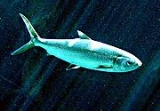
Ostariophysi

Encyclopedia
Ostariophysi is the second-largest superorder of fish
. Members of this superorder are called ostariophysians. This diverse group contains almost 8,000 species, about 28% of known fish species in the world and 68% of freshwater species, and are present on all major continents except Antarctica. They have a number of common characteristics such as an alarm substance and a Weberian apparatus
. Members of this group include fish important to people for food, sport, the aquarium industry, and research.
and Greenwood
to separate the traditional Ostariophysians from the added Gonorynchiformes.
The superorder is classified below:
The monophyly
of Ostariophysi has come into question with molecular evidence. Gonorynchiformes is more closely related to Clupeiformes
than Otophysi. It is possible that the Gonorynchiformes and Clupeiformes form a monophyletic group. There is evidence for a sister group relationship between Ostariophysi and Clupeomorpha (the taxon Ostarioclupeomorpha, also known as Otocephala, was coined to describe this possibly monophyletic group).
. Ostariophysian fossils are known from every continent except Australia
.
Ostariophysians are currently distributed worldwide on all continents except Antarctica. The common ancestor of this group entered fresh water about coincident with the global decrease in oxygen levels in marine waters. The Otophysi originated in freshwaters during the Jurassic (c. 200-145 Ma) before the breakup of the super continent Pangea. The division of the Otophysi into the four extant clades closely follows the breakup of Pangea. The separation of Laurasia in the north from Gondwanna in the south isolated the lineages which gave rise to the modern Cyprinoformes and Characiphysi. The Characiphysi then was itself divided into the diurnal (day-active) Characiformes and the nocturnal (night-active) Siluriphysi, including Siluriformes and Gymnotiformes. Modern Characiformes are present in both South America and Africa, and have relatively recently extended their range to North America. The Siluriphysi are characterized by many derived traits, including notably, electroreception. The Siluriphysi originated before the breakup of Gondwanna into South America and Africa in the Aptian (c. 110 Ma) but the presence of several basal Siluriphysan taxa in modern South America (Gymnotiformes, Diplomystidae, Loricaridea) suggest that the Siluriphysi may have originated on the western portion of Gondwanna. Alternatively, these basal taxa have subsequently become extinct in Africa. The modern distribution of Siluriformes is cosmopolitan due to subsequest dispersal.
. Ostariophysians includes five major lineages and is a very diverse group. As of 2006 (Nelson), the five orders contain 1,075 genera in 64 families and about 7,931 species, which is about 28% of all known fish species. The four largest families in this group (Cyprinidae, Characidae
, Loricariidae
, and Balitoridae) include 4,656 species, over half (59%) of ostariophysian species. Cyprinidae itself is the largest fresh water
fish family and the largest family of vertebrate
s after Gobiidae. Ostariophysians account for about 68% of all freshwater species; in fact, there are only about 123 marine species (Chanidae, Gonorynchidae, most Ariidae
, about half of Plotosidae). They are present on all continents and major land masses except Antarctica, Greenland
, and New Zealand
.
This group includes a wide variety of different fishes. It contains the largest freshwater fish ever caught, the Mekong giant catfish
, which can weigh up to about 300 kg. It also contains the smallest species of freshwater fish, Danionella translucida
at only 12 mm in length. Some of these fish are able to breathe atmospheric oxygen (Clariidae) or even live out of water (Phreatobius cisternarum
). Some Ostariphysans have the ability to produce electricity (Malapteruridae, Gymnotiformes).
Many ostariophysians have the characteristic of an alarm substance that is part of a fright reaction. This is a pheromone produced in epidermal club cells, and is similar or identical in all ostariophysians. When the fish is injured, this pheromone is released; other fish of the same species or similar species can smell this pheromone, causing a fright reaction. However, some fish possess the alarm substance without the fright reaction or lack both the alarm substance and the fright reaction to the alarm substance.
. Apart from this structure, there is no other trait that could explain the success of otophysians. It is made up of a set of bones known as Weberian ossicles, a chain of small bones that connect the auditory system to the gas bladder
of fishes. The ossicles connect the gas bladder wall with Y-shaped lymph sinus that abuts the lymph-filled transverse canal joining the sacculi of the right and left ears. This allows the transmission of vibrations to the inner ear.
In anotophysians, the three first vertebrae are specialized and associated with one or more cephalic ribs (a primitive Weberian apparatus). In the otophysians, a distinct modification of the anterior four or five first vertebrae is found, as well as the Weberian ossicles.
The fully functioning Weberian apparatus consists of the swim bladder, the Weberian ossicles, a portion of the anterior vertebral column, and some muscles and ligaments. It is named after the German anatomist and physiologist Ernst Heinrich Weber
who first described the Weberian ossicles.
Fish
Fish are a paraphyletic group of organisms that consist of all gill-bearing aquatic vertebrate animals that lack limbs with digits. Included in this definition are the living hagfish, lampreys, and cartilaginous and bony fish, as well as various extinct related groups...
. Members of this superorder are called ostariophysians. This diverse group contains almost 8,000 species, about 28% of known fish species in the world and 68% of freshwater species, and are present on all major continents except Antarctica. They have a number of common characteristics such as an alarm substance and a Weberian apparatus
Weberian apparatus
The Weberian apparatus is an anatomical structure that connects the swim bladder to the auditory system in fishes belonging to the Superorder Ostariophysi. When it is fully developed in adult fish, the elements of the apparatus are sometimes collectively referred to as the Weberian ossicles...
. Members of this group include fish important to people for food, sport, the aquarium industry, and research.
Taxonomy
Currently, this superorder is divided into two series, Anotophysi and Otophysi. However, in older literature, Ostariophysi was restricted only to the fish that are currently classified under Otophysi. Otophysi was coined in 1970 by RosenRosen
-People:* Al Rosen , American All Star and MVP baseball player* Al Rosen , American actor in Cheers* Albert Rosen , conductor* Andrea Rosen , American comedian and actress...
and Greenwood
Greenwood (surname)
Greenwood is a British surname, believed to be derived from the Greenwood or Greenwode settlement near Heptonstall in the metropolitan district of Calderdale in West Yorkshire. It was the homestead of Wyomarus de Greenwode, believed to be the principal ancestor of British Greenwoods.-People with...
to separate the traditional Ostariophysians from the added Gonorynchiformes.
The superorder is classified below:
- Series Anotophysi
- GonorynchiformesGonorynchiformesGonorynchiformes is an order of ray-finned fish that includes the important food source, the milkfish , and a number of lesser-known types, both marine and freshwater....
, about 37 species
- Gonorynchiformes
- Series Otophysi (Euostariophysi)
- CypriniformesCypriniformesThe Cypriniformes are an order of ray-finned fish, including the carps, minnows, loaches and relatives. This order contains 5-6 families, over 320 genera, and more than 3,250 species, with new species being described every few months or so, and new genera being recognized regularly...
(minnowMinnowMinnow is a general term used to refer to small freshwater and saltwater fish, especially those used as bait fish or for fishing bait. More specifically, it refers to small freshwater fish of the carp family.-True minnows:...
s and allies), about 3,268 species (contains Cyprinidae, largest family of freshwater fishes) - CharaciformesCharaciformesThe Characiformes are an order of ray-finned fish, comprising the characins and their allies. Grouped in 18 recognized families, there are a few thousand different species, including the well-known piranha and tetras.-Taxonomy:...
(characins and allies), at least 1,674 species - Siluriformes (catfishCatfishCatfishes are a diverse group of ray-finned fish. Named for their prominent barbels, which resemble a cat's whiskers, catfish range in size and behavior from the heaviest and longest, the Mekong giant catfish from Southeast Asia and the second longest, the wels catfish of Eurasia, to detritivores...
es), about 1,727 species - GymnotiformesGymnotiformesThe Gymnotiformes are a group of teleost bony fishes commonly known as the Neotropical or South American knifefishes. They have long bodies and swim using undulations of their elongated anal fin...
(electric eelElectric eelThe electric eel , is an electric fish, and the only species of the genus Electrophorus. It is capable of generating powerful electric shocks, of up to six hundred volts, which it uses for both hunting and self-defense. It is an apex predator in its South American range...
s, American knifefishes), at least 173 species (sometimes grouped under Siluriformes)
- Cypriniformes
The monophyly
Monophyly
In common cladistic usage, a monophyletic group is a taxon which forms a clade, meaning that it contains all the descendants of the possibly hypothetical closest common ancestor of the members of the group. The term is synonymous with the uncommon term holophyly...
of Ostariophysi has come into question with molecular evidence. Gonorynchiformes is more closely related to Clupeiformes
Clupeiformes
Clupeiformes is the order of ray-finned fish that includes the herring family, Clupeidae, and the anchovy family, Engraulidae. The group includes many of the most important food fish....
than Otophysi. It is possible that the Gonorynchiformes and Clupeiformes form a monophyletic group. There is evidence for a sister group relationship between Ostariophysi and Clupeomorpha (the taxon Ostarioclupeomorpha, also known as Otocephala, was coined to describe this possibly monophyletic group).
Evolution
Ostariophysian fossils, both anotophysan and otophysian, are known from the early CretaceousCretaceous
The Cretaceous , derived from the Latin "creta" , usually abbreviated K for its German translation Kreide , is a geologic period and system from circa to million years ago. In the geologic timescale, the Cretaceous follows the Jurassic period and is followed by the Paleogene period of the...
. Ostariophysian fossils are known from every continent except Australia
Australia
Australia , officially the Commonwealth of Australia, is a country in the Southern Hemisphere comprising the mainland of the Australian continent, the island of Tasmania, and numerous smaller islands in the Indian and Pacific Oceans. It is the world's sixth-largest country by total area...
.
Ostariophysians are currently distributed worldwide on all continents except Antarctica. The common ancestor of this group entered fresh water about coincident with the global decrease in oxygen levels in marine waters. The Otophysi originated in freshwaters during the Jurassic (c. 200-145 Ma) before the breakup of the super continent Pangea. The division of the Otophysi into the four extant clades closely follows the breakup of Pangea. The separation of Laurasia in the north from Gondwanna in the south isolated the lineages which gave rise to the modern Cyprinoformes and Characiphysi. The Characiphysi then was itself divided into the diurnal (day-active) Characiformes and the nocturnal (night-active) Siluriphysi, including Siluriformes and Gymnotiformes. Modern Characiformes are present in both South America and Africa, and have relatively recently extended their range to North America. The Siluriphysi are characterized by many derived traits, including notably, electroreception. The Siluriphysi originated before the breakup of Gondwanna into South America and Africa in the Aptian (c. 110 Ma) but the presence of several basal Siluriphysan taxa in modern South America (Gymnotiformes, Diplomystidae, Loricaridea) suggest that the Siluriphysi may have originated on the western portion of Gondwanna. Alternatively, these basal taxa have subsequently become extinct in Africa. The modern distribution of Siluriformes is cosmopolitan due to subsequest dispersal.
Diversity
Ostariophysi is the second largest teleost superorderOrder (biology)
In scientific classification used in biology, the order is# a taxonomic rank used in the classification of organisms. Other well-known ranks are life, domain, kingdom, phylum, class, family, genus, and species, with order fitting in between class and family...
. Ostariophysians includes five major lineages and is a very diverse group. As of 2006 (Nelson), the five orders contain 1,075 genera in 64 families and about 7,931 species, which is about 28% of all known fish species. The four largest families in this group (Cyprinidae, Characidae
Characidae
The Characidae, characids or characins are a family of freshwater subtropical and tropical fish, belonging to the order Characiformes. The name "characins" is the historical one, but scientists today tend to prefer "characids" to reflect their status as a by and large monophyletic group at family...
, Loricariidae
Loricariidae
Loricariidae is the largest family of catfish , with almost 700 species and new species being described each year. Loricariids originate from fresh water habitats of Costa Rica, Panama, and tropical and subtropical South America. These fish are noted for the bony plates covering their bodies and...
, and Balitoridae) include 4,656 species, over half (59%) of ostariophysian species. Cyprinidae itself is the largest fresh water
Fresh Water
Fresh Water is the debut album by Australian rock and blues singer Alison McCallum, released in 1972. Rare for an Australian artist at the time, it came in a gatefold sleeve...
fish family and the largest family of vertebrate
Vertebrate
Vertebrates are animals that are members of the subphylum Vertebrata . Vertebrates are the largest group of chordates, with currently about 58,000 species described. Vertebrates include the jawless fishes, bony fishes, sharks and rays, amphibians, reptiles, mammals, and birds...
s after Gobiidae. Ostariophysians account for about 68% of all freshwater species; in fact, there are only about 123 marine species (Chanidae, Gonorynchidae, most Ariidae
Ariidae
The Ariidae or ariid catfish are a family of catfish that mainly live in marine waters with many freshwater and brackish water species. They are found worldwide in tropical to warm temperate zones.-Taxonomy:...
, about half of Plotosidae). They are present on all continents and major land masses except Antarctica, Greenland
Greenland
Greenland is an autonomous country within the Kingdom of Denmark, located between the Arctic and Atlantic Oceans, east of the Canadian Arctic Archipelago. Though physiographically a part of the continent of North America, Greenland has been politically and culturally associated with Europe for...
, and New Zealand
New Zealand
New Zealand is an island country in the south-western Pacific Ocean comprising two main landmasses and numerous smaller islands. The country is situated some east of Australia across the Tasman Sea, and roughly south of the Pacific island nations of New Caledonia, Fiji, and Tonga...
.
This group includes a wide variety of different fishes. It contains the largest freshwater fish ever caught, the Mekong giant catfish
Mekong giant catfish
The Mekong giant catfish, Pangasianodon gigas, is a species of catfish in the shark catfish family , native to the Mekong basin in Southeast Asia.-Species characteristics:...
, which can weigh up to about 300 kg. It also contains the smallest species of freshwater fish, Danionella translucida
Danionella translucida
Danionella translucida is an extremely small species of cyprinid fish endemic to Myanmar. When described, it was considered to be the smallest freshwater vertebrate. It was collected from the roots of floating aquatic plants in a slow-flowing, shallow stream in the Pegu Division of Myanmar...
at only 12 mm in length. Some of these fish are able to breathe atmospheric oxygen (Clariidae) or even live out of water (Phreatobius cisternarum
Phreatobius cisternarum
Phreatobius cisternarum is a species of catfish in the genus Phreatobius. This Brazilian fish is one of the few fish species that live underground in phreatic habitats. It has proved problematic in its classification, which remains uncertain....
). Some Ostariphysans have the ability to produce electricity (Malapteruridae, Gymnotiformes).
Physical characteristics
Most species possess a swim bladder (except in Gonorynchus). The swim bladder is usually divided into two chambers. A smaller anterior chamber is partially or completely covered by a silvery peritoneal tunic. A larger posterior chamber may be reduced or absent in some groups. Minute, unicellular, horny projections known as "unculi" are commonly present on various body parts and are only known from ostariophysians.Many ostariophysians have the characteristic of an alarm substance that is part of a fright reaction. This is a pheromone produced in epidermal club cells, and is similar or identical in all ostariophysians. When the fish is injured, this pheromone is released; other fish of the same species or similar species can smell this pheromone, causing a fright reaction. However, some fish possess the alarm substance without the fright reaction or lack both the alarm substance and the fright reaction to the alarm substance.
Weberian apparatus
In otophysians, one of the main characteristics is the Weberian apparatusWeberian apparatus
The Weberian apparatus is an anatomical structure that connects the swim bladder to the auditory system in fishes belonging to the Superorder Ostariophysi. When it is fully developed in adult fish, the elements of the apparatus are sometimes collectively referred to as the Weberian ossicles...
. Apart from this structure, there is no other trait that could explain the success of otophysians. It is made up of a set of bones known as Weberian ossicles, a chain of small bones that connect the auditory system to the gas bladder
Gas bladder
The swim bladder, gas bladder, fish maw or air bladder is an internal gas-filled organ that contributes to the ability of a fish to control its buoyancy, and thus to stay at the current water depth without having to waste energy in swimming...
of fishes. The ossicles connect the gas bladder wall with Y-shaped lymph sinus that abuts the lymph-filled transverse canal joining the sacculi of the right and left ears. This allows the transmission of vibrations to the inner ear.
In anotophysians, the three first vertebrae are specialized and associated with one or more cephalic ribs (a primitive Weberian apparatus). In the otophysians, a distinct modification of the anterior four or five first vertebrae is found, as well as the Weberian ossicles.
The fully functioning Weberian apparatus consists of the swim bladder, the Weberian ossicles, a portion of the anterior vertebral column, and some muscles and ligaments. It is named after the German anatomist and physiologist Ernst Heinrich Weber
Ernst Heinrich Weber
Ernst Heinrich Weber was a German physician who is considered one of the founders of experimental psychology.Weber studied medicine at Wittenberg University...
who first described the Weberian ossicles.