

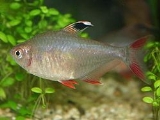
Characiformes

Encyclopedia
The Characiformes are an order of ray-finned fish
, comprising the characins and their allies. Grouped in 18 recognized families, there are a few thousand different species, including the well-known piranha
and tetra
s.
within the superorder Ostariophysi
. Otophysi contains four other orders, Cypriniformes
, Siluriformes, and Gymnotiformes
. Characiformes forms a group known as Characaphysi with Siluriformes and Gymnotiformes. Characiformes is the sister group to the orders Siluriformes and Gymnotiformes, though this has been debated in light of recent molecular evidence.
Originally the characins were all grouped within a single family, the Characidae
. Since then 18 different families have been separated out. However, classification varies somewhat, and the most recent (2011) study confirms the circumscribed Characidae as monophyletic. Currently, there are eighteen families
, about 270 genera
, and at least 1674 species
. The suborder Citharinoidei, which contains the families Distichodontidae
and Citharinidae
, is considered the sister group to the rest of the characins, suborder Characoidei.
of the early Cretaceous
(Albian
stage) of Brazil
. While all extant species are freshwater, this species was probably either brackish or marine. Many other fossils are also known. Characiformes likely first diversified during the Cretaceous period, though fossils are poorly known. During the Cretaceous period, the rift between South America and Africa would be forming; this may explain the contrast in diversity between the two continents. Their low diversity in Africa may explain why some primitive fish families and Cypriniformes coexist with them while they are absent in South America, where these fish may have been driven extinct. The characiforms had not spread into Africa soon enough to also reach the land bridge between Africa and Asia. The earliest they could have spread into Central America was the late Miocene
.
and Central America
. At least 209 species of characins are found in Africa, including the distichodontids
, the citharinids
, the alestiids
, and the monotypic
Hepsetidae, Hepsetus odoe
. The rest of the characins originate from the Americas
.
, a series of bony
parts connecting the swim bladder and inner ear
. Superficially, the Characiformes somewhat resemble their relatives of the order Cypriniformes
, but have a small fleshy adipose fin between the dorsal fin
and tail
. Most species have teeth within the mouth, since they are often carnivorous. The body is almost always covered in well-defined scales. The mouth is also usually not truly protractile.
The largest characin is Hydrocynus goliath
at 1.3 metres (4.3 ft), while the smallest size is about 1.7 centimetre (0.669291338582677 in) in the Bolivian pygmy blue characin, Xenurobrycon polyancistrus. Many members are under 3 centimetres (1.2 in).
s are popular in aquaria thanks to their bright colors, general hardiness, and tolerance towards other fish in community tanks.
Actinopterygii
The Actinopterygii or ray-finned fishes constitute a class or sub-class of the bony fishes.The ray-finned fishes are so called because they possess lepidotrichia or "fin rays", their fins being webs of skin supported by bony or horny spines , as opposed to the fleshy, lobed fins that characterize...
, comprising the characins and their allies. Grouped in 18 recognized families, there are a few thousand different species, including the well-known piranha
Piranha
A piranha or piraña is a member of family Characidae in order Characiformes, an omnivorous freshwater fish that inhabits South American rivers. In Venezuela, they are called caribes...
and tetra
Tetra
thumb|right|250px|Pristella tetra — [[Pristella maxillaris]].thumb|right|250px|Golden Pristella tetra, a [[morph |morph]] of [[Pristella maxillaris]].thumb|right|250px|[[Silvertip tetra]] — Hasemania nana....
s.
Taxonomy
Characiformes form part of a series called OtophysiOstariophysi
Ostariophysi is the second-largest superorder of fish. Members of this superorder are called ostariophysians. This diverse group contains almost 8,000 species, about 28% of known fish species in the world and 68% of freshwater species, and are present on all major continents except Antarctica...
within the superorder Ostariophysi
Ostariophysi
Ostariophysi is the second-largest superorder of fish. Members of this superorder are called ostariophysians. This diverse group contains almost 8,000 species, about 28% of known fish species in the world and 68% of freshwater species, and are present on all major continents except Antarctica...
. Otophysi contains four other orders, Cypriniformes
Cypriniformes
The Cypriniformes are an order of ray-finned fish, including the carps, minnows, loaches and relatives. This order contains 5-6 families, over 320 genera, and more than 3,250 species, with new species being described every few months or so, and new genera being recognized regularly...
, Siluriformes, and Gymnotiformes
Gymnotiformes
The Gymnotiformes are a group of teleost bony fishes commonly known as the Neotropical or South American knifefishes. They have long bodies and swim using undulations of their elongated anal fin...
. Characiformes forms a group known as Characaphysi with Siluriformes and Gymnotiformes. Characiformes is the sister group to the orders Siluriformes and Gymnotiformes, though this has been debated in light of recent molecular evidence.
Originally the characins were all grouped within a single family, the Characidae
Characidae
The Characidae, characids or characins are a family of freshwater subtropical and tropical fish, belonging to the order Characiformes. The name "characins" is the historical one, but scientists today tend to prefer "characids" to reflect their status as a by and large monophyletic group at family...
. Since then 18 different families have been separated out. However, classification varies somewhat, and the most recent (2011) study confirms the circumscribed Characidae as monophyletic. Currently, there are eighteen families
Family (biology)
In biological classification, family is* a taxonomic rank. Other well-known ranks are life, domain, kingdom, phylum, class, order, genus, and species, with family fitting between order and genus. As for the other well-known ranks, there is the option of an immediately lower rank, indicated by the...
, about 270 genera
Genus
In biology, a genus is a low-level taxonomic rank used in the biological classification of living and fossil organisms, which is an example of definition by genus and differentia...
, and at least 1674 species
Species
In biology, a species is one of the basic units of biological classification and a taxonomic rank. A species is often defined as a group of organisms capable of interbreeding and producing fertile offspring. While in many cases this definition is adequate, more precise or differing measures are...
. The suborder Citharinoidei, which contains the families Distichodontidae
Distichodontidae
Distichodontidae is a family of fresh water African fish of the order Characiformes.There are two evolutionary grades in this family; micropredators and herbivores have a non-protractile upper jaw and a deep to shallow body, while carnivores have a movable upper jaw and have an elongate body...
and Citharinidae
Citharinidae
Citharinidae is a small family of characiform fish. They are fresh-water fish native to Africa, and are sufficiently abundant to be a significant food fish.They are deep-bodied, silvery fish, measuring up to in length and weighing up to...
, is considered the sister group to the rest of the characins, suborder Characoidei.
Evolution
The oldest characiform is SantanichthysSantanichthys
Santanichthys diasii is a species of extinct fish that existed around 115 million years ago. It is the earliest known fish that can be classified in the Otophysi. It appears as a small fish, similar in appearance to a modern-day herring no more than 30 centimeters in length...
of the early Cretaceous
Cretaceous
The Cretaceous , derived from the Latin "creta" , usually abbreviated K for its German translation Kreide , is a geologic period and system from circa to million years ago. In the geologic timescale, the Cretaceous follows the Jurassic period and is followed by the Paleogene period of the...
(Albian
Albian
The Albian is both an age of the geologic timescale and a stage in the stratigraphic column. It is the youngest or uppermost subdivision of the Early/Lower Cretaceous epoch/series. Its approximate time range is 112.0 ± 1.0 Ma to 99.6 ± 0.9 Ma...
stage) of Brazil
Brazil
Brazil , officially the Federative Republic of Brazil , is the largest country in South America. It is the world's fifth largest country, both by geographical area and by population with over 192 million people...
. While all extant species are freshwater, this species was probably either brackish or marine. Many other fossils are also known. Characiformes likely first diversified during the Cretaceous period, though fossils are poorly known. During the Cretaceous period, the rift between South America and Africa would be forming; this may explain the contrast in diversity between the two continents. Their low diversity in Africa may explain why some primitive fish families and Cypriniformes coexist with them while they are absent in South America, where these fish may have been driven extinct. The characiforms had not spread into Africa soon enough to also reach the land bridge between Africa and Asia. The earliest they could have spread into Central America was the late Miocene
Miocene
The Miocene is a geological epoch of the Neogene Period and extends from about . The Miocene was named by Sir Charles Lyell. Its name comes from the Greek words and and means "less recent" because it has 18% fewer modern sea invertebrates than the Pliocene. The Miocene follows the Oligocene...
.
Distribution
Characins are most diverse in the Neotropics, where they are found in tropical lakes and rivers throughout most of SouthSouth America
South America is a continent situated in the Western Hemisphere, mostly in the Southern Hemisphere, with a relatively small portion in the Northern Hemisphere. The continent is also considered a subcontinent of the Americas. It is bordered on the west by the Pacific Ocean and on the north and east...
and Central America
Central America
Central America is the central geographic region of the Americas. It is the southernmost, isthmian portion of the North American continent, which connects with South America on the southeast. When considered part of the unified continental model, it is considered a subcontinent...
. At least 209 species of characins are found in Africa, including the distichodontids
Distichodontidae
Distichodontidae is a family of fresh water African fish of the order Characiformes.There are two evolutionary grades in this family; micropredators and herbivores have a non-protractile upper jaw and a deep to shallow body, while carnivores have a movable upper jaw and have an elongate body...
, the citharinids
Citharinidae
Citharinidae is a small family of characiform fish. They are fresh-water fish native to Africa, and are sufficiently abundant to be a significant food fish.They are deep-bodied, silvery fish, measuring up to in length and weighing up to...
, the alestiids
Alestiidae
African tetras are a group of Characiformes fish exclusively found in Africa. This family contains about 18 genera and 110 species....
, and the monotypic
Monotypic
In biology, a monotypic taxon is a taxonomic group with only one biological type. The term's usage differs slightly between botany and zoology. The term monotypic has a separate use in conservation biology, monotypic habitat, regarding species habitat conversion eliminating biodiversity and...
Hepsetidae, Hepsetus odoe
Hepsetus odoe
The Hepsetus odoe, also known as the African pike or Kafue pike, is a predatory fish, and the only living member of the Family Hepsetidae.-Anatomy and Morphology:...
. The rest of the characins originate from the Americas
Americas
The Americas, or America , are lands in the Western hemisphere, also known as the New World. In English, the plural form the Americas is often used to refer to the landmasses of North America and South America with their associated islands and regions, while the singular form America is primarily...
.
Appearance and anatomy
Characins possess a Weberian apparatusOstariophysi
Ostariophysi is the second-largest superorder of fish. Members of this superorder are called ostariophysians. This diverse group contains almost 8,000 species, about 28% of known fish species in the world and 68% of freshwater species, and are present on all major continents except Antarctica...
, a series of bony
Bone
Bones are rigid organs that constitute part of the endoskeleton of vertebrates. They support, and protect the various organs of the body, produce red and white blood cells and store minerals. Bone tissue is a type of dense connective tissue...
parts connecting the swim bladder and inner ear
Inner ear
The inner ear is the innermost part of the vertebrate ear. In mammals, it consists of the bony labyrinth, a hollow cavity in the temporal bone of the skull with a system of passages comprising two main functional parts:...
. Superficially, the Characiformes somewhat resemble their relatives of the order Cypriniformes
Cypriniformes
The Cypriniformes are an order of ray-finned fish, including the carps, minnows, loaches and relatives. This order contains 5-6 families, over 320 genera, and more than 3,250 species, with new species being described every few months or so, and new genera being recognized regularly...
, but have a small fleshy adipose fin between the dorsal fin
Dorsal fin
A dorsal fin is a fin located on the backs of various unrelated marine and freshwater vertebrates, including most fishes, marine mammals , and the ichthyosaurs...
and tail
Tail
The tail is the section at the rear end of an animal's body; in general, the term refers to a distinct, flexible appendage to the torso. It is the part of the body that corresponds roughly to the sacrum and coccyx in mammals, reptiles, and birds...
. Most species have teeth within the mouth, since they are often carnivorous. The body is almost always covered in well-defined scales. The mouth is also usually not truly protractile.
The largest characin is Hydrocynus goliath
Hydrocynus goliath
Hydrocynus goliath, also known as the goliath tigerfish, giant tigerfish or mbenga, is a very large African fish from the Congo River Basin, Lualaba River, Lake Upemba, and Lake Tanganyika. This large-toothed, highly predatory fish grows to a length of and a weight of .A number of incidents have...
at 1.3 metres (4.3 ft), while the smallest size is about 1.7 centimetre (0.669291338582677 in) in the Bolivian pygmy blue characin, Xenurobrycon polyancistrus. Many members are under 3 centimetres (1.2 in).
Relationship to humans
A few characins become quite large, and are important as food or game. Most, however, are small shoaling fish. Many species known as tetraTetra
thumb|right|250px|Pristella tetra — [[Pristella maxillaris]].thumb|right|250px|Golden Pristella tetra, a [[morph |morph]] of [[Pristella maxillaris]].thumb|right|250px|[[Silvertip tetra]] — Hasemania nana....
s are popular in aquaria thanks to their bright colors, general hardiness, and tolerance towards other fish in community tanks.