


Cupar

Encyclopedia
Cupar is a town and former royal burgh
in Fife
, Scotland
. The town is situated between Dundee
and the New Town
of Glenrothes
.
According to a recent population estimate (2006), Cupar had a population around 8,980 making the town the ninth largest settlement in Fife.
Towards the latter stages of the 13th century, the burgh became of great importance staging the site of an assembly of the three estates - clergy, nobility and burgesses - organised by Alexander III
in 1276 as a predecessor of the Parliament of Scotland
. Although, written information of a charter for the modern town was lost, evidence has suggested that this did exist as one of the many properties owned by the Earls of Fife by 1294.
During the middle of the 14th century, the burgh started to pay customs on taxable incomes, which probably meant that royal burgh status was gifted sometime between 1294 and 1328.
The oldest document, referring to the royal burgh, was a grant by Robert II
in 1381 to give a port at Guardbridge
on the River Eden
for the residents of the burgh to help boost trade with Flanders
. This grant was officially recognised by James II
in 1428.
is the executive
, deliberative
and legislative body responsible for local governance. The Scottish Parliament
is responsible for devolved matters
such as education
, health and justice
while reserved matters
are dealt with by the Parliament of the United Kingdom
. The Cupar area supports three multi-member wards with eleven councillors sitting on the committee of Fife Council. The County Buildings on Catherine Street are the main headquarters for the east region of Fife Council, which deals with administrative, planning and agricultural issues.
Cupar forms part of the North East Fife
, electing one Member of Parliament
(MP) to the House of Commons of the Parliament of the United Kingdom by the first past the post system. The constituency is represented by Sir Menzies Campbell, MP
of the Scottish Liberal Democrats
. For the purposes of the Scottish Parliament
, Cupar forms part of the North East Fife constituency. The North East Fife Scottish Parliament (or Holyrood) constituency created in 1999 is one of nine within the Mid Scotland and Fife electoral region. Each constituency elects one Member of the Scottish Parliament
(MSP) by the first past the post system of election, and the region elects seven additional members to produce a form of proportional representation. The constituency is represented by Rod Campbell
for the SNP
.
At EU level, Cupar is part of the pan-Scotland European Parliament constituency
which elects seven Members of the European Parliament (MEP)s using the d'Hondt method
of party-list proportional representation
. Currently, Scotland returns two Labour MEPs, two Conservative and Unionist
MEPs, two SNP MEPs and one Liberal Democrat
MEP, to the European Parliament
.
According to the 2001 census, Cupar had had a total population of 8,506. The population of Cupar has since increased slightly to around 8,980 in 2008. The demographic make-up of the population is much in line with the rest of Scotland. The age group from 30 to 44 forms the largest portion of the population (22%). The median age of males and females living in Cupar was 39 and 43 years respectively, compared to 37 and 39 years for those in the whole of Scotland.
The place of birth of the town's residents was 95.81% United Kingdom (including 81.64% from Scotland), 0.51% Republic of Ireland, 1.60% from other European Union countries, and 2.09% from elsewhere in the world. The economic activity of residents aged 16–74 was 42.20% in full-time employment, 12.32% in part-time employment, 5.89% self-employed, 3.10% unemployed, 2.96% students with jobs, 3.94% students without jobs, 17.68% retired, 4.83% looking after home or family, 4.35% permanently sick or disabled, and 2.72% economically inactive for other reasons. Compared with the average demography of Scotland, Cupar has low proportions of people born outside the United Kingdom but has higher proportions for people over 75 years old.
for being the only example replicating the style of buildings in the New Town of Edinburgh
. The Category B listed tower of the corn exchange can be seen across the skyline of the town.
At the east end of St Catherine Street is the Category B listed Cupar War Memorial in a classical Greek
style overlooking the Cart Haugh, one of several to be designed by John Kinross
with assistance from leading contemporary sculptors, for the exception of the Victory statue which was done by HS Gamby. The memorial was first unveiled by Field Marshal Earl Haig in 1922 and then again for the addition of the World War II
memorial in 1950 by the Earl of Elgin
. Nearby on Coal Road is a former Category B listed classical style prison building built between 1813 and 1814.
On the bonnygate, the Category A listed Preston Lodge built by the Laird of Airdrie is the second oldest building in the town. The date of 1623, when the house was first built, is inscribed on a stone on the west wall. The house was extended in 1702 by James Preston and was remodelled by William Preston, a London goldsmith in 1765. Later, the Reverend Sir James Preston occupied the house between 1775 and 1791, when he was the minister of the Cupar Old Parish Church. The original design of the building is believed to have been inspired by Culross Palace
in Culross
. Situated at the corner of the Crossgate, the Category C(s) Listed Duncan's institute was built around 1870-71 as a mechanics' institute for the "working classes of Cupar" by Mrs Duncan. The building, a mixture of Gothic, Scottish and Flemish styles is recognised in the town for having a twisted spire. On the Kirkgate, is the Parish Church of Cupar Old and St Michael of Tarvit, designed by the architect, Hay Bell. This consists of the Category A listed Parish Church tower dating from 1415 and the Category B listed main church building from 1745. The tower is the only surviving piece of the old Cupar parish church, founded by the priory of St Andrews.
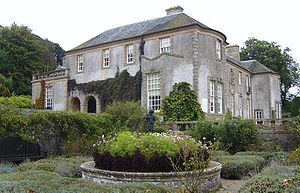 To the south of the town on the A914 and A916 is the Category A listed Hill of Tarvit
mansion house and nearby Category A listed Scotstarvit Tower
. The Hill of Tarvit
was formerly known as Wemyss Hall, designed by Sir Walter Bruce around 1692. When the house was sold in 1904, Robert Lorimer
was commissioned to design a bigger house in size compared to the existing Wemyss Hall to be able to hold the owner's French architecture. This was completed around 1907 and 1908, granting the present name Hill of Tarvit. The interior of the house which showcased the owner's love of antique furniture ranging from Flemish
tapestries; Louis V
; Louis XI; English
and Scottish
have been considered by many to be Lormier's best work. The service accommodation is the most fascinating aspects of the house which shows the range of rooms and equipment used by a family, prior to the First World War. Situated between the Tarvit and Walton Hills, is Scotstarvit Tower
, a well-preserved simple L-plan early 17th century tower house of five stories and an attic.
Cupar Sports Centre has a 25 metre Swimming pool, badminton courts, squash courts and a fitness suite. Cupar is also home to Cupar Cricket Club, founded in 1884 the club is celebrating its 125th anniversary in the 2009 season.
The Castlehill Community Association is home to a variety of local groups including Cupar Camera Club, Cupar Art Club, Cupar & District Model Railway Club. They operate from the Old Castlehill Primary School and from 11 St Catherine Street.
Bell Baxter High School
located on Carslogie Road, serves both the town and surrounding villages. The School role recorded in February 2009, was estimated at 1620 pupils. Elmwood College has three main campuses situated in the town and surrounding area. The college has been praised as a centre for excellence in golf-related studies and being a specialist in land-based education. Local businesses also benefit from the work of the Elmwood Rural Business Centre.
 A express bus service connects the town every hour between Edinburgh
and St Andrews
and also between Glasgow
and St Andrews
. Other services run less frerquently from Stirling and various local villages through Cupar to St Andrews
. An express service also runs via the town from Ladybank
to Dundee
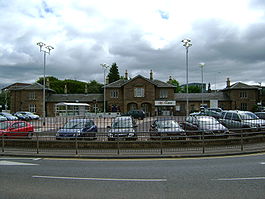
. A railway station
can be found to the south-east of the town centre. The station is situated on the East Coast Main Line, served by Scotrail
and Arriva
CrossCountry
with regular services running between Edinburgh Waverley
and Aberdeen
. Nearby stations are located to the north-east of the town at Leuchars
and to the south of the town in neighbouring Springfield
(limited service) and Ladybank
. The nearest major international airport is in Edinburgh airport
with the nearest ferry sea port at Rosyth
being 42 miles and 35 miles, respectively.
Royal burgh
A royal burgh was a type of Scottish burgh which had been founded by, or subsequently granted, a royal charter. Although abolished in 1975, the term is still used in many of the former burghs....
in Fife
Fife
Fife is a council area and former county of Scotland. It is situated between the Firth of Tay and the Firth of Forth, with inland boundaries to Perth and Kinross and Clackmannanshire...
, Scotland
Scotland
Scotland is a country that is part of the United Kingdom. Occupying the northern third of the island of Great Britain, it shares a border with England to the south and is bounded by the North Sea to the east, the Atlantic Ocean to the north and west, and the North Channel and Irish Sea to the...
. The town is situated between Dundee
Dundee
Dundee is the fourth-largest city in Scotland and the 39th most populous settlement in the United Kingdom. It lies within the eastern central Lowlands on the north bank of the Firth of Tay, which feeds into the North Sea...
and the New Town
New towns in the United Kingdom
Below is a list of some of the new towns in the United Kingdom created under the various New Town Acts of the 20th century. Some earlier towns were developed as Garden Cities or overspill estates early in the twentieth century. The New Towns proper were planned to disperse population following the...
of Glenrothes
Glenrothes
Glenrothes is a large town situated in the heart of Fife, in east-central Scotland. It is located approximately from both Edinburgh, which lies to the south and Dundee to the north. The town had an estimated population of 38,750 in 2008, making Glenrothes the third largest settlement in Fife...
.
According to a recent population estimate (2006), Cupar had a population around 8,980 making the town the ninth largest settlement in Fife.
History
The town is believed to have grown around the site of Cupar Castle, which was the seat of the sheriff and was owned by the earls of Fife. The area became a centre for judiciary as the county of Fife and as a market town catering for both cattle and sheep.Towards the latter stages of the 13th century, the burgh became of great importance staging the site of an assembly of the three estates - clergy, nobility and burgesses - organised by Alexander III
Alexander III of Scotland
Alexander III was King of Scots from 1249 to his death.-Life:...
in 1276 as a predecessor of the Parliament of Scotland
Parliament of Scotland
The Parliament of Scotland, officially the Estates of Parliament, was the legislature of the Kingdom of Scotland. The unicameral parliament of Scotland is first found on record during the early 13th century, with the first meeting for which a primary source survives at...
. Although, written information of a charter for the modern town was lost, evidence has suggested that this did exist as one of the many properties owned by the Earls of Fife by 1294.
During the middle of the 14th century, the burgh started to pay customs on taxable incomes, which probably meant that royal burgh status was gifted sometime between 1294 and 1328.
The oldest document, referring to the royal burgh, was a grant by Robert II
Robert II of Scotland
Robert II became King of Scots in 1371 as the first monarch of the House of Stewart. He was the son of Walter Stewart, hereditary High Steward of Scotland and of Marjorie Bruce, daughter of Robert I and of his first wife Isabella of Mar...
in 1381 to give a port at Guardbridge
Guardbridge
Guardbridge is a village in north-east Fife, Scotland.It is approximately 3 miles north-west of St. Andrews, and is situated on the estuary of the River Eden. It stands at the junction of the A91 St...
on the River Eden
River Eden, Fife
The River Eden is a river in Fife in Scotland, and is one of Fife's two principal rivers, along with the Leven. It is nearly 30 miles long and has a fall of around 90 metres...
for the residents of the burgh to help boost trade with Flanders
Flanders
Flanders is the community of the Flemings but also one of the institutions in Belgium, and a geographical region located in parts of present-day Belgium, France and the Netherlands. "Flanders" can also refer to the northern part of Belgium that contains Brussels, Bruges, Ghent and Antwerp...
. This grant was officially recognised by James II
James II of Scotland
James II reigned as King of Scots from 1437 to his death.He was the son of James I, King of Scots, and Joan Beaufort...
in 1428.
Governance
Cupar is represented by several tiers of elected government. Cupar Community Council form the lowest tier of governance whose statutory role is to communicate local opinion to local and central government. Fife Council, the unitary local authority for Cupar, based in GlenrothesGlenrothes
Glenrothes is a large town situated in the heart of Fife, in east-central Scotland. It is located approximately from both Edinburgh, which lies to the south and Dundee to the north. The town had an estimated population of 38,750 in 2008, making Glenrothes the third largest settlement in Fife...
is the executive
Executive (government)
Executive branch of Government is the part of government that has sole authority and responsibility for the daily administration of the state bureaucracy. The division of power into separate branches of government is central to the idea of the separation of powers.In many countries, the term...
, deliberative
Deliberation
Deliberation is a process of thoughtfully weighing options, usually prior to voting. In legal settings a jury famously uses deliberation because it is given specific options, like guilty or not guilty, along with information and arguments to evaluate. Deliberation emphasizes the use of logic and...
and legislative body responsible for local governance. The Scottish Parliament
Scottish Parliament
The Scottish Parliament is the devolved national, unicameral legislature of Scotland, located in the Holyrood area of the capital, Edinburgh. The Parliament, informally referred to as "Holyrood", is a democratically elected body comprising 129 members known as Members of the Scottish Parliament...
is responsible for devolved matters
Devolution
Devolution is the statutory granting of powers from the central government of a sovereign state to government at a subnational level, such as a regional, local, or state level. Devolution can be mainly financial, e.g. giving areas a budget which was formerly administered by central government...
such as education
Education in Scotland
Scotland has a long history of universal provision of public education, and the Scottish education system is distinctly different from the other countries of the United Kingdom...
, health and justice
Scots law
Scots law is the legal system of Scotland. It is considered a hybrid or mixed legal system as it traces its roots to a number of different historical sources. With English law and Northern Irish law it forms the legal system of the United Kingdom; it shares with the two other systems some...
while reserved matters
Reserved matters
In the United Kingdom reserved matters and excepted matters are the areas of government policy where Parliament had kept the power to make laws in Scotland, Northern Ireland and Wales....
are dealt with by the Parliament of the United Kingdom
Parliament of the United Kingdom
The Parliament of the United Kingdom of Great Britain and Northern Ireland is the supreme legislative body in the United Kingdom, British Crown dependencies and British overseas territories, located in London...
. The Cupar area supports three multi-member wards with eleven councillors sitting on the committee of Fife Council. The County Buildings on Catherine Street are the main headquarters for the east region of Fife Council, which deals with administrative, planning and agricultural issues.
Cupar forms part of the North East Fife
North East Fife (UK Parliament constituency)
North East Fife is a county constituency in Fife, Scotland, represented in the House of Commons of the Parliament of the United Kingdom currently held by Sir Menzies Campbell, former leader of the Liberal Democrats...
, electing one Member of Parliament
Member of Parliament
A Member of Parliament is a representative of the voters to a :parliament. In many countries with bicameral parliaments, the term applies specifically to members of the lower house, as upper houses often have a different title, such as senate, and thus also have different titles for its members,...
(MP) to the House of Commons of the Parliament of the United Kingdom by the first past the post system. The constituency is represented by Sir Menzies Campbell, MP
Member of Parliament
A Member of Parliament is a representative of the voters to a :parliament. In many countries with bicameral parliaments, the term applies specifically to members of the lower house, as upper houses often have a different title, such as senate, and thus also have different titles for its members,...
of the Scottish Liberal Democrats
Scottish Liberal Democrats
The Scottish Liberal Democrats are one of the three state parties within the federal Liberal Democrats; the others being the Welsh Liberal Democrats and the Liberal Democrats in England...
. For the purposes of the Scottish Parliament
Scottish Parliament
The Scottish Parliament is the devolved national, unicameral legislature of Scotland, located in the Holyrood area of the capital, Edinburgh. The Parliament, informally referred to as "Holyrood", is a democratically elected body comprising 129 members known as Members of the Scottish Parliament...
, Cupar forms part of the North East Fife constituency. The North East Fife Scottish Parliament (or Holyrood) constituency created in 1999 is one of nine within the Mid Scotland and Fife electoral region. Each constituency elects one Member of the Scottish Parliament
Member of the Scottish Parliament
Member of the Scottish Parliament is the title given to any one of the 129 individuals elected to serve in the Scottish Parliament.-Methods of Election:MSPs are elected in one of two ways:...
(MSP) by the first past the post system of election, and the region elects seven additional members to produce a form of proportional representation. The constituency is represented by Rod Campbell
Roderick Campbell
Roderick Campbell is SNP MSP for North East Fife, elected in 2011.Campbell was educated at Reading School and graduated BA in politics from Exeter University...
for the SNP
Scottish National Party
The Scottish National Party is a social-democratic political party in Scotland which campaigns for Scottish independence from the United Kingdom....
.
At EU level, Cupar is part of the pan-Scotland European Parliament constituency
Scotland (European Parliament constituency)
Scotland constitutes a single constituency of the European Parliament. For 2009 it elects 6 MEPs using the d'Hondt method of party-list proportional representation.- Boundaries :...
which elects seven Members of the European Parliament (MEP)s using the d'Hondt method
D'Hondt method
The d'Hondt method is a highest averages method for allocating seats in party-list proportional representation. The method described is named after Belgian mathematician Victor D'Hondt who described it in 1878...
of party-list proportional representation
Party-list proportional representation
Party-list proportional representation systems are a family of voting systems emphasizing proportional representation in elections in which multiple candidates are elected...
. Currently, Scotland returns two Labour MEPs, two Conservative and Unionist
Conservative Party (UK)
The Conservative Party, formally the Conservative and Unionist Party, is a centre-right political party in the United Kingdom that adheres to the philosophies of conservatism and British unionism. It is the largest political party in the UK, and is currently the largest single party in the House...
MEPs, two SNP MEPs and one Liberal Democrat
Liberal Democrats
The Liberal Democrats are a social liberal political party in the United Kingdom which supports constitutional and electoral reform, progressive taxation, wealth taxation, human rights laws, cultural liberalism, banking reform and civil liberties .The party was formed in 1988 by a merger of the...
MEP, to the European Parliament
European Parliament
The European Parliament is the directly elected parliamentary institution of the European Union . Together with the Council of the European Union and the Commission, it exercises the legislative function of the EU and it has been described as one of the most powerful legislatures in the world...
.
Demography
| Cupar | Fife | Scotland | |
|---|---|---|---|
| Total population | 8,506 | 349,429 | 5,062,011 |
| Foreign born British nationality law British nationality law is the law of the United Kingdom that concerns citizenship and other categories of British nationality. The law is complex because of the United Kingdom's former status as an imperial power.-History:... |
1.60% | 1.18% | 1.10% |
| Over 75 years old | 10.29% | 7.46% | 7.09% |
| Unemployed | 3.10% | 3.97% | 4.0% |
According to the 2001 census, Cupar had had a total population of 8,506. The population of Cupar has since increased slightly to around 8,980 in 2008. The demographic make-up of the population is much in line with the rest of Scotland. The age group from 30 to 44 forms the largest portion of the population (22%). The median age of males and females living in Cupar was 39 and 43 years respectively, compared to 37 and 39 years for those in the whole of Scotland.
The place of birth of the town's residents was 95.81% United Kingdom (including 81.64% from Scotland), 0.51% Republic of Ireland, 1.60% from other European Union countries, and 2.09% from elsewhere in the world. The economic activity of residents aged 16–74 was 42.20% in full-time employment, 12.32% in part-time employment, 5.89% self-employed, 3.10% unemployed, 2.96% students with jobs, 3.94% students without jobs, 17.68% retired, 4.83% looking after home or family, 4.35% permanently sick or disabled, and 2.72% economically inactive for other reasons. Compared with the average demography of Scotland, Cupar has low proportions of people born outside the United Kingdom but has higher proportions for people over 75 years old.
Landmarks
The historic hub of the town centre, is the junction of Bonnygate and the Crossgate. This is where the town's mercat cross which dates from 1683 is located with the original shaft being supported by a unicorn. To the east is St Catherine Street, is home to the burgh chambers and county buildings, both designed by Robert Hutchison. The Category B listed burgh chambers built around 1815 and 1818 contain a three storey bow street corner and a robust domic entrance. The adjacent Category B listed county buildings built between 1812 and 1817 are unique in FifeFife
Fife is a council area and former county of Scotland. It is situated between the Firth of Tay and the Firth of Forth, with inland boundaries to Perth and Kinross and Clackmannanshire...
for being the only example replicating the style of buildings in the New Town of Edinburgh
New Town, Edinburgh
The New Town is a central area of Edinburgh, the capital of Scotland. It is often considered to be a masterpiece of city planning, and is a UNESCO World Heritage Site...
. The Category B listed tower of the corn exchange can be seen across the skyline of the town.
At the east end of St Catherine Street is the Category B listed Cupar War Memorial in a classical Greek
Ancient Greece
Ancient Greece is a civilization belonging to a period of Greek history that lasted from the Archaic period of the 8th to 6th centuries BC to the end of antiquity. Immediately following this period was the beginning of the Early Middle Ages and the Byzantine era. Included in Ancient Greece is the...
style overlooking the Cart Haugh, one of several to be designed by John Kinross
John Kinross
-Biography:Born in Stirling, Kinross was articled to Glasgow architect John Hutchison around 1870, and moved to the Edinburgh firm of Wardrop and Reid in 1875. He travelled to Italy in 1880 to study Renaissance buildings. In 1882 Kinross he established a partnership with Henry Seymour, which lasted...
with assistance from leading contemporary sculptors, for the exception of the Victory statue which was done by HS Gamby. The memorial was first unveiled by Field Marshal Earl Haig in 1922 and then again for the addition of the World War II
World War II
World War II, or the Second World War , was a global conflict lasting from 1939 to 1945, involving most of the world's nations—including all of the great powers—eventually forming two opposing military alliances: the Allies and the Axis...
memorial in 1950 by the Earl of Elgin
Earl of Elgin
The title Earl of Elgin was created on June 21, 1633 in the Peerage of Scotland for Thomas Bruce, 3rd Lord Kinloss. He was later created Baron Bruce of Whorlton in the Peerage of England on July 30, 1641. His son, Robert, succeeded him, and was also created Earl of Ailesbury in the Peerage of...
. Nearby on Coal Road is a former Category B listed classical style prison building built between 1813 and 1814.
On the bonnygate, the Category A listed Preston Lodge built by the Laird of Airdrie is the second oldest building in the town. The date of 1623, when the house was first built, is inscribed on a stone on the west wall. The house was extended in 1702 by James Preston and was remodelled by William Preston, a London goldsmith in 1765. Later, the Reverend Sir James Preston occupied the house between 1775 and 1791, when he was the minister of the Cupar Old Parish Church. The original design of the building is believed to have been inspired by Culross Palace
Culross Palace
Culross Palace is a late 16th - early 17th century merchant's house in Culross, Fife, Scotland.The palace, or "Great Lodging", was constructed between 1597 and 1611 by Sir George Bruce, the Laird of Carnock. Bruce was a successful merchant who had a flourishing trade with other Forth ports, the Low...
in Culross
Culross
The town of Culross, pronounced "Coo-ros", is a former royal burgh in Fife, Scotland.According to the 2006 estimate, the village has a population of 395...
. Situated at the corner of the Crossgate, the Category C(s) Listed Duncan's institute was built around 1870-71 as a mechanics' institute for the "working classes of Cupar" by Mrs Duncan. The building, a mixture of Gothic, Scottish and Flemish styles is recognised in the town for having a twisted spire. On the Kirkgate, is the Parish Church of Cupar Old and St Michael of Tarvit, designed by the architect, Hay Bell. This consists of the Category A listed Parish Church tower dating from 1415 and the Category B listed main church building from 1745. The tower is the only surviving piece of the old Cupar parish church, founded by the priory of St Andrews.
Hill of Tarvit
The Hill of Tarvit is a 20th-century mansion house and gardens in Fife, Scotland. They were designed by Sir Robert Lorimer and are today owned by the National Trust for Scotland.- Description :...
mansion house and nearby Category A listed Scotstarvit Tower
Scotstarvit Tower
Scotstarvit Tower is a tower house in Fife, Scotland. It is situated south of Cupar, between Tarvit Hill and Walton Hill, south of the River Eden, near the A916 road....
. The Hill of Tarvit
Hill of Tarvit
The Hill of Tarvit is a 20th-century mansion house and gardens in Fife, Scotland. They were designed by Sir Robert Lorimer and are today owned by the National Trust for Scotland.- Description :...
was formerly known as Wemyss Hall, designed by Sir Walter Bruce around 1692. When the house was sold in 1904, Robert Lorimer
Robert Lorimer
Sir Robert Stodart Lorimer was a prolific Scottish architect noted for his restoration work on historic houses and castles, and for promotion of the Arts and Crafts style.-Early life:...
was commissioned to design a bigger house in size compared to the existing Wemyss Hall to be able to hold the owner's French architecture. This was completed around 1907 and 1908, granting the present name Hill of Tarvit. The interior of the house which showcased the owner's love of antique furniture ranging from Flemish
Flanders
Flanders is the community of the Flemings but also one of the institutions in Belgium, and a geographical region located in parts of present-day Belgium, France and the Netherlands. "Flanders" can also refer to the northern part of Belgium that contains Brussels, Bruges, Ghent and Antwerp...
tapestries; Louis V
Louis V
Louis V may refer to:* Louis V of France * Louis IV, Holy Roman Emperor and V of Germany * Louis V, Duke of Bavaria * Louis V, Elector Palatine * Louis V, Landgrave of Hesse-Darmstadt...
; Louis XI; English
English people
The English are a nation and ethnic group native to England, who speak English. The English identity is of early mediaeval origin, when they were known in Old English as the Anglecynn. England is now a country of the United Kingdom, and the majority of English people in England are British Citizens...
and Scottish
Scottish people
The Scottish people , or Scots, are a nation and ethnic group native to Scotland. Historically they emerged from an amalgamation of the Picts and Gaels, incorporating neighbouring Britons to the south as well as invading Germanic peoples such as the Anglo-Saxons and the Norse.In modern use,...
have been considered by many to be Lormier's best work. The service accommodation is the most fascinating aspects of the house which shows the range of rooms and equipment used by a family, prior to the First World War. Situated between the Tarvit and Walton Hills, is Scotstarvit Tower
Scotstarvit Tower
Scotstarvit Tower is a tower house in Fife, Scotland. It is situated south of Cupar, between Tarvit Hill and Walton Hill, south of the River Eden, near the A916 road....
, a well-preserved simple L-plan early 17th century tower house of five stories and an attic.
Economy
Fife Council is the largest employer in the area whilst many people are employed in food and drink, with the larger employers being Kettle Produce (fruit and vegetable producer) and Fishers Services Ltd. Other employers include: Elmwood College (Fife education); Scotsfruit Ltd (food and drink); Quaker Oats Ltd (food and drink) and Fisher and Donaldson (food and drink). There are 72% people employed in the town with unemployment below the national average at 2.1%. The main shopping facilities are also located mainly here with a majority of family-owned businesses and some chain stores. Under the Cupar and Howe of Fife local plan, there is a proposal to upgrade shopping facilities in the town for the aim to become a secondary retail area in Fife.Sport, recreation & hobbies
Cupar has an unusual golf course on the side of a hill to the South of the town. Stratheden, a large psychiatric hospital is located nearby.Cupar Sports Centre has a 25 metre Swimming pool, badminton courts, squash courts and a fitness suite. Cupar is also home to Cupar Cricket Club, founded in 1884 the club is celebrating its 125th anniversary in the 2009 season.
The Castlehill Community Association is home to a variety of local groups including Cupar Camera Club, Cupar Art Club, Cupar & District Model Railway Club. They operate from the Old Castlehill Primary School and from 11 St Catherine Street.
Education
Today, Cupar is home to one secondary school and two primary schools. Castlehill Primary School which opened to pupils in 1975 is located on the outskirks of the town and has a school role of 420.Bell Baxter High School
Bell Baxter High School
Bell Baxter High School is a non-denominational comprehensive state school for 11-18 year olds in Cupar, Fife, Scotland.-School history:Bell Baxter High School was descended from the Cupar Grammar School and was founded in 1889 when the Madras Academy combined with the Sir David Baxter's Institute...
located on Carslogie Road, serves both the town and surrounding villages. The School role recorded in February 2009, was estimated at 1620 pupils. Elmwood College has three main campuses situated in the town and surrounding area. The college has been praised as a centre for excellence in golf-related studies and being a specialist in land-based education. Local businesses also benefit from the work of the Elmwood Rural Business Centre.
Transport
Edinburgh
Edinburgh is the capital city of Scotland, the second largest city in Scotland, and the eighth most populous in the United Kingdom. The City of Edinburgh Council governs one of Scotland's 32 local government council areas. The council area includes urban Edinburgh and a rural area...
and St Andrews
St Andrews
St Andrews is a university town and former royal burgh on the east coast of Fife in Scotland. The town is named after Saint Andrew the Apostle.St Andrews has a population of 16,680, making this the fifth largest settlement in Fife....
and also between Glasgow
Glasgow
Glasgow is the largest city in Scotland and third most populous in the United Kingdom. The city is situated on the River Clyde in the country's west central lowlands...
and St Andrews
St Andrews
St Andrews is a university town and former royal burgh on the east coast of Fife in Scotland. The town is named after Saint Andrew the Apostle.St Andrews has a population of 16,680, making this the fifth largest settlement in Fife....
. Other services run less frerquently from Stirling and various local villages through Cupar to St Andrews
St Andrews
St Andrews is a university town and former royal burgh on the east coast of Fife in Scotland. The town is named after Saint Andrew the Apostle.St Andrews has a population of 16,680, making this the fifth largest settlement in Fife....
. An express service also runs via the town from Ladybank
Ladybank
Ladybank is a town and former burgh of Fife, Scotland. It is located about north of Edinburgh, southwest of Cupar, close to the River Eden. Its 2006 population was estimated at 1,582.-History:Prior to the 18th century, this area was mostly marshland...
to Dundee
Dundee
Dundee is the fourth-largest city in Scotland and the 39th most populous settlement in the United Kingdom. It lies within the eastern central Lowlands on the north bank of the Firth of Tay, which feeds into the North Sea...
. A railway station
Cupar railway station
Cupar railway station is a railway station that serves the town of Cupar in Fife. The station has two platforms, of which the southbound one is now wheelchair accessible...
can be found to the south-east of the town centre. The station is situated on the East Coast Main Line, served by Scotrail
ScotRail
ScotRail was a brand name used for all Scottish regional and commuter rail services, including some cross-border services, from 1997 to 2004....
and Arriva
Arriva
Arriva plc is a multinational public transport company owned by Deutsche Bahn and headquartered in Sunderland, United Kingdom. It has bus, coach, train, tram and waterbus operations in 12 countries across Europe, employs more than 47,500 people and services over 1.5 billion passenger journeys each...
CrossCountry
CrossCountry
CrossCountry is the brand name of XC Trains Ltd., a British train operating company owned by Arriva...
with regular services running between Edinburgh Waverley
Edinburgh Waverley railway station
Edinburgh Waverley railway station is the main railway station in the Scottish capital Edinburgh. Covering an area of over 25 acres in the centre of the city, it is the second-largest main line railway station in the United Kingdom in terms of area, the largest being...
and Aberdeen
Aberdeen railway station
Aberdeen railway station is the main railway station in Aberdeen, Scotland. It is the busiest railway station in Scotland north of the major cities of Glasgow and Edinburgh.- History :...
. Nearby stations are located to the north-east of the town at Leuchars
Leuchars railway station
Leuchars railway station serves the towns of Leuchars and St Andrews in Fife, Scotland. The station is the penultimate stop before Dundee.The station was built as Leuchars Junction station for the route over the Tay Bridge to Dundee, the previous Leuchars station being on the line to Tayport.There...
and to the south of the town in neighbouring Springfield
Springfield railway station
Springfield railway station serves the village of Springfield in Fife, Scotland.The station has two platforms and is unstaffed. Only a few trains are scheduled to stop at Springfield station Mondays to Saturdays. There is no Sunday Service....
(limited service) and Ladybank
Ladybank railway station
- History :The station was opened in 1847 by Edinburgh and Northern Railway. On 6 June 1857 the Fife and Kinross Railway opened providing a link to Kinross. This line was closed to passengers on 6 June 1950, with the line between Auchtermuchty and Ladybank closing to freight on 29 January 1957.-...
. The nearest major international airport is in Edinburgh airport
Edinburgh
Edinburgh is the capital city of Scotland, the second largest city in Scotland, and the eighth most populous in the United Kingdom. The City of Edinburgh Council governs one of Scotland's 32 local government council areas. The council area includes urban Edinburgh and a rural area...
with the nearest ferry sea port at Rosyth
Rosyth
Rosyth is a town located on the Firth of Forth, three miles south of the centre of Dunfermline. According to an estimate taken in 2008, the town has a population of 12,790....
being 42 miles and 35 miles, respectively.
Notable people
- Colonel Robert Hope Moncrieff AitkenRobert Hope Moncrieff AitkenColonel Robert Hope Moncrieff Aitken VC CB was a Scottish recipient of the Victoria Cross, the highest and most prestigious award for gallantry in the face of the enemy that can be awarded to British and Commonwealth forces.-Details:He was 31 years old, and a Lieutenant in the 13th, Bengal Native...
VCVictoria CrossThe Victoria Cross is the highest military decoration awarded for valour "in the face of the enemy" to members of the armed forces of various Commonwealth countries, and previous British Empire territories....
(1826 – 1887), recipient of the Victoria CrossVictoria CrossThe Victoria Cross is the highest military decoration awarded for valour "in the face of the enemy" to members of the armed forces of various Commonwealth countries, and previous British Empire territories....
during the Indian Mutiny, was born in Cupar.