

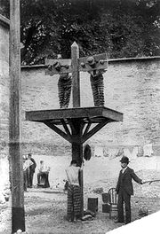
Flagellation

Encyclopedia
Flagellation or flogging is the act of methodically beating or whip
ping (Latin flagellum, "whip") the human body. Specialised implements for it include rods, switches
, the cat o' nine tails
and the sjambok
. Typically, flogging is imposed on an unwilling subject as a punishment; however, it can also be submitted to willingly, or performed on oneself, in religious or sadomasochistic contexts
.
In some circumstances the word "flogging" is used loosely to include any sort of corporal punishment, including birching
and caning
. However, in British legal terminology, a distinction was drawn (and still is, in one or two colonial territories) between "flogging" (with a cat-o'-nine-tails) and "whipping" (formerly with a whip, but since the early 19th century with a birch). In Britain these were both abolished in 1948.
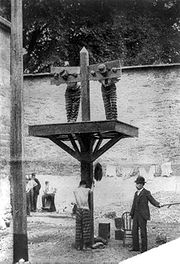 Flogging was a common disciplinary measure in the British navy
that became associated with a seaman's manly disregard for pain. Aboard ships, knittles or the cat o' nine tails
was used for severe formal punishment, while a "rope's end" or "starter" was used to administer informal, on-the-spot discipline.
Flagellation probably originated in the Near East but then spread throughout the ancient world. In Sparta
, young men were flogged as a test of their masculinity. Jewish law
limited flagellation to forty strokes, and in practice delivered thirty-nine, so as to avoid any possibility of breaking this law due to a miscount. Additionally they would have a doctor monitor the punishment, who would stop it if it became too much for the person to bear safely.
In the Roman Empire
, flagellation was often used as a prelude to crucifixion
, and in this context is sometimes referred to as scourging. Whips with small pieces of metal or bone at the tips were commonly used. Such a device could easily cause disfigurement and serious trauma, such as ripping pieces of flesh from the body or loss of an eye. In addition to causing severe pain, the victim would approach a state of hypovolemic shock
due to loss of blood.
The Romans reserved this treatment for non-citizens, as stated in the lex Porcia and lex Sempronia, dating from 195 and 123 BCE. The poet Horace
refers to the horribile flagellum (horrible whip) in his Satires. Typically, the one to be punished was stripped naked and bound to a low pillar so that he could bend over it, or chained to an upright pillar so as to be stretched out. Two lictor
s (some reports indicate scourgings with four or six lictors) alternated blows from the bare shoulders down the body to the soles of the feet. There was no limit to the number of blows inflicted - this was left to the lictors to decide, though they were normally not supposed to kill the victim. Nonetheless, Livy
, Suetonius
and Josephus
report cases of flagellation where victims died while still bound to the post. Flagellation was referred to as "half death" by some authors and apparently, many victims died shortly thereafter. Cicero
reports in In Verrem, "pro mortuo sublatus brevi postea mortuus" ("taken away for a dead man, shortly thereafter he was dead"). In some cases the victim was turned over to allow flagellation on the chest, though this proceeded with more caution, as the possibility of inflicting a fatal blow was much greater.
In the reign of Henry VIII was passed (1530) the famous Whipping Act, directing vagrant
s to be carried to some market town or other place “and there tied to the end of a cart naked and beaten with whips throughout such market town till the body shall be bloody.”
Whipping was used during the French Revolution. On 31 May 1793, the Jacobin women seized a revolutionary leader, Anne Josephe Theroigne de Mericourt
, stripped her naked, and flogged her on the bare bottom in the public garden of the Tuileries. After this humiliation, she refused to wear any clothes, in memory of the outrage she had suffered. She went mad and ended her days in an asylum after the public whipping.
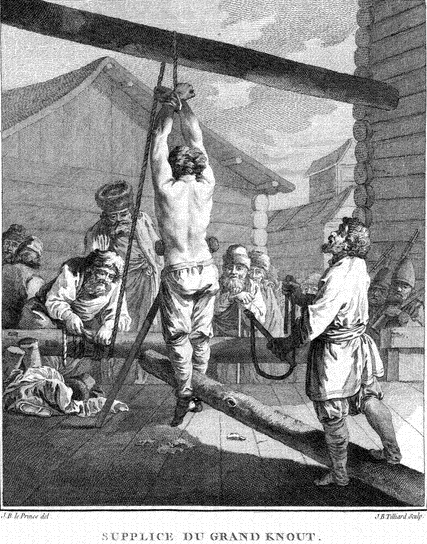 Knout
Knout
s were used in Russia
for flogging as formal corporal punishment of criminals and political offenders. A sentence of 100 or 120 lashes was equivalent to a death sentence. Whipping was also a common punishment for Russian serfs.
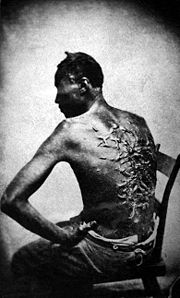 Whipping has been used as a form of discipline against slaves. It was frequently carried out during the period of slavery in the United States, by owners of slaves and their employees. The power was also given to slave "patrollers," mostly poor whites, who had among their powers the ability to whip any slave who violated the slave codes
.
is still a common form of punishment in some parts of the world, particularly in many former British territories and in Islam
ic countries. Medically supervised caning
is routinely ordered by the courts as a penalty for some categories of crime in Singapore
, Brunei
, Malaysia
, Tanzania
, Zimbabwe
and elsewhere.
, the American Congress raised the legal limit on lashes from 39 to 100 for soldiers who were convicted by courts-martial. Generally, officers were not flogged. However, in 1745, a cashiered British officer could have his sword broken over his head, among other indignities inflicted on him.
In the Napoleonic Wars
, the maximum number of lashes that could be inflicted on soldiers in the British Army reached 1,200. This many lashes could permanently disable or kill a man. Oman
, historian of the Peninsular War
, noted that the maximum sentence was inflicted "nine or ten times by general court-martial during the whole six years of the war" and that 1,000 lashes were administered about 50 times. Other sentences were for 900, 700, 500 and 300 lashes. One soldier was sentenced to 700 lashes for stealing a beehive. Another man was let off after only 175 of 400 lashes, but spent three weeks in the hospital. Later in the war, the more draconian punishments were abandoned and the offenders shipped to New South Wales instead, where more whippings often awaited them. (See Australian penal colonies section.) Oman later wrote:
Meanwhile, during the French Revolutionary Wars
the French Army stopped floggings altogether. The King's German Legion
(KGL), which were German units in British pay, did not flog. In one case, a British soldier on detached duty with the KGL was sentenced to be flogged, but the German commander refused to carry out the punishment. When the British 73rd Foot flogged a man in occupied France in 1814, disgusted French citizens protested against it.
At the urging of New Hampshire
Senator John P. Hale
, the United States
"Congress banned flogging on all U.S. ships in September 1850." Hale was inspired by Herman Melville
's "vivid description of flogging, a brutal staple of 19th century naval discipline" in Melville's "novelized memoir" White Jacket. Melville also included a vivid depiction of flogging, and the circumstances surrounding it, in his more famous work, Moby-Dick
.
One of few countries where corporal punishment is still officially used in the armed forces is Singapore
, where military legislation provides that errant soldiers can be sentenced by court-martial to strokes of the cane
.
and British Royal Navy as a means of discipline, flagellation also featured prominently in the British penal colonies
in early colonial Australia. Given that convict
s in Australia were already "imprisoned", punishments for offenses committed in the colonies could not usually result in imprisonment and thus usually consisted of corporal punishment such as hard labour or flagellation. Unlike Roman times, British law explicitly forbade the combination of corporal and capital punishment
; thus, a convict was either flogged or hanged but never both.
Flagellation took place either with a single whip or, more notoriously, with the cat o' nine tails
. Typically, the offender's upper half was bared and he was suspended by the wrists beneath a tripod of wooden beams (known as 'the triangle').
With the prisoner thus stripped and bound, either one or two floggers administered the prescribed number of strokes, or "lashes," to the victim's back. During the flogging, a doctor or other medical worker was consulted at regular intervals as to the condition of the prisoner.
Female convicts were also subject to flogging as punishment, both on the convict ships and in the penal colonies. Although they were generally given fewer lashes than males (usually limited to 40 in each flogging), there was no other difference between the manner in which males and females were flogged.
Floggings of both male and female convicts were public, administered before the whole colony's company, assembled especially for the purpose. In addition to the infliction of pain, one of the principal purposes of the flogging was to humiliate the offender in front of his mates and to demonstrate, in a forceful way, that he had been required to submit to authority.
(See also: History of Australia
).
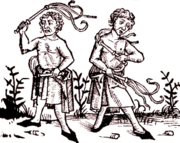
and Rabbinic law lashes may be given for offenses that do not merit capital punishment, and may not exceed 40. However in the absence of a Sanhedrin
, corporal punishment is not practiced in Jewish law. Halakha
specifies the lashes must be given in sets of three, so the total number cannot exceed 39. Also, the person whipped is first judged whether they can withstand the punishment, if not, the number of whips is decreased.
young men ran through the streets with thongs cut from the hide of goats which had just been sacrificed, and women who wished to conceive put themselves in their way to receive blows, apparently mostly on the hands. Greco-Roman mystery religions
also sometimes involved ritual flagellation, as famously depicted in the Villa of the Mysteries
at Pompeii
, apparently showing initiation into the Dionysian Mysteries
.
, an episode in the Passion of Christ
prior to the Jesus' crucifixion
. The practice of mortification of the flesh
for religious purposes was utilized by some Christians throughout most of Christian history, especially in Catholic monasteries and convents.
In the 13th century, a radical group of Christians, known as the Flagellant
s, took this practice to an extreme. The Flagellants were later condemned by the Catholic Church as a cult in the 14th century. Self-flagellation remains common in the Philippines
and Latin America
.
Some members of strict monastic orders, and some members of the lay organization Opus Dei
, practice mild self-flagellation using an instrument called a "discipline", a cattail whip usually made of knotted cords, which is flung over the shoulders repeatedly during private prayer. The practice has become rare within the Catholic Church, particularly as rigorism is rejected.
St. Therese of Lisieux, a Carmelite nun of late 19th century France who has now been declared a Doctor of the Church, is an influential example of a Catholic Saint who questioned prevailing attitudes toward physical penance. Her view was that loving acceptance of the many sufferings of daily life was pleasing to God, and fostered loving relationships with other people, moreso than taking on oneself extraneous sufferings through instruments of penance.
law. It is the prescribed punishment (hadd) for offences including fornication, alcohol use and slander and is also widely favoured as a discretionary punishment (ta'zir) for many offences, such as violating gender interaction laws. Punishment is normally carried out in public.
In Islam, lashes for punishment for women are often performed with the Qu'ran under one arm to minimise the swing and as a reminder of the source of legislation. They are not supposed to leave permanent scars, and when the number of lashes is high, are frequently done in batches to minimise risk of harm. Such protection does not exist in the case of lashing for men.
In some Shi'ite communities worldwide, Shi'ites march in massive parades while flogging themselves on the back with knives, blades and chains every year to commemorate the martyrdom of Hussein
. Some of these self-flogging rituals include zanjeer zani, talwar
zani, qama ka matam, and tatbir. This happens in many countries of the world including India
, Pakistan
, Iraq
and Lebanon
. In Iran
there is an unannounced ban on the use of knives and sharp blades for Mätam
or flagellation but chains can be used. In hardline Salafi
countries like Saudi Arabia
these practises are strictly forbidden in every form, which, by many Shi'ites is considered a severe violation of Human Rights
and religious freedom.
s as part of ritualistic practices or ceremonies to achieve unusual states of mind.
Whip
A whip is a tool traditionally used by humans to exert control over animals or other people, through pain compliance or fear of pain, although in some activities whips can be used without use of pain, such as an additional pressure aid in dressage...
ping (Latin flagellum, "whip") the human body. Specialised implements for it include rods, switches
Switch (rod)
A switch is a flexible rod, typically used for corporal punishment of the birching type, called switching after it, especially when using a single branch: multiple branches are rather called a rod, a less flexible single rod is rather called a cane, an inflexible one a stick; a paddle is broader...
, the cat o' nine tails
Cat o' nine tails
The cat o' nine tails, commonly shortened to the cat, is a type of multi-tailed whipping device that originated as an implement for severe physical punishment, notably in the Royal Navy and Army of the United Kingdom, and also as a judicial punishment in Britain and some other...
and the sjambok
Sjambok
The sjambok or litupa is the official heavy leather whip of South Africa, sometimes seen as synonymous with apartheid but actually much older and still used outside the official judiciary....
. Typically, flogging is imposed on an unwilling subject as a punishment; however, it can also be submitted to willingly, or performed on oneself, in religious or sadomasochistic contexts
Impact play
Impact play is a human sexual practice in which one person is struck by another person for the sexual gratification of either or both parties. Impact play is sometimes referred to as corporal punishment or CP...
.
In some circumstances the word "flogging" is used loosely to include any sort of corporal punishment, including birching
Birching
Birching is a corporal punishment with a birch rod, typically applied to the recipient's bare buttocks, although occasionally to the back and/or shoulders.-Implement:...
and caning
Caning
Caning is a form of corporal punishment consisting of a number of hits with a single cane usually made of rattan, generally applied to the offender's bare or clothed buttocks or hand . Application of a cane to the knuckles or the shoulders has been much less common...
. However, in British legal terminology, a distinction was drawn (and still is, in one or two colonial territories) between "flogging" (with a cat-o'-nine-tails) and "whipping" (formerly with a whip, but since the early 19th century with a birch). In Britain these were both abolished in 1948.
Disciplinary use and torture
Royal Navy
The Royal Navy is the naval warfare service branch of the British Armed Forces. Founded in the 16th century, it is the oldest service branch and is known as the Senior Service...
that became associated with a seaman's manly disregard for pain. Aboard ships, knittles or the cat o' nine tails
Cat o' nine tails
The cat o' nine tails, commonly shortened to the cat, is a type of multi-tailed whipping device that originated as an implement for severe physical punishment, notably in the Royal Navy and Army of the United Kingdom, and also as a judicial punishment in Britain and some other...
was used for severe formal punishment, while a "rope's end" or "starter" was used to administer informal, on-the-spot discipline.
Flagellation probably originated in the Near East but then spread throughout the ancient world. In Sparta
Sparta
Sparta or Lacedaemon, was a prominent city-state in ancient Greece, situated on the banks of the River Eurotas in Laconia, in south-eastern Peloponnese. It emerged as a political entity around the 10th century BC, when the invading Dorians subjugated the local, non-Dorian population. From c...
, young men were flogged as a test of their masculinity. Jewish law
Halakha
Halakha — also transliterated Halocho , or Halacha — is the collective body of Jewish law, including biblical law and later talmudic and rabbinic law, as well as customs and traditions.Judaism classically draws no distinction in its laws between religious and ostensibly non-religious life; Jewish...
limited flagellation to forty strokes, and in practice delivered thirty-nine, so as to avoid any possibility of breaking this law due to a miscount. Additionally they would have a doctor monitor the punishment, who would stop it if it became too much for the person to bear safely.
In the Roman Empire
Roman Empire
The Roman Empire was the post-Republican period of the ancient Roman civilization, characterised by an autocratic form of government and large territorial holdings in Europe and around the Mediterranean....
, flagellation was often used as a prelude to crucifixion
Crucifixion
Crucifixion is an ancient method of painful execution in which the condemned person is tied or nailed to a large wooden cross and left to hang until dead...
, and in this context is sometimes referred to as scourging. Whips with small pieces of metal or bone at the tips were commonly used. Such a device could easily cause disfigurement and serious trauma, such as ripping pieces of flesh from the body or loss of an eye. In addition to causing severe pain, the victim would approach a state of hypovolemic shock
Hypovolemia
In physiology and medicine, hypovolemia is a state of decreased blood volume; more specifically, decrease in volume of blood plasma...
due to loss of blood.
The Romans reserved this treatment for non-citizens, as stated in the lex Porcia and lex Sempronia, dating from 195 and 123 BCE. The poet Horace
Horace
Quintus Horatius Flaccus , known in the English-speaking world as Horace, was the leading Roman lyric poet during the time of Augustus.-Life:...
refers to the horribile flagellum (horrible whip) in his Satires. Typically, the one to be punished was stripped naked and bound to a low pillar so that he could bend over it, or chained to an upright pillar so as to be stretched out. Two lictor
Lictor
The lictor was a member of a special class of Roman civil servant, with special tasks of attending and guarding magistrates of the Roman Republic and Empire who held imperium, the right and power to command; essentially, a bodyguard...
s (some reports indicate scourgings with four or six lictors) alternated blows from the bare shoulders down the body to the soles of the feet. There was no limit to the number of blows inflicted - this was left to the lictors to decide, though they were normally not supposed to kill the victim. Nonetheless, Livy
Livy
Titus Livius — known as Livy in English — was a Roman historian who wrote a monumental history of Rome and the Roman people. Ab Urbe Condita Libri, "Chapters from the Foundation of the City," covering the period from the earliest legends of Rome well before the traditional foundation in 753 BC...
, Suetonius
Lives of the Twelve Caesars
De vita Caesarum commonly known as The Twelve Caesars, is a set of twelve biographies of Julius Caesar and the first 11 emperors of the Roman Empire written by Gaius Suetonius Tranquillus.The work, written in AD 121 during the reign of the emperor Hadrian, was the most popular work of Suetonius,...
and Josephus
Josephus
Titus Flavius Josephus , also called Joseph ben Matityahu , was a 1st-century Romano-Jewish historian and hagiographer of priestly and royal ancestry who recorded Jewish history, with special emphasis on the 1st century AD and the First Jewish–Roman War, which resulted in the Destruction of...
report cases of flagellation where victims died while still bound to the post. Flagellation was referred to as "half death" by some authors and apparently, many victims died shortly thereafter. Cicero
Cicero
Marcus Tullius Cicero , was a Roman philosopher, statesman, lawyer, political theorist, and Roman constitutionalist. He came from a wealthy municipal family of the equestrian order, and is widely considered one of Rome's greatest orators and prose stylists.He introduced the Romans to the chief...
reports in In Verrem, "pro mortuo sublatus brevi postea mortuus" ("taken away for a dead man, shortly thereafter he was dead"). In some cases the victim was turned over to allow flagellation on the chest, though this proceeded with more caution, as the possibility of inflicting a fatal blow was much greater.
In the reign of Henry VIII was passed (1530) the famous Whipping Act, directing vagrant
Vagrant
A vagrant is an itinerant person without a home or regular employment.Vagrant or vagrancy may also refer to:*Vagrancy , the state of roaming or growing far outside of ones species' usual range*Vagrant , an American racehorse...
s to be carried to some market town or other place “and there tied to the end of a cart naked and beaten with whips throughout such market town till the body shall be bloody.”
Whipping was used during the French Revolution. On 31 May 1793, the Jacobin women seized a revolutionary leader, Anne Josephe Theroigne de Mericourt
Anne Josephe Theroigne de Mericourt
Anne-Josèphe Théroigne de Méricourt , a French woman who was a figure in the French Revolution, was born at Marcourt , a small town in Luxembourg province in modern Belgium, on the banks of the Ourthe...
, stripped her naked, and flogged her on the bare bottom in the public garden of the Tuileries. After this humiliation, she refused to wear any clothes, in memory of the outrage she had suffered. She went mad and ended her days in an asylum after the public whipping.
Knout
A knout is a heavy scourge-like multiple whip, usually made of a bunch of rawhide thongs attached to a long handle, sometimes with metal wire or hooks incorporated....
s were used in Russia
Russian Empire
The Russian Empire was a state that existed from 1721 until the Russian Revolution of 1917. It was the successor to the Tsardom of Russia and the predecessor of the Soviet Union...
for flogging as formal corporal punishment of criminals and political offenders. A sentence of 100 or 120 lashes was equivalent to a death sentence. Whipping was also a common punishment for Russian serfs.
Use against slaves
Slave codes
Slave codes were laws each US state, which defined the status of slaves and the rights of masters. These codes gave slave-owners absolute power over the African slaves.-Definition of "slaves":Virginia, 1650:“Act XI...
.
Present-day official flogging
No longer used in most Western countries, flogging or whippingJudicial corporal punishment
Judicial corporal punishment refers to the infliction of corporal punishment as a result of a sentence by a court of law. The punishment can be flogging, caning, birching, whipping, or strapping...
is still a common form of punishment in some parts of the world, particularly in many former British territories and in Islam
Islam
Islam . The most common are and . : Arabic pronunciation varies regionally. The first vowel ranges from ~~. The second vowel ranges from ~~~...
ic countries. Medically supervised caning
Caning
Caning is a form of corporal punishment consisting of a number of hits with a single cane usually made of rattan, generally applied to the offender's bare or clothed buttocks or hand . Application of a cane to the knuckles or the shoulders has been much less common...
is routinely ordered by the courts as a penalty for some categories of crime in Singapore
Caning in Singapore
Caning is a widely used form of legal corporal punishment in Singapore. It can be divided into several contexts: judicial, military, school, reformatory/prison, and domestic/private....
, Brunei
Brunei
Brunei , officially the State of Brunei Darussalam or the Nation of Brunei, the Abode of Peace , is a sovereign state located on the north coast of the island of Borneo, in Southeast Asia...
, Malaysia
Caning in Malaysia
Caning is form of corporal punishment used in Malaysia. Judicial caning, ordered as part of a criminal sentence imposed by a civil court on a male offender, is the most severe form of caning used in Malaysia and is always combined with a prison sentence for adult offenders.A much less severe form...
, Tanzania
Tanzania
The United Republic of Tanzania is a country in East Africa bordered by Kenya and Uganda to the north, Rwanda, Burundi, and the Democratic Republic of the Congo to the west, and Zambia, Malawi, and Mozambique to the south. The country's eastern borders lie on the Indian Ocean.Tanzania is a state...
, Zimbabwe
Zimbabwe
Zimbabwe is a landlocked country located in the southern part of the African continent, between the Zambezi and Limpopo rivers. It is bordered by South Africa to the south, Botswana to the southwest, Zambia and a tip of Namibia to the northwest and Mozambique to the east. Zimbabwe has three...
and elsewhere.
Flogging as military punishment
In the 18th and 19th centuries, European armies administered floggings to common soldiers who committed breaches of the military code. During the American Revolutionary WarAmerican Revolutionary War
The American Revolutionary War , the American War of Independence, or simply the Revolutionary War, began as a war between the Kingdom of Great Britain and thirteen British colonies in North America, and ended in a global war between several European great powers.The war was the result of the...
, the American Congress raised the legal limit on lashes from 39 to 100 for soldiers who were convicted by courts-martial. Generally, officers were not flogged. However, in 1745, a cashiered British officer could have his sword broken over his head, among other indignities inflicted on him.
In the Napoleonic Wars
Napoleonic Wars
The Napoleonic Wars were a series of wars declared against Napoleon's French Empire by opposing coalitions that ran from 1803 to 1815. As a continuation of the wars sparked by the French Revolution of 1789, they revolutionised European armies and played out on an unprecedented scale, mainly due to...
, the maximum number of lashes that could be inflicted on soldiers in the British Army reached 1,200. This many lashes could permanently disable or kill a man. Oman
Charles Oman
Sir Charles William Chadwick Oman was a British military historian of the early 20th century. His reconstructions of medieval battles from the fragmentary and distorted accounts left by chroniclers were pioneering...
, historian of the Peninsular War
Peninsular War
The Peninsular War was a war between France and the allied powers of Spain, the United Kingdom, and Portugal for control of the Iberian Peninsula during the Napoleonic Wars. The war began when French and Spanish armies crossed Spain and invaded Portugal in 1807. Then, in 1808, France turned on its...
, noted that the maximum sentence was inflicted "nine or ten times by general court-martial during the whole six years of the war" and that 1,000 lashes were administered about 50 times. Other sentences were for 900, 700, 500 and 300 lashes. One soldier was sentenced to 700 lashes for stealing a beehive. Another man was let off after only 175 of 400 lashes, but spent three weeks in the hospital. Later in the war, the more draconian punishments were abandoned and the offenders shipped to New South Wales instead, where more whippings often awaited them. (See Australian penal colonies section.) Oman later wrote:
Meanwhile, during the French Revolutionary Wars
French Revolutionary Wars
The French Revolutionary Wars were a series of major conflicts, from 1792 until 1802, fought between the French Revolutionary government and several European states...
the French Army stopped floggings altogether. The King's German Legion
King's German Legion
The King's German Legion was a British Army unit of expatriate German personnel, 1803–16. The Legion achieved the distinction of being the only German force to fight without interruption against the French during the Napoleonic Wars....
(KGL), which were German units in British pay, did not flog. In one case, a British soldier on detached duty with the KGL was sentenced to be flogged, but the German commander refused to carry out the punishment. When the British 73rd Foot flogged a man in occupied France in 1814, disgusted French citizens protested against it.
At the urging of New Hampshire
New Hampshire
New Hampshire is a state in the New England region of the northeastern United States of America. The state was named after the southern English county of Hampshire. It is bordered by Massachusetts to the south, Vermont to the west, Maine and the Atlantic Ocean to the east, and the Canadian...
Senator John P. Hale
John P. Hale
John Parker Hale was an American politician and lawyer from New Hampshire. He served in the United States House of Representatives from 1843 to 1845 and in the United States Senate from 1847 to 1853 and again from 1855 to 1865. He was the first senator to make a stand against slavery...
, the United States
United States
The United States of America is a federal constitutional republic comprising fifty states and a federal district...
"Congress banned flogging on all U.S. ships in September 1850." Hale was inspired by Herman Melville
Herman Melville
Herman Melville was an American novelist, short story writer, essayist, and poet. He is best known for his novel Moby-Dick and the posthumous novella Billy Budd....
's "vivid description of flogging, a brutal staple of 19th century naval discipline" in Melville's "novelized memoir" White Jacket. Melville also included a vivid depiction of flogging, and the circumstances surrounding it, in his more famous work, Moby-Dick
Moby-Dick
Moby-Dick; or, The Whale, was written by American author Herman Melville and first published in 1851. It is considered by some to be a Great American Novel and a treasure of world literature. The story tells the adventures of wandering sailor Ishmael, and his voyage on the whaleship Pequod,...
.
One of few countries where corporal punishment is still officially used in the armed forces is Singapore
Singapore
Singapore , officially the Republic of Singapore, is a Southeast Asian city-state off the southern tip of the Malay Peninsula, north of the equator. An island country made up of 63 islands, it is separated from Malaysia by the Straits of Johor to its north and from Indonesia's Riau Islands by the...
, where military legislation provides that errant soldiers can be sentenced by court-martial to strokes of the cane
Caning in Singapore
Caning is a widely used form of legal corporal punishment in Singapore. It can be divided into several contexts: judicial, military, school, reformatory/prison, and domestic/private....
.
Australian penal colonies
Common in the British ArmyBritish Army
The British Army is the land warfare branch of Her Majesty's Armed Forces in the United Kingdom. It came into being with the unification of the Kingdom of England and Scotland into the Kingdom of Great Britain in 1707. The new British Army incorporated Regiments that had already existed in England...
and British Royal Navy as a means of discipline, flagellation also featured prominently in the British penal colonies
Penal colony
A penal colony is a settlement used to exile prisoners and separate them from the general populace by placing them in a remote location, often an island or distant colonial territory...
in early colonial Australia. Given that convict
Convict
A convict is "a person found guilty of a crime and sentenced by a court" or "a person serving a sentence in prison", sometimes referred to in slang as simply a "con". Convicts are often called prisoners or inmates. Persons convicted and sentenced to non-custodial sentences often are not termed...
s in Australia were already "imprisoned", punishments for offenses committed in the colonies could not usually result in imprisonment and thus usually consisted of corporal punishment such as hard labour or flagellation. Unlike Roman times, British law explicitly forbade the combination of corporal and capital punishment
Capital punishment
Capital punishment, the death penalty, or execution is the sentence of death upon a person by the state as a punishment for an offence. Crimes that can result in a death penalty are known as capital crimes or capital offences. The term capital originates from the Latin capitalis, literally...
; thus, a convict was either flogged or hanged but never both.
Flagellation took place either with a single whip or, more notoriously, with the cat o' nine tails
Cat o' nine tails
The cat o' nine tails, commonly shortened to the cat, is a type of multi-tailed whipping device that originated as an implement for severe physical punishment, notably in the Royal Navy and Army of the United Kingdom, and also as a judicial punishment in Britain and some other...
. Typically, the offender's upper half was bared and he was suspended by the wrists beneath a tripod of wooden beams (known as 'the triangle').
With the prisoner thus stripped and bound, either one or two floggers administered the prescribed number of strokes, or "lashes," to the victim's back. During the flogging, a doctor or other medical worker was consulted at regular intervals as to the condition of the prisoner.
Female convicts were also subject to flogging as punishment, both on the convict ships and in the penal colonies. Although they were generally given fewer lashes than males (usually limited to 40 in each flogging), there was no other difference between the manner in which males and females were flogged.
Floggings of both male and female convicts were public, administered before the whole colony's company, assembled especially for the purpose. In addition to the infliction of pain, one of the principal purposes of the flogging was to humiliate the offender in front of his mates and to demonstrate, in a forceful way, that he had been required to submit to authority.
(See also: History of Australia
History of Australia
The History of Australia refers to the history of the area and people of Commonwealth of Australia and its preceding Indigenous and colonial societies. Aboriginal Australians are believed to have first arrived on the Australian mainland by boat from the Indonesian archipelago between 40,000 to...
).
Association with religion
Judaism
According to the TorahTorah
Torah- A scroll containing the first five books of the BibleThe Torah , is name given by Jews to the first five books of the bible—Genesis , Exodus , Leviticus , Numbers and Deuteronomy Torah- A scroll containing the first five books of the BibleThe Torah , is name given by Jews to the first five...
and Rabbinic law lashes may be given for offenses that do not merit capital punishment, and may not exceed 40. However in the absence of a Sanhedrin
Sanhedrin
The Sanhedrin was an assembly of twenty-three judges appointed in every city in the Biblical Land of Israel.The Great Sanhedrin was the supreme court of ancient Israel made of 71 members...
, corporal punishment is not practiced in Jewish law. Halakha
Halakha
Halakha — also transliterated Halocho , or Halacha — is the collective body of Jewish law, including biblical law and later talmudic and rabbinic law, as well as customs and traditions.Judaism classically draws no distinction in its laws between religious and ostensibly non-religious life; Jewish...
specifies the lashes must be given in sets of three, so the total number cannot exceed 39. Also, the person whipped is first judged whether they can withstand the punishment, if not, the number of whips is decreased.
Pre-Christianity
During the Ancient Roman festival of LupercaliaLupercalia
Lupercalia was a very ancient, possibly pre-Roman pastoral festival, observed on February 13 through 15 to avert evil spirits and purify the city, releasing health and fertility...
young men ran through the streets with thongs cut from the hide of goats which had just been sacrificed, and women who wished to conceive put themselves in their way to receive blows, apparently mostly on the hands. Greco-Roman mystery religions
Greco-Roman mysteries
Mystery religions, sacred Mysteries or simply mysteries, were religious cults of the Greco-Roman world, participation in which was reserved to initiates....
also sometimes involved ritual flagellation, as famously depicted in the Villa of the Mysteries
Villa of the Mysteries
The Villa of the Mysteries or Villa dei Misteri is a well preserved ruin of a Roman Villa which lies some 400 metres northwest of Pompeii, southern Italy.-Overview:...
at Pompeii
Pompeii
The city of Pompeii is a partially buried Roman town-city near modern Naples in the Italian region of Campania, in the territory of the comune of Pompei. Along with Herculaneum, Pompeii was destroyed and completely buried during a long catastrophic eruption of the volcano Mount Vesuvius spanning...
, apparently showing initiation into the Dionysian Mysteries
Dionysian Mysteries
The Dionysian Mysteries were a ritual of ancient Greece and Rome which used intoxicants and other trance-inducing techniques to remove inhibitions and social constraints, liberating the individual to return to a natural state. It also provided some liberation for those marginalized by Greek...
.
Christianity
The Flagellation refers in a Christian context to the Flagellation of ChristFlagellation of Christ
The Flagellation of Christ, sometimes known as Christ at the Column or the Scourging at the Pillar, is a scene from the Passion of Christ very frequently shown in Christian art, in cycles of the Passion or the larger subject of the Life of Christ. It is the fourth station of the modern alternate...
, an episode in the Passion of Christ
Passion (Christianity)
The Passion is the Christian theological term used for the events and suffering – physical, spiritual, and mental – of Jesus in the hours before and including his trial and execution by crucifixion...
prior to the Jesus' crucifixion
Crucifixion of Jesus
The crucifixion of Jesus and his ensuing death is an event that occurred during the 1st century AD. Jesus, who Christians believe is the Son of God as well as the Messiah, was arrested, tried, and sentenced by Pontius Pilate to be scourged, and finally executed on a cross...
. The practice of mortification of the flesh
Mortification of the flesh
Mortification of the flesh literally means "putting the flesh to death". The term is primarily used in religious and spiritual contexts. The institutional and traditional terminology of this practice in Catholicism is corporal mortification....
for religious purposes was utilized by some Christians throughout most of Christian history, especially in Catholic monasteries and convents.
In the 13th century, a radical group of Christians, known as the Flagellant
Flagellant
Flagellants are practitioners of an extreme form of mortification of their own flesh by whipping it with various instruments.- History :Flagellantism was a 13th and 14th centuries movement, consisting of radicals in the Catholic Church. It began as a militant pilgrimage and was later condemned by...
s, took this practice to an extreme. The Flagellants were later condemned by the Catholic Church as a cult in the 14th century. Self-flagellation remains common in the Philippines
Philippines
The Philippines , officially known as the Republic of the Philippines , is a country in Southeast Asia in the western Pacific Ocean. To its north across the Luzon Strait lies Taiwan. West across the South China Sea sits Vietnam...
and Latin America
Latin America
Latin America is a region of the Americas where Romance languages – particularly Spanish and Portuguese, and variably French – are primarily spoken. Latin America has an area of approximately 21,069,500 km² , almost 3.9% of the Earth's surface or 14.1% of its land surface area...
.
Some members of strict monastic orders, and some members of the lay organization Opus Dei
Opus Dei
Opus Dei, formally known as The Prelature of the Holy Cross and Opus Dei , is an organization of the Catholic Church that teaches that everyone is called to holiness and that ordinary life is a path to sanctity. The majority of its membership are lay people, with secular priests under the...
, practice mild self-flagellation using an instrument called a "discipline", a cattail whip usually made of knotted cords, which is flung over the shoulders repeatedly during private prayer. The practice has become rare within the Catholic Church, particularly as rigorism is rejected.
St. Therese of Lisieux, a Carmelite nun of late 19th century France who has now been declared a Doctor of the Church, is an influential example of a Catholic Saint who questioned prevailing attitudes toward physical penance. Her view was that loving acceptance of the many sufferings of daily life was pleasing to God, and fostered loving relationships with other people, moreso than taking on oneself extraneous sufferings through instruments of penance.
Islam
Flogging is a form of punishment used under Islamic ShariaSharia
Sharia law, is the moral code and religious law of Islam. Sharia is derived from two primary sources of Islamic law: the precepts set forth in the Quran, and the example set by the Islamic prophet Muhammad in the Sunnah. Fiqh jurisprudence interprets and extends the application of sharia to...
law. It is the prescribed punishment (hadd) for offences including fornication, alcohol use and slander and is also widely favoured as a discretionary punishment (ta'zir) for many offences, such as violating gender interaction laws. Punishment is normally carried out in public.
In Islam, lashes for punishment for women are often performed with the Qu'ran under one arm to minimise the swing and as a reminder of the source of legislation. They are not supposed to leave permanent scars, and when the number of lashes is high, are frequently done in batches to minimise risk of harm. Such protection does not exist in the case of lashing for men.
In some Shi'ite communities worldwide, Shi'ites march in massive parades while flogging themselves on the back with knives, blades and chains every year to commemorate the martyrdom of Hussein
Husayn ibn Ali
Hussein ibn ‘Alī ibn Abī Ṭālib was the son of ‘Alī ibn Abī Ṭālib and Fātimah Zahrā...
. Some of these self-flogging rituals include zanjeer zani, talwar
Talwar
The talwar is a type of curved sword or sabre from India and modern-day Pakistan...
zani, qama ka matam, and tatbir. This happens in many countries of the world including India
India
India , officially the Republic of India , is a country in South Asia. It is the seventh-largest country by geographical area, the second-most populous country with over 1.2 billion people, and the most populous democracy in the world...
, Pakistan
Pakistan
Pakistan , officially the Islamic Republic of Pakistan is a sovereign state in South Asia. It has a coastline along the Arabian Sea and the Gulf of Oman in the south and is bordered by Afghanistan and Iran in the west, India in the east and China in the far northeast. In the north, Tajikistan...
, Iraq
Iraq
Iraq ; officially the Republic of Iraq is a country in Western Asia spanning most of the northwestern end of the Zagros mountain range, the eastern part of the Syrian Desert and the northern part of the Arabian Desert....
and Lebanon
Lebanon
Lebanon , officially the Republic of LebanonRepublic of Lebanon is the most common term used by Lebanese government agencies. The term Lebanese Republic, a literal translation of the official Arabic and French names that is not used in today's world. Arabic is the most common language spoken among...
. In Iran
Iran
Iran , officially the Islamic Republic of Iran , is a country in Southern and Western Asia. The name "Iran" has been in use natively since the Sassanian era and came into use internationally in 1935, before which the country was known to the Western world as Persia...
there is an unannounced ban on the use of knives and sharp blades for Mätam
Matam
Matam may refer to:*Bramham Gari Matham, a pilgrim in India.*Matam, Senegal, a city in Senegal*Matam, Haifa, a business park in Haifa, Israel*Matam, Guinea, a district of the capital Conakr...
or flagellation but chains can be used. In hardline Salafi
Salafi
A Salafi come from Sunni Islam is a follower of an Islamic movement, Salafiyyah, that is supposed to take the Salaf who lived during the patristic period of early Islam as model examples...
countries like Saudi Arabia
Saudi Arabia
The Kingdom of Saudi Arabia , commonly known in British English as Saudi Arabia and in Arabic as as-Sa‘ūdiyyah , is the largest state in Western Asia by land area, constituting the bulk of the Arabian Peninsula, and the second-largest in the Arab World...
these practises are strictly forbidden in every form, which, by many Shi'ites is considered a severe violation of Human Rights
Human rights
Human rights are "commonly understood as inalienable fundamental rights to which a person is inherently entitled simply because she or he is a human being." Human rights are thus conceived as universal and egalitarian . These rights may exist as natural rights or as legal rights, in both national...
and religious freedom.
Ecstatics and Mystics
Because practices such as starvation, sleep denial and flagellation are known to induce altered states, flagellation may be used by religious ecstatics and mysticMysticism
Mysticism is the knowledge of, and especially the personal experience of, states of consciousness, i.e. levels of being, beyond normal human perception, including experience and even communion with a supreme being.-Classical origins:...
s as part of ritualistic practices or ceremonies to achieve unusual states of mind.
See also
- AlgolagniaAlgolagniaAlgolagnia is a sexual tendency which is defined by deriving sexual pleasure and stimulation from physical pain, often involving an erogenous zone.Studies conducted indicate differences in how the brains of those with algolagnia interpret nerve input....
- BirchingBirchingBirching is a corporal punishment with a birch rod, typically applied to the recipient's bare buttocks, although occasionally to the back and/or shoulders.-Implement:...
- CaningCaningCaning is a form of corporal punishment consisting of a number of hits with a single cane usually made of rattan, generally applied to the offender's bare or clothed buttocks or hand . Application of a cane to the knuckles or the shoulders has been much less common...
- Corporal punishmentCorporal punishmentCorporal punishment is a form of physical punishment that involves the deliberate infliction of pain as retribution for an offence, or for the purpose of disciplining or reforming a wrongdoer, or to deter attitudes or behaviour deemed unacceptable...
- Flagellant Confraternities (Central Italy)Flagellant Confraternities (Central Italy)Central Italian flagellant confraternities evolved and emerged from Central Italian confraternities that originated in the tenth century. The members of these original confraternities were lay persons who were devoted to religious life.These groups promoted religious life but were independent of...
- FlayingFlayingFlaying is the removal of skin from the body. Generally, an attempt is made to keep the removed portion of skin intact.-Scope:An animal may be flayed in preparation for human consumption, or for its hide or fur; this is more commonly called skinning....
- Florentine floggingFlorentine floggingFlorentine flogging is a two-handed style of flagellation used in BDSM which involves the rhythmic use of a pair of matching floggers, one in each hand of the person administering the flogging....
- Foot whippingFoot whippingFoot whipping, variously known as bastinado, falanga , and falaka , is a form of corporal punishment in which the soles of the feet are beaten with an object such as a cane, rod or club, a stout leather bullwhip, or a flexible bat of heavy rubber...
- Judicial corporal punishmentJudicial corporal punishmentJudicial corporal punishment refers to the infliction of corporal punishment as a result of a sentence by a court of law. The punishment can be flogging, caning, birching, whipping, or strapping...
- Mortification of the fleshMortification of the fleshMortification of the flesh literally means "putting the flesh to death". The term is primarily used in religious and spiritual contexts. The institutional and traditional terminology of this practice in Catholicism is corporal mortification....
(used primarily in religious and spiritual contexts)
- Paddle (spanking)Paddle (spanking)A spanking paddle is an implement used to strike a person on the buttocks. The act of striking a person with a paddle is known as "paddling". A paddling may be for punishment , or as an initiation or hazing ritual, or for erotic purposes.A paddle has two parts: a handle and a blade...
- ScourgeScourgeA scourge is a whip or lash, especially a multi-thong type used to inflict severe corporal punishment or self-mortification on the back.-Description:...
- SpankingSpankingSpanking refers to the act of striking the buttocks of another person to cause temporary pain without producing physical injury. It generally involves one person striking the buttocks of another person with an open hand. When an open hand is used, spanking is referred to in some countries as...
- Whip
External links
- "Forensic and Clinical Knowledge of the Practice of Crucifixion" by Dr. Frederick Zugibe
- Pilot Guides - Flogging in penal Australia (including animation)
- Zanjeer Zani
- Catholic Encyclopedia: Flagellation
- Suffering and Sainthood The importance of penance and mortification in the Catholic Church