


Common land

Encyclopedia
Common land is land owned collectively or by one person, but over which other people have certain traditional rights, such as to allow their livestock to graze upon it, to collect firewood, or to cut turf for fuel. Originally in medieval England the common was an integral part of the manor
Manor
-Land tenure:*Manor, an estate in land of the mediaeval era in England*Manorialism, a system of land tenure and organization of the rural economy and society in parts of medieval Europe based on the manor*Manor house, the principal house of a manor...
, and was thus legally part of the estate in land
Estate in land
An estate in land is an interest in real property that is or may become possessory.This should be distinguished from an "estate" as used in reference to an area of land, and "estate" as used to refer to property in general....
owned by the lord of the manor
Lord of the Manor
The Lordship of a Manor is recognised today in England and Wales as a form of property and one of three elements of a manor that may exist separately or be combined and may be held in moieties...
, but over which certain classes of manorial tenants and others held certain rights. By extension, the term "commons" has come to be applied to other resources which a community has rights or access to. The older texts use the word "common" to denote any such right, but more modern usage is to refer to particular rights of common, and to reserve the name "common" for the land over which the rights are exercised. "Common land" does not mean state-owned or public land, but is owned by private individuals or corporations called partition units.
Today commons still exist in England, Wales, Scotland and the USA, although their extent is much reduced from the millions of acres that existed until the 17th century.
Historical origins
Historically most rights of common were appurtenant to tenancies of particular plots of land held within a manorManor
-Land tenure:*Manor, an estate in land of the mediaeval era in England*Manorialism, a system of land tenure and organization of the rural economy and society in parts of medieval Europe based on the manor*Manor house, the principal house of a manor...
, and the commoner would be the person who, for the time being, was the occupier of a particular plot of land (or in the case of turbary
Turbary
Turbary is the term used to describe the ancient right to cut turf, or peat, for fuel on a particular area of bog. The word may also be used to describe the associated piece of bog or peatland and, by extension, the material extracted from the turbary...
, even a particular heath
Heath (habitat)
A heath or heathland is a dwarf-shrub habitat found on mainly low quality acidic soils, characterised by open, low growing woody vegetation, often dominated by plants of the Ericaceae. There are some clear differences between heath and moorland...
). Some rights of common were said to be in gross
Easement
An easement is a certain right to use the real property of another without possessing it.Easements are helpful for providing pathways across two or more pieces of property or allowing an individual to fish in a privately owned pond...
, that is, they were unconnected with tenure of land. This was more usual in regions where commons are more extensive, such as in Northern England or the Fens
The Fens
The Fens, also known as the , are a naturally marshy region in eastern England. Most of the fens were drained several centuries ago, resulting in a flat, damp, low-lying agricultural region....
, but also included many village green
Village green
A village green is a common open area which is a part of a settlement. Traditionally, such an area was often common grass land at the centre of a small agricultural settlement, used for grazing and sometimes for community events...
s across England and Wales. Most land with appurtenant commons rights is adjacent to the common or even surrounded by it, but in a few cases it may be some considerable distance away.
Manorial courts defined the details of many of the rights of common allowed to manorial tenants, and such rights formed part of the copyhold
Copyhold
At its origin in medieval England, copyhold tenure was tenure of land according to the custom of the manor, the "title deeds" being a copy of the record of the manorial court....
tenancy whose terms were defined in the manorial court roll.
Example rights of common are:
- PasturePasturePasture is land used for grazing. Pasture lands in the narrow sense are enclosed tracts of farmland, grazed by domesticated livestock, such as horses, cattle, sheep or swine. The vegetation of tended pasture, forage, consists mainly of grasses, with an interspersion of legumes and other forbs...
. Right to pasture cattle, horses, sheep or other animals on the common land. The most widespread right. - Piscary. Right to fish.
- TurbaryTurbaryTurbary is the term used to describe the ancient right to cut turf, or peat, for fuel on a particular area of bog. The word may also be used to describe the associated piece of bog or peatland and, by extension, the material extracted from the turbary...
. Right to take sods of turf for fuel. - Common of marlMarlMarl or marlstone is a calcium carbonate or lime-rich mud or mudstone which contains variable amounts of clays and aragonite. Marl was originally an old term loosely applied to a variety of materials, most of which occur as loose, earthy deposits consisting chiefly of an intimate mixture of clay...
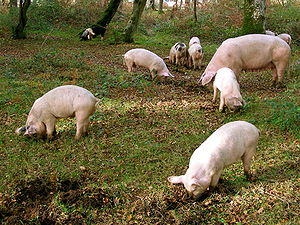
. Right to take sand and gravel. - Mast or pannagePannagePannage is the practice of turning out domestic pigs in a wood or forest, in order that they may feed on fallen acorns, beechmast, chestnuts or other nuts. Historically, it was a right or privilege granted to local people on common land or in royal forests...
. Right to turn out pigs for a period in autumn to eat mast (beechBeechBeech is a genus of ten species of deciduous trees in the family Fagaceae, native to temperate Europe, Asia and North America.-Habit:...
mast, acorns and other nuts). - EstoversEstoversIn English law, estovers is wood that a tenant is allowed to take, for life or a period of years, from the land he holds for the repair of his house, the implements of husbandry, hedges and fences, and for firewood....
. Right to take sufficient wood for the commoner's house or holding; usually limited to smaller trees, bushes (such as gorseGorseGorse, furze, furse or whin is a genus of about 20 plant species of thorny evergreen shrubs in the subfamily Faboideae of the pea family Fabaceae, native to western Europe and northwest Africa, with the majority of species in Iberia.Gorse is closely related to the brooms, and like them, has green...
) and fallen branches.
On most commons, rights of pasture
Pasture
Pasture is land used for grazing. Pasture lands in the narrow sense are enclosed tracts of farmland, grazed by domesticated livestock, such as horses, cattle, sheep or swine. The vegetation of tended pasture, forage, consists mainly of grasses, with an interspersion of legumes and other forbs...
and pannage
Pannage
Pannage is the practice of turning out domestic pigs in a wood or forest, in order that they may feed on fallen acorns, beechmast, chestnuts or other nuts. Historically, it was a right or privilege granted to local people on common land or in royal forests...
for each commoner are tightly defined by number and type of animal. For example the occupier of a particular cottage might be allowed to graze fifteen cattle
Cattle
Cattle are the most common type of large domesticated ungulates. They are a prominent modern member of the subfamily Bovinae, are the most widespread species of the genus Bos, and are most commonly classified collectively as Bos primigenius...
, four horse
Horse
The horse is one of two extant subspecies of Equus ferus, or the wild horse. It is a single-hooved mammal belonging to the taxonomic family Equidae. The horse has evolved over the past 45 to 55 million years from a small multi-toed creature into the large, single-toed animal of today...
s, ponies
Pony
A pony is a small horse . Depending on context, a pony may be a horse that is under an approximate or exact height at the withers, or a small horse with a specific conformation and temperament. There are many different breeds...
or donkey
Donkey
The donkey or ass, Equus africanus asinus, is a domesticated member of the Equidae or horse family. The wild ancestor of the donkey is the African Wild Ass, E...
s, and fifty geese, whilst the numbers allowed for their neighbours would probably be different. On some commons (such as the New Forest
New Forest
The New Forest is an area of southern England which includes the largest remaining tracts of unenclosed pasture land, heathland and forest in the heavily-populated south east of England. It covers south-west Hampshire and extends into south-east Wiltshire....
and adjoining commons), the rights are not limited by numbers, and instead a marking fee is paid each year for each animal turned out.
Partition unit
A partition unit is a corporationCorporation
A corporation is created under the laws of a state as a separate legal entity that has privileges and liabilities that are distinct from those of its members. There are many different forms of corporations, most of which are used to conduct business. Early corporations were established by charter...
that owns common land. In this case, the land is not state-owned or in joint-ownership under a trust, but is owned by a definite partition unit, a legal partnership
Partnership
A partnership is an arrangement where parties agree to cooperate to advance their mutual interests.Since humans are social beings, partnerships between individuals, businesses, interest-based organizations, schools, governments, and varied combinations thereof, have always been and remain commonplace...
whose partners are the participating individual landowners. Common lands and waterways owned by a partition unit were created by an agreement where certain land was reserved for the common use of all adjacent landowners.
Pasture commons
PasturePasture
Pasture is land used for grazing. Pasture lands in the narrow sense are enclosed tracts of farmland, grazed by domesticated livestock, such as horses, cattle, sheep or swine. The vegetation of tended pasture, forage, consists mainly of grasses, with an interspersion of legumes and other forbs...
commons are those where the primary right is to pasture livestock
Livestock
Livestock refers to one or more domesticated animals raised in an agricultural setting to produce commodities such as food, fiber and labor. The term "livestock" as used in this article does not include poultry or farmed fish; however the inclusion of these, especially poultry, within the meaning...
. In the uplands, they are largely moorland
Moorland
Moorland or moor is a type of habitat, in the temperate grasslands, savannas, and shrublands biome, found in upland areas, characterised by low-growing vegetation on acidic soils and heavy fog...
, on the coast they may be salt marsh
Salt marsh
A salt marsh is an environment in the upper coastal intertidal zone between land and salt water or brackish water, it is dominated by dense stands of halophytic plants such as herbs, grasses, or low shrubs. These plants are terrestrial in origin and are essential to the stability of the salt marsh...
, sand dunes or cliff
Cliff
In geography and geology, a cliff is a significant vertical, or near vertical, rock exposure. Cliffs are formed as erosion landforms due to the processes of erosion and weathering that produce them. Cliffs are common on coasts, in mountainous areas, escarpments and along rivers. Cliffs are usually...
s, and on inland lowlands they may be downland
Downland
A downland is an area of open chalk hills. This term is especially used to describe the chalk countryside in southern England. Areas of downland are often referred to as Downs....
, grassland
Grassland
Grasslands are areas where the vegetation is dominated by grasses and other herbaceous plants . However, sedge and rush families can also be found. Grasslands occur naturally on all continents except Antarctica...
, heathland or wood pasture
Wood pasture
Wood pasture is a historical European land management system in which open woodland provided shelter and forage for grazing animals, particularly sheep and cattle, as well as woodland products such as timber for construction and fuel, coppiced stems for wattle and charcoal making and pollarded poles...
, depending on the soil and history. These habitats are often of very high nature conservation value, because of their very long continuity of management extending in some cases over many hundreds of years. In the past, most pasture commons would have been grazed by mixtures of cattle, sheep and ponies (often also geese). The modern survival of grazing on pasture commons over the past century is uneven.
Arable and haymeadow commons
Surviving commons are almost all pasture. In earlier times, arableArable land
In geography and agriculture, arable land is land that can be used for growing crops. It includes all land under temporary crops , temporary meadows for mowing or pasture, land under market and kitchen gardens and land temporarily fallow...
farming and hay
Hay
Hay is grass, legumes or other herbaceous plants that have been cut, dried, and stored for use as animal fodder, particularly for grazing livestock such as cattle, horses, goats, and sheep. Hay is also fed to pets such as rabbits and guinea pigs...
making were also included in the commons system, with strips of land in the common arable fields
Open field system
The open field system was the prevalent agricultural system in much of Europe from the Middle Ages to as recently as the 20th century in some places, particularly Russia and Iran. Under this system, each manor or village had several very large fields, farmed in strips by individual families...
and common haymeadows assigned annually by lot
Sortition
In politics, sortition is the selection of decision makers by lottery. The decision-makers are chosen as a random sample from a larger pool of candidates....
. When not in use for these purposes, such commons were also grazed. Examples include the common arable fields around the village of Laxton in Nottinghamshire, and a common meadow at North Meadow, Cricklade
North Meadow, Cricklade
North Meadow, Cricklade is a hay meadow near the village of Cricklade, in Wiltshire, England. It is 24.6 hectares in size.Over 250 species of higher plant occur in the meadow, but it is of particular note as it holds by far the largest British population of the Snake's-head Fritillary...
.
Law of the Commons
Common law
Common law is law developed by judges through decisions of courts and similar tribunals rather than through legislative statutes or executive branch action...
(coincidence of term only), which pre-date statute law
Statute
A statute is a formal written enactment of a legislative authority that governs a state, city, or county. Typically, statutes command or prohibit something, or declare policy. The word is often used to distinguish law made by legislative bodies from case law, decided by courts, and regulations...
laid down by parliament
Parliament
A parliament is a legislature, especially in those countries whose system of government is based on the Westminster system modeled after that of the United Kingdom. The name is derived from the French , the action of parler : a parlement is a discussion. The term came to mean a meeting at which...
. The exact rights which apply to individual commons were in some cases documented but more often were based on long-held traditions. The UK government tried to regularise the definitions of common land with the Commons Registration Act 1965, which established a register of common land. However numerous inconsistencies and irregularities remain.
Prior to the Erection of Cottages Act 1588, an Englishman could build his house on common land, if he could raise the roof over his head and have a fire in the hearth between sunrise and sunset, and claim the dwelling as his home.
Registered commons often abut each other, so what may appear to be a single large common may in fact consist of several commons with no visible boundary between them — these may for example be in different parish
Parish
A parish is a territorial unit historically under the pastoral care and clerical jurisdiction of one parish priest, who might be assisted in his pastoral duties by a curate or curates - also priests but not the parish priest - from a more or less central parish church with its associated organization...
es. The commoners will have reciprocal rights over each other's commons.
Law of fencing
The maintenance of fences around a common is the responsibility of the occupiers of the adjacent enclosed land, not (as it would be with enclosed land) the responsibility of the owners of the grazed livestock. This can lead to difficulties where not all adjacent occupiers maintain their fences properly.Enclosures
The act of transferring resources from the commons to purely private ownership is known as enclosureEnclosure
Enclosure or inclosure is the process which ends traditional rights such as mowing meadows for hay, or grazing livestock on common land. Once enclosed, these uses of the land become restricted to the owner, and it ceases to be common land. In England and Wales the term is also used for the...
, or (especially in formal use, and in place names) Inclosure. The Inclosure Acts were a series of private Acts of Parliament, mainly from about 1750 to 1850, which enclosed large areas of common, especially the arable and haymeadow land and the better pasture land.
Contrast with "Waste"
It is often thought that a common is somehow owned by everyone, or at least by the community in some sense. While that may have been true more than a thousand years ago, when would be used for grazing by the local community and over which there would not be, nor would there need to be, any particular limit or control of usage; since at least late Anglo-Saxon times, the right to exercise a right of common has been restricted to a commoner.Contrasted with "Forest"
Royal ForestRoyal forest
A royal forest is an area of land with different meanings in England, Wales and Scotland; the term forest does not mean forest as it is understood today, as an area of densely wooded land...
s are legally separate from ordinary commons, but most have a similar commoning system.
Boards of Conservators
Some commons are managed by Boards of ConservatorsConservators
In certain areas of the England, Conservators are statutory bodies which manage areas of countryside for the use of the public.- Establishment, Role and Powers :...
for the wider public benefit. The Commons Act 2006 provides for the establishment of Commons Councils to manage common land. Those provisions of the Act are not yet in force, but the Department of the Environment, Food and Rural Affairs (DEFRA) plans to bring them into force in the spring of 2009. The Commons Councils established under the Act will have a similar role to that of existing Conservators.
Overgrazing
The use of commons rights were carefully controlled, and so in practice commons did not usually suffer from the so-called tragedy of the commonsTragedy of the commons
The tragedy of the commons is a dilemma arising from the situation in which multiple individuals, acting independently and rationally consulting their own self-interest, will ultimately deplete a shared limited resource, even when it is clear that it is not in anyone's long-term interest for this...
. For example, in response to overgrazing a common would be stinted, that is, a limit would be put on the number of animals each commoner was allowed to graze. These regulations were responsive to demographic and economic pressure thus rather than let a common become degraded, access was restricted even further.
Neglect
Ashdown Forest
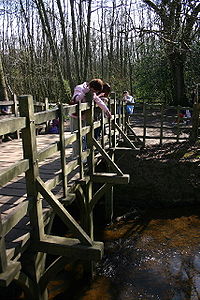
Ashdown Forest is an ancient area of tranquil open heathland occupying the highest sandy ridge-top of the High Weald Area of Outstanding Natural Beauty. It is situated some south of London in the county of East Sussex, England...
, the beautiful Sussex heathland recognised worldwide as the setting for the Winnie-the-Pooh
Winnie-the-Pooh
Winnie-the-Pooh, also called Pooh Bear, is a fictional anthropomorphic bear created by A. A. Milne. The first collection of stories about the character was the book Winnie-the-Pooh , and this was followed by The House at Pooh Corner...
stories, became the centre of a dispute between some local residents and the Forest's governing body, the Board of Conservators, which is responsible for administering the Forest's 2400 hectares (5,930.5 acre) of common land. The Conservators wished to restore the Forest's landscape to one that predominantly consisted of heathland—its defining characteristic until the mid-twentieth century, but something that was in danger of being lost after the Second World War as a result of the advance of woodland into traditional heathland areas when
The Conservators were forced to intervene to stem the invasion of trees, scrub and bracken that threatened the ecologicially precious heathlands, cutting down saplings, removing scrub and mowing the bracken. Some residents complained that the results looked like a First World War battle field. This is not a problem restricted to this common, but according to Jonathan Brown writing in the Independent on 21 April 2007 "similar debates are raging between locals and the authorities at other heathland areas in the New Forest and Surrey".
Roadways
Commons are often crossed by public roads, and this leads to another problem on modern pasture commons where grazing survives (or is to be reintroduced). Historically, the roads would have been cart-tracksCart
A cart is a vehicle designed for transport, using two wheels and normally pulled by one or a pair of draught animals. A handcart is pulled or pushed by one or more people...
, and there would have been no conflict between their horse-drawn
Horse
The horse is one of two extant subspecies of Equus ferus, or the wild horse. It is a single-hooved mammal belonging to the taxonomic family Equidae. The horse has evolved over the past 45 to 55 million years from a small multi-toed creature into the large, single-toed animal of today...
(or ox-drawn
Ox
An ox , also known as a bullock in Australia, New Zealand and India, is a bovine trained as a draft animal. Oxen are commonly castrated adult male cattle; castration makes the animals more tractable...
) traffic and the pastured animals, and no great difficulty if pastured animals wandered off the common along the roads. However, these roads now have fast motorised traffic which does not mix safely with animals. To continue (or restore) grazing, such roads may need fencing or at least blocking at the edge of the common with cattle grid
Cattle grid
A cattle grid or cattle guard – also known as a vehicle pass, Texas gate, stock gap A cattle grid (or stock grid)(British English) or cattle guard (American English) – also known as a vehicle pass, Texas gate, stock gap A cattle grid (or stock grid)(British English) or cattle guard (American...
s — however fencing a common is reminiscent of the process of enclosure, historically fatal to its survival, and permission for fencing on a common is a bureaucratic
Bureaucracy
A bureaucracy is an organization of non-elected officials of a governmental or organization who implement the rules, laws, and functions of their institution, and are occasionally characterized by officialism and red tape.-Weberian bureaucracy:...
process which can be interrupted or prevented by objectors (see neglect of commons below).
Global development
Joachim RadkauJoachim Radkau
Joachim Radkau is a German historian.- Life :Son of a Protestant priest, he studied history in Münster, Berlin and Hamburg from 1963 to 1968. He was influenced e.g. by Fritz Fischer. His doctorate 1970 treated the role of German immigrants 1933-45 on Franklin D. Roosevelt...
assumes the treatment of the commons in the scientific literature of the 18th and later centuries as politically motivated to hasten the Enclosure
Enclosure
Enclosure or inclosure is the process which ends traditional rights such as mowing meadows for hay, or grazing livestock on common land. Once enclosed, these uses of the land become restricted to the owner, and it ceases to be common land. In England and Wales the term is also used for the...
Movement. The omnipresent examples of "Klapprige Allmendekühe" (thin cows of the Commons) in the writings of early agricultural scientists were used to modernize existing common land rule towards a more capitalized and ownership based agriculture. In Germany, based on the English experience, Albrecht Thaer
Albrecht Thaer
Albrecht Daniel Thaer was a renowned German agronomist and an avid supporter of the humus theory for plant nutrition.Thaer was born in Celle and died in Wriezen...
suggested a similar approach. The Allmende or Commons were used to establish experts rule in agriculture, which had before been based on an empiric and practical approach without much interference of trained staff. Radkau assumes that the real Commons estate - meadows and grassland are not at all exhausted but very rich from an ecological standpoint. Neither the old or new use of the Tragedy of the Commons
Tragedy of the commons
The tragedy of the commons is a dilemma arising from the situation in which multiple individuals, acting independently and rationally consulting their own self-interest, will ultimately deplete a shared limited resource, even when it is clear that it is not in anyone's long-term interest for this...
, e.g. of Garrett Hardin
Garrett Hardin
Garrett James Hardin was an American ecologist who warned of the dangers of overpopulation and whose concept of the tragedy of the commons brought attention to "the damage that innocent actions by individuals can inflict on the environment"...
who used the example to ask for management of global common goods (asking for an 'Ökodiktatur', ecodictatorship) were in line with the state of real "Commons". The latter are useful examples of sustainable agriculture and not a failure at all.
England & Wales
Common land, an English development, was used extensively under the law of England and WalesEngland and Wales
England and Wales is a jurisdiction within the United Kingdom. It consists of England and Wales, two of the four countries of the United Kingdom...
and in many former British colonies, for example in Ireland and the USA. All land in England and Wales is owned by someone, and in most cases that person has all the rights of exclusive ownership, to use the land as they wish. However, for common land the owner's rights are restricted, and other people (usually local residents) have some rights over the land. These people are known as commoners—the landowner retains other rights to the land, such as rights to minerals and large timber, and to any common rights left unexercised by the commoners. For example, there are 500 practising commoners in the New Forest
New Forest
The New Forest is an area of southern England which includes the largest remaining tracts of unenclosed pasture land, heathland and forest in the heavily-populated south east of England. It covers south-west Hampshire and extends into south-east Wiltshire....
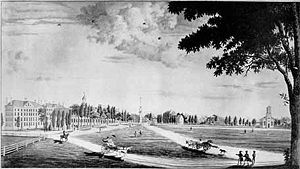
, England. A famous example is the New Haven Green
New Haven Green
The New Haven Green is a privately owned park and recreation area located in the downtown district of the city of New Haven, Connecticut. It comprises the central square of the nine-square settlement plan of the original Puritan colonists in New Haven, and was designed and surveyed by colonist...
in New Haven, Connecticut
New Haven, Connecticut
New Haven is the second-largest city in Connecticut and the sixth-largest in New England. According to the 2010 Census, New Haven's population increased by 5.0% between 2000 and 2010, a rate higher than that of the State of Connecticut, and higher than that of the state's five largest cities, and...
. The North American colonies adopted the English laws in establishing their own commons.
Scotland
There are seven main types of common land in ScotlandScotland
Scotland is a country that is part of the United Kingdom. Occupying the northern third of the island of Great Britain, it shares a border with England to the south and is bounded by the North Sea to the east, the Atlantic Ocean to the north and west, and the North Channel and Irish Sea to the...
, some of which have similarities to common land in England and Wales.
Commonties
The overwhelming majority of areas of common land in lowland Scotland and the HighlandScottish Highlands
The Highlands is an historic region of Scotland. The area is sometimes referred to as the "Scottish Highlands". It was culturally distinguishable from the Lowlands from the later Middle Ages into the modern period, when Lowland Scots replaced Scottish Gaelic throughout most of the Lowlands...
fringes were commonties. A commonty is an area of land where the rights of property
Real property
In English Common Law, real property, real estate, realty, or immovable property is any subset of land that has been legally defined and the improvements to it made by human efforts: any buildings, machinery, wells, dams, ponds, mines, canals, roads, various property rights, and so forth...
or use are shared by two or more neighbouring (though not necessarily adjacent) landowners. They are not therefore truly 'common' land in the sense that anyone can use them, and this distinction meant that it was often very easy for commonties to be divided between landowners after a series of Acts permitting this were passed by the Parliament of Scotland
Parliament of Scotland
The Parliament of Scotland, officially the Estates of Parliament, was the legislature of the Kingdom of Scotland. The unicameral parliament of Scotland is first found on record during the early 13th century, with the first meeting for which a primary source survives at...
in the 17th century, most notably the 1695 Act for the Division of Commonties. As a result the number of commonties declined very rapidly in the 18th and 19th centuries.
Common mosses
Common mosses were areas of bogBog
A bog, quagmire or mire is a wetland that accumulates acidic peat, a deposit of dead plant material—often mosses or, in Arctic climates, lichens....
where the right to dig peat
Peat
Peat is an accumulation of partially decayed vegetation matter or histosol. Peat forms in wetland bogs, moors, muskegs, pocosins, mires, and peat swamp forests. Peat is harvested as an important source of fuel in certain parts of the world...
for fuel were shared by neighbouring landowners. They are therefore similar to commonties and most commonties included a common moss. However the difficulties of dividing such wet areas meant that they were left out of many commonty divisions and many common mosses may still survive, un-noticed because of the decline of peat-cutting.
Run rig
Scottish Highlands
The Highlands is an historic region of Scotland. The area is sometimes referred to as the "Scottish Highlands". It was culturally distinguishable from the Lowlands from the later Middle Ages into the modern period, when Lowland Scots replaced Scottish Gaelic throughout most of the Lowlands...
, where runrig was often associated with an adjacent area of common hill grazing which was also shared by the same farmers as the runrig.
Scattalds
Scattalds are unique to Shetland and are based on udal lawUdal Law
Udal law is a near-defunct Norse derived legal system, which is found in Shetland and Orkney, Scotland and in Manx law at the Isle of Man. It is closely related to Odelsrett....
, rather than the feudal law that predominated in the rest of Scotland. However, Scattalds are very similar to commonties and many were divided under the same 1695 Act that allowed for the division of commonties.
Crown Commons
Crown Commons were areas of land held directly by the crown and therefore the common rights that could be used were rights of use rather than rights of property. Unlike commonties, the rights to use crown commons (for example for grazing livestock) were available to anyone, not just the neighbouring landowners. There are no crown commons left in Scotland; those that survived into the 20th century were taken over by the Crown EstateCrown Estate
In the United Kingdom, the Crown Estate is a property portfolio owned by the Crown. Although still belonging to the monarch and inherent with the accession of the throne, it is no longer the private property of the reigning monarch and cannot be sold by him/her, nor do the revenues from it belong...
.
Greens and loans
Greens were small areas of common land near a settlement where livestock could be kept overnight, markets held and other communal activities carried out. Sometimes they were adjacent to drovers' roads near river crossing points or overnight accommodation. Most were genuinely common land with only the Crown holding any title to them. A loan was a common route through private property allowing access to an area of common land or other public place. As the traditional uses of greens and loans declined, they were often absorbed by the neighbouring landowners.Burgh commons
Burgh commons were areas of common land where property rights or privileges of use were held by the burghBurgh
A burgh was an autonomous corporate entity in Scotland and Northern England, usually a town. This type of administrative division existed from the 12th century, when King David I created the first royal burghs. Burgh status was broadly analogous to borough status, found in the rest of the United...
for their inhabitants. They could include any of the other six types of common land and were sometimes shared with landowners outside the burgh. By the early 19th century, most burgh commons had been appropriated by the wealthy landowners who dominated burgh councils, and very few have survived.
Foreign equivalents
Similar common property regimes are also to be found in southern Asia (e.g., India and Nepal) and Latin America (e.g., Mexico, see ejidoEjido
The ejido system is a process whereby the government promotes the use of communal land shared by the people of the community. This use of community land was a common practice during the time of Aztec rule in Mexico...
), and a concept similar to the Commons is still in use in the alpine countries, especially in Switzerland, known by the German word Allmende. In Finland, water areas are usually commons, owned collectively by the landowners of the shores.
Freedom to Roam
The freedom to roam in Scandinavia and elsewhere is a distinct concept of common land, since it grants rights which are not exploitable for profit, but purely for personal enjoyment. In Scandinavia this is termed AllemansrättenSee also
- Agrarian JusticeAgrarian JusticeAgrarian Justice is the title of a pamphlet written by Thomas Paine, published in 1797, which advocated the use of an estate tax and a tax on land values to fund a universal old-age and disability pension, as well as a fixed sum to be paid to all citizens on reaching maturity...
by Thomas PaineThomas PaineThomas "Tom" Paine was an English author, pamphleteer, radical, inventor, intellectual, revolutionary, and one of the Founding Fathers of the United States... - Citizen's dividendCitizen's dividendCitizen's dividend or citizen's income is a proposed state policy based upon the principle that the natural world is the common property of all persons . It is proposed that all citizens receive regular payments from revenue raised by the state through leasing or selling natural resources for...
- Commons
- Crown EstateCrown EstateIn the United Kingdom, the Crown Estate is a property portfolio owned by the Crown. Although still belonging to the monarch and inherent with the accession of the throne, it is no longer the private property of the reigning monarch and cannot be sold by him/her, nor do the revenues from it belong...
- ExmoorExmoorExmoor is an area of hilly open moorland in west Somerset and north Devon in South West England, named after the main river that flows out of the district, the River Exe. The moor has given its name to a National Park, which includes the Brendon Hills, the East Lyn Valley, the Vale of Porlock and ...
– still grazed by commoners' ponies and sheep. - FlurbereinigungFlurbereinigungFlurbereinigung is the German word used to describe land reforms in various countries, especially Germany and Austria. The term can best be translated as land consolidation. Another European country where those land reforms have been carried out is France...
- Ithaca CommonsIthaca CommonsThe Ithaca Commons is a two-block pedestrian mall in downtown Ithaca, New York, built in 1974. Its boundaries are Green Street to the south, Cayuga Street to the west, Seneca Street to the north, and Aurora Street to the east. It sits at the intersection of Tioga and State Streets...
- Leyton MarshesLeyton MarshesLeyton Marshes are located in the London Borough of Waltham Forest at Leyton.- Geography :The marshes are bordered by the Walthamstow Marshes, River Lee Navigation, River Lee Flood Relief Channel and Hackney Marshes. Much of the original area has been taken over for other uses...
in London, historically Lammas land. - PotreroPotrero-See also:*Potrero Hill, San Francisco, a neighborhood in San Francisco, California, USA*Potrero Chico, a rock climbing area in Mexico*Potrero Point, a land mass extending into San Francisco Bay, San Francisco, California*Point Potrero, Richmond, California...
- Property rights (economics)Property rights (economics)A property right is the exclusive authority to determine how a resource is used, whether that resource is owned by government or by individuals. All economic goods have a property rights attribute...
- Res extra commerciumRes extra commerciumRes extra commercium is a doctrine originating in Roman law, holding that certain things may not be the object of private rights, and are therefore insusceptible to being traded....
- Rights of Way
- SatoyamaSatoyamais a Japanese term applied to the border zone or area between mountain foothills and arable flat land. Literally, sato means arable and livable land or home land, and yama means mountain...
– Japanese term for rural lands used in common by villagers. - Tragedy of the anticommonsTragedy of the anticommonsThe tragedy of the anticommons is a neologism coined by Michael Heller to describe a coordination breakdown where the existence of numerous rightsholders frustrates achieving a socially desirable outcome. The term mirrors the older term tragedy of the commons used to describe coordination...
- Wong – a local term for common.
External links
- http://dlc.dlib.indiana.edu:8080/DLCImage/index.jsp Digital Library of the Commons (DLC), research archive of full-text articles, papers, and dissertations; Comprehensive Bibliography and links to relevant reference sources on the study of the commons
- http://www.thecommonsjournal.org/index.php/ijc International Journal of the Commons
- The Commons: Open Society Sustainability Initiative Technology, sustainable development and "social justice"
- Common land, town and village greens and the Commons Bill
- The Commons Institute - promoting the use of commons (in the wider sense)
- Conservation Commons The Conservation Commons promotes conscious, effective, and equitable sharing of knowledge resources to advance conservation.