

New Haven Green

Encyclopedia
The New Haven Green is a 16 acres (64,749.8 m²) privately owned park and recreation area located in the downtown
district of the city of New Haven, Connecticut
. It comprises the central square of the nine-square settlement plan of the original Puritan
colonists in New Haven, and was designed and surveyed by colonist John Brockett
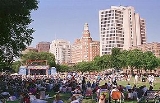
. Today the Green is bordered by the modern paved roads of College, Chapel, Church, and Elm streets. Temple Street bisects the Green into upper (northwest) and lower (southeast) halves. The green is host to numerous public events, such as the Festival of Arts and Ideas]and [New Haven Jazz Festival, summer jazz and classical music concerts that can draw hundreds of thousands of people, as well as typical daily park activities. As New Haven Green Historic District, it was designated a National Historic Landmark District on December 30, 1970.
(commons
) and was originally known as "the marketplace". It was completed in 1638. The Puritans were said to have designed the green large enough to hold the number of people who they believed would be spared in the Second Coming of Christ: 144,000.
In its early years, the Green held a watch house, a prison and a school. The upper Green also once held the First Methodist Church. The church was removed from the Green in 1848 with a new church built across Elm Street (designed by Henry Austin
). The Green also held a succession of statehouses, dating from the time when New Haven was joint capital of Connecticut with Hartford. The most recent state house was erected in 1837, designed by Ithiel Town
in a Greek Revival
style. Ultimately, Hartford was declared the sole capital and the building was demolished in 1889.
The Green served as the parade grounds for the New Haven militia, who, under the leadership of Benedict Arnold
, rushed to Massachusetts after hearing of the Battle of Lexington and Concord and participated in the Battle of Bunker Hill
in the American Revolution
. This indirectly led to the burning of most of the city by the British when they landed in New Haven in 1779.
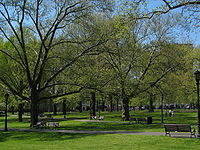
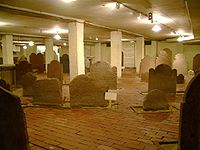 The Green was used as the main burial grounds for the residents of New Haven during its first 150 years, but by 1821 the practice was abolished and many of the headstones were moved to the Grove Street Cemetery
. However, the remains of the dead were not moved, and thus still remain below the soil of the Green. It is estimated that between 5,000 and 10,000 people remain buried there, including Benedict Arnold's
first wife, Reverend James Pierpont
(founder of Yale University
), members of President Rutherford B. Hayes'
family, and Theophilus Eaton
, one of the founders of New Haven and the church and governor of the New Haven Colony for 19 years. A small portion of the burial ground is now preserved in the The Center Church Crypt.
Descendants of the city's original settlers maintain ownership of the green. There are five members of the committee that oversee the large, main portion of the green. Today's committee members — called proprietors — are drawn from the ranks of prominent city residents. Members are appointed for life, and when one dies the four remaining members convene in private to select a replacement.
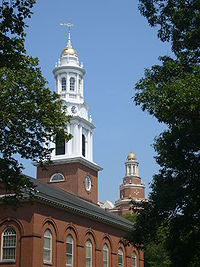 Located on the upper Green are three historic early 19th century churches which reflect the city's theocratic roots:
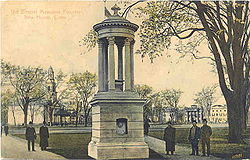
In the lower Green are the Bennett Fountain (built in 1907 and designed after the Choragic Monument of Lysicrates
in Athens) and the flagpole with granite World War I
memorial (designed by Douglas Orr
in 1928) and fountain (added in 2003).
While once the edges of the Green were covered with a glorious canopy of elms, planted originally by James Hillhouse
, most died of dutch elm disease
. In the 1980s, through the efforts of the Garden Club of New Haven, disease-resistant elms were planted in an attempt to memorialize the legacy of the trees that gave New Haven the nickname "Elm City".
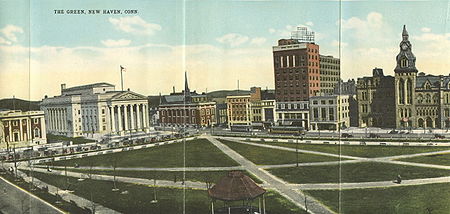
 Bordering the Green are municipal, commercial and university structures. On the northwest side of the Green, across College Street, stand Phelps Gate and the Yale University
buildings bordering Old Campus
. Before the Old Campus was built, the buildings of Yale's Old Brick Row bordered the Green here. On the southwest side along Chapel Street are stores, bars, and such popular restaurants as Claire's Corner Copia
. On the southeast side of the green, across Church Street is The Exchange Building (1832, restored in 1990) and the Federal Courthouse (James Gamble Rogers
, 1913). This was once the site of the Tontine Hotel, built by David Hoadley. New Haven's Victorian City Hall (by Henry Austin
in 1861; restored and added to by Herbert S. Newman and Partners) and the Amistad
Memorial are also at this end of the Green. The memorial stands on the site of the jail that held the Amistad captives during their time in New Haven. Spectators came to see them when they were brought out to exercise on the Green and paid 12 and a half cents to view them in the jail.
Opposite the eastern corner of the lower green is the Union and New Haven Trust Building
(now Wachovia Bank) designed by Cross and Cross in colonial revival style in 1927. The design is a tribute to the federal churches on the green and even borrows the cupola from the United Church. On the northeast side along Elm Street by the lower Green is the New Haven Free Public Library
(Cass Gilbert
, 1908). The library was once the site of the Bristol House, also designed by David Hoadley, whose doorway is now at the Metropolitan Museum of Art
.
 Next to the library is the Beaux-Arts, neoclassical
New Haven County Courthouse
. The courthouse was designed by New Haven architects William Allen and Richard Williams, modeled after St. George's Hall
in Liverpool, England. The statuary in front of the courthouse is by the sculptor J. Massey Rhind
and murals and lunettes inside the courthouse are by the painter T. Thomas Gilbert.
The upper Green on Elm is bordered by "Quality Row", containing some of the oldest structures in New Haven: the federal style white clapboard Nicholas Callahan house, once a tavern (now the Yale Elihu Senior Society
), the federal Eli W. Blake House (now the Graduate Club), the federal John Pierpont house (now the Yale University
Visitor Center) built in 1767 and the brick Greek Revival
Governor Ralph Isaacs Ingersoll House, designed in 1829 by Town and Davis
(future home of Dwight Hall, the student community service organization at Yale).
Downtown New Haven
Downtown New Haven is the neighborhood located in the heart of the city of New Haven, Connecticut. It is made up of the original nine squares laid out in 1638 to form New Haven, including the New Haven Green, and the immediate surrounding central business district, as well as a significant portion...
district of the city of New Haven, Connecticut
New Haven, Connecticut
New Haven is the second-largest city in Connecticut and the sixth-largest in New England. According to the 2010 Census, New Haven's population increased by 5.0% between 2000 and 2010, a rate higher than that of the State of Connecticut, and higher than that of the state's five largest cities, and...
. It comprises the central square of the nine-square settlement plan of the original Puritan
Puritan
The Puritans were a significant grouping of English Protestants in the 16th and 17th centuries. Puritanism in this sense was founded by some Marian exiles from the clergy shortly after the accession of Elizabeth I of England in 1558, as an activist movement within the Church of England...
colonists in New Haven, and was designed and surveyed by colonist John Brockett
John Brockett
John Brockett born in Brockett Hall, Hertfordshire, England. John Brockett was almost certainly the disinherited first son of Sir John Brockett of Brockett Hall in Hertfordshire, England. John fell in love with a maiden, Mary Blackwell , who was also a Puritan...
. Today the Green is bordered by the modern paved roads of College, Chapel, Church, and Elm streets. Temple Street bisects the Green into upper (northwest) and lower (southeast) halves. The green is host to numerous public events, such as the Festival of Arts and Ideas]and [New Haven Jazz Festival, summer jazz and classical music concerts that can draw hundreds of thousands of people, as well as typical daily park activities. As New Haven Green Historic District, it was designated a National Historic Landmark District on December 30, 1970.
History
The Green is a traditional town greenVillage green
A village green is a common open area which is a part of a settlement. Traditionally, such an area was often common grass land at the centre of a small agricultural settlement, used for grazing and sometimes for community events...
(commons
Common land
Common land is land owned collectively or by one person, but over which other people have certain traditional rights, such as to allow their livestock to graze upon it, to collect firewood, or to cut turf for fuel...
) and was originally known as "the marketplace". It was completed in 1638. The Puritans were said to have designed the green large enough to hold the number of people who they believed would be spared in the Second Coming of Christ: 144,000.
In its early years, the Green held a watch house, a prison and a school. The upper Green also once held the First Methodist Church. The church was removed from the Green in 1848 with a new church built across Elm Street (designed by Henry Austin
Henry Austin (architect)
Henry Austin was a prominent and prolific American architect based in New Haven, Connecticut. He practiced for more than fifty years and designed many public buildings and homes primarily in the New Haven area...
). The Green also held a succession of statehouses, dating from the time when New Haven was joint capital of Connecticut with Hartford. The most recent state house was erected in 1837, designed by Ithiel Town
Ithiel Town
Ithiel Town was a prominent American architect and civil engineer. One of the first generation of professional architects in the United States, Town made significant contributions to American architecture in the first half of the 19th century. He was high-strung, sophisticated, generous,...
in a Greek Revival
Greek Revival architecture
The Greek Revival was an architectural movement of the late 18th and early 19th centuries, predominantly in Northern Europe and the United States. A product of Hellenism, it may be looked upon as the last phase in the development of Neoclassical architecture...
style. Ultimately, Hartford was declared the sole capital and the building was demolished in 1889.
The Green served as the parade grounds for the New Haven militia, who, under the leadership of Benedict Arnold
Benedict Arnold
Benedict Arnold V was a general during the American Revolutionary War. He began the war in the Continental Army but later defected to the British Army. While a general on the American side, he obtained command of the fort at West Point, New York, and plotted to surrender it to the British forces...
, rushed to Massachusetts after hearing of the Battle of Lexington and Concord and participated in the Battle of Bunker Hill
Battle of Bunker Hill
The Battle of Bunker Hill took place on June 17, 1775, mostly on and around Breed's Hill, during the Siege of Boston early in the American Revolutionary War...
in the American Revolution
American Revolution
The American Revolution was the political upheaval during the last half of the 18th century in which thirteen colonies in North America joined together to break free from the British Empire, combining to become the United States of America...
. This indirectly led to the burning of most of the city by the British when they landed in New Haven in 1779.
Grove Street Cemetery, New Haven
Grove Street Cemetery or Grove Street Burial Ground in New Haven, Connecticut is located adjacent to the Yale University campus. It was organized in 1796 as the New Haven Burying Ground and incorporated in October 1797 to replace the crowded burial ground on the New Haven Green...
. However, the remains of the dead were not moved, and thus still remain below the soil of the Green. It is estimated that between 5,000 and 10,000 people remain buried there, including Benedict Arnold's
Benedict Arnold
Benedict Arnold V was a general during the American Revolutionary War. He began the war in the Continental Army but later defected to the British Army. While a general on the American side, he obtained command of the fort at West Point, New York, and plotted to surrender it to the British forces...
first wife, Reverend James Pierpont
James Pierpont (Yale founder)
James Pierpont was a Congregationalist minister who is credited with the founding of Yale University in the United States...
(founder of Yale University
Yale University
Yale University is a private, Ivy League university located in New Haven, Connecticut, United States. Founded in 1701 in the Colony of Connecticut, the university is the third-oldest institution of higher education in the United States...
), members of President Rutherford B. Hayes'
Rutherford B. Hayes
Rutherford Birchard Hayes was the 19th President of the United States . As president, he oversaw the end of Reconstruction and the United States' entry into the Second Industrial Revolution...
family, and Theophilus Eaton
Theophilus Eaton
Theophilus Eaton was a merchant, farmer, and Puritan colonial leader who was the co-founder and first governor of New Haven Colony, Connecticut.-Early life and first marriage:...
, one of the founders of New Haven and the church and governor of the New Haven Colony for 19 years. A small portion of the burial ground is now preserved in the The Center Church Crypt.
Descendants of the city's original settlers maintain ownership of the green. There are five members of the committee that oversee the large, main portion of the green. Today's committee members — called proprietors — are drawn from the ranks of prominent city residents. Members are appointed for life, and when one dies the four remaining members convene in private to select a replacement.
On the Green
- United Church on the Green (United Church of ChristUnited Church of ChristThe United Church of Christ is a mainline Protestant Christian denomination primarily in the Reformed tradition but also historically influenced by Lutheranism. The Evangelical and Reformed Church and the Congregational Christian Churches united in 1957 to form the UCC...
/ Congregational), or North Church, was built in Federal style by David HoadleyDavid HoadleyDavid Hoadley was an American architect who worked in New Haven and Middlesex counties in Connecticut.-Career:Born in Waterbury, Connecticut, the son of Lemuel and Urania Hoadley, he began as a carpenter and builder. He was a descendant of William Hoadley of Branford, Connecticut and a cousin of...
in 1814.
- "Center Church of the Green", or The First Church of Christ (United Church of ChristUnited Church of ChristThe United Church of Christ is a mainline Protestant Christian denomination primarily in the Reformed tradition but also historically influenced by Lutheranism. The Evangelical and Reformed Church and the Congregational Christian Churches united in 1957 to form the UCC...
/ Congregational) was established in 1639. The current church, designed in Georgian styleGeorgian architectureGeorgian architecture is the name given in most English-speaking countries to the set of architectural styles current between 1720 and 1840. It is eponymous for the first four British monarchs of the House of Hanover—George I of Great Britain, George II of Great Britain, George III of the United...
by architect Ithiel TownIthiel TownIthiel Town was a prominent American architect and civil engineer. One of the first generation of professional architects in the United States, Town made significant contributions to American architecture in the first half of the 19th century. He was high-strung, sophisticated, generous,...
, was built in 1812. The Center Church Crypt contains the identified remains of about 137 people, and the likely remains of over 1,000 that are unidentified. Sarah Rutherford Trowbridge has the oldest dated stone (1687) in the Crypt.
- Trinity Episcopal Church on the Green is an Episcopal congregation founded in 1752, and was also designed by Ithiel Town. It is one of the first Gothic Revival churches in the United States. It was consecrated in 1816.
In the lower Green are the Bennett Fountain (built in 1907 and designed after the Choragic Monument of Lysicrates
Choragic Monument of Lysicrates
The Choragic Monument of Lysicrates near the Acropolis of Athens was erected by the choregos Lysicrates, a wealthy patron of musical performances in the Theater of Dionysus to commemorate the award of first prize in 335/334 BCE, to one of the performances he had sponsored...
in Athens) and the flagpole with granite World War I
World War I
World War I , which was predominantly called the World War or the Great War from its occurrence until 1939, and the First World War or World War I thereafter, was a major war centred in Europe that began on 28 July 1914 and lasted until 11 November 1918...
memorial (designed by Douglas Orr
Douglas Orr
Douglas William Orr was an American architect based in New Haven, Connecticut. Born in Meriden, Connecticut, he was prolific and designed many public and commercial buildings, primarily in the New Haven area...
in 1928) and fountain (added in 2003).
While once the edges of the Green were covered with a glorious canopy of elms, planted originally by James Hillhouse
James Hillhouse
James Hillhouse was an American lawyer, real estate developer, and politician from New Haven, Connecticut. He represented Connecticut in both the U.S. House and Senate...
, most died of dutch elm disease
Dutch elm disease
Dutch elm disease is a disease caused by a member of the sac fungi category, affecting elm trees which is spread by the elm bark beetle. Although believed to be originally native to Asia, the disease has been accidentally introduced into America and Europe, where it has devastated native...
. In the 1980s, through the efforts of the Garden Club of New Haven, disease-resistant elms were planted in an attempt to memorialize the legacy of the trees that gave New Haven the nickname "Elm City".
Around the Green
Yale University
Yale University is a private, Ivy League university located in New Haven, Connecticut, United States. Founded in 1701 in the Colony of Connecticut, the university is the third-oldest institution of higher education in the United States...
buildings bordering Old Campus
Old Campus
The Old Campus is a complex of buildings at Yale University on the block at the northwest end of the green in New Haven, Connecticut, consisting of dormitories, classrooms, chapels and offices...
. Before the Old Campus was built, the buildings of Yale's Old Brick Row bordered the Green here. On the southwest side along Chapel Street are stores, bars, and such popular restaurants as Claire's Corner Copia
Claire's Corner Copia
Claire's Corner Copia is a vegetarian restaurant in New Haven, Connecticut. It is located at 1000 Chapel Street near the campus of Yale University and the New Haven Green. It is owned by chef Claire Criscuolo and her husband Frank Criscuolo...
. On the southeast side of the green, across Church Street is The Exchange Building (1832, restored in 1990) and the Federal Courthouse (James Gamble Rogers
James Gamble Rogers
James Gamble Rogers was an American architect best known for his academic commissions at Yale University, Columbia University, Northwestern University, and elsewhere....
, 1913). This was once the site of the Tontine Hotel, built by David Hoadley. New Haven's Victorian City Hall (by Henry Austin
Henry Austin (architect)
Henry Austin was a prominent and prolific American architect based in New Haven, Connecticut. He practiced for more than fifty years and designed many public buildings and homes primarily in the New Haven area...
in 1861; restored and added to by Herbert S. Newman and Partners) and the Amistad
Amistad (1841)
The Amistad, also known as United States v. Libellants and Claimants of the Schooner Amistad, 40 U.S. 518 , was a United States Supreme Court case resulting from the rebellion of slaves on board the Spanish schooner Amistad in 1839...
Memorial are also at this end of the Green. The memorial stands on the site of the jail that held the Amistad captives during their time in New Haven. Spectators came to see them when they were brought out to exercise on the Green and paid 12 and a half cents to view them in the jail.
Opposite the eastern corner of the lower green is the Union and New Haven Trust Building
Union and New Haven Trust Building
The Union and New Haven Trust Building, also known as 205 Church Street, is a Georgian-Colonial Revival skyscraper in New Haven, Connecticut. Constructed in 1927, it was designed by architects Cross and Cross...
(now Wachovia Bank) designed by Cross and Cross in colonial revival style in 1927. The design is a tribute to the federal churches on the green and even borrows the cupola from the United Church. On the northeast side along Elm Street by the lower Green is the New Haven Free Public Library
New Haven Free Public Library
The New Haven Free Public Library is the public library system serving New Haven, Connecticut.The system began in 1887 in a leased location but quickly outgrew its space. The Ives Memorial Library is the main branch of the system and is located on the New Haven Green. The neo-Georgian building...
(Cass Gilbert
Cass Gilbert
- Historical impact :Gilbert is considered a skyscraper pioneer; when designing the Woolworth Building he moved into unproven ground — though he certainly was aware of the ground-breaking work done by Chicago architects on skyscrapers and once discussed merging firms with the legendary Daniel...
, 1908). The library was once the site of the Bristol House, also designed by David Hoadley, whose doorway is now at the Metropolitan Museum of Art
Metropolitan Museum of Art
The Metropolitan Museum of Art is a renowned art museum in New York City. Its permanent collection contains more than two million works, divided into nineteen curatorial departments. The main building, located on the eastern edge of Central Park along Manhattan's Museum Mile, is one of the...
.
Neoclassical architecture
Neoclassical architecture was an architectural style produced by the neoclassical movement that began in the mid-18th century, manifested both in its details as a reaction against the Rococo style of naturalistic ornament, and in its architectural formulas as an outgrowth of some classicizing...
New Haven County Courthouse
New Haven County Courthouse
The New Haven County Courthouse is located in the Downtown section of New Haven, Connecticut. The building was built in 1917 and was added to the National Register of Historic Places on May 16, 2003....
. The courthouse was designed by New Haven architects William Allen and Richard Williams, modeled after St. George's Hall
St. George's Hall, Liverpool
St George's Hall is on Lime Street in the centre of the English city of Liverpool, opposite Lime Street railway station. It is a building in Neoclassical style which contains concert halls and law courts, and has been designated by English Heritage as a Grade I listed building...
in Liverpool, England. The statuary in front of the courthouse is by the sculptor J. Massey Rhind
J. Massey Rhind
John Massey Rhind was a Scottish-American sculptor. Among Rhind's better known works is the marble statue of Dr. Crawford W. Long located in the National Statuary Hall Collection in Washington D.C...
and murals and lunettes inside the courthouse are by the painter T. Thomas Gilbert.
The upper Green on Elm is bordered by "Quality Row", containing some of the oldest structures in New Haven: the federal style white clapboard Nicholas Callahan house, once a tavern (now the Yale Elihu Senior Society
Elihu (secret society)
Elihu, founded in 1903, is the sixth oldest secret society at Yale University, New Haven, CT. While similar to Skull and Bones, Scroll and Key and Wolf's Head societies in charter and function, Elihu favors privacy over overt secrecy...
), the federal Eli W. Blake House (now the Graduate Club), the federal John Pierpont house (now the Yale University
Yale University
Yale University is a private, Ivy League university located in New Haven, Connecticut, United States. Founded in 1701 in the Colony of Connecticut, the university is the third-oldest institution of higher education in the United States...
Visitor Center) built in 1767 and the brick Greek Revival
Greek Revival architecture
The Greek Revival was an architectural movement of the late 18th and early 19th centuries, predominantly in Northern Europe and the United States. A product of Hellenism, it may be looked upon as the last phase in the development of Neoclassical architecture...
Governor Ralph Isaacs Ingersoll House, designed in 1829 by Town and Davis
Ithiel Town
Ithiel Town was a prominent American architect and civil engineer. One of the first generation of professional architects in the United States, Town made significant contributions to American architecture in the first half of the 19th century. He was high-strung, sophisticated, generous,...
(future home of Dwight Hall, the student community service organization at Yale).