
All Topics  
Genetic code


   Email Print
   Bookmark   Link


Genetic code


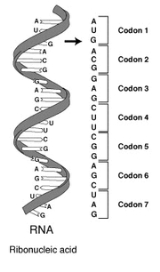
The genetic code is the set of rules by which information encoded in genetic material (DNA
DNA

Deoxyribonucleic acid is a nucleic acid that contains the genetics instructions used in the development and functioning of all known living organisms and some viruses....
 or RNA
RNA

Ribonucleic acid is a type of molecule that consists of a long chain of nucleotide units. Each nucleotide consists of a nucleobase, a ribose sugar, and a phosphate....
 sequences) is translated into protein
Protein

Proteins are organic compounds made of amino acids arranged in a linear chain and joined together by peptide bonds between the carboxyl and amino groups of adjacent amino acid Residue ....
s (amino acid
Amino acid

In chemistry, an amino acid is a molecule containing both amine and carboxyl functional groups. These molecules are particularly important in biochemistry, where this term refers to alpha-amino acids with the general formula H2NCHRCOOH, where R is an organic substituent....
 sequences) by living cell
Cell (biology)

The cell is the structural and functional unit of all known Life organisms. It is the smallest unit of an organism that is classified as living, and is often called the building bricks of life....
s. The code defines a mapping between tri-nucleotide
Nucleotide

Nucleotides are molecules that comprise the structural units of RNA and DNA. Additionally, nucleotides play central roles in metabolism. In that capacity, they serve as sources of chemical energy , participate in cell signaling , and are incorporated into important cofactors of enzymatic reactions ....
 sequences, called codons, and amino acids. A triplet codon in a nucleic acid sequence usually specifies a single amino acid (though insertion of two amino acids at one codon can occur unambiguously in different places in the same protein).


Discussion
Ask a question about 'Genetic code'
Start a new discussion about 'Genetic code'
Answer questions from other users
Full Discussion Forum


Encyclopedia


The genetic code is the set of rules by which information encoded in genetic material (DNA
DNA

Deoxyribonucleic acid is a nucleic acid that contains the genetics instructions used in the development and functioning of all known living organisms and some viruses....
 or RNA
RNA

Ribonucleic acid is a type of molecule that consists of a long chain of nucleotide units. Each nucleotide consists of a nucleobase, a ribose sugar, and a phosphate....
 sequences) is translated into protein
Protein

Proteins are organic compounds made of amino acids arranged in a linear chain and joined together by peptide bonds between the carboxyl and amino groups of adjacent amino acid Residue ....
s (amino acid
Amino acid

In chemistry, an amino acid is a molecule containing both amine and carboxyl functional groups. These molecules are particularly important in biochemistry, where this term refers to alpha-amino acids with the general formula H2NCHRCOOH, where R is an organic substituent....
 sequences) by living cell
Cell (biology)

The cell is the structural and functional unit of all known Life organisms. It is the smallest unit of an organism that is classified as living, and is often called the building bricks of life....
s. The code defines a mapping between tri-nucleotide
Nucleotide

Nucleotides are molecules that comprise the structural units of RNA and DNA. Additionally, nucleotides play central roles in metabolism. In that capacity, they serve as sources of chemical energy , participate in cell signaling , and are incorporated into important cofactors of enzymatic reactions ....
 sequences, called codons, and amino acids. A triplet codon in a nucleic acid sequence usually specifies a single amino acid (though insertion of two amino acids at one codon can occur unambiguously in different places in the same protein). Because the vast majority of gene
Gene

A gene is the basic unit of heredity in a living organism. All living things depend on genes. Genes hold the information to build and maintain their cell and pass genetic trait to offspring....
s are encoded with exactly the same code (see #RNA codon table), this particular code is often referred to as the canonical or standard genetic code, or simply the genetic code, though in fact there are many variant codes. Thus the canonical genetic code is not universal. For example, in humans, protein synthesis in mitochondria
Mitochondrion

In cell biology, a mitochondrion is a membrane-enclosed organelle found in most eukaryote cell . These organelles range from 0.5–10 micrometers in diameter....
 relies on a genetic code that varies from the canonical code.

It is important to know that not all genetic information is stored as the genetic code. All organisms' DNA contain regulatory sequences, intergenic segments, chromosomal structural areas, which can contribute greatly to phenotype
Phenotype

A phenotype is any observable characteristic or trait_ of an organism: such as its morphology , development, biochemical or physiological properties, or behavior....
 but operate using a distinct sets of rules that may or may not be as straightforward as the codon-to-amino acid paradigm that usually underlies the genetic code.

Cracking the genetic code

After the structure of DNA was deciphered by James Watson
James Watson

James Watson is the name of:*James D. Watson , American biologist and co-discoverer of the structure of DNA*James Watson , British film and television actor...
, Francis Crick
Francis Crick

Francis Harry Compton Crick Order of Merit Royal Society , Ph.D., was a British molecular biology, physics, and neuroscience, and most noted for being one of the co-discoverers of the structure of the DNA molecule in 1953....
, Maurice Wilkins
Maurice Wilkins

Maurice Hugh Frederick Wilkins Order of the British Empire Royal Society was a New Zealand-born UKmolecular biology, and Nobel Laureate who contributed research in the fields of phosphorescence, radar, isotope separation, and X-ray diffraction....
 and Rosalind Franklin
Rosalind Franklin

Rosalind Elsie Franklin was an English people biophysicist and X-ray crystallography who made important contributions to the understanding of the fine molecular structures of DNA, viruses, coal and graphite....
, serious efforts to understand the nature of the encoding of proteins began. George Gamow
George Gamow

George Gamow , born Georgiy Antonovich Gamov , was a Russian Empire-born theoretical physicist and cosmologist. He discovered quantum tunneling and worked on radioactive decay of the atomic nucleus, stellar evolution, stellar nucleosynthesis, big bang nucleosynthesis, nucleocosmogenesis and genetics....
 postulated that a three-letter code must be employed to encode the 20 standard amino acid
Amino acid

In chemistry, an amino acid is a molecule containing both amine and carboxyl functional groups. These molecules are particularly important in biochemistry, where this term refers to alpha-amino acids with the general formula H2NCHRCOOH, where R is an organic substituent....
s used by living cells to encode proteins (because 3 is the smallest integer n such that 4n is at least 20).

The fact that codons did consist of three DNA bases was first demonstrated in the Crick, Brenner et al. experiment
Crick, Brenner et al. experiment

The Crick, Brenner et al. experiment was a scientific experiment performed in 1961 by Francis Crick and Sydney Brenner. They demonstrated that three bases of DNA code for one amino acid in the genetic code....
. The first elucidation of a codon was done by Marshall Nirenberg and Heinrich J. Matthaei
Heinrich J. Matthaei

J. Heinrich Matthaei is a German biochemist. He is best known for his unique contribution to solving the genetic code on May 15, 1961. Whilst a post-doctoral visitor in the laboratory of Marshall Warren Nirenberg at the National Institutes of Health in Bethesda, Maryland, he discovered that a synthetic RNA polynucleotide, composed of a repe...
 in 1961 at the National Institutes of Health
National Institutes of Health

The National Institutes of Health is an agency of the United States Department of Health and Human Services and is the primary agency of the United States government responsible for biomedical and health-related research....
. They used a cell-free system
Cell-free system

A cell-free system is a widely-used in vitro tool used to study biological reactions that happen within a Cell with less of the complex interactions found in a whole cell....
 to translate a poly-uracil RNA sequence (or UUUUU... in biochemical terms) and discovered that the polypeptide that they had synthesized consisted of only the amino acid phenylalanine
Phenylalanine

Phenylalanine is an a-amino acid with the chemical formula HO2CCHCH2C6H5, which is found naturally in the breast milk of mammals and manufactured for food and drink products and are also sold as nutritional supplements for their reputed analgesic and antidepressant effects....
. They thereby deduced from this poly-phenylalanine that the codon UUU specified the amino-acid phenylalanine. Extending this work, Nirenberg and his coworkers were able to determine the nucleotide makeup of each codon. In order to determine the order of the sequence, trinucleotides were bound to ribosomes, and radioactively labeled aminoacyl-tRNA was used to determine which amino acid corresponded to the codon. Nirenberg's group was able to determine the sequences of 54 out of 64 codons.

Subsequent work by Har Gobind Khorana
Har Gobind Khorana

Har Gobind Khorana, or Hargobind Khorana is an Indian-American molecular biologist. He was awarded the Nobel Prize in Physiology or Medicine in 1968 for his work on the interpretation of the genetic code and its function in protein biosynthesis....
 identified the rest of the code, and shortly thereafter Robert W. Holley
Robert W. Holley

Robert William Holley was an American biochemist, he was awarded the Nobel Prize in Physiology or Medicine in 1968 for describing the structure of alanine tRNA, linking DNA and protein synthesis....
 determined the structure of transfer RNA
Transfer RNA

Transfer RNA is a small RNA that transfers a specific active amino acid to a growing polypeptide chain at the ribosomal site of protein synthesis during translation ....
, the adapter molecule that facilitates translation. This work was based upon earlier studies by Severo Ochoa
Severo Ochoa

Severo Ochoa de Albornoz was a Spain-United States biochemistry, and the recipient of the 1959 Nobel Prize in Physiology or Medicine....
, who received the Nobel prize in 1959 for his work on the enzymology of RNA synthesis. In 1968, Khorana, Holley and Nirenberg also received the Nobel Prize
Nobel Prize

The Nobel Prize , established in the 1895 will of Swedish chemist Alfred Nobel; it was first awarded in Nobel Prize in Physics, Nobel Prize in Chemistry, Nobel Prize in Physiology or Medicine, Nobel Prize in Literature, and Nobel Peace Prize in 1901....
 in Physiology or Medicine for their work.

Transfer of information via the genetic code


The genome
Genome

In classical genetics, the genome of a diploid organism including eukarya refers to a full set of chromosomes or genes in a gamete; thereby, a regular somatic cell contains two full sets of genomes....
 of an organism
Organism

In biology, an organism is any life thing . In at least some form, all organisms are capable of response to stimulus , reproduction, growth and developmental biology, and maintenance of homeostasis as a stable whole....
 is inscribed in DNA
DNA

Deoxyribonucleic acid is a nucleic acid that contains the genetics instructions used in the development and functioning of all known living organisms and some viruses....
, or in some viruses RNA
RNA

Ribonucleic acid is a type of molecule that consists of a long chain of nucleotide units. Each nucleotide consists of a nucleobase, a ribose sugar, and a phosphate....
. The portion of the genome that codes for a protein or an RNA is referred to as a gene
Gene

A gene is the basic unit of heredity in a living organism. All living things depend on genes. Genes hold the information to build and maintain their cell and pass genetic trait to offspring....
. Those genes that code for proteins are composed of tri-nucleotide units called codons, each coding for a single amino acid. Each nucleotide sub-unit consists of a phosphate
Phosphate

A phosphate, an inorganic chemical, is a Salt of phosphoric acid. Inorganic phosphates are mining to obtain phosphorus for use in agriculture and industry....
, deoxyribose
Deoxyribose

Deoxyribose, also known as D-Deoxyribose and 2-deoxyribose, is an aldopentose — a monosaccharide containing five carbon atoms, and including an aldehyde functional group in its linear structure....
 sugar and one of the 4 nitrogenous nucleotide
Nucleotide

Nucleotides are molecules that comprise the structural units of RNA and DNA. Additionally, nucleotides play central roles in metabolism. In that capacity, they serve as sources of chemical energy , participate in cell signaling , and are incorporated into important cofactors of enzymatic reactions ....
 bases. The purine
Purine

Purine is a heterocyclic compound aromatic organic compound, consisting of a pyrimidine ring fused to an imidazole ring. Purines, including substituted purines and their tautomers, are the most widely distributed kind of nitrogen-containing heterocycle in nature....
 bases adenine
Adenine

Adenine is a nucleobase with a variety of roles in biochemistry including cellular respiration, in the form of both the energy-rich adenosine triphosphate and the cofactor s nicotinamide adenine dinucleotide and flavin adenine dinucleotide , and Protein biosynthesis, as a chemical component of DNA and RNA....
 (A) and guanine
Guanine

Guanine is one of the five main nucleobases found in the nucleic acids DNA and RNA, the others being adenine, cytosine, thymine, and uracil. In DNA, guanine is paired with cytosine....
 (G) are larger and consist of two aromatic rings. The pyrimidine
Pyrimidine

Pyrimidine is a heterocyclic aromatic organic compound similar to benzene and pyridine, containing two nitrogen atoms at positions 1 and 3 of the six-member ring....
 bases cytosine
Cytosine

Cytosine is one of the five main bases found in DNA and RNA. It is a pyrimidine derivative, with a heterocyclic aromatic ring and two substituents attached ....
 (C) and thymine
Thymine

Thymine is one of the four bases in the nucleic acid of DNA that make up the letters GCAT. The others are adenine, guanine, and cytosine. Thymine always pairs with adenine....
 (T) are smaller and consist of only one aromatic ring. In the double-helix configuration, two strands of DNA are joined to each other by hydrogen bonds in an arrangement known as base pair
Base pair

In molecular biology, two nucleotides on opposite complementarity DNA or RNA strands that are connected via hydrogen bonds are called a base pair ....
ing. These bonds almost always form between an adenine base on one strand and a thymine on the other strand and between a cytosine base on one strand and a guanine base on the other. This means that the number of A and T residues will be the same in a given double helix, as will the number of G and C residues. In RNA, thymine (T) is replaced by uracil
Uracil

Uracil is a common and naturally occurring pyrimidine derivative. Originally discovered in 1900, it was isolated by hydrolysis of yeast nuclein that was found in bovine thymus and spleen, herring, sperm, and wheat germ....
 (U), and the deoxyribose is substituted by ribose
Ribose

Ribose, primarily occurring as D-ribose, is an organic compound that occurs widely in nature. It is an aldopentose, that is a monosaccharide containing five carbon atoms that, in its acyclic form, has an aldehyde functional group at one end....
.

Each protein-coding gene is transcribed
Transcription (genetics)

Transcription is the synthesis of RNA under the direction of DNA. RNA synthesis, or transcription, is the process of transcribing DNA nucleotide sequence information into RNA sequence information....
 into a template molecule of the related polymer RNA, known as messenger RNA
Messenger RNA

Messenger ribonucleic acid is a molecule of RNA encoding a chemical "blueprint" for a protein product. mRNA is transcription from a DNA template, and carries coding information to the sites of protein synthesis: the ribosomes....
 or mRNA. This, in turn, is translated
Translation (genetics)

Translation is the first stage of protein biosynthesis . Translation is the production of proteins by decoding mRNA produced in Transcription ....
 on the ribosome
Ribosome

Ribosomes are complexes of RNA and protein that are found in all cell s. Ribosomes from bacteria, archaea and eukaryotes, the three domains of life on Earth, have significantly different structure and RNA....
 into an amino acid
Amino acid

In chemistry, an amino acid is a molecule containing both amine and carboxyl functional groups. These molecules are particularly important in biochemistry, where this term refers to alpha-amino acids with the general formula H2NCHRCOOH, where R is an organic substituent....
 chain or polypeptide
Peptide

Peptides are short polymers formed from the linking, in a defined order, of a-amino acids. The link between one amino acid residue and the next is known as an amide chemical bond or a peptide bond....
. The process of translation requires transfer RNA
Transfer RNA

Transfer RNA is a small RNA that transfers a specific active amino acid to a growing polypeptide chain at the ribosomal site of protein synthesis during translation ....
s specific for individual amino acids with the amino acids covalently attached to them, guanosine triphosphate
Guanosine triphosphate

Guanosine-5'-triphosphate is a purine nucleotide. One role is as substrate for the synthesis of RNA during transcription . Its structure is similar to that of the guanine nucleoside, the only difference being that there are three phosphate groups attached to the 5' carbon....
 as an energy source, and a number of translation factors. tRNAs have anticodons complementary to the codons in mRNA and can be "charged" covalently with amino acids at their 3' terminal CCA ends. Individual tRNAs are charged with specific amino acids by enzymes known as aminoacyl tRNA synthetase
Aminoacyl tRNA synthetase

An aminoacyl tRNA synthetase is an enzyme that catalyzes the esterification of a specific amino acid or its precursor to one of all its compatible cognate tRNAs to form an aminoacyl-tRNA....
s, which have high specificity for both their cognate amino acids and tRNAs. The high specificity of these enzymes is a major reason why the fidelity of protein translation is maintained.

There are 4³ = 64 different codon combinations possible with a triplet codon of three nucleotides. In reality, all 64 codons of the standard genetic code are assigned for either amino acids or stop signals during translation. If, for example, an RNA sequence, UUUAAACCC is considered and the reading-frame starts with the first U (by convention, 5' to 3'
DNA

Deoxyribonucleic acid is a nucleic acid that contains the genetics instructions used in the development and functioning of all known living organisms and some viruses....
), there are three codons, namely, UUU, AAA and CCC, each of which specifies one amino acid. This RNA sequence will be translated into an amino acid sequence, three amino acids long. A comparison may be made with computer science
Computer science

Computer science is the study of the theoretical foundations of information and computation, and of practical techniques for their implementation and application in computer systems....
, where the codon is the equivalent of a word, which is the standard "chunk" for handling data (like one amino acid of a protein), and a nucleotide for a bit
Bit

A bit is a binary numeral system numerical digit, taking a value of either 0 or 1. Binary digits are a basic unit of information Computer data storage and transmission in digital computing and digital information theory....
.

The standard genetic code is shown in the following tables. Table 1 shows what amino acid each of the 64 codons specifies. Table 2 shows what codons specify each of the 20 standard amino acids involved in translation. These are called forward and reverse codon tables, respectively. For example, the codon AAU represents the amino acid asparagine
Asparagine

Asparagine is one of the 20 most common natural amino acids on Earth. It has carboxamide as the side chain's functional group. It is not an essential amino acid....
, and UGU and UGC represent cysteine
Cysteine

Cysteine is an a-amino acid with the chemical formula HO2CCHCH2SH. It is a non-essential amino acid, which means that humans can synthesize it....
 (standard three-letter designations, Asn and Cys, respectively).

RNA codon table


nonpolar polar basic acidic


The table shows the 64 codons and the amino acid for each. The direction
Directionality (molecular biology)

Directionality, in molecular biology, refers to the end-to-end chemical orientation of a single strand of nucleic acid. The chemical convention of naming carbon atoms in the nucleotide Furanose numerically gives rise to a 5' end and a 3' end ....
 of the mRNA is 5' to 3'.
  2nd base
U C A G
1st
base
U UUU (Phe/F) Phenylalanine
Phenylalanine

Phenylalanine is an a-amino acid with the chemical formula HO2CCHCH2C6H5, which is found naturally in the breast milk of mammals and manufactured for food and drink products and are also sold as nutritional supplements for their reputed analgesic and antidepressant effects....

UUC (Phe/F) Phenylalanine
UCU (Ser/S) Serine
Serine

Serine is an organic compound with the chemical formula hydrogenoxygen2carbonCHCH2OH....

UCC (Ser/S) Serine
UAU (Tyr/Y) Tyrosine
Tyrosine

Tyrosine or 4-hydroxyphenylalanine, is one of the 20 amino acids that are used by cell to protein biosynthesis proteins. This is a non-essential amino acid and it is found in casein....

UAC (Tyr/Y) Tyrosine
UGU (Cys/C) Cysteine
Cysteine

Cysteine is an a-amino acid with the chemical formula HO2CCHCH2SH. It is a non-essential amino acid, which means that humans can synthesize it....

UGC (Cys/C) Cysteine
UUA (Leu/L) Leucine
Leucine

Leucine is an a-amino acid with the chemical formula HO2CCHCH2CH2. It is an essential amino acid, which means that humans cannot synthesise it....
UCA (Ser/S) Serine UAA Ochre (Stop) UGA Opal (Stop)
UUG (Leu/L) Leucine UCG (Ser/S) Serine UAG Amber (Stop) UGG (Trp/W) Tryptophan
Tryptophan

Tryptophan is one of the 20 List of standard amino acids, as well as an essential amino acid in the human diet. It is encoded in the standard genetic code as the codon UGG....
C CUU (Leu/L) Leucine
CUC (Leu/L) Leucine
CCU (Pro/P) Proline
Proline

Proline is an a-amino acid, one of the twenty DNA-encoded amino acids. Its codons are CCU, CCC, CCA, and CCG. It is not an essential amino acid, which means that humans can synthesize it....

CCC (Pro/P) Proline
CAU (His/H) Histidine
Histidine

Histidine is one of the 20 standard amino acids present in proteins. In the nutritional sense, in humans, histidine is considered an essential amino acid, but only in children....

CAC (His/H) Histidine
CGU (Arg/R) Arginine
Arginine

Arginine is an a-amino acid. The Optical isomerism is one of the 20 most common natural amino acids. Its codons are CGU, CGC, CGA, CGG, AGA, and AGG....

CGC (Arg/R) Arginine
CUA (Leu/L) Leucine
CUG (Leu/L) Leucine
CCA (Pro/P) Proline
CCG (Pro/P) Proline
CAA (Gln/Q) Glutamine
Glutamine

Glutamine is one of the 20 amino acids encoded by the standard genetic code. Its side chain is an amide formed by replacing the side-chain hydroxyl of glutamic acid with an amine functional group....
CAG (Gln/Q) Glutamine
CGA (Arg/R) Arginine
CGG (Arg/R) Arginine
A AUU (Ile/I) Isoleucine
Isoleucine

Isoleucine is an a-amino acid with the chemical formula HO2CCHCHCH2CH3. It is an essential amino acid, which means that humans cannot synthesize it, so it must be part of our diet....

AUC (Ile/I) Isoleucine
ACU (Thr/T) Threonine
Threonine

Threonine is an a-amino acid with the chemical formula HO2CCHCHCH3. Its codons are ACU, ACA, ACC, and ACG. This essential amino acid is classified as Chemical polarity....

ACC (Thr/T) Threonine
AAU (Asn/N) Asparagine
Asparagine

Asparagine is one of the 20 most common natural amino acids on Earth. It has carboxamide as the side chain's functional group. It is not an essential amino acid....

AAC (Asn/N) Asparagine
AGU (Ser/S) Serine
AGC (Ser/S) Serine
AUA (Ile/I) Isoleucine ACA (Thr/T) Threonine AAA (Lys/K) Lysine
Lysine

Lysine is an a-amino acid with the chemical formula HO2CCH4NH2. This amino acid is an essential amino acid, which means that humans cannot synthesize it....
AGA (Arg/R) Arginine
AUG (Met/M) Methionine
Methionine

Methionine is an a-amino acid with the chemical formula HO2CCHCH2CH2SCH3. This Essential amino acid is classified as nonpolar....
, Start
ACG (Thr/T) Threonine AAG (Lys/K) Lysine AGG (Arg/R) Arginine
G GUU (Val/V) Valine
Valine

Valine is an a-amino acid with the chemical formula HO2CCHCH2. L-Valine is one of 20 proteogenic amino acids....

GUC (Val/V) Valine
GCU (Ala/A) Alanine
Alanine

Alanine is an a-amino acid with the chemical formula CH3CHCOOH. The L-isomer is one of the 20 proteinogenic amino acids, i.e. the building blocks of proteins....

GCC (Ala/A) Alanine
GAU (Asp/D) Aspartic acid
Aspartic acid

Aspartic acid is an a-amino acid with the chemical formula HO2CCHCH2CO2H. The carboxylate anion of aspartic acid is known as aspartate....

GAC (Asp/D) Aspartic acid
GGU (Gly/G) Glycine
Glycine

Glycine is the organic compound with the chemical formula NH2CH2COOH. It is the smallest of the 20 amino acids commonly found in proteins, coded by codons GGU, GGC, GGA and GGG....

GGC (Gly/G) Glycine
GUA (Val/V) Valine
GUG (Val/V) Valine
GCA (Ala/A) Alanine
GCG (Ala/A) Alanine
GAA (Glu/E) Glutamic acid
Glutamic acid

Glutamic acid is one of the 20 proteinogenic amino acids and its codons are GAA and GAG. It is a non-essential amino acid. The carboxylate anions and salt of glutamic acid are known as glutamates....

GAG (Glu/E) Glutamic acid
GGA (Gly/G) Glycine
GGG (Gly/G) Glycine


The codon AUG both codes for methionine and serves as an initiation site: the first AUG in an mRNA's coding region is where translation into protein begins.


Inverse table
Ala/A GCU, GCC, GCA, GCG Leu/L UUA, UUG, CUU, CUC, CUA, CUG
Arg/R CGU, CGC, CGA, CGG, AGA, AGG Lys/K AAA, AAG
Asn/N AAU, AAC Met/M AUG
Asp/D GAU, GAC Phe/F UUU, UUC
Cys/C UGU, UGC Pro/P CCU, CCC, CCA, CCG
Gln/Q CAA, CAG Ser/S UCU, UCC, UCA, UCG, AGU, AGC
Glu/E GAA, GAG Thr/T ACU, ACC, ACA, ACG
Gly/G GGU, GGC, GGA, GGG Trp/W UGG
His/H CAU, CAC Tyr/Y UAU, UAC
Ile/I AUU, AUC, AUA Val/V GUU, GUC, GUA, GUG
START AUG STOP UAG, UGA, UAA


Salient features


Reading frame of a sequence


Note that a codon is defined by the initial nucleotide from which translation starts. For example, the string GGGAAACCC, if read from the first position, contains the codons GGG, AAA and CCC; and, if read from the second position, it contains the codons GGA and AAC; if read starting from the third position, GAA and ACC. Partial codons have been ignored in this example. Every sequence can thus be read in three reading frames, each of which will produce a different amino acid sequence (in the given example, Gly-Lys-Pro, Gly-Asp, or Glu-Thr, respectively). With double-stranded DNA there are six possible reading frames, three in the forward orientation on one strand and three reverse (on the opposite strand).

The actual frame in which a protein sequence is translated is defined by a start codon
Start codon

ATG and AUG denote sequences of DNA and RNA respectively that are the start codon or initiation codon encoding the amino acid methionine in eukaryotes and a modified Met in prokaryotes....
, usually the first AUG codon in the mRNA sequence. Mutations that disrupt the reading frame by insertions or deletions of a non-multiple of 3 nucleotide bases are known as frameshift mutation
Frameshift mutation

A frameshift mutation genetics mutation caused by indels, ie. gene insertion or genetic deletion of a number of nucleotides that is not evenly divisible by three from a DNA sequence....
s. These mutations may impair the function of the resulting protein, if it is formed, and are thus rare in in vivo
In vivo

In vivo means that which takes place inside an organism. In science, in vivo refers to experimentation done in or on the living tissue of a whole, living organism as opposed to a partial or dead one or a in vitro....
 protein-coding sequences. Often such misformed proteins are targeted for proteolytic degradation. In addition, a frame shift mutation is very likely to cause a stop codon
Stop codon

In the genetic code, a stop codon is a nucleotide triplet within messenger RNA that signals a termination of translation. Proteins are unique sequences of amino acids, and most codons in messenger RNA correspond to the addition of an amino acid to a growing protein chain — stop codons signal the termination of this process, releasing t...
 to be read, which truncates the creation of the protein (example ). One reason for the rareness of frame-shifted mutations' being inherited is that, if the protein being translated is essential for growth under the selective pressures the organism faces, absence of a functional protein may cause lethality before the organism is viable.

Start/stop codons


Translation starts with a chain initiation codon
Start codon

ATG and AUG denote sequences of DNA and RNA respectively that are the start codon or initiation codon encoding the amino acid methionine in eukaryotes and a modified Met in prokaryotes....
 (start codon). Unlike stop codons, the codon alone is not sufficient to begin the process. Nearby sequences (Such as the Shine-Dalgarno sequence in E.Coli) and initiation factor
Initiation factor

Initiation factors are proteins that bind to the small subunit of the ribosome during the initiation of Translation , a part of protein biosynthesis....
s are also required to start translation. The most common start codon is AUG, which also codes for methionine. There are sometimes other alternative start codons (depending on the organism), such as "UUG", which normally codes for leucine. However, when used as a start codon, these alternative start codons are usually translated as methionine (regardless of their normal meaning).

The three stop codon
Stop codon

In the genetic code, a stop codon is a nucleotide triplet within messenger RNA that signals a termination of translation. Proteins are unique sequences of amino acids, and most codons in messenger RNA correspond to the addition of an amino acid to a growing protein chain — stop codons signal the termination of this process, releasing t...
s have been given names: UAG is amber, UGA is opal (sometimes also called umber), and UAA is ochre. "Amber" was named by discoverers Richard Epstein and Charles Steinberg after their friend Harris Bernstein, whose last name means "amber" in German. The other two stop codons were named 'ochre" and "opal" in order to keep the "color names" theme. Stop codons are also called termination codons and they signal release of the nascent polypeptide from the ribosome due to binding of release factor
Release factor

The release factor is a protein that recognizes the termination codon or stop codon in a mRNA sequence on the ribosome.The function of prokaryotic release factors and eukaryotic release factors involve different proteins but have many similarities....
s in the absence of cognate tRNAs with anticodons complementary to these stop signals.

Degeneracy of the genetic code


The genetic code has redundancy but no ambiguity (see the codon tables above for the full correlation). For example, although codons GAA and GAG both specify glutamic acid (redundancy), neither of them specifies any other amino acid (no ambiguity). The codons encoding one amino acid may differ in any of their three positions. For example the amino acid glutamic acid
Glutamic acid

Glutamic acid is one of the 20 proteinogenic amino acids and its codons are GAA and GAG. It is a non-essential amino acid. The carboxylate anions and salt of glutamic acid are known as glutamates....
 is specified by GAA and GAG codons (difference in the third position), the amino acid leucine
Leucine

Leucine is an a-amino acid with the chemical formula HO2CCHCH2CH2. It is an essential amino acid, which means that humans cannot synthesise it....
 is specified by UUA, UUG, CUU, CUC, CUA, CUG codons (difference in the first or third position), while the amino acid serine
Serine

Serine is an organic compound with the chemical formula hydrogenoxygen2carbonCHCH2OH....
 is specified by UCA, UCG, UCC, UCU, AGU, AGC (difference in the first, second or third position).

A position of a codon is said to be a fourfold degenerate site if any nucleotide at this position specifies the same amino acid. For example, the third position of the glycine
Glycine

Glycine is the organic compound with the chemical formula NH2CH2COOH. It is the smallest of the 20 amino acids commonly found in proteins, coded by codons GGU, GGC, GGA and GGG....
 codons (GGA, GGG, GGC, GGU) is a fourfold degenerate site, because all nucleotide substitutions at this site are synonymous; i.e., they do not change the amino acid. Only the third positions of some codons may be fourfold degenerate. A position of a codon is said to be a twofold degenerate site if only two of four possible nucleotides at this position specify the same amino acid. For example, the third position of the glutamic acid
Glutamic acid

Glutamic acid is one of the 20 proteinogenic amino acids and its codons are GAA and GAG. It is a non-essential amino acid. The carboxylate anions and salt of glutamic acid are known as glutamates....
 codons (GAA, GAG) is a twofold degenerate site. In twofold degenerate sites, the equivalent nucleotides are always either two purine
Purine

Purine is a heterocyclic compound aromatic organic compound, consisting of a pyrimidine ring fused to an imidazole ring. Purines, including substituted purines and their tautomers, are the most widely distributed kind of nitrogen-containing heterocycle in nature....
s (A/G) or two pyrimidine
Pyrimidine

Pyrimidine is a heterocyclic aromatic organic compound similar to benzene and pyridine, containing two nitrogen atoms at positions 1 and 3 of the six-member ring....
s (C/U), so only transversional substitutions (purine to pyrimidine or pyrimidine to purine) in twofold degenerate sites are nonsynonymous. A position of a codon is said to be a non-degenerate site if any mutation at this position results in amino acid substitution. There is only one threefold degenerate site where changing three of the four nucleotides has no effect on the amino acid, while changing the fourth possible nucleotide results in an amino acid substitution. This is the third position of an isoleucine
Isoleucine

Isoleucine is an a-amino acid with the chemical formula HO2CCHCHCH2CH3. It is an essential amino acid, which means that humans cannot synthesize it, so it must be part of our diet....
 codon: AUU, AUC, or AUA all encode isoleucine, but AUG encodes methionine
Methionine

Methionine is an a-amino acid with the chemical formula HO2CCHCH2CH2SCH3. This Essential amino acid is classified as nonpolar....
. In computation this position is often treated as a twofold degenerate site.

There are three amino acids encoded by six different codons: serine
Serine

Serine is an organic compound with the chemical formula hydrogenoxygen2carbonCHCH2OH....
, leucine
Leucine

Leucine is an a-amino acid with the chemical formula HO2CCHCH2CH2. It is an essential amino acid, which means that humans cannot synthesise it....
, arginine
Arginine

Arginine is an a-amino acid. The Optical isomerism is one of the 20 most common natural amino acids. Its codons are CGU, CGC, CGA, CGG, AGA, and AGG....
. Only two amino acids are specified by a single codon; one of these is the amino-acid methionine
Methionine

Methionine is an a-amino acid with the chemical formula HO2CCHCH2CH2SCH3. This Essential amino acid is classified as nonpolar....
, specified by the codon AUG, which also specifies the start of translation; the other is tryptophan
Tryptophan

Tryptophan is one of the 20 List of standard amino acids, as well as an essential amino acid in the human diet. It is encoded in the standard genetic code as the codon UGG....
, specified by the codon UGG. The degeneracy of the genetic code is what accounts for the existence of silent mutation
Silent mutation

Silent mutations are DNA mutations that do not result in a change to the amino acid sequence of a protein. They may occur in a noncoding DNA , or they may occur within an exon in a manner that does not alter the final amino acid sequence....
s.

Degeneracy results because a triplet code designates 20 amino acids and a stop codon. Because there are four bases, triplet codons are required to produce at least 21 different codes. For example, if there were two bases per codon, then only 16 amino acids could be coded for (4²=16). Because at least 21 codes are required, then 4³ gives 64 possible codons, meaning that some degeneracy must exist.

These properties of the genetic code make it more fault-tolerant for point mutation
Point mutation

A point mutation, or single base substitution, is a type of mutation that causes the replacement of a single base nucleotide with another nucleotide of the genetic material, DNA or RNA....
s. For example, in theory, fourfold degenerate codons can tolerate any point mutation at the third position, although codon usage bias
Codon usage bias

Codon usage bias refers to differences among organisms in the frequency of occurrence of codons in protein-coding DNA sequences . A codon is a series of three nucleotides that Genetic codes a specific amino acid residue in a polypeptide chain....
 restricts this in practice in many organisms; twofold degenerate codons can tolerate one out of the three possible point mutations at the third position. Since transition
Transition (genetics)

In genetics, a transition is a mutation changing a purine to another purine nucleotide or a pyrimidine to another pyrimidine nucleotide . Approximately two out of every three single nucleotide polymorphisms are transitions....
 mutations (purine to purine or pyrimidine to pyrimidine mutations) are more likely than transversion
Transversion

In molecular biology, transversion refers to the substitution of a purine for a pyrimidine or vice versa. It can only be reverted by a spontaneous reversion....
 (purine to pyrimidine or vice-versa) mutations, the equivalence of purines or that of pyrimidines at twofold degenerate sites adds a further fault-tolerance.

A practical consequence of redundancy is that some errors in the genetic code only cause a silent mutation or an error that would not affect the protein because the hydrophilicity or hydrophobicity is maintained by equivalent substitution of amino acids; for example, a codon of NUN (where N = any nucleotide) tends to code for hydrophobic amino acids. NCN yields amino acid residues that are small in size and moderate in hydropathy; NAN encodes average size hydrophilic residues; UNN encodes residues that are not hydrophilic. These tendencies may result from that the aminoacyl tRNA synthetases related the such codons share a common ancestry.

Even so, single point mutations can still cause dysfunctional proteins. For example, a mutated hemoglobin
Hemoglobin

Hemoglobin is the iron-containing oxygen-transport metalloprotein in the red blood cells of vertebrates, and the tissues of some invertebrates....
 gene causes sickle-cell disease
Sickle-cell disease

Sickle-cell disease or sickle-cell anaemia is a life-long blood disorder characterized by red blood cells that assume an abnormal, rigid, sickle shape....
. In the mutant hemoglobin a hydrophilic glutamate (Glu) is substituted by the hydrophobic valine
Valine

Valine is an a-amino acid with the chemical formula HO2CCHCH2. L-Valine is one of 20 proteogenic amino acids....
 (Val), which reduces the solubility of ß-globin
Beta globulins

Beta globulins are a group of globular proteins in blood plasma thatare more mobile in alkaline or electrically charged solutions than gamma globulins, but less mobile than alpha globulins....
. In this case, this mutation causes hemoglobin
Hemoglobin

Hemoglobin is the iron-containing oxygen-transport metalloprotein in the red blood cells of vertebrates, and the tissues of some invertebrates....
 to form linear polymers linked by the hydrophobic interaction between the valine groups causing sickle-cell deformation of erythrocytes. Sickle-cell disease is generally not caused by a de novo mutation
Mutation

In biology, mutations are changes to the nucleotide sequence of the genetic material of an organism. Mutations can be caused by copying errors in the genetic material during cell division, by exposure to ultraviolet or ionizing radiation, chemical mutagens, or virus , or can be induced by the organism, itself, by cellular processes such as s...
. Rather it is selected for in malaria
Malaria

Malaria is a Vector -borne infectious disease caused by protozoan parasites. It is widespread in Tropics and subtropical regions, including parts of the Americas, Asia, and Africa....
l regions (in a way similar to thalassemia
Thalassemia

Thalassemia is an inherited autosomal recessive blood disease. In thalassemia, the genetic defect results in reduced rate of synthesis of one of the globin chains that make up hemoglobin....
), as heterozygous
Zygosity

In genetics, zygosity refers to the similarity or dissimilarity of the DNA sequences in specific coding segments, or genes, on the homologous chromosomes chromosomes of a zygote, or fertilisation ovum....
 people have some resistance to the malarial Plasmodium
Plasmodium

Plasmodium is a genus of parasitic protozoa. Infection with these parasites is known as malaria. The genus Plasmodium was created in 1885 by Ettore Marchiafava and Angelo Celli....
 parasite (heterozygote advantage
Heterozygote advantage

A heterozygote advantage describes the case in which the Zygosity genotype has a higher relative fitness than either the Zygosity dominant gene or homozygote recessive gene genotype....
).

These variable codes for amino acids are allowed because of modified bases in the first base of the anticodon of the tRNA, and the base-pair formed is called a wobble base pair
Wobble base pair

A wobble base pair is a G-U and I-U / I-A / I-C pair fundamental in RNA secondary structure. Its thermodynamic stability is comparable to that of the Base pair....
. The modified bases include inosine
Inosine

Inosine is a nucleoside that is formed when hypoxanthine is attached to a ribose ring via a ?-N9-glycosidic bond.Inosine is commonly found in tRNAs and is essential for proper translation of the genetic code in wobble base pairs....
 and the Non-Watson-Crick U-G basepair.

Variations to the standard genetic code


While slight variations on the standard code had been predicted earlier, none were discovered until 1979, when researchers studying human mitochondrial genes
Human mitochondrial genetics

Human mitochondrial genetics is the study of the genetics of the DNA contained in human mitochondria. Mitochondria are small structures in cells that generate energy for the cell to use, and are hence referred to as the "powerhouses" of the cell....
 discovered they used an alternative code. Many slight variants have been discovered since, including various alternative mitochondrial codes, as well as small variants such as Mycoplasma
Mycoplasma

Mycoplasma is a genus of bacterium which lack a cell wall. Without a cell wall, they are unaffected by many common antibiotics such as penicillin or other beta-lactam antibiotics that target cell wall synthesis....
 translating the codon UGA as tryptophan. In bacteria
Bacteria

The Bacteria are a large group of unicellular microorganisms. Typically a few micrometres in length, bacteria have a wide range of shapes, ranging from spheres to rods and spirals....
 and archaea
Archaea

The Archaea are a group of single-celled microorganisms. A single individual or species from this domain is called an archaeon . Archaea, like bacteria, are prokaryotic....
, GUG and UUG are common start codons. However, in rare cases, certain specific proteins may use alternative initiation (start) codons not normally used by that species.

In certain proteins, non-standard amino acids are substituted for standard stop codons, depending upon associated signal sequences in the messenger RNA: UGA can code for selenocysteine
Selenocysteine

Selenocysteine is an amino acid that is present in several enzymes ....
 and UAG can code for pyrrolysine
Pyrrolysine

Pyrrolysine is a naturally occurring, genetically coded amino acid used by some methanogenic archaea in enzymes that are part of their methane-producing metabolism....
 as discussed in the relevant articles. Selenocysteine is now viewed as the 21st amino acid, and pyrrolysine is viewed as the 22nd. A detailed description of variations in the genetic code can be found at the .

Notwithstanding these differences, all known codes have strong similarities to each other, and the coding mechanism is the same for all organisms: three-base codons, tRNA, ribosomes, reading the code in the same direction and translating the code three letters at a time into sequences of amino acids.

Theories on the origin of the genetic code


Despite the variations that exist, the genetic codes used by all known forms of life on Earth are very similar. Since there are many possible genetic codes that are thought to have similar utility to the one used by Earth life, the theory of evolution
Evolution

In biology, evolution is change in the heritability trait of a population of organisms from one generation to the next. These changes are caused by a combination of three main processes: variation, reproduction, and selection....
 suggests that the genetic code was established very early in the history of life. Phylogenetic analysis of transfer RNA suggests that tRNA molecules evolved before the present set of aminoacyl-tRNA synthetases.

The genetic code is not a random assignment of codons to amino acids. For example, amino acids that share the same biosynthetic pathway tend to have the same first base in their codons, and amino acids with similar physical properties tend to have similar codons.

There are three themes running through the many theories that seek to explain the evolution of the genetic code (and hence the origin of these patterns).:
  • Recent aptamer
    Aptamer

    Aptamers are oligonucleotide or peptide molecules that bind a specific target molecule. Aptamers are usually created by selecting them from a large random Sequencing pool, but natural aptamers also exist in riboswitches....
     experiments show that some amino acids have a selective chemical affinity for the base triplets that code for them. This suggests that the current complex translation mechanism involving tRNA and associated enzymes may be a later development, and that originally, protein sequences were directly templated on base sequences.
  • That the standard modern genetic code grew from a simpler earlier code through a process of "biosynthetic expansion". Here the idea is that primordial life 'discovered' new amino acids (e.g., as by-products of metabolism) and later back-incorporated some of these into the machinery of genetic coding. Although much circumstantial evidence has been found to suggest that fewer different amino acids were used in the past than today, precise and detailed hypotheses about exactly which amino acids entered the code in exactly what order has proved far more controversial.
  • That natural selection
    Natural selection

    Natural selection is the process by which favorable heritable trait become more common in successive generations of a population of Reproduction organisms, and unfavorable heritable traits become less common, due to differential reproduction of genotypes....
     has led to codon assignments of the genetic code that minimize the effects of mutations.


Further reading


  • Griffiths, Anthony J.F.; Miller, Jeffrey H.; Suzuki, David T.; Lewontin, Richard C.; Gelbart, William M. (1999). . New York: W. H. Freeman & Co. ISBN 0-7167-3771-X
  • Alberts, Bruce; Johnson, Alexander; Lewis, Julian; Raff, Martin; Roberts, Keith; Walter, Peter. (2002). . New York: Garland Publishing. ISBN 0-8153-3218-1
  • Lodish, Harvey; Berk, Arnold; Zipursky, S. Lawrence; Matsudaira, Paul; Baltimore, David; Darnell, James E. (1999). . New York: W. H. Freeman & Co. ISBN 0-7167-3706-X


External links

  • The ? Codon frequency tables for many organisms