

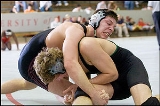
Collegiate wrestling

Encyclopedia
Collegiate wrestling, sometimes known in the United States
as Folkstyle wrestling, is a style of amateur wrestling
practised at the collegiate
and university
level in the United States. Collegiate wrestling emerged from the folk wrestling
styles practised in the early history of the United States. This style, with some slight modifications, is also practised at the high school
and middle school
levels, and also among younger participants, where it is known as scholastic wrestling
. These names help distinguish collegiate wrestling from other styles of wrestling that are practised around the world such as those in the Olympic Games
: Freestyle wrestling
and Greco-Roman wrestling
.
Collegiate wrestling, like its international counterpart, freestyle wrestling, has its main origins in catch-as-catch-can wrestling
. In both styles, the ultimate goal is to pin the opponent to the mat, which results in an immediate win. Collegiate and freestyle wrestling, unlike Greco-Roman, also both allow the use of the wrestler's or his opponent's legs in offense and defense. However, collegiate wrestling has had so many influences from the wide variety of folk wrestling
styles brought into the country that it has become distinctly American
.
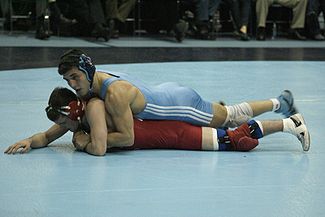
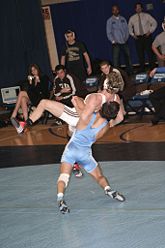 Collegiate wrestling differs in a number of ways from freestyle
and Greco-Roman
. Some of the differences are listed below.
This emphasis on control was present in collegiate wrestling from its earliest days. Since 1915, collegiate wrestling officials have recorded the time that each participant had in controlling his opponent on the mat (known as "time advantage" or "riding time"). Early on, this was the major way to determine the winner in the absence of a fall. Over time, the significance of such timekeeping has declined, and now such "time advantage" only counts for one point in college competition at the most. As in both of the international styles, a wrestler can win the match by pinning
both of his opponent's shoulder
s or both of his opponent's scapulae (shoulder blades)
to the mat.
Generally, rather than lifting the opponent or throwing him for grand amplitude in order to win the period as in the international styles, the collegiate wrestler most often seeks to take his opponent down to the mat and perform a "breakdown" (that is, to get his opponent in the defensive position flat on his stomach or side). With the opponent off of his base of support (that is, off of his hands and knees), the collegiate wrestler in the offensive position would then seek to run pinning combinations, or combinations of techniques designed to secure a fall. Failing to gain a fall could still result in an advantage in riding time and potential nearfall points.
The defensive wrestler could counter such attempts for a takedown, or when once taken down try to escape his opponent's control or reverse control altogether. In a last ditch attempt to foil a fall, the defensive wrestler could also "bridge" out of his opponent's control (that is, pry his head, his back, and both of his feet up from the mat and then turn toward his stomach). Overall, a collegiate wrestler in his techniques would most likely emphasize physical control and dominance over the opponent on the mat.
varying from tribe and nation by the 15th and 16th centuries, when the first Europe
ans settled. The English
and French
who settled on the North American continent sought out wrestling as a popular pastime. Soon, there were local champions in every settlement, with contests between them on a regional level. The colonists in what would become the United States
started out with something more akin to Greco-Roman wrestling
, but soon found that style too restrictive in favor of a style which a greater allowance of holds.
The Irish
were known for their "collar-and-elbow" style, in which wrestlers at the start of the match would grasp each other by the collar with one hand and by the elbow with the other. From this position, wrestlers sought to achieve a fall. If no fall occurred, the wrestlers would continue grappling both standing on their feet and on the ground until a fall was made. Irish immigrants later brought this style to the United States
where it soon became widespread. There was also what became known as "catch-as-catch-can" wrestling, which had a particular following in Great Britain
and the variant developed in Lancashire
had a particular effect on future freestyle wrestling
in particular.
. Since "catch-as-catch-can" wrestling was very similar, it gained great popularity in fairs and festivals in the United States during the 19th century. The collar-and-elbow style was also refined by later Irish immigrants, and gained great ground because of the success of George William Flagg from Vermont
, the wrestling champion of the Army of the Potomac
. After the Civil War
, freestyle wrestling
began to emerge as a distinct sport, and soon spread rapidly in the United States. Professional wrestling also emerged in the late 19th century (not like the "sports-entertainment" seen today). By the 1880s, American wrestling became organized, with matches often being conducted alongside gymnastic meets and boxing
tournaments in athletic clubs. The growth of cities, industrialization, and the closing of the frontier provided the necessary avenue for sports such as wrestling to increase in popularity.
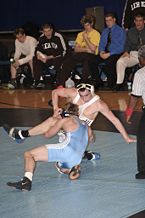 In 1903, the first intercollegiate dual meet took place between Yale University
and Columbia University
. The Eastern Intercollegiate Wrestling Association
held its first tournament in 1905, which soon sparked many more wrestling tournaments for both college
and university
students and high school
students. Edward Clark Gallagher, a football
and track and field
athlete at Oklahoma A&M College (now Oklahoma State University), launched wrestling as an official varsity sport just before World War I
and with his team launched a dynasty, with undefeated matches from 1921-1931. In 1927, Dr. Raymond G. Clapp published the rules for collegiate wrestling, and the next year, the first NCAA Wrestling Team Championship
took place on March 30 to March 31 on the campus of Iowa State College
. The rules of collegiate wrestling marked a sharp contrast to the freestyle wrestling rules of the International Amateur Wrestling Federation (IAWF)
and the AAU
. From then on, collegiate wrestling emerged as a distinctly American sport. College and high school wrestling grew especially after the standardization of the NCAA wrestling rules, which applied early on to both collegiate and scholastic wrestling (with high school modifications). More colleges, universities, and junior colleges began offering dual meets and tournaments, including championships and having organized wrestling seasons. There were breaks in wrestling seasons because of World War I
and World War II
, but in the high schools especially, state association wrestling championships sprung up in different regions throughout the 1930s and 1940s. As amateur wrestling grew after World War II, various collegiate athletic conferences also increased the number and quality of their wrestling competition, with more wrestlers making the progression of wrestling in high school, being recruited by college coaches, and then entering collegiate competition.
For most of the 20th century, collegiate wrestling was the most popular form of amateur wrestling
in the country, especially in the Midwest and the Southwest
. The 1960s and 1970s saw major developments in collegiate wrestling, with the emergence of the United States Wrestling Federation (USWF) (now known as USA Wrestling (USAW)
). The USWF, with its membership of coaches, educators, and officials, became recognized eventually as the official governing body of American wrestling and as the official representative to the United States Olympic Committee
, in place of the Amateur Athletic Union
.
Today, on the collegiate level, several universities are known for regularly having competitive wrestling teams. The Oklahoma State Cowboys
(Oklahoma State University) wrestling team
, Iowa Hawkeyes
(University of Iowa
) wrestling team
, the the Iowa State Cyclones
(Iowa State University
) wrestling team
, and the Oklahoma Sooners
(University of Oklahoma
) wrestling team are four of the most storied and honored programs in the country and have won the majority of NCAA wrestling team championships. Collegiate wrestling teams compete for the NCAA Wrestling Team Championship
each year in each of the three divisions. The NCAA awards individual championships in the 10 weight classes, as well as a team title.
is the organization that regulates collegiate wrestling. The wrestling rules developed by the NCAA are followed by each of the NCAA's three divisions. In addition, the National Association of Intercollegiate Athletics (NAIA)
, the National Junior College Athletic Association (NJCAA)
, and the National Collegiate Wrestling Association (NCWA)
have also adopted them, with some modifications. The NCAA generally sets the standard for weight classes for college-level dual meets, multiple duals, and tournaments. There are currently 10 main weight classes currently open to college-level competition, ranging from 125 lb to the Heavyweight division that ranges from 198 lb to 285 lb. Also, there is a 235 lb weight class, which only the National Collegiate Wrestling Association, the organization that governs college wrestling for institutions outside of the NCAA, NAIA
, and NJCAA, currently allows that ranges from 174 lb to 235 lb. The National Collegiate Wrestling Association also allows eight weight classes for women ranging from 105 lb to 200 lb. A wrestler must normally have his weight assessed by a member of the institution's athletics medical staff (e.g. a physician, certified athletic trainer, or registered dietician) before the first official team practice. The weight assessed is then his minimum weight class. The athletics medical staff member and the head coach then review all of the assessed weights of the wrestling team members and certify them online at the website of the National Wrestling Coaches Association (NWCA). After the certification, the wrestler may not compete below that weight class and may only compete at one weight class higher than his minimum weight. If a wrestler does gain weight over his certified weight class and wrestles at two weight classes above it, he forfeits his previous lowest weight class for the one weight class below where he wrestled. If a contestant wishes to weigh-in and wrestle at only one weight class above his certified weight class and later return to his lowest certified weight class, he may do so. However, the wrestler may only return to that certified weight class according to the weight-loss plan of the National Wrestling Coaches Association. This weight loss plan takes into account potential dehydration during the wrestling season and minimum amounts of body fat. All of this has been done in order to protect the wrestler's health and safety.
s or universities
would compete in what is known as a dual meet. It is possible for there also to be a multiple dual, where more than two wrestling teams compete against each other at the same event on the same day. For example, one college wrestling team may face another wrestling team for the first dual, and then a third wrestling team for the second dual. Also, those two wrestling teams may compete against each other in a dual meet as well. Colleges and universities often compete within their particular athletic conference; though competition outside of a team's conference or even outside of its division within the NCAA is not uncommon.
(Monday through Friday); on Saturday mornings, afternoons, or evenings; or even on Sunday mornings or afternoons during the wrestling season and begin with weigh-ins at a maximum of one hour before the meet begins. No weight allowances are made for dual meets and multiple-day dual meets. Wrestlers are also examined by a physician or a certified athletic trainer for any communicable skin diseases. If a student-wrestler does not make weight, he is ineligible for that weight class and a forfeit is scored. If there are any communicable skin diseases, it is a ground for disqualification. The wrestler's coach or athletic trainer can provide written documentation from a physician that a skin infection of a wrestler would not be communicable. The final judgment for whether a wrestler would be allowed to compete lies with the meet physician or athletic trainer on site. In all cases, after determining the sequence of weight classes for the dual meet, the referee will call the wrestlers from each team who have been designated as captains. One of the visiting captains will call a disk toss. The colored disk will then fall to the floor and determine: 1) which team has the choice of position at the start of the second period and 2) which one of the team's members is to appear first on the mat when called by the referee for each weight class. The wrestler-captain who won the disk toss may choose the even or odd weight classes. That is, he may choose the weight classes, from lowest to highest, that are numbered evenly or oddly. For example, the 125 lb, 141 lb, 157 lb, etc. weight classes would be odd, and the 133 lb, 149 lb, 165 lb, etc. weight classes would be even. This order would work in the traditional sequence until the last even weight class of 285 lb.
During a dual meet, the top varsity
wrestlers usually compete against each other. There can also be junior varsity matches, such as in Iowa
, which are rare, that would take place immediately before the varsity matches. Also, before both varsity (and junior varsity) competition, there can also be an exhibition match in one or more weight classes. The exhibition matches do not count towards the varsity (or junior varsity) team score, but such matches allow wrestlers, especially at the freshmen level, to gain more competitive experience. Wrestling matches usually proceed in each of the 10 weight classes. The order the matches occur in is determined after the weigh-ins either by a mutual decision of the coaches or by a random draw choosing a particular weight class to be featured first. In either case, the succeeding wrestling matches will follow in sequence. For example, if the 157 lb weight class competes first, the succeeding wrestling matches will follow until the heavyweight class. Then, beginning at 125 lb, the rest of the matches will follow until the 149 lb match.
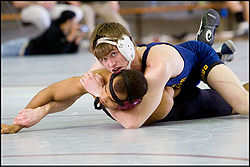 Often, many college
s and universities
in the United States
will compete with their teams in what is known as a tournament. In the tournament, from eight, 16, 32, 64, 75, or more individual wrestlers/teams can compete in each bracket. This allows many schools to establish their rankings, not only for individual student-wrestlers, but also for college and university wrestling teams as a whole (e.g. a conference or regional championship, or the NCAA Wrestling Team Championship
). A tournament committee usually administers the event and after individual and team entries have been verified, the officials then determine the order of the matches (called "drawing") by certain brackets (e.g. brackets of eight, 16, etc.). The tournament officials when doing this drawing take into account each wrestler's win-loss record, previous tournament placements, and other factors that indicate the wrestler's ability. With that in mind, wrestlers who are noticed as having the most superior records are bracketed so that two top-ranked superior wrestlers in each weight class do not compete against each other in an early round. This is called seeding. Tournaments are often sponsored by a college or university and are usually held on Friday, Saturday, Sunday, or over any of two days within the weekend
. Admission is often charged to cover costs and make a small profit for the host. A tournament begins with weigh-ins starting two hours or less before competition begins on the first day or one hour or less before competitions begins on any subsequent day. An allowance of one pound is granted for each subsequent day of the tournament.
With the drawing and weigh-ins completed, wrestlers then compete in two brackets in each of the 10 weight classes. If there are not enough wrestlers to fill up the bracket in a weight class, a bye will be awarded to a wrestler who does not have to compete against another wrestler in his pairing. After taking account the number of byes, the first round in each weight class then begins. Most college wrestling tournaments are in double elimination format. The last two wrestlers in the upper (championship) bracket wrestle for first place in the finals, with the loser winning second place. In other words, a wrestler cannot place higher than third if he is knocked down to the lower (wrestle-back) bracket by losing in the championship semifinals. This is largely the result of time constraints: one-day tournaments often last into the evening. If the winner of the wrestle-back bracket were allowed to challenge the winner of the championship bracket in the championship, the tournament could continue well past midnight before finishing.
After the first match of the round of 16 in a championship bracket in each weight class, the wrestle-back rounds would then commence, beginning among all of the wrestlers who lost to the winners of the round of 16. The winner of the wrestle-back finals would then win third place, with the loser winning fourth place. In tournaments where six places are awarded, the losers of the wrestle-back semifinals would wrestle for fifth place, with the loser winning sixth place. If eight places are awarded, the losers of the wrestle-back quarterfinals would wrestle for seventh place, with the loser winning eighth place, and so on. After the championships finals, the awards ceremony usually takes place with plaques, medals, trophies, or other awards given to the individual and team winners with the highest placements. Precise rules for tournaments may vary from one event to the next.
Each intercollegiate athletic conference or geographic area features two or three "elite" tournaments every year. These events are by invitation only. Hence, the commonly-used name for them, Invitationals. Tournament sponsors (which are usually colleges and universities, but sometimes other organizations) invite the best varsity wrestlers from their area to compete against each other. Many elite tournaments last two or even three days. For this reason, elite tournaments are often scheduled during the college's or university's winter break.
Between one season and the next, postseason tournaments and preseason tournaments are often held in collegiate wrestling and also in freestyle
and Greco-Roman
. The most active wrestlers often take part in those to sharpen their skills and techniques. Also, clinics and camps are often held for both wrestlers and their coaches to help refresh old techniques and gain new strategies. College wrestlers often serve as referees, volunteer coaches, assistants, or as counselors during many of the camps, clinics, and tournaments held during the off-season.
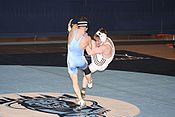 The match takes place on a thick rubber mat that is shock-absorbing to ensure safety. A large outer circle between 32 to 42 feet in diameter that designates the wrestling area is marked on the mat. The circumference line of that circle is called the boundary line. The wrestling area is surrounded by a mat area or apron (or protection area) that is at least five inches in width that helps prevent serious injury. The mat area is designated by the use of contrasting colors or a 2 inches (50.8 mm) line, which is part of the wrestling area and included in bounds. The wrestlers are within bounds when any part of either wrestler is on or inside this boundary line.
The mat can be no thicker than four inches nor thinner than a mat with the shock-absorbing qualities of a 2 inches (50.8 mm) hair-felt mat. Inside the outer circle is usually an inner circle about 10 feet in diameter, designated by the use of contrasting colors or a 2 inches (50.8 mm) line, although this is no longer specified by the NCAA Wrestling Rules and Interpretations. Wrestlers are encouraged to stay near the center of the mat within the inner circle, or else they risk being penalized for stalling (that is, deliberately attempting to slow down the action of the match). Each wrestler begins action at one of two one-inch starting lines inside the inner circle that is three feet long. Two one-inch lines close the ends of the starting lines and are marked red for the wrestler from the visiting team and green for the wrestler from the home team. The two starting lines are 10 inches apart from each other and form a rectangle in the middle of the wrestling area. This rectangle designates the starting positions for the three periods. Additional padding may be added under the mat to protect the wrestlers, especially if the wrestlers are competing on a concrete floor. All mats that are in sections are secured together.

 A match is a competition between two individual wrestlers of the same weight class. The match consists of three periods totaling seven minutes in college matches (with an overtime
round if necessary if the score is tied at the end of regulation.).
The main official at the wrestling match is the referee, who is in full control in matters of judgment at the competition and is responsible for starting and stopping the match; observing all holds; signaling points; calling penalties such as illegal holds, unnecessary roughness, fleeing the mat, or flagrant misconduct; and finally observing a full view of and determining the fall. There can also be one assistant referee (especially at tournaments) that helps the referee with making any difficult decisions and in preventing error. Also, scorers are there to record the points of the two individual wrestlers. Finally, a match or meet timekeeper with assistant timekeepers are present to note the match time, timeouts, and time advantage and work with the scorers.
Each wrestler is called by the referee, steps onto the mat, and may put on a green (for the home team) or red (for the visiting team) anklet about three inches wide which the referee will use to indicate scoring. The referee
then prepares the wrestlers to begin the first period.
The referee prepares both wrestlers for the first period by making sure each wrestler is correctly in the neutral position. The neutral position has the two wrestlers standing opposite each other on their feet. Each wrestler starts with his lead foot on the green or red area of the starting lines, and his other foot even with or behind the lead foot. Both wrestlers then usually slightly crouch with their arms in front of them at or above waist level. In this position, neither wrestler is in control. When the referee is certain that both wrestlers are correctly in the neutral position, he blows the whistle to begin the first period (as well as whenever wrestling is resumed, such as at the beginning of the second and third periods, when contestants resume wrestling after going out of bounds, etc.). The match commences with each wrestler attempting to take down his opponent. The first period in college and university matches is three minutes long.
If the match is not ended by a fall, technical fall, default, or disqualification, the referee then prepares both wrestlers to begin the second period. After the first period ends, one wrestler will have the choice of starting position in the second period. In dual meets, this is determined by the colored disk toss that took place before the meet began. In tournaments, the referee will toss a colored disk, with a green-colored side and a red-colored side, and the winner of that disk toss will have the choice of position. The wrestler could choose between the neutral position, or as is most commonly chosen to begin in a place called the referee's position on the mat. The referee's position has both wrestlers beginning action at the center of the mat with one wrestler (in the defensive starting position) on the bottom with his hands spread apart in front of the forward starting line and his knees spread apart behind the rear starting line with his legs held together. The other wrestler on the top (in the offensive starting position) then kneels beside him with one arm wrapped around the bottom wrestler's waist (with the palm of his hand against the opponent's navel) and the other hand on or over the back of the opponent's near elbow for control. Most often, the wrestler with the choice chooses the defensive (bottom) position because of the relative ease of scoring an escape or reversal in comparison to a near fall. The wrestler could also defer his choice to the beginning of the third period.
More recently, another starting position choice has been allowed, known as the optional offensive starting position or optional start. After the wrestler with the choice (the offensive wrestler) indicates his intention to the referee, the referee lets the defensive wrestler adjust and begin in the defensive starting position. Next, the offensive wrestler goes to either side of the defensive wrestler or behind him, with all his weight supported by both his feet or by one or both knees. The offensive wrestler would then place both his hands on the opponent's back between the neck and the waist. When the referee starts the match by blowing the whistle, the defensive wrestler then has the opportunity to get back to his feet in a neutral position. Any of the starting positions may be used to resume action during a period when the wrestlers go off the mat, depending on the referee's judgment as to whether any or which wrestler had the position of advantage.
The second period is two minutes long.
If the match is not ended by a fall, technical fall, default, or disqualification, the referee then prepares both wrestlers to begin the third period. The wrestler who did not choose the starting position for the second period now chooses the starting position. The third period is also two minutes long.
If the third period ends in a tie, a one-minute, sudden victory period occurs. Both wrestlers start in the neutral position. The first wrestler to score a point wins. Time advantage is not used in any sudden victory period.
If no points are scored in the sudden victory period, or if the first points were scored simultaneously, two 30-second tiebreaker periods occur. Both wrestlers start in the referee's position. The wrestler who scored the first points (besides escapes and penalty points) in regulation has the choice of top or bottom position. If the only points scored in regulation were for escapes or penalties, the choice of position will be given to the winner of a colored disk toss. After the wrestler makes his choice, the two contestants then wrestle. Either of the two wrestlers must try to score as many points as he can. Once one 30-second period is over, the wrestler who was in the bottom position then wrestles on the top in another 30-second period. Whoever scores the most points (or is awarded a fall, default, or disqualification) wins the match. Time advantage is kept, and points are awarded accordingly.
If no wrestler has won by the end of the two tiebreaker periods, a second overtime round starts with a one-minute, sudden victory period, and then two 30-second tiebreaker periods for each wrestler. The wrestler who did not have the choice of position in the previous overtime round's first tiebreaker period now has the choice of position in this overtime round's first tiebreaker period. If the score remains tied after the end of the second overtime round, the wrestler who has one second or more of net time advantage from the two rounds of tiebreaker periods will be declared the winner.
If a winner still cannot be determined, overtime rounds that are structured like the second round of overtime take place until one wrestler scores enough points for the victory.
After the match is completed, regardless of the victory condition, the wrestlers will return to the center of the mat (on the 10-foot inner circle) while the referee checks with the scorer's table. Upon the referee's return to the mat, the two wrestlers shake hands, and the referee proclaims the winner by raising the winner's hand. Both contestants then return to their team benches from the mat.

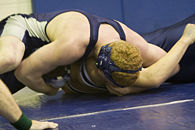
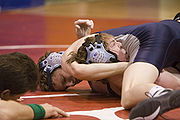
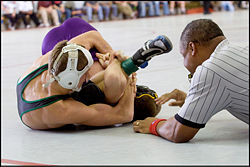 A match can be won in the following ways:
In a dual meet, when all team points are totaled, the team with the most points wins the competition. In all victory cases, if there are junior varsity matches, the junior varsity and varsity competitions are scored separately. If this is the case, it is entirely possible for one participating institution to win the junior varsity dual meet and another participating institution to win the varsity dual meet. On the college level, it is possible for a dual meet to end in a tie, except in dual meet advancement tournaments, where then the tie is broken by one team point awarded to the winning team based on certain criteria.
Individual placement points are also awarded. For example, in a tournament scoring eight places, the winner of a quarterfinal or a semifinal in the championship bracket (where first and second places are awarded) would win six place points. The winners of first and second place would then win four additional place points. In the wrestle-back bracket (where third and fifth places are awarded), the winner of a semifinal match, for example, would receive three place points. The winners of third, fifth, and seventh place would receive one additional place point, and so on. A more detailed account of how individual and team points are awarded for tournaments is given on pages WR-49 to WR-51 of the 2009 NCAA Wrestling Rules and Interpretations.
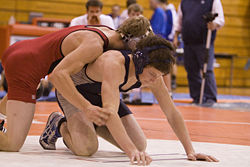
Also known as scholastic wrestling when practised at the high school
and middle (junior high) school
level, collegiate wrestling differs from wrestling at the high school level in multiple aspects. Scholastic wrestling is regulated by the National Federation of State High School Associations (NFHS)
. This association mandates that high school matches are to have periods of shorter length, three periods consisting of two minutes each, than collegiate matches which begin with a three minute first period. Additionally, college wrestling uses the concept of "time advantage" or "riding time" in the referees position, while high school wrestling does not.
According to an Athletics Participation Survey taken by the National Federation of State High School Associations
, boys' wrestling ranked eighth in terms of the number of schools sponsoring teams, with 9,445 schools participating in the 2006-07 school year. Also, 257,246 boys participated in the sport during that school year, making scholastic wrestling the sixth most popular sport among high school boys. In addition, 5,048 girls participated in wrestling in 1,227 schools during the 2006-07 season. Scholastic wrestling is currently practised in 49 of the 50 states; only Mississippi
does not officially sanction scholastic wrestling for high schools and middle schools. Arkansas, the 49th state to sanction high school wrestling, began scholastic wrestling competition in the 2008-09 season.
and Greco-Roman
styles. There are also tournaments where wrestlers compete in a style very similar to collegiate or high school (scholastic) wrestling. To differentiate this style from freestyle and Greco-Roman, the term folkstyle wrestling is a more commonly used phrase than collegiate wrestling.
United States
The United States of America is a federal constitutional republic comprising fifty states and a federal district...
as Folkstyle wrestling, is a style of amateur wrestling
Amateur wrestling
Amateur wrestling is the most widespread form of sport wrestling. There are two international wrestling styles performed in the Olympic Games under the supervision of FILA : Greco-Roman and freestyle. Freestyle is possibly derived from the English Lancashire style...
practised at the collegiate
College
A college is an educational institution or a constituent part of an educational institution. Usage varies in English-speaking nations...
and university
University
A university is an institution of higher education and research, which grants academic degrees in a variety of subjects. A university is an organisation that provides both undergraduate education and postgraduate education...
level in the United States. Collegiate wrestling emerged from the folk wrestling
Folk wrestling
A folk wrestling style is a traditional wrestling discipline which may or may not be codified as a modern sport. Most human cultures have developed their own sort of grappling style unique from other styles practiced...
styles practised in the early history of the United States. This style, with some slight modifications, is also practised at the high school
High school
High school is a term used in parts of the English speaking world to describe institutions which provide all or part of secondary education. The term is often incorporated into the name of such institutions....
and middle school
Middle school
Middle School and Junior High School are levels of schooling between elementary and high schools. Most school systems use one term or the other, not both. The terms are not interchangeable...
levels, and also among younger participants, where it is known as scholastic wrestling
Scholastic wrestling
Scholastic wrestling, sometimes known in the United States as Folkstyle wrestling, is a style of amateur wrestling practised at the high school and middle school levels in the United States. This wrestling style is essentially Collegiate wrestling with some slight modifications. It is currently...
. These names help distinguish collegiate wrestling from other styles of wrestling that are practised around the world such as those in the Olympic Games
Olympic Games
The Olympic Games is a major international event featuring summer and winter sports, in which thousands of athletes participate in a variety of competitions. The Olympic Games have come to be regarded as the world’s foremost sports competition where more than 200 nations participate...
: Freestyle wrestling
Freestyle wrestling
Freestyle wrestling is a style of amateur wrestling that is practised throughout the world. Along with Greco-Roman, it is one of the two styles of wrestling contested in the Olympic games. It is, along with track and field, one of the oldest organized sports in history...
and Greco-Roman wrestling
Greco-Roman wrestling
Greco-Roman wrestling is a style of wrestling that is practised worldwide. It was contested at the first modern Olympic Games in 1896 and has been included in every edition of the summer Olympics held since 1908. Two wrestlers are scored for their performance in three two-minute periods, which can...
.
Collegiate wrestling, like its international counterpart, freestyle wrestling, has its main origins in catch-as-catch-can wrestling
Catch wrestling
Catch wrestling is a style of folk wrestling that was developed and popularised in the late 19th century by the wrestlers of traveling carnivals who incorporated submission holds, or "hooks", into their wrestling to increase their effectiveness against their opponents...
. In both styles, the ultimate goal is to pin the opponent to the mat, which results in an immediate win. Collegiate and freestyle wrestling, unlike Greco-Roman, also both allow the use of the wrestler's or his opponent's legs in offense and defense. However, collegiate wrestling has had so many influences from the wide variety of folk wrestling
Folk wrestling
A folk wrestling style is a traditional wrestling discipline which may or may not be codified as a modern sport. Most human cultures have developed their own sort of grappling style unique from other styles practiced...
styles brought into the country that it has become distinctly American
United States
The United States of America is a federal constitutional republic comprising fifty states and a federal district...
.
Contrast with the international styles
Freestyle wrestling
Freestyle wrestling is a style of amateur wrestling that is practised throughout the world. Along with Greco-Roman, it is one of the two styles of wrestling contested in the Olympic games. It is, along with track and field, one of the oldest organized sports in history...
and Greco-Roman
Greco-Roman wrestling
Greco-Roman wrestling is a style of wrestling that is practised worldwide. It was contested at the first modern Olympic Games in 1896 and has been included in every edition of the summer Olympics held since 1908. Two wrestlers are scored for their performance in three two-minute periods, which can...
. Some of the differences are listed below.
- There are some scoring differences. For example, in collegiate wrestling, "exposure" points are not given to a wrestler for simply forcing the opponent's shoulders to quickly rotate and be exposed to the mat. Instead, for example, a wrestler must control one of the opponent's shoulders on the mat and have the opponent's other shoulder forced to the mat at an angle of 45 degrees or less for two to five seconds to score. The points generated in this situation are called "near fall" points. This shows a difference in focus: while the international styles encourage explosive action and risk, collegiate wrestling encourages and rewards control over the opponent.
This emphasis on control was present in collegiate wrestling from its earliest days. Since 1915, collegiate wrestling officials have recorded the time that each participant had in controlling his opponent on the mat (known as "time advantage" or "riding time"). Early on, this was the major way to determine the winner in the absence of a fall. Over time, the significance of such timekeeping has declined, and now such "time advantage" only counts for one point in college competition at the most. As in both of the international styles, a wrestler can win the match by pinning
Pin (amateur wrestling)
A pin, or fall, is a victory condition in various forms of wrestling that is met by holding an opponent's shoulders or scapulae on the wrestling mat for a prescribed period of time. This article deals with the pin as it is defined in amateur wrestling.In amateur wrestling, a pin ends the match...
both of his opponent's shoulder
Shoulder
The human shoulder is made up of three bones: the clavicle , the scapula , and the humerus as well as associated muscles, ligaments and tendons. The articulations between the bones of the shoulder make up the shoulder joints. The major joint of the shoulder is the glenohumeral joint, which...
s or both of his opponent's scapulae (shoulder blades)
Scapula
In anatomy, the scapula , omo, or shoulder blade, is the bone that connects the humerus with the clavicle ....
to the mat.
- In collegiate wrestling, there is an additional position to commence wrestling after the first period, and also to resume wrestling after various other situations. All three styles begin a match with both wrestlers facing each other on their feet with the opportunity given to both to score a takedownTakedown (grappling)A takedown is a martial arts and combat sports term for a technique that involves off-balancing an opponent and bringing him or her to the ground, typically with the combatant performing the takedown landing on top. The process of quickly advancing on an opponent and attempting a takedown is known...
and thus gain control over the opponent. In collegiate wrestling, once a takedown is scored, the wrestler under control in the inferior (defensive or bottom) position remains there until he escapes the move, until he reverses the position, until the period ends, or until various penalty situations occur. The inferior position is similar to a choice for a starting position in the second and third periods, known as the referee's position. The referee's position is roughly analogous to the "par terre" starting position in the international wrestling styles. In the international styles, the "par terre" starting position is not utilized as often as the referee's position is in collegiate wrestling. In the two international styles, the inferior position in the "par terre" starting position is now used to penalize a wrestler who has committed an illegal act.
- In collegiate wrestling, there is a de-emphasis on "throwsThrow (grappling)A throw is a martial arts term for a grappling technique that involves off-balancing or lifting an opponent, and tossing them to the ground in Japanese martial arts referred to as nage-waza, 投げ技, "throwing technique"...
", or maneuvers where the other wrestler is taken off his feet, taken through the air, and lands on his back or shoulders. This lack of emphasis on throws is another example of how collegiate wrestling emphasizes dominance or control, as opposed to the element of risk and explosive action. A legal throw in collegiate wrestling is awarded the same amount of points as any other takedown. In freestyle and Greco-Roman wrestling, points awarded for a wrestler's takedowns increase with the level of explosiveness seen in the throws. Well-executed throws can even win a period in the international styles, especially when a throw is of grand amplitude (a throw in which a wrestler takes an opponent off of the mat and controls his opponent so that his feet go directly above his head). In collegiate wrestling, some of the throws seen in the international styles may even be illegal, such as a full-back suplay from a rear standing position. However, many collegiate wrestlers still incorporate some throws into their repertoire of moves because a thrown opponent often lands on his back or shoulders and thus in a position more conducive to producing near fall points or securing a fall.
Generally, rather than lifting the opponent or throwing him for grand amplitude in order to win the period as in the international styles, the collegiate wrestler most often seeks to take his opponent down to the mat and perform a "breakdown" (that is, to get his opponent in the defensive position flat on his stomach or side). With the opponent off of his base of support (that is, off of his hands and knees), the collegiate wrestler in the offensive position would then seek to run pinning combinations, or combinations of techniques designed to secure a fall. Failing to gain a fall could still result in an advantage in riding time and potential nearfall points.
The defensive wrestler could counter such attempts for a takedown, or when once taken down try to escape his opponent's control or reverse control altogether. In a last ditch attempt to foil a fall, the defensive wrestler could also "bridge" out of his opponent's control (that is, pry his head, his back, and both of his feet up from the mat and then turn toward his stomach). Overall, a collegiate wrestler in his techniques would most likely emphasize physical control and dominance over the opponent on the mat.
American wrestling in the early colonial era
There were already wrestling styles among Native AmericansIndigenous peoples of the Americas
The indigenous peoples of the Americas are the pre-Columbian inhabitants of North and South America, their descendants and other ethnic groups who are identified with those peoples. Indigenous peoples are known in Canada as Aboriginal peoples, and in the United States as Native Americans...
varying from tribe and nation by the 15th and 16th centuries, when the first Europe
Europe
Europe is, by convention, one of the world's seven continents. Comprising the westernmost peninsula of Eurasia, Europe is generally 'divided' from Asia to its east by the watershed divides of the Ural and Caucasus Mountains, the Ural River, the Caspian and Black Seas, and the waterways connecting...
ans settled. The English
English people
The English are a nation and ethnic group native to England, who speak English. The English identity is of early mediaeval origin, when they were known in Old English as the Anglecynn. England is now a country of the United Kingdom, and the majority of English people in England are British Citizens...
and French
French people
The French are a nation that share a common French culture and speak the French language as a mother tongue. Historically, the French population are descended from peoples of Celtic, Latin and Germanic origin, and are today a mixture of several ethnic groups...
who settled on the North American continent sought out wrestling as a popular pastime. Soon, there were local champions in every settlement, with contests between them on a regional level. The colonists in what would become the United States
United States
The United States of America is a federal constitutional republic comprising fifty states and a federal district...
started out with something more akin to Greco-Roman wrestling
Greco-Roman wrestling
Greco-Roman wrestling is a style of wrestling that is practised worldwide. It was contested at the first modern Olympic Games in 1896 and has been included in every edition of the summer Olympics held since 1908. Two wrestlers are scored for their performance in three two-minute periods, which can...
, but soon found that style too restrictive in favor of a style which a greater allowance of holds.
The Irish
Irish people
The Irish people are an ethnic group who originate in Ireland, an island in northwestern Europe. Ireland has been populated for around 9,000 years , with the Irish people's earliest ancestors recorded having legends of being descended from groups such as the Nemedians, Fomorians, Fir Bolg, Tuatha...
were known for their "collar-and-elbow" style, in which wrestlers at the start of the match would grasp each other by the collar with one hand and by the elbow with the other. From this position, wrestlers sought to achieve a fall. If no fall occurred, the wrestlers would continue grappling both standing on their feet and on the ground until a fall was made. Irish immigrants later brought this style to the United States
United States
The United States of America is a federal constitutional republic comprising fifty states and a federal district...
where it soon became widespread. There was also what became known as "catch-as-catch-can" wrestling, which had a particular following in Great Britain
Great Britain
Great Britain or Britain is an island situated to the northwest of Continental Europe. It is the ninth largest island in the world, and the largest European island, as well as the largest of the British Isles...
and the variant developed in Lancashire
Lancashire
Lancashire is a non-metropolitan county of historic origin in the North West of England. It takes its name from the city of Lancaster, and is sometimes known as the County of Lancaster. Although Lancaster is still considered to be the county town, Lancashire County Council is based in Preston...
had a particular effect on future freestyle wrestling
Freestyle wrestling
Freestyle wrestling is a style of amateur wrestling that is practised throughout the world. Along with Greco-Roman, it is one of the two styles of wrestling contested in the Olympic games. It is, along with track and field, one of the oldest organized sports in history...
in particular.
Wrestling in the 18th and 19th century United States
By the 18th century, wrestling soon became recognized as a legitimate spectator sport, despite its roughness. Among those who were well known for their wrestling techniques were several U.S. PresidentsPresident of the United States
The President of the United States of America is the head of state and head of government of the United States. The president leads the executive branch of the federal government and is the commander-in-chief of the United States Armed Forces....
. Since "catch-as-catch-can" wrestling was very similar, it gained great popularity in fairs and festivals in the United States during the 19th century. The collar-and-elbow style was also refined by later Irish immigrants, and gained great ground because of the success of George William Flagg from Vermont
Vermont
Vermont is a state in the New England region of the northeastern United States of America. The state ranks 43rd in land area, , and 45th in total area. Its population according to the 2010 census, 630,337, is the second smallest in the country, larger only than Wyoming. It is the only New England...
, the wrestling champion of the Army of the Potomac
Army of the Potomac
The Army of the Potomac was the major Union Army in the Eastern Theater of the American Civil War.-History:The Army of the Potomac was created in 1861, but was then only the size of a corps . Its nucleus was called the Army of Northeastern Virginia, under Brig. Gen...
. After the Civil War
American Civil War
The American Civil War was a civil war fought in the United States of America. In response to the election of Abraham Lincoln as President of the United States, 11 southern slave states declared their secession from the United States and formed the Confederate States of America ; the other 25...
, freestyle wrestling
Freestyle wrestling
Freestyle wrestling is a style of amateur wrestling that is practised throughout the world. Along with Greco-Roman, it is one of the two styles of wrestling contested in the Olympic games. It is, along with track and field, one of the oldest organized sports in history...
began to emerge as a distinct sport, and soon spread rapidly in the United States. Professional wrestling also emerged in the late 19th century (not like the "sports-entertainment" seen today). By the 1880s, American wrestling became organized, with matches often being conducted alongside gymnastic meets and boxing
Boxing
Boxing, also called pugilism, is a combat sport in which two people fight each other using their fists. Boxing is supervised by a referee over a series of between one to three minute intervals called rounds...
tournaments in athletic clubs. The growth of cities, industrialization, and the closing of the frontier provided the necessary avenue for sports such as wrestling to increase in popularity.
The 20th century: American wrestling becomes "collegiate"
Yale University
Yale University is a private, Ivy League university located in New Haven, Connecticut, United States. Founded in 1701 in the Colony of Connecticut, the university is the third-oldest institution of higher education in the United States...
and Columbia University
Columbia University
Columbia University in the City of New York is a private, Ivy League university in Manhattan, New York City. Columbia is the oldest institution of higher learning in the state of New York, the fifth oldest in the United States, and one of the country's nine Colonial Colleges founded before the...
. The Eastern Intercollegiate Wrestling Association
Eastern Intercollegiate Wrestling Association
The Eastern Intercollegiate Wrestling Association is an NCAA Division I collegiate wrestling conference. It has been active since 1905 and has had a variety of schools as members throughout its tenure.-Current members:*American University...
held its first tournament in 1905, which soon sparked many more wrestling tournaments for both college
College
A college is an educational institution or a constituent part of an educational institution. Usage varies in English-speaking nations...
and university
University
A university is an institution of higher education and research, which grants academic degrees in a variety of subjects. A university is an organisation that provides both undergraduate education and postgraduate education...
students and high school
High school
High school is a term used in parts of the English speaking world to describe institutions which provide all or part of secondary education. The term is often incorporated into the name of such institutions....
students. Edward Clark Gallagher, a football
College football
College football refers to American football played by teams of student athletes fielded by American universities, colleges, and military academies, or Canadian football played by teams of student athletes fielded by Canadian universities...
and track and field
Track and field
Track and field is a sport comprising various competitive athletic contests based around the activities of running, jumping and throwing. The name of the sport derives from the venue for the competitions: a stadium which features an oval running track surrounding a grassy area...
athlete at Oklahoma A&M College (now Oklahoma State University), launched wrestling as an official varsity sport just before World War I
World War I
World War I , which was predominantly called the World War or the Great War from its occurrence until 1939, and the First World War or World War I thereafter, was a major war centred in Europe that began on 28 July 1914 and lasted until 11 November 1918...
and with his team launched a dynasty, with undefeated matches from 1921-1931. In 1927, Dr. Raymond G. Clapp published the rules for collegiate wrestling, and the next year, the first NCAA Wrestling Team Championship
NCAA Wrestling Team Championship
The NCAA Wrestling Team Championship was first officially awarded in 1929 and began to be continuously awarded on an annual basis in 1934 except during World War II 1943-1945. In 1928 and from 1931 to 1933, there was only an unofficial title. Oklahoma A&M, now Oklahoma State, won the 1928, 1931...
took place on March 30 to March 31 on the campus of Iowa State College
Iowa State University
Iowa State University of Science and Technology, more commonly known as Iowa State University , is a public land-grant and space-grant research university located in Ames, Iowa, United States. Iowa State has produced astronauts, scientists, and Nobel and Pulitzer Prize winners, along with a host of...
. The rules of collegiate wrestling marked a sharp contrast to the freestyle wrestling rules of the International Amateur Wrestling Federation (IAWF)
International Federation of Associated Wrestling Styles
The International Federation of Associated Wrestling Styles, also known in French as Fédération Internationale des Luttes Associées , is an international wrestling federation that holds events around the world. It is the governing body of international amateur wrestling...
and the AAU
Amateur Athletic Union
The Amateur Athletic Union is one of the largest non-profit volunteer sports organizations in the United States. A multi-sport organization, the AAU is dedicated exclusively to the promotion and development of amateur sports and physical fitness programs.-History:The AAU was founded in 1888 to...
. From then on, collegiate wrestling emerged as a distinctly American sport. College and high school wrestling grew especially after the standardization of the NCAA wrestling rules, which applied early on to both collegiate and scholastic wrestling (with high school modifications). More colleges, universities, and junior colleges began offering dual meets and tournaments, including championships and having organized wrestling seasons. There were breaks in wrestling seasons because of World War I
World War I
World War I , which was predominantly called the World War or the Great War from its occurrence until 1939, and the First World War or World War I thereafter, was a major war centred in Europe that began on 28 July 1914 and lasted until 11 November 1918...
and World War II
World War II
World War II, or the Second World War , was a global conflict lasting from 1939 to 1945, involving most of the world's nations—including all of the great powers—eventually forming two opposing military alliances: the Allies and the Axis...
, but in the high schools especially, state association wrestling championships sprung up in different regions throughout the 1930s and 1940s. As amateur wrestling grew after World War II, various collegiate athletic conferences also increased the number and quality of their wrestling competition, with more wrestlers making the progression of wrestling in high school, being recruited by college coaches, and then entering collegiate competition.
For most of the 20th century, collegiate wrestling was the most popular form of amateur wrestling
Amateur wrestling
Amateur wrestling is the most widespread form of sport wrestling. There are two international wrestling styles performed in the Olympic Games under the supervision of FILA : Greco-Roman and freestyle. Freestyle is possibly derived from the English Lancashire style...
in the country, especially in the Midwest and the Southwest
Southwestern United States
The Southwestern United States is a region defined in different ways by different sources. Broad definitions include nearly a quarter of the United States, including Arizona, California, Colorado, Nevada, New Mexico, Oklahoma, Texas and Utah...
. The 1960s and 1970s saw major developments in collegiate wrestling, with the emergence of the United States Wrestling Federation (USWF) (now known as USA Wrestling (USAW)
USA Wrestling
USA Wrestling is the organization that currently governs freestyle wrestling and Greco-Roman wrestling in the United States...
). The USWF, with its membership of coaches, educators, and officials, became recognized eventually as the official governing body of American wrestling and as the official representative to the United States Olympic Committee
United States Olympic Committee
The United States Olympic Committee is a non-profit organization that serves as the National Olympic Committee and National Paralympic Committee for the United States and coordinates the relationship between the United States Anti-Doping Agency and the World Anti-Doping Agency and various...
, in place of the Amateur Athletic Union
Amateur Athletic Union
The Amateur Athletic Union is one of the largest non-profit volunteer sports organizations in the United States. A multi-sport organization, the AAU is dedicated exclusively to the promotion and development of amateur sports and physical fitness programs.-History:The AAU was founded in 1888 to...
.
Today, on the collegiate level, several universities are known for regularly having competitive wrestling teams. The Oklahoma State Cowboys
Oklahoma State Cowboys
Oklahoma State Cowboys are the athletic teams that represent Oklahoma State University. Their mascot is a cowboy named Pistol Pete. Oklahoma State participates in the NCAA's Division I-A and in the Big 12 Conference's South Division. The university's current athletic director is Mike Holder...
(Oklahoma State University) wrestling team
Oklahoma State Cowboys wrestling
The Oklahoma State Cowboys wrestling team is a NCAA Division I wrestling program and is one of five Big 12 Conference schools which participate in wrestling. Since the team's first season in 1914-15, it has won thirty-four team national championships , 133 individual NCAA championships, and 213...
, Iowa Hawkeyes
Iowa Hawkeyes
The Iowa Hawkeyes are the athletics teams that represent the University of Iowa in Iowa City, Iowa, United States. The Hawkeyes have varsity teams in 24 sports, 11 for men and 13 for women. The teams participate in Division I of the National Collegiate Athletic Association and are members of the...
(University of Iowa
University of Iowa
The University of Iowa is a public state-supported research university located in Iowa City, Iowa, United States. It is the oldest public university in the state. The university is organized into eleven colleges granting undergraduate, graduate, and professional degrees...
) wrestling team
Iowa Hawkeyes wrestling
The University of Iowa wrestling program is one of the most successful athletic programs in NCAA Division I. The University of Iowa Hawkeyes are a member of the Big Ten Athletic Conference. Iowa is second in NCAA history with 23 national championships, all of which have come since 1975...
, the the Iowa State Cyclones
Iowa State Cyclones
The Iowa State Cyclones are the athletic teams of Iowa State University. The university is a member of the Big 12 Conference and competes in NCAA Division I, fielding 16 varsity teams in 12 sports.*Men's sports...
(Iowa State University
Iowa State University
Iowa State University of Science and Technology, more commonly known as Iowa State University , is a public land-grant and space-grant research university located in Ames, Iowa, United States. Iowa State has produced astronauts, scientists, and Nobel and Pulitzer Prize winners, along with a host of...
) wrestling team
Iowa State Cyclones wrestling
Iowa State has won 8 national championships in wrestling. Iowa State's head coach is Kevin Jackson. Iowa State became the first collegiate wrestling program to reach 1000 dual wins on February 7, 2010.-Charles Mayser:...
, and the Oklahoma Sooners
Oklahoma Sooners
The University of Oklahoma features 19 varsity sports teams. Both men's and women's teams are called the Sooners, a nickname given to the early participants in the land rushes which initially opened the Oklahoma Indian Territory to non-native settlement. They participate in the NCAA's Division I-A,...
(University of Oklahoma
University of Oklahoma
The University of Oklahoma is a coeducational public research university located in Norman, Oklahoma. Founded in 1890, it existed in Oklahoma Territory near Indian Territory for 17 years before the two became the state of Oklahoma. the university had 29,931 students enrolled, most located at its...
) wrestling team are four of the most storied and honored programs in the country and have won the majority of NCAA wrestling team championships. Collegiate wrestling teams compete for the NCAA Wrestling Team Championship
NCAA Wrestling Team Championship
The NCAA Wrestling Team Championship was first officially awarded in 1929 and began to be continuously awarded on an annual basis in 1934 except during World War II 1943-1945. In 1928 and from 1931 to 1933, there was only an unofficial title. Oklahoma A&M, now Oklahoma State, won the 1928, 1931...
each year in each of the three divisions. The NCAA awards individual championships in the 10 weight classes, as well as a team title.
Weight classes
The National Collegiate Athletic Association (NCAA)National Collegiate Athletic Association
The National Collegiate Athletic Association is a semi-voluntary association of 1,281 institutions, conferences, organizations and individuals that organizes the athletic programs of many colleges and universities in the United States...
is the organization that regulates collegiate wrestling. The wrestling rules developed by the NCAA are followed by each of the NCAA's three divisions. In addition, the National Association of Intercollegiate Athletics (NAIA)
National Association of Intercollegiate Athletics
The National Association of Intercollegiate Athletics is an athletic association that organizes college and university-level athletic programs. Membership in the NAIA consists of smaller colleges and universities across the United States. The NAIA allows colleges and universities outside the USA...
, the National Junior College Athletic Association (NJCAA)
National Junior College Athletic Association
The National Junior College Athletic Association , founded in 1938, is an association of community college and junior college athletic departments throughout the United States. It is held as Divisions and Regions. The current NJCAA holds 24 separate regions.-History:The idea for the NJCAA was...
, and the National Collegiate Wrestling Association (NCWA)
National Collegiate Wrestling Association
The National Collegiate Wrestling Association is a post secondary athletic association built to help the promotion of collegiate wrestling...
have also adopted them, with some modifications. The NCAA generally sets the standard for weight classes for college-level dual meets, multiple duals, and tournaments. There are currently 10 main weight classes currently open to college-level competition, ranging from 125 lb to the Heavyweight division that ranges from 198 lb to 285 lb. Also, there is a 235 lb weight class, which only the National Collegiate Wrestling Association, the organization that governs college wrestling for institutions outside of the NCAA, NAIA
National Association of Intercollegiate Athletics
The National Association of Intercollegiate Athletics is an athletic association that organizes college and university-level athletic programs. Membership in the NAIA consists of smaller colleges and universities across the United States. The NAIA allows colleges and universities outside the USA...
, and NJCAA, currently allows that ranges from 174 lb to 235 lb. The National Collegiate Wrestling Association also allows eight weight classes for women ranging from 105 lb to 200 lb. A wrestler must normally have his weight assessed by a member of the institution's athletics medical staff (e.g. a physician, certified athletic trainer, or registered dietician) before the first official team practice. The weight assessed is then his minimum weight class. The athletics medical staff member and the head coach then review all of the assessed weights of the wrestling team members and certify them online at the website of the National Wrestling Coaches Association (NWCA). After the certification, the wrestler may not compete below that weight class and may only compete at one weight class higher than his minimum weight. If a wrestler does gain weight over his certified weight class and wrestles at two weight classes above it, he forfeits his previous lowest weight class for the one weight class below where he wrestled. If a contestant wishes to weigh-in and wrestle at only one weight class above his certified weight class and later return to his lowest certified weight class, he may do so. However, the wrestler may only return to that certified weight class according to the weight-loss plan of the National Wrestling Coaches Association. This weight loss plan takes into account potential dehydration during the wrestling season and minimum amounts of body fat. All of this has been done in order to protect the wrestler's health and safety.
Structure of the season - dual meets and tournaments
The collegiate wrestling season customarily runs from October or November to March. Regular season competition begins in late October or early November and continues until February. Post-season competition usually continues from February to March (depending on, if individual wrestlers or teams qualify for a conference, regional, or national championship). Normally, wrestling teams from two different collegeCollege
A college is an educational institution or a constituent part of an educational institution. Usage varies in English-speaking nations...
s or universities
University
A university is an institution of higher education and research, which grants academic degrees in a variety of subjects. A university is an organisation that provides both undergraduate education and postgraduate education...
would compete in what is known as a dual meet. It is possible for there also to be a multiple dual, where more than two wrestling teams compete against each other at the same event on the same day. For example, one college wrestling team may face another wrestling team for the first dual, and then a third wrestling team for the second dual. Also, those two wrestling teams may compete against each other in a dual meet as well. Colleges and universities often compete within their particular athletic conference; though competition outside of a team's conference or even outside of its division within the NCAA is not uncommon.
Dual meets
Dual meets usually take place on evenings during the school weekSchool week
In most schools, the school week consists of days Monday through Thursday or Friday.However, in some countries it goes from Monday to Saturday. There is no school on Sundays, and some afternoon classes may be cancelled or skipped. A few schools are cancelling Fridays, due to fuel costs...
(Monday through Friday); on Saturday mornings, afternoons, or evenings; or even on Sunday mornings or afternoons during the wrestling season and begin with weigh-ins at a maximum of one hour before the meet begins. No weight allowances are made for dual meets and multiple-day dual meets. Wrestlers are also examined by a physician or a certified athletic trainer for any communicable skin diseases. If a student-wrestler does not make weight, he is ineligible for that weight class and a forfeit is scored. If there are any communicable skin diseases, it is a ground for disqualification. The wrestler's coach or athletic trainer can provide written documentation from a physician that a skin infection of a wrestler would not be communicable. The final judgment for whether a wrestler would be allowed to compete lies with the meet physician or athletic trainer on site. In all cases, after determining the sequence of weight classes for the dual meet, the referee will call the wrestlers from each team who have been designated as captains. One of the visiting captains will call a disk toss. The colored disk will then fall to the floor and determine: 1) which team has the choice of position at the start of the second period and 2) which one of the team's members is to appear first on the mat when called by the referee for each weight class. The wrestler-captain who won the disk toss may choose the even or odd weight classes. That is, he may choose the weight classes, from lowest to highest, that are numbered evenly or oddly. For example, the 125 lb, 141 lb, 157 lb, etc. weight classes would be odd, and the 133 lb, 149 lb, 165 lb, etc. weight classes would be even. This order would work in the traditional sequence until the last even weight class of 285 lb.
During a dual meet, the top varsity
Varsity team
In the United States and Canada, varsity sports teams are the principal athletic teams representing a college, university, high school or other secondary school. Such teams compete against the principal athletic teams at other colleges/universities, or in the case of secondary schools, against...
wrestlers usually compete against each other. There can also be junior varsity matches, such as in Iowa
Iowa
Iowa is a state located in the Midwestern United States, an area often referred to as the "American Heartland". It derives its name from the Ioway people, one of the many American Indian tribes that occupied the state at the time of European exploration. Iowa was a part of the French colony of New...
, which are rare, that would take place immediately before the varsity matches. Also, before both varsity (and junior varsity) competition, there can also be an exhibition match in one or more weight classes. The exhibition matches do not count towards the varsity (or junior varsity) team score, but such matches allow wrestlers, especially at the freshmen level, to gain more competitive experience. Wrestling matches usually proceed in each of the 10 weight classes. The order the matches occur in is determined after the weigh-ins either by a mutual decision of the coaches or by a random draw choosing a particular weight class to be featured first. In either case, the succeeding wrestling matches will follow in sequence. For example, if the 157 lb weight class competes first, the succeeding wrestling matches will follow until the heavyweight class. Then, beginning at 125 lb, the rest of the matches will follow until the 149 lb match.
Tournaments
College
A college is an educational institution or a constituent part of an educational institution. Usage varies in English-speaking nations...
s and universities
University
A university is an institution of higher education and research, which grants academic degrees in a variety of subjects. A university is an organisation that provides both undergraduate education and postgraduate education...
in the United States
United States
The United States of America is a federal constitutional republic comprising fifty states and a federal district...
will compete with their teams in what is known as a tournament. In the tournament, from eight, 16, 32, 64, 75, or more individual wrestlers/teams can compete in each bracket. This allows many schools to establish their rankings, not only for individual student-wrestlers, but also for college and university wrestling teams as a whole (e.g. a conference or regional championship, or the NCAA Wrestling Team Championship
NCAA Wrestling Team Championship
The NCAA Wrestling Team Championship was first officially awarded in 1929 and began to be continuously awarded on an annual basis in 1934 except during World War II 1943-1945. In 1928 and from 1931 to 1933, there was only an unofficial title. Oklahoma A&M, now Oklahoma State, won the 1928, 1931...
). A tournament committee usually administers the event and after individual and team entries have been verified, the officials then determine the order of the matches (called "drawing") by certain brackets (e.g. brackets of eight, 16, etc.). The tournament officials when doing this drawing take into account each wrestler's win-loss record, previous tournament placements, and other factors that indicate the wrestler's ability. With that in mind, wrestlers who are noticed as having the most superior records are bracketed so that two top-ranked superior wrestlers in each weight class do not compete against each other in an early round. This is called seeding. Tournaments are often sponsored by a college or university and are usually held on Friday, Saturday, Sunday, or over any of two days within the weekend
Workweek
The workweek and weekend are those complementary parts of the week devoted to labour and rest respectively. The legal working week , or workweek , is the part of the seven-day week devoted to labor. In most Western countries it is Monday to Friday. The weekend comprises the two traditionally...
. Admission is often charged to cover costs and make a small profit for the host. A tournament begins with weigh-ins starting two hours or less before competition begins on the first day or one hour or less before competitions begins on any subsequent day. An allowance of one pound is granted for each subsequent day of the tournament.
With the drawing and weigh-ins completed, wrestlers then compete in two brackets in each of the 10 weight classes. If there are not enough wrestlers to fill up the bracket in a weight class, a bye will be awarded to a wrestler who does not have to compete against another wrestler in his pairing. After taking account the number of byes, the first round in each weight class then begins. Most college wrestling tournaments are in double elimination format. The last two wrestlers in the upper (championship) bracket wrestle for first place in the finals, with the loser winning second place. In other words, a wrestler cannot place higher than third if he is knocked down to the lower (wrestle-back) bracket by losing in the championship semifinals. This is largely the result of time constraints: one-day tournaments often last into the evening. If the winner of the wrestle-back bracket were allowed to challenge the winner of the championship bracket in the championship, the tournament could continue well past midnight before finishing.
After the first match of the round of 16 in a championship bracket in each weight class, the wrestle-back rounds would then commence, beginning among all of the wrestlers who lost to the winners of the round of 16. The winner of the wrestle-back finals would then win third place, with the loser winning fourth place. In tournaments where six places are awarded, the losers of the wrestle-back semifinals would wrestle for fifth place, with the loser winning sixth place. If eight places are awarded, the losers of the wrestle-back quarterfinals would wrestle for seventh place, with the loser winning eighth place, and so on. After the championships finals, the awards ceremony usually takes place with plaques, medals, trophies, or other awards given to the individual and team winners with the highest placements. Precise rules for tournaments may vary from one event to the next.
Each intercollegiate athletic conference or geographic area features two or three "elite" tournaments every year. These events are by invitation only. Hence, the commonly-used name for them, Invitationals. Tournament sponsors (which are usually colleges and universities, but sometimes other organizations) invite the best varsity wrestlers from their area to compete against each other. Many elite tournaments last two or even three days. For this reason, elite tournaments are often scheduled during the college's or university's winter break.
Between one season and the next, postseason tournaments and preseason tournaments are often held in collegiate wrestling and also in freestyle
Freestyle wrestling
Freestyle wrestling is a style of amateur wrestling that is practised throughout the world. Along with Greco-Roman, it is one of the two styles of wrestling contested in the Olympic games. It is, along with track and field, one of the oldest organized sports in history...
and Greco-Roman
Greco-Roman wrestling
Greco-Roman wrestling is a style of wrestling that is practised worldwide. It was contested at the first modern Olympic Games in 1896 and has been included in every edition of the summer Olympics held since 1908. Two wrestlers are scored for their performance in three two-minute periods, which can...
. The most active wrestlers often take part in those to sharpen their skills and techniques. Also, clinics and camps are often held for both wrestlers and their coaches to help refresh old techniques and gain new strategies. College wrestlers often serve as referees, volunteer coaches, assistants, or as counselors during many of the camps, clinics, and tournaments held during the off-season.
Layout of the mat
The mat can be no thicker than four inches nor thinner than a mat with the shock-absorbing qualities of a 2 inches (50.8 mm) hair-felt mat. Inside the outer circle is usually an inner circle about 10 feet in diameter, designated by the use of contrasting colors or a 2 inches (50.8 mm) line, although this is no longer specified by the NCAA Wrestling Rules and Interpretations. Wrestlers are encouraged to stay near the center of the mat within the inner circle, or else they risk being penalized for stalling (that is, deliberately attempting to slow down the action of the match). Each wrestler begins action at one of two one-inch starting lines inside the inner circle that is three feet long. Two one-inch lines close the ends of the starting lines and are marked red for the wrestler from the visiting team and green for the wrestler from the home team. The two starting lines are 10 inches apart from each other and form a rectangle in the middle of the wrestling area. This rectangle designates the starting positions for the three periods. Additional padding may be added under the mat to protect the wrestlers, especially if the wrestlers are competing on a concrete floor. All mats that are in sections are secured together.
Equipment
- A singletWrestling singletA wrestling singlet is a one-piece, tight-fitting, colored uniform, usually made of spandex, lycra, or nylon, used in amateur wrestling. The uniform is tight fitting so as not to get grasped accidentally by one's opponent, and allows the referee to see each wrestler's body clearly when awarding...
is a one-piece wrestling garment made of spandexSpandexSpandex or elastane is a synthetic fibre known for its exceptional elasticity. It is strong, but less durable than natural Latex, its major non-synthetic competitor. It is a polyurethane-polyurea copolymer that was co-invented in 1959 by chemists C. L. Sandquist and Joseph Shivers at DuPont's...
that should provide a tight and comfortable fit for the wrestler. It is made from nylonNylonNylon is a generic designation for a family of synthetic polymers known generically as polyamides, first produced on February 28, 1935, by Wallace Carothers at DuPont's research facility at the DuPont Experimental Station...
or lycra and prevents an opponent from using anything on the wrestler as leverage. The singlets are usually light or dark depending on whether the wrestlers are competing at home or abroad, and they are usually designed according to the institution's or club's team colors. Wrestlers also have the option of wearing leggingsLeggingsLeggings are a type of fitted clothing covering the legs, which can be worn by both men and women.Originally leggings were two separate garments, one for each leg....
with their singlets. Recently, some college wrestlers have begun to wear short-sleeved, tight-fitting shirts with accompanying shorts made out of spandexSpandexSpandex or elastane is a synthetic fibre known for its exceptional elasticity. It is strong, but less durable than natural Latex, its major non-synthetic competitor. It is a polyurethane-polyurea copolymer that was co-invented in 1959 by chemists C. L. Sandquist and Joseph Shivers at DuPont's...
or lycra. - A special pair of shoesWrestling shoesWrestling shoes are active wear used in competition and practice for the sport of wrestling. Generally extremely light and flexible, they try to mimic the bare foot, while providing slightly more traction and ankle support and less chance of contracting a disease or hurting the opponent with...
is worn by a wrestler to increase his mobility and flexibility. Wrestling shoes are light and flexible in order to provide maximum comfort and movement. Usually made with rubber soles, they help give the wrestler's feet a better grip on the mat. - HeadgearWrestling headgearWrestling headgear is protection that a person wears over the ears and chin during wrestling matches.-Description:The main purpose of headgear is to protect the ears of the wrestler, not really the head as the name implies. Thus, wrestling headgear equipment are also simply called ear guards or ear...
, equipment worn around the ears to protect them, is mandatory in collegiate wrestling. Headgear is worn to decrease the participant's own risk for injury, as there is the potential to develop cauliflower earCauliflower earCauliflower ear is a condition that occurs when the external portion of the ear suffers a blow, blood clot or other collection of fluid under the perichondrium...
. - In addition, special equipment, such as face masks, braces, mouthguards, hair coverings, knee pads, or elbow pads may be worn by either wrestler. Anything worn that prevents normal movement or execution of holds is prohibited.
The match
Overtime (sports)
Overtime or extra time is an additional period of play specified under the rules of a sport to bring a game to a decision and avoid declaring the match a tie or draw. In most sports, this extra period is only played if the game is required to have a clear winner, as in single-elimination...
round if necessary if the score is tied at the end of regulation.).
The main official at the wrestling match is the referee, who is in full control in matters of judgment at the competition and is responsible for starting and stopping the match; observing all holds; signaling points; calling penalties such as illegal holds, unnecessary roughness, fleeing the mat, or flagrant misconduct; and finally observing a full view of and determining the fall. There can also be one assistant referee (especially at tournaments) that helps the referee with making any difficult decisions and in preventing error. Also, scorers are there to record the points of the two individual wrestlers. Finally, a match or meet timekeeper with assistant timekeepers are present to note the match time, timeouts, and time advantage and work with the scorers.
Period format
- Pre-match
Each wrestler is called by the referee, steps onto the mat, and may put on a green (for the home team) or red (for the visiting team) anklet about three inches wide which the referee will use to indicate scoring. The referee
Referee
A referee is the person of authority, in a variety of sports, who is responsible for presiding over the game from a neutral point of view and making on the fly decisions that enforce the rules of the sport...
then prepares the wrestlers to begin the first period.
- First period
The referee prepares both wrestlers for the first period by making sure each wrestler is correctly in the neutral position. The neutral position has the two wrestlers standing opposite each other on their feet. Each wrestler starts with his lead foot on the green or red area of the starting lines, and his other foot even with or behind the lead foot. Both wrestlers then usually slightly crouch with their arms in front of them at or above waist level. In this position, neither wrestler is in control. When the referee is certain that both wrestlers are correctly in the neutral position, he blows the whistle to begin the first period (as well as whenever wrestling is resumed, such as at the beginning of the second and third periods, when contestants resume wrestling after going out of bounds, etc.). The match commences with each wrestler attempting to take down his opponent. The first period in college and university matches is three minutes long.
- Second period
If the match is not ended by a fall, technical fall, default, or disqualification, the referee then prepares both wrestlers to begin the second period. After the first period ends, one wrestler will have the choice of starting position in the second period. In dual meets, this is determined by the colored disk toss that took place before the meet began. In tournaments, the referee will toss a colored disk, with a green-colored side and a red-colored side, and the winner of that disk toss will have the choice of position. The wrestler could choose between the neutral position, or as is most commonly chosen to begin in a place called the referee's position on the mat. The referee's position has both wrestlers beginning action at the center of the mat with one wrestler (in the defensive starting position) on the bottom with his hands spread apart in front of the forward starting line and his knees spread apart behind the rear starting line with his legs held together. The other wrestler on the top (in the offensive starting position) then kneels beside him with one arm wrapped around the bottom wrestler's waist (with the palm of his hand against the opponent's navel) and the other hand on or over the back of the opponent's near elbow for control. Most often, the wrestler with the choice chooses the defensive (bottom) position because of the relative ease of scoring an escape or reversal in comparison to a near fall. The wrestler could also defer his choice to the beginning of the third period.
More recently, another starting position choice has been allowed, known as the optional offensive starting position or optional start. After the wrestler with the choice (the offensive wrestler) indicates his intention to the referee, the referee lets the defensive wrestler adjust and begin in the defensive starting position. Next, the offensive wrestler goes to either side of the defensive wrestler or behind him, with all his weight supported by both his feet or by one or both knees. The offensive wrestler would then place both his hands on the opponent's back between the neck and the waist. When the referee starts the match by blowing the whistle, the defensive wrestler then has the opportunity to get back to his feet in a neutral position. Any of the starting positions may be used to resume action during a period when the wrestlers go off the mat, depending on the referee's judgment as to whether any or which wrestler had the position of advantage.
The second period is two minutes long.
- Third period
If the match is not ended by a fall, technical fall, default, or disqualification, the referee then prepares both wrestlers to begin the third period. The wrestler who did not choose the starting position for the second period now chooses the starting position. The third period is also two minutes long.
- First overtime round
-
-
- Sudden victory period
-
If the third period ends in a tie, a one-minute, sudden victory period occurs. Both wrestlers start in the neutral position. The first wrestler to score a point wins. Time advantage is not used in any sudden victory period.
-
-
- Tiebreaker periods
-
If no points are scored in the sudden victory period, or if the first points were scored simultaneously, two 30-second tiebreaker periods occur. Both wrestlers start in the referee's position. The wrestler who scored the first points (besides escapes and penalty points) in regulation has the choice of top or bottom position. If the only points scored in regulation were for escapes or penalties, the choice of position will be given to the winner of a colored disk toss. After the wrestler makes his choice, the two contestants then wrestle. Either of the two wrestlers must try to score as many points as he can. Once one 30-second period is over, the wrestler who was in the bottom position then wrestles on the top in another 30-second period. Whoever scores the most points (or is awarded a fall, default, or disqualification) wins the match. Time advantage is kept, and points are awarded accordingly.
- Second overtime round
If no wrestler has won by the end of the two tiebreaker periods, a second overtime round starts with a one-minute, sudden victory period, and then two 30-second tiebreaker periods for each wrestler. The wrestler who did not have the choice of position in the previous overtime round's first tiebreaker period now has the choice of position in this overtime round's first tiebreaker period. If the score remains tied after the end of the second overtime round, the wrestler who has one second or more of net time advantage from the two rounds of tiebreaker periods will be declared the winner.
- Subsequent overtime round(s)
If a winner still cannot be determined, overtime rounds that are structured like the second round of overtime take place until one wrestler scores enough points for the victory.
- Post-match
After the match is completed, regardless of the victory condition, the wrestlers will return to the center of the mat (on the 10-foot inner circle) while the referee checks with the scorer's table. Upon the referee's return to the mat, the two wrestlers shake hands, and the referee proclaims the winner by raising the winner's hand. Both contestants then return to their team benches from the mat.
Match scoring
In collegiate wrestling, points are awarded mostly on the basis of control. Control occurs when a wrestler has gained restraining power over an opponent, usually, by controlling the opponent's legs and torso. When a wrestler gains control and maintains restraining power over an opponent, he is said to be in the position of advantage. Scoring can be accomplished in the following ways:- Takedown (2 points): A wrestler is awarded two points for a takedown when, from the neutral position, he gains control by taking the other wrestler down to the mat in bounds and beyond reaction time. This is most often accomplished by attacking the legs of the opponent, although various throws can also be used to bring a wrestler down to the mat.
- Escape (1 point): A defensive wrestler who is being controlled on the bottom is awarded one point for an escape when the offensive wrestler loses control of the opponent while any part of either wrestler remains in bounds. An escape may be awarded when the wrestlers are still in contact.
- Reversal (2 points): A defensive wrestler who is being controlled on the bottom is awarded two points for a reversal when he comes from the bottom/defensive position and gains control of the opponent either on the mat or in a rear standing position. Reversal points are awarded on the edge of the wrestling area if control is established while any part of either wrestler remains in bounds.
- Near fall: Near fall points are similar to the points awarded for exposure or the danger position in the international styles of wrestling, but the emphasis for near falls is on control, not risk. Near fall criteria are met when: (1) the offensive wrestler holds the defensive wrestler in a high bridge or on both elbows; (2) the offensive wrestler holds any part of both his opponent's shoulders or scapulae (shoulder blades) within four inches of the mat; or (3) the offensive wrestler controls the defensive wrestler in such a way that one of the bottom wrestler's shoulders or scapulae, or the head, is touching the mat, and the other shoulder or scapula is held at an angle of 45 degrees or less to the mat. The referee counts the seconds off. Only one near fall is scored for a wrestler using the same pinning combination, regardless of the number of times the offensive wrestler places the defensive wrestler in a near fall position during the situation. Near fall points are also known as "back points." Much of the criteria for the near fall were used in a former scoring opportunity known as predicament in collegiate wrestling. When near fall points are given after the opponent is injured, signals an injury, or bleeds excessively, it is a consequence of what is sometimes referred to as the scream rule.
-
- (2 points): Two points are given when near fall criteria are met for two to four seconds. Two points can also be granted in cases where a pinning combination is executed legally and a near fall is imminent, but the defensive wrestler is injured, signals an injury, or bleeds excessively before the near fall criterion is met.
-
- (3 points): Three points are given when near fall criteria are met for five seconds or more. After five seconds, the referee awards three points and stops counting. When a near fall criterion is met that is between two and four seconds, and the defensive wrestler is injured, indicates an injury, or bleeds excessively, three points are also awarded.
- (4 points): Four points are given when the criteria for a near fall are met for five seconds, and the defensive wrestler later is injured, indicates an injury, or bleeds excessively.
- Penalty (1 or 2 points): One or two points can be awarded by the referee to the opponent for various penalty situations. "Unsportsmanlike conduct" by the wrestler includes swearing, teasing the opponent, etc. "Unnecessary roughness" involves physical acts during the match that exceed normal aggressiveness. "Flagrant misconduct" includes actions (physical or nonphysical) that intentionally attack the opponent, the opponent's team, or others in a severe way. Illegal holds are also penalized accordingly, and potentially dangerous holds are not penalized, but the match will be stopped by the referee. Also, "technical violations" such as stalling, interlocking hands, and other minor infractions are penalized. With some situations, such as stalling, a warning is given after the first occurrence, and if there is another occurrence the penalty point is given. In other situations, there is no warning and penalty points are automatically given. In general, after a certain number of occurrences where penalty points are given, the penalized wrestler is disqualified. A fuller treatment of the situations in which penalty points are awarded in college wrestling matches is found in the Penalty Table on pages WR-64 to WR-67 of the 2009 NCAA Wrestling Rules and Interpretations.
- Imminent scoring: When a match is stopped for an injury during a scoring situation (e.g. a takedown, reversal, or escape), and the referee determines that scoring would have been successful if the wrestling had continued, an injury timeout is charged to the injured wrestler and the applicable points are given to his non-injured opponent. This is also a consequence of the scream rule.
- Time advantage or riding time (1 point): Whenever a wrestler is controlling an opponent on the mat in such a way that prevents an escape or a reversal, he is gaining time advantage (or riding time). An assistant timekeeper then records the time advantage of each wrestler throughout the match. At the end of the third period, one point is awarded to the wrestler with the greater time advantage, provided that the difference of time advantage between the two wrestlers is one minute or more. Points for time advantage are awarded only in college competition.
Victory conditions in collegiate wrestling
- Win by fallPin (amateur wrestling)A pin, or fall, is a victory condition in various forms of wrestling that is met by holding an opponent's shoulders or scapulae on the wrestling mat for a prescribed period of time. This article deals with the pin as it is defined in amateur wrestling.In amateur wrestling, a pin ends the match...
: The object of the entire wrestling match is to attain victory by what is known as the fallPin (amateur wrestling)A pin, or fall, is a victory condition in various forms of wrestling that is met by holding an opponent's shoulders or scapulae on the wrestling mat for a prescribed period of time. This article deals with the pin as it is defined in amateur wrestling.In amateur wrestling, a pin ends the match...
. A fall, also known as a pinPin (amateur wrestling)A pin, or fall, is a victory condition in various forms of wrestling that is met by holding an opponent's shoulders or scapulae on the wrestling mat for a prescribed period of time. This article deals with the pin as it is defined in amateur wrestling.In amateur wrestling, a pin ends the match...
, occurs when one wrestler holds any part of both of his opponent's shoulderShoulderThe human shoulder is made up of three bones: the clavicle , the scapula , and the humerus as well as associated muscles, ligaments and tendons. The articulations between the bones of the shoulder make up the shoulder joints. The major joint of the shoulder is the glenohumeral joint, which...
s or both of his opponent's scapulae (shoulder blades)ScapulaIn anatomy, the scapula , omo, or shoulder blade, is the bone that connects the humerus with the clavicle ....
in continuous contact with the mat for one second at the college level. The fall ends the match immediately, and the offensive wrestler who secured the fall is declared the winner. Falls (or pins) can be attained in many different ways. The most common way of securing the fall is through the various nelson holdNelson holdA nelson hold is a grappling hold which is executed from the backside of the opponent. One or both arms are used to encircle the opponent's arm under the armpit, and secured at the opponent's neck...
s, in particular, the half nelson. Other techniques used to secure falls are cradlesCradle (wrestling)The cradle is a basic technique in amateur wrestling. Its name refers to the move's similarity to the way a person holds an infant in their arms. The wrestler performs the cradle by grabbing the neck of his opponent with one arm, and wrapping the elbow of the other arm behind the knee of the...
, the headlock (head and arm)Grappling holdA grappling hold is a grappling, wrestling, judo or other martial arts term for a specific grip that is applied to an opponent. Holds are principally used to control the opponent, and to advance in points or positioning...
, single or double armbars (bar arms), the "back bow" and the leg Turk, the reverse body lock, the guillotine, the leg split (also known as the banana split or spread eagle), the spladle, the figure-4 to the head, the straight body scissors, and the double grapevineGrappling holdA grappling hold is a grappling, wrestling, judo or other martial arts term for a specific grip that is applied to an opponent. Holds are principally used to control the opponent, and to advance in points or positioning...
(also called the Saturday night ride).
- Win by technical fallTechnical FallIn amateur wrestling, a technical fall, or technical superiority, is a victory condition satisfied by outscoring your opponent by a specified number of points. It is wrestling's version of the mercy rule...
: If a fall is not secured to end the match, a wrestler can win a match simply by points. If a wrestler can secure an advantage of 15 points over an opponent, then the wrestler can win the match by technical fallTechnical FallIn amateur wrestling, a technical fall, or technical superiority, is a victory condition satisfied by outscoring your opponent by a specified number of points. It is wrestling's version of the mercy rule...
. A technical fall is very likely when one wrestler has great control over the other wrestler and is able to score near fall points repeatedly. If the 15-point advantage is gained while the offensive wrestler has his opponent in a pinning situation, the match would continue to allow the offensive wrestler to secure the fall. If the offensive wrestler is unable to secure a fall, the match ends once a near fall situation is no longer seen by the referee or when the wrestlers return to the neutral position.
- Win by major decision: If no fall or technical fall occurs, a wrestler can also win simply by points. If the match concludes, and a wrestler has a margin of victory of eight or more points over an opponent, but under the 15 points needed for a technical fall, the win is known as a major decision.
- Win by decision: If the match concludes, and a wrestler has a margin of victory of less than eight points over an opponent, or wins the first point in a sudden victory period in overtime without gaining a fall, default, or a win by an opponent's disqualification, the wrestler then wins by decision.
- Win by default: If for any reason, a wrestler is unable to continue competing during the match (e.g. because of injury, illness, etc.), his opponent is awarded victory by default. A wrestler can concede a win by default to his opponent by informing the referee himself of his inability to continue wrestling. The decision to concede the win by default can also be made by the wrestler's coach.
- Win by disqualification: If a wrestler is banned from participating further in a match by virtue of acquiring penalties or for flagrant misconduct, his opponent wins by disqualification.
- Win by forfeit: A wrestler also may gain a victory by forfeit when the other wrestler for some reason fails to appear for the match. In a tournament, the wrestler could also win by a medical forfeit if for some reason his opponent becomes ill or injured during the course of the tournament and decides not to continue wrestling. For a wrestler to win by forfeit or medical forfeit however, he must appear on the mat in a wrestling uniform. The existence of the forfeit condition encourages teams to have at least one varsity (and one junior varsity) competitor at every weight class. The wrestler who declared the medical forfeit is excused from further weigh-ins but is eliminated from further competition.
Team scoring in dual meets
On the college level in a dual meet, the wrestler not only wins the match for himself, but also gains points for his team. The number of points awarded to a team during a dual meet depends on the victory condition. It is possible for a team to lose team points in certain infractions, such as unsportsmanlike conduct, flagrant misconduct, team personnel illegally leaving the reserved zone around the mat, and unauthorized questioning of the referee by the coach.Summary of team scoring in a dual meet
| Victory Condition | Number of Team Points Awarded |
|---|---|
| Fall | 6 |
| Forfeit | 6 |
| Default | 6 |
| Disqualification | 6 |
| Technical Fall (with near fall points scored during the course of the match) | 5 |
| Technical Fall (with no near fall points scored during the course of the match) | 4 |
| Major Decision | 4 |
| Decision | 3 |
In a dual meet, when all team points are totaled, the team with the most points wins the competition. In all victory cases, if there are junior varsity matches, the junior varsity and varsity competitions are scored separately. If this is the case, it is entirely possible for one participating institution to win the junior varsity dual meet and another participating institution to win the varsity dual meet. On the college level, it is possible for a dual meet to end in a tie, except in dual meet advancement tournaments, where then the tie is broken by one team point awarded to the winning team based on certain criteria.
Team scoring in tournaments
In a tournament, most of the team points are scored for advancement. For example, a team winning a match in the championship bracket would be awarded one team advancement point; one-half of an advancement point would be awarded if a team won a match in the wrestle-back bracket. The corresponding team points also apply if a wrestler from the team gained a bye and then won his next match in that bracket. Two additional advancement points are for victories by fall, default, disqualification, and forfeit (including victories by medical forfeit). One and one-half additional advancement points are awarded for victories by technical fall with near fall points scored in the course of the match. One additional advancement point is awarded for victories by technical fall victories with no near fall points scored during the course of the match and also for victories by major decision. A team could then win a certain number of placement points if its wrestlers have placed individually in the championship and wrestle-back brackets. Thus, whole teams are awarded placements (first, second, etc.) based on their total number of victories.Individual placement points are also awarded. For example, in a tournament scoring eight places, the winner of a quarterfinal or a semifinal in the championship bracket (where first and second places are awarded) would win six place points. The winners of first and second place would then win four additional place points. In the wrestle-back bracket (where third and fifth places are awarded), the winner of a semifinal match, for example, would receive three place points. The winners of third, fifth, and seventh place would receive one additional place point, and so on. A more detailed account of how individual and team points are awarded for tournaments is given on pages WR-49 to WR-51 of the 2009 NCAA Wrestling Rules and Interpretations.
High school level
Also known as scholastic wrestling when practised at the high school
High school
High school is a term used in parts of the English speaking world to describe institutions which provide all or part of secondary education. The term is often incorporated into the name of such institutions....
and middle (junior high) school
Middle school
Middle School and Junior High School are levels of schooling between elementary and high schools. Most school systems use one term or the other, not both. The terms are not interchangeable...
level, collegiate wrestling differs from wrestling at the high school level in multiple aspects. Scholastic wrestling is regulated by the National Federation of State High School Associations (NFHS)
National Federation of State High School Associations
The National Federation of State High School Associations is the body that writes the rules of competition for most high school sports and activities in the United States. Most high schools, whether public or private, belong to their state's high school association; in turn, each state association...
. This association mandates that high school matches are to have periods of shorter length, three periods consisting of two minutes each, than collegiate matches which begin with a three minute first period. Additionally, college wrestling uses the concept of "time advantage" or "riding time" in the referees position, while high school wrestling does not.
According to an Athletics Participation Survey taken by the National Federation of State High School Associations
National Federation of State High School Associations
The National Federation of State High School Associations is the body that writes the rules of competition for most high school sports and activities in the United States. Most high schools, whether public or private, belong to their state's high school association; in turn, each state association...
, boys' wrestling ranked eighth in terms of the number of schools sponsoring teams, with 9,445 schools participating in the 2006-07 school year. Also, 257,246 boys participated in the sport during that school year, making scholastic wrestling the sixth most popular sport among high school boys. In addition, 5,048 girls participated in wrestling in 1,227 schools during the 2006-07 season. Scholastic wrestling is currently practised in 49 of the 50 states; only Mississippi
Mississippi
Mississippi is a U.S. state located in the Southern United States. Jackson is the state capital and largest city. The name of the state derives from the Mississippi River, which flows along its western boundary, whose name comes from the Ojibwe word misi-ziibi...
does not officially sanction scholastic wrestling for high schools and middle schools. Arkansas, the 49th state to sanction high school wrestling, began scholastic wrestling competition in the 2008-09 season.
Folkstyle - age-group Level
At young ages, independent tournaments are often run in the freestyleFreestyle wrestling
Freestyle wrestling is a style of amateur wrestling that is practised throughout the world. Along with Greco-Roman, it is one of the two styles of wrestling contested in the Olympic games. It is, along with track and field, one of the oldest organized sports in history...
and Greco-Roman
Greco-Roman wrestling
Greco-Roman wrestling is a style of wrestling that is practised worldwide. It was contested at the first modern Olympic Games in 1896 and has been included in every edition of the summer Olympics held since 1908. Two wrestlers are scored for their performance in three two-minute periods, which can...
styles. There are also tournaments where wrestlers compete in a style very similar to collegiate or high school (scholastic) wrestling. To differentiate this style from freestyle and Greco-Roman, the term folkstyle wrestling is a more commonly used phrase than collegiate wrestling.
See also
- Amateur wrestlingAmateur wrestlingAmateur wrestling is the most widespread form of sport wrestling. There are two international wrestling styles performed in the Olympic Games under the supervision of FILA : Greco-Roman and freestyle. Freestyle is possibly derived from the English Lancashire style...
- Folk wrestlingFolk wrestlingA folk wrestling style is a traditional wrestling discipline which may or may not be codified as a modern sport. Most human cultures have developed their own sort of grappling style unique from other styles practiced...
- Freestyle wrestlingFreestyle wrestlingFreestyle wrestling is a style of amateur wrestling that is practised throughout the world. Along with Greco-Roman, it is one of the two styles of wrestling contested in the Olympic games. It is, along with track and field, one of the oldest organized sports in history...
- Greco-Roman wrestlingGreco-Roman wrestlingGreco-Roman wrestling is a style of wrestling that is practised worldwide. It was contested at the first modern Olympic Games in 1896 and has been included in every edition of the summer Olympics held since 1908. Two wrestlers are scored for their performance in three two-minute periods, which can...
- Wrestling Talk
- Collegiate wrestling movesCollegiate wrestling movesA wrestling move is a technique that helps you directly or indirectly win a wrestling match.There are four broad categories of collegiate and scholastic wrestling moves.# Basic Skills# Take-downs# Reversals and escapes...
- College athleticsCollege athleticsCollege athletics refers primarily to sports and athletic competition organized and funded by institutions of tertiary education . In the United States, college athletics is a two-tiered system. The first tier includes the sports that are sanctioned by one of the collegiate sport governing bodies...
- College rivalries
- Intercollegiate women's wrestling champions
- National Wrestling Hall of Fame and MuseumNational Wrestling Hall of Fame and MuseumThe National Wrestling Hall of Fame and Museum is located in Stillwater, Oklahoma, on the campus of Oklahoma State University. The museum opened on September 11, 1976...
External links
- National Collegiate Athletic Association Wrestling
- National Collegiate Athletic Association Wrestling - Administrative Page
- National Association of Intercollegiate Athletics Wrestling
- http://www.rockymountainnationals.com] nder=m&slid=22 National Junior College Athletic Association Wrestling
- WrestlingRef.Com
- National Collegiate Wrestling Association
- National Wrestling Coaches Association
- Referee's Signals for Both High School and College Wrestling
- National Wrestling Officials Association
- InterMat
- TheWrestlingTalk
- USA Wrestling
- Amateur Athletic Union (AAU) Wrestling
- National Wrestling Hall of Fame and Museum (Stillwater, OK)
- http://www.rockymountainnationals.com