
All Topics  
Greco-Roman wrestling

 
Greco Roman Wrestling

   Email Print
   Bookmark   Link


Greco-Roman wrestling


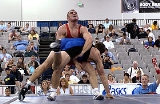
Greco-Roman wrestling is a style of amateur wrestling
Amateur wrestling

Amateur wrestling is the most widespread form of sport wrestling. There are two international wrestling styles performed in the Olympic Games under the supervision of International Federation of Associated Wrestling Styles : Greco-Roman wrestling and Freestyle wrestling....
 that is practiced throughout the world. Along with freestyle
Freestyle wrestling

Freestyle wrestling is a style of amateur wrestling that is practiced throughout the world. Along with Greco-Roman wrestling, it is one of the two styles of wrestling contested in the Olympic games....
, it is one of the two styles of wrestling contested in the Olympic games
Olympic Games

The Olympic Games are an international multi-sport event established for both summer and winter sports. There have been two generations of the Olympic Games; the first were the Ancient Olympic Games held at Olympia, Greece, Greece....
.

Colloquially referred to simply as Greco, this style of wrestling
Wrestling

Wrestling is part of the martial arts. A wrestling match consists of physical engagement between two people in which each wrestler strives to get an advantage over, or control of, the opponent....
 forbids attacks below the waist. As a result, throws
Throw (grappling)

A throw is a martial arts term for a grappling technique that involves off-balancing or lifting an opponent, and tossing them to the ground. It usually involves a rotating motion as opposed to a takedown )....
 are encouraged as the Greco-Roman wrestler cannot avoid being thrown by simply hooking or grabbing his opponent's leg.


Discussion
Ask a question about 'Greco-Roman wrestling'
Start a new discussion about 'Greco-Roman wrestling'
Answer questions from other users
Full Discussion Forum


Encyclopedia


Greco-Roman wrestling is a style of amateur wrestling
Amateur wrestling

Amateur wrestling is the most widespread form of sport wrestling. There are two international wrestling styles performed in the Olympic Games under the supervision of International Federation of Associated Wrestling Styles : Greco-Roman wrestling and Freestyle wrestling....
 that is practiced throughout the world. Along with freestyle
Freestyle wrestling

Freestyle wrestling is a style of amateur wrestling that is practiced throughout the world. Along with Greco-Roman wrestling, it is one of the two styles of wrestling contested in the Olympic games....
, it is one of the two styles of wrestling contested in the Olympic games
Olympic Games

The Olympic Games are an international multi-sport event established for both summer and winter sports. There have been two generations of the Olympic Games; the first were the Ancient Olympic Games held at Olympia, Greece, Greece....
.

Colloquially referred to simply as Greco, this style of wrestling
Wrestling

Wrestling is part of the martial arts. A wrestling match consists of physical engagement between two people in which each wrestler strives to get an advantage over, or control of, the opponent....
 forbids attacks below the waist. As a result, throws
Throw (grappling)

A throw is a martial arts term for a grappling technique that involves off-balancing or lifting an opponent, and tossing them to the ground. It usually involves a rotating motion as opposed to a takedown )....
 are encouraged as the Greco-Roman wrestler cannot avoid being thrown by simply hooking or grabbing his opponent's leg. Otherwise, the sport is similar to freestyle.

Arm drags, bearhugs, and headlocks found in freestyle have greater prominence in Greco-Roman. Throws especially known as a suplex
Suplex

A suplex is an offensive move used in wrestling, both in competitive sport wrestling, including Olympic and collegiate wrestling, and professional wrestling....
 are used, in which the offensive wrestler lifts his opponent in a high arch while falling backward on his own neck to a bridge in order to bring his opponent's shoulders down to the mat. Even on the mat, a Greco-Roman wrestler must still find several ways to turn his opponent's shoulders to the mat for a fall without legs, including (but not limited to) techniques known as the bodylock and the gut-wrench.

According to the International Federation of Associated Wrestling Styles (FILA)
International Federation of Associated Wrestling Styles

The International Federation of Associated Wrestling Styles, also known in French language as F?d?ration Internationale des Luttes Associ?es , is an international wrestling federation that holds events around the world....
, Greco-Roman wrestling is one of the four main forms of amateur competitive wrestling
Wrestling

Wrestling is part of the martial arts. A wrestling match consists of physical engagement between two people in which each wrestler strives to get an advantage over, or control of, the opponent....
 practiced internationally today. The other three forms are freestyle wrestling
Freestyle wrestling

Freestyle wrestling is a style of amateur wrestling that is practiced throughout the world. Along with Greco-Roman wrestling, it is one of the two styles of wrestling contested in the Olympic games....
, grappling
Grappling

Grappling refers to the gripping, handling, and controlling of an opponent without the use of strike , typically through the application of various grappling holds, choke holds, and counters to various hold attempts....
 (also called submission wrestling
Submission wrestling

Submission wrestling is a formula of competition and a general term describing the aspect of martial arts and combat sports that focus on clinch fighting and ground fighting with the aim of obtaining a submission using grappling hold#Submission hold....
), and sambo
Sambo (martial art)

Sambo is a modern martial art, combat sport and self-defense system developed in the Soviet Union and recognized as an official sport by the USSR All-Union Sports Committee in 1938, presented by Anatoly Kharlampiev....
.

History

Greco-Roman wrestling actually derived from a 19th century French
France

France , officially the French Republic , is a country whose Metropolitan France is located in Western Europe and that also comprises various Overseas departments and territories of France....
 form of show-wrestling popular for its high throws. It is speculated that many styles of European folk wrestling
Folk wrestling

Folk wrestling is a generic term for traditional wrestling disciplines which may or may not be codified as a modern sport. Most human cultures have some sort of grappling style, and "folk wrestling" is a catch-all term for such styles....
 may have spurred the origins of Greco-Roman wrestling. The British wrestling styles that originated in Cumberland
Cumberland

Cumberland is one of the 39 historic counties of England. It formed an Administrative counties of England from 1889 to 1974 and now forms part of Cumbria....
 and Westmoreland
Westmoreland

Westmoreland is a historic county in England. It may also refer to:...
 have some holds that are not allowed in Greco-Roman, but restricted arm holds to the upper torso, and was quite similar to Greco-Roman. The styles of Devon
Devon

Devon is a large Counties of England in South West England. The county is also referred to as Devonshire, but that is an entirely unofficial name, rarely used inside of the county but often indicating a shire....
 and Cornwall
Cornwall

Cornwall , constitutional Duchy and palatine, is a metropolitan and non-metropolitan counties of England of England, United Kingdom, located at the tip of the south-western peninsula of Great Britain....
 also had the wrestlers using their holds above waist level. According to FILA
International Federation of Associated Wrestling Styles

The International Federation of Associated Wrestling Styles, also known in French language as F?d?ration Internationale des Luttes Associ?es , is an international wrestling federation that holds events around the world....
, a Napoleonic soldier named Exbroyat first developed the style. Exbroyat performed in fairs and called his style of wrestling "flat hand wrestling" to distinguish it from other forms of hand-to-hand combat that allowed striking. In 1848, Exbroyat established the rule that no holds below the waist were to be allowed; neither were painful holds or torsions that would hurt the opponent. "Flat hand wrestling" or "French wrestling" (as the style became known) developed all throughout Europe
Europe

Europe is, conventionally, one of the world's seven continents. Comprising the westernmost peninsula of Eurasia, Europe is generally divided from Asia to its east by the water divide of the Ural Mountains, the Ural , the Caspian Sea, and by the Caucasus Mountains to the southeast....
 and became a popular sport. The Italian
Italy

Italy , officially the Italian Republic , is a country located on the Italian Peninsula in Southern Europe and on the two largest islands in the Mediterranean Sea, Sicily and Sardinia....
 wrestler Basilio Bartoletti first coined the term "Greco-Roman" for the sport to underline the interest in "ancient values." Many others in the 18th and 19th centuries sought to add value to their contemporary athletic practices by finding some connections with ancient counterparts. So, it was widely believed soon enough that Greco-Roman wrestling emerged from a Greek wrestling competition known as "upright wrestling" in which only upper body holds were allowed. The 18th century work Gymnastics for Youth by Johann Friedrich Guts Muths
Johann Christoph Friedrich GutsMuths

Johann Christoph Friedrich GutsMuths, also called Guts Muth or Gutsmuths was a teacher and educator in Germany, and is especially known for his role in the development of physical education....
 described a form of schoolboy wrestling called "orthopale" (used by Plato
Plato

Plato , was a Classical Greece Greeks philosopher, mathematician, writer of philosophical dialogues, and founder of the Platonic Academy in Ancient Athens, the first institution of higher learning in the western world....
 to describe the standing part of wrestling) that did not mention any lower-body holds. Real ancient wrestling was quite different; see Greek wrestling
Greek wrestling

Greek wrestling or Ancient Greek wrestling-- Pale was the most popular organized sport in Ancient Greece. A point was scored when one player touched the ground with his back, tapped out due to a submission-hold or was forced out of the wrestling-area....
. The British
United Kingdom

The United Kingdom of Great Britain and Northern Ireland, commonly known as the United Kingdom , the UK or Britain,is a sovereign state located off the northwestern coast of continental Europe....
 never really enjoyed Greco-Roman wrestling in comparison to its more unrestrictive counterpart, freestyle
Freestyle wrestling

Freestyle wrestling is a style of amateur wrestling that is practiced throughout the world. Along with Greco-Roman wrestling, it is one of the two styles of wrestling contested in the Olympic games....
, but on the continent, the style was highly promoted. Almost all the continental European capital cities hosted international Greco-Roman tournaments in the 19th century, with much prize money given to the place winners. For example, the Czar of Russia
Russia

Russia , or the Russian Federation , is a list of countries spanning more than one continent country extending over much of northern Eurasia....
 paid 500 francs for wrestlers to train and compete in his tournament, with 5,000 francs awarded as a prize to the tournament winner. Greco-Roman wrestling soon became prestigious in continental Europe and was the first style registered at the modern Olympic games
Olympic Games

The Olympic Games are an international multi-sport event established for both summer and winter sports. There have been two generations of the Olympic Games; the first were the Ancient Olympic Games held at Olympia, Greece, Greece....
, beginning in Athens
Athens

Athens , the Capital and largest city of Greece, dominates the Attica periphery; as one of the List of cities by time of continuous habitation, its recorded history spans around 3,400 years....
 in 1896 with one heavyweight bout, and grew in popularity during the 20th century. It has always been featured in the Olympic games, except during the Paris
Paris

Paris is the Capital of France and the country's largest city. It is situated on the river Seine, in northern France, at the heart of the ?le-de-France Regions of France ....
 Olympic Games in 1900 and the St. Louis
St. Louis, Missouri

St. Louis is an independent city in the U.S. state of Missouri, located near the confluence of the Mississippi River and the Missouri River. St....
 Olympic Games of 1904, when freestyle first emerged as an Olympic sport.

Greco-Roman wrestling never really caught on in the English-speaking world, despite its connection in style to many British
Great Britain

Great Britain is an island lying to the northwest of Continental Europe. It is the List of islands by area, and the largest in Europe. With a population of 58.9 million people it is List of islands by population....
 styles of folk wrestling and the efforts of William Muldoon
William Muldoon

William Muldoon was a champion American wrestler, physical culture and the first chairman of the New York State Athletic Commission. He once wrestled a match that lasted over seven hours....
 (a successful New York barroom freestyle wrestler who served in the Franco-Prussian War
Franco-Prussian War

The Franco-Prussian War or Franco-German War, often referred to in France as the 1870 War was a conflict between Second French Empire and Kingdom of Prussia, while Prussia was backed by the North German Confederation, of which it was a member, and the South German states of Grand Duchy of Baden, History of W?rttemberg#The Kingdom...
 and learned the style in France
France

France , officially the French Republic , is a country whose Metropolitan France is located in Western Europe and that also comprises various Overseas departments and territories of France....
) to promote it in the United States
United States

The United States of America is a Federal government constitutional republic comprising U.S. state and a federal district. The country is situated mostly in central North America, where its Contiguous United States and Washington, D.C., the Capital districts and territories, lie between the Pacific Ocean and Atlantic Oceans, Borders of the U...
 after the Civil War
American Civil War

The American Civil War , also known as the War Between the States and several Naming the American Civil War, was a civil war in the United States....
. Muldoon's matches in particular drew large crowds but failed to gain a foothold among Americans. Instead, freestyle became the wrestling of choice in Great Britain
Great Britain

Great Britain is an island lying to the northwest of Continental Europe. It is the List of islands by area, and the largest in Europe. With a population of 58.9 million people it is List of islands by population....
 and the United States
United States

The United States of America is a Federal government constitutional republic comprising U.S. state and a federal district. The country is situated mostly in central North America, where its Contiguous United States and Washington, D.C., the Capital districts and territories, lie between the Pacific Ocean and Atlantic Oceans, Borders of the U...
, where it later influenced the development of collegiate wrestling
Collegiate wrestling

Collegiate wrestling is the style of amateur wrestling practiced at the college and university level in the United States. Collegiate wrestling is sometimes known as folkstyle wrestling because by and large, it is the style that emerged out of the folk wrestling styles practiced in the early history of the United States....
. Perhaps, the most well-known of Greco-Roman wrestlers in the nineteenth century was Georg Hackenschmidt
Georg Hackenschmidt

Georg Karl Julius Hackenschmidt was an early 20th-century strongman and professional wrestling. Born in Estonia and living most of his life in London, England, he was nicknamed "The Russian Lion" ....
 born in Estonia
Estonia

Estonia , officially the Republic of Estonia is a country in the Baltic region of Northern Europe. It is bordered to the north by Finland across the Gulf of Finland, to the west by Sweden across the Baltic Sea, to the south by Latvia , and to the east by the Russia ....
 and nicknamed "The Russian Lion." Hackenschmidt in 1898 at the age of 21 and with 15 months of training defeated the experienced Paul Pons in a match in St. Petersburg, Russia. In 1900, he won professional tournaments in Moscow
Moscow

Moscow is the capital and the largest types of inhabited localities in Russia of the Russian Federation. It is also the largest European cities and metropolitan areas, with the Moscow metropolitan area ranking among the largest urban areas in the world....
 and St. Petersburg and a series of international tournaments after that. After defeating Tom Jenkins (from the United States) in both freestyle and Greco-Roman matches in England, Georg Hackenschmidt wrestled exclusively freestyle in order to compete better against English, Australian, and American opponents. Winning more than 2,000 victories in Greco-Roman and freestyle, Hackenschmidt served as the physical education
Physical education

In most educational systems, physical education class,Phys Ed, is a course that utilizes learning in the cognitive, affective and psychomotor domains in a play or movement exploration setting....
 adviser to the House of Lords
House of Lords

The House of Lords is the second house of the Parliament of the United Kingdom and is also commonly referred to as "the Lords". The Parliament comprises the British monarchy, the British House of Commons , and the Lords....
 after his retirement.

Professional matches in Greco-Roman wrestling were known for their great brutality. Body slams, choke-holds, and head-butting was allowed, and even caustic substances were used to weaken the opponent. By the end of the nineteenth century, gouging with the nails, punching, and violently slamming the arms together around the opponent's stomach were forbidden. Greco-Roman matches were also famous for their length. Professionally, it was not uncommon for there to be matches lasting two or three hours. William Muldoon's bout with Clarence Whistler at the Terrace Garden Theater in New York lasted eight hours before ending in a draw. Even in the 1912 Olympics, a match between Anders Ahlgren
Anders Ahlgren

Anders Oscar Ahlgren was a Sweden Amateur wrestling who competed in the 1912 Summer Olympics and in the 1920 Summer Olympics.He won the silver medal in the light heavyweight class....
 of Sweden
Sweden

Sweden , officially the Kingdom of Sweden , is a Nordic countries on the Scandinavian Peninsula in Northern Europe. Sweden has land borders with Norway to the west and Finland to the northeast, and it is connected to Denmark by the ?resund Bridge in the south....
 and Ivar Boehling of Finland
Finland

Finland , officially the Republic of Finland , is a Nordic countries situated in the Fennoscandian region of northern Europe. It borders Sweden on the west, Russia on the east, and Norway on the north, while Estonia lies to its south across the Gulf of Finland....
 lasted for nine hours before a draw was called and both wrestlers awarded the silver medal. The International Amateur Wrestling Federation (IAWF)
International Federation of Associated Wrestling Styles

The International Federation of Associated Wrestling Styles, also known in French language as F?d?ration Internationale des Luttes Associ?es , is an international wrestling federation that holds events around the world....
 took over the regulation of Greco-Roman wrestling in 1921. Since then matches have been dramatically cut short, and today all movements that put the life or limb of the wrestler in jeopardy are forbidden.

In terms of Olympic competition, countries of the former Soviet Union
Soviet Union

The Union of Soviet Socialist Republics was a Constitution of the Soviet Union socialist state that existed in Eurasia from 1922 to 1991.The name is a translation of the , romanization of Russian Soyuz Sovetskikh Sotsialisticheskikh Respublik, abbreviated ????, SSSR....
, Bulgaria
Bulgaria

The state of Bulgaria , Scientific transliteration Balgarija, officially the Republic of Bulgaria has played a significant role in the Balkans in south-eastern Europe for over fourteen centuries....
, Romania
Romania

Romania is a country located in Southeastern Europe Central Europe, North of the Balkan Peninsula, on the Lower Danube, within and outside the Carpathian Mountains, bordering on the Black Sea....
, Japan
Japan

Japan is an island country in East Asia. Located in the Pacific Ocean, it lies to the east of the Sea of Japan, People's Republic of China, North Korea, South Korea and Russia, stretching from the Sea of Okhotsk in the north to the East China Sea and Taiwan in the south....
, Sweden
Sweden

Sweden , officially the Kingdom of Sweden , is a Nordic countries on the Scandinavian Peninsula in Northern Europe. Sweden has land borders with Norway to the west and Finland to the northeast, and it is connected to Denmark by the ?resund Bridge in the south....
, and Finland
Finland

Finland , officially the Republic of Finland , is a Nordic countries situated in the Fennoscandian region of northern Europe. It borders Sweden on the west, Russia on the east, and Norway on the north, while Estonia lies to its south across the Gulf of Finland....
 have had great success. Carl Westergren of Sweden won three Greco-Roman gold medals in 1920, 1924, and 1932, and was the first Greco-Roman wrestler to do so. Alexander Karelin
Alexander Karelin

Aleksandr Aleksandrovich Karelin, or simply Alexander Karelin, is a Hero of the Russian Federation and was a dominant Greco-Roman wrestling amateur wrestling for the Soviet Union and later, after its dissolution, for Russia.He won gold medals at the 1988, 1992, and 1996 Olympic Games....
 did the same in 1988, 1992, and 1996. Ivar Johansson of Sweden won gold medals in Greco-Roman in 1932 and 1936 and also a gold medal in freestyle in 1932. The United States Olympic delegation (exclusively wrestling freestyle before) first entered Greco-Roman wrestling in 1952 and has taken three gold medals, won by Steve Fraser
Steve Fraser

Steve Fraser was the 1984 Olympic Games Gold Medalist in Greco-Roman wrestling in the 198 lb weight class. A native of Hazel Park, Michigan, Fraser was a Michigan High School Athletic Association state wrestling champion and later an All-American in wrestling at the University of Michigan....
 and Jeffrey Blatnick
Jeff Blatnick

Jeff Blatnick is a former United States of America Wrestling weight classes Greco-Roman wrestling and cancer survivor....
 in the 1984 Los Angeles
Los Ángeles

Los ?ngeles is the Capital of the Biob?o Province, in the municipality of the same name, in Regions of Chile VIII , in the center-south of Chile....
 Olympic Games, and by Rulon Gardner
Rulon Gardner

Rulon Gardner is an sport wrestling in the Greco-Roman wrestling discipline from the United States, most notable for his gold medal in the 2000 Olympics after defeating Russian Alexander Karelin, who was previously undefeated in 13 years of international competition....
 at the 2000 Olympic Games in Sydney, Australia
Australia

Australia, officially the Commonwealth of Australia, is a country in the southern hemisphere comprising the Australia of the world's smallest continent, the major island of Tasmania, and numerous list of islands of Australia in the Indian Ocean and Pacific Oceans....
.

Weight Classes

Currently, international Greco-Roman wrestling is divided into four main age categories: schoolboys, cadets, juniors, and seniors. Schoolboys (young men ages 14-15; or age 13 with a medical certificate and parental authorization) wrestle in 10 weight classes ranging from 29 to 85 kg. Cadets (young men ages 16-17; or age 15 with a medical certificate and parental authorization) wrestle in 10 weight classes ranging from 39 to 100 kg. Juniors (young men ages 18 to 20; or age 17 with a medical certificate and parental authorization) wrestle in eight weight classes ranging from 46 to 120 kg. Seniors (men ages 20 and up) wrestle in seven weight classes ranging from 50 to 120 kg. For men, there is also a special category for some Greco-Roman competitions, "Veterans", for men ages 35 and older, presumably featuring the same weight classes as seniors. Also, all of the men's age categories and weight classes can be applied to freestyle wrestling
Freestyle wrestling

Freestyle wrestling is a style of amateur wrestling that is practiced throughout the world. Along with Greco-Roman wrestling, it is one of the two styles of wrestling contested in the Olympic games....
. Wrestlers after weigh-in may only wrestle in their own weight class. Wrestlers in the senior age category may wrestle up a weight class except for the heavyweight division (which starts at a weight more than 96 kg for the men). Different nations may have different weight classes and different age categories for their levels of Greco-Roman competition. Enrique Reyes is an upcoming wrestler for Greco Roman.

Structure of the Tournament

A typical international wrestling tournament takes place by direct elimination with an ideal number of wrestlers (4, 8, 16, 32, 64, etc.) in each weight class and age category competing for placement. The competition in each weight class takes place in one day. The day before the wrestling in a scheduled weight class and age category takes place, all the applicable wrestlers are examined by a physician and weighed-in. Each wrestler after being weighed on the scale then draws a token randomly that gives a certain number.

If an ideal number is not reached to begin elimination rounds, a qualification round will take place to eliminate the excess number of wrestlers. For example, 22 wrestlers may weigh-in over the ideal number of 16 wrestlers. The six wrestlers who drew the highest numbers after 16 and the six wrestlers who drew the six numbers immediately before 17 would then wrestle in six matches in the qualification round. The winners of those matches would then go on to the elimination round.

In the elimination round, the ideal number of wrestlers then pair off and compete in matches until two victors emerge who will compete in the finals for first and second place. All of the wrestlers who lost to the two finals then have the chance to wrestle in a repechage
Repechage

Repechage , meaning "to rescue" or "to save", is a practice amongst ladder competitions that allows participants that failed to meet qualifying standards by a small margin to continue to the next round....
 round
. The repechage round begins with the wrestlers who lost to the two finalists at the lowest level of competition in the elimination round. The matches are paired off by the wrestlers who lost to one finalist and the wrestlers who lost to the other. The two wrestlers who win after every level of competition are the victors of the repechage round.

In the finals, the two victors of the elimination round compete for first and second place.

In all rounds of the tournament, the wrestlers compete in matches paired off in the order of the numbers they drew after the weigh-in.

After the finals match, the awards ceremony will take place. The first place and second place wrestlers will receive a gold and silver medal, respectively. (At the FILA World Championships, the first place wrestler will receive the World Championship Belt.) The two repechage round winners will each be awarded third place with a bronze medal. The two wrestlers who lost in the finals for the third place are awarded fifth place. From seventh place down, the wrestlers are ranked according to the classification points earned for their victories or losses. If there is a tie among wrestlers for classification points, the ranking is determined in this order from the highest to the lowest:
  • Most victories earned by fall
  • Most matches won by technical superiority
  • Most periods won by technical superiority
  • Most technical points scored in the tournament
  • Least technical points scored in the tournament
Wrestlers who remained tied after that will be awarded placements "ex aequo." Wrestlers classified from the fifth to the 10th place will receive a special diploma. The wrestling tournaments in the Olympic Games
Olympic Games

The Olympic Games are an international multi-sport event established for both summer and winter sports. There have been two generations of the Olympic Games; the first were the Ancient Olympic Games held at Olympia, Greece, Greece....
 and the Senior and Junior World Championships are designed to take place over three days on three mats.

Layout of the Mat

The match takes place on a thick rubber mat that is shock-absorbing to ensure safety. For the Olympic Games, all World Championships, and World Cups, the mat has to be new. The main wrestling area has a nine meter diameter and is surrounded by a 1.5 meter border of the same thickness known as the protection area. Inside the nine meter in diameter circle is a red band of one meter in width that is on the outer edge of the circle and is known as the red zone. The red zone is used to help indicate passivity on the part of a wrestler; thus, it is also known as the passivity zone. Inside the red zone is the central wrestling area which is seven meters in diameter. In the middle of the central wrestling area is the central circle, which is one meter in diameter. The central circle is surrounded by a band 10 centimeters wide and is divided in half by a red line eight centimeters in width. The diagonally opposite corners of the mat are marked with the wrestlers' colors, red and blue.

For competition in the Olympic Games, the World Championships, and the Continental Championships, the mat is installed on a platform no greater than 1.1 meters in height. If the mat lays on a podium and the protection margin (covering and free space around the mat) does not reach two meters, then the sides of the podium are covered with 45º (degree) inclined panels. In all cases, the color of the protection area is different from the color of the mat.

Equipment

  • A singlet
    Wrestling singlet

    A wrestling singlet is a one-piece, tight-fitting, colored uniform, usually made of spandex, lycra, or nylon, used in amateur wrestling. The uniform is tight fitting so as not to get grasped accidentally by one's opponent, and allows the referee to see each wrestler's body clearly when awarding points or a Pin ....
     is a one-piece wrestling garment made of spandex
    Spandex

    Spandex or elastane is a synthetic fiber known for its exceptional elasticity . It is stronger and more durable than rubber, its major non-synthetic competitor....
     that should provide a tight and comfortable fit for the wrestler. It is made from nylon
    Nylon

    Nylon is a generic designation for a family of synthetic polymers known generically as polyamides and first produced on February 28, 1935 by Wallace Carothers at DuPont....
     or lycra and prevents an opponent from using anything on the wrestler as leverage. One wrestler usually competes in a red singlet and the other in a blue singlet.
  • A special pair of shoes
    Wrestling shoes

    Wrestling shoes are active wear used in competition and practice for the sport of amateur wrestling. Generally extremely light and flexible, they try to mimic the bare foot with slightly more traction and ankle support and less chance of contracting a disease or hurting someone with your toe nails....
     is worn by the wrestler to increase his mobility and flexibility. Wrestling shoes are light and flexible in order to provide maximum comfort and movement. Usually made with rubber soles, they help give the wrestler's feet a better grip on the mat.
  • A handkerchief, also called a bloodrag is carried in the singlet. In the event of bleeding, the wrestler will remove the cloth from his singlet and attempt to stop the bleeding or clean up any bodily fluids that may have gotten onto the mat.
  • Headgear
    Wrestling headgear

    Wrestling headgear is protection that a person wears over the ears and chin during Amateur wrestling matches. The main purpose of headgear is to protect the ears of the wrestler, not really the head as the name implies....
    , equipment worn around the ears to protect the wrestler, is optional in Greco-Roman. Headgear is omitted at the participant's own risk, as there is the potential to develop cauliflower ear
    Cauliflower ear

    Cauliflower ear is a condition most common among amateur wrestling, rugby football, Mixed martial arts, and grapplers. If the pinna suffers a blow, a Thrombus or other fluid may collect under the perichondrium....
    .


The Match

A match is a competition between two individual wrestlers of the same weight class. In Greco-Roman wrestling, a jury (or team) of three officials (referees)
Referee

A referee is a person who has authority to make decisions about play in many sports. Officials in various sports are known by a variety of titles, including: referee, umpire, judge, linesman, commissaire, timekeeper or touch judge....
 is used. The referee controls the action in the center, blowing the whistle to start and stop the action, and supervises the scoring of holds and infractions. The judge sits at the side of the mat, keeps score, and occasionally gives his approval when needed by the referee for various decisions. The mat chairman sits at the scoring table, keeps time, is responsible for declaring technical superiority, and supervises the work of the referee and judge. To call a fall, two of the three officials must agree (usually, the referee and either the judge or the mat chairman).

Period Format

In Greco-Roman and freestyle, the format is now three two-minute periods. Before each match, each wrestler's name is called, and the wrestler takes his place at the corner of the mat assigned to his color. The referee then calls both of them to his side at the center of the mat, shakes hands with them, inspects their apparel, and checks for any perspiration, oily or greasy substances, and any other infractions. The two wrestlers then greet each other, shake hands, and the referee blows his whistle to start the period.

A wrestler wins the match when he has won two out of three periods. For example, if one competitor were to win the first period 1-0 and the second period 1-0, the match would be over. However, if the other competitor were to win the second period, then a third and deciding period would result. Only a fall, injury default, or disqualification terminates the match; all other modes of victory result only in period termination. One side effect of this format is that it is possible for the losing wrestler to outscore the winner. For example, periods may be scored 3-2, 0-4, 1-0, leading to a total score of 4-6 but a win for the wrestler scoring fewer points.

As of 2005, each Greco-Roman period is broken up into a phase for wrestling from the neutral position and a maximum of two par terre (ground wrestling) phases. During the wrestling phase from the neutral position, both wrestlers compete for takedowns and points for 60 seconds as usual. At the end of the first minute, in general, the wrestler who has scored the most points will receive the advantage in an Olympic lift from an open par terre position on the other wrestler. This position is known as The Clinch. If neither wrestler at this point has any points, the referee will toss a colored disk, with a red-colored side and a blue-colored side. The wrestler who won the colored disk toss will receive the advantage in the Olympic lift.

The wrestler who lost the colored disk toss then places his hands and knees in the center circle, with the hands and knees at least 20 centimeters apart and the distance between the hands a maximum of 30 centimeters. The arms of that wrestler would be stretched out, the feet would not be crossed, and the thighs would be stretched out forming a 90 degree angle with the mat. The wrestler who won the colored disk toss would then be allowed to step beside the wrestler on the bottom, not touching him with his legs. If the wrestler who won the colored disk toss wished, he could place one knee on the mat. The top wrestler would then wrap his hands and arms around the bottom wrestler's waist and execute the Olympic lift (called an upside-down belt hold) at the beginning of the first 30 seconds. The bottom wrestler could then attempt to defend himself.

At the end of first thirty seconds, the clinch position is reversed with the other wrestler receiving the Olympic lift, and the period continuing for the remaining 30 seconds. The period is decided by who accumulated the most points during both standing and ground phases. During each ground phase, if the top wrestler cannot score, the other wrestler is awarded one point. In the case of no scoring moves being executed during either ground phase the score will be 1-1, and in this case generally the wrestler to score last will be awarded the period.

When the period (or match) has concluded, the referee stands at the center of the mat facing the officials' table. Both wrestlers then come, shake hands, and stand on either side of the referee to await the decision. The referee then proclaims the winner by raising the winner's hand. At the end of the match, each wrestler then shakes hands with the referee and returns to shake hands with his opponent's coach.

Match Scoring

In Greco-Roman wrestling, as well as in freestyle wrestling, points are awarded mostly on the basis of explosive action and risk. For example, when one wrestler performs a grand amplitude throw that brings his opponent into the danger position, he is awarded the greatest number of points that can be scored in one instance. Also, a wrestler who takes the risk to briefly roll on the mat (with his shoulders in contact with the mat) could give a certain number of points to his opponent. Scoring can be accomplished in the following ways:
  • Takedown (1 to 5 points): A wrestler is awarded points for a takedown when the wrestler gains control over his opponent on the mat from a neutral position (when the wrestler is on his feet). At least three points of contact have to be controlled on the mat (e.g. two arms and one knee; two knees and one arm or the head; or two arms and the head).
- Five points are awarded for a takedown brought about by a throw of grand amplitude (a throw in which a wrestler brings his opponent off of the mat and controls him so that his feet go directly above his head) either from the standing or par terre position into a direct and immediate danger position.
- Generally, three points are awarded for a takedown brought about by a grand amplitude throw that does not bring his opponent in a direct and immediate danger position or for a takedown in which a wrestler's opponent is taken from his feet or his stomach to his back or side (a throw of short amplitude) so that he is in the danger position.
- One point is awarded for a takedown brought about by a wrestler taking his opponent from his feet to his stomach or side such that his back or shoulders are not exposed to the mat.
  • Reversal (1 point): A wrestler is awarded one point for a reversal when the wrestler gains control over his opponent from a defensive position (when the wrestler is being controlled by his opponent).
  • Exposure also called the Danger Position (2 or 3 points): A wrestler is awarded points for exposure when the wrestler exposes his opponent's back to the mat for several seconds. Points for exposure are also awarded if a wrestler's back is to the mat but the wrestler is not pinned. Criteria for exposure or the danger position is met when 1) a wrestler's opponent is in a bridge position to avoid being pinned, 2) a wrestler's opponent is on one or both elbows with his back to the mat and avoids getting pinned, 3) a wrestler holds one of his opponent's shoulders to the mat and the other shoulder at an acute angle (less than 90 degrees), 4) a wrestler's opponent is in an "instantaneous fall" position (where both of his shoulders are on the mat for less than one second), or 5) the wrestler's opponent rolls on his shoulders. A wrestler in the danger position allows his opponent to score two points. An additional hold-down point may be earned by maintaining the exposure continuously for five seconds.
  • Penalty (1 or 2 points): Under the 2004–2005 changes to the international styles, a wrestler whose opponent takes an injury time-out receives one point unless the injured wrestler is bleeding. Other infractions (e.g. fleeing a hold or the mat, striking the opponent, acting with brutality or intent to injure, using illegal holds, etc.) are penalized by an award of either one or two points, a Caution, and a choice of position to the opponent.
  • Out-of-Bounds (1 point): Whenever a wrestler places his foot in the protection area, the match is stopped, and one point is awarded to his opponent.


Classification points are also awarded in an international wrestling tournament, which give most points to the winner and in some cases, one point to the loser depending on the outcome of the match and how the victory was attained. For example, a victory by fall would give the winner five classification points and the loser no points, while a match won by technical superiority with the loser scoring technical points would award three points to the winner and one point to loser.

The full determinations for scoring are found .

Scores no longer rewarded in Greco-Roman and freestyle wrestling
In 2004, FILA radically changed the format and scoring of the international styles. Part of this involved eliminating a way of scoring which is possible from the par terre, or 'on the mat,' position.
  • Lifting: A wrestler was awarded points for successfully lifting an opponent in the defensive position and exposing his back.


Victory Conditions in Greco-Roman Wrestling

A match can be won in the following ways:
  • Win by Fall
    Pin (amateur wrestling)

    A pin, a fall, or a pinfall is a victory condition in various forms of sport wrestling that is met by holding an opponent's shoulders or scapula on the wrestling mat for a prescribed period of time....
    : The object of the entire wrestling match is to attain victory by what is known as the fall
    Pin (amateur wrestling)

    A pin, a fall, or a pinfall is a victory condition in various forms of sport wrestling that is met by holding an opponent's shoulders or scapula on the wrestling mat for a prescribed period of time....
    . A fall, also known as a pin
    Pin (amateur wrestling)

    A pin, a fall, or a pinfall is a victory condition in various forms of sport wrestling that is met by holding an opponent's shoulders or scapula on the wrestling mat for a prescribed period of time....
    , occurs when one wrestler holds both of his opponents' shoulders on the mat simultaneously. In Greco-Roman and freestyle wrestling, the two shoulders of the defensive wrestler must be held long enough for the referee to "observe the total control of the fall" (usually ranging from one half-second to about one or two seconds). Then either the judge or the mat chairman concurs with the referee that a fall is made. (If the referee does not indicate a fall, and the fall is valid, the judge and the mat chairman can concur together and announce the fall.) A fall ends the match entirely regardless of when it occurs. In the United States
    United States

    The United States of America is a Federal government constitutional republic comprising U.S. state and a federal district. The country is situated mostly in central North America, where its Contiguous United States and Washington, D.C., the Capital districts and territories, lie between the Pacific Ocean and Atlantic Oceans, Borders of the U...
    , for the Kids freestyle and Greco-Roman wrestling division (wrestlers ages 8 to 14) in competitions sponsored by USA Wrestling
    USA Wrestling

    USA Wrestling is the organization that currently governs freestyle wrestling and Greco-Roman wrestling in the United States. USA Wrestling is also the official representative to the United States Olympic Committee and to the International Federation of Associated Wrestling Styles and is considered the Sport governing body of the sport....
    , it is specified that a fall must be held for two seconds.
  • Win by Technical Superiority
    Technical Fall

    In amateur wrestling, a technical fall, or technical superiority , is a victory condition satisfied by outscoring your opponent by a specified number of points....
     (Also called Technical Fall): If a fall is not secured to end the match, a wrestler can win a period simply by points. If one wrestler gains a six-point lead over his opponent at any time in the period, scores a five point throw (a throw where the person's feet go directly above his head, also called a throw of grand amplitude), or scores two three point takedowns (taking an opponent from his feet to his back or sides so that there is shoulder exposure), the current period is declared over and he is declared the winner of that period by technical superiority. If a wrestler wins two out of three periods in this way, he is then the winner of the match by technical superiority.
  • Win by Decision: If neither wrestler achieves either a fall or technical superiority, the wrestler who scored more points during the period is declared the winner of that period. If the score is tied at 1-1 at the end of both standing and ground phases, the winner is determined by certain criteria. First, the number of cautions given to each wrestler for penalties; next, the value of points gained (that is, whether a wrestler gained points based on a one-, two-, or three-point move); and finally, the last scored technical point are taken into account to determine the winner of the period. Generally, the wrestler who scored the last technical point would be awarded the period. Generally, the wrestler who scored the last technical point will be awarded the period.
  • Win by Default: If one wrestler is unable to continue participating for any reason or fails to show up on the mat after his name was called three times before the match begins, his opponent is declared the winner of the match by default, forfeit, or withdrawal.
  • Win by Injury: If one wrestler is injured and unable to continue, the other wrestler is declared the winner. This is also referred to as a medical forfeit or injury default. The term also encompasses situations where wrestlers become ill, take too many injury time-outs, or bleed uncontrollably. If a wrestler is injured by his opponent's illegal maneuver and cannot continue, the wrestler at fault is disqualified.
  • Win by Disqualification: Normally, if a wrestler is assessed three Cautions for breaking the rules, he is disqualified. Under other circumstances, such as flagrant brutality, the match may be ended immediately and the wrestler disqualified and removed from the tournament.


Team Scoring in Tournaments

In an international wrestling tournament, teams enter one wrestler at each weight class and score points based on the individual performances. For example, if a wrestler at the 60 kg weight class finishes in first place, then his team will receive 10 points. If he were to finish in tenth place, then the team would only receive one. At the end of the tournament, each team's score is tallied, and the teams are then placed first, second, third, etc.

Team Competition

A team competition or dual meet is a meeting between (typically two) teams in which individual wrestlers at a given weight class compete against each other. A team receives one point for each victory in a weight class regardless of the outcome. The team that scores the most points at the end of the matches wins the team competition. If there are two sets of competitions with one team winning the home competition and one winning the away competition, a third competition may take place to determine the winner for ranking purposes, or the ranking may take place by assessing in order: 1) the most victories by adding the points of the two matches; 2) the most points by fall, default, forfeit, or disqualification; 3) the most matches won by technical superiority; 4) the most periods won by technical superiority; 5) the most technical points won in all the competition; 6) the least technical points won in all the competition. This works similarly when more than two teams are involved in this predicament.

Mixed Martial Arts


Successful fighters with Wrestling backgrounds, include: Randy Couture
Randy Couture

Randy Duane Couture , also known as "The Natural" and "Captain America," is an American actor and mixed martial artist, Greco-Roman wrestling, and former collegiate wrestling, and the former heavyweight champion of the Ultimate Fighting Championship....
, Dan Henderson
Dan Henderson

Dan "Hendo" Henderson is a former Olympic wrestler and current Ultimate Fighting Championship mixed martial artist who was the last welterweight and middleweight champion of the Pride Fighting Championships....
, Matt Lindland
Matt Lindland

Matthew James "The Law" Lindland is an United States professional mixed martial arts fighter, Olympic Games wrestler, and politician. He won the Oregon Republican Party's nomination for the Oregon House of Representatives, district 52 seat on May 20 2008, in a close race....
 and Dan Severn
Dan Severn

Daniel DeWayne Severn is an United States Mixed martial arts and Professional wrestling, notable for his success in the early years of Ultimate Fighting Championship tournaments....
.

See also

  • Amateur wrestling
    Amateur wrestling

    Amateur wrestling is the most widespread form of sport wrestling. There are two international wrestling styles performed in the Olympic Games under the supervision of International Federation of Associated Wrestling Styles : Greco-Roman wrestling and Freestyle wrestling....
  • Folk wrestling
    Folk wrestling

    Folk wrestling is a generic term for traditional wrestling disciplines which may or may not be codified as a modern sport. Most human cultures have some sort of grappling style, and "folk wrestling" is a catch-all term for such styles....
  • Freestyle wrestling
    Freestyle wrestling

    Freestyle wrestling is a style of amateur wrestling that is practiced throughout the world. Along with Greco-Roman wrestling, it is one of the two styles of wrestling contested in the Olympic games....
  • Collegiate wrestling
    Collegiate wrestling

    Collegiate wrestling is the style of amateur wrestling practiced at the college and university level in the United States. Collegiate wrestling is sometimes known as folkstyle wrestling because by and large, it is the style that emerged out of the folk wrestling styles practiced in the early history of the United States....


External links