

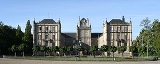
Coburg

Encyclopedia
Coburg is a town located on the Itz River in Bavaria
, Germany. Its 2005 population was 42,015. Long one of the Thuringia
n states of the Wettin line
, it joined with Bavaria
by popular vote in 1920. Before 1918, it was one of the capital cities in the duchy
of Saxe-Coburg and Gotha
and the duchy
of Saxe-Coburg-Saalfeld
.
Coburg's Coat of Arms
honoring the city's patron
Saint Maurice
was granted in 1493.
 Coburg lies about 90 km south of Erfurt
and about 100 km north of Nuremberg
. Coburg was first mentioned in a document dated 1056, although there was a settlement at the site that predates it called Trufalistat. Following several changes of aristocratic ownership, it came into the hands of the House of Wettin
in 1353 from the House of Henneberg
with the marriage of Friedrich III, the Strong, with Katherina von Henneberg and was initially regarded by them as a Saxon
outpost within Franconia
.
In 1596, it was raised to the status of capital of one of the dynasty's splintered Saxon-Thuringian
territories, the new Duchy of Saxe-Coburg
under the leadership of Duke Johann Casimir (ruled 1596–1633). From 1699 to 1826, it was one of the two capitals of the duchy of Saxe-Coburg-Saalfeld
, and from 1826-1918 it was a capital of the duchy of Saxe-Coburg-Gotha.
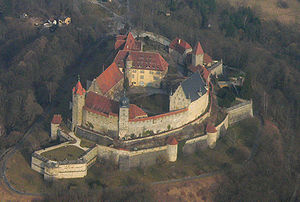
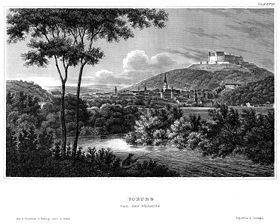
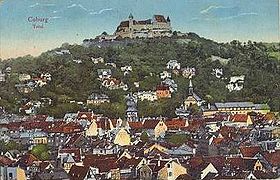
One of Germany's largest castles, the mighty Veste Coburg citadel, built starting in 1225 (upon the site of an 11th century chapel), dominates the town from its hilltop. During the Diet of Augsburg in 1530 reformer Martin Luther spent six months at the castle (located at the southernmost point of the Saxon duchy) while his liege lord, the Duke of Saxony, attended the Diet. Luther was forbidden to attend by the duke, who feared that he would be imprisoned and burned as a heretic. While quartered at the castle Luther continued with his translation of the Bible into German.
Today the Veste Coburg is home to three museums. One is the Ducal Palace (Fürstenbau), with many furnished rooms of the Dukes of Coburg, including the apartment where Martin Luther lived in 1530. Probably the most notable room in the castle (unique in all of Germany) is the Hunting Room (Jagdzimmer) of 1632, which is entirely made of marquetry wood inlay, done up with over 60 marquetry panels, deeply coffered marquetry ceilings and a wood paneled floor. Another museum is the Armory (Rüstkammer), containing the largest collection of medieval armour and weaponry in Germany, with over 10,500 items. The third is the Art Collections (Kunstsammlungen), which contains a world class collection of 300,000 engravings (Kupferstich-Kabinett), a 20,000 piece coin collection (Münzkabinett), a 7000 piece documentation collection (Briefe & Urkunden), and a 3,500 piece glassware collection (Gläser-Sammlung).
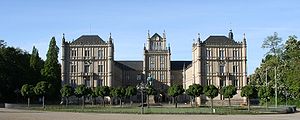
In the old town at the base of the castle hill, the Ehrenburg Palace
(a former Franciscan Monastery), was rebuilt in 1543. It was gutted by fire in 1690 and rebuilt in a Baroque style, with stucco work by North Italian craftsmen that includes a famous "Hall of the Giants" (which contains a plaque that states it was the location of the first meeting between England's Queen Victoria and Franz Josef Emperor of Austria in 1860). Its Gothic Revival exterior was remodelled by Karl Friedrich Schinkel
in the 19th century. It now also houses a museum as well as a famous library.
Ernst Frederick, the fourth Duke of Saxe-Coburg-Saalfeld, moved his capital from Saalfeld to Coburg in 1764. Coburg then became capital of the Duchy of Saxe-Coburg-Saalfeld
and then the Duchy of Saxe-Coburg and Gotha
. During the 19th century, dynastic marriages created ties with the royal families of Belgium, Bulgaria, Portugal, as well as Great Britain. The era of political dominance peaked with Leopold Friedrich
; born Prince of Saxe-Coburg-Saalfeld, becoming the King of Belgians in 1831 and Prince Albert of Saxe-Coburg and Gotha, born in Schloss Rosenau
, marrying his first cousin, Queen Victoria
in 1840. The marriage between Albert and Victoria established the present British royal house, which renamed itself Windsor
during World War I. This marriage in turn led to a union with Germany's ruling dynasty, the Hohenzollerns, when the couple's eldest child, Victoria, married the future Kaiser Friedrich III.
After her marriage, Queen Victoria said of Coburg
Due to the royal connections among the royal houses of Europe, Coburg was the site of many royal Ducal weddings and visits. Britain's Queen Victoria made 6 visits to Coburg during her 64 year reign. In 1894 one ceremony brought together Queen Victoria, her son Edward (future Edward VII), her second son Alfred (Duke of Saxe-Coburg-Gotha), her daughter the German dowager Empress Friedrich (Victoria), and many of her grandchildren, such as future Tsar Nicholas and Alexandra of Russia, Kaiser Wilhelm II of Germany, and the future King George V of Great Britain.

 In 1920, two years after the abdication of the last duke, the locals voted to join Bavaria
. Thus whilst the other Saxon-Thuringian principalities were later incorporated into the German Democratic Republic
after World War II, Coburg became part of West Germany
. As a result, the town spent the Cold War
years lying right next to the Iron Curtain
, surrounded by East German territory on three sides.
In 1929, Coburg was the first German city in which the Nazi Party won the absolute majority of the popular votes during municipal elections.
In 1946, it was alleged that Coburg was a base for the Western Allies
to organize a Polish armed insurgency against Soviet-backed communists in Poland
.
(Lutheran). Other Christian communities are Baptists, Seventh-day Adventists
, the ICF Movement, Jehovah's Witnesses
, Catholics, Old Catholics and the New Apostolic Church
, as well as The Church of Jesus Christ of Latter-day Saints. There are also three communities of Muslim
s. Coburg had a large Jewish community until the 1940s. Jews had lived there since the 14th century. The old synagogue was a former church. Today it is used by Old Catholics. Coburg became Protestant after the Reformation
. All Catholics were persecuted. A new Catholic community was founded in the 19th century.
Over two thirds of Coburg's population live in Coburg City.
As a result of the large presence of the US Army prior to German re-unification, Americans and American culture are still present in Coburg and the surrounding area. This influence ranges from American-style pubs and restaurants to two sports clubs sponsoring baseball teams.
(graduated), William Frishmuth
(born), and Eduard Study
(born).
In 1530, Martin Luther
stayed in the Veste Coburg to follow negotiations at the Imperial Diet
in Augsburg
. He also preached at St. Moriz church.
In 1887, Johann Strauss
, better known as the Waltz King, left Vienna when the Roman Catholic Church forbade his divorce from his second wife. So he moved to Lutheran Saxe-Coburg-Gotha with his future third wife Adele, where he lived the last 13 years of his life in Coburg. He was however buried in Vienna.
In 1922, Adolf Hitler
led several hundred stormtroopers
in a march through the city, fighting pitched street battles with leftists. During the Nazi era, the Coburg Badge
was one of the most prestigious party medals.
Hans Morgenthau
, founder of International Relations
as a field of study, was born here.
Fritz Mollwitz
, professional baseball player, was born here.
Baroness Louise Lehzen,(born) governess and adviser to Queen Victoria
Prince Albert
, husband of Queen Victoria, was born in Schloss Rosenau, Coburg
is traditionally credited with originating the frankfurter
. According to the Council, this claim is disputed and that the hot dog was created in the late 17th century by Johann Georghehner, a butcher, living in Coburg.
Coburg was the first German town to elect a Nazi Mayor.
A popular local delicacy is the Coburger bratwurst, a sausage (the official size of which is denoted by a statue of a man holding a bratwurst located on the town hall, overlooking the square) roasted over a pine cone fire. The sausage is served in a semmel (a small bread bun, a third the size of the sausage itself), and is highly popular with locals and tourists alike.
Coburg Peak
on Trinity Peninsula
in Graham Land
, Antarctica is named after the town, in connection with the Bulgarian royal house
of Coburg (Saxe-Coburg-Gotha
).
-Coburg-Schirnding, B 4 Hamburg
-Coburg-Nürnberg or motorway A 73 Suhl
-Coburg-Nürnberg. Seven-times Formula 1 world champion Michael Schumacher has been a recently noted driver in Coburg.
From the main station one can go to Lichtenfels
, Bamberg
, Forchheim
, Erlangen
, Fürth
and Nürnberg, to Neustadt bei Coburg
, Sonneberg
, to Bad Rodach
and to Kulmbach
, Neuenmarkt-Wirsberg.
In future, some Intercity-Express high speed trains will stop in Coburg on the Nuremberg–Erfurt high-speed railway, part of a new Berlin-Erfurt
-Coburg-Nürnberg route.
Large airports nearby are in Frankfurt
, Erfurt
and Nuremberg
.
The OVF ("Omnibus Verkehr Franken") covers Coburg's surrounding countryside with additional 11 bus lines.
with: Cobourg, Ontario, Canada Gais, South Tyrol Garden City, New York
, USA Isle of Wight
, United Kingdom Niort
, France Oudenaarde
, Belgium
Bavaria
Bavaria, formally the Free State of Bavaria is a state of Germany, located in the southeast of Germany. With an area of , it is the largest state by area, forming almost 20% of the total land area of Germany...
, Germany. Its 2005 population was 42,015. Long one of the Thuringia
Thuringia
The Free State of Thuringia is a state of Germany, located in the central part of the country.It has an area of and 2.29 million inhabitants, making it the sixth smallest by area and the fifth smallest by population of Germany's sixteen states....
n states of the Wettin line
Ernestine duchies
The Ernestine duchies, also called the Saxon duchies , were a changing number of small states largely located in the present German state of Thuringia, governed by dukes of the Ernestine line of the House of Wettin.-Overview:The...
, it joined with Bavaria
Bavaria
Bavaria, formally the Free State of Bavaria is a state of Germany, located in the southeast of Germany. With an area of , it is the largest state by area, forming almost 20% of the total land area of Germany...
by popular vote in 1920. Before 1918, it was one of the capital cities in the duchy
Duchy
A duchy is a territory, fief, or domain ruled by a duke or duchess.Some duchies were sovereign in areas that would become unified realms only during the Modern era . In contrast, others were subordinate districts of those kingdoms that unified either partially or completely during the Medieval era...
of Saxe-Coburg and Gotha
Saxe-Coburg and Gotha
Saxe-Coburg and Gotha or Saxe-Coburg-Gotha served as the collective name of two duchies, Saxe-Coburg and Saxe-Gotha, in Germany. They were located in what today are the states of Bavaria and Thuringia, respectively, and the two were in personal union between 1826 and 1918...
and the duchy
Duchy
A duchy is a territory, fief, or domain ruled by a duke or duchess.Some duchies were sovereign in areas that would become unified realms only during the Modern era . In contrast, others were subordinate districts of those kingdoms that unified either partially or completely during the Medieval era...
of Saxe-Coburg-Saalfeld
Saxe-Coburg-Saalfeld
The Duchy of Saxe-Coburg-Saalfeld was one of the Saxon Duchies held by the Ernestine line of the Wettin Dynasty. Established in the 17th century, the Saxe-Coburg-Saalfield line lasted until the reshuffle of Ernestine territories that occurred following the extinction of the Saxe-Gotha line in...
.
Coburg's Coat of Arms
Coat of arms
A coat of arms is a unique heraldic design on a shield or escutcheon or on a surcoat or tabard used to cover and protect armour and to identify the wearer. Thus the term is often stated as "coat-armour", because it was anciently displayed on the front of a coat of cloth...
honoring the city's patron
Patron saint
A patron saint is a saint who is regarded as the intercessor and advocate in heaven of a nation, place, craft, activity, class, clan, family, or person...
Saint Maurice
Saint Maurice
Saint Maurice was the leader of the legendary Roman Theban Legion in the 3rd century, and one of the favorite and most widely venerated saints of that group. He was the patron saint of several professions, locales, and kingdoms...
was granted in 1493.
History
Erfurt
Erfurt is the capital city of Thuringia and the main city nearest to the geographical centre of Germany, located 100 km SW of Leipzig, 150 km N of Nuremberg and 180 km SE of Hannover. Erfurt Airport can be reached by plane via Munich. It lies in the southern part of the Thuringian...
and about 100 km north of Nuremberg
Nuremberg
Nuremberg[p] is a city in the German state of Bavaria, in the administrative region of Middle Franconia. Situated on the Pegnitz river and the Rhine–Main–Danube Canal, it is located about north of Munich and is Franconia's largest city. The population is 505,664...
. Coburg was first mentioned in a document dated 1056, although there was a settlement at the site that predates it called Trufalistat. Following several changes of aristocratic ownership, it came into the hands of the House of Wettin
Wettin (dynasty)
The House of Wettin is a dynasty of German counts, dukes, prince-electors and kings that once ruled the area of today's German states of Saxony, the Saxon part of Saxony-Anhalt, and Thuringia for more than 800 years...
in 1353 from the House of Henneberg
House of Henneberg
-Origins:The distant origins of this family are speculative yet seem to originate in the Rhine Valley, east of modern-day France. Charibert, a nobleman in Neustria is the earliest recorded ancestor of the family, dating before 636. Five generations pass between Charibert and the next descendant...
with the marriage of Friedrich III, the Strong, with Katherina von Henneberg and was initially regarded by them as a Saxon
Saxony
The Free State of Saxony is a landlocked state of Germany, contingent with Brandenburg, Saxony Anhalt, Thuringia, Bavaria, the Czech Republic and Poland. It is the tenth-largest German state in area, with of Germany's sixteen states....
outpost within Franconia
Franconia
Franconia is a region of Germany comprising the northern parts of the modern state of Bavaria, a small part of southern Thuringia, and a region in northeastern Baden-Württemberg called Tauberfranken...
.
In 1596, it was raised to the status of capital of one of the dynasty's splintered Saxon-Thuringian
Thuringia
The Free State of Thuringia is a state of Germany, located in the central part of the country.It has an area of and 2.29 million inhabitants, making it the sixth smallest by area and the fifth smallest by population of Germany's sixteen states....
territories, the new Duchy of Saxe-Coburg
Saxe-Coburg
Saxe-Coburg was a duchy held by the Ernestine branch of the Wettin dynasty in today's Bavaria, Germany.After the Division of Erfurt in 1572, Coburg was part of the Duchy of Saxe-Coburg-Eisenach, ruled by the Ernestine duke John Casimir jointly with his brother John Ernest. In 1596...
under the leadership of Duke Johann Casimir (ruled 1596–1633). From 1699 to 1826, it was one of the two capitals of the duchy of Saxe-Coburg-Saalfeld
Saxe-Coburg-Saalfeld
The Duchy of Saxe-Coburg-Saalfeld was one of the Saxon Duchies held by the Ernestine line of the Wettin Dynasty. Established in the 17th century, the Saxe-Coburg-Saalfield line lasted until the reshuffle of Ernestine territories that occurred following the extinction of the Saxe-Gotha line in...
, and from 1826-1918 it was a capital of the duchy of Saxe-Coburg-Gotha.
One of Germany's largest castles, the mighty Veste Coburg citadel, built starting in 1225 (upon the site of an 11th century chapel), dominates the town from its hilltop. During the Diet of Augsburg in 1530 reformer Martin Luther spent six months at the castle (located at the southernmost point of the Saxon duchy) while his liege lord, the Duke of Saxony, attended the Diet. Luther was forbidden to attend by the duke, who feared that he would be imprisoned and burned as a heretic. While quartered at the castle Luther continued with his translation of the Bible into German.
Today the Veste Coburg is home to three museums. One is the Ducal Palace (Fürstenbau), with many furnished rooms of the Dukes of Coburg, including the apartment where Martin Luther lived in 1530. Probably the most notable room in the castle (unique in all of Germany) is the Hunting Room (Jagdzimmer) of 1632, which is entirely made of marquetry wood inlay, done up with over 60 marquetry panels, deeply coffered marquetry ceilings and a wood paneled floor. Another museum is the Armory (Rüstkammer), containing the largest collection of medieval armour and weaponry in Germany, with over 10,500 items. The third is the Art Collections (Kunstsammlungen), which contains a world class collection of 300,000 engravings (Kupferstich-Kabinett), a 20,000 piece coin collection (Münzkabinett), a 7000 piece documentation collection (Briefe & Urkunden), and a 3,500 piece glassware collection (Gläser-Sammlung).
In the old town at the base of the castle hill, the Ehrenburg Palace
Ehrenburg Palace
Ehrenburg Palace is a palace in Coburg, Germany.The palace was built by John Ernest, Duke of Saxe-Coburg in 1543.The new city palace was built around a dissolved Franciscan monastery....
(a former Franciscan Monastery), was rebuilt in 1543. It was gutted by fire in 1690 and rebuilt in a Baroque style, with stucco work by North Italian craftsmen that includes a famous "Hall of the Giants" (which contains a plaque that states it was the location of the first meeting between England's Queen Victoria and Franz Josef Emperor of Austria in 1860). Its Gothic Revival exterior was remodelled by Karl Friedrich Schinkel
Karl Friedrich Schinkel
Karl Friedrich Schinkel was a Prussian architect, city planner, and painter who also designed furniture and stage sets. Schinkel was one of the most prominent architects of Germany and designed both neoclassical and neogothic buildings.-Biography:Schinkel was born in Neuruppin, Margraviate of...
in the 19th century. It now also houses a museum as well as a famous library.
Ernst Frederick, the fourth Duke of Saxe-Coburg-Saalfeld, moved his capital from Saalfeld to Coburg in 1764. Coburg then became capital of the Duchy of Saxe-Coburg-Saalfeld
Saxe-Coburg-Saalfeld
The Duchy of Saxe-Coburg-Saalfeld was one of the Saxon Duchies held by the Ernestine line of the Wettin Dynasty. Established in the 17th century, the Saxe-Coburg-Saalfield line lasted until the reshuffle of Ernestine territories that occurred following the extinction of the Saxe-Gotha line in...
and then the Duchy of Saxe-Coburg and Gotha
Saxe-Coburg and Gotha
Saxe-Coburg and Gotha or Saxe-Coburg-Gotha served as the collective name of two duchies, Saxe-Coburg and Saxe-Gotha, in Germany. They were located in what today are the states of Bavaria and Thuringia, respectively, and the two were in personal union between 1826 and 1918...
. During the 19th century, dynastic marriages created ties with the royal families of Belgium, Bulgaria, Portugal, as well as Great Britain. The era of political dominance peaked with Leopold Friedrich
Leopold I of Belgium
Leopold I was from 21 July 1831 the first King of the Belgians, following Belgium's independence from the Netherlands. He was the founder of the Belgian line of the House of Saxe-Coburg-Gotha...
; born Prince of Saxe-Coburg-Saalfeld, becoming the King of Belgians in 1831 and Prince Albert of Saxe-Coburg and Gotha, born in Schloss Rosenau
Schloss Rosenau, Coburg
Schloss Rosenau, called in English The Rosenau or Rosenau Palace, is a former castle, converted into a ducal country house, between the towns of Coburg and Rödental, formerly in Saxe-Coburg, now lying in Bavaria, Germany....
, marrying his first cousin, Queen Victoria
Victoria of the United Kingdom
Victoria was the monarch of the United Kingdom of Great Britain and Ireland from 20 June 1837 until her death. From 1 May 1876, she used the additional title of Empress of India....
in 1840. The marriage between Albert and Victoria established the present British royal house, which renamed itself Windsor
House of Windsor
The House of Windsor is the royal house of the Commonwealth realms. It was founded by King George V by royal proclamation on the 17 July 1917, when he changed the name of his family from the German Saxe-Coburg and Gotha to the English Windsor, due to the anti-German sentiment in the United Kingdom...
during World War I. This marriage in turn led to a union with Germany's ruling dynasty, the Hohenzollerns, when the couple's eldest child, Victoria, married the future Kaiser Friedrich III.
After her marriage, Queen Victoria said of Coburg
Due to the royal connections among the royal houses of Europe, Coburg was the site of many royal Ducal weddings and visits. Britain's Queen Victoria made 6 visits to Coburg during her 64 year reign. In 1894 one ceremony brought together Queen Victoria, her son Edward (future Edward VII), her second son Alfred (Duke of Saxe-Coburg-Gotha), her daughter the German dowager Empress Friedrich (Victoria), and many of her grandchildren, such as future Tsar Nicholas and Alexandra of Russia, Kaiser Wilhelm II of Germany, and the future King George V of Great Britain.
Bavaria
Bavaria, formally the Free State of Bavaria is a state of Germany, located in the southeast of Germany. With an area of , it is the largest state by area, forming almost 20% of the total land area of Germany...
. Thus whilst the other Saxon-Thuringian principalities were later incorporated into the German Democratic Republic
German Democratic Republic
The German Democratic Republic , informally called East Germany by West Germany and other countries, was a socialist state established in 1949 in the Soviet zone of occupied Germany, including East Berlin of the Allied-occupied capital city...
after World War II, Coburg became part of West Germany
West Germany
West Germany is the common English, but not official, name for the Federal Republic of Germany or FRG in the period between its creation in May 1949 to German reunification on 3 October 1990....
. As a result, the town spent the Cold War
Cold War
The Cold War was the continuing state from roughly 1946 to 1991 of political conflict, military tension, proxy wars, and economic competition between the Communist World—primarily the Soviet Union and its satellite states and allies—and the powers of the Western world, primarily the United States...
years lying right next to the Iron Curtain
Iron Curtain
The concept of the Iron Curtain symbolized the ideological fighting and physical boundary dividing Europe into two separate areas from the end of World War II in 1945 until the end of the Cold War in 1989...
, surrounded by East German territory on three sides.
In 1929, Coburg was the first German city in which the Nazi Party won the absolute majority of the popular votes during municipal elections.
In 1946, it was alleged that Coburg was a base for the Western Allies
Western Allies
The Western Allies were a political and geographic grouping among the Allied Powers of the Second World War. It generally includes the United Kingdom and British Commonwealth, the United States, France and various other European and Latin American countries, but excludes China, the Soviet Union,...
to organize a Polish armed insurgency against Soviet-backed communists in Poland
Poland
Poland , officially the Republic of Poland , is a country in Central Europe bordered by Germany to the west; the Czech Republic and Slovakia to the south; Ukraine, Belarus and Lithuania to the east; and the Baltic Sea and Kaliningrad Oblast, a Russian exclave, to the north...
.
Main sights
Coburg has the typical features of a former capital of German little states. There are numerous houses from the 16th, 17th and 18th centuries. The most important landmarks include:- EhrenburgEhrenburg PalaceEhrenburg Palace is a palace in Coburg, Germany.The palace was built by John Ernest, Duke of Saxe-Coburg in 1543.The new city palace was built around a dissolved Franciscan monastery....
, a former Franciscan convent built in 1220 and turned into a castle in 1543–1549, and renovated until the 19th century. The internal decoration dates from the late 17th-early 18th centuries. - St.-Moriz Church ("St. Maurice", 14th-16th centuries), is a GothicGothic architectureGothic architecture is a style of architecture that flourished during the high and late medieval period. It evolved from Romanesque architecture and was succeeded by Renaissance architecture....
edifice on the Hallenkirche plan with two towers. The interior, remade in 1701, include the notable funerary moment of Duke John Casimir, a 12 m-tall alabaster sculpture painted with statue and reliefs (1595–1598). - The medieval Veste Coburg, one of the biggest and most beautiful castles in Germany. It was mostly rebuilt in the 19th century. It has a triple line of walls with numerous towers. Martin LutherMartin LutherMartin Luther was a German priest, professor of theology and iconic figure of the Protestant Reformation. He strongly disputed the claim that freedom from God's punishment for sin could be purchased with money. He confronted indulgence salesman Johann Tetzel with his Ninety-Five Theses in 1517...
resided here in 1530. The edifices contain today 3 museums with armories, art galleria, exhibitions and other attractions. - Casimirium, an elegant Renaissance edifice from 1598.
- Gymnasium Casimirianum, begun in 1601.
- Arsenal (1616–1621)
- Coburg State Theater
- Coburg Doll Museum
- Callenberg Palace
- Town Hall (1414)
- Castle Rosenau near Coburg
- The Baroque sanctuary at the Basilica of the Vierzehnheiligen, 20 km outside the city.
Religion
Most residents of Coburg are members of the Evangelical ChurchEvangelical Church in Germany
The Evangelical Church in Germany is a federation of 22 Lutheran, Unified and Reformed Protestant regional church bodies in Germany. The EKD is not a church in a theological understanding because of the denominational differences. However, the member churches share full pulpit and altar...
(Lutheran). Other Christian communities are Baptists, Seventh-day Adventists
Seventh-day Adventist Church
The Seventh-day Adventist Church is a Protestant Christian denomination distinguished by its observance of Saturday, the original seventh day of the Judeo-Christian week, as the Sabbath, and by its emphasis on the imminent second coming of Jesus Christ...
, the ICF Movement, Jehovah's Witnesses
Jehovah's Witnesses
Jehovah's Witnesses is a millenarian restorationist Christian denomination with nontrinitarian beliefs distinct from mainstream Christianity. The religion reports worldwide membership of over 7 million adherents involved in evangelism, convention attendance of over 12 million, and annual...
, Catholics, Old Catholics and the New Apostolic Church
New Apostolic Church
The New Apostolic Church is a chiliastic church, converted to Protestantism as a free church from the Catholic Apostolic Church. The church has existed since 1879 in Germany and since 1897 in the Netherlands...
, as well as The Church of Jesus Christ of Latter-day Saints. There are also three communities of Muslim
Muslim
A Muslim, also spelled Moslem, is an adherent of Islam, a monotheistic, Abrahamic religion based on the Quran, which Muslims consider the verbatim word of God as revealed to prophet Muhammad. "Muslim" is the Arabic term for "submitter" .Muslims believe that God is one and incomparable...
s. Coburg had a large Jewish community until the 1940s. Jews had lived there since the 14th century. The old synagogue was a former church. Today it is used by Old Catholics. Coburg became Protestant after the Reformation
Protestant Reformation
The Protestant Reformation was a 16th-century split within Western Christianity initiated by Martin Luther, John Calvin and other early Protestants. The efforts of the self-described "reformers", who objected to the doctrines, rituals and ecclesiastical structure of the Roman Catholic Church, led...
. All Catholics were persecuted. A new Catholic community was founded in the 19th century.
Districts
Coburg is divided into 15 districts:- Coburg City
- BeiersdorfBeiersdorf (Coburg)Beiersdorf is the Western district of the Bavarian city of Coburg.With a population of 1,421 on 7,31 km², it has a population density of 194 per km²....
- Bertelsdorf
- CortendorfCortendorf (Coburg)Cortendorf is a north-eastern district of the Bavarian city of Coburg.With a population of 1.349 and a size of 1,65 km², it has a population density of 818 inhabitants/km²....
- CreidlitzCreidlitz (Coburg)Creidlitz is a southern quarter of the Bavarian city of Coburg.Its population is 1,705 as of 2010. It has an area of .There is a train station in Creidlitz providing access to the lines of Coburg-Lichtenfels, Coburg-Nürnberg and Coburg-Kulmbach....
- Glend
- Ketschendorf
- Löbelstein
- Lützelbuch
- Neu- and Neershof
- Neuses
- Rögen
- Scheuerfeld
- Seidmansdorf
- Wüstenahorn
Over two thirds of Coburg's population live in Coburg City.
Culture
Coburg is home to two major festivals: Samba Festival and Johann Strauss Musiktage. Coburg is referred to as "Europe's Capital of Samba".As a result of the large presence of the US Army prior to German re-unification, Americans and American culture are still present in Coburg and the surrounding area. This influence ranges from American-style pubs and restaurants to two sports clubs sponsoring baseball teams.
Famous people
Besides various royalty, other famous individuals associated with Coburg include Hans BergerHans Berger
Hans Berger was born in Neuses near Coburg, Bavaria, Germany. He is best known as the first to record human electroencephalograms in 1924, for which he invented the electroencephalogram , and the discoverer of the alpha wave rhythm known as "Berger's wave".- Biography :After attending...
(graduated), William Frishmuth
William Frishmuth
William Frishmuth was a German-born American architect and metallurgist.William Frishmuth was born Johan Wilhelm Gottfreid Frishmuth in Coburg, Germany in 1830. Aluminum is a metal not found in a pure state in nature. The first patent for refining aluminum by electrolysis was granted to...
(born), and Eduard Study
Eduard Study
Eduard Study was a German mathematician known for work on invariant theory of ternary forms and for the study of spherical trigonometry. He is also known for contributions to space geometry, hypercomplex numbers, and criticism of early physical chemistry.Study was born in Coburg in the Duchy of...
(born).
In 1530, Martin Luther
Martin Luther
Martin Luther was a German priest, professor of theology and iconic figure of the Protestant Reformation. He strongly disputed the claim that freedom from God's punishment for sin could be purchased with money. He confronted indulgence salesman Johann Tetzel with his Ninety-Five Theses in 1517...
stayed in the Veste Coburg to follow negotiations at the Imperial Diet
Reichstag (Holy Roman Empire)
The Imperial Diet was the Diet, or general assembly, of the Imperial Estates of the Holy Roman Empire.During the period of the Empire, which lasted formally until 1806, the Diet was not a parliament in today's sense; instead, it was an assembly of the various estates of the realm...
in Augsburg
Augsburg
Augsburg is a city in the south-west of Bavaria, Germany. It is a university town and home of the Regierungsbezirk Schwaben and the Bezirk Schwaben. Augsburg is an urban district and home to the institutions of the Landkreis Augsburg. It is, as of 2008, the third-largest city in Bavaria with a...
. He also preached at St. Moriz church.
In 1887, Johann Strauss
Johann Strauss II
Johann Strauss II , also known as Johann Baptist Strauss or Johann Strauss, Jr., the Younger, or the Son , was an Austrian composer of light music, particularly dance music and operettas. He composed over 500 waltzes, polkas, quadrilles, and other types of dance music, as well as several operettas...
, better known as the Waltz King, left Vienna when the Roman Catholic Church forbade his divorce from his second wife. So he moved to Lutheran Saxe-Coburg-Gotha with his future third wife Adele, where he lived the last 13 years of his life in Coburg. He was however buried in Vienna.
In 1922, Adolf Hitler
Adolf Hitler
Adolf Hitler was an Austrian-born German politician and the leader of the National Socialist German Workers Party , commonly referred to as the Nazi Party). He was Chancellor of Germany from 1933 to 1945, and head of state from 1934 to 1945...
led several hundred stormtroopers
Sturmabteilung
The Sturmabteilung functioned as a paramilitary organization of the National Socialist German Workers' Party . It played a key role in Adolf Hitler's rise to power in the 1920s and 1930s...
in a march through the city, fighting pitched street battles with leftists. During the Nazi era, the Coburg Badge
Coburg Badge
The Coburg Badge is one of the highest ranked awards in the Nazi Party. It consists in the form of a simple looking badge in bronze with a little village on top of a wreath and a sword placed tip downward across the face of a swastika within the wreath...
was one of the most prestigious party medals.
Hans Morgenthau
Hans Morgenthau
Hans Joachim Morgenthau was one of the leading twentieth-century figures in the study of international politics...
, founder of International Relations
International relations
International relations is the study of relationships between countries, including the roles of states, inter-governmental organizations , international nongovernmental organizations , non-governmental organizations and multinational corporations...
as a field of study, was born here.
Fritz Mollwitz
Fritz Mollwitz
Fritz Mollwitz was a Major League Baseball first baseman. Mollwitz was drafted in 1913 by the Chicago Cubs from the minor leagues, where he had been playing in the Wisconsin-Illinois League. He would play with the Cubs beginning that season and into the next season until he was traded to the...
, professional baseball player, was born here.
Baroness Louise Lehzen,(born) governess and adviser to Queen Victoria
Prince Albert
Prince Albert
Prince Albert was the husband and consort of Queen Victoria.Prince Albert may also refer to:-Royalty:*Prince Albert Edward or Edward VII of the United Kingdom , son of Albert and Victoria...
, husband of Queen Victoria, was born in Schloss Rosenau, Coburg
Schloss Rosenau, Coburg
Schloss Rosenau, called in English The Rosenau or Rosenau Palace, is a former castle, converted into a ducal country house, between the towns of Coburg and Rödental, formerly in Saxe-Coburg, now lying in Bavaria, Germany....
Trivia
The National Hot Dog and Sausage Council asserts that FrankfurtFrankfurt
Frankfurt am Main , commonly known simply as Frankfurt, is the largest city in the German state of Hesse and the fifth-largest city in Germany, with a 2010 population of 688,249. The urban area had an estimated population of 2,300,000 in 2010...
is traditionally credited with originating the frankfurter
Hot dog
A hot dog is a sausage served in a sliced bun. It is very often garnished with mustard, ketchup, onions, mayonnaise, relish and/or sauerkraut.-History:...
. According to the Council, this claim is disputed and that the hot dog was created in the late 17th century by Johann Georghehner, a butcher, living in Coburg.
Coburg was the first German town to elect a Nazi Mayor.
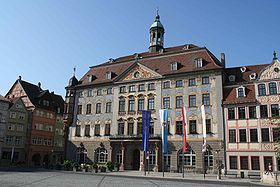
A popular local delicacy is the Coburger bratwurst, a sausage (the official size of which is denoted by a statue of a man holding a bratwurst located on the town hall, overlooking the square) roasted over a pine cone fire. The sausage is served in a semmel (a small bread bun, a third the size of the sausage itself), and is highly popular with locals and tourists alike.
Coburg Peak
Coburg Peak
Coburg Peak is the rocky peak rising to 783 m in Erul Heights on Trinity Peninsula in Graham Land, Antarctica. It is surmounting Cugnot Ice Piedmont to the northeast.The peak is named after the Bulgarian royal house of Coburg , 1887-1946....
on Trinity Peninsula
Trinity Peninsula
Trinity Peninsula is the extreme northern portion of the Antarctic Peninsula, extending northeastward for about from a line connecting Cape Kjellman and Cape Longing. Dating back more than a century, chartmakers used various names for this portion of the Antarctic peninsula, each name having some...
in Graham Land
Graham Land
Graham Land is that portion of the Antarctic Peninsula which lies north of a line joining Cape Jeremy and Cape Agassiz. This description of Graham Land is consistent with the 1964 agreement between the British Antarctic Place-names Committee and the US Advisory Committee on Antarctic Names, in...
, Antarctica is named after the town, in connection with the Bulgarian royal house
Royal House
A royal house or royal dynasty consists of at least one, but usually more monarchs who are related to one another, as well as their non-reigning descendants and spouses. Monarchs of the same realm who are not related to one another are usually deemed to belong to different houses, and each house is...
of Coburg (Saxe-Coburg-Gotha
Royal House of Bulgaria
The current Bulgarian royal family is a line of the Kohary branch of the House of Saxe-Coburg and Gotha which ruled Bulgaria from 1887 to 1946. The last tsar, Simeon II, became Prime Minister of Bulgaria in 2001 and remained in office until 2005...
).
Car
Coburg can be reached by car via B 303 SchweinfurtSchweinfurt
Schweinfurt is a city in the Lower Franconia region of Bavaria in Germany on the right bank of the canalized Main, which is here spanned by several bridges, 27 km northeast of Würzburg.- History :...
-Coburg-Schirnding, B 4 Hamburg
Hamburg
-History:The first historic name for the city was, according to Claudius Ptolemy's reports, Treva.But the city takes its modern name, Hamburg, from the first permanent building on the site, a castle whose construction was ordered by the Emperor Charlemagne in AD 808...
-Coburg-Nürnberg or motorway A 73 Suhl
Suhl
- Geography :Suhl sits on the south edge of the Suhler Scholle, an upthrust granite complex that is streaked by numerous dikes. This is part of the Ruhla-Schleusingen Horst that defines the southwest side of the Thuringian Forest...
-Coburg-Nürnberg. Seven-times Formula 1 world champion Michael Schumacher has been a recently noted driver in Coburg.
Railways
Coburg has four train stations- Coburg-Neuses
- Coburg-Nord
- Coburg main station
- Coburg-Creidlitz
From the main station one can go to Lichtenfels
Lichtenfels, Bavaria
Lichtenfels is a town in Bavaria, Germany, capital of the district of Lichtenfels. It is situated on the upper course of the river Main , approx. 15 km southeast of Coburg, and 30 km northeast of Bamberg, in an area called Gottesgarten am Obermain .Lichtenfels became as of middle of the 19...
, Bamberg
Bamberg
Bamberg is a city in Bavaria, Germany. It is located in Upper Franconia on the river Regnitz, close to its confluence with the river Main. Bamberg is one of the few cities in Germany that was not destroyed by World War II bombings because of a nearby Artillery Factory that prevented planes from...
, Forchheim
Forchheim (Oberfranken)
Forchheim is a large town in Upper Franconia in northern Bavaria, and also the seat of the administrative district of Forchheim. Forchheim is a former royal city, and is sometimes called the “Gateway to the Franconian Switzerland”, as the region is known. Its population, as of October 2008, was...
, Erlangen
Erlangen
Erlangen is a Middle Franconian city in Bavaria, Germany. It is located at the confluence of the river Regnitz and its large tributary, the Untere Schwabach.Erlangen has more than 100,000 inhabitants....
, Fürth
Fürth
The city of Fürth is located in northern Bavaria, Germany in the administrative region of Middle Franconia. It is now contiguous with the larger city of Nuremberg, the centres of the two cities being only 7 km apart....
and Nürnberg, to Neustadt bei Coburg
Neustadt bei Coburg
Neustadt bei Coburg is a town in the district of Coburg in northern Bavaria, Germany. It is situated 15 km northeast of Coburg, as its name indicates.-Local sudivisions:...
, Sonneberg
Sonneberg
Sonneberg is a town in Thuringia, Germany, which is seat of the district Sonneberg.It has long been a centre of toy making and is still well known for this...
, to Bad Rodach
Bad Rodach
Bad Rodach is a town in the district of Coburg, in Upper Franconia, a north Bavarian Regierungsbezirk, Germany. It is situated 10 km southeast of Hildburghausen, and 17 km northwest of Coburg...
and to Kulmbach
Kulmbach
Kulmbach is the capital of the district of Kulmbach in Bavaria in Germany. The town is famous for Plassenburg Castle, which houses the largest tin soldier museum in the world, and for its famous sausages, or Bratwürste.-Location:...
, Neuenmarkt-Wirsberg.
In future, some Intercity-Express high speed trains will stop in Coburg on the Nuremberg–Erfurt high-speed railway, part of a new Berlin-Erfurt
Erfurt
Erfurt is the capital city of Thuringia and the main city nearest to the geographical centre of Germany, located 100 km SW of Leipzig, 150 km N of Nuremberg and 180 km SE of Hannover. Erfurt Airport can be reached by plane via Munich. It lies in the southern part of the Thuringian...
-Coburg-Nürnberg route.
Airports
Small planes can land on the two airfields:- Coburg Brandensteinsebene (ICAOInternational Civil Aviation OrganizationThe International Civil Aviation Organization , pronounced , , is a specialized agency of the United Nations. It codifies the principles and techniques of international air navigation and fosters the planning and development of international air transport to ensure safe and orderly growth...
-Code: EDQC, founded in 1912) - Coburg Steinrücken (ICAO-Code: EDQY)
Large airports nearby are in Frankfurt
Frankfurt International Airport
Frankfurt am Main Airport , or simply Frankfurt Airport, known in German as Flughafen Frankfurt am Main or Rhein-Main-Flughafen, is a major international airport located in Frankfurt, Germany, southwest of the city centre....
, Erfurt
Erfurt Airport
Erfurt-Weimar Airport is the national airport of Erfurt, Germany, which was changed from Erfurt Airport in 2011. It was felt that from a marketing point of view the addition of 'Weimar' to the name would better sell the area.- Ground transportation:...
and Nuremberg
Nuremberg Airport
Nuremberg Airport is the international airport of the Franconian metropolitan area of Nuremberg and the second-busiest airport in Bavaria. The airport is ranked 10th among German airports and 87th in Europe. It is also a hub for Air Berlin - Germany's second largest airline...
.
Public transportation system
The public transportation system in Coburg is operated by SÜC ("Stadt- und Überlandwerke Coburg") with 22 bus lines.The OVF ("Omnibus Verkehr Franken") covers Coburg's surrounding countryside with additional 11 bus lines.
International relations
Coburg is twinnedTown twinning
Twin towns and sister cities are two of many terms used to describe the cooperative agreements between towns, cities, and even counties in geographically and politically distinct areas to promote cultural and commercial ties.- Terminology :...
with: Cobourg, Ontario, Canada Gais, South Tyrol Garden City, New York
Garden City, New York
Garden City is a village in the town of Hempstead in central Nassau County, New York, in the United States. It was founded by multi-millionaire Alexander Turney Stewart in 1869, and is located on Long Island, to the east of New York City, from mid-town Manhattan, and just south of the town of...
, USA Isle of Wight
Isle of Wight
The Isle of Wight is a county and the largest island of England, located in the English Channel, on average about 2–4 miles off the south coast of the county of Hampshire, separated from the mainland by a strait called the Solent...
, United Kingdom Niort
Niort
Niort is a commune in the Deux-Sèvres department in western France.The Latin name of the city was Novioritum.The population of Niort is 60,486 and more than 137,000 people live in the urban area....
, France Oudenaarde
Oudenaarde
Oudenaarde is a Belgian municipality in the Flemish province of East Flanders. The municipality comprises the city of Oudenaarde proper and the towns of Bevere, Edelare, Eine, Ename, Heurne, Leupegem, Mater, Melden, Mullem, Nederename, Welden, Volkegem and a part of Ooike.From the 15th to the 18th...
, Belgium