

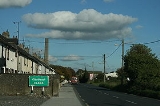
Clara

Encyclopedia
Clara is a town on the River Brosna
in County Offaly
and is the 10th largest town in the midlands of Ireland. The town has a population of 3001 (2006 census), however a number of well populated housing estates lie outside the town boundary making the actual population higher. Clara has plenty of local services including churches, banks, credit union, schools, supermarkets, shops, garages, pubs, nightclubs and restaurants. It has its own Garda(police) and fire station while the Midlands regional hospital is located just seven miles away in Tullamore. Clara has a strong association with sport. The successful GAA club looks after Gaelic football and hurling from under 8 to senior level. Clara also has a successful junior soccer club. The town has two swimming pools and a successful pitch and putt club. Clara's power lifting club has won a number of national and international awards. A golf driving range is located in the town also with the Esker Hills golf club located just outside the town. There is a local equestrian centre and sports centre also.
near the border with County Westmeath
, on national route N80
some 12 km northwest of Tullamore
. Situated on a plain (Clóirtheach meaning plain or level place), the town is in reality an urban centre surrounded by a series of mini-villages. The town is connected to the River Shannon
by one of its tributaries, the Brosna. Clara is the modern name of what was known as the Barony of Kilcoursey and Parish
of Kilbride. The earliest known map of Clara dates from the Ordnance Survey of 1838.
, the ancient thoroughfare which connected the east and west coasts of Ireland, numerous ring forts
are to be found in the countryside surrounding the town suggesting that the early settlement may have been an important staging post for travellers. Just outside the town in Kilbride, the remnants of a 12th century monastery
testify to the existence of a vibrant religious presence. According to tradition this monastery was founded by St Brigid of Kildare
(d.c 525 AD) and is linked by an ancient road to Durrow Abbey
founded by St Colm Cille (St Columba). St Brigid's original monastery, founded shortly after her religious profession - her first foundation, would have been constructed in wood and consisted of a number of buildings surrounding a central church. These buildings were replaced by stone structures in the 12th century. The original parish was named after St Brigid: Kilbride (from Cill Bhride: the Church of Brigid). The ruins of an ancient church are to be found not far from the monastery at the foot of a hill (Chapel Hill) and this may have been the original parish church.
Politically the family which had dominion over the area was the Sinnach O'Catharniagh (Fox O'Carney) clan; they were referred to as the Muinter Tadgain (people of Tadgain). The O'Catharniagh were princes of Teffia (an area in County Westmeath). The ruins of their castle, Lehinch Castle, are to be found on a hill in Kilcoursey, less than a mile from the town centre. The McAuley family are also associated with the Barony of Kilcoursey. Mass rocks are also to be found in the hills outside the town, having provided secret places for Catholics to worship during the persecution which followed the Reformation.
The Fox family owned much of the district up until the 1650s. Following the involvement of the Chieftain, Hubert Fox in a rebellion in the 1640s - he was defending Catholic
interests against the Puritan
Oliver Cromwell
who came to Ireland to suppress uprisings against English rule. Ironically, in 1599, Fox's father, also Hubert, had signed an agreement of "surrender and regrant" with the English crown to avoid the complete destruction of his estates following the Nine Years War: the lands were returned to Fox senior in recognition of his fealty. Hubert junior, however, was not so inclined, preferring to stand by the family's traditional allegiance. Cromwell proved victorious and Fox lost his lands which were given to Samuel Rust, a Cromwellian soldier. He in turn sold the district to two families - the Armstrongs and the Bagots. The Armstrongs settled in the town and would eventually establish industries, notably a Linen factory which proved quite lucrative. Andrew Armstrong (1727–1802) built Clara House on the west side of the town in the 1770s - a fine neo-classical building. Members of the Armstrong family distinguished themselves in other areas of life. One of them, John Armstrong, uncle of Andrew, was Governor
of Minorca
and author of a history of the island in 1752. Andrew Armstrong died in 1802 and the estates were sold to a Cox family, another family with notable connections.
In 1825, the Goodbody family moved to Clara from Mountmellick
and introduced industry into the town, trading under the name of J & L F Goodbody. Buying flour mills at Erry and Charlestown, they developed the river Brosna and used it to harness power for their factories. In 1864 the Goodbodys started a jute
factory at Clashawaun. The jute was imported from India
and the resulting bags were exported worldwide. In the last decades of the 20th century the factories declined and the last Goodbody's factory closed in 1984. The family had provided the people of Clara with employment in a number of areas: factory work, domestic service and farming. Other industries in the town included flour mills, distilleries, a brewery, manufacturers of tobacco, soap, candles, and clothes together with food processing companies.
As the town entered a heyday at the end of the 19th and for much of the 20th centuries, its prosperity led to a number of building projects. Stately houses litter the town and surrounding countryside as the various members of the Goodbody family set up their households. Thanks to Catholic Emancipation in 1829 a more prominent Catholic church was built on the outskirts of the town in Charlestown, but this proved too small and in the 1880s the parish, now St Brigid's Parish, built a fine neo-gothic church in the centre of the town on one side of the main square: a relic
of St Brigid is preserved in the church. To cater for the needs of the townspeople, two religious orders founded communities and schools: the Franciscan Brothers arrived in 1821 and the Sisters of Mercy
some years later. Other religious buildings in the town consist of St Brigid's parish church for the Church of Ireland community (Anglican Communion
) looking down over the Fair Green and the Friends' Meeting Hall (Quaker) which is no longer in use. As the town prospered so did social life. Numerous cultural and sporting associations flourished in the town and continue to do so to this day.

opened on 3 October 1859, and located beside Railway View Housing Estate. It is on the main Dublin to Ballina
/ Westport
/ Galway
railway line
. Clara was once a railway junction, with a branch to Streamstown on the now disused Athlone–Mullingar
link. There was also a railway junction west of Clara serving the Banagher branch line.
Clara is also served by the M6 Dublin/Galway motorway with junction 6 less than 5 minutes drive from the town centre.
Consultation is ongoing regarding a small airport which is proposed on lands between Clara, Tubber and Horseleap.
. Born in Faughart
, Co. Louth, Ireland, St Brigid was the daughter of a pagan chieftain and Christian slave woman. She was religious by nature and when she reached maturity she took vows under St. Mel. She founded a famous monastery
in Kildare
(Cill Dara) which became an ecclesiastical city and eventually the cathedral city of a diocese
. She was revered as a saint in her own lifetime. She is buried with St Patrick and St Columba in Downpatrick
, Northern Ireland
: the three are considered the patron saints of Ireland. Her association with Clara is ancient: according to tradition she founded her first monastery there, the ruins of which are still extant. She is the patron of the parish
of Clara and the local Catholic church preserves a first-class relic of the saint.
Matilda de Lacy (1223–1289). Born in Lincolnshire
in England
in 1223, Matilda (Maud) was one of the most significant women of her time. The daughter of John de Lacy, the Earl
of Lincolnshire
and Margaret de Quincy, Countess of Derby
, granddaughter of Walter de Lacy
, Lord of Meath, she inherited a considerable fortune following her grandfather's death on 1241. As the eldest of her family, she inherited the family castle in Trim
, Co. Meath and with it a number of estates. Unusual for women at the time, she exercised considerable power and influence. She was married to Peter de Genevre (died 1249). She founded a convent at Gageborough, a townland of Clara. She died in 1289.
Connall Mac Geoghegan (17th century). Connall Mac Geoghegan, known as Connall the Historian, lived in Lismoyny, a townland of Clara. He is noted by history as the translator of the Annals of Clonmacnoise
, a chronicle of historical events in Ireland from pre-history to 1408 AD. His translation into English was complete by 1627 and was his work was praised for its understanding of the Gaelic idiom. The years of Connall's life are not known, but he was still alive in 1644.
Hubert Fox (17th century). The Irish love a rebel, and Hubert Fox can stake a claim to this affection. Chief of the Fox clan in the 17th century he resisted English rule and fought against Cromwellian forces. He lost his estates and fled his ancestral home, Lehinch castle, in 1641 with a price of 400 pounds on his head: the English even promised outlaws a pardon if they delivered Fox into their hands. A testament to the loyalty of the Irish, no one did, and he disappeared from history. Many lines of the Fox family today claim descent from him.
Fr James Dillon (c 1643- ?). Fr Dillon was the Catholic pastor of the parish of Kilbride (Clara). Born around 1643, he was ordained priest in 1688 in Ballyleoge, Co. Galway. He was appointed to the parish in 1704. He was an astounding pastor, but given the nature of the times he was the victim of much persecution. He was betrayed a number of times to the priest-hunters and several times arrested for carrying out his ministry, spending time in prison and almost dying of his ill-treatment at one stage. The date of his death is unknown, but he was buried in the cemetery of St Brigid's monastery in Kilbride.
Andrew Armstrong (1727–1802). As noted above, Armstrong was a successful industrialist in the town. Born in 1727 the son of Warenford Armstrong of Ballycumber and Elizabeth Bagot of Newtown. He was responsible for Clara's prominence as a manufacturing town in the late 18th/early 19th centuries.
Robert Goodbody (1781–1860). Born in Mountmellick
, County Laois
, Ireland, on April 9, 1781, he was the son of Quaker parents, Mark Goodbody and Elizabeth Pim. The Goodbodys were already a prominent merchant family in the Midlands, but Robert would prove to be the one who would strengthen the family's position in Ireland's industrial elite. He moved to Clara on October 17, 1825 when he took over Brosna Mills and from this industry he founded a dynasty of merchants who would dominate not only the commercial life of the Midlands, but have considerable influence in Ireland and abroad. He married twice and had six children. When he was 74 years old he began writing his Memoirs which constitute not only an autobiography
but also a valuable record of events in the Midlands including the rebellion of 1798, an important uprising against English rule in Ireland.
Vivian Mercier (1919–1989). Vivian Mercier
was a foremost literary historian. Born in Clara in 1919 he studied at Portora Royal School
in Enniskillen
(Oscar Wilde
's alma mater) and afterwards at Trinity College, Dublin
, where he completed his doctorate entitled Realism in Irish Fiction. After a spell in Ireland working for a literary periodical, he went to the US where he held a number of positions in various universities, finally accepting a professorship at the University of California at Santa Barbara in 1974. The same year he married his second wife, the Irish writer Eilis Dillon
. He published a number of works in the area of literature and was a committed defender of the Irish language (Gaelic), writing a landmark work on Irish literature in 1964. He was also regarded as an authority on the works of Samuel Beckett
. He died in 1989 and is buried in Clara with his wife, Eilis.
Br Placidus Timmons, OSF (1948–1997). Larry Timmons
was born in Delvin
, County Westmeath
on April 17, 1948. He entered the Franciscan
Brothers (Third Order of Penance) taking the name Br , and after profession was appointed to the Franciscan
Monastery
in Clara where he spent a number of years as a teacher in the Boy's Primary School. He was a popular figure in the parish, involved in numerous organisations and with a deep concern for the young and poor. In 1982 he was transferred to the Order's mission house in Kenya
where he spent fifteen years teaching and helping improve the living standards of the local communities he served. On January 22, 1997 during an armed break-in, Br Placidus was shot dead. An investigation into his death revealed that his death was not an unfortunate mistake, but was in fact, deliberate: he was murdered for his efforts to obtain justice for the victims of a corrupt regime. His remains were brought back to Clara and a large crowd attended his funeral. He is buried in the community cemetery of the Franciscan Brothers. He is regarded as a martyr
for justice by many.
Brian Cowen
(born 1960) Taoiseach
(Prime Minister of Ireland) from 2008 to 2011. Son of Bernard Cowen
, former TD and Junior Minister for Agriculture. He took office on 7 May 2008, heading a coalition government led by his Fianna Fáil
party that includes the Green Party
and the Progressive Democrats
, with the support of independent TDs. He has been a Teachta Dála
(TD) for the constituency of Laois–Offaly since 1984. He previously served as Minister for Labour
(1992–1993), Minister for Energy
(1993), Minister for Transport, Energy and Communications
(1993–1994), Minister for Health and Children
(1997–2000), Minister for Foreign Affairs
(2000–2004) and Minister for Finance
(2004–2008). He served as Tánaiste
from 2007 to 2008. He became leader of Fianna Fáil on the resignation of Bertie Ahern
. On 7 May 2008 following the resignation of Bertie Ahern
as Taoiseach, Cowen was nominated in the Dáil and elected Taoiseach. Some commentators describe him as the unluckiest taoiseach ever. Within a short period of him taking office Ireland was hit by the global recession, a construction industry collapse and a near-collapse of the country's banks leading to job losses, wage reductions,etc. This caused him and his government to take many unpopular decisions. Brian Cowen's term as Taoiseach came to an end following the general election in February 2011. He did not contest the election and stepped down from public life.
Michelle McKeon-Bennett (born 1974) current (Space Life Science researcher). Daughter of Michael and Margaret McKeon, was chosen in 2002 to travel to NASA, Florida as a potential astronaut candidate, after she approached NASA researchers regarding her research on bog plants. It was not until September 2003 that she began research into the use of Sphagnum Moss from Clara Bog for space applications. She developed a system that allowed water to be filtered and plants to grow in the enclosed environment of a space orbiter (shuttle) and planetary colony. She returned to Ireland (and [Limerick Institute of Technology]) in September 2004 and continued her research link with NASA, Kennedy Space Centre Florida under a student transfer programme from LIT with Dynamac Corporation, the space life science company contracted to NASA to carry out space life science research. She established the Controlled Environment Laboratory for Life Sciences (CELLS) in LIT in 2008, and successfully obtained funding to purchase state-of-the-art growth chambers to the exact specifications as those in Kennedy Space Centre, Florida. They are the only ones in of this specification in Europe. She currently has 6 postgraduate students based in LIT with placements in Kennedy Space Centre researching the use of Irish plants in space research with terrestrial applications such as health foods and natural pharmaceutical products. In 2005 she was made Head of Department of Applied Science, LIT and is currently developing a new space science programme for undergraduate students, the first in Ireland. In 2009, she made it to the third last round of astronaut selection in Europe.
Professional golfer Shane Lowry comes from Clara. He was born on April 2, 1987 and comes from a strong sporting background. His father Brendan played Gaelic football for Offaly, winning a senior All-Ireland medal in 1982. Shane's mother Brigid, nee Scanlon, comes from a prominent sporting and musical family from Clara. Shane attended Clara's St. Francis boys national school and Clara vocational school. During his school years he played both football and hurling. At the age of 12 he developed an interest in pitch and putt and quickly began winning numerous prizes in the sport. In his mid teens Shane's interest turned to golf. Within a couple of years he was rising within the ranks of the amateur golf circuit. In 2009 he came to international attention when he won the Irish open golf championship, as an amateur. He turned professional shortly afterwards.
Top hurling referee BRIAN GAVIN comes from Clara. Brian, born 13 July 1977, is the son of Maria and Michael Gavin. He began refereeing at a much younger age than most, and quickly rose through the ranks to become a top inter-county referee in his late 20's. Respected for allowing games to flow freely he has refereed a number of top hurling matches. He refereed his first All-Ireland final in 2011. Despite receiving a nasty facial injury, which held up the game for 4 minutes, Gavin was able to complete the match, in which Kilkenny beat Tipperary.
Brian Gavin also plays and coaches hurling with his native Clara GAA club.
. Marconi was born in Bologna
, Italy
on April 25, 1874, the son of Giuseppe Marconi and Annie Jameson, the daughter of Andrew Jameson of Daphne Castle, County Wexford
, Ireland. He grew up and was educated in Italy proudly aware of his Irish and Italian heritages.
In 1895 he began the experiments which would eventually lead to his invention of the radiotelegraph system. He was a frequent visitor to Ireland and in 1905 he married the Hon. Beatrice O'Brien, the daughter of the 14th Baron Inchiquin
. The marriage broke down and the couple were granted an annulment
in 1927, after which he married the Countess Bezzi-Scali of Rome
. He received numerous awards and honours including the Nobel Prize
in Physics
in 1909 and was conferred with the hereditary title
of Marchese in 1929. He died in Rome on 20 July 1937.
Marconi was a friend of the Goodbody family and it was during one of his visits to Robert Goodbody at Inchmore House in Clara that he conducted some of his experiments which made important advances in the development of the radiotelegraph system. Marconi received considerable backing from the Goodbody family.
Two kilometres from the town centre lies Clara Bog, a raised bog which contains rare flora. It was considered for nomination as a UNESCO
World Heritage Site
.
The Clara Bog visitor centre is located beside the town's library.
A bog boardwalk (Accessible from Ballinough, off Tullamore road) is very popular with local walkers, but is virtually unknown to visitors. The board walk allows walkers to safely cross the surface of the bog.
Sharon Touhey got to the final of the model agent, aired on RTÉ in spring 2009. She is currently repeating her leaving certificate in Ard Scoil Chiarain Naofa, Clara.
River Brosna
The River Brosna is a river in Ireland, flowing through County Westmeath and County Offaly.The river rises in Lough Owel north of Mullingar and is a tributary of the River Shannon. It meets the Shannon at Shannon Harbour.-Course:...
in County Offaly
County Offaly
County Offaly is a county in Ireland. It is part of the Midlands Region and is also located in the province of Leinster. It is named after the ancient Kingdom of Uí Failghe and was formerly known as King's County until the establishment of the Irish Free State in 1922. Offaly County Council is...
and is the 10th largest town in the midlands of Ireland. The town has a population of 3001 (2006 census), however a number of well populated housing estates lie outside the town boundary making the actual population higher. Clara has plenty of local services including churches, banks, credit union, schools, supermarkets, shops, garages, pubs, nightclubs and restaurants. It has its own Garda(police) and fire station while the Midlands regional hospital is located just seven miles away in Tullamore. Clara has a strong association with sport. The successful GAA club looks after Gaelic football and hurling from under 8 to senior level. Clara also has a successful junior soccer club. The town has two swimming pools and a successful pitch and putt club. Clara's power lifting club has won a number of national and international awards. A golf driving range is located in the town also with the Esker Hills golf club located just outside the town. There is a local equestrian centre and sports centre also.
Geography
Clara is situated in the north of County OffalyCounty Offaly
County Offaly is a county in Ireland. It is part of the Midlands Region and is also located in the province of Leinster. It is named after the ancient Kingdom of Uí Failghe and was formerly known as King's County until the establishment of the Irish Free State in 1922. Offaly County Council is...
near the border with County Westmeath
County Westmeath
-Economy:Westmeath has a strong agricultural economy. Initially, development occurred around the major market centres of Mullingar, Moate, and Kinnegad. Athlone developed due to its military significance, and its strategic location on the main Dublin–Galway route across the River Shannon. Mullingar...
, on national route N80
Roads in Ireland
The island of Ireland, comprising Northern Ireland and the Republic of Ireland, has an extensive network of tens of thousands of kilometres of public roads, usually surfaced. These roads have been developed and modernised over centuries, from trackways suitable only for walkers and horses, to...
some 12 km northwest of Tullamore
Tullamore
Tullamore is a town in County Offaly, in the midlands of Ireland. It is Offaly's county town and the centre of the district.Tullamore is an important commercial and industrial centre in the region. Major international employers in the town include 'Tyco Healthcare' and 'Boston Scientific'. In...
. Situated on a plain (Clóirtheach meaning plain or level place), the town is in reality an urban centre surrounded by a series of mini-villages. The town is connected to the River Shannon
River Shannon
The River Shannon is the longest river in Ireland at . It divides the west of Ireland from the east and south . County Clare, being west of the Shannon but part of the province of Munster, is the major exception...
by one of its tributaries, the Brosna. Clara is the modern name of what was known as the Barony of Kilcoursey and Parish
Parish
A parish is a territorial unit historically under the pastoral care and clerical jurisdiction of one parish priest, who might be assisted in his pastoral duties by a curate or curates - also priests but not the parish priest - from a more or less central parish church with its associated organization...
of Kilbride. The earliest known map of Clara dates from the Ordnance Survey of 1838.
History
While the town as we know it today was established by Quakers in the mid-18th century, there is evidence of community habitation for some time. Situated on the Esker RiadaEsker Riada
Esker Riada, , is a system of ridges that stretch across the middle of Ireland, between Dublin and Galway.-Geography:The Esker Riada is a collection of eskers, that passes through the counties of Dublin, Meath, Kildare, Westmeath, Offaly, Roscommon and Galway...
, the ancient thoroughfare which connected the east and west coasts of Ireland, numerous ring forts
Ringfort
Ringforts are circular fortified settlements that were mostly built during the Iron Age , although some were built as late as the Early Middle Ages . They are found in Northern Europe, especially in Ireland...
are to be found in the countryside surrounding the town suggesting that the early settlement may have been an important staging post for travellers. Just outside the town in Kilbride, the remnants of a 12th century monastery
Monastery
Monastery denotes the building, or complex of buildings, that houses a room reserved for prayer as well as the domestic quarters and workplace of monastics, whether monks or nuns, and whether living in community or alone .Monasteries may vary greatly in size – a small dwelling accommodating only...
testify to the existence of a vibrant religious presence. According to tradition this monastery was founded by St Brigid of Kildare
Brigid of Kildare
Saint Brigit of Kildare, or Brigit of Ireland , nicknamed Mary of the Gael is one of Ireland's patron saints along with Saints Patrick and Columba...
(d.c 525 AD) and is linked by an ancient road to Durrow Abbey
Durrow Abbey
Durrow Abbey is a historic site located off the N52 some 5 miles from Tullamore, County Offaly, Ireland.To this day, Durrow Abbey remains a largely undisturbed early historic and medieval monastic site containing a complex of archaeological monuments, ecclesiastical and secular, visible and...
founded by St Colm Cille (St Columba). St Brigid's original monastery, founded shortly after her religious profession - her first foundation, would have been constructed in wood and consisted of a number of buildings surrounding a central church. These buildings were replaced by stone structures in the 12th century. The original parish was named after St Brigid: Kilbride (from Cill Bhride: the Church of Brigid). The ruins of an ancient church are to be found not far from the monastery at the foot of a hill (Chapel Hill) and this may have been the original parish church.
Politically the family which had dominion over the area was the Sinnach O'Catharniagh (Fox O'Carney) clan; they were referred to as the Muinter Tadgain (people of Tadgain). The O'Catharniagh were princes of Teffia (an area in County Westmeath). The ruins of their castle, Lehinch Castle, are to be found on a hill in Kilcoursey, less than a mile from the town centre. The McAuley family are also associated with the Barony of Kilcoursey. Mass rocks are also to be found in the hills outside the town, having provided secret places for Catholics to worship during the persecution which followed the Reformation.
The Fox family owned much of the district up until the 1650s. Following the involvement of the Chieftain, Hubert Fox in a rebellion in the 1640s - he was defending Catholic
Catholic
The word catholic comes from the Greek phrase , meaning "on the whole," "according to the whole" or "in general", and is a combination of the Greek words meaning "about" and meaning "whole"...
interests against the Puritan
Puritan
The Puritans were a significant grouping of English Protestants in the 16th and 17th centuries. Puritanism in this sense was founded by some Marian exiles from the clergy shortly after the accession of Elizabeth I of England in 1558, as an activist movement within the Church of England...
Oliver Cromwell
Oliver Cromwell
Oliver Cromwell was an English military and political leader who overthrew the English monarchy and temporarily turned England into a republican Commonwealth, and served as Lord Protector of England, Scotland, and Ireland....
who came to Ireland to suppress uprisings against English rule. Ironically, in 1599, Fox's father, also Hubert, had signed an agreement of "surrender and regrant" with the English crown to avoid the complete destruction of his estates following the Nine Years War: the lands were returned to Fox senior in recognition of his fealty. Hubert junior, however, was not so inclined, preferring to stand by the family's traditional allegiance. Cromwell proved victorious and Fox lost his lands which were given to Samuel Rust, a Cromwellian soldier. He in turn sold the district to two families - the Armstrongs and the Bagots. The Armstrongs settled in the town and would eventually establish industries, notably a Linen factory which proved quite lucrative. Andrew Armstrong (1727–1802) built Clara House on the west side of the town in the 1770s - a fine neo-classical building. Members of the Armstrong family distinguished themselves in other areas of life. One of them, John Armstrong, uncle of Andrew, was Governor
Governor
A governor is a governing official, usually the executive of a non-sovereign level of government, ranking under the head of state...
of Minorca
Minorca
Min Orca or Menorca is one of the Balearic Islands located in the Mediterranean Sea belonging to Spain. It takes its name from being smaller than the nearby island of Majorca....
and author of a history of the island in 1752. Andrew Armstrong died in 1802 and the estates were sold to a Cox family, another family with notable connections.
In 1825, the Goodbody family moved to Clara from Mountmellick
Mountmellick
Other than that its a 15th-century settlement on the narrow Owenass river with an encampment on its banks at Irishtown. Overlooking this valley with its trees and wildlife was a small church called Kilmongan which was closed by the Penal Laws in 1640...
and introduced industry into the town, trading under the name of J & L F Goodbody. Buying flour mills at Erry and Charlestown, they developed the river Brosna and used it to harness power for their factories. In 1864 the Goodbodys started a jute
Jute
Jute is a long, soft, shiny vegetable fibre that can be spun into coarse, strong threads. It is produced from plants in the genus Corchorus, which has been classified in the family Tiliaceae, or more recently in Malvaceae....
factory at Clashawaun. The jute was imported from India
India
India , officially the Republic of India , is a country in South Asia. It is the seventh-largest country by geographical area, the second-most populous country with over 1.2 billion people, and the most populous democracy in the world...
and the resulting bags were exported worldwide. In the last decades of the 20th century the factories declined and the last Goodbody's factory closed in 1984. The family had provided the people of Clara with employment in a number of areas: factory work, domestic service and farming. Other industries in the town included flour mills, distilleries, a brewery, manufacturers of tobacco, soap, candles, and clothes together with food processing companies.
As the town entered a heyday at the end of the 19th and for much of the 20th centuries, its prosperity led to a number of building projects. Stately houses litter the town and surrounding countryside as the various members of the Goodbody family set up their households. Thanks to Catholic Emancipation in 1829 a more prominent Catholic church was built on the outskirts of the town in Charlestown, but this proved too small and in the 1880s the parish, now St Brigid's Parish, built a fine neo-gothic church in the centre of the town on one side of the main square: a relic
Relic
In religion, a relic is a part of the body of a saint or a venerated person, or else another type of ancient religious object, carefully preserved for purposes of veneration or as a tangible memorial...
of St Brigid is preserved in the church. To cater for the needs of the townspeople, two religious orders founded communities and schools: the Franciscan Brothers arrived in 1821 and the Sisters of Mercy
Sisters of Mercy
The Religious Order of the Sisters of Mercy is an order of Catholic women founded by Catherine McAuley in Dublin, Ireland, in 1831. , the order has about 10,000 members worldwide, organized into a number of independent congregations....
some years later. Other religious buildings in the town consist of St Brigid's parish church for the Church of Ireland community (Anglican Communion
Anglican Communion
The Anglican Communion is an international association of national and regional Anglican churches in full communion with the Church of England and specifically with its principal primate, the Archbishop of Canterbury...
) looking down over the Fair Green and the Friends' Meeting Hall (Quaker) which is no longer in use. As the town prospered so did social life. Numerous cultural and sporting associations flourished in the town and continue to do so to this day.
Transport
Clara railway stationClara railway station
Clara railway station serves the town of Clara in County Offaly.The station opened on 3 October 1859. It is on the main Dublin to Ballina / Westport / Galway railway line. Clara was once a railway junction, with a branch to Streamstown on the now disused Athlone–Mullingar link....
opened on 3 October 1859, and located beside Railway View Housing Estate. It is on the main Dublin to Ballina
Ballina, County Mayo
Ballina is a large town in north County Mayo in Ireland. It lies at the mouth of the River Moy near Killala Bay, in the Moy valley and Parish of Kilmoremoy, with the Ox Mountain range to the east and the Nephin Beg mountains to the west...
/ Westport
Westport, County Mayo
Westport is a town in County Mayo, Ireland. It is situated on the west coast at the south-east corner of Clew Bay, an inlet of the Atlantic Ocean....
/ Galway
Galway
Galway or City of Galway is a city in County Galway, Republic of Ireland. It is the sixth largest and the fastest-growing city in Ireland. It is also the third largest city within the Republic and the only city in the Province of Connacht. Located on the west coast of Ireland, it sits on the...
railway line
Rail transport in Ireland
Rail services in Ireland are provided by Iarnród Éireann in the Republic of Ireland and by Northern Ireland Railways in Northern Ireland.Most routes in the Republic radiate from Dublin...
. Clara was once a railway junction, with a branch to Streamstown on the now disused Athlone–Mullingar
Mullingar
Mullingar is the county town of County Westmeath in Ireland. The Counties of Meath and Westmeath Act of 1542, proclaimed Westmeath a county, separating it from Meath. Mullingar became the administrative centre for County Westmeath...
link. There was also a railway junction west of Clara serving the Banagher branch line.
Clara is also served by the M6 Dublin/Galway motorway with junction 6 less than 5 minutes drive from the town centre.
Consultation is ongoing regarding a small airport which is proposed on lands between Clara, Tubber and Horseleap.
Notable figures
St Brigid of Ireland (c 450 – c 525). Also known as St Brigid of KildareBrigid of Kildare
Saint Brigit of Kildare, or Brigit of Ireland , nicknamed Mary of the Gael is one of Ireland's patron saints along with Saints Patrick and Columba...
. Born in Faughart
Faughart
Faughart is a town in County Louth, Ireland, situated between Forkill and Dundalk. It was the birthplace of St. Brigid , and Edward Bruce is buried in the graveyard on the hill above the town. Bruce, who had taken the title King of Ireland, was defeated and killed at the Battle of Faughart in 1318....
, Co. Louth, Ireland, St Brigid was the daughter of a pagan chieftain and Christian slave woman. She was religious by nature and when she reached maturity she took vows under St. Mel. She founded a famous monastery
Monastery
Monastery denotes the building, or complex of buildings, that houses a room reserved for prayer as well as the domestic quarters and workplace of monastics, whether monks or nuns, and whether living in community or alone .Monasteries may vary greatly in size – a small dwelling accommodating only...
in Kildare
Kildare
-External links:*******...
(Cill Dara) which became an ecclesiastical city and eventually the cathedral city of a diocese
Diocese
A diocese is the district or see under the supervision of a bishop. It is divided into parishes.An archdiocese is more significant than a diocese. An archdiocese is presided over by an archbishop whose see may have or had importance due to size or historical significance...
. She was revered as a saint in her own lifetime. She is buried with St Patrick and St Columba in Downpatrick
Downpatrick
Downpatrick is a medium-sized town about 33 km south of Belfast in County Down, Northern Ireland. It is the county town of Down with a rich history and strong connection to Saint Patrick. It had a population of 10,316 at the 2001 Census...
, Northern Ireland
Northern Ireland
Northern Ireland is one of the four countries of the United Kingdom. Situated in the north-east of the island of Ireland, it shares a border with the Republic of Ireland to the south and west...
: the three are considered the patron saints of Ireland. Her association with Clara is ancient: according to tradition she founded her first monastery there, the ruins of which are still extant. She is the patron of the parish
Parish
A parish is a territorial unit historically under the pastoral care and clerical jurisdiction of one parish priest, who might be assisted in his pastoral duties by a curate or curates - also priests but not the parish priest - from a more or less central parish church with its associated organization...
of Clara and the local Catholic church preserves a first-class relic of the saint.
Matilda de Lacy (1223–1289). Born in Lincolnshire
Lincolnshire
Lincolnshire is a county in the east of England. It borders Norfolk to the south east, Cambridgeshire to the south, Rutland to the south west, Leicestershire and Nottinghamshire to the west, South Yorkshire to the north west, and the East Riding of Yorkshire to the north. It also borders...
in England
England
England is a country that is part of the United Kingdom. It shares land borders with Scotland to the north and Wales to the west; the Irish Sea is to the north west, the Celtic Sea to the south west, with the North Sea to the east and the English Channel to the south separating it from continental...
in 1223, Matilda (Maud) was one of the most significant women of her time. The daughter of John de Lacy, the Earl
Earl
An earl is a member of the nobility. The title is Anglo-Saxon, akin to the Scandinavian form jarl, and meant "chieftain", particularly a chieftain set to rule a territory in a king's stead. In Scandinavia, it became obsolete in the Middle Ages and was replaced with duke...
of Lincolnshire
Lincolnshire
Lincolnshire is a county in the east of England. It borders Norfolk to the south east, Cambridgeshire to the south, Rutland to the south west, Leicestershire and Nottinghamshire to the west, South Yorkshire to the north west, and the East Riding of Yorkshire to the north. It also borders...
and Margaret de Quincy, Countess of Derby
Derby
Derby , is a city and unitary authority in the East Midlands region of England. It lies upon the banks of the River Derwent and is located in the south of the ceremonial county of Derbyshire. In the 2001 census, the population of the city was 233,700, whilst that of the Derby Urban Area was 229,407...
, granddaughter of Walter de Lacy
Walter de Lacy
Walter de Lacy was Lord of Meath in Ireland and Ludlow in Shropshire in the Welsh Marches.- Life :With his father Hugh de Lacy, Lord of Meath he built Trim Castle , Trim, County Meath....
, Lord of Meath, she inherited a considerable fortune following her grandfather's death on 1241. As the eldest of her family, she inherited the family castle in Trim
Trim, County Meath
Trim is the traditional county town of County Meath in Ireland, although the county town is now Navan. The town was recorded in the 2006 census to have a population of 6,870....
, Co. Meath and with it a number of estates. Unusual for women at the time, she exercised considerable power and influence. She was married to Peter de Genevre (died 1249). She founded a convent at Gageborough, a townland of Clara. She died in 1289.
Connall Mac Geoghegan (17th century). Connall Mac Geoghegan, known as Connall the Historian, lived in Lismoyny, a townland of Clara. He is noted by history as the translator of the Annals of Clonmacnoise
Annals of Clonmacnoise
The Annals of Clonmacnoise are an early 17th-century Early Modern English translation of a lost Irish chronicle, which covered events in Ireland from pre-history to A.D. 1408...
, a chronicle of historical events in Ireland from pre-history to 1408 AD. His translation into English was complete by 1627 and was his work was praised for its understanding of the Gaelic idiom. The years of Connall's life are not known, but he was still alive in 1644.
Hubert Fox (17th century). The Irish love a rebel, and Hubert Fox can stake a claim to this affection. Chief of the Fox clan in the 17th century he resisted English rule and fought against Cromwellian forces. He lost his estates and fled his ancestral home, Lehinch castle, in 1641 with a price of 400 pounds on his head: the English even promised outlaws a pardon if they delivered Fox into their hands. A testament to the loyalty of the Irish, no one did, and he disappeared from history. Many lines of the Fox family today claim descent from him.
Fr James Dillon (c 1643- ?). Fr Dillon was the Catholic pastor of the parish of Kilbride (Clara). Born around 1643, he was ordained priest in 1688 in Ballyleoge, Co. Galway. He was appointed to the parish in 1704. He was an astounding pastor, but given the nature of the times he was the victim of much persecution. He was betrayed a number of times to the priest-hunters and several times arrested for carrying out his ministry, spending time in prison and almost dying of his ill-treatment at one stage. The date of his death is unknown, but he was buried in the cemetery of St Brigid's monastery in Kilbride.
Andrew Armstrong (1727–1802). As noted above, Armstrong was a successful industrialist in the town. Born in 1727 the son of Warenford Armstrong of Ballycumber and Elizabeth Bagot of Newtown. He was responsible for Clara's prominence as a manufacturing town in the late 18th/early 19th centuries.
Robert Goodbody (1781–1860). Born in Mountmellick
Mountmellick
Other than that its a 15th-century settlement on the narrow Owenass river with an encampment on its banks at Irishtown. Overlooking this valley with its trees and wildlife was a small church called Kilmongan which was closed by the Penal Laws in 1640...
, County Laois
County Laois
County Laois is a county in Ireland. It is part of the Midlands Region and is also located in the province of Leinster. It was formerly known as Queen's County until the establishment of the Irish Free State in 1922. The county's name was formerly spelt as Laoighis and Leix. Laois County Council...
, Ireland, on April 9, 1781, he was the son of Quaker parents, Mark Goodbody and Elizabeth Pim. The Goodbodys were already a prominent merchant family in the Midlands, but Robert would prove to be the one who would strengthen the family's position in Ireland's industrial elite. He moved to Clara on October 17, 1825 when he took over Brosna Mills and from this industry he founded a dynasty of merchants who would dominate not only the commercial life of the Midlands, but have considerable influence in Ireland and abroad. He married twice and had six children. When he was 74 years old he began writing his Memoirs which constitute not only an autobiography
Autobiography
An autobiography is a book about the life of a person, written by that person.-Origin of the term:...
but also a valuable record of events in the Midlands including the rebellion of 1798, an important uprising against English rule in Ireland.
Vivian Mercier (1919–1989). Vivian Mercier
Vivian Mercier
Vivian Mercier was an Irish literary critic. He was born in Clara, County Offaly, Ireland and educated first at Portora Royal School, Enniskillen, Co. Fermanagh, and then at Trinity College, Dublin. He became a Scholar of the College and edited the student magazine T.C.D...
was a foremost literary historian. Born in Clara in 1919 he studied at Portora Royal School
Portora Royal School
Portora Royal School for boys, and some 6th form girls, located in Enniskillen, County Fermanagh, Northern Ireland, is one of a number of 'free schools' founded by Royal Charter in 1608, by James I...
in Enniskillen
Enniskillen
Enniskillen is a town in County Fermanagh, Northern Ireland. It is located almost exactly in the centre of the county between the Upper and Lower sections of Lough Erne. It had a population of 13,599 in the 2001 Census...
(Oscar Wilde
Oscar Wilde
Oscar Fingal O'Flahertie Wills Wilde was an Irish writer and poet. After writing in different forms throughout the 1880s, he became one of London's most popular playwrights in the early 1890s...
's alma mater) and afterwards at Trinity College, Dublin
Trinity College, Dublin
Trinity College, Dublin , formally known as the College of the Holy and Undivided Trinity of Queen Elizabeth near Dublin, was founded in 1592 by letters patent from Queen Elizabeth I as the "mother of a university", Extracts from Letters Patent of Elizabeth I, 1592: "...we...found and...
, where he completed his doctorate entitled Realism in Irish Fiction. After a spell in Ireland working for a literary periodical, he went to the US where he held a number of positions in various universities, finally accepting a professorship at the University of California at Santa Barbara in 1974. The same year he married his second wife, the Irish writer Eilis Dillon
Eilís Dillon
Eilís Dillon was an Irish author of 50 books. Her work has been translated into 14 languages....
. He published a number of works in the area of literature and was a committed defender of the Irish language (Gaelic), writing a landmark work on Irish literature in 1964. He was also regarded as an authority on the works of Samuel Beckett
Samuel Beckett
Samuel Barclay Beckett was an Irish avant-garde novelist, playwright, theatre director, and poet. He wrote both in English and French. His work offers a bleak, tragicomic outlook on human nature, often coupled with black comedy and gallows humour.Beckett is widely regarded as among the most...
. He died in 1989 and is buried in Clara with his wife, Eilis.
Br Placidus Timmons, OSF (1948–1997). Larry Timmons
Larry Timmons
Brother Placidus, O.S.F., , born Larry Timmons, was an Irish Catholic Franciscan lay brother and missionary who was shot dead in the Diocese of Nakuru, Rift Valley Province, Kenya in January 1997....
was born in Delvin
Delvin
Delvin is a small town in east County Westmeath, Ireland located on the N52 road at a junction with the N51 to Navan. The town is from Mullingar and is the setting of the book Valley of the Squinting Windows by Delvin native Brinsley MacNamara, described under the fictitious name of "Garradrimna"...
, County Westmeath
County Westmeath
-Economy:Westmeath has a strong agricultural economy. Initially, development occurred around the major market centres of Mullingar, Moate, and Kinnegad. Athlone developed due to its military significance, and its strategic location on the main Dublin–Galway route across the River Shannon. Mullingar...
on April 17, 1948. He entered the Franciscan
Franciscan
Most Franciscans are members of Roman Catholic religious orders founded by Saint Francis of Assisi. Besides Roman Catholic communities, there are also Old Catholic, Anglican, Lutheran, ecumenical and Non-denominational Franciscan communities....
Brothers (Third Order of Penance) taking the name Br , and after profession was appointed to the Franciscan
Franciscan
Most Franciscans are members of Roman Catholic religious orders founded by Saint Francis of Assisi. Besides Roman Catholic communities, there are also Old Catholic, Anglican, Lutheran, ecumenical and Non-denominational Franciscan communities....
Monastery
Monastery
Monastery denotes the building, or complex of buildings, that houses a room reserved for prayer as well as the domestic quarters and workplace of monastics, whether monks or nuns, and whether living in community or alone .Monasteries may vary greatly in size – a small dwelling accommodating only...
in Clara where he spent a number of years as a teacher in the Boy's Primary School. He was a popular figure in the parish, involved in numerous organisations and with a deep concern for the young and poor. In 1982 he was transferred to the Order's mission house in Kenya
Kenya
Kenya , officially known as the Republic of Kenya, is a country in East Africa that lies on the equator, with the Indian Ocean to its south-east...
where he spent fifteen years teaching and helping improve the living standards of the local communities he served. On January 22, 1997 during an armed break-in, Br Placidus was shot dead. An investigation into his death revealed that his death was not an unfortunate mistake, but was in fact, deliberate: he was murdered for his efforts to obtain justice for the victims of a corrupt regime. His remains were brought back to Clara and a large crowd attended his funeral. He is buried in the community cemetery of the Franciscan Brothers. He is regarded as a martyr
Martyr
A martyr is somebody who suffers persecution and death for refusing to renounce, or accept, a belief or cause, usually religious.-Meaning:...
for justice by many.
Brian Cowen
Brian Cowen
Brian Cowen is a former Irish politician who served as Taoiseach of Ireland from 7 May 2008 to 9 March 2011. He was head of a coalition government led by Fianna Fáil which until 23 January 2011 had the support of the Green Party and independent TDs.Cowen was also leader of Fianna Fáil from 7 May...
(born 1960) Taoiseach
Taoiseach
The Taoiseach is the head of government or prime minister of Ireland. The Taoiseach is appointed by the President upon the nomination of Dáil Éireann, the lower house of the Oireachtas , and must, in order to remain in office, retain the support of a majority in the Dáil.The current Taoiseach is...
(Prime Minister of Ireland) from 2008 to 2011. Son of Bernard Cowen
Bernard Cowen
Bernard F. "Ber" Cowen was an Irish Fianna Fáil politician who was elected five times to Dáil Éireann.-Early life:...
, former TD and Junior Minister for Agriculture. He took office on 7 May 2008, heading a coalition government led by his Fianna Fáil
Fianna Fáil
Fianna Fáil – The Republican Party , more commonly known as Fianna Fáil is a centrist political party in the Republic of Ireland, founded on 23 March 1926. Fianna Fáil's name is traditionally translated into English as Soldiers of Destiny, although a more accurate rendition would be Warriors of Fál...
party that includes the Green Party
Green Party (Ireland)
The Green Party is a green political party in Ireland. It was founded as the Ecology Party of Ireland in 1981 by Dublin teacher Christopher Fettes. The party became the Green Alliance in 1983 and in 1987 was renamed to its current title in English...
and the Progressive Democrats
Progressive Democrats
The Progressive Democrats , commonly known as the PDs, was a pro-free market liberal political party in the Republic of Ireland.Launched on 21 December 1985 by Desmond O'Malley and other politicians who had split from Fianna Fáil and Fine Gael, the Progressive Democrats took liberal positions on...
, with the support of independent TDs. He has been a Teachta Dála
Teachta Dála
A Teachta Dála , usually abbreviated as TD in English, is a member of Dáil Éireann, the lower house of the Oireachtas . It is the equivalent of terms such as "Member of Parliament" or "deputy" used in other states. The official translation of the term is "Deputy to the Dáil", though a more literal...
(TD) for the constituency of Laois–Offaly since 1984. He previously served as Minister for Labour
Minister for Labour (Ireland)
The Minister for Labour was originally the name of a government department in the Government of the Irish Republic, the self-declared state which was established in 1919 by Dáil Éireann, the parliamentary assembly made up of the majority of Irish MPs elected in the 1918 general election. Constance...
(1992–1993), Minister for Energy
Minister for Arts, Sport and Tourism (Ireland)
The Minister for Arts, Heritage and the Gaeltacht is the senior minister at the Department of Arts, Heritage and the Gaeltacht in the Government of Ireland.The current minister is Jimmy Deenihan, TD. He is assisted by:...
(1993), Minister for Transport, Energy and Communications
Minister for Transport (Ireland)
The Minister for Transport, Tourism and Sport is the senior minister at the Department of Transport, Tourism and Sport in the Government of Ireland.The current Minister for Transport, Tourism and Sport is Leo Varadkar, TD...
(1993–1994), Minister for Health and Children
Minister for Health and Children (Ireland)
The Minister for Health is the senior minister at the Department of Health in the Government of Ireland and is responsible for health care in the Republic of Ireland and related services.The current Minister for Health is James Reilly, TD...
(1997–2000), Minister for Foreign Affairs
Minister for Foreign Affairs (Ireland)
The Minister for Foreign Affairs and Trade is the senior minister at the Department of Foreign Affairs and Trade in the Government of Ireland. Its headquarters are at Iveagh House, on St Stephen's Green in Dublin; "Iveagh House" is often used as a metonym for the department as a whole.The current...
(2000–2004) and Minister for Finance
Minister for Finance (Ireland)
The Minister for Finance is the title held by the Irish government minister responsible for all financial and monetary matters. The office-holder controls the Department of Finance and is considered one of the most important members of the Government of Ireland.The current Minister for Finance is...
(2004–2008). He served as Tánaiste
Tánaiste
The Tánaiste is the deputy prime minister of Ireland. The current Tánaiste is Eamon Gilmore, TD who was appointed on 9 March 2011.- Origins and etymology :...
from 2007 to 2008. He became leader of Fianna Fáil on the resignation of Bertie Ahern
Bertie Ahern
Patrick Bartholomew "Bertie" Ahern is a former Irish politician who served as Taoiseach of Ireland from 26 June 1997 to 7 May 2008....
. On 7 May 2008 following the resignation of Bertie Ahern
Bertie Ahern
Patrick Bartholomew "Bertie" Ahern is a former Irish politician who served as Taoiseach of Ireland from 26 June 1997 to 7 May 2008....
as Taoiseach, Cowen was nominated in the Dáil and elected Taoiseach. Some commentators describe him as the unluckiest taoiseach ever. Within a short period of him taking office Ireland was hit by the global recession, a construction industry collapse and a near-collapse of the country's banks leading to job losses, wage reductions,etc. This caused him and his government to take many unpopular decisions. Brian Cowen's term as Taoiseach came to an end following the general election in February 2011. He did not contest the election and stepped down from public life.
Michelle McKeon-Bennett (born 1974) current (Space Life Science researcher). Daughter of Michael and Margaret McKeon, was chosen in 2002 to travel to NASA, Florida as a potential astronaut candidate, after she approached NASA researchers regarding her research on bog plants. It was not until September 2003 that she began research into the use of Sphagnum Moss from Clara Bog for space applications. She developed a system that allowed water to be filtered and plants to grow in the enclosed environment of a space orbiter (shuttle) and planetary colony. She returned to Ireland (and [Limerick Institute of Technology]) in September 2004 and continued her research link with NASA, Kennedy Space Centre Florida under a student transfer programme from LIT with Dynamac Corporation, the space life science company contracted to NASA to carry out space life science research. She established the Controlled Environment Laboratory for Life Sciences (CELLS) in LIT in 2008, and successfully obtained funding to purchase state-of-the-art growth chambers to the exact specifications as those in Kennedy Space Centre, Florida. They are the only ones in of this specification in Europe. She currently has 6 postgraduate students based in LIT with placements in Kennedy Space Centre researching the use of Irish plants in space research with terrestrial applications such as health foods and natural pharmaceutical products. In 2005 she was made Head of Department of Applied Science, LIT and is currently developing a new space science programme for undergraduate students, the first in Ireland. In 2009, she made it to the third last round of astronaut selection in Europe.
Professional golfer Shane Lowry comes from Clara. He was born on April 2, 1987 and comes from a strong sporting background. His father Brendan played Gaelic football for Offaly, winning a senior All-Ireland medal in 1982. Shane's mother Brigid, nee Scanlon, comes from a prominent sporting and musical family from Clara. Shane attended Clara's St. Francis boys national school and Clara vocational school. During his school years he played both football and hurling. At the age of 12 he developed an interest in pitch and putt and quickly began winning numerous prizes in the sport. In his mid teens Shane's interest turned to golf. Within a couple of years he was rising within the ranks of the amateur golf circuit. In 2009 he came to international attention when he won the Irish open golf championship, as an amateur. He turned professional shortly afterwards.
Top hurling referee BRIAN GAVIN comes from Clara. Brian, born 13 July 1977, is the son of Maria and Michael Gavin. He began refereeing at a much younger age than most, and quickly rose through the ranks to become a top inter-county referee in his late 20's. Respected for allowing games to flow freely he has refereed a number of top hurling matches. He refereed his first All-Ireland final in 2011. Despite receiving a nasty facial injury, which held up the game for 4 minutes, Gavin was able to complete the match, in which Kilkenny beat Tipperary.
Brian Gavin also plays and coaches hurling with his native Clara GAA club.
Guglielmo Marconi
One of Clara's visitors provide it with some notability in the history of modern communications: Guglielmo MarconiGuglielmo Marconi
Guglielmo Marconi was an Italian inventor, known as the father of long distance radio transmission and for his development of Marconi's law and a radio telegraph system. Marconi is often credited as the inventor of radio, and indeed he shared the 1909 Nobel Prize in Physics with Karl Ferdinand...
. Marconi was born in Bologna
Bologna
Bologna is the capital city of Emilia-Romagna, in the Po Valley of Northern Italy. The city lies between the Po River and the Apennine Mountains, more specifically, between the Reno River and the Savena River. Bologna is a lively and cosmopolitan Italian college city, with spectacular history,...
, Italy
Italy
Italy , officially the Italian Republic languages]] under the European Charter for Regional or Minority Languages. In each of these, Italy's official name is as follows:;;;;;;;;), is a unitary parliamentary republic in South-Central Europe. To the north it borders France, Switzerland, Austria and...
on April 25, 1874, the son of Giuseppe Marconi and Annie Jameson, the daughter of Andrew Jameson of Daphne Castle, County Wexford
County Wexford
County Wexford is a county in Ireland. It is part of the South-East Region and is also located in the province of Leinster. It is named after the town of Wexford. In pre-Norman times it was part of the Kingdom of Uí Cheinnselaig, whose capital was at Ferns. Wexford County Council is the local...
, Ireland. He grew up and was educated in Italy proudly aware of his Irish and Italian heritages.
In 1895 he began the experiments which would eventually lead to his invention of the radiotelegraph system. He was a frequent visitor to Ireland and in 1905 he married the Hon. Beatrice O'Brien, the daughter of the 14th Baron Inchiquin
Baron Inchiquin
Baron Inchiquin is one of the older titles in the Peerage of Ireland. It was created in 1543 for Murrough O'Brien, Prince of Thomond, who was descended from the great high king Brian Boru)...
. The marriage broke down and the couple were granted an annulment
Annulment
Annulment is a legal procedure for declaring a marriage null and void. Unlike divorce, it is usually retroactive, meaning that an annulled marriage is considered to be invalid from the beginning almost as if it had never taken place...
in 1927, after which he married the Countess Bezzi-Scali of Rome
Rome
Rome is the capital of Italy and the country's largest and most populated city and comune, with over 2.7 million residents in . The city is located in the central-western portion of the Italian Peninsula, on the Tiber River within the Lazio region of Italy.Rome's history spans two and a half...
. He received numerous awards and honours including the Nobel Prize
Nobel Prize
The Nobel Prizes are annual international awards bestowed by Scandinavian committees in recognition of cultural and scientific advances. The will of the Swedish chemist Alfred Nobel, the inventor of dynamite, established the prizes in 1895...
in Physics
Physics
Physics is a natural science that involves the study of matter and its motion through spacetime, along with related concepts such as energy and force. More broadly, it is the general analysis of nature, conducted in order to understand how the universe behaves.Physics is one of the oldest academic...
in 1909 and was conferred with the hereditary title
Hereditary Title
Hereditary titles, in a general sense, are titles, positions or styles that are hereditary and thus tend or are bound to remain in particular families....
of Marchese in 1929. He died in Rome on 20 July 1937.
Marconi was a friend of the Goodbody family and it was during one of his visits to Robert Goodbody at Inchmore House in Clara that he conducted some of his experiments which made important advances in the development of the radiotelegraph system. Marconi received considerable backing from the Goodbody family.
Special Area of Conservation
Main article Clara bogClara bog
Clara Bog is one of the largest relatively intact raised bogs remaining in Ireland. It lies southeast of the R436 regional road between the village of Ballycumber and the town of Clara, in County Offaly....
Two kilometres from the town centre lies Clara Bog, a raised bog which contains rare flora. It was considered for nomination as a UNESCO
UNESCO
The United Nations Educational, Scientific and Cultural Organization is a specialized agency of the United Nations...
World Heritage Site
World Heritage Site
A UNESCO World Heritage Site is a place that is listed by the UNESCO as of special cultural or physical significance...
.
The Clara Bog visitor centre is located beside the town's library.
A bog boardwalk (Accessible from Ballinough, off Tullamore road) is very popular with local walkers, but is virtually unknown to visitors. The board walk allows walkers to safely cross the surface of the bog.
Recent
Clara continues to be an industrial town albeit not to the same extent as it had been. Farming remains an important way of life for many. Plans for urban renewal are currently underway. There is a strong musical tradition in the area producing numerous singers and bands of various genres and the Clara Musical Society.Sharon Touhey got to the final of the model agent, aired on RTÉ in spring 2009. She is currently repeating her leaving certificate in Ard Scoil Chiarain Naofa, Clara.
See also
- List of towns and villages in Ireland