

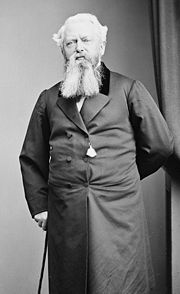
Townsend Harris

Encyclopedia
Townsend Harris was a successful New York City
merchant and minor politician, and the first United States
Consul General to Japan
. He negotiated the "Harris Treaty" between the US and Japan and is credited as the diplomat who first opened the Empire of Japan
to foreign trade and culture in the Edo period
.
), in Washington County
in upstate New York
. He moved early to New York City
, where he became a successful merchant and importer from China
.
In 1846 Harris joined the New York City Board of Education
, serving as its president until 1848. He was an avid and critical reader and also taught himself French
, Italian
and Spanish
. He founded the Free Academy of the City of New York, which later became the City College of New York
, to provide education to the city's working people. A city high school
bearing Harris's name, Townsend Harris High School
, soon emerged as a separate entity out of the Free Academy's secondary-level curriculum; the school survived until 1942 when Fiorello La Guardia closed it because of budget constraints. Townsend Harris High School was re-created in 1984 as a public magnet school for the humanities.
and during the following six years made trading voyages to China and the Dutch and English Indies, becoming thoroughly acquainted with the manifold Oriental varieties of human nature. He acted for a time as American vice-consul at Ningpo.
 President Franklin Pierce
named Harris the first Consul General
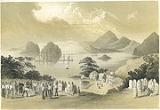
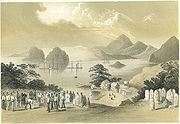
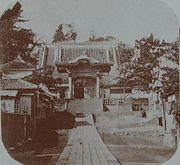
to the Empire of Japan in July, 1856, where he opened the first US Consulate at the Gyokusen-ji Temple in the city of Shimoda
, Shizuoka Prefecture
, some time after Commodore Perry
had first opened trade between the US and Japan in 1853.
 Harris demanded the courtesies due to an accredited envoy, and refused to deliver his president's letter to any one but the Shogun in Yedo, and to him personally. After prolonged negotiations lasting 18 months, Harris finally received a personal audience of the Shogun in the palace. After another four months, he successfully negotiated the "Treaty of Peace and Commerce," or the Harris Treaty, in 1858, securing trade between the US and Japan and paving the way for greater Western influence in Japan's economy and politics.
Harris returned to the US in 1861. Upon his departure, senior Japanese diplomat Moriyama wrote to him "You have been more than a friend. You have been our benefactor and teacher. Your spirit and memory will live forever in the history of Japan."
Harris was favorably impressed by his experiences in Japan at the end of its self-imposed period of isolation. He wrote: "The people all appeared clean and well fed... well clad and happy looking. It is more like the golden age of simplicity and honesty than I have ever seen in any other country".
According to a persistent legend, Harris adopted a 17-year-old geisha
named Okichi , who was heavily pressured into the relationship by Japanese authorities and then ostracized after Harris' departure, eventually committing suicide in 1892. However, it appears that Okichi was merely one of Harris' housekeepers, and the Kodansha Encyclopedia states that Harris fired her after just three days of work.
 As reported in the New York Times, when he was interviewed in 1874 by someone recently returned from Japan, his first question was, "What do the Japanese think of me?" Masao Miyoshi asserts in his book As We Saw Them: The First Japanese to the United State (1860) that the restrictive lifestyle for Townsend Harris as ambassador in Japan "had forever molded the opener of Japan into a hermit" for the rest of his life while in New York City.
Harris is buried in Green-Wood Cemetery
in Brooklyn
, New York
. In 1986, the nation of Japan presented a gift of a refurbished gravesite including paving stones, a stone lantern, a cherry tree, a dogwood tree, and two commemorative stones, in commemoration of the continuing respect and affection of the Japanese people for Harris.
in the 1958 movie The Barbarian and the Geisha
, directed by John Huston
. Although the primary plot, dealing with Harris's attempt diplomatically to achieve détente between the U.S. and Japan, is essentially accurate, the subplot dealing with the love affair between Harris and Okichi is substantially fictional.
Harris also appears as the main character of several episodes of the satirical Japanese manga
-based anime
, Gag Manga Biyori as a desperate man with a thick accent attempting to outshine Commodore Perry's arrival in a black-hulled ship in 1853, while making preparations for finalizing the Treaty of Peace and Commerce.
Harris was mentioned by a visiting Japanese dignitary in The Rifleman
, in the episode "The Sixteenth Cousin".
Harris is seen in the 47th NHK Taiga Drama Atsuhime. He is played by Blake Crawford.
Harris's visit to Japan is the basis for Puccini's opera "Madame Butterfly".
New York City
New York is the most populous city in the United States and the center of the New York Metropolitan Area, one of the most populous metropolitan areas in the world. New York exerts a significant impact upon global commerce, finance, media, art, fashion, research, technology, education, and...
merchant and minor politician, and the first United States
United States
The United States of America is a federal constitutional republic comprising fifty states and a federal district...
Consul General to Japan
Japan
Japan is an island nation in East Asia. Located in the Pacific Ocean, it lies to the east of the Sea of Japan, China, North Korea, South Korea and Russia, stretching from the Sea of Okhotsk in the north to the East China Sea and Taiwan in the south...
. He negotiated the "Harris Treaty" between the US and Japan and is credited as the diplomat who first opened the Empire of Japan
Empire of Japan
The Empire of Japan is the name of the state of Japan that existed from the Meiji Restoration on 3 January 1868 to the enactment of the post-World War II Constitution of...
to foreign trade and culture in the Edo period
Edo period
The , or , is a division of Japanese history which was ruled by the shoguns of the Tokugawa family, running from 1603 to 1868. The political entity of this period was the Tokugawa shogunate....
.
In New York
Harris was born in the village of Sandy Hill (now Hudson FallsHudson Falls, New York
Hudson Falls is a village located in Washington County, New York, USA. The village is in the southwest part of the town of Kingsbury, on US Route 4. Hudson Falls is part of the Glens Falls Metropolitan Statistical Area. As of the 2000 census, the village had a population of 6,927...
), in Washington County
Washington County, New York
Washington County is a county located in the U.S. state of New York. It is part of the Glens Falls, New York, Metropolitan Statistical Area. As of the 2010 census, the population was 63,216. It was named for the Revolutionary War general George Washington...
in upstate New York
New York
New York is a state in the Northeastern region of the United States. It is the nation's third most populous state. New York is bordered by New Jersey and Pennsylvania to the south, and by Connecticut, Massachusetts and Vermont to the east...
. He moved early to New York City
New York City
New York is the most populous city in the United States and the center of the New York Metropolitan Area, one of the most populous metropolitan areas in the world. New York exerts a significant impact upon global commerce, finance, media, art, fashion, research, technology, education, and...
, where he became a successful merchant and importer from China
China
Chinese civilization may refer to:* China for more general discussion of the country.* Chinese culture* Greater China, the transnational community of ethnic Chinese.* History of China* Sinosphere, the area historically affected by Chinese culture...
.
In 1846 Harris joined the New York City Board of Education
New York City Department of Education
The New York City Department of Education is the branch of municipal government in New York City that manages the city's public school system. It is the largest school system in the United States, with over 1.1 million students taught in more than 1,700 separate schools...
, serving as its president until 1848. He was an avid and critical reader and also taught himself French
French language
French is a Romance language spoken as a first language in France, the Romandy region in Switzerland, Wallonia and Brussels in Belgium, Monaco, the regions of Quebec and Acadia in Canada, and by various communities elsewhere. Second-language speakers of French are distributed throughout many parts...
, Italian
Italian language
Italian is a Romance language spoken mainly in Europe: Italy, Switzerland, San Marino, Vatican City, by minorities in Malta, Monaco, Croatia, Slovenia, France, Libya, Eritrea, and Somalia, and by immigrant communities in the Americas and Australia...
and Spanish
Spanish language
Spanish , also known as Castilian , is a Romance language in the Ibero-Romance group that evolved from several languages and dialects in central-northern Iberia around the 9th century and gradually spread with the expansion of the Kingdom of Castile into central and southern Iberia during the...
. He founded the Free Academy of the City of New York, which later became the City College of New York
City College of New York
The City College of the City University of New York is a senior college of the City University of New York , in New York City. It is also the oldest of the City University's twenty-three institutions of higher learning...
, to provide education to the city's working people. A city high school
High school
High school is a term used in parts of the English speaking world to describe institutions which provide all or part of secondary education. The term is often incorporated into the name of such institutions....
bearing Harris's name, Townsend Harris High School
Townsend Harris High School
Townsend Harris High School is a public magnet high school for the humanities in the borough of Queens in New York City. Students and alumni often refer to themselves as "Harrisites." Townsend Harris consistently ranks as among the top 100 High Schools in the United States. It currently operates as...
, soon emerged as a separate entity out of the Free Academy's secondary-level curriculum; the school survived until 1942 when Fiorello La Guardia closed it because of budget constraints. Townsend Harris High School was re-created in 1984 as a public magnet school for the humanities.
Commerce
In 1848 he went to CaliforniaCalifornia
California is a state located on the West Coast of the United States. It is by far the most populous U.S. state, and the third-largest by land area...
and during the following six years made trading voyages to China and the Dutch and English Indies, becoming thoroughly acquainted with the manifold Oriental varieties of human nature. He acted for a time as American vice-consul at Ningpo.
In Japan
Franklin Pierce
Franklin Pierce was the 14th President of the United States and is the only President from New Hampshire. Pierce was a Democrat and a "doughface" who served in the U.S. House of Representatives and the Senate. Pierce took part in the Mexican-American War and became a brigadier general in the Army...
named Harris the first Consul General
Consul (representative)
The political title Consul is used for the official representatives of the government of one state in the territory of another, normally acting to assist and protect the citizens of the consul's own country, and to facilitate trade and friendship between the peoples of the two countries...
to the Empire of Japan in July, 1856, where he opened the first US Consulate at the Gyokusen-ji Temple in the city of Shimoda
Shimoda, Shizuoka
is a city and port in Shizuoka, Japan.As of 2010, the city had an estimated population of 25,054 and a population density of 242 persons per square kilometer...
, Shizuoka Prefecture
Shizuoka Prefecture
is a prefecture of Japan located in the Chūbu region on Honshu island. The capital is the city of Shizuoka.- History :Shizuoka prefecture was formed from the former Tōtōmi, Suruga and Izu provinces.The area was the home of the first Tokugawa Shogun...
, some time after Commodore Perry
Matthew Perry (naval officer)
Matthew Calbraith Perry was the Commodore of the U.S. Navy and served commanding a number of US naval ships. He served several wars, most notably in the Mexican-American War and the War of 1812. He played a leading role in the opening of Japan to the West with the Convention of Kanagawa in 1854...
had first opened trade between the US and Japan in 1853.
Harris returned to the US in 1861. Upon his departure, senior Japanese diplomat Moriyama wrote to him "You have been more than a friend. You have been our benefactor and teacher. Your spirit and memory will live forever in the history of Japan."
Harris was favorably impressed by his experiences in Japan at the end of its self-imposed period of isolation. He wrote: "The people all appeared clean and well fed... well clad and happy looking. It is more like the golden age of simplicity and honesty than I have ever seen in any other country".
According to a persistent legend, Harris adopted a 17-year-old geisha
Geisha
, Geiko or Geigi are traditional, female Japanese entertainers whose skills include performing various Japanese arts such as classical music and dance.-Terms:...
named Okichi , who was heavily pressured into the relationship by Japanese authorities and then ostracized after Harris' departure, eventually committing suicide in 1892. However, it appears that Okichi was merely one of Harris' housekeepers, and the Kodansha Encyclopedia states that Harris fired her after just three days of work.
Aftermath
Harris is buried in Green-Wood Cemetery
Green-Wood Cemetery
Green-Wood Cemetery was founded in 1838 as a rural cemetery in Brooklyn, Kings County , New York. It was granted National Historic Landmark status in 2006 by the U.S. Department of the Interior.-History:...
in Brooklyn
Brooklyn
Brooklyn is the most populous of New York City's five boroughs, with nearly 2.6 million residents, and the second-largest in area. Since 1896, Brooklyn has had the same boundaries as Kings County, which is now the most populous county in New York State and the second-most densely populated...
, New York
New York
New York is a state in the Northeastern region of the United States. It is the nation's third most populous state. New York is bordered by New Jersey and Pennsylvania to the south, and by Connecticut, Massachusetts and Vermont to the east...
. In 1986, the nation of Japan presented a gift of a refurbished gravesite including paving stones, a stone lantern, a cherry tree, a dogwood tree, and two commemorative stones, in commemoration of the continuing respect and affection of the Japanese people for Harris.
In popular culture
Harris was portrayed by John WayneJohn Wayne
Marion Mitchell Morrison , better known by his stage name John Wayne, was an American film actor, director and producer. He epitomized rugged masculinity and became an enduring American icon. He is famous for his distinctive calm voice, walk, and height...
in the 1958 movie The Barbarian and the Geisha
The Barbarian and the Geisha
The Barbarian and the Geisha is a 1958 film starring John Wayne, Sam Jaffe and Japanese American actress Eiko Ando set in 1850s Japan. Shot largely on location, it was directed by John Huston.-Plot:...
, directed by John Huston
John Huston
John Marcellus Huston was an American film director, screenwriter and actor. He wrote most of the 37 feature films he directed, many of which are today considered classics: The Maltese Falcon , The Treasure of the Sierra Madre , Key Largo , The Asphalt Jungle , The African Queen , Moulin Rouge...
. Although the primary plot, dealing with Harris's attempt diplomatically to achieve détente between the U.S. and Japan, is essentially accurate, the subplot dealing with the love affair between Harris and Okichi is substantially fictional.
Harris also appears as the main character of several episodes of the satirical Japanese manga
Manga
Manga is the Japanese word for "comics" and consists of comics and print cartoons . In the West, the term "manga" has been appropriated to refer specifically to comics created in Japan, or by Japanese authors, in the Japanese language and conforming to the style developed in Japan in the late 19th...
-based anime
Anime
is the Japanese abbreviated pronunciation of "animation". The definition sometimes changes depending on the context. In English-speaking countries, the term most commonly refers to Japanese animated cartoons....
, Gag Manga Biyori as a desperate man with a thick accent attempting to outshine Commodore Perry's arrival in a black-hulled ship in 1853, while making preparations for finalizing the Treaty of Peace and Commerce.
Harris was mentioned by a visiting Japanese dignitary in The Rifleman
The Rifleman
The Rifleman is an American Western television program that starred Chuck Connors as homesteader Lucas McCain and Johnny Crawford as his son, Mark McCain. It was set in the 1880s in the town of North Fork, New Mexico Territory. The show, filmed in black-and-white with a half hour running time, ran...
, in the episode "The Sixteenth Cousin".
Harris is seen in the 47th NHK Taiga Drama Atsuhime. He is played by Blake Crawford.
Harris's visit to Japan is the basis for Puccini's opera "Madame Butterfly".
External links
- Selected comments from Harris's conversation with Bakufu Grand Councillor Hotta MasayoshiHotta Masayoshiwas a Japanese daimyo in the Edo period; and he was a prominent figure in the Tokugawa shogunate.-Rōjū:the Shogun's advisor from 1837 to 1843, and again from 1855 to 1858...
on December 12, 1857 - The Japan Connection: The 150th Anniversary of Townsend Harris' Arrival in Japan, April 25 - August 18, 2006, exhibit at CCNY Library