


Brooklyn College

Encyclopedia
Brooklyn College is a senior college of the City University of New York
, located in Brooklyn, New York, United States.
Established in 1930 by the New York City Board of Higher Education, the College had its beginnings as the Downtown Brooklyn branches of Hunter College
(then a women's college
) and the City College of New York
(then a men's college
). With the merger of these branches, Brooklyn College became the first public coeducational liberal arts college
in New York City. The 26 acres (105,218.4 m²) campus is known for its great beauty, and is often regarded as "the poor man's Harvard" because of its low tuition and reputation for academic excellence (former President, Robert Hess, responded to the moniker by saying "I like to think of Harvard as the rich man's Brooklyn College").
The 2003 edition of The Best 345 Colleges, published by The Princeton Review
, ranked Brooklyn College #1 for Most Beautiful Campus and in the Top Ten for Best Academic Value, Diversity, and Location. The College ranked in the top 2 nationally for the second consecutive year in Princeton Review’s 2006 guidebook, America’s Best Value Colleges. Brooklyn College was ranked as one of America’s Top Fifty Best Value Public Colleges for 2009 by The Princeton Review in its annual survey.
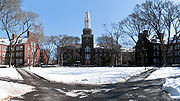 In 1932, the architect
Randolph Evans drafted a plan for the college's campus on a large plot of land his employer owned in the Midwood section of Brooklyn. He sketched out a Georgian
-style campus facing a central quadrangle
, and anchored by a library building with a tall tower. Evans presented the sketches to the president of the college at the time, Dr. William A. Boylan. Boylan was pleased with the plans, and the lot of land was purchased for $1.6 million. Construction of the new campus began in 1935, with a groundbreaking ceremony attended by then Mayor
Fiorello La Guardia and Brooklyn Borough President
Raymond Ingersoll. In 1936, then-President of the United States Franklin D. Roosevelt
went to Brooklyn College to lay the cornerstone
of the Brooklyn College Gymnasium. President Boylan, Borough President Ingersoll, and President Roosevelt all had buildings on Brooklyn College's campus named after them. The campus located in Midwood became the only Brooklyn College campus after the school's Downtown Brooklyn
campus was shut down during the 1975 budget emergency.
.
The most recent construction to take place was the demolition of Plaza Building, due to its inefficient use of space, poor ventilation, and significant maintenance costs. To replace Plaza Building, the college has constructed a new West Quad, designed by the notable Uruguay
an architect Rafael Viñoly
. The new grounds contain a newly landscaped quadrangle
with grassy areas and trees. Also, new façade
s are being constructed on Roosevelt and James halls where they once connected with Plaza Building. In addition to these changes, a new West Quad Center has been completed. It contains classroom space, offices, and the Department of Physical Education
and Exercise Science. The building also has new gymnasiums and a swimming pool. The 2009–10 CUNYAC
championship men's basketball team now plays its home games in the new West Quad Center.
This follows a major library renovation that saw the library moved to a temporary home while construction took place. The Brooklyn College library is now located in its original location in a completely renovated and expanded LaGuardia Hall. The Leonard & Claire Tow Center for the Performing Arts is scheduled to be built on the site of Gershwin Hall. Noted as one of the most beautiful in the United States, the campus has been shown on numerous movies and television shows.
Ninety percent of the Brooklyn College faculty hold the highest degree in their field. Among them are Fulbright and Guggenheim
fellows, an American Book Award
winner, a National Book Award
finalist, an Obie Award
-winning playwright, three Pulitzer Prize
-winning authors, and award-winning scientists and musicians.
The College ranks 1st nationally in the number of its undergraduates who have gone on to earn Ph.D.
degrees.
Also, the Conservatory of Music at Brooklyn College
offers undergraduate and graduate work in performance, musicology, composition, and music education.
In 2006, the Core Curriculum was revamped, and the 13 required courses were replaced with 15 courses in 3 disciplines, from which students were required to take 11.
Graduate programs are offered in
Accounting,
Africana Studies,
Anthropology and Archaeology,
Art,
Biology,
Chemistry,
Computer and Information Science,
Earth and Environmental Sciences,
Economics,
Education,
English,
Health and Nutrition Sciences,
History,
Judaic Studies,
Mathematics,
Modern Languages and Literatures,
Music,
Physical Education and Exercise Science,
Physics,
Political Science,
Psychology,
Puerto Rican and Latino Studies,
Sociology,
Speech Communication Arts and Sciences,
Television and Radio, and
Theater.
-M.D.
program is an 8-year program affiliated with SUNY Downstate Medical Center
. The Program follows a rigorous selection process, with a maximum of 15 students selected every year. Each student selected to the program receives a Brooklyn College Presidential Scholarship. B.A.-M.D. students must engage in community service
for three years, beginning in their lower sophomore semester. During one summer of their undergraduate studies, students are required to volunteer in a clinical setting where they are involved in direct patient care. B.A.-M.D. students are encouraged to major in the humanities
or social sciences
. A student who majors in a science must choose a minor in the humanities or social sciences. All students meet the pre-med science requirements by taking cell
and molecular biology
, botany
, physiology
, general chemistry
, organic chemistry
, and general physics
. B.A.-M.D. students must maintain at Brooklyn College an overall grade point average of 3.5, and a pre-med science GPA of 3.5.
. It was the first honors program in the City University of New York, and one of the earliest at any American college or university. The program received national recognition, became a model for honors programs elsewhere, and was the foundation of the Brooklyn College Honors Academy, which now includes nine federated programs.
Students in the program are distinguished by their strong writing ability. Applicants must score at least 680 on their SAT II Writing, and maintain a GPA over 3.50. Graduates of the Scholars Program enter such fields as medicine, law, speech therapy, public health, journalism, television, film producing and directing, and biochemistry. They are admitted to graduate programs at such schools as Harvard Law School, Princeton, Columbia, the University of Pennsylvania, Yale, Berkeley, New York University, and London School of Economics and Political Science. Many are elected to membership in Phi Beta Kappa, and have received awards, including Brooklyn College’s Tow Travel Fellowship and Furman Travel Fellowship for undergraduate international study and research, and the nationally competitive Beinecke Fellowship and Mellon Humanities Fellowship for graduate study. Limited to 15–20 new students per year, the Program offers a community much like a small residential college.
Built in 1959, the Tanger building was designed by Percival Goodman, a leading architect of American synagogues. It is located at the junction of Campus Road and Hillel Place, across from Gershwin Hall, at the center of Brooklyn.
Brooklyn College currently houses the largest Hillel facility among CUNY campuses, featuring a host of recreational and social amenities.
study of baccalaureate origins of Ph.D. recipients between 1920 and 1995, Brooklyn College ranked 19th in the nation.
City University of New York
The City University of New York is the public university system of New York City, with its administrative offices in Yorkville in Manhattan. It is the largest urban university in the United States, consisting of 23 institutions: 11 senior colleges, six community colleges, the William E...
, located in Brooklyn, New York, United States.
Established in 1930 by the New York City Board of Higher Education, the College had its beginnings as the Downtown Brooklyn branches of Hunter College
Hunter College
Hunter College, established in 1870, is a public university and one of the constituent colleges of the City University of New York, located on Manhattan's Upper East Side. Hunter grants undergraduate, graduate, and post-graduate degrees in more than one hundred fields of study, and is recognized...
(then a women's college
Women's college
Women's colleges in higher education are undergraduate, bachelor's degree-granting institutions, often liberal arts colleges, whose student populations are composed exclusively or almost exclusively of women...
) and the City College of New York
City College of New York
The City College of the City University of New York is a senior college of the City University of New York , in New York City. It is also the oldest of the City University's twenty-three institutions of higher learning...
(then a men's college
Men's college
Men's colleges in higher education are undergraduate, bachelor's degree-granting institutions whose students are exclusively men. Many are liberal arts colleges.-United States:...
). With the merger of these branches, Brooklyn College became the first public coeducational liberal arts college
Liberal arts college
A liberal arts college is one with a primary emphasis on undergraduate study in the liberal arts and sciences.Students in the liberal arts generally major in a particular discipline while receiving exposure to a wide range of academic subjects, including sciences as well as the traditional...
in New York City. The 26 acres (105,218.4 m²) campus is known for its great beauty, and is often regarded as "the poor man's Harvard" because of its low tuition and reputation for academic excellence (former President, Robert Hess, responded to the moniker by saying "I like to think of Harvard as the rich man's Brooklyn College").
The 2003 edition of The Best 345 Colleges, published by The Princeton Review
The Princeton Review
The Princeton Review is an American-based standardized test preparation and admissions consulting company. The Princeton Review operates in 41 states and 22 countries across the globe. It offers test preparation for standardized aptitude tests such as the SAT and advice regarding college...
, ranked Brooklyn College #1 for Most Beautiful Campus and in the Top Ten for Best Academic Value, Diversity, and Location. The College ranked in the top 2 nationally for the second consecutive year in Princeton Review’s 2006 guidebook, America’s Best Value Colleges. Brooklyn College was ranked as one of America’s Top Fifty Best Value Public Colleges for 2009 by The Princeton Review in its annual survey.
Campus history
Architect
An architect is a person trained in the planning, design and oversight of the construction of buildings. To practice architecture means to offer or render services in connection with the design and construction of a building, or group of buildings and the space within the site surrounding the...
Randolph Evans drafted a plan for the college's campus on a large plot of land his employer owned in the Midwood section of Brooklyn. He sketched out a Georgian
Georgian architecture
Georgian architecture is the name given in most English-speaking countries to the set of architectural styles current between 1720 and 1840. It is eponymous for the first four British monarchs of the House of Hanover—George I of Great Britain, George II of Great Britain, George III of the United...
-style campus facing a central quadrangle
Quadrangle (architecture)
In architecture, a quadrangle is a space or courtyard, usually rectangular in plan, the sides of which are entirely or mainly occupied by parts of a large building. The word is probably most closely associated with college or university campus architecture, but quadrangles may be found in other...
, and anchored by a library building with a tall tower. Evans presented the sketches to the president of the college at the time, Dr. William A. Boylan. Boylan was pleased with the plans, and the lot of land was purchased for $1.6 million. Construction of the new campus began in 1935, with a groundbreaking ceremony attended by then Mayor
Mayor
In many countries, a Mayor is the highest ranking officer in the municipal government of a town or a large urban city....
Fiorello La Guardia and Brooklyn Borough President
Borough president
Borough President is an elective office in each of the five boroughs of New York City.-Reasons for establishment:...
Raymond Ingersoll. In 1936, then-President of the United States Franklin D. Roosevelt
Franklin D. Roosevelt
Franklin Delano Roosevelt , also known by his initials, FDR, was the 32nd President of the United States and a central figure in world events during the mid-20th century, leading the United States during a time of worldwide economic crisis and world war...
went to Brooklyn College to lay the cornerstone
Cornerstone
The cornerstone concept is derived from the first stone set in the construction of a masonry foundation, important since all other stones will be set in reference to this stone, thus determining the position of the entire structure.Over time a cornerstone became a ceremonial masonry stone, or...
of the Brooklyn College Gymnasium. President Boylan, Borough President Ingersoll, and President Roosevelt all had buildings on Brooklyn College's campus named after them. The campus located in Midwood became the only Brooklyn College campus after the school's Downtown Brooklyn
Downtown Brooklyn
Downtown Brooklyn is the third largest central business district in New York City , and is located in the northwestern section of the borough of Brooklyn...
campus was shut down during the 1975 budget emergency.
Modern campus history
Brooklyn College's campus today looks much as it did when it was originally constructed, but with extensions of Ingersoll Hall and Roosevelt Hall. The campus also serves as home to the Brooklyn Center for the Performing Arts complex and its four theaters, including the George GershwinGeorge Gershwin Theatre (Brooklyn)
The George Gershwin Theatre is a 500-seat proscenium theatre, one of four situated in the Brooklyn Center for the Performing Arts complex located on the campus of Brooklyn College at 2900 Campus Road in Brooklyn, New York, United States....
.
The most recent construction to take place was the demolition of Plaza Building, due to its inefficient use of space, poor ventilation, and significant maintenance costs. To replace Plaza Building, the college has constructed a new West Quad, designed by the notable Uruguay
Uruguay
Uruguay ,officially the Oriental Republic of Uruguay,sometimes the Eastern Republic of Uruguay; ) is a country in the southeastern part of South America. It is home to some 3.5 million people, of whom 1.8 million live in the capital Montevideo and its metropolitan area...
an architect Rafael Viñoly
Rafael Viñoly
Rafael Viñoly is an Uruguayan architect living in the United States.-Biography:He was born in Montevideo, Uruguay to Román Viñoly Barreto, and Maria Beceiro ....
. The new grounds contain a newly landscaped quadrangle
Quadrangle (architecture)
In architecture, a quadrangle is a space or courtyard, usually rectangular in plan, the sides of which are entirely or mainly occupied by parts of a large building. The word is probably most closely associated with college or university campus architecture, but quadrangles may be found in other...
with grassy areas and trees. Also, new façade
Facade
A facade or façade is generally one exterior side of a building, usually, but not always, the front. The word comes from the French language, literally meaning "frontage" or "face"....
s are being constructed on Roosevelt and James halls where they once connected with Plaza Building. In addition to these changes, a new West Quad Center has been completed. It contains classroom space, offices, and the Department of Physical Education
Physical education
Physical education or gymnastics is a course taken during primary and secondary education that encourages psychomotor learning in a play or movement exploration setting....
and Exercise Science. The building also has new gymnasiums and a swimming pool. The 2009–10 CUNYAC
City University of New York Athletic Conference
The City University of New York Athletic Conference is an intercollegiate athletic conference affiliated with the NCAA's Division III. Its member institutions are all located in New York City and are campuses of the City University of New York...
championship men's basketball team now plays its home games in the new West Quad Center.
This follows a major library renovation that saw the library moved to a temporary home while construction took place. The Brooklyn College library is now located in its original location in a completely renovated and expanded LaGuardia Hall. The Leonard & Claire Tow Center for the Performing Arts is scheduled to be built on the site of Gershwin Hall. Noted as one of the most beautiful in the United States, the campus has been shown on numerous movies and television shows.
Ninety percent of the Brooklyn College faculty hold the highest degree in their field. Among them are Fulbright and Guggenheim
Guggenheim Fellowship
Guggenheim Fellowships are American grants that have been awarded annually since 1925 by the John Simon Guggenheim Memorial Foundation to those "who have demonstrated exceptional capacity for productive scholarship or exceptional creative ability in the arts." Each year, the foundation makes...
fellows, an American Book Award
American Book Award
The American Book Award was established in 1978 by the Before Columbus Foundation. It seeks to recognize outstanding literary achievement by contemporary American authors, without restriction to race, sex, ethnic background, or genre...
winner, a National Book Award
National Book Award
The National Book Awards are a set of American literary awards. Started in 1950, the Awards are presented annually to American authors for literature published in the current year. In 1989 the National Book Foundation, a nonprofit organization which now oversees and manages the National Book...
finalist, an Obie Award
Obie Award
The Obie Awards or Off-Broadway Theater Awards are annual awards given by The Village Voice newspaper to theatre artists and groups in New York City...
-winning playwright, three Pulitzer Prize
Pulitzer Prize
The Pulitzer Prize is a U.S. award for achievements in newspaper and online journalism, literature and musical composition. It was established by American publisher Joseph Pulitzer and is administered by Columbia University in New York City...
-winning authors, and award-winning scientists and musicians.
The College ranks 1st nationally in the number of its undergraduates who have gone on to earn Ph.D.
Ph.D.
A Ph.D. is a Doctor of Philosophy, an academic degree.Ph.D. may also refer to:* Ph.D. , a 1980s British group*Piled Higher and Deeper, a web comic strip*PhD: Phantasy Degree, a Korean comic series* PhD Docbook renderer, an XML renderer...
degrees.
Divisions
Brooklyn College is made up of three academic divisions:- College of Liberal Arts and Sciences
- School of General StudiesGeneral StudiesGeneral Studies may refer to:* Bachelor of General Studies, a degree offered in some Western Universities* A GCSE and A-level examination offered to 16-18 year olds in the United Kingdom and some other countries...
- Division of Graduate Studies
Also, the Conservatory of Music at Brooklyn College
Conservatory of Music at Brooklyn College
The Conservatory of Music at Brooklyn College is the music school of Brooklyn College of the City University of New York...
offers undergraduate and graduate work in performance, musicology, composition, and music education.
Undergraduate curriculum
Beginning in 1981, the college instituted a group of classes that all undergraduates were required to take, called "Core Studies". The classes were: Classical Origins of Western Culture, Introduction to Art, Introduction to Music, People, Power, and Politics, The Shaping of the Modern World, Introduction to Mathematical Reasoning and Computer Programming, Landmarks of Literature, Chemistry, Physics, Biology, Geology, Studies in African, Asian, and Latin American Cultures, and Knowledge, Existence and Values.In 2006, the Core Curriculum was revamped, and the 13 required courses were replaced with 15 courses in 3 disciplines, from which students were required to take 11.
Division of Graduate Studies
The Division of Graduate Studies at Brooklyn College was established in 1935 and offers more than seventy programs in the arts, education, humanities, sciences, and computer and social sciences.Graduate programs are offered in
Accounting,
Africana Studies,
Anthropology and Archaeology,
Art,
Biology,
Chemistry,
Computer and Information Science,
Earth and Environmental Sciences,
Economics,
Education,
English,
Health and Nutrition Sciences,
History,
Judaic Studies,
Mathematics,
Modern Languages and Literatures,
Music,
Physical Education and Exercise Science,
Physics,
Political Science,
Psychology,
Puerto Rican and Latino Studies,
Sociology,
Speech Communication Arts and Sciences,
Television and Radio, and
Theater.
B.A.-M.D. program
The Brooklyn College B.A.Bachelor of Arts
A Bachelor of Arts , from the Latin artium baccalaureus, is a bachelor's degree awarded for an undergraduate course or program in either the liberal arts, the sciences, or both...
-M.D.
Doctor of Medicine
Doctor of Medicine is a doctoral degree for physicians. The degree is granted by medical schools...
program is an 8-year program affiliated with SUNY Downstate Medical Center
SUNY Downstate Medical Center
The State University of New York Health Science Center at Brooklyn, better known as SUNY Downstate Medical Center, is a public university and medical center located in central Brooklyn, New York and the only academic center for health education, research, and patient care serving Brooklyn’s 2.5...
. The Program follows a rigorous selection process, with a maximum of 15 students selected every year. Each student selected to the program receives a Brooklyn College Presidential Scholarship. B.A.-M.D. students must engage in community service
Community service
Community service is donated service or activity that is performed by someone or a group of people for the benefit of the public or its institutions....
for three years, beginning in their lower sophomore semester. During one summer of their undergraduate studies, students are required to volunteer in a clinical setting where they are involved in direct patient care. B.A.-M.D. students are encouraged to major in the humanities
Humanities
The humanities are academic disciplines that study the human condition, using methods that are primarily analytical, critical, or speculative, as distinguished from the mainly empirical approaches of the natural sciences....
or social sciences
Social sciences
Social science is the field of study concerned with society. "Social science" is commonly used as an umbrella term to refer to a plurality of fields outside of the natural sciences usually exclusive of the administrative or managerial sciences...
. A student who majors in a science must choose a minor in the humanities or social sciences. All students meet the pre-med science requirements by taking cell
Cell biology
Cell biology is a scientific discipline that studies cells – their physiological properties, their structure, the organelles they contain, interactions with their environment, their life cycle, division and death. This is done both on a microscopic and molecular level...
and molecular biology
Molecular biology
Molecular biology is the branch of biology that deals with the molecular basis of biological activity. This field overlaps with other areas of biology and chemistry, particularly genetics and biochemistry...
, botany
Botany
Botany, plant science, or plant biology is a branch of biology that involves the scientific study of plant life. Traditionally, botany also included the study of fungi, algae and viruses...
, physiology
Physiology
Physiology is the science of the function of living systems. This includes how organisms, organ systems, organs, cells, and bio-molecules carry out the chemical or physical functions that exist in a living system. The highest honor awarded in physiology is the Nobel Prize in Physiology or...
, general chemistry
Chemistry
Chemistry is the science of matter, especially its chemical reactions, but also its composition, structure and properties. Chemistry is concerned with atoms and their interactions with other atoms, and particularly with the properties of chemical bonds....
, organic chemistry
Organic chemistry
Organic chemistry is a subdiscipline within chemistry involving the scientific study of the structure, properties, composition, reactions, and preparation of carbon-based compounds, hydrocarbons, and their derivatives...
, and general physics
Physics
Physics is a natural science that involves the study of matter and its motion through spacetime, along with related concepts such as energy and force. More broadly, it is the general analysis of nature, conducted in order to understand how the universe behaves.Physics is one of the oldest academic...
. B.A.-M.D. students must maintain at Brooklyn College an overall grade point average of 3.5, and a pre-med science GPA of 3.5.
The Scholars Program
The Scholars Program was established in 1960 with support from the Ford FoundationFord Foundation
The Ford Foundation is a private foundation incorporated in Michigan and based in New York City created to fund programs that were chartered in 1936 by Edsel Ford and Henry Ford....
. It was the first honors program in the City University of New York, and one of the earliest at any American college or university. The program received national recognition, became a model for honors programs elsewhere, and was the foundation of the Brooklyn College Honors Academy, which now includes nine federated programs.
Students in the program are distinguished by their strong writing ability. Applicants must score at least 680 on their SAT II Writing, and maintain a GPA over 3.50. Graduates of the Scholars Program enter such fields as medicine, law, speech therapy, public health, journalism, television, film producing and directing, and biochemistry. They are admitted to graduate programs at such schools as Harvard Law School, Princeton, Columbia, the University of Pennsylvania, Yale, Berkeley, New York University, and London School of Economics and Political Science. Many are elected to membership in Phi Beta Kappa, and have received awards, including Brooklyn College’s Tow Travel Fellowship and Furman Travel Fellowship for undergraduate international study and research, and the nationally competitive Beinecke Fellowship and Mellon Humanities Fellowship for graduate study. Limited to 15–20 new students per year, the Program offers a community much like a small residential college.
Coordinated Engineering Program
The Coordinated Honors Engineering Program offers a course of study equivalent to the first two years at any engineering school. Students who maintain the required academic level are guaranteed transfer to one of the three coordinating schools—Polytechnic University, City College of New York School of Engineering, and the College of Staten Island Engineering Science Program—to complete their bachelor’s degree in engineering. Coordinating Engineering students have also transferred to SUNY Stony Brook, University of Wisconsin, University of Michigan, Cooper Union, and the Massachusetts Institute of Technology. Students admitted as incoming First-Year receive a Brooklyn College Foundation Presidential Scholarship that provides full tuition for their two years of full-time undergraduate study in the Coordinated Engineering Program. As members of the Honors Academy, Engineering Honors students take advantage of individual advising, faculty consultation, and early registration. In the Commons they find study facilities, computer access, academic, scholarship, internship, and career opportunities, and, above all, intellectual stimulation among other talented students like themselves. Students applying to the Engineering Honors Program will also be considered for the Scholars Program.Tanger Hillel
The Tanger Hillel at Brooklyn College is part of the Hillel Foundation organization in the United States.Built in 1959, the Tanger building was designed by Percival Goodman, a leading architect of American synagogues. It is located at the junction of Campus Road and Hillel Place, across from Gershwin Hall, at the center of Brooklyn.
Brooklyn College currently houses the largest Hillel facility among CUNY campuses, featuring a host of recreational and social amenities.
Alumni
In a National Research CouncilUnited States National Research Council
The National Research Council of the USA is the working arm of the United States National Academies, carrying out most of the studies done in their names.The National Academies include:* National Academy of Sciences...
study of baccalaureate origins of Ph.D. recipients between 1920 and 1995, Brooklyn College ranked 19th in the nation.
Notable faculty
- F. Murray AbrahamF. Murray AbrahamFahrid Murray Abraham is an American actor. He became known during the 1980s after winning the Academy Award for Best Actor for his role as Antonio Salieri in Amadeus. He has appeared in many roles, both leading and supporting, in films such as All the President's Men and Scarface...
– actor of stage and screen; professor of theater, winner of the Academy Award for Best Actor - Eric AltermanEric AltermanEric Alterman is an American English teacher, historian, journalist, author, media critic, blogger, and educator. His political weblog named Altercation was hosted by MSNBC.com from 2002 until 2006, moved to Media Matters for America until December 2008, and is now hosted by The...
– American liberal journalist - Hannah ArendtHannah ArendtHannah Arendt was a German American political theorist. She has often been described as a philosopher, although she refused that label on the grounds that philosophy is concerned with "man in the singular." She described herself instead as a political theorist because her work centers on the fact...
– philosopher and political theorist; author of The Origins of TotalitarianismThe Origins of TotalitarianismThe Origins of Totalitarianism is a book by Hannah Arendt which describes and analyzes the two major totalitarian movements of the twentieth century, Nazism and Stalinism...
(1951) and The Human ConditionThe Human Condition (book)The Human Condition, published in 1958, is one of the central theoretical works of the philosopher Hannah Arendt. It is an account of the historical development of the situation of human existence, from the Ancient Greeks to modern Europe....
(1958) - John AshberyJohn AshberyJohn Lawrence Ashbery is an American poet. He has published more than twenty volumes of poetry and won nearly every major American award for poetry, including a Pulitzer Prize in 1976 for his collection Self-Portrait in a Convex Mirror. But Ashbery's work still proves controversial...
– poet, Pulitzer Prize winner - Robert BeauchampRobert BeauchampRobert Beauchamp was an American figurative painter and arts educator. Beauchamp's paintings and drawings are known for depicting dramatic creatures and figures with expressionistic colors. His work was described in the New York Times as being "both frightening and amusing,"...
– painter - Edwin G. BurrowsEdwin G. BurrowsEdwin G. "Ted" Burrows is a Distinguished Professor of History at Brooklyn College. He is the co-author of the Pulitzer Prize-winning Gotham: A History of New York City to 1898 and author of 2008's Forgotten Patriots: The Untold Story of American Prisoners During the Revolutionary War. Burrows...
– historian; Pulitzer Prize winner for co-writing Gotham: A History of New York City to 1898Gotham: A History of New York City to 1898Gotham: A History of New York City to 1898 is a non-fiction book by historians Edwin G. Burrows and Mike Wallace. Based on over twenty years of research by Burrows and Wallace, it was published in 1998 by Oxford University Press and won the 1999 Pulitzer Prize for History...
with Mike WallaceMike Wallace (historian)Mike Wallace is an American historian, Distinguished Professor of History at John Jay College of Criminal Justice of the City University of New York, where he has taught since 1971, and the director of the Gotham Center for New York City History.... - Eleanor CoryEleanor CoryEleanor Cory is an American composer.Cory studied at Sarah Lawrence College, Harvard University, New England Conservatory, and Columbia University...
– composer - Michael CunninghamMichael CunninghamMichael Cunningham is an American writer, best known for his 1998 novel The Hours, which won the Pulitzer Prize for Fiction and the PEN/Faulkner Award in 1999.-Early life and education:...
– novelist; winner of Pulitzer Prize for Fiction and PEN/Faulkner Award for The HoursThe HoursThe Hours can refer to:* The Hours , by Francesco Bartolozzi, based on a painting by Maria Cosway* The Hours , by Michael Cunningham... - Rudy D'AmicoRudy D'AmicoRudy D'Amico is a professional National Basketball Association scout, and former college and professional basketball coach who coached Maccabi Tel Aviv to the Euroleague Championship. He scouts for the Orlando Magic....
– professional National Basketball AssociationNational Basketball AssociationThe National Basketball Association is the pre-eminent men's professional basketball league in North America. It consists of thirty franchised member clubs, of which twenty-nine are located in the United States and one in Canada...
scout, and former Brooklyn College and professional basketball coach who coached Maccabi Tel Aviv to the EuroleagueEuroleagueEuroleague Basketball, commonly known as the Euroleague, is the highest level tier and most important professional club basketball competition in Europe, with teams from up to 18 different countries, members of FIBA Europe. For sponsorship reasons, for five seasons starting with 2010–2011, it is...
Championship - Charles DodgeCharles Dodge (composer)Charles Dodge is an American composer best known for his electronic music, specifically his computer music. He is a former student of Darius Milhaud and Gunther Schuller.-Education and teaching career:...
– composer, founder of the Center for Computer Music - Paul EdwardsPaul Edwards (philosopher)Paul Edwards, born Paul Eisenstein, was an Austrian American moral philosopher.-Life and career:Edwards was born in Vienna in 1923 to assimilated Jewish parents, the youngest of three brothers....
– Professor of Philosophy, editor of the Encyclopedia of Philosophy - John Hope FranklinJohn Hope FranklinJohn Hope Franklin was a United States historian and past president of Phi Beta Kappa, the Organization of American Historians, the American Historical Association, and the Southern Historical Association. Franklin is best known for his work From Slavery to Freedom, first published in 1947, and...
, historian, president of Phi Beta Kappa, and recipient of the Presidential Medal of Freedom - Allen GinsbergAllen GinsbergIrwin Allen Ginsberg was an American poet and one of the leading figures of the Beat Generation in the 1950s. He vigorously opposed militarism, materialism and sexual repression...
– beat poet; taught at Brooklyn College from 1986–97 - David GrubbsDavid GrubbsDavid Grubbs , guitarist, pianist, and vocalist, was a founding member of Squirrel Bait, Bastro, and Gastr del Sol. He has also played in Codeine, The Red Krayola, Bitch Magnet and The Wingdale Community Singers....
– musician, composer, recording artist - Carey HarrisonCarey Harrison-Life:Harrison was born in London to actors Rex Harrison and Lilli Palmer, and raised in Los Angeles and New York, where he attended the Lycée Français. Subsequently, in Britain, he attended Sunningdale School, Harrow School, and Jesus College, Cambridge....
– novelist/dramatist - Amy HempelAmy HempelAmy Hempel is an American short story writer, journalist, and university professor at Brooklyn College.-Life:Hempel was born in Chicago, Illinois...
– American short storyShort storyA short story is a work of fiction that is usually written in prose, often in narrative format. This format tends to be more pointed than longer works of fiction, such as novellas and novels. Short story definitions based on length differ somewhat, even among professional writers, in part because...
writer, journalist, and coordinator of the MFA Fiction-Writing Program - Seymour L. HessSeymour HessSeymour Lester Hess was an American meteorologist and planetary scientist.He was born in Brooklyn, New York. After earning a bachelors degree in chemistry from Brooklyn College, in 1943 he entered the University of Chicago as an Army Air Cadet...
– meteorologist and planetary scientist. - Agnieszka HollandAgnieszka HollandAgnieszka Holland is a Polish film and TV director and screenwriter. Best recognized for her highly political contributions to Polish cinema, Holland is one of Poland's most prominent filmmakers.-Personal life:...
– film director, best-known for Europa EuropaEuropa EuropaEuropa Europa is a 1990 German language film directed by Agnieszka Holland. Its original German title is Hitlerjunge Salomon, i.e. "Hitler Youth Salomon". It is based on the 1989 autobiography of Solomon Perel, a German Jewish boy who escaped The Holocaust by masquerading not just as a non-Jew, but...
(1992) - Carl HoltyCarl HoltyCarl Robert Holty was a German-born American abstract painter. Raised in Wisconsin, he was the first major abstract painter to gain notoriety from the state. Harold Rosenberg described Holty as "a figure of our art history," known for his use of color, shape and form.-Personal life and...
– painter - John Hope FranklinJohn Hope FranklinJohn Hope Franklin was a United States historian and past president of Phi Beta Kappa, the Organization of American Historians, the American Historical Association, and the Southern Historical Association. Franklin is best known for his work From Slavery to Freedom, first published in 1947, and...
– American historian, former Chairman of the History Department - John HospersJohn HospersJohn Hospers was an American philosopher. In 1972 he was the first presidential candidate of the Libertarian Party, and the only minor party candidate to receive an electoral vote in the 1972 U.S. Presidential election....
– first presidential candidate of the United States Libertarian Party; professor from 1956–66 - KC JohnsonKC JohnsonDr. Robert David Johnson , also known as KC Johnson, is a history professor at Brooklyn College and the City University of New York Graduate Center...
– Professor of American history - Tania LeónTania LeonTania León is a Cuban composer and conductor who has been recognized as an educator and advisor to arts organizations.-León's Music:...
– Cuban-born composer and conductor - Ben LernerBen LernerBenjamin S. Lerner is an American poet, novelist, and critic. He was awarded the Hayden Carruth prize for his cycle of fifty-two sonnets, . In 2004, Library Journal named it one of the year's twelve best books of poetry...
– poet and writer - Abraham MaslowAbraham MaslowAbraham Harold Maslow was an American professor of psychology at Brandeis University, Brooklyn College, New School for Social Research and Columbia University who created Maslow's hierarchy of needs...
– psychologist in the school of humanistic psychologyHumanistic psychologyHumanistic psychology is a psychological perspective which rose to prominence in the mid-20th century, drawing on the work of early pioneers like Carl Rogers and the philosophies of existentialism and phenomenology...
, best known for his theory of human motivation which led to a therapeutic technique known as self-actualization; taught from 1937–51 - Wilson Carey McWilliamsWilson Carey McWilliamsWilson Carey McWilliams , aka Carey McWilliams, Jr., son of Carey McWilliams, was a political scientist with a storied career at Rutgers University. He served in the 11th Airborne Division of the United States Army from 1955–1961, after which he took his Masters and Ph.D. degrees at the University...
– political scientist, author of The Idea of Fraternity in America (1973, University of California Press), for which he won the National Historical Society prize in 1974 - Ursula OppensUrsula OppensUrsula Oppens is an American classical pianist.-Biography:After earning her master's degree from the Juilliard School of Music, Oppens won the Young Concert Artists International Auditions in 1968. This win led to her New York City debut at Carnegie Hall in 1969...
– pianist, co-founded the contemporary music ensemble Speculum MusicaeSpeculum MusicaeSpeculum Musicae is an American chamber ensemble dedicated to the performance of contemporary classical music. It was founded in New York City in 1971 and is particularly noted for its performances of the music of Elliott Carter...
, Conservatory of Music - Itzhak PerlmanItzhak PerlmanItzhak Perlman is an Israeli-born violinist, conductor, and instructor of master classes. He is regarded as one of the pre-eminent violinists of the 20th and early-21st centuries.-Early life:...
– violinist, Conservatory of Music - Susan Fromberg SchaefferSusan Fromberg SchaefferSusan Fromberg Schaeffer was a noted novelist and poet who was a Professor of English at Brooklyn College for over thirty years...
– novelist and Broeklundian Professor of English - Albert SchatzAlbert Schatz (scientist)Albert Schatz was the co-discoverer of streptomycin, the first antibiotic remedy used to treat tuberculosis and a number of other diseases...
– microbiologist, co-discoverer of streptomycinStreptomycinStreptomycin is an antibiotic drug, the first of a class of drugs called aminoglycosides to be discovered, and was the first antibiotic remedy for tuberculosis. It is derived from the actinobacterium Streptomyces griseus. Streptomycin is a bactericidal antibiotic. Streptomycin cannot be given... - Mark StrandMark StrandMark Strand is an American poet, essayist, and translator. He was appointed Poet Laureate Consultant in Poetry to the Library of Congress in 1990. Since 2005, he has been a professor of English at Columbia University.- Biography :...
– Pulitzer Prize-winning poet, essayist, and translator - Mark RothkoMark RothkoMark Rothko, born Marcus Rothkowitz , was a Russian-born American painter. He is classified as an abstract expressionist, although he himself rejected this label, and even resisted classification as an "abstract painter".- Childhood :Mark Rothko was born in Dvinsk, Vitebsk Province, Russian...
, Philip PearlsteinPhilip PearlsteinPhilip Pearlstein is an American painter, and part of the contemporary Realist school.-Biography:Pearlstein was born in Pittsburgh, Pennsylvania. He studied at the Carnegie Institute of Technology and received his Masters in art history at New York University. He was a friend of Andy Warhol from...
, Ad ReinhardtAd ReinhardtAdolph Frederick Reinhardt was an Abstract painter active in New York beginning in the 1930s and continuing through the 1960s. He was a member of the American Abstract Artists and was a part of the movement centered around the Betty Parsons Gallery that became known as Abstract Expressionism...
, Elizabeth Murray, Vito AcconciVito AcconciVito Hannibal Acconci is a Bronx, New York-born, Brooklyn-based designer, landscape architect, performance and installation artist.-Education:...
, William T. WilliamsWilliam T. WilliamsWilliam T. Williams was born in Cross Creek, North Carolina, United States. He received a BFA degree from Pratt Institute in 1966 and studied at The Skowhegan School of Art. In 1968 he received an MFA degree from Yale University School of Art and Architecture...
, Archie RandArchie RandArchie Rand is an artist from Brooklyn, New York. Rand's work as a painter and muralist is displayed around the world, including in the collections of the San Francisco Museum of Modern Art, the Art Institute of Chicago, the Victoria and Albert Museum in London, the Bibliothèque Nationale de...
– artists (1950s to present) - Theresa WolfsonTheresa WolfsonTheresa Wolfson was a Jewish-American labor economist and educator. Wolfson is best remembered as the education director of the International Ladies' Garment Workers' Union during the second half of the 1920s and as a leader of the workers education movement during the 1930s.-Early years:Theresa...
– Professor of Labor Economics, won the John Dewey Award of the League for Industrial DemocracyLeague for Industrial DemocracyThe League for Industrial Democracy , from 1960-1965 known as the Students for a Democratic Society , was founded in 1905 by a group of notable socialists including Harry W. Laidler, Jack London, Norman Thomas, Upton Sinclair, and J.G. Phelps Stokes...