
Home      Discussion      Topics      Dictionary      Almanac
Signup       Login
Film speed

Film speed

Overview
Film speed is the measure of a photographic film's
Photographic film
Photographic film is a sheet of plastic coated with an emulsion containing light-sensitive silver halide salts with variable crystal sizes that determine the sensitivity, contrast and resolution of the film...

 sensitivity to light
Light
Light or visible light is electromagnetic radiation that is visible to the human eye, and is responsible for the sense of sight. Visible light has wavelength in a range from about 380 nanometres to about 740 nm, with a frequency range of about 405 THz to 790 THz...

, determined by sensitometry
Sensitometry
Sensitometry is the scientific study of light-sensitive materials, especially photographic film. The study has its origins in the work by Ferdinand Hurter and Vero Charles Driffield with early black-and-white emulsions...

 and measured on various numerical scales, the most recent being the ISO system.
Discussion
Ask a question about 'Film speed'
Start a new discussion about 'Film speed'
Answer questions from other users
Full Discussion Forum
 
Unanswered Questions
Encyclopedia
Film speed is the measure of a photographic film's
Photographic film
Photographic film is a sheet of plastic coated with an emulsion containing light-sensitive silver halide salts with variable crystal sizes that determine the sensitivity, contrast and resolution of the film...

 sensitivity to light
Light
Light or visible light is electromagnetic radiation that is visible to the human eye, and is responsible for the sense of sight. Visible light has wavelength in a range from about 380 nanometres to about 740 nm, with a frequency range of about 405 THz to 790 THz...

, determined by sensitometry
Sensitometry
Sensitometry is the scientific study of light-sensitive materials, especially photographic film. The study has its origins in the work by Ferdinand Hurter and Vero Charles Driffield with early black-and-white emulsions...

 and measured on various numerical scales, the most recent being the ISO system.

A closely related ISO system is used to measure the sensitivity of digital imaging systems.

Relatively insensitive film, with a correspondingly lower speed index requires more exposure
Exposure (photography)
In photography, exposure is the total amount of light allowed to fall on the photographic medium during the process of taking a photograph. Exposure is measured in lux seconds, and can be computed from exposure value and scene luminance over a specified area.In photographic jargon, an exposure...

 to light to produce the same image density as a more sensitive film, and is thus commonly termed a slow film. Highly sensitive films are correspondingly termed fast films.

In both digital and film photography, the reduction of exposure corresponding to use of higher sensitivities generally leads to reduced image quality (via coarser film grain
Film grain
Film grain or granularity is the random optical texture of processed photographic film due to the presence of small particles of a metallic silver, or dye clouds, developed from silver halide that have received enough photons. While film grain is a function of such particles it is not the same...

 or higher image noise
Image noise
Image noise is random variation of brightness or color information in images, and is usually an aspect of electronic noise. It can be produced by the sensor and circuitry of a scanner or digital camera...

 of other types). In short, the higher the sensitivity, the grainier the image will be.

Warnerke


The first known practical sensitometer
Sensitometry
Sensitometry is the scientific study of light-sensitive materials, especially photographic film. The study has its origins in the work by Ferdinand Hurter and Vero Charles Driffield with early black-and-white emulsions...

, which allowed measurements of the speed of photographic materials, was invented by the Polish engineer Leon Warnerke
Leon Warnerke
Leon Warnerke . Polish engineer and inventor in the field of photography, independence activist and revolutionary. Leon Warnerke have been a pseudonym. His real name is Władysław Małachowski....

 - pseudonym of (1837–1900) - in 1880, among the achievements for which he was awarded the Progress Medal of the Photographic Society of Great Britain in 1882. It was commercialized since 1881.

The Warnerke Standard Sensitometer consisted of a frame holding an opaque screen with an array of typically 25 numbered, gradually pigmented squares brought into contact with the photographic plate during a timed test exposure under a phosphorescent
Phosphorescence
Phosphorescence is a specific type of photoluminescence related to fluorescence. Unlike fluorescence, a phosphorescent material does not immediately re-emit the radiation it absorbs. The slower time scales of the re-emission are associated with "forbidden" energy state transitions in quantum...

 tablet excited before by the light of a burning Magnesium
Magnesium
Magnesium is a chemical element with the symbol Mg, atomic number 12, and common oxidation number +2. It is an alkaline earth metal and the eighth most abundant element in the Earth's crust and ninth in the known universe as a whole...

 ribbon. The speed of the emulsion was then expressed in 'degrees' Warnerke (sometimes seen as Warn. or °W.) corresponding with the last number visible on the exposed plate after development and fixation. Each number represented an increase of 1/3 in speed, typical plate speeds were between 10° and 25° Warnerke at the time.

His system saw some success but proved to be unreliable due to its spectral sensitivity to light, the fading intensity of the light emitted by the phosphorescent tablet after its excitation as well as high built-tolerances.

The concept, however, was later built upon in 1900 by Henry Chapman Jones (1855–1932) in the development of his plate tester and modified speed system.

Hurter & Driffield


Another early practical system for measuring the sensitivity of an emulsion was that of Hurter and Driffield
Hurter and Driffield
Ferdinand Hurter and Vero Charles Driffield were nineteenth-century photographic scientists who brought quantitative scientific practice to photography through the methods of sensitometry and densitometry....

 (H&D), originally described in 1890, by the Swiss-born Ferdinand Hurter
Ferdinand Hurter
Ferdinand Hurter was a Swiss industrial chemist who settled in England. He also carried out research into photography.-Early life:...

 (1844–1898) and British Vero Charles Driffield
Vero Charles Driffield
Vero Charles Driffield was a chemical engineer who also became involved in photographic research.Driffield was educated at Liverpool Collegiate and Sandbach Grammar School. He also attended a private school in Southport where he came into contact with a Swiss master called Dr Knecht...

 (1848–1915).

In their system, speed numbers were inversely proportional to the exposure required. For example, an emulsion rated at 250 H&D would require ten times the exposure of an emulsion rated at 2500 H&D.

The methods to determine the sensitivity were later modified in 1925 (in regard to the light source used) and in 1928 (regarding light source, developer and proportional factor)—this later variant was sometimes called "H&D 10". The H&D system was officially accepted as a standard in the former Soviet Union
Soviet Union
The Soviet Union , officially the Union of Soviet Socialist Republics , was a constitutionally socialist state that existed in Eurasia between 1922 and 1991....

 from 1928 until September 1951, when it was superseded by GOST 2817-50.

Scheiner


The Scheinergrade (Sch.) system was devised by the German astronomer Julius Scheiner
Julius Scheiner
Julius Scheiner was a German astronomer, born in Cologne and educated at Bonn. He became assistant at the astrophysical observatory in Potsdam in 1887 and its observer in chief in 1898, three years after his appointment to the chair of astrophysics in the University of Berlin...

 (1858–1913) in 1894 originally as a method of comparing the speeds of plates used for astronomical photography.

Scheiner's system rated the speed of a plate by the least exposure to produce a visible darkening upon development. Speed was expressed in degrees Scheiner, originally ranging from 1° Sch. to 20° Sch., where an increment of 19° Sch. corresponded to a hundredfold increase in sensitivity, which meant that an increment of 3° Sch. came close to a doubling of sensitivity.


The system was later extended to cover larger ranges and some of its practical shortcomings were addressed by the Austrian scientist Josef Maria Eder
Josef Maria Eder
Josef Maria Eder 16 March 1855 – 18 October 1944) was an Austrian chemist who specialized in the chemistry of photography.-Life and work:Eder was born in Krems an der Donau in 1855. He studied chemistry, physics and mathematics at the Vienna University of Technology and at the University of Vienna...

 (1855–1944) and Flemish-born botanist (1896–1960), (who, in 1919/1920, jointly developed their Eder–Hecht neutral wedge sensitometer measuring emulsion speeds in Eder–Hecht grades). Still, it remained difficult for manufactures to reliably determine film speeds, often only by comparing with competing products, so that an increasing number of modified semi-Scheiner-based systems started to spread, which no longer followed Scheiner's original procedures and thereby defeated the idea of comparability.

Scheiner's system was eventually abandoned in Germany, when the standardized DIN system was introduced in 1934. In various forms, it continued to be in widespread use in other countries for some time.

DIN


The DIN system, officially DIN standard 4512 by (but still named (DNA) at this time), was published in January 1934. It grew out of drafts for a standardized method of sensitometry put forward by
as proposed by the committee for sensitometry of the since 1930 and presented by (1868–1945) and Emanuel Goldberg
Emanuel Goldberg
Emanuel Goldberg was born in Moscow and moved first to Germany and later to Israel...

 (1881–1970) at the influential VIII. International Congress of Photography (German: ) held in Dresden
Dresden
Dresden is the capital city of the Free State of Saxony in Germany. It is situated in a valley on the River Elbe, near the Czech border. The Dresden conurbation is part of the Saxon Triangle metropolitan area....

 from August 3 to 8, 1931.

The DIN system was inspired by Scheiner's system, but the sensitivities were represented as the base 10 logarithm of the sensitivity multiplied by 10, similar to decibel
Decibel
The decibel is a logarithmic unit that indicates the ratio of a physical quantity relative to a specified or implied reference level. A ratio in decibels is ten times the logarithm to base 10 of the ratio of two power quantities...

s. Thus an increase of 20° (and not 19°) represented a hundredfold increase in sensitivity, and a difference of 3° was much closer to the base 10 logarithm of 2 (0.30103…):


As in the Scheiner system, speeds were expressed in 'degrees'. Originally the sensitivity was written as a fraction with 'tenths' (for example "18/10° DIN"), where the resultant value 1.8 represented the relative base 10 logarithm of the speed. 'Tenths' were later abandoned with DIN 4512:1957-11, and the example above would be written as "18° DIN". The degree symbol was finally dropped with DIN 4512:1961-10. This revision also saw significant changes in the definition of film speeds in order to accommodate then-recent changes in the American ASA PH2.5-1960 standard, so that film speeds of black-and-white negative film effectively would become doubled, that is, a film previously marked as "18° DIN" would now be labeled as "21 DIN" without emulsion changes.

Originally only meant for black-and-white negative film, the system was later extended and regrouped into nine parts, including DIN 4512-1:1971-04 for black-and-white negative film, DIN 4512-4:1977-06 for color reversal film and DIN 4512-5:1977-10 for color negative film.

On an international level the German DIN 4512 system has been effectively superseded in the 1980s by ISO 6:1974, ISO 2240:1982, and ISO 5800:1979 where the same sensitivity is written in linear and logarithmic form as "ISO 100/21°" (now again with degree symbol). These ISO standards were subsequently adopted by DIN as well. Finally, the latest DIN 4512 revisions were replaced by corresponding ISO standards, DIN 4512-1:1993-05 by DIN ISO 6:1996-02 in September 2000, DIN 4512-4:1985-08 by DIN ISO 2240:1998-06 and DIN 4512-5:1990-11 by DIN ISO 5800:1998-06 both in July 2002.

BSI


The film speed scale recommended by the British Standards Institution (BSI) was almost identical to the DIN system except that the BS number was 10 degrees greater than the DIN number.

Weston


Before the advent of the ASA system, the system of Weston film speed ratings was introduced by Edward Faraday Weston (1878–1971) and his father Dr. Edward Weston
Edward Weston (chemist)
Edward Weston was an English-born American chemist noted for his achievements in electroplating and his development of the electrochemical cell, named the Weston cell, for the voltage standard...

 (1850–1936), a British-born electrical engineer, industrialist and founder of the US-based Weston Electrical Instrument Corporation, with the Weston model 617, one of the earliest photo-electric exposure meters, in August 1932. The meter and film rating system were invented by William Nelson Goodwin, Jr., who worked for them and later received a Howard N. Potts Medal
Howard N. Potts Medal
The Howard N. Potts Medal was a science and engineering award presented by the Franklin Institute, of Philadelphia, Pennsylvania, USA.Also see The Franklin Institute Awards.-Laureates:Following people received the Howard N. Potts Medal:...

 for his contributions to engineering.

The company tested and frequently published speed ratings for most films of the time. Weston film speed ratings could since be found on most Weston exposure meters and were sometimes referred to by film manufactures and third-parties in their exposure guidelines. Since manufactures were sometimes creative about film speeds, the company went as far as to warn users about unauthorized uses of their film ratings in their "Weston film ratings" booklets.

The Weston Cadet (model 852 introduced in 1949), Direct Reading (model 853 introduced 1954) and Master III (models 737 and S141.3 introduced in 1956) were the first in their line of exposure meters to switch and utilize the meanwhile established ASA scale instead. Other models used the original Weston scale up until ca. 1955. The company continued to publish Weston film ratings after 1955, but while their recommended values often differed slightly from the ASA film speeds found on film boxes, these newer Weston values were based on the ASA system and had to be converted for use with older Weston meters by subtracting 1/3 exposure stop as per Weston's recommendation. Vice versa, "old" Weston film speed ratings could be converted into "new" Westons and the ASA scale by adding the same amount, that is, a film rating of 100 Weston (up to 1955) corresponded with 125 ASA (as per ASA PH2.5-1954 and before). This conversion was not necessary on Weston meters manufactured and Weston film ratings published since 1956 due to their inherent use of the ASA system; however the changes of the ASA PH2.5-1960 revision may be taken into account when comparing with newer ASA or ISO values.

General Electric


Prior to the establishment of the ASA scale and similar to Weston film speed ratings another manufacturer of photo-electric exposure meters, General Electric
General Electric
General Electric Company , or GE, is an American multinational conglomerate corporation incorporated in Schenectady, New York and headquartered in Fairfield, Connecticut, United States...

, developed its own rating system of so called General Electric film values (often abbreviated as G-E or GE) around 1937.

Film speed values for use with their meters were published in regularly updated General Electric Film Values leaflets and in the General Electric Photo Data Book.

General Electric switched to use the ASA scale in 1946. Meters manufactured since February 1946 were equipped with the ASA scale (labeled "Exposure Index") already. For some of the older meters with scales in "Film Speed" or "Film Value" (e.g. models DW-48, DW-49 as well as early DW-58 and GW-68 variants), replaceable hoods with ASA scales were available from the manufacturer. The company continued to publish recommended film values after that date, however, they were now aligned to the ASA scale.

ASA


Based on earlier research work by Loyd Ancile Jones
Loyd A. Jones
Loyd A. Jones was an American scientist who worked for Eastman Kodak Company, where he was head of its physics department for many years. During World War I, he was also a major contributor to the development of naval camouflage....

 (1884–1954) of Kodak and inspired by the systems of Weston film speed ratings and General Electric film values, the American Standards Association (now named ANSI
Ansi
Ansi is a village in Kaarma Parish, Saare County, on the island of Saaremaa, Estonia....

) defined a new method to determine and specify film speeds of black-and-white negative films in 1943. ASA Z38.2.1-1943 was revised in 1946 and 1947 before the standard grew into ASA PH2.5-1954. Originally, ASA values were frequently referred to as American standard speed numbers or ASA exposure-index numbers. (See also: Exposure Index (EI).)

The ASA scale was arithmetic, that is, a film denoted as having a film speed of 200 ASA was twice as fast as a film with 100 ASA.

The ASA standard underwent a major revision in 1960 with ASA PH2.5-1960, when the method to determine film speed was refined and previously applied safety factors against under-exposure were abandoned, effectively doubling the nominal speed of many black-and-white negative films. For example, an Ilford HP3
Ilford HP
HP is a cubic-grain black-and-white film from Ilford Photo with a long history. It originated as Hypersensitive Panchromatic plates in 1931. Since then it progressed through a number of versions, with HP5 plus being the latest...

 that has been rated at 200 ASA before 1960 was labeled 400 ASA afterwards without any change to the emulsion. Similar changes were applied to the DIN system with DIN 4512:1961-10 and the BS system with BS 1380:1963 in the following years.

In addition to the established arithmetic speed scale, ASA PH2.5-1960 also introduced logarithmic ASA grades (100 ASA = 5° ASA), where a difference of 1° ASA represented a full exposure stop and therefore the doubling of a film speed. For some while, ASA grades were also printed on film boxes, and they saw life in the form of the APEX
APEX system
APEX stands for Additive system of Photographic EXposure, whichwas proposed in the 1960 ASA standardfor monochrome film speed, ASA PH2.5-1960,as a means of simplifying exposure computation.-Exposure equation:...

 speed value Sv (without degree symbol) as well.

ASA PH2.5-1960 was revised as ANSI PH2.5-1979, without the logarithmic speeds, and later replaced by NAPM IT2.5-1986 of the National Association of Photographic Manufacturers, which represented the US adoption of the international standard ISO 6. The latest issue of ANSI/NAPM IT2.5 was published in 1993.

The standard for color negative film was introduced as ASA PH2.27-1965 and saw a string of revisions in 1971, 1976, 1979 and 1981, before it finally became ANSI IT2.27-1988 prior to its withdrawal.

Color reversal film speeds were defined in ANSI PH2.21-1983, which was revised in 1989 before it became ANSI/NAPM IT2.21 in 1994, the US adoption of the ISO 2240 standard.

On an international level, the ASA system was superseded by the ISO film speed system between 1982 and 1987, however, the arithmetic ASA speed scale continued to live on as the linear speed value of the ISO system.

GOST


(Cyrillic: ) was an arithmetic film speed scale defined in GOST 2817-45 and GOST 2817-50. It was used in the former Soviet Union
Soviet Union
The Soviet Union , officially the Union of Soviet Socialist Republics , was a constitutionally socialist state that existed in Eurasia between 1922 and 1991....

 since October 1951, replacing Hurter & Driffield (H&D) numbers, which had been used since 1928.

GOST 2817-50 was similar to the ASA standard, having been based on a speed point at a density 0.2 above base plus fog, as opposed to the ASA's 0.1. GOST markings are only found on pre-1987 photographic equipment (film, cameras, lightmeters
Light meter
A light meter is a device used to measure the amount of light. In photography, a light meter is often used to determine the proper exposure for a photograph...

, etc.) of Soviet Union manufacture.

On 1 January 1987, the GOST scale was realigned to the ISO scale with GOST 10691-84,

This evolved into multiple parts including GOST 10691.6-88 and GOST 10691.5-88, which both became functional on 1 Januar 1991.

Current system: ISO


The ASA and DIN film speed standards have been combined into the ISO standards since 1974.

The current International Standard
International standard
International standards are standards developed by international standards organizations. International standards are available for consideration and use, worldwide...

 for measuring the speed of color negative film
Color print film
Color print film is the most common type of photographic film in consumer use. Print film produces a negative image when it is developed, requiring it to be reversed again when it is printed on to photographic paper....

 is ISO 5800:2001 (first published in 1979, revised in November 1987) from the International Organization for Standardization
International Organization for Standardization
The International Organization for Standardization , widely known as ISO, is an international standard-setting body composed of representatives from various national standards organizations. Founded on February 23, 1947, the organization promulgates worldwide proprietary, industrial and commercial...

 (ISO). Related standards ISO 6:1993 (first published in 1974) and ISO 2240:2003 (first published in July 1982, revised in September 1994, and corrected in October 2003) define scales for speeds of black-and-white negative film and color reversal film, respectively.

The determination of ISO speeds with digital still-cameras is described in ISO 12232:2006 (first published in August 1998, revised in April 2006, and corrected in October 2006).

The ISO system defines both an arithmetic
Arithmetic
Arithmetic or arithmetics is the oldest and most elementary branch of mathematics, used by almost everyone, for tasks ranging from simple day-to-day counting to advanced science and business calculations. It involves the study of quantity, especially as the result of combining numbers...

 and a logarithmic scale
Logarithmic scale
A logarithmic scale is a scale of measurement using the logarithm of a physical quantity instead of the quantity itself.A simple example is a chart whose vertical axis increments are labeled 1, 10, 100, 1000, instead of 1, 2, 3, 4...

. The arithmetic ISO scale corresponds to the arithmetic ASA system, where a doubling of film sensitivity is represented by a doubling of the numerical film speed value. In the logarithmic ISO scale, which corresponds to the DIN scale, adding 3° to the numerical value constitutes a doubling of sensitivity. For example, a film rated ISO 200/24° is twice as sensitive as one rated ISO 100/21°.

Commonly, the logarithmic speed is omitted; for example, "ISO 100" denotes "ISO 100/21°", while logarithmic ISO speeds are written as "ISO 21°" as per the standard.

Conversion between current scales


Conversion from arithmetic speed S to logarithmic speed S° is given by


and rounding to the nearest integer; the log is base 10. Conversion from logarithmic speed to arithmetic speed is given by


and rounding to the nearest standard arithmetic speed in Table 1 below.
Table 1. Comparison of various film speed scales
APEX Sv (1960–) ISO (1974–)
arith./log.°
Camera mfrs. (2009–) ASA (1960–1987)
arith.
DIN (1961–2002)
log.
GOST (1951–1986)
arith.
Example of film stock
with this nominal speed
−2 0.8/0°   0.8 0    
  1/1°   1 1 (1)  
  1.2/2°   1.2 2 (1)  
−1 1.6/3°   1.6 3 1.4  
  2/4°   2 4 (2)  
  2.5/5°   2.5 5 (2)  
0 3/6°   3 6 2.8  
  4/7°   4 7 (4)  
  5/8°   5 8 (4)  
1 6/9°   6 9 5.5 original Kodachrome
Kodachrome
Kodachrome is the trademarked brand name of a type of color reversal film that was manufactured by Eastman Kodak from 1935 to 2009.-Background:...

  8/10°   8 10 (8) Polaroid PolaBlue
  10/11°   10 11 (8) Kodachrome 8 mm film
2 12/12°   12 12 11 Gevacolor 8 mm reversal film, later Agfa Dia-Direct
  16/13°   16 13 (16) Agfacolor 8 mm reversal film
  20/14°   20 14 (16) Adox CMS 20
3 25/15°   25 15 22 old Agfacolor, Kodachrome II and (later) Kodachrome 25, Efke 25
  32/16°   32 16 (32) Kodak Panatomic-X
  40/17°   40 17 (32) Kodachrome 40 (movie)
4 50/18°   50 18 45 Fuji RVP (Velvia
Velvia
Velvia is a brand of daylight-balanced color reversal film produced by the Japanese company Fujifilm. The name is a contraction of "Velvet Media", a reference to its smooth image structure. The original incarnation of the film was called "Velvia for Professionals", known as RVP, a classification...

), Ilford Pan F Plus, Kodak Vision2 50D 5201 (movie), AGFA CT18, Efke 50
  64/19°   64 19 (65) Kodachrome 64, Ektachrome-X
  80/20°   80 20 (65) Ilford Commercial Ortho
5 100/21°   100 21 90 Kodacolor Gold
Kodacolor (still photography)
In still photography, Kodak's Kodacolor brand has been associated with various color negative films since 1942. Kodak claims that Kodacolor print film was the world's first true color negative film...

, Kodak T-Max (TMX), Provia
Provia
Provia is a brandname for a pair of daylight-balanced color reversal films produced by the Japanese film company Fujifilm. It is available in two speeds: 100/21° marketed as Fujichrome Provia 100F Professional [RDP III], and 400/27° marketed as Fujichrome Provia 400X Professional [RXP].Provia 100F...

, Efke 100
  125/22°   125 22 (130) Ilford FP4+
Ilford FP
FP is a cubic-grain black-and-white film from Ilford Photo with a long history. It originated as Fine grain Panchromatic roll film in 1935. Like HP film, it has gone through a number of versions since then, with the latest being FP4 plus .- External links :*...

, Kodak Plus-X Pan
  160/23°   160 23 (130) Fujicolor Pro 160C/S
Fujicolor Pro
Fujicolor Pro is a line of professional color negative films from Japanese company Fujifilm. It currently consists of Pro 160S, Pro 160C, Pro 400H, and Pro 800Z....

, Kodak High-Speed Ektachrome, Kodak Portra
Kodak Portra
Kodak Portra is a family of daylight-balanced professional colour negative films made mainly for portrait and wedding applications. The films come in three speeds — 160, 400, and 800 ISO — with the 160 speed available as "natural color" and "vivid color" varieties.Despite the supplement of...

 160NC and 160VC
6 200/24°   200 24 180 Fujicolor Superia
Fujifilm Superia
Superia is a brand of daylight balanced colour negative film produced by the Japanese company Fujifilm. It is available in 100, 200, 400, 800 and 1600 speeds...

 200, Agfa Scala 200x
  250/25°   250 25 (250) Tasma Foto-250
  320/26°   320 26 (250) Kodak Tri-X Pan Professional (TXP)
7 400/27°   400 27 350 Kodak T-Max (TMY), Tri-X 400
Kodak Tri-X
Tri-X is a classic high-speed black-and-white photographic film from Kodak. Introduced around 1940 in sheets rated at ASA daylight 200 and tungsten 160, it was one of Kodak's first high-speed black-and-white films. Tri-X was released in 35mm and 120 in 1954. Currently it is available in two...

, Ilford HP5+
Ilford HP
HP is a cubic-grain black-and-white film from Ilford Photo with a long history. It originated as Hypersensitive Panchromatic plates in 1931. Since then it progressed through a number of versions, with HP5 plus being the latest...

, Fujifilm Superia X-tra 400
  500/28°   500 28 (500) Kodak Vision3 500T 5219 (movie)
  640/29°   640 29 (500) Polaroid 600
8 800/30°   800 30 700 Fuji Pro 800Z
Fujicolor Pro
Fujicolor Pro is a line of professional color negative films from Japanese company Fujifilm. It currently consists of Pro 160S, Pro 160C, Pro 400H, and Pro 800Z....

  1000/31°   1000 31 (1000) Kodak P3200 TMAX
Kodak T-MAX
Kodak Professional T-MAX Film is a continuous tone, panchromatic, tabular-grain black and white negative film made by Eastman Kodak. It is sold in three speeds: 100, 400 and 3200...

, Ilford Delta
Ilford Delta
Ilford Delta is a series of photographic films manufactured by Harman Technology Limited. Delta films are tabular-grain black-and-white films....

 3200 (see Marketing anomalies below)
  1250/32°   1250 32 (1000) Kodak Royal-X Panchromatic
9 1600/33°   1600 33 1400 (1440) Fujicolor 1600
  2000/34°   2000 34 (2000)  
  2500/35°   2500 35 (2000)  
10 3200/36°   3200 36 2800 (2880) Konica 3200
  4000/37°     37 (4000)  
  5000/38°     38 (4000)  
11 6400/39°     39 5600  
  8000/40°          
  10000/41°          
12 12500/42° 12800       No ISO speeds greater than 10000 have been assigned as of July 2011.
  16000/43°          
  20000/44°          
13 25000/45° 25600        
  32000/46°          
  40000/47°          
14 50000/48° 51200        
  64000/49°          
  80000/50°          
15 100000/51° 102400   51   First commercial digital SLR cameras with this ISO equivalent: Nikon D3s
Nikon D3S
The Nikon D3S is a 12.1 megapixel professional-grade full frame digital single-lens reflex camera announced by Nikon Corporation on 14 October 2009. The D3S is the fourth camera in Nikon's line to feature a full frame sensor, following the D3, D700 and D3X. It is also Nikon's first full frame...

 and Canon EOS-1D Mark IV
Canon EOS-1D Mark IV
The EOS-1D Mark IV is a professional 16.1 effective megapixels digital single lens reflex camera camera body produced by Canon. The EOS-1D Mark IV is the successor of the Canon EOS-1D Mark III and was announced on October 20, 2009, just four days after Nikon announced the D3s...

 (2009)
  125000/52°          
  160000/53°          
16 200000/54° 204800       First commercial SLR camera with this ISO equivalent: Canon EOS-1D X
Canon EOS-1D X
The Canon EOS-1D X is a future digital SLR camera body by Canon Inc. It will succeed the company's flagship Canon EOS-1Ds Mark III and the Canon EOS-1D Mark IV. It was announced on October 18, 2011 and is expected to reach dealers in March 2012...

 (2011)


Table notes:
  1. Speeds shown in bold under APEX, ISO and ASA are values actually assigned in speed standards from the respective agencies; other values are calculated extensions to assigned speeds using the same progressions as for the assigned speeds.
  2. APEX Sv values 1 to 10 correspond with logarithmic ASA grades 1° to 10° found in ASA PH2.5-1960.
  3. ASA arithmetic speeds from 4 to 5 are taken from ANSI PH2.21-1979 (Table 1, p. 8).
  4. ASA arithmetic speeds from 6 to 3200 are taken from ANSI PH2.5-1979 (Table 1, p. 5) and ANSI PH2.27-1979.
  5. ISO arithmetic speeds from 4 to 3200 are taken from ISO 5800:1987 (Table "ISO speed scales", p. 4).
  6. ISO arithmetic speeds from 6 to 10000 are taken from ISO 12232:1998 (Table 1, p. 9).
  7. ISO 12232:1998 does not specify speeds greater than 10000. However, the upper limit for Snoise 10000 is given as 12500, suggesting that ISO may have envisioned a progression of 12500, 25000, 50000, and 100000, similar to that from 1250 to 10000. This is consistent with ASA PH2.12-1961. For digital cameras, Nikon, Canon, Sony, Pentax, and Fujifilm apparently chose to express the greater speeds in an exact power-of-2 progression from the highest previously realized speed (6400) rather than rounding to an extension of the existing progression.
  8. Most of the modern 35 mm film
    35 mm film
    35 mm film is the film gauge most commonly used for chemical still photography and motion pictures. The name of the gauge refers to the width of the photographic film, which consists of strips 35 millimeters in width...

     SLRs support an automatic film speed range from ISO 25/15° to 5000/38° with DX-coded films
    DX encoding
    DX encoding is an ANSI and I3A standard, originally introduced by Kodak in March 1983, for marking 135 and APS photographic film and film cartridges...

    , or ISO 6/9° to 6400/39° manually (without utilizing exposure compensation
    Exposure compensation
    Exposure compensation is a technique for adjusting the exposure indicated by a photographic exposure meter, in consideration of factors that may cause the indicated exposure to result in a less-than-optimal image. Factors considered may include unusual lighting distribution, variations within a...

    ). The film speed range with support for TTL flash is smaller, typically ISO 12/12° to 3200/36° or less.
  9. The Booster accessory for the Canon Pellix QL (1965) and Canon FT QL
    Canon FT QL
    The Canon FT QL is a 35mm single-lens reflex camera introduced by Canon of Japan in March 1966. It has a Canon FL lens mount compatible with the large range of FL series lenses. The FT can also operate the later Canon FD series lenses in stop-down mode, but the earlier R series has a different...

     (1966) supported film speeds from 25 to 12800 ASA.
  10. The film speed dial of the Canon A-1
    Canon A-1
    The Canon A-1 is an advanced level single-lens reflex 35 mm film camera for use with interchangeable lenses. It was manufactured by Canon Camera K. K. in Japan from April 1978 to 1985. It employs a horizontal cloth-curtain focal-plane shutter with a speed range of 30 to 1/1000 second plus bulb...

     (1978) supported a speed range from 6 to 12800 ASA (but already called ISO film speeds in the manual). On this camera exposure compensation and extreme film speeds were mutually exclusive.
  11. The Leica R8
    Leica R8
    The Leica R8 is a manual focus 35 mm single-lens reflex camera produced by the German firm of Leica as part of their R series of cameras. Development began in 1990:...

     (1996) and R9
    Leica R9
    The Leica R9 is a manual focus 35 mm single-lens reflex camera produced by the German firm of Leica as part of their R series of cameras. It was released in 2002, replacing the very similar Leica R8, upon which it improved in several aspects...

     (2002) officially supported film speeds of 8000/40°, 10000/41° and 12800/42° (in the case of the R8) or 12500/42° (in the case of the R9), and utilizing its ±3 EV exposure compensation the range could be extended from ISO 0.8/0° to ISO 100000/51° in half exposure steps.
  12. Digital camera manufacturers' arithmetic speeds from 12800 to 204800 are from specifications by Nikon (12800, 25600, 51200 and 102400 in 2009), Canon (12800, 25600, 51200 and 102400 in 2009, and 204800 in 2011), Sony (12800 in 2009, 25600 in 2010), Pentax (12800, 25600, 51200 in 2010) and Fujifilm (12800 in 2011).

Determining film speed


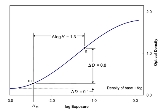
Film speed is found from a plot of optical density vs. log of exposure for the film, known as the D–log H curve or Hurter–Driffield
Sensitometry
Sensitometry is the scientific study of light-sensitive materials, especially photographic film. The study has its origins in the work by Ferdinand Hurter and Vero Charles Driffield with early black-and-white emulsions...

 curve. There typically are five regions in the curve: the base + fog, the toe, the linear region, the shoulder, and the overexposed region. For black-and-white
Black-and-white
Black-and-white, often abbreviated B/W or B&W, is a term referring to a number of monochrome forms in visual arts.Black-and-white as a description is also something of a misnomer, for in addition to black and white, most of these media included varying shades of gray...

 negative film, the “speed point” m is the point on the curve where density exceeds the base + fog density by 0.1 when the negative is developed so that a point n where the log of exposure is 1.3 units greater than the exposure at point m has a density 0.8 greater than the density at point m. The exposure Hm, in lux-s, is that for point m when the specified contrast condition is satisfied. The ISO arithmetic speed is determined from:


This value is then rounded to the nearest standard speed in Table 1 of ISO 6:1993.

Determining speed for color negative film is similar in concept but more complex because it involves separate curves for blue, green, and red. The film is processed according to the film manufacturer’s recommendations rather than to a specified contrast. ISO speed for color reversal film is determined from the middle rather than the threshold of the curve; it again involves separate curves for blue, green, and red, and the film is processed according to the film manufacturer’s recommendations.

Applying film speed


Film speed is used in the exposure equations to find the appropriate exposure parameters. Four variables are available to the photographer to obtain the desired effect: lighting
Lighting
Lighting or illumination is the deliberate application of light to achieve some practical or aesthetic effect. Lighting includes the use of both artificial light sources such as lamps and light fixtures, as well as natural illumination by capturing daylight...

, film speed, f-number
F-number
In optics, the f-number of an optical system expresses the diameter of the entrance pupil in terms of the focal length of the lens; in simpler terms, the f-number is the focal length divided by the "effective" aperture diameter...

 (aperture size), and shutter speed
Shutter speed
In photography, shutter speed is a common term used to discuss exposure time, the effective length of time a camera's shutter is open....

 (exposure time). The equation may be expressed as ratios, or, by taking the logarithm (base 2) of both sides, by addition, using the APEX system
APEX system
APEX stands for Additive system of Photographic EXposure, whichwas proposed in the 1960 ASA standardfor monochrome film speed, ASA PH2.5-1960,as a means of simplifying exposure computation.-Exposure equation:...

, in which every increment of 1 is a doubling of exposure; this increment is commonly known as a "stop". The effective f-number is proportional to the ratio between the lens focal length
Focal length
The focal length of an optical system is a measure of how strongly the system converges or diverges light. For an optical system in air, it is the distance over which initially collimated rays are brought to a focus...

 and aperture
Aperture
In optics, an aperture is a hole or an opening through which light travels. More specifically, the aperture of an optical system is the opening that determines the cone angle of a bundle of rays that come to a focus in the image plane. The aperture determines how collimated the admitted rays are,...

 diameter, the diameter itself being proportional to the square root of the aperture area. Thus, a lens set to allows twice as much light to strike the focal plane as a lens set to 2. Therefore, each f-number factor of the square root of two (approximately 1.4) is also a stop, so lenses are typically marked in that progression: 1.4, 2, 2.8, 4, 5.6, 8, 11, 16, 22, 32, etc.

The ISO arithmetic speed has a useful property for photographers without the equipment for taking a metered light reading. Correct exposure will usually be achieved for a frontlighted scene in bright sun if the aperture of the lens is set to f/16 and the shutter speed is the reciprocal of the ISO film speed (e.g. 1/100 second for 100 ISO film). This known as the sunny 16 rule
Sunny 16 rule
In photography, the Sunny 16 rule is a method of estimating correct daylight exposures without a light meter. Apart from the obvious advantage of independence from a light meter, the Sunny 16 rule can also aid in achieving correct exposure of difficult subjects...

.

Exposure index


Exposure index, or EI, refers to speed rating assigned to a particular film and shooting situation in variance to the film's actual speed. It is used to compensate for equipment calibration inaccuracies or process variables, or to achieve certain effects. The exposure index may simply be called the speed setting, as compared to the speed rating.

For example, a photographer may rate an ISO 400 film at EI 800 and then use push processing
Push processing
Push processing in photography, sometimes called uprating, refers to a film developing technique that increases the effective sensitivity of the film being processed. Push processing involves developing the film for more time, possibly in combination with a higher temperature, than the...

 to obtain printable negatives in low-light conditions. The film has been exposed at EI 800.

Another example occurs where a camera's shutter
Shutter (photography)
In photography, a shutter is a device that allows light to pass for a determined period of time, for the purpose of exposing photographic film or a light-sensitive electronic sensor to light to capture a permanent image of a scene...

 is miscalibrated and consistently overexposes or underexposes the film; similarly, a light meter
Light meter
A light meter is a device used to measure the amount of light. In photography, a light meter is often used to determine the proper exposure for a photograph...

 may be inaccurate. One may adjust the EI rating accordingly in order to compensate for these defects and consistently produce correctly exposed negatives.

Reciprocity


Upon exposure, the amount of light energy that reaches the film determines the effect upon the emulsion. If the brightness of the light is multiplied by a factor and the exposure of the film decreased by the same factor by varying the camera's shutter speed
Shutter speed
In photography, shutter speed is a common term used to discuss exposure time, the effective length of time a camera's shutter is open....

 and aperture
Aperture
In optics, an aperture is a hole or an opening through which light travels. More specifically, the aperture of an optical system is the opening that determines the cone angle of a bundle of rays that come to a focus in the image plane. The aperture determines how collimated the admitted rays are,...

, so that the energy received is the same, the film will be developed to the same density. This rule is called reciprocity
Reciprocity (photography)
In photography reciprocity refers to the inverse relationship between the intensity and duration of light that determines the reaction of light-sensitive material. Within a normal exposure range for film stock, for example, the reciprocity law states that the film response will be determined by the...

. The systems for determining the sensitivity for an emulsion are possible because reciprocity holds. In practice, reciprocity works reasonably well for normal photographic films for the range of exposures between 1/1000 second to 1/2 second. However, this relationship breaks down outside these limits, a phenomenon known as reciprocity failure.

Film sensitivity and grain


The size of silver halide
Silver halide
A silver halide is one of the compounds formed between silver and one of the halogens — silver bromide , chloride , iodide , and three forms of silver fluorides. As a group, they are often referred to as the silver halides, and are often given the pseudo-chemical notation AgX...

 grains in the emulsion
Emulsion
An emulsion is a mixture of two or more liquids that are normally immiscible . Emulsions are part of a more general class of two-phase systems of matter called colloids. Although the terms colloid and emulsion are sometimes used interchangeably, emulsion is used when both the dispersed and the...

 affect film sensitivity; which is related to granularity
Film grain
Film grain or granularity is the random optical texture of processed photographic film due to the presence of small particles of a metallic silver, or dye clouds, developed from silver halide that have received enough photons. While film grain is a function of such particles it is not the same...

 because larger grains give film greater sensitivity to light. Fine-grain film, such as film designed for portraiture or copying original camera negative
Original camera negative
The original camera negative is the film in a motion picture camera which captures the original image. This is the film from which all other copies will be made. It is known as raw stock prior to exposure....

s, is relatively insensitive, or "slow", because it requires brighter light or a longer exposure than a "fast" film. Fast films, used for photographing in low light or capturing high-speed motion, produce comparatively grainy images.

Kodak
Eastman Kodak
Eastman Kodak Company is a multinational imaging and photographic equipment, materials and services company headquarted in Rochester, New York, United States. It was founded by George Eastman in 1892....

 has defined a "Print Grain Index" (PGI) to characterize film grain (color negative films only), based on perceptual just-noticeable difference of graininess in prints. They also define "granularity", a measurement of grain using an RMS measurement of density fluctuations in uniformly exposed film, measured with a microdensitometer with 48 micrometre aperture. Granularity varies with exposure — underexposed film looks grainier than overexposed film.

Marketing anomalies


Some high-speed black-and-white films, such as Ilford Delta
Ilford Delta
Ilford Delta is a series of photographic films manufactured by Harman Technology Limited. Delta films are tabular-grain black-and-white films....

 3200 and Kodak T-MAX
Kodak T-MAX
Kodak Professional T-MAX Film is a continuous tone, panchromatic, tabular-grain black and white negative film made by Eastman Kodak. It is sold in three speeds: 100, 400 and 3200...

 P3200, are marketed with film speeds in excess of their true ISO speed as determined using the ISO testing method. For example, the Ilford product is actually an ISO 1000 film, according to its data sheet. The manufacturers do not indicate that the 3200 number is an ISO rating on their packaging. Kodak and Fuji also marketed E6 films designed for pushing (hence the "P" prefix), such as Ektachrome P800/1600 and Fujichrome P1600, both with a base speed of ISO 400.

Digital camera ISO speed and exposure index


In digital camera systems
Digital camera
A digital camera is a camera that takes video or still photographs, or both, digitally by recording images via an electronic image sensor. It is the main device used in the field of digital photography...

, an arbitrary relationship between exposure and sensor data values can be achieved by setting the signal gain of the sensor. The relationship between the sensor data values and the lightness of the finished image is also arbitrary, depending on the parameters chosen for the interpretation of the sensor data into an image color space
Color space
A color model is an abstract mathematical model describing the way colors can be represented as tuples of numbers, typically as three or four values or color components...

 such as sRGB.

For digital photo cameras ("digital still cameras"), an exposure index (EI) rating—commonly called ISO setting—is specified by the manufacturer such that the sRGB image files produced by the camera will have a lightness similar to what would be obtained with film of the same EI rating at the same exposure. The usual design is that the camera's parameters for interpreting the sensor data values into sRGB values are fixed, and a number of different EI choices are accommodated by varying the sensor's signal gain in the analog realm, prior to conversion to digital. Some camera designs provide at least some EI choices by adjusting the sensor's signal gain in the digital realm. A few camera designs also provide EI adjustment through a choice of lightness parameters for the interpretation of sensor data values into sRGB; this variation allows different tradeoffs between the range of highlights that can be captured and the amount of noise introduced into the shadow areas of the photo.

Digital cameras have far surpassed film in terms of sensitivity to light, with ISO equivalent speeds of up to 204800, a number that is unfathomable in the realm of conventional film photography. Faster processors, as well as advances in software noise reduction techniques allow this type of processing to be executed the moment the photo is captured, allowing photographers to store images that have a higher level of refinement and would have been prohibitively time consuming to process with earlier generations of digital camera hardware.

The ISO 12232:2006 standard


The ISO standard ISO 12232:2006 gives digital still camera manufacturers a choice of five different techniques for determining the exposure index rating at each sensitivity setting provided by a particular camera model. Three of the techniques in ISO 12232:2006 are carried over from the 1998 version of the standard, while two new techniques allowing for measurement of JPEG output files are introduced from CIPA
Camera & Imaging Products Association
, is a Japan-based organization set up in July 2002 to deal with technologies related to photography. Its members are engaged with the production of film-based and digital cameras, and other related equipment....

 DC-004. Depending on the technique selected, the exposure index rating can depend on the sensor sensitivity, the sensor noise, and the appearance of the resulting image. The standard specifies the measurement of light sensitivity of the entire digital camera system and not of individual components such as digital sensors, although Kodak has reported using a variation to characterize the sensitivity of two of their sensors in 2001.

The Recommended Exposure Index (REI) technique, new in the 2006 version of the standard, allows the manufacturer to specify a camera model’s EI choices arbitrarily. The choices are based solely on the manufacturer’s opinion of what EI values produce well-exposed sRGB images at the various sensor sensitivity settings. This is the only technique available under the standard for output formats that are not in the sRGB color space. This is also the only technique available under the standard when multi-zone metering (also called pattern metering) is used.

The Standard Output Sensitivity (SOS) technique, also new in the 2006 version of the standard, effectively specifies that the average level in the sRGB image must be 18% gray plus or minus 1/3 stop when the exposure is controlled by an automatic exposure control system calibrated per ISO 2721
Light meter
A light meter is a device used to measure the amount of light. In photography, a light meter is often used to determine the proper exposure for a photograph...

 and set to the EI with no exposure compensation
Exposure compensation
Exposure compensation is a technique for adjusting the exposure indicated by a photographic exposure meter, in consideration of factors that may cause the indicated exposure to result in a less-than-optimal image. Factors considered may include unusual lighting distribution, variations within a...

. Because the output level is measured in the sRGB output from the camera, it is only applicable to sRGB JPEG
JPEG
In computing, JPEG . The degree of compression can be adjusted, allowing a selectable tradeoff between storage size and image quality. JPEG typically achieves 10:1 compression with little perceptible loss in image quality....

—and not to output files in raw image format
RAW image format
A camera raw image file contains minimally processed data from the image sensor of either a digital camera, image scanner, or motion picture film scanner. Raw files are so named because they are not yet processed and therefore are not ready to be printed or edited with a bitmap graphics editor...

. It is not applicable when multi-zone metering is used.

The CIPA DC-004 standard requires that Japanese manufacturers of digital still cameras use either the REI or SOS techniques, and DC-008 updates the Exif
Exchangeable image file format
Exchangeable image file format is a standard that specifies the formats for images, sound, and ancillary tags used by digital cameras , scanners and other systems handling image and sound files recorded by digital cameras...

 specification to differentiate between these values. Consequently, the three EI techniques carried over from ISO 12232:1998 are not widely used in recent camera models (approximately 2007 and later). As those earlier techniques did not allow for measurement from images produced with lossy compression, they cannot be used at all on cameras that produce images only in JPEG format.

The saturation-based technique is closely related to the SOS technique, with the sRGB output level being measured at 100% white rather than 18% gray. The saturation-based value is effectively 0.704 times the SOS value. Because the output level is measured in the sRGB output from the camera, it is only applicable to sRGB images—typically TIFF
Tagged Image File Format
TIFF is a file format for storing images, popular among graphic artists, the publishing industry, and both amateur and professional photographers in general. As of 2009, it is under the control of Adobe Systems...

—and not to output files in raw image format. It is not applicable when multi-zone metering is used.

The two noise-based techniques have rarely been used for consumer digital still cameras. These techniques specify the highest EI that can be used while still providing either an “excellent” picture or a “usable” picture depending on the technique chosen.

Measurements and calculations


ISO speed ratings of a digital camera are based on the properties of the sensor and the image processing done in the camera, and are expressed in terms of the luminous exposure H (in lux
Lux
The lux is the SI unit of illuminance and luminous emittance, measuring luminous flux per unit area. It is used in photometry as a measure of the intensity, as perceived by the human eye, of light that hits or passes through a surface...

 second
Second
The second is a unit of measurement of time, and is the International System of Units base unit of time. It may be measured using a clock....

s) arriving at the sensor. For a typical camera lens with an effective focal length
Focal length
The focal length of an optical system is a measure of how strongly the system converges or diverges light. For an optical system in air, it is the distance over which initially collimated rays are brought to a focus...

 f that is much smaller than the distance between the camera and the photographed scene, H is given by
where L is the luminance
Luminance
Luminance is a photometric measure of the luminous intensity per unit area of light travelling in a given direction. It describes the amount of light that passes through or is emitted from a particular area, and falls within a given solid angle. The SI unit for luminance is candela per square...

 of the scene (in candela
Candela
The candela is the SI base unit of luminous intensity; that is, power emitted by a light source in a particular direction, weighted by the luminosity function . A common candle emits light with a luminous intensity of roughly one candela...

 per m
Metre
The metre , symbol m, is the base unit of length in the International System of Units . Originally intended to be one ten-millionth of the distance from the Earth's equator to the North Pole , its definition has been periodically refined to reflect growing knowledge of metrology...

²), t is the exposure time (in seconds), N is the aperture f-number, and
is a factor depending on the transmittance
Transmittance
In optics and spectroscopy, transmittance is the fraction of incident light at a specified wavelength that passes through a sample. A related term is absorptance, or absorption factor, which is the fraction of radiation absorbed by a sample at a specified wavelength...

 T of the lens, the vignetting
Vignetting
In photography and optics, vignetting  is a reduction of an image's brightness or saturation at the periphery compared to the image center. The word vignette, from the same root as vine, originally referred to a decorative border in a book. Later, the word came to be used for a photographic...

 factor v(θ), and the angle θ relative to the axis of the lens. A typical value is q = 0.65, based on θ = 10°, T = 0.9, and v = 0.98.

Saturation-based speed


The saturation-based speed is defined as
where is the maximum possible exposure that does not lead to a clipped or bloomed camera output. Typically, the lower limit of the saturation speed is determined by the sensor itself, but with the gain
Gain
In electronics, gain is a measure of the ability of a circuit to increase the power or amplitude of a signal from the input to the output. It is usually defined as the mean ratio of the signal output of a system to the signal input of the same system. It may also be defined on a logarithmic scale,...

 of the amplifier between the sensor and the analog-to-digital converter
Analog-to-digital converter
An analog-to-digital converter is a device that converts a continuous quantity to a discrete time digital representation. An ADC may also provide an isolated measurement...

, the saturation speed can be increased. The factor 78 is chosen such that exposure settings based on a standard light meter
Light meter
A light meter is a device used to measure the amount of light. In photography, a light meter is often used to determine the proper exposure for a photograph...

 and an 18-percent reflective surface will result in an image with a grey level of 18%/√2 = 12.7% of saturation. The factor √2 indicates that there is half a stop of headroom to deal with specular reflection
Specular reflection
Specular reflection is the mirror-like reflection of light from a surface, in which light from a single incoming direction is reflected into a single outgoing direction...

s that would appear brighter than a 100% reflecting white surface.

Noise-based speed


The noise-based speed is defined as the exposure that will lead to a given signal-to-noise ratio
Signal-to-noise ratio
Signal-to-noise ratio is a measure used in science and engineering that compares the level of a desired signal to the level of background noise. It is defined as the ratio of signal power to the noise power. A ratio higher than 1:1 indicates more signal than noise...

 on individual pixel
Pixel
In digital imaging, a pixel, or pel, is a single point in a raster image, or the smallest addressable screen element in a display device; it is the smallest unit of picture that can be represented or controlled....

s. Two ratios are used, the 40:1 ("excellent image quality") and the 10:1 ("acceptable image quality") ratio. These ratios have been subjectively determined based on a resolution of 70 pixels per cm (180 DPI) when viewed at 25 cm (10 inch) distance. The signal-to-noise ratio is defined as the standard deviation
Standard deviation
Standard deviation is a widely used measure of variability or diversity used in statistics and probability theory. It shows how much variation or "dispersion" there is from the average...

 of a weighted average of the luminance
Luminance
Luminance is a photometric measure of the luminous intensity per unit area of light travelling in a given direction. It describes the amount of light that passes through or is emitted from a particular area, and falls within a given solid angle. The SI unit for luminance is candela per square...

 (overall brightness) and color of individual pixels. The noise-based speed is mostly determined by the properties of the sensor and somewhat affected by the noise in the electronic gain and AD converter.

Standard output sensitivity (SOS)


In addition to the above speed ratings, the standard also defines the standard output sensitivity (SOS), how the exposure is related to the digital pixel values in the output image. It is defined as
where is the exposure that will lead to values of 118 in 8-bit pixels, which is 18 percent of the saturation value in images encoded as sRGB or with gamma
Gamma correction
Gamma correction, gamma nonlinearity, gamma encoding, or often simply gamma, is the name of a nonlinear operation used to code and decode luminance or tristimulus values in video or still image systems...

 = 2.2.

Discussion


The standard specifies how speed ratings should be reported by the camera. If the noise-based speed (40:1) is higher than the saturation-based speed, the noise-based speed should be reported, rounded downwards to a standard value (e.g. 200, 250, 320, or 400). The rationale is that exposure according to the lower saturation-based speed would not result in a visibly better image. In addition, an exposure latitude can be specified, ranging from the saturation-based speed to the 10:1 noise-based speed. If the noise-based speed (40:1) is lower than the saturation-based speed, or undefined because of high noise, the saturation-based speed is specified, rounded upwards to a standard value, because using the noise-based speed would lead to overexposed images. The camera may also report the SOS-based speed (explicitly as being an SOS speed), rounded to the nearest standard speed rating.

For example, a camera sensor may have the following properties: , , and . According to the standard, the camera should report its sensitivity as
ISO 100 (daylight)
ISO speed latitude 50–1600
ISO 100 (SOS, daylight).

The SOS rating could be user controlled. For a different camera with a noisier sensor, the properties might be , , and . In this case, the camera should report
ISO 200 (daylight),

as well as a user-adjustable SOS value. In all cases, the camera should indicate for the white balance setting for which the speed rating applies, such as daylight or tungsten (incandescent light).

Despite these detailed standard definitions, cameras typically do not clearly indicate whether the user "ISO" setting refers to the noise-based speed, saturation-based speed, or the specified output sensitivity, or even some made-up number for marketing purposes. Because the 1998 version of ISO 12232 did not permit measurement of camera output that had lossy compression, it was not possible to correctly apply any of those measurements to cameras that did not produce sRGB files in an uncompressed format such as TIFF
Tagged Image File Format
TIFF is a file format for storing images, popular among graphic artists, the publishing industry, and both amateur and professional photographers in general. As of 2009, it is under the control of Adobe Systems...

. Following the publication of CIPA DC-004 in 2006, Japanese manufacturers of digital still cameras are required to specify whether a sensitivity rating is REI or SOS.

As should be clear from the above, a greater SOS setting for a given sensor comes with some loss of image quality, just like with analog film. However, this loss is visible as image noise rather than grain
Film grain
Film grain or granularity is the random optical texture of processed photographic film due to the presence of small particles of a metallic silver, or dye clouds, developed from silver halide that have received enough photons. While film grain is a function of such particles it is not the same...

. Current (January 2010) APS and 35mm sized digital image sensors, both CMOS and CCD based, do not produce significant noise until about ISO 1600.

External links