


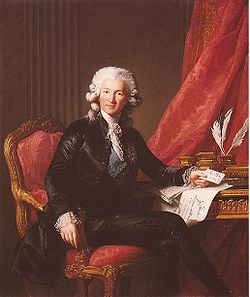
Charles Alexandre de Calonne

Encyclopedia
Viscount
A viscount or viscountess is a member of the European nobility whose comital title ranks usually, as in the British peerage, above a baron, below an earl or a count .-Etymology:...
de Calonne (20 January 1734, Douai
Douai
-Main sights:Douai's ornate Gothic style belfry was begun in 1380, on the site of an earlier tower. The 80 m high structure includes an impressive carillon, consisting of 62 bells spanning 5 octaves. The originals, some dating from 1391 were removed in 1917 during World War I by the occupying...
– 30 October 1802) was a French
France
The French Republic , The French Republic , The French Republic , (commonly known as France , is a unitary semi-presidential republic in Western Europe with several overseas territories and islands located on other continents and in the Indian, Pacific, and Atlantic oceans. Metropolitan France...
statesman, best known for his involvement in the French Revolution
French Revolution
The French Revolution , sometimes distinguished as the 'Great French Revolution' , was a period of radical social and political upheaval in France and Europe. The absolute monarchy that had ruled France for centuries collapsed in three years...
.
Rise to prominence
Born at DouaiDouai
-Main sights:Douai's ornate Gothic style belfry was begun in 1380, on the site of an earlier tower. The 80 m high structure includes an impressive carillon, consisting of 62 bells spanning 5 octaves. The originals, some dating from 1391 were removed in 1917 during World War I by the occupying...
of an upper-class family, he entered the legal profession and became successively lawyer
Lawyer
A lawyer, according to Black's Law Dictionary, is "a person learned in the law; as an attorney, counsel or solicitor; a person who is practicing law." Law is the system of rules of conduct established by the sovereign government of a society to correct wrongs, maintain the stability of political...
to the general council of Artois
Artois
Artois is a former province of northern France. Its territory has an area of around 4000 km² and a population of about one million. Its principal cities are Arras , Saint-Omer, Lens and Béthune.-Location:...
, procureur to the parlement
Parlement
Parlements were regional legislative bodies in Ancien Régime France.The political institutions of the Parlement in Ancien Régime France developed out of the previous council of the king, the Conseil du roi or curia regis, and consequently had ancient and customary rights of consultation and...
of Douai, maître des requêtes
Maître des requêtes
Masters of Requests are high-level judicial officers of administrative law in France and other European countries that have existed in one form or another since the Middle Ages.-Old Regime France:...
, intendant
Intendant
The title of intendant has been used in several countries through history. Traditionally, it refers to the holder of a public administrative office...
of Metz
Metz
Metz is a city in the northeast of France located at the confluence of the Moselle and the Seille rivers.Metz is the capital of the Lorraine region and prefecture of the Moselle department. Located near the tripoint along the junction of France, Germany, and Luxembourg, Metz forms a central place...
(1768) and of Lille
Lille
Lille is a city in northern France . It is the principal city of the Lille Métropole, the fourth-largest metropolitan area in the country behind those of Paris, Lyon and Marseille. Lille is situated on the Deûle River, near France's border with Belgium...
(1774). He seems to have been a man with notable business abilities and an entrepreneurial spirit, while generally unscrupulous in his political actions. In the terrible crisis preceding the French Revolution
French Revolution
The French Revolution , sometimes distinguished as the 'Great French Revolution' , was a period of radical social and political upheaval in France and Europe. The absolute monarchy that had ruled France for centuries collapsed in three years...
, when successive ministers tried in vain to replenish the exhausted royal treasury
Treasury
A treasury is either*A government department related to finance and taxation.*A place where currency or precious items is/are kept....
, Calonne was summoned as Controller-General of Finances, an office he assumed on 3 November 1783.
He owed the position to the Comte de Vergennes
Charles Gravier, comte de Vergennes
Charles Gravier, comte de Vergennes was a French statesman and diplomat. He served as Foreign Minister from 1774 during the reign of Louis XVI, notably during the American War of Independence....
, who for over three years continued to support him. According to the Habsburg
Habsburg Monarchy
The Habsburg Monarchy covered the territories ruled by the junior Austrian branch of the House of Habsburg , and then by the successor House of Habsburg-Lorraine , between 1526 and 1867/1918. The Imperial capital was Vienna, except from 1583 to 1611, when it was moved to Prague...
ambassador, his public image was extremely poor. Calonne immediately set about remedying the fiscal crisis, and he found in Louis XVI enough support to create a vast and ambitious plan of revenue-raising and administrative centralization. He presented the king with his plan on 20 August 1786. At its heart was a new land tax, which would replace the old vingtieme taxes and finally sweep away the fiscal exemptions of the privileged orders. The new tax would be administered by a system of provincial assemblies elected by the local property owners at parish, district and provincial level. This central proposal was accompanied by a further package of rationalizing reform, including free trade in grain and abolition of France's myriad internal customs barriers. It was in effect one, if not the most, comprehensive attempt at enlightened reform during the reign of Louis XVI.
Measures
In taking office he found debts of 113 million livres, debts caused by France's involvement in the American Revolution among other reasons, and no means of paying them. At first he attempted to obtain credit, and to support the government by means of loans so as to maintain public confidence in its solvencySolvency
Solvency, in finance or business, is the degree to which the current assets of an individual or entity exceed the current liabilities of that individual or entity. Solvency can also be described as the ability of a corporation to meet its long-term fixed expenses and to accomplish long-term...
. In October 1785 he recoined the gold coin
Gold coin
A gold coin is a coin made mostly or entirely of gold. Gold has been used for coins practically since the invention of coinage, originally because of gold's intrinsic value...
age, and he developed the caisse d'escompte (dealing in cash discounts
Discounts and allowances
Discounts and allowances are reductions to a basic price of goods or services.They can occur anywhere in the distribution channel, modifying either the manufacturer's list price , the retail price , or the list price Discounts and allowances are reductions to a basic price of goods or services.They...
). Calonne's eventual reform package, which was introduced to the Assembly of Notables, consisted of 5 major points:
1) Cut Government Spending
2) Create a revival of free trade methods
3) Authorize the sale of Church property
4) Equalization of salt and tobacco taxes
5) Establish a universal land tax
All these measures failed because of the powerlessness of the crown to impose them. As a last resort, he proposed to the king the suppression of internal customs duties
Duty (economics)
In economics, a duty is a kind of tax, often associated with customs, a payment due to the revenue of a state, levied by force of law. It is a tax on certain items purchased abroad...
, and argued in favor of the taxation of the property
Property tax
A property tax is an ad valorem levy on the value of property that the owner is required to pay. The tax is levied by the governing authority of the jurisdiction in which the property is located; it may be paid to a national government, a federated state or a municipality...
of nobles and clergy
Estates of the realm
The Estates of the realm were the broad social orders of the hierarchically conceived society, recognized in the Middle Ages and Early Modern period in Christian Europe; they are sometimes distinguished as the three estates: the clergy, the nobility, and commoners, and are often referred to by...
. Anne Robert Jacques Turgot
Anne Robert Jacques Turgot, Baron de Laune
Anne-Robert-Jacques Turgot, Baron de Laune , often referred to as Turgot, was a French economist and statesman. Turgot was a student of Francois Quesnay and as such belonged to the Physiocratic school of economic thought...
and Jacques Necker
Jacques Necker
Jacques Necker was a French statesman of Swiss birth and finance minister of Louis XVI, a post he held in the lead-up to the French Revolution in 1789.-Early life:...
had attempted these reforms, and Calonne attributed their failure to the opposition of the parlements. Therefore, he called an Assemblée des notables
Assembly of Notables
The Assembly of Notables was a group of notables invited by the King of France to consult on matters of state.-History:Assemblies of Notables had met in 1583, 1596–97, 1617, 1626, 1787, and 1788. Like the Estates General, they served a consultative purpose only...
in January 1787, to which he presented the deficit in the treasury, and proposed the establishment of a subvention territoriale, which would be levied on all property without distinction.
Deposition and exile
This suppression of privileges was badly received. Calonne's spendthrift and authoritarian reputation was well-known to the parlements, earning him their enmity. Knowing this, he intentionally submitted his reform programme directly to the king and the hand-picked assembly of notables, not to the sovereign courts or parlements, first. Composed of the old regime's social and political elite, however, the assembly of notables balked at the deficit presented to them when they met at Versailles in February of 1787, and despite Calonne's plan for reform and his backing from the king, they suspected that the controller-general was in some way responsible for the enormous financial strains. Calonne, angered, printed his reports and so alienated the court. Louis XVI dismissed him on 8 April 1787 and exiled him to LorraineLorraine (province)
The Duchy of Upper Lorraine was an historical duchy roughly corresponding with the present-day northeastern Lorraine region of France, including parts of modern Luxembourg and Germany. The main cities were Metz, Verdun, and the historic capital Nancy....
. The joy was general in Paris, where Calonne, accused of wishing to raise taxes, was known as Monsieur Déficit. Calonne soon afterwards left for Great Britain
Kingdom of Great Britain
The former Kingdom of Great Britain, sometimes described as the 'United Kingdom of Great Britain', That the Two Kingdoms of Scotland and England, shall upon the 1st May next ensuing the date hereof, and forever after, be United into One Kingdom by the Name of GREAT BRITAIN. was a sovereign...
, and during his residence there kept up a polemical correspondence with Necker.
In 1789, when the Estates-General
Estates-General of 1789
The Estates-General of 1789 was the first meeting since 1614 of the French Estates-General, a general assembly representing the French estates of the realm: the nobility, the Church, and the common people...
were about to assemble, he crossed to Flanders in the hope of offering himself for election, but he was forbidden to enter France. In revenge he joined the émigré
Émigré
Émigré is a French term that literally refers to a person who has "migrated out", but often carries a connotation of politico-social self-exile....
group at Coblenz, wrote in their favour, and spent nearly all the fortune brought him by his wife, a wealthy widow. He was present with the Count of Artois
Charles X of France
Charles X was known for most of his life as the Comte d'Artois before he reigned as King of France and of Navarre from 16 September 1824 until 2 August 1830. A younger brother to Kings Louis XVI and Louis XVIII, he supported the latter in exile and eventually succeeded him...
, the reactionary brother of Louis XVI, at Pillnitz
Pillnitz
Pillnitz is a city quarter in the east of Dresden, Germany. The quarter is situated in the east of Dresden. It can be reached by bus, ship, walking along the river or by bicycle...
in August of 1791 at the time of the issuance of the Declaration of Pillnitz
Declaration of Pillnitz
The Declaration of Pillnitz was a statement issued on 27 August 1791 at Pillnitz Castle near Dresden by the Habsburg Holy Roman Emperor Leopold II and Frederick William II of Prussia...
, an attempt to intimidate the revolutionary government of France that the Count of Artois pressed for. In 1802, having again settled in London, he received permission from Napoleon Bonaparte
Napoleon I of France
Napoleon Bonaparte was a French military and political leader during the latter stages of the French Revolution.As Napoleon I, he was Emperor of the French from 1804 to 1815...
to return to France. He died about a month after his arrival in his native country.
Calonne's negative reputation and assumed responsibility for France's financial crisis in the years leading to the Revolution of 1789 have been judged unfair by historians such as Munro Price. During his position as controller-general, he had genuinely tried to make amends for his previous spendthrift policies. As a contemporary writer, Chamfort, remarked, Calonne was "applauded when he lit the fire, and condemned when he sounded the alarm." His fall had important significance to the fate of the monarchy in France before 1789. The financial strains made apparent through Calonne's attempts at reform revealed the instability of the monarchy as a whole, which up until then had been managed on the basis of traditional monarchical absolutism: secretly, hierarchically, without public scrutiny of accounts or consent to taxation. For centuries, the monarchy had controlled fiscal policy on its own terms, and when knowledge of an unmanageable and growing deficit became more widely-known, the image was of a failed and, in many ways, corrupt institution. Louis XVI, who had backed Calonne's reform programme wholehearthedly, saw its refusal by the notables and the parlement as a personal failure. Conscientious in his attempts to alleviate the suffering of the French people, it is clear that the king genuinely hoped to implement an enlightened policy with the help of Calonne. Crushed by this opposition to Calonne's project, the king withdrew to long hours of hunting and larger meals. Many historians see the ensuing months as the beginning of the king's bouts of depression.