

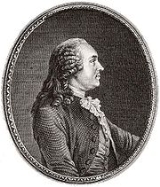
Anne Robert Jacques Turgot, Baron de Laune

Encyclopedia
Anne-Robert-Jacques Turgot, Baron de Laune (10 May 1727 – 18 March 1781), often referred to as Turgot, was a French
economist
and statesman
. Turgot was a student of Francois Quesnay
and as such belonged to the Physiocratic school of economic thought. Today he is best remembered as an early advocate for economic liberalism
.
, he was the youngest son of Michel-Étienne Turgot
, "Provost
of the merchants" of Paris, and Madeleine Francoise Martineau de Brétignolles, and came of an old Norman
family. He was educated for the Church, and at the Sorbonne
, to which he was admitted in 1749 (being then styled abbé de Brucourt). He delivered two remarkable Latin
dissertations, On the Benefits which the Christian Religion has conferred on Mankind, and On the Historical Progress of the Human Mind. The first sign we have of his interest in economics
is a letter (1749) on paper money
, written to his fellow student the abbé de Cicé, refuting the abbé Jean Terrasson
's defence of John Law
's system. He was fond of verse-making, and tried to introduce into French
verse the rules of Latin prosody, his translation of the fourth book of the Aeneid
into classical hexameter
verses being greeted by Voltaire
as the only prose translation in which he had found any enthusiasm.
He decided not to take holy orders, giving as his reason, according to Dupont de Nemours
, "that he could not bear to wear a mask all his life."
is that of Turgot, in his "A Philosophical Review of the Successive Advances of the Human Mind" (1750). For Turgot progress covers not simply the arts and sciences but, on their base, the whole of culture—manner, mores, institutions, legal codes, economy, and society.
. In 1754 he was a member of the chambre royale which sat during an exile of the parlement. In Paris he frequented the salons, especially those of Mme de Graffigny—whose niece, Mlle de Ligniville ("Minette"), later Mme Helvétius
, he is supposed at one time to have wished to marry; they remained lifelong friends—Mme Geoffrin
, Mme du Deffand
, Mlle de Lespinasse
and the duchesse d'Enville. It was during this period that he met the leaders of the "physiocratic" school, Quesnay
and Vincent de Gournay, and with them Dupont de Nemours, the abbé Morellet
and other economists.
In 1743 and 1756 he accompanied Gournay, the intendant
of commerce, during Gournay's tours of inspection in the provinces. (Gournay's bye-word on the government's proper involvement in the economy — "laisser faire, laisser passer" — would pass into the vocabulary of economics.) In 1760, while travelling in the east of France and Switzerland, he visited Voltaire
, who became one of his chief friends and supporters. All this time he was studying various branches of science, and languages both ancient and modern. In 1753 he translated the Questions sur le commerce from the English of Josias Tucker, and in 1754 he wrote his Lettre sur la tolérance civile, and a pamphlet, Le Conciliateur, in support of religious tolerance. Between 1755 and 1756 he composed various articles for the Encyclopédie
, and between 1757 and 1760 an article on Valeurs des monnaies, probably for the Dictionnaire du commerce of the abbé Morellet. In 1759 appeared his work Eloge de Gournay.
, which included some of the poorest and most over-taxed parts of France; here he remained for thirteen years. He was already deeply imbued with the theories of Quesnay and Gournay, and set to work to apply them as far as possible in his province. His first plan was to continue the work, already initiated by his predecessor Tourny, of making a fresh survey of the land (cadastre
), in order to arrive at a more just assessment of the taille
; he also obtained a large reduction in the contribution of the province. He published his Avis sur l'assiette et la repartition de la taille (1762–1770), and as president of the Société d'agriculture de Limoges offered prizes for essays on the principles of taxation. Quesnay and Mirabeau had advocated a proportional tax
(impôt de quotité), but Turgot proposed a distributive tax
(impôt de repartition). Another reform was the substitution for the corvée
of a tax in money levied on the whole province, the construction of roads being handed over to contractors, by which means Turgot was able to leave his province with a good system of highways, while distributing more justly the expense of their construction.
In 1769 he wrote his Mémoire sur les prêts à intérêt, on the occasion of a scandalous financial crisis at Angoulême
, the particular interest of which is that in it the question of lending money
at interest
was for the first time treated scientifically, and not merely from the ecclesiastical point of view. Turgot's opinion was that a compromise had to be reached between both methods. Among other works written during Turgot's intendancy were the Mémoire sur les mines et carrières, and the Mémoire sur la marque des fers, in which he protested against state regulation and interference and advocated free competition. At the same time he did much to encourage agriculture and local industries, among others establishing the manufacture of porcelain at Limoges
. During the famine of 1770–1771 he enforced on landowners "the obligation of relieving the poor" and especially the métayers
dependent upon them, and organized in every province ateliers and bureaux de charité for providing work for the able-bodied and relief for the infirm, while at the same time he condemned indiscriminate charity
. It may be noted that Turgot always made the curés
the agents of his charities and reforms when possible. It was in 1770 that he wrote his famous Lettres sur la liberté du commerce des grains, addressed to the controller-general, the abbé Terray
. Three of these letters have disappeared, having been sent to Louis XVI
by Turgot at a later date and never recovered, but those remaining demonstrate that free trade
in grain is to the interest of landowner, farmer and consumer alike, and in forcible terms demand the removal of all restrictions.
In the Réflexions, after tracing the origin of commerce
, Turgot develops Quesnay's theory that the land
is the only source of wealth
, and divides society into three classes, the productive or agricultural, the salaried (the classe stipendice) or artisan class, and the land-owning class (classe disponible). After discussing the evolution of the different systems of cultivation, the nature of exchange and barter, money, and the functions of capital
, he sets forth the theory of the impôt unique, i.e. that only the net product (produit net) of the land should be taxed. In addition he demanded the complete freedom of commerce and industry.
, the "Mentor" of Louis XVI
, to whom he was warmly recommended by the abbé Very, a mutual friend. His appointment met with general approval, and was hailed with enthusiasm by the philosophes. A month later (24 August) he was appointed controller-general. His first act was to submit to the king a statement of his guiding principles: "No bankruptcy, no increase of taxation, no borrowing." Turgot's policy, in face of the desperate financial position, was to enforce the most rigid economy in all departments. All departmental expenses were to be submitted for the approval of the controller-general, a number of sinecure
s were suppressed, the holders of them being compensated, and the abuse of the acquits au comptant was attacked, while Turgot appealed personally to the king against the lavish giving of places and pensions. He also contemplated a thorough-going reform of the Ferme Générale
, but contented himself, as a beginning, with imposing certain conditions on the leases as they were renewed—such as a more efficient personnel, and the abolition for the future of the abuse of the croupes (the name given to a class of pensions), a reform which Terray had shirked on finding how many persons in high places were interested in them, and annulling certain leases, such as those of the manufacture of gunpowder and the administration of the royal mails, the former of which was handed over to a company with the scientist Lavoisier as one of its advisers, and the latter superseded by a quicker and more comfortable service of diligences which were nicknamed "turgotines"
. He also prepared a regular budget. Turgot's measures succeeded in considerably reducing the deficit, and raised the national credit to such an extent that in 1776, just before his fall, he was able to negotiate a loan with some Dutch
bankers at 4%; but the deficit was still so large as to prevent him from attempting at once to realize his favourite scheme of substituting for indirect taxation a single tax on land
. He suppressed, however, a number of octroi
s and minor duties, and opposed, on grounds of economy, the participation of France in the American Revolutionary War
, though without success.
Turgot at once set to work to establish free trade in grain, but his edict, which was signed on 13 September 1774, met with strong opposition even in the conseil du roi
. A striking feature was the preamble, setting forth the doctrines on which the edict was based, which won the praise of the philosophes and the ridicule of the wits; this Turgot rewrote three times, it is said, in order to make it "so clear that any village judge could explain it to the peasants." The opposition to the edict was strong. Turgot was hated by those who had been interested in the speculations in grain under the regime of the abbé Terray, among whom were included some of the princes of the blood. Moreover, the commerce des blés had been a favourite topic of the salons
for some years past, and the witty Galiani
, the opponent of the physiocrats
, had a large following. The opposition was now continued by Linguet
and by Necker
, who in 1775 published his Essai sur la législation et le commerce des grains. But Turgot's worst enemy was the poor harvest of 1774, which led to a slight rise in the price of bread in the winter and early spring of 1774 - 1775. In April disturbances arose at Dijon
, and early in May there occurred those extraordinary bread-riots known as the guerre des farines, which may be looked upon as a first sample of the French Revolution
, so carefully were they organized. Turgot showed great firmness and decision in repressing the riots, and was loyally supported by the king throughout. His position was strengthened by the entry of Malesherbes
into the ministry (July 1775).
All this time Turgot had been preparing his famous Six Edicts, which were finally presented to the conseil du roi (January 1776). Of the six edicts four were of minor importance, but the two which met with violent opposition were, firstly, the edict suppressing the corvée
s, and secondly, that suppressing the jurandes and maîtrises, by which the craft guild
s maintained their privileges. In the preamble to the former Turgot boldly announced as his object the abolition of privilege, and the subjection of all three Estates of the realm
to taxation; the clergy were afterwards excepted, at the request of Maurepas. In the preamble to the edict on the jurandes he laid down as a principle the right of every man to work without restriction. He obtained the registration of the edicts by the lit de justice
of 12 March, but by that time he had nearly everybody against him. His attacks on privilege had won him the hatred of the nobles and the parlement
s ; his attempted reforms in the royal household, that of the court; his free trade legislation, that of the financiers ; his views on tolerance and his agitation for the suppression of the phrase that was offensive to Protestants
in the king's coronation
oath, that of the clergy; and his edict on the jurandes, that of the rich bourgeoisie of Paris and others, such as the prince de Conti, whose interests were involved. The queen
disliked him for opposing the grant of favours to her proteges, and he had offended Mme. de Polignac in a similar manner.
All might yet have gone well if Turgot could have retained the confidence of the king, but the king could not fail to see that Turgot had not the support of the other ministers. Even his friend Malesherbes thought he was too rash, and was, moreover, himself discouraged and wished to resign. The alienation of Maurepas was also increasing. Whether through jealousy of the ascendancy which Turgot had acquired over the king, or through the natural incompatibility of their characters, he was already inclined to take sides against Turgot, and the reconciliation between him and the queen, which took place about this time, meant that he was henceforth the tool of the Polignac clique
and the Choiseul
party. About this time, too, appeared a pamphlet, Le Songe de M. Maurepas, generally ascribed to the comte de Provence (Louis XVIII
), containing a bitter caricature
of Turgot.
Before relating the circumstances of Turgot's fall we may briefly resume his views on the administrative system. With the physiocrats, he believed in an enlightened political absolutism
, and looked to the king to carry through all reforms. As to the parlements, he opposed all interference on their part in legislation, considering that they had no competency outside the sphere of justice. He recognized the danger of the recap of the old parlement, but was unable effectively to oppose it since he had been associated with the dismissal of Maupeou
and Terray, and seems to have underestimated its power. He was opposed to the summoning of the states-general
advocated by Malesherbes (6 May 1775), possibly on the ground that the two privileged orders would have too much power in them. His own plan is to be found in his Mémoire sur les municipalités, which was submitted informally to the king. In Turgot's proposed system, landed proprietors alone were to form the electorate, no distinction being made among the three orders; the members of the town and country municipalités were to elect representatives for the district municipalités, which in turn would elect to the provincial municipalités, and the latter to a grande municipalité, which should have no legislative powers, but should concern itself entirely with the administration of taxation. With this was to be combined a whole system of education, relief of the poor, etc. Louis XVI recoiled from this as being too great a leap in the dark, and such a fundamental difference of opinion between king and minister was bound to lead to a breach sooner or later. Turgot's only choice, however, was between "tinkering" at the existing system in detail and a complete revolution, and his attack on privilege, which might have been carried through by a popular minister and a strong king, was bound to form part of any effective scheme of reform.
, and shown to the king to prove his incapacity. Others attribute it to the queen, and there is no doubt that she hated Turgot for supporting Vergennes
in demanding the recall of the comte de Guînes, the ambassador in London
, whose cause she had ardently espoused at the prompting of the Choiseul clique. Others attribute it to an intrigue of Maurepas. On the resignation of Malesherbes
(April 1776), whom Turgot wished to replace by the abbé Very, Maurepas proposed to the king as his successor a nonentity named Amelot. Turgot, on hearing of this, wrote an indignant letter to the king, in which he reproached him for refusing to see him, pointed out in strong terms the dangers of a weak ministry and a weak king, and complained bitterly of Maurepas's irresolution and subjection to court intrigues; this letter the king, though asked to treat it as confidential, is said to have shown to Maurepas, whose dislike for Turgot it still further embittered. With all these enemies, Turgot's fall was certain, but he wished to stay in office long enough to finish his project for the reform of the royal household before resigning. To his dismay, he was not allowed to do, and on 12 May was ordered to send in his resignation. He at once retired to La Roche-Guyon
, the château of the duchesse d'Enville, returning shortly to Paris, where he spent the rest of his life in scientific and literary studies, being made vice-president of the Académie des Inscriptions et Belles-Lettres
in 1777.
In character Turgot was simple, honourable and upright, with a passion for justice and truth. He was an idealist, his enemies would say a doctrinaire, and certainly the terms "natural rights," "natural law," frequently occur in his writings. His friends speak of his charm and gaiety in intimate intercourse, but among strangers he was silent and awkward, and produced the impression of being reserved and disdainful. On one point both friends and enemies agree, and that is his brusquerie and his lack of tact in the management of men; August Oncken points out with some reason the schoolmasterish tone of his letters, even to the king. As a statesman he has been very variously estimated, but it is generally agreed that a large number of the reforms and ideas of the Revolution were due to him; the ideas did not as a rule originate with him, but it was he who first gave them prominence. As to his position as an economist, opinion is also divided. Oncken, to take the extreme of condemnation, looks upon him as a bad physiocrat and a confused thinker, while Leon Say
considers that he was the founder of modern political economy, and that "though he failed in the 18th century he triumphed in the 19th."
France
The French Republic , The French Republic , The French Republic , (commonly known as France , is a unitary semi-presidential republic in Western Europe with several overseas territories and islands located on other continents and in the Indian, Pacific, and Atlantic oceans. Metropolitan France...
economist
Economist
An economist is a professional in the social science discipline of economics. The individual may also study, develop, and apply theories and concepts from economics and write about economic policy...
and statesman
Statesman
A statesman is usually a politician or other notable public figure who has had a long and respected career in politics or government at the national and international level. As a term of respect, it is usually left to supporters or commentators to use the term...
. Turgot was a student of Francois Quesnay
François Quesnay
François Quesnay was a French economist of the Physiocratic school. He is known for publishing the "Tableau économique" in 1758, which provided the foundations of the ideas of the Physiocrats...
and as such belonged to the Physiocratic school of economic thought. Today he is best remembered as an early advocate for economic liberalism
Economic liberalism
Economic liberalism is the ideological belief in giving all people economic freedom, and as such granting people with more basis to control their own lives and make their own mistakes. It is an economic philosophy that supports and promotes individual liberty and choice in economic matters and...
.
Education
Born in ParisParis
Paris is the capital and largest city in France, situated on the river Seine, in northern France, at the heart of the Île-de-France region...
, he was the youngest son of Michel-Étienne Turgot
Michel-Étienne Turgot
Michel-Étienne Turgot was prévôt des marchands de Paris from 1729 to 1740...
, "Provost
Provost (civil)
A provost is the ceremonial head of many Scottish local authorities, and under the name prévôt was a governmental position of varying importance in Ancien Regime France.-History:...
of the merchants" of Paris, and Madeleine Francoise Martineau de Brétignolles, and came of an old Norman
Normandy
Normandy is a geographical region corresponding to the former Duchy of Normandy. It is in France.The continental territory covers 30,627 km² and forms the preponderant part of Normandy and roughly 5% of the territory of France. It is divided for administrative purposes into two régions:...
family. He was educated for the Church, and at the Sorbonne
Collège de Sorbonne
The Collège de Sorbonne was a theological college of the University of Paris, founded in 1257 by Robert de Sorbon, after whom it is named. With the rest of the Paris colleges, it was suppressed during the French Revolution. It was restored in 1808 but finally closed in 1882. The name Sorbonne...
, to which he was admitted in 1749 (being then styled abbé de Brucourt). He delivered two remarkable Latin
Latin
Latin is an Italic language originally spoken in Latium and Ancient Rome. It, along with most European languages, is a descendant of the ancient Proto-Indo-European language. Although it is considered a dead language, a number of scholars and members of the Christian clergy speak it fluently, and...
dissertations, On the Benefits which the Christian Religion has conferred on Mankind, and On the Historical Progress of the Human Mind. The first sign we have of his interest in economics
Economics
Economics is the social science that analyzes the production, distribution, and consumption of goods and services. The term economics comes from the Ancient Greek from + , hence "rules of the house"...
is a letter (1749) on paper money
Banknote
A banknote is a kind of negotiable instrument, a promissory note made by a bank payable to the bearer on demand, used as money, and in many jurisdictions is legal tender. In addition to coins, banknotes make up the cash or bearer forms of all modern fiat money...
, written to his fellow student the abbé de Cicé, refuting the abbé Jean Terrasson
Jean Terrasson
Jean Terrasson , often referred to as the Abbe Terrasson, was a French priest, author, and most notably a member of the Académie française....
's defence of John Law
John Law (economist)
John Law was a Scottish economist who believed that money was only a means of exchange that did not constitute wealth in itself and that national wealth depended on trade...
's system. He was fond of verse-making, and tried to introduce into French
French language
French is a Romance language spoken as a first language in France, the Romandy region in Switzerland, Wallonia and Brussels in Belgium, Monaco, the regions of Quebec and Acadia in Canada, and by various communities elsewhere. Second-language speakers of French are distributed throughout many parts...
verse the rules of Latin prosody, his translation of the fourth book of the Aeneid
Aeneid
The Aeneid is a Latin epic poem, written by Virgil between 29 and 19 BC, that tells the legendary story of Aeneas, a Trojan who travelled to Italy, where he became the ancestor of the Romans. It is composed of roughly 10,000 lines in dactylic hexameter...
into classical hexameter
Hexameter
Hexameter is a metrical line of verse consisting of six feet. It was the standard epic metre in classical Greek and Latin literature, such as in the Iliad and Aeneid. Its use in other genres of composition include Horace's satires, and Ovid's Metamorphoses. According to Greek mythology, hexameter...
verses being greeted by Voltaire
Voltaire
François-Marie Arouet , better known by the pen name Voltaire , was a French Enlightenment writer, historian and philosopher famous for his wit and for his advocacy of civil liberties, including freedom of religion, free trade and separation of church and state...
as the only prose translation in which he had found any enthusiasm.
He decided not to take holy orders, giving as his reason, according to Dupont de Nemours
Pierre Samuel du Pont de Nemours
Pierre Samuel du Pont de Nemours was a French nobleman, writer, economist, and government official, who was the father of Eleuthère Irénée du Pont, the founder of E.I...
, "that he could not bear to wear a mask all his life."
Idea of Progress
The first complete statement of the Idea of ProgressIdea of Progress
In historiography, the Idea of Progress is the theory that advances in technology, science, and social organization inevitably produce an improvement in the human condition. That is, people can become happier in terms of quality of life through economic development , and the application of science...
is that of Turgot, in his "A Philosophical Review of the Successive Advances of the Human Mind" (1750). For Turgot progress covers not simply the arts and sciences but, on their base, the whole of culture—manner, mores, institutions, legal codes, economy, and society.
Early appointments
In 1752 he became substitut, and later conseiller in the parlement of Paris, and in 1753 maître des requêtesMaître des requêtes
Masters of Requests are high-level judicial officers of administrative law in France and other European countries that have existed in one form or another since the Middle Ages.-Old Regime France:...
. In 1754 he was a member of the chambre royale which sat during an exile of the parlement. In Paris he frequented the salons, especially those of Mme de Graffigny—whose niece, Mlle de Ligniville ("Minette"), later Mme Helvétius
Claude Adrien Helvétius
Claude Adrien Helvétius was a French philosopher and littérateur.-Life:...
, he is supposed at one time to have wished to marry; they remained lifelong friends—Mme Geoffrin
Marie Thérèse Rodet Geoffrin
Marie Thérèse Rodet Geoffrin has been referred to as one of the leading female figures in the French Enlightenment. From 1750-1777, Madame Geoffrin played host to many of the most influential Philosophes and Encyclopédistes of her time...
, Mme du Deffand
Marie Anne de Vichy-Chamrond, marquise du Deffand
Marie Anne de Vichy-Chamrond, marquise du Deffand was a French hostess and patron of the arts.She was born at the Château de Chamrond, in Ligny-en-Brionnais, a village near Charolles of a noble family. Educated at a convent in Paris, she showed great intelligence and a sceptical, cynical turn of...
, Mlle de Lespinasse
Jeanne Julie Eleonore de Lespinasse
Jeanne Julie Éléonore de Lespinasse owned a prominent salon in France.-Early life:She was born in Lyon, an illegitimate child of the comtesse d'Albon, but was brought up as the daughter of Claude Lespinasse of Lyon...
and the duchesse d'Enville. It was during this period that he met the leaders of the "physiocratic" school, Quesnay
François Quesnay
François Quesnay was a French economist of the Physiocratic school. He is known for publishing the "Tableau économique" in 1758, which provided the foundations of the ideas of the Physiocrats...
and Vincent de Gournay, and with them Dupont de Nemours, the abbé Morellet
André Morellet
André Morellet was a French economist and writer. He was one of the last of the philosophes, and in this character he figures in many memoirs, such as those of Madame de Rémusat....
and other economists.
In 1743 and 1756 he accompanied Gournay, the intendant
Intendant
The title of intendant has been used in several countries through history. Traditionally, it refers to the holder of a public administrative office...
of commerce, during Gournay's tours of inspection in the provinces. (Gournay's bye-word on the government's proper involvement in the economy — "laisser faire, laisser passer" — would pass into the vocabulary of economics.) In 1760, while travelling in the east of France and Switzerland, he visited Voltaire
Voltaire
François-Marie Arouet , better known by the pen name Voltaire , was a French Enlightenment writer, historian and philosopher famous for his wit and for his advocacy of civil liberties, including freedom of religion, free trade and separation of church and state...
, who became one of his chief friends and supporters. All this time he was studying various branches of science, and languages both ancient and modern. In 1753 he translated the Questions sur le commerce from the English of Josias Tucker, and in 1754 he wrote his Lettre sur la tolérance civile, and a pamphlet, Le Conciliateur, in support of religious tolerance. Between 1755 and 1756 he composed various articles for the Encyclopédie
Encyclopédie
Encyclopédie, ou dictionnaire raisonné des sciences, des arts et des métiers was a general encyclopedia published in France between 1751 and 1772, with later supplements, revised editions, and translations. It was edited by Denis Diderot and Jean le Rond d'Alembert...
, and between 1757 and 1760 an article on Valeurs des monnaies, probably for the Dictionnaire du commerce of the abbé Morellet. In 1759 appeared his work Eloge de Gournay.
Intendant of Limoges, 1761-74
In August 1761 Turgot was appointed intendant (tax collector) of the genéralité of LimogesLimoges
Limoges |Limousin]] dialect of Occitan) is a city and commune, the capital of the Haute-Vienne department and the administrative capital of the Limousin région in west-central France....
, which included some of the poorest and most over-taxed parts of France; here he remained for thirteen years. He was already deeply imbued with the theories of Quesnay and Gournay, and set to work to apply them as far as possible in his province. His first plan was to continue the work, already initiated by his predecessor Tourny, of making a fresh survey of the land (cadastre
Cadastre
A cadastre , using a cadastral survey or cadastral map, is a comprehensive register of the metes-and-bounds real property of a country...
), in order to arrive at a more just assessment of the taille
Taille
The taille was a direct land tax on the French peasantry and non-nobles in Ancien Régime France. The tax was imposed on each household and based on how much land it held.-History:Originally only an "exceptional" tax The taille was a direct land tax on the French peasantry and non-nobles in Ancien...
; he also obtained a large reduction in the contribution of the province. He published his Avis sur l'assiette et la repartition de la taille (1762–1770), and as president of the Société d'agriculture de Limoges offered prizes for essays on the principles of taxation. Quesnay and Mirabeau had advocated a proportional tax
Flat tax
A flat tax is a tax system with a constant marginal tax rate. Typically the term flat tax is applied in the context of an individual or corporate income that will be taxed at one marginal rate...
(impôt de quotité), but Turgot proposed a distributive tax
Progressive tax
A progressive tax is a tax by which the tax rate increases as the taxable base amount increases. "Progressive" describes a distribution effect on income or expenditure, referring to the way the rate progresses from low to high, where the average tax rate is less than the marginal tax rate...
(impôt de repartition). Another reform was the substitution for the corvée
Corvée
Corvée is unfree labour, often unpaid, that is required of people of lower social standing and imposed on them by the state or a superior . The corvée was the earliest and most widespread form of taxation, which can be traced back to the beginning of civilization...
of a tax in money levied on the whole province, the construction of roads being handed over to contractors, by which means Turgot was able to leave his province with a good system of highways, while distributing more justly the expense of their construction.
In 1769 he wrote his Mémoire sur les prêts à intérêt, on the occasion of a scandalous financial crisis at Angoulême
Angoulême
-Main sights:In place of its ancient fortifications, Angoulême is encircled by boulevards above the old city walls, known as the Remparts, from which fine views may be obtained in all directions. Within the town the streets are often narrow. Apart from the cathedral and the hôtel de ville, the...
, the particular interest of which is that in it the question of lending money
Money
Money is any object or record that is generally accepted as payment for goods and services and repayment of debts in a given country or socio-economic context. The main functions of money are distinguished as: a medium of exchange; a unit of account; a store of value; and, occasionally in the past,...
at interest
Interest
Interest is a fee paid by a borrower of assets to the owner as a form of compensation for the use of the assets. It is most commonly the price paid for the use of borrowed money, or money earned by deposited funds....
was for the first time treated scientifically, and not merely from the ecclesiastical point of view. Turgot's opinion was that a compromise had to be reached between both methods. Among other works written during Turgot's intendancy were the Mémoire sur les mines et carrières, and the Mémoire sur la marque des fers, in which he protested against state regulation and interference and advocated free competition. At the same time he did much to encourage agriculture and local industries, among others establishing the manufacture of porcelain at Limoges
Limoges porcelain
Limoges porcelain designates hard-paste porcelain produced by factories near the city of Limoges, France beginning in the late 18th century, but does not refer to a particular manufacturer.- History :...
. During the famine of 1770–1771 he enforced on landowners "the obligation of relieving the poor" and especially the métayers
Metayage
The Metayage system is the cultivation of land for a proprietor by one who receives a proportion of the produce, as a kind of sharecropping.-Origin and function:...
dependent upon them, and organized in every province ateliers and bureaux de charité for providing work for the able-bodied and relief for the infirm, while at the same time he condemned indiscriminate charity
Charity (virtue)
In Christian theology charity, or love , means an unlimited loving-kindness toward all others.The term should not be confused with the more restricted modern use of the word charity to mean benevolent giving.- Caritas: altruistic love :...
. It may be noted that Turgot always made the curés
Parson
In the pre-Reformation church, a parson was the priest of an independent parish church, that is, a parish church not under the control of a larger ecclesiastical or monastic organization...
the agents of his charities and reforms when possible. It was in 1770 that he wrote his famous Lettres sur la liberté du commerce des grains, addressed to the controller-general, the abbé Terray
Joseph Marie Terray
Joseph Marie Terray was a Controller-General of Finances during the reign of Louis XV of France, an agent of fiscal reform, cut short by his death....
. Three of these letters have disappeared, having been sent to Louis XVI
Louis XVI of France
Louis XVI was a Bourbon monarch who ruled as King of France and Navarre until 1791, and then as King of the French from 1791 to 1792, before being executed in 1793....
by Turgot at a later date and never recovered, but those remaining demonstrate that free trade
Free trade
Under a free trade policy, prices emerge from supply and demand, and are the sole determinant of resource allocation. 'Free' trade differs from other forms of trade policy where the allocation of goods and services among trading countries are determined by price strategies that may differ from...
in grain is to the interest of landowner, farmer and consumer alike, and in forcible terms demand the removal of all restrictions.
Turgot's Réflexions
Turgot's best known work, Réflexions sur la formation et la distribution des richesses (Reflections on the Formation and Distribution of Wealth), was written early in the period of his intendancy, ostensibly for the benefit of two young Chinese students. Written in 1766, it appeared in 1769–1770 in Dupont's journal, the Ephémérides du citoyen, and was published separately in 1776. Dupont, however, made various alterations in the text, in order to bring it more into accordance with Quesnay's doctrines, which led to a "friendship" between him and Turgot.In the Réflexions, after tracing the origin of commerce
Commerce
While business refers to the value-creating activities of an organization for profit, commerce means the whole system of an economy that constitutes an environment for business. The system includes legal, economic, political, social, cultural, and technological systems that are in operation in any...
, Turgot develops Quesnay's theory that the land
Land (economics)
In economics, land comprises all naturally occurring resources whose supply is inherently fixed. Examples are any and all particular geographical locations, mineral deposits, and even geostationary orbit locations and portions of the electromagnetic spectrum. Natural resources are fundamental to...
is the only source of wealth
Wealth
Wealth is the abundance of valuable resources or material possessions. The word wealth is derived from the old English wela, which is from an Indo-European word stem...
, and divides society into three classes, the productive or agricultural, the salaried (the classe stipendice) or artisan class, and the land-owning class (classe disponible). After discussing the evolution of the different systems of cultivation, the nature of exchange and barter, money, and the functions of capital
Capital (economics)
In economics, capital, capital goods, or real capital refers to already-produced durable goods used in production of goods or services. The capital goods are not significantly consumed, though they may depreciate in the production process...
, he sets forth the theory of the impôt unique, i.e. that only the net product (produit net) of the land should be taxed. In addition he demanded the complete freedom of commerce and industry.
Turgot as minister, 1774-76
Turgot owed his appointment as minister of the navy in July 1774 to MaurepasJean-Frédéric Phélypeaux, comte de Maurepas
Jean-Frédéric Phélypeaux, comte de Maurepas was a French statesman.He was born at Versailles, the son of Jérôme Phélypeaux, secretary of state for the marine and the royal household...
, the "Mentor" of Louis XVI
Louis XVI of France
Louis XVI was a Bourbon monarch who ruled as King of France and Navarre until 1791, and then as King of the French from 1791 to 1792, before being executed in 1793....
, to whom he was warmly recommended by the abbé Very, a mutual friend. His appointment met with general approval, and was hailed with enthusiasm by the philosophes. A month later (24 August) he was appointed controller-general. His first act was to submit to the king a statement of his guiding principles: "No bankruptcy, no increase of taxation, no borrowing." Turgot's policy, in face of the desperate financial position, was to enforce the most rigid economy in all departments. All departmental expenses were to be submitted for the approval of the controller-general, a number of sinecure
Sinecure
A sinecure means an office that requires or involves little or no responsibility, labour, or active service...
s were suppressed, the holders of them being compensated, and the abuse of the acquits au comptant was attacked, while Turgot appealed personally to the king against the lavish giving of places and pensions. He also contemplated a thorough-going reform of the Ferme Générale
Ferme générale
The Ferme générale was, in ancien régime France, essentially an outsourced customs and excise operation which collected duties on behalf of the king, under six-year contracts...
, but contented himself, as a beginning, with imposing certain conditions on the leases as they were renewed—such as a more efficient personnel, and the abolition for the future of the abuse of the croupes (the name given to a class of pensions), a reform which Terray had shirked on finding how many persons in high places were interested in them, and annulling certain leases, such as those of the manufacture of gunpowder and the administration of the royal mails, the former of which was handed over to a company with the scientist Lavoisier as one of its advisers, and the latter superseded by a quicker and more comfortable service of diligences which were nicknamed "turgotines"
Stagecoach
A stagecoach is a type of covered wagon for passengers and goods, strongly sprung and drawn by four horses, usually four-in-hand. Widely used before the introduction of railway transport, it made regular trips between stages or stations, which were places of rest provided for stagecoach travelers...
. He also prepared a regular budget. Turgot's measures succeeded in considerably reducing the deficit, and raised the national credit to such an extent that in 1776, just before his fall, he was able to negotiate a loan with some Dutch
Netherlands
The Netherlands is a constituent country of the Kingdom of the Netherlands, located mainly in North-West Europe and with several islands in the Caribbean. Mainland Netherlands borders the North Sea to the north and west, Belgium to the south, and Germany to the east, and shares maritime borders...
bankers at 4%; but the deficit was still so large as to prevent him from attempting at once to realize his favourite scheme of substituting for indirect taxation a single tax on land
Land value tax
A land value tax is a levy on the unimproved value of land. It is an ad valorem tax on land that disregards the value of buildings, personal property and other improvements...
. He suppressed, however, a number of octroi
Octroi
Octroi is a local tax collected on various articles brought into a district for consumption.-Antiquity:Octroi taxes have a respectable antiquity, being known in Roman times as vectigalia...
s and minor duties, and opposed, on grounds of economy, the participation of France in the American Revolutionary War
American Revolutionary War
The American Revolutionary War , the American War of Independence, or simply the Revolutionary War, began as a war between the Kingdom of Great Britain and thirteen British colonies in North America, and ended in a global war between several European great powers.The war was the result of the...
, though without success.
Turgot at once set to work to establish free trade in grain, but his edict, which was signed on 13 September 1774, met with strong opposition even in the conseil du roi
Conseil du Roi
The Conseil du Roi or King's Council is a general term for the administrative and governmental apparatus around the king of France during the Ancien Régime designed to prepare his decisions and give him advice...
. A striking feature was the preamble, setting forth the doctrines on which the edict was based, which won the praise of the philosophes and the ridicule of the wits; this Turgot rewrote three times, it is said, in order to make it "so clear that any village judge could explain it to the peasants." The opposition to the edict was strong. Turgot was hated by those who had been interested in the speculations in grain under the regime of the abbé Terray, among whom were included some of the princes of the blood. Moreover, the commerce des blés had been a favourite topic of the salons
Salon (gathering)
A salon is a gathering of people under the roof of an inspiring host, held partly to amuse one another and partly to refine taste and increase their knowledge of the participants through conversation. These gatherings often consciously followed Horace's definition of the aims of poetry, "either to...
for some years past, and the witty Galiani
Ferdinando Galiani
Ferdinando Galiani was an Italian economist, a leading Italian figure of the Enlightenment. Friedrich Nietzsche called him the "most fastidious and refined intelligence" of the 18th century....
, the opponent of the physiocrats
Physiocrats
Physiocracy is an economic theory developed by the Physiocrats, a group of economists who believed that the wealth of nations was derived solely from the value of "land agriculture" or "land development." Their theories originated in France and were most popular during the second half of the 18th...
, had a large following. The opposition was now continued by Linguet
Simon-Nicholas Henri Linguet
Simon-Nicholas Henri Linguet , French journalist and advocate, was born in Reims, where his father, the assistant principal in the Collège de Beauvais of Paris, had recently been exiled by lettre de cachet for engaging in the Jansenist controversy.He attended the College de Beauvais and won the...
and by Necker
Jacques Necker
Jacques Necker was a French statesman of Swiss birth and finance minister of Louis XVI, a post he held in the lead-up to the French Revolution in 1789.-Early life:...
, who in 1775 published his Essai sur la législation et le commerce des grains. But Turgot's worst enemy was the poor harvest of 1774, which led to a slight rise in the price of bread in the winter and early spring of 1774 - 1775. In April disturbances arose at Dijon
Dijon
Dijon is a city in eastern France, the capital of the Côte-d'Or département and of the Burgundy region.Dijon is the historical capital of the region of Burgundy. Population : 151,576 within the city limits; 250,516 for the greater Dijon area....
, and early in May there occurred those extraordinary bread-riots known as the guerre des farines, which may be looked upon as a first sample of the French Revolution
French Revolution
The French Revolution , sometimes distinguished as the 'Great French Revolution' , was a period of radical social and political upheaval in France and Europe. The absolute monarchy that had ruled France for centuries collapsed in three years...
, so carefully were they organized. Turgot showed great firmness and decision in repressing the riots, and was loyally supported by the king throughout. His position was strengthened by the entry of Malesherbes
Guillaume-Chrétien de Lamoignon de Malesherbes
Guillaume-Chrétien de Lamoignon de Malesherbes , often referred to as Malesherbes or Lamoignon-Malesherbes, was a French statesman, minister, and afterwards counsel for the defence of Louis XVI.-Biography:...
into the ministry (July 1775).
All this time Turgot had been preparing his famous Six Edicts, which were finally presented to the conseil du roi (January 1776). Of the six edicts four were of minor importance, but the two which met with violent opposition were, firstly, the edict suppressing the corvée
Corvée
Corvée is unfree labour, often unpaid, that is required of people of lower social standing and imposed on them by the state or a superior . The corvée was the earliest and most widespread form of taxation, which can be traced back to the beginning of civilization...
s, and secondly, that suppressing the jurandes and maîtrises, by which the craft guild
Guild
A guild is an association of craftsmen in a particular trade. The earliest types of guild were formed as confraternities of workers. They were organized in a manner something between a trade union, a cartel, and a secret society...
s maintained their privileges. In the preamble to the former Turgot boldly announced as his object the abolition of privilege, and the subjection of all three Estates of the realm
Estates of the realm
The Estates of the realm were the broad social orders of the hierarchically conceived society, recognized in the Middle Ages and Early Modern period in Christian Europe; they are sometimes distinguished as the three estates: the clergy, the nobility, and commoners, and are often referred to by...
to taxation; the clergy were afterwards excepted, at the request of Maurepas. In the preamble to the edict on the jurandes he laid down as a principle the right of every man to work without restriction. He obtained the registration of the edicts by the lit de justice
Lit de Justice
Lit de Justice is an American Champion Thoroughbred racehorse. He was bred by Robert Sangster's Swettenham Stud, and purchased by the French racing operation Mise de Moratalla who named him for a famous Parlement of Paris known as the Lit de justice...
of 12 March, but by that time he had nearly everybody against him. His attacks on privilege had won him the hatred of the nobles and the parlement
Parlement
Parlements were regional legislative bodies in Ancien Régime France.The political institutions of the Parlement in Ancien Régime France developed out of the previous council of the king, the Conseil du roi or curia regis, and consequently had ancient and customary rights of consultation and...
s ; his attempted reforms in the royal household, that of the court; his free trade legislation, that of the financiers ; his views on tolerance and his agitation for the suppression of the phrase that was offensive to Protestants
Protestantism
Protestantism is one of the three major groupings within Christianity. It is a movement that began in Germany in the early 16th century as a reaction against medieval Roman Catholic doctrines and practices, especially in regards to salvation, justification, and ecclesiology.The doctrines of the...
in the king's coronation
Coronation
A coronation is a ceremony marking the formal investiture of a monarch and/or their consort with regal power, usually involving the placement of a crown upon their head and the presentation of other items of regalia...
oath, that of the clergy; and his edict on the jurandes, that of the rich bourgeoisie of Paris and others, such as the prince de Conti, whose interests were involved. The queen
Marie Antoinette
Marie Antoinette ; 2 November 1755 – 16 October 1793) was an Archduchess of Austria and the Queen of France and of Navarre. She was the fifteenth and penultimate child of Holy Roman Empress Maria Theresa and Holy Roman Emperor Francis I....
disliked him for opposing the grant of favours to her proteges, and he had offended Mme. de Polignac in a similar manner.
All might yet have gone well if Turgot could have retained the confidence of the king, but the king could not fail to see that Turgot had not the support of the other ministers. Even his friend Malesherbes thought he was too rash, and was, moreover, himself discouraged and wished to resign. The alienation of Maurepas was also increasing. Whether through jealousy of the ascendancy which Turgot had acquired over the king, or through the natural incompatibility of their characters, he was already inclined to take sides against Turgot, and the reconciliation between him and the queen, which took place about this time, meant that he was henceforth the tool of the Polignac clique
Clique
A clique is an exclusive group of people who share common interests, views, purposes, patterns of behavior, or ethnicity. A clique as a reference group can be either normative or comparative. Membership in a clique is typically exclusive, and qualifications for membership may be social or...
and the Choiseul
Étienne François, duc de Choiseul
Étienne-François, comte de Stainville, duc de Choiseul was a French military officer, diplomat and statesman. Between 1758 and 1761, and 1766 and 1770, he was Foreign Minister of France and had a strong influence on France's global strategy throughout the period...
party. About this time, too, appeared a pamphlet, Le Songe de M. Maurepas, generally ascribed to the comte de Provence (Louis XVIII
Louis XVIII of France
Louis XVIII , known as "the Unavoidable", was King of France and of Navarre from 1814 to 1824, omitting the Hundred Days in 1815...
), containing a bitter caricature
Caricature
A caricature is a portrait that exaggerates or distorts the essence of a person or thing to create an easily identifiable visual likeness. In literature, a caricature is a description of a person using exaggeration of some characteristics and oversimplification of others.Caricatures can be...
of Turgot.
Before relating the circumstances of Turgot's fall we may briefly resume his views on the administrative system. With the physiocrats, he believed in an enlightened political absolutism
Enlightened absolutism
Enlightened absolutism is a form of absolute monarchy or despotism in which rulers were influenced by the Enlightenment. Enlightened monarchs embraced the principles of the Enlightenment, especially its emphasis upon rationality, and applied them to their territories...
, and looked to the king to carry through all reforms. As to the parlements, he opposed all interference on their part in legislation, considering that they had no competency outside the sphere of justice. He recognized the danger of the recap of the old parlement, but was unable effectively to oppose it since he had been associated with the dismissal of Maupeou
René Nicolas Charles Augustin de Maupeou
René Nicolas Charles Augustin de Maupeou was a French politician, chancellor of France, whose attempts at fiscal reform signalled the failure of enlightened despotism in France.-Biography:...
and Terray, and seems to have underestimated its power. He was opposed to the summoning of the states-general
French States-General
In France under the Old Regime, the States-General or Estates-General , was a legislative assembly of the different classes of French subjects. It had a separate assembly for each of the three estates, which were called and dismissed by the king...
advocated by Malesherbes (6 May 1775), possibly on the ground that the two privileged orders would have too much power in them. His own plan is to be found in his Mémoire sur les municipalités, which was submitted informally to the king. In Turgot's proposed system, landed proprietors alone were to form the electorate, no distinction being made among the three orders; the members of the town and country municipalités were to elect representatives for the district municipalités, which in turn would elect to the provincial municipalités, and the latter to a grande municipalité, which should have no legislative powers, but should concern itself entirely with the administration of taxation. With this was to be combined a whole system of education, relief of the poor, etc. Louis XVI recoiled from this as being too great a leap in the dark, and such a fundamental difference of opinion between king and minister was bound to lead to a breach sooner or later. Turgot's only choice, however, was between "tinkering" at the existing system in detail and a complete revolution, and his attack on privilege, which might have been carried through by a popular minister and a strong king, was bound to form part of any effective scheme of reform.
American Revolution
As minister of the navy from 1774 to 1776, he opposed financial support for the American Revolution. He believed in the virtue and inevitable success of the revolution but warned that France could neither financially nor socially afford to overtly aid it. French intellectuals saw America as the hope of mankind and magnified American virtues to demonstrate the validity of their ideals. Turgot, however, emphasized what he believed were American inadequacies. He complained that the new American state constitutions failed to adopt the physiocratic principle of distinguishing for purposes of taxation between those who owned land and those who did not, the principle of direct taxation of property holders had not been followed, and a complicated legal and administrative structure had been created to regulate commerce. On the social level, Turgot and the philosophes suffered further disappointment: a religious oath was required of elected officials and slavery was not abolished. Turgot died in 1781 before the conclusion of the war. Although disappointed, Turgot never doubted positive evolution.The fall of Turgot
The immediate cause of Turgot's fall is uncertain. Some speak of a plot, of forged letters containing attacks on the queen shown to the king as Turgot's, of a series of notes on Turgot's budget prepared, it is said, by NeckerJacques Necker
Jacques Necker was a French statesman of Swiss birth and finance minister of Louis XVI, a post he held in the lead-up to the French Revolution in 1789.-Early life:...
, and shown to the king to prove his incapacity. Others attribute it to the queen, and there is no doubt that she hated Turgot for supporting Vergennes
Charles Gravier, comte de Vergennes
Charles Gravier, comte de Vergennes was a French statesman and diplomat. He served as Foreign Minister from 1774 during the reign of Louis XVI, notably during the American War of Independence....
in demanding the recall of the comte de Guînes, the ambassador in London
London
London is the capital city of :England and the :United Kingdom, the largest metropolitan area in the United Kingdom, and the largest urban zone in the European Union by most measures. Located on the River Thames, London has been a major settlement for two millennia, its history going back to its...
, whose cause she had ardently espoused at the prompting of the Choiseul clique. Others attribute it to an intrigue of Maurepas. On the resignation of Malesherbes
Guillaume-Chrétien de Lamoignon de Malesherbes
Guillaume-Chrétien de Lamoignon de Malesherbes , often referred to as Malesherbes or Lamoignon-Malesherbes, was a French statesman, minister, and afterwards counsel for the defence of Louis XVI.-Biography:...
(April 1776), whom Turgot wished to replace by the abbé Very, Maurepas proposed to the king as his successor a nonentity named Amelot. Turgot, on hearing of this, wrote an indignant letter to the king, in which he reproached him for refusing to see him, pointed out in strong terms the dangers of a weak ministry and a weak king, and complained bitterly of Maurepas's irresolution and subjection to court intrigues; this letter the king, though asked to treat it as confidential, is said to have shown to Maurepas, whose dislike for Turgot it still further embittered. With all these enemies, Turgot's fall was certain, but he wished to stay in office long enough to finish his project for the reform of the royal household before resigning. To his dismay, he was not allowed to do, and on 12 May was ordered to send in his resignation. He at once retired to La Roche-Guyon
La Roche-Guyon
La Roche-Guyon is a commune in the Val-d'Oise department in Île-de-France in northern France.The commune grew around the Château de La Roche-Guyon, upon which historically it depended for its existence...
, the château of the duchesse d'Enville, returning shortly to Paris, where he spent the rest of his life in scientific and literary studies, being made vice-president of the Académie des Inscriptions et Belles-Lettres
Académie des Inscriptions et Belles-Lettres
The Académie des Inscriptions et Belles-Lettres is a French learned society devoted to the humanities, founded in February 1663 as one of the five academies of the Institut de France.-History:...
in 1777.
In character Turgot was simple, honourable and upright, with a passion for justice and truth. He was an idealist, his enemies would say a doctrinaire, and certainly the terms "natural rights," "natural law," frequently occur in his writings. His friends speak of his charm and gaiety in intimate intercourse, but among strangers he was silent and awkward, and produced the impression of being reserved and disdainful. On one point both friends and enemies agree, and that is his brusquerie and his lack of tact in the management of men; August Oncken points out with some reason the schoolmasterish tone of his letters, even to the king. As a statesman he has been very variously estimated, but it is generally agreed that a large number of the reforms and ideas of the Revolution were due to him; the ideas did not as a rule originate with him, but it was he who first gave them prominence. As to his position as an economist, opinion is also divided. Oncken, to take the extreme of condemnation, looks upon him as a bad physiocrat and a confused thinker, while Leon Say
Léon Say
Jean-Baptiste Léon Say , French statesman and economist, was born in Paris.-Biography:The family was a most remarkable one. His grandfather Jean-Baptiste Say was a well-known economist. His brother Louis Auguste Say , director of a sugar refinery at Nantes, wrote several books against his theories...
considers that he was the founder of modern political economy, and that "though he failed in the 18th century he triumphed in the 19th."
External links
- Map of Paris, 1739 by Michel Turgot at the University of Southern Maine
- Map of Paris, 1739 by Michel Turgot at the University of Chicago
- Dr David Hart, "Turgot: life and works" Annotated bibliography of Turgot's published works.
- "Biography of A.R.J. Turgot: Brief, Lucid, and Brilliant" by Murray Rothbard
- "Notice sur la linguistique de Turgot" by D. Droixhe, 1993, Encyclopedia of language and linguistics
- Turgot Page at McMaster
- Turgot Page at Akamac
- Turgot entry at Bartleby
- Jacques Turgot at Catholic Encyclopedia
- Turgot Page at Acton institute.
- Turgot page at UCL
- "Turgot's Gallant Failure" by David Redfearn
- Turgot on progress and political economy
- Turgot Page at Paulette Taïeb.
- Notice Biographique by Paulette Taïeb.
- "L'Eclat de Turgot" by Murray Rothbard (French translation of "The Brilliance of Turgot")
- Turgot page at Académie de Strasbourg
- 12 mai 1776: "Renvoi de Turgot" by Hérodote
- The Lycée Turgot in Paris
- The Lycée Turgot in Limoges
- The Institut Turgot in Paris
- Turgot & 18th and 19th century Dutch economics and politics
- The Brilliance of Turgot by Murray N. Rothbard.