


Monoclonius

Encyclopedia
Monoclonius was a ceratopsian dinosaur
from the Judith River Formation
of Late Cretaceous
Montana
and Canada
. It is often confused with Centrosaurus
, a similar genus of ceratopsian (some think the two may even be identical, of a different age or gender). Monoclonius was described by Edward Drinker Cope
in 1876. All Monoclonius specimens are now believed to be juveniles or subadults, in many cases of other genera such as Centrosaurus.
("double sprout"), which was named by Edward Drinker Cope
in the same paper as Monoclonius. In Diclonius, Cope interpreted the fossils to show two series of teeth in use at one time (one mature set and one sprouting replacement set), while in Monoclonius, there appeared to be only one set of teeth in use as a chewing surface at any one time, with replacement teeth growing in only after mature teeth had fallen out.
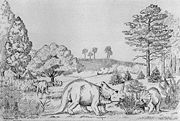 Monoclonius was Edward Drinker Cope
's third named ceratopsian (after Agathaumas
and Polyonax
). The type specimen was found in the summer of 1876 in Montana, only about 100 miles from the site of the Battle of the Little Bighorn
that June. Although it was not an articulated skeleton, Cope recovered most of the animal (only the feet were entirely missing), including skull material and the base part of a long nasal horn. Since the ceratopsians were still unknown, Cope was uncertain about much of the skull material, not recognizing the horn core as part of a fossil horn.
After O. C. Marsh's description of Triceratops
in 1889, Cope reexamined his Monoclonius specimen and realized that Triceratops, Monoclonius, and Agathaumas
represented a group of similar dinosaurs. In the same paper that Cope examined M. crassus, he also named three more Monoclonius species. He described Monoclonius as having a large nasal horn and two smaller horns over the eyes and a large frill
(parietal
) with broad openings.
Later, John Bell Hatcher
(one of Marsh's workers and therefore in the 'Yale
Camp' of the Bone Wars
), in continuing Marsh's monograph on the Ceratopsidae
, derided Cope's collecting methods. Cope rarely identified specimens in the field with precise locations and often ended up describing composites, rather than single individuals. Hatcher reexamined the type specimen of M. crassus and the only skull remain that he could positively assign to this specimen was the left half of the parietal (the dorsal part of the neck frill). He could not assign any of the several squamosal
s (side of the frill) in the collection to the type specimen and did not believe that Cope's orbital horn (catalogued under a different number) belonged to it.
, including three new species of Monoclonius based on fragmentary skulls.
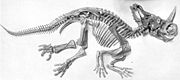 In 1904, Lambe described Centrosaurus
, based on a second specimen (a skull in better condition than the first) that he had attributed to Monoclonius dawsoni in 1902. With newer specimens collected by Charles H. Sternberg
, it became clear that Centrosaurus
was distinctly separate from Monoclonius, at least to Lambe. In a 1914 paper, Barnum Brown
reviewed Monoclonius and Centrosaurus
, dismissing most of Cope's species, leaving only M. crassus. Comparing Monoclonius to Centrosaurus, he determined that the M. crassus specimen had been that of an old animal and damaged by erosion and that the two were synonymous. In 1915, Lambe answered Brown in another paper (this is the review of Ceratopsia in which Lambe established three families), transferring M. dawsoni to Brachyceratops
and M. sphenocerus to Styracosaurus
. This left M. crassus, which he considered non-diagnostic, largely due to its damage and the lack of a nasal horn. Lambe ended the paper by attributing Brown's M. flexus to Centrosaurus apertus (the type species of Centrosaurus). The next round fell to Brown in a paper on Albertan centrosaurines, which, for the first time, analyzed a complete ceratopsian skeleton, which he named Monoclonius nasicornus (he contributed to the confusion even more by describing yet another species, M. cutleri).
The matter bounced back and forth, over the next few years, until Richard Swann Lull
published his "Revision of Ceratopsia", in 1933. Although, unlike the beautifully illustrated 1907 monograph, it has relatively few illustrations, it is known for the attempt to identify and locate all ceratopsian specimens then known. Lull described another specimen from Alberta (YPM 2015; Monoclonius (Centrosaurus) flexus) and decided that Centrosaurus
was a junior synonym of Monoclonius, perhaps distinct enough to deserve subgeneric rank. (This specimen is exhibited at Yale's Peabody Museum in an unusual way: the left half shows the skeleton, but the right side is a reconstruction of the living animal.) Charles M. Sternberg, son of Charles H. Sternberg, in 1940 firmly established the existence of Monoclonius-type forms in Alberta (no further specimens have come from Montana since 1876) and showed that differences justified the separation of the two genera. Monoclonius-types are rarer and found in earlier horizons than Centrosaurus-types, seemingly indicating that the one is probably ancestral to the other.
Other Species:
. During the Cretaceous, flowering plants were "geographically limited on the landscape", so it is likely that this dinosaur fed on the predominant plants of the era: fern
s, cycad
s and conifers. It would have used its sharp Ceratopsian beak to bite off the leaves or needles.
's short Prehistoric Beast
(1984). The following year, 1985, the shots used on Prehistoric Beast were used again in the TV documentary Dinosaur!
, directed by Robert Guenette. On April 6, 2011 the Tippett Studio
had published on its YouTube official channel a digital restoration of the Prehistoric Beast short.
Dinosaur
Dinosaurs are a diverse group of animals of the clade and superorder Dinosauria. They were the dominant terrestrial vertebrates for over 160 million years, from the late Triassic period until the end of the Cretaceous , when the Cretaceous–Paleogene extinction event led to the extinction of...
from the Judith River Formation
Judith River Formation
The Judith River Formation is a fossil-bearing geologic formation in Montana, and is part of the Judith River Group. It dates to the upper Cretaceous, between 80 and 75 million years ago, corresponding to the "Judithian" land vertebrate age...
of Late Cretaceous
Late Cretaceous
The Late Cretaceous is the younger of two epochs into which the Cretaceous period is divided in the geologic timescale. Rock strata from this epoch form the Upper Cretaceous series...
Montana
Montana
Montana is a state in the Western United States. The western third of Montana contains numerous mountain ranges. Smaller, "island ranges" are found in the central third of the state, for a total of 77 named ranges of the Rocky Mountains. This geographical fact is reflected in the state's name,...
and Canada
Canada
Canada is a North American country consisting of ten provinces and three territories. Located in the northern part of the continent, it extends from the Atlantic Ocean in the east to the Pacific Ocean in the west, and northward into the Arctic Ocean...
. It is often confused with Centrosaurus
Centrosaurus
Centrosaurus is a genus of herbivorous ceratopsian dinosaurs from the late Cretaceous of Canada. Their remains have been found in the Dinosaur Park Formation and uppermost Oldman Formation, dating from 76.5 to 75.5 million years ago....
, a similar genus of ceratopsian (some think the two may even be identical, of a different age or gender). Monoclonius was described by Edward Drinker Cope
Edward Drinker Cope
Edward Drinker Cope was an American paleontologist and comparative anatomist, as well as a noted herpetologist and ichthyologist. Born to a wealthy Quaker family, Cope distinguished himself as a child prodigy interested in science; he published his first scientific paper at the age of nineteen...
in 1876. All Monoclonius specimens are now believed to be juveniles or subadults, in many cases of other genera such as Centrosaurus.
Etymology
Contrary to popular belief, the name Monoclonius does not mean "single horn" or refer to its distinctive single nasal horn. In fact, the genus was named before it was known to have been a horned dinosaur, and had previously been considered a "hadrosaur." The name in fact means "single sprout", in reference to the way its teeth grew compared to its relative DicloniusDiclonius
Diclonius is a genus of dinosaur from the Late Cretaceous. It was a hadrosaur based solely on teeth. Its fossils have been found in North America. The name is in reference to the method of tooth replacement, in which newly erupting replacement teeth could be in functional use at the same time as...
("double sprout"), which was named by Edward Drinker Cope
Edward Drinker Cope
Edward Drinker Cope was an American paleontologist and comparative anatomist, as well as a noted herpetologist and ichthyologist. Born to a wealthy Quaker family, Cope distinguished himself as a child prodigy interested in science; he published his first scientific paper at the age of nineteen...
in the same paper as Monoclonius. In Diclonius, Cope interpreted the fossils to show two series of teeth in use at one time (one mature set and one sprouting replacement set), while in Monoclonius, there appeared to be only one set of teeth in use as a chewing surface at any one time, with replacement teeth growing in only after mature teeth had fallen out.
History
Edward Drinker Cope
Edward Drinker Cope was an American paleontologist and comparative anatomist, as well as a noted herpetologist and ichthyologist. Born to a wealthy Quaker family, Cope distinguished himself as a child prodigy interested in science; he published his first scientific paper at the age of nineteen...
's third named ceratopsian (after Agathaumas
Agathaumas
Agathaumas is a dubious genus of a large ceratopsid dinosaur that lived in Wyoming during the Late Cretaceous . The name comes from Greek, αγαν - 'much' and θαυμα - 'wonder'...
and Polyonax
Polyonax
Polyonax was a genus of ceratopsid dinosaur from the late Maastrichtian-age Upper Cretaceous Denver Formation of Colorado, USA...
). The type specimen was found in the summer of 1876 in Montana, only about 100 miles from the site of the Battle of the Little Bighorn
Battle of the Little Bighorn
The Battle of the Little Bighorn, also known as Custer's Last Stand and, by the Indians involved, as the Battle of the Greasy Grass, was an armed engagement between combined forces of Lakota, Northern Cheyenne and Arapaho people against the 7th Cavalry Regiment of the United States Army...
that June. Although it was not an articulated skeleton, Cope recovered most of the animal (only the feet were entirely missing), including skull material and the base part of a long nasal horn. Since the ceratopsians were still unknown, Cope was uncertain about much of the skull material, not recognizing the horn core as part of a fossil horn.
After O. C. Marsh's description of Triceratops
Triceratops
Triceratops is a genus of herbivorous ceratopsid dinosaur which lived during the late Maastrichtian stage of the Late Cretaceous Period, around 68 to 65 million years ago in what is now North America. It was one of the last dinosaur genera to appear before the great Cretaceous–Paleogene...
in 1889, Cope reexamined his Monoclonius specimen and realized that Triceratops, Monoclonius, and Agathaumas
Agathaumas
Agathaumas is a dubious genus of a large ceratopsid dinosaur that lived in Wyoming during the Late Cretaceous . The name comes from Greek, αγαν - 'much' and θαυμα - 'wonder'...
represented a group of similar dinosaurs. In the same paper that Cope examined M. crassus, he also named three more Monoclonius species. He described Monoclonius as having a large nasal horn and two smaller horns over the eyes and a large frill
Frill
Frill may refer to:* Frill , a form of trimming* Neck frill, the relatively extensive margin seen on the back of the heads of some reptiles* Oriental Frill, a breed of Fancy pigeon...
(parietal
Parietal
Parietal may refer to:*Parietal placentation*Parietal lobe of the brain*Parietal bone of the skull*Parietal scales of a snake lie in the general region of the parietal bone*Parietal cell in the stomach*Parietal pleura...
) with broad openings.
Later, John Bell Hatcher
John Bell Hatcher
John Bell Hatcher was an American paleontologist and fossil hunter best known for discovering Torosaurus.-Biography:...
(one of Marsh's workers and therefore in the 'Yale
YALE
RapidMiner, formerly YALE , is an environment for machine learning, data mining, text mining, predictive analytics, and business analytics. It is used for research, education, training, rapid prototyping, application development, and industrial applications...
Camp' of the Bone Wars
Bone Wars
The Bone Wars, also known as the "Great Dinosaur Rush", refers to a period of intense fossil speculation and discovery during the Gilded Age of American history, marked by a heated rivalry between Edward Drinker Cope and Othniel Charles Marsh...
), in continuing Marsh's monograph on the Ceratopsidae
Ceratopsidae
Ceratopsidae is a speciose group of marginocephalian dinosaurs including Triceratops and Styracosaurus...
, derided Cope's collecting methods. Cope rarely identified specimens in the field with precise locations and often ended up describing composites, rather than single individuals. Hatcher reexamined the type specimen of M. crassus and the only skull remain that he could positively assign to this specimen was the left half of the parietal (the dorsal part of the neck frill). He could not assign any of the several squamosal
Squamosal
The squamosal is a bone of the head of higher vertebrates. It is the principal component of the cheek region in the skull, lying below the temporal series and otic notch and bounded anteriorly by postorbital. Posteriorly, the squamosal articulates with the posterior elements of the palatal complex,...
s (side of the frill) in the collection to the type specimen and did not believe that Cope's orbital horn (catalogued under a different number) belonged to it.
Centrosaurus intrudes
In the years after Cope's 1889 paper, it appears that there was a tendency to describe everything from the Judith River beds as Monoclonius. The first dinosaur species described from Canada were ceratopsians in 1902 by Lawrence LambeLawrence Lambe
Lawrence Morris Lambe was a Canadian geologist and palaeontologist from the Geological Survey of Canada .His published work, describing the diverse and plentiful dinosaur discoveries from the fossil beds in Alberta, did much to bring dinosaurs into the public eye and helped usher in the Golden...
, including three new species of Monoclonius based on fragmentary skulls.
Centrosaurus
Centrosaurus is a genus of herbivorous ceratopsian dinosaurs from the late Cretaceous of Canada. Their remains have been found in the Dinosaur Park Formation and uppermost Oldman Formation, dating from 76.5 to 75.5 million years ago....
, based on a second specimen (a skull in better condition than the first) that he had attributed to Monoclonius dawsoni in 1902. With newer specimens collected by Charles H. Sternberg
Charles Hazelius Sternberg
Charles Hazelius Sternberg , was an American fossil collector and amateur paleontologist. His older brother, Dr. George M. Sternberg was a military surgeon assigned to Fort Harker near Ellsworth, Kansas and brought the rest of Sternberg family to Kansas to live on his ranch about 1868...
, it became clear that Centrosaurus
Centrosaurus
Centrosaurus is a genus of herbivorous ceratopsian dinosaurs from the late Cretaceous of Canada. Their remains have been found in the Dinosaur Park Formation and uppermost Oldman Formation, dating from 76.5 to 75.5 million years ago....
was distinctly separate from Monoclonius, at least to Lambe. In a 1914 paper, Barnum Brown
Barnum Brown
Barnum Brown , a paleontologist born in Carbondale, Kansas, and named after the circus showman P.T. Barnum, discovered the second fossil of Tyrannosaurus rex during a career that made him one of the most famous fossil hunters working from the late Victorian era into the early 20th century.Sponsored...
reviewed Monoclonius and Centrosaurus
Centrosaurus
Centrosaurus is a genus of herbivorous ceratopsian dinosaurs from the late Cretaceous of Canada. Their remains have been found in the Dinosaur Park Formation and uppermost Oldman Formation, dating from 76.5 to 75.5 million years ago....
, dismissing most of Cope's species, leaving only M. crassus. Comparing Monoclonius to Centrosaurus, he determined that the M. crassus specimen had been that of an old animal and damaged by erosion and that the two were synonymous. In 1915, Lambe answered Brown in another paper (this is the review of Ceratopsia in which Lambe established three families), transferring M. dawsoni to Brachyceratops
Brachyceratops
Brachyceratops is a dubious genus of ceratopsian dinosaur known only from partial juvenile specimens dating to the late Cretaceous Period of Montana, United States....
and M. sphenocerus to Styracosaurus
Styracosaurus
Styracosaurus was a genus of herbivorous ceratopsian dinosaur from the Cretaceous Period , about 76.5 to 75.0 million years ago...
. This left M. crassus, which he considered non-diagnostic, largely due to its damage and the lack of a nasal horn. Lambe ended the paper by attributing Brown's M. flexus to Centrosaurus apertus (the type species of Centrosaurus). The next round fell to Brown in a paper on Albertan centrosaurines, which, for the first time, analyzed a complete ceratopsian skeleton, which he named Monoclonius nasicornus (he contributed to the confusion even more by describing yet another species, M. cutleri).
The matter bounced back and forth, over the next few years, until Richard Swann Lull
R. S. Lull
Richard Swann Lull was an American paleontologist from the early 20th century, active at Yale University, who is largely remembered now for championing a Pre-Neo-Darwinian Synthesis view of evolution, whereby mutation could unlock mysterious genetic drives that, over time, would lead populations...
published his "Revision of Ceratopsia", in 1933. Although, unlike the beautifully illustrated 1907 monograph, it has relatively few illustrations, it is known for the attempt to identify and locate all ceratopsian specimens then known. Lull described another specimen from Alberta (YPM 2015; Monoclonius (Centrosaurus) flexus) and decided that Centrosaurus
Centrosaurus
Centrosaurus is a genus of herbivorous ceratopsian dinosaurs from the late Cretaceous of Canada. Their remains have been found in the Dinosaur Park Formation and uppermost Oldman Formation, dating from 76.5 to 75.5 million years ago....
was a junior synonym of Monoclonius, perhaps distinct enough to deserve subgeneric rank. (This specimen is exhibited at Yale's Peabody Museum in an unusual way: the left half shows the skeleton, but the right side is a reconstruction of the living animal.) Charles M. Sternberg, son of Charles H. Sternberg, in 1940 firmly established the existence of Monoclonius-type forms in Alberta (no further specimens have come from Montana since 1876) and showed that differences justified the separation of the two genera. Monoclonius-types are rarer and found in earlier horizons than Centrosaurus-types, seemingly indicating that the one is probably ancestral to the other.
Classification
Aside from fossils that were classified in Monoclonius because of confusion about the genus (see above), Monoclonius specimens are now generally recognized as juveniles or subadults. In some cases the adult form is an already-known species, but in others the adult may not yet be known to science.Species
Type:- Monoclonius crassus Cope 1876 [AMNH 3998]
Other Species:
- M. albertensis (Lambe, 1913/Leahy, 1987); included with StyracosaurusStyracosaurusStyracosaurus was a genus of herbivorous ceratopsian dinosaur from the Cretaceous Period , about 76.5 to 75.0 million years ago...
albertensis. - M. apertus (Lambe, 1904/Kuhn, 1964); included with CentrosaurusCentrosaurusCentrosaurus is a genus of herbivorous ceratopsian dinosaurs from the late Cretaceous of Canada. Their remains have been found in the Dinosaur Park Formation and uppermost Oldman Formation, dating from 76.5 to 75.5 million years ago....
apertus. - M. belli (Lambe, 1902); included with ChasmosaurusChasmosaurusChasmosaurus is a genus of ceratopsid dinosaur from the Upper Cretaceous Period of North America. Its name means 'opening lizard', referring to the large openings in its frill . With a length of and a weight of , Chasmosaurus was a ceratopsian of average size...
belli. - M. canadensis (Lambe, 1902); included with ChasmosaurusChasmosaurusChasmosaurus is a genus of ceratopsid dinosaur from the Upper Cretaceous Period of North America. Its name means 'opening lizard', referring to the large openings in its frill . With a length of and a weight of , Chasmosaurus was a ceratopsian of average size...
canadensis. - M. cutleri (Brown, 1917); back half of skeleton with some skull fragments, included with CentrosaurusCentrosaurusCentrosaurus is a genus of herbivorous ceratopsian dinosaurs from the late Cretaceous of Canada. Their remains have been found in the Dinosaur Park Formation and uppermost Oldman Formation, dating from 76.5 to 75.5 million years ago....
apertus. - M. dawsoni (Lambe, 1902; including BrachyceratopsBrachyceratopsBrachyceratops is a dubious genus of ceratopsian dinosaur known only from partial juvenile specimens dating to the late Cretaceous Period of Montana, United States....
dawsoni and CentrosaurusCentrosaurusCentrosaurus is a genus of herbivorous ceratopsian dinosaurs from the late Cretaceous of Canada. Their remains have been found in the Dinosaur Park Formation and uppermost Oldman Formation, dating from 76.5 to 75.5 million years ago....
dawsoni), included with CentrosaurusCentrosaurusCentrosaurus is a genus of herbivorous ceratopsian dinosaurs from the late Cretaceous of Canada. Their remains have been found in the Dinosaur Park Formation and uppermost Oldman Formation, dating from 76.5 to 75.5 million years ago....
apertus. - M. fissus Cope, 1889; isolated pterygoidPterygoidPterygoid can refer to:* Pterygoid processes of the sphenoid bone** The Lateral pterygoid plate by it* a muscle such as Lateral pterygoid muscle or Medial pterygoid muscle* a branch of the Mandibular nerve...
(Cope identified it as a squamosalSquamosalThe squamosal is a bone of the head of higher vertebrates. It is the principal component of the cheek region in the skull, lying below the temporal series and otic notch and bounded anteriorly by postorbital. Posteriorly, the squamosal articulates with the posterior elements of the palatal complex,...
); nomen nudumNomen nudumThe phrase nomen nudum is a Latin term, meaning "naked name", used in taxonomy...
. - M. flexus (Brown, 1914); included with CentrosaurusCentrosaurusCentrosaurus is a genus of herbivorous ceratopsian dinosaurs from the late Cretaceous of Canada. Their remains have been found in the Dinosaur Park Formation and uppermost Oldman Formation, dating from 76.5 to 75.5 million years ago....
apertus. - M. longirostris (Sternberg, 1940/Kuhn, 1964); included with CentrosaurusCentrosaurusCentrosaurus is a genus of herbivorous ceratopsian dinosaurs from the late Cretaceous of Canada. Their remains have been found in the Dinosaur Park Formation and uppermost Oldman Formation, dating from 76.5 to 75.5 million years ago....
apertus. - M. lowei (Sternberg, 1940); a large, somewhat flattened, skull, apparently that of a subadult (sutures are not completely closed). Sternberg pointed out the resemblances of this specimen to BrachyceratopsBrachyceratopsBrachyceratops is a dubious genus of ceratopsian dinosaur known only from partial juvenile specimens dating to the late Cretaceous Period of Montana, United States....
. The species was named in honor of Harold D'acre Robinson Lowe from Drumheller, AB. Lowe was a field assistant to C.M. Sternberg and worked six field seasons (during the 1925-1937 period) with him across southern Alberta, with other work in ManitobaManitobaManitoba is a Canadian prairie province with an area of . The province has over 110,000 lakes and has a largely continental climate because of its flat topography. Agriculture, mostly concentrated in the fertile southern and western parts of the province, is vital to the province's economy; other...
and SaskatchewanSaskatchewanSaskatchewan is a prairie province in Canada, which has an area of . Saskatchewan is bordered on the west by Alberta, on the north by the Northwest Territories, on the east by Manitoba, and on the south by the U.S. states of Montana and North Dakota....
. - M. montanensis (Gilmore, 1914); included with Brachyceratops montanensis.
- M. nasicornis (Brown, 1917); included part with CentrosaurusCentrosaurusCentrosaurus is a genus of herbivorous ceratopsian dinosaurs from the late Cretaceous of Canada. Their remains have been found in the Dinosaur Park Formation and uppermost Oldman Formation, dating from 76.5 to 75.5 million years ago....
apertus and part with StyracosaurusStyracosaurusStyracosaurus was a genus of herbivorous ceratopsian dinosaur from the Cretaceous Period , about 76.5 to 75.0 million years ago...
albertensis (Dodson believes this is actually the female of Styracosaurus) - M. recurvicornis Cope, 1889; braincase, 3 horns and isolated fragments; nomen nudum included with CeratopsCeratopsCeratops is a dubious genus of ceratopsian dinosaur which lived during the Late Cretaceous. Its fossils have been found in Montana. Although poorly known, Ceratops is important in the history of dinosaurs, since it is the type species for which both Ceratopsia and Ceratopsidae are named...
recurvicornis. - M. sphenoceras Cope, 1890; nasal horn and premaxillaPremaxillaThe incisive bone is the portion of the maxilla adjacent to the incisors. It is a pair of small cranial bones at the very tip of the jaws of many animals, usually bearing teeth, but not always. They are connected to the maxilla and the nasals....
; nomen nudum including AgathaumasAgathaumasAgathaumas is a dubious genus of a large ceratopsid dinosaur that lived in Wyoming during the Late Cretaceous . The name comes from Greek, αγαν - 'much' and θαυμα - 'wonder'...
sphenoceras, A. monoclonius and Styracosaurus sphenoceras).
Diet and ecology
Monoclonius, like all Ceratopsians, was a herbivoreHerbivore
Herbivores are organisms that are anatomically and physiologically adapted to eat plant-based foods. Herbivory is a form of consumption in which an organism principally eats autotrophs such as plants, algae and photosynthesizing bacteria. More generally, organisms that feed on autotrophs in...
. During the Cretaceous, flowering plants were "geographically limited on the landscape", so it is likely that this dinosaur fed on the predominant plants of the era: fern
Fern
A fern is any one of a group of about 12,000 species of plants belonging to the botanical group known as Pteridophyta. Unlike mosses, they have xylem and phloem . They have stems, leaves, and roots like other vascular plants...
s, cycad
Cycad
Cycads are seed plants typically characterized by a stout and woody trunk with a crown of large, hard and stiff, evergreen leaves. They usually have pinnate leaves. The individual plants are either all male or all female . Cycads vary in size from having a trunk that is only a few centimeters...
s and conifers. It would have used its sharp Ceratopsian beak to bite off the leaves or needles.
In popular culture
Monoclonius, as other well known ceratopsian dinosaurs, appears on several movies and TV shows. It had a special appearance, holding the leading role, in Phil TippettPhil Tippett
Phil Tippett is a movie director and an award-winning visual effects supervisor and producer, who specializes in creature design and character animation.-Early career:...
's short Prehistoric Beast
Prehistoric Beast
Prehistoric Beast is a ten minutes long experimental animated film fully conceived and made by Phil Tippett in 1984. This sequence is considered as being the first film produced by the Tippett Studio, founded by Tippett himself in 1984...
(1984). The following year, 1985, the shots used on Prehistoric Beast were used again in the TV documentary Dinosaur!
Dinosaur!
Dinosaur! is an American television documentary about dinosaurs. It was first aired on CBS in the United States on November 5, 1985. Years later, in 1991, another documentary entitled Dinosaur!, not related with that one, was hosted on A&E by CBS anchorman Walter Cronkite.-Content:Directed by...
, directed by Robert Guenette. On April 6, 2011 the Tippett Studio
Tippett Studio
Tippett Studio is a visual effects company specializing in computer-generated imagery for movies and television commercials. Phil Tippett founded the studio in 1984, which employs effects artists who work with his partners Jules Roman and Craig Hayes....
had published on its YouTube official channel a digital restoration of the Prehistoric Beast short.