

Pentaceratops

Encyclopedia
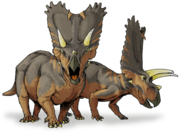
Pentaceratops is a genus
of ceratopsid
dinosaur
from the late Cretaceous
Period of what is now North America
. The appearance of Pentaceratops sternbergii in the fossil record marks the end of the Judithian land vertebrate age and the start of the Kirtlandian. Its name means "five-horned face", derived from the Greek
penta (πέντα, meaning 'five'), ceras (κέρας, 'horn') and -ops (ωψ, 'face'), in reference to its two long epijugal bones, spikes which protrude out sidewards from under its eyes, in addition to the three more obvious horns.
Pentaceratops lived around 75-73 million years ago, its remains having been mostly found in the Kirtland Formation
in the San Juan Basin in New Mexico
. Other dinosaurs which shared its time period include Parasaurolophus cyrtocristatus
, the pachycephalosaur Sphaerotholus
, the armored dinosaur Nodocephalosaurus
and the tyrannosauroid Bistahieversor
.
It was about 8 m (27 ft) long, and has been estimated to have weighed around 5,500 kg (13,000 lb).
 The first examples were collected by C. H. Sternberg
in the San Juan Basin in New Mexico
and described by Henry Fairfield Osborn
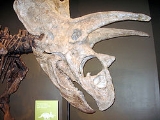
in 1923, who obligingly gave it the specific name sternbergii after its discoverer. The frill of Pentaceratops is larger than that of Triceratops
, with two large holes (fenestrae
) in it. In 1930, Carl Wiman
described a second species of Pentaceratops, P. fenestratus, but this was later determined to be the same species as the original finds. Further material discovered in Colorado
has been identified as Pentaceratops in 2006.
Pentaceratops has the distinction of having produced the largest known skull
for a land vertebrate
. That skull and its associated skeleton
are on display at the Sam Noble Oklahoma Museum of Natural History
. The skeleton was found in New Mexico
in 1941, and has since been reclassified as Titanoceratops
.
, Pentaceratops belonged to the subfamily Ceratopsinae and appears to be most closely related to Anchiceratops
and the earlier genus Chasmosaurus
. It may have been a close relative to the ancestor of Torosaurus
, which lived a few million years later, right at the end of the Cretaceous period, when all ceratopsians died out.
. During the Cretaceous, flowering plants were "geographically limited on the landscape", and so it is likely that this dinosaur fed on the predominant plants of the era: ferns, cycads and conifers. It would have used its sharp ceratopsian beak to bite off the leaves or needles.
ceratopsian from New Mexico
. Large herbivores like the ceratopsians living in North America during the Late Cretaceous had "remarkably small geographic ranges" despite their large body size and high mobility. This restricted distribution strongly contrasts with modern mammalian faunas whose large herbivores' ranges "typical[ly] ... span much of a continent." Pentaceratops along with Kritosaurus
and Parasaurolophus
formed the dominant fauna of southern North America. This region was characterized by lower taxonomic diversity in communities where lambeosaurine were less common and centrosaurs were completely lacking.
Genus
In biology, a genus is a low-level taxonomic rank used in the biological classification of living and fossil organisms, which is an example of definition by genus and differentia...
of ceratopsid
Ceratopsidae
Ceratopsidae is a speciose group of marginocephalian dinosaurs including Triceratops and Styracosaurus...
dinosaur
Dinosaur
Dinosaurs are a diverse group of animals of the clade and superorder Dinosauria. They were the dominant terrestrial vertebrates for over 160 million years, from the late Triassic period until the end of the Cretaceous , when the Cretaceous–Paleogene extinction event led to the extinction of...
from the late Cretaceous
Cretaceous
The Cretaceous , derived from the Latin "creta" , usually abbreviated K for its German translation Kreide , is a geologic period and system from circa to million years ago. In the geologic timescale, the Cretaceous follows the Jurassic period and is followed by the Paleogene period of the...
Period of what is now North America
North America
North America is a continent wholly within the Northern Hemisphere and almost wholly within the Western Hemisphere. It is also considered a northern subcontinent of the Americas...
. The appearance of Pentaceratops sternbergii in the fossil record marks the end of the Judithian land vertebrate age and the start of the Kirtlandian. Its name means "five-horned face", derived from the Greek
Ancient Greek
Ancient Greek is the stage of the Greek language in the periods spanning the times c. 9th–6th centuries BC, , c. 5th–4th centuries BC , and the c. 3rd century BC – 6th century AD of ancient Greece and the ancient world; being predated in the 2nd millennium BC by Mycenaean Greek...
penta (πέντα, meaning 'five'), ceras (κέρας, 'horn') and -ops (ωψ, 'face'), in reference to its two long epijugal bones, spikes which protrude out sidewards from under its eyes, in addition to the three more obvious horns.
Pentaceratops lived around 75-73 million years ago, its remains having been mostly found in the Kirtland Formation
Kirtland Formation
The Kirtland Formation is a sedimentary geological formation. It is the product of alluvial muds and overbank sand deposits from the many channels draining the coastal plain that existed on the inland seashore of North America, in the late Cretaceous period. It overlies the Fruitland Formation...
in the San Juan Basin in New Mexico
New Mexico
New Mexico is a state located in the southwest and western regions of the United States. New Mexico is also usually considered one of the Mountain States. With a population density of 16 per square mile, New Mexico is the sixth-most sparsely inhabited U.S...
. Other dinosaurs which shared its time period include Parasaurolophus cyrtocristatus
Parasaurolophus
Parasaurolophus is a genus of ornithopod dinosaur that lived in what is now North America during the Late Cretaceous Period, about 76.5–73 million years ago. It was an herbivore that walked both as a biped and a quadruped. Three species are recognized: P. walkeri , P. tubicen, and the...
, the pachycephalosaur Sphaerotholus
Sphaerotholus
Sphaerotholus is a genus of pachycephalosaurid dinosaur from the Upper Cretaceous of the western United States. To date, two species have been described: the type species, S. goodwini, from the Den-na-zin Member of the Kirtland Formation of San Juan County, New Mexico, and a second species, S...
, the armored dinosaur Nodocephalosaurus
Nodocephalosaurus
Nodocephalosaurus is a genus of herbivorous ankylosaurine ankylosaurid dinosaur from Upper Cretaceous deposits of San Juan Basin, New Mexico. The holotype was recovered from the Late Campanian De-na-zin Member of the Kirtland Formation and consists of an incomplete skull...
and the tyrannosauroid Bistahieversor
Bistahieversor
Bistahieversor is a genus of tyrannosauroid dinosaur. Bistahieversor existed around 75 million years ago during the Late Cretaceous....
.
It was about 8 m (27 ft) long, and has been estimated to have weighed around 5,500 kg (13,000 lb).
Discoveries and species
Charles Hazelius Sternberg
Charles Hazelius Sternberg , was an American fossil collector and amateur paleontologist. His older brother, Dr. George M. Sternberg was a military surgeon assigned to Fort Harker near Ellsworth, Kansas and brought the rest of Sternberg family to Kansas to live on his ranch about 1868...
in the San Juan Basin in New Mexico
New Mexico
New Mexico is a state located in the southwest and western regions of the United States. New Mexico is also usually considered one of the Mountain States. With a population density of 16 per square mile, New Mexico is the sixth-most sparsely inhabited U.S...
and described by Henry Fairfield Osborn
Henry Fairfield Osborn
Henry Fairfield Osborn, Sr. ForMemRS was an American geologist, paleontologist, and eugenicist.-Early life and career:...
in 1923, who obligingly gave it the specific name sternbergii after its discoverer. The frill of Pentaceratops is larger than that of Triceratops
Triceratops
Triceratops is a genus of herbivorous ceratopsid dinosaur which lived during the late Maastrichtian stage of the Late Cretaceous Period, around 68 to 65 million years ago in what is now North America. It was one of the last dinosaur genera to appear before the great Cretaceous–Paleogene...
, with two large holes (fenestrae
Fenestrae
Fenestræ is a Latin word that means "window".* In histology, fenestræ are small pores in endothelial cells that allow for rapid exchange of molecules between sinusoid blood vessels and surrounding tissue...
) in it. In 1930, Carl Wiman
Carl Wiman
Carl Wiman was a Swedish paleontologist and the first professor of paleontology at Uppsala University. He published on a variety of topics, including extinct penguins, and dinosaur fossils sent to Sweden from China and the San Juan Basin of New Mexico...
described a second species of Pentaceratops, P. fenestratus, but this was later determined to be the same species as the original finds. Further material discovered in Colorado
Colorado
Colorado is a U.S. state that encompasses much of the Rocky Mountains as well as the northeastern portion of the Colorado Plateau and the western edge of the Great Plains...
has been identified as Pentaceratops in 2006.
Pentaceratops has the distinction of having produced the largest known skull
Skull
The skull is a bony structure in the head of many animals that supports the structures of the face and forms a cavity for the brain.The skull is composed of two parts: the cranium and the mandible. A skull without a mandible is only a cranium. Animals that have skulls are called craniates...
for a land vertebrate
Vertebrate
Vertebrates are animals that are members of the subphylum Vertebrata . Vertebrates are the largest group of chordates, with currently about 58,000 species described. Vertebrates include the jawless fishes, bony fishes, sharks and rays, amphibians, reptiles, mammals, and birds...
. That skull and its associated skeleton
Skeleton
The skeleton is the body part that forms the supporting structure of an organism. There are two different skeletal types: the exoskeleton, which is the stable outer shell of an organism, and the endoskeleton, which forms the support structure inside the body.In a figurative sense, skeleton can...
are on display at the Sam Noble Oklahoma Museum of Natural History
Sam Noble Oklahoma Museum of Natural History
The Sam Noble Oklahoma Museum of Natural History is a natural history museum in Norman, Oklahoma, operated by the University of Oklahoma. It is currently housed in a building on Chautauqua Avenue that opened on May 1, 2000. The museum's exhibits include a Native American gallery and collections of...
. The skeleton was found in New Mexico
New Mexico
New Mexico is a state located in the southwest and western regions of the United States. New Mexico is also usually considered one of the Mountain States. With a population density of 16 per square mile, New Mexico is the sixth-most sparsely inhabited U.S...
in 1941, and has since been reclassified as Titanoceratops
Titanoceratops
Titanoceratops is a genus of herbivorous ceratopsian dinosaur. It was a giant chasmosaurine ceratopsian which lived during the Late Cretaceous period in what is now New Mexico, and the earliest known triceratopsin. It is known from the holotype OMNH 10165, a partial skeleton including...
.
Classification
Within the CeratopsiaCeratopsia
Ceratopsia or Ceratopia is a group of herbivorous, beaked dinosaurs which thrived in what are now North America, Europe, and Asia, during the Cretaceous Period, although ancestral forms lived earlier, in the Jurassic. The earliest known ceratopsian, Yinlong downsi, lived between 161.2 and 155.7...
, Pentaceratops belonged to the subfamily Ceratopsinae and appears to be most closely related to Anchiceratops
Anchiceratops
Anchiceratops is a genus of chasmosaurine ceratopsid dinosaur from the Late Cretaceous Period of western North America. Like other ceratopsids, it was a quadrupedal herbivore with three horns on its face, a parrot-like beak, and a long frill extending from the back of its head. The two horns above...
and the earlier genus Chasmosaurus
Chasmosaurus
Chasmosaurus is a genus of ceratopsid dinosaur from the Upper Cretaceous Period of North America. Its name means 'opening lizard', referring to the large openings in its frill . With a length of and a weight of , Chasmosaurus was a ceratopsian of average size...
. It may have been a close relative to the ancestor of Torosaurus
Torosaurus
Torosaurus is a genus of ceratopsid dinosaur that lived during the late Cretaceous period , between 70 and 65 million years ago. It possessed one of the largest skulls of any known land animal. The frilled skull reached in length...
, which lived a few million years later, right at the end of the Cretaceous period, when all ceratopsians died out.
Diet
Pentaceratops, like all ceratopsians, was an herbivoreHerbivore
Herbivores are organisms that are anatomically and physiologically adapted to eat plant-based foods. Herbivory is a form of consumption in which an organism principally eats autotrophs such as plants, algae and photosynthesizing bacteria. More generally, organisms that feed on autotrophs in...
. During the Cretaceous, flowering plants were "geographically limited on the landscape", and so it is likely that this dinosaur fed on the predominant plants of the era: ferns, cycads and conifers. It would have used its sharp ceratopsian beak to bite off the leaves or needles.
Paleobiogeography
Thomas M. Lehman has observed that Pentaceratops is the only known JudithianJudithian
The Judithian was a North American faunal stage lasting from 83.5 to 70.6 million years ago. It overlaps with the Campanian global stage.-Fauna:Dinosaur faunas of the Judithian age may represent the peak of dinosaur evolution in North America...
ceratopsian from New Mexico
New Mexico
New Mexico is a state located in the southwest and western regions of the United States. New Mexico is also usually considered one of the Mountain States. With a population density of 16 per square mile, New Mexico is the sixth-most sparsely inhabited U.S...
. Large herbivores like the ceratopsians living in North America during the Late Cretaceous had "remarkably small geographic ranges" despite their large body size and high mobility. This restricted distribution strongly contrasts with modern mammalian faunas whose large herbivores' ranges "typical[ly] ... span much of a continent." Pentaceratops along with Kritosaurus
Kritosaurus
Kritosaurus is an incompletely known but historically important genus of hadrosaurid dinosaur. It lived about 73 million years ago, in the Late Cretaceous of North America...
and Parasaurolophus
Parasaurolophus
Parasaurolophus is a genus of ornithopod dinosaur that lived in what is now North America during the Late Cretaceous Period, about 76.5–73 million years ago. It was an herbivore that walked both as a biped and a quadruped. Three species are recognized: P. walkeri , P. tubicen, and the...
formed the dominant fauna of southern North America. This region was characterized by lower taxonomic diversity in communities where lambeosaurine were less common and centrosaurs were completely lacking.
See also
- Ah-Shi-Sle-Pah Wilderness Study AreaAh-Shi-Sle-Pah Wilderness Study AreaAh-Shi-Sle-Pah Wilderness Study Area is located in San Juan County, New Mexico between Chaco Canyon and the De-Na-Zin Wilderness. The Wilderness Study Area has multicolored badlands, sandstone hoodoos, petrified wood and dinosaur bones, similar to those found in the nearby Bisti Badlands and...
, the type localityType locality (geology)Type locality , also called type area or type locale, is the where a particular rock type, stratigraphic unit, fossil or mineral species is first identified....
for Pentaceratops fenestratus