


International Scale of River Difficulty

Encyclopedia
Whitewater
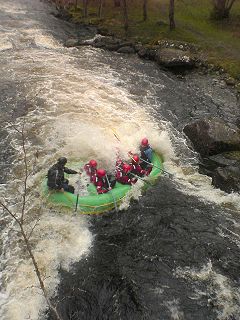
Whitewater is formed in a rapid, when a river's gradient increases enough to disturb its laminar flow and create turbulence, i.e. form a bubbly, or aerated and unstable current; the frothy water appears white...
) rapid
Rapid
A rapid is a section of a river where the river bed has a relatively steep gradient causing an increase in water velocity and turbulence. A rapid is a hydrological feature between a run and a cascade. A rapid is characterised by the river becoming shallower and having some rocks exposed above the...
. The grade reflects the technical difficulty and skill level required associated with the section of river. The scale is of use to various water sports and activities, such as rafting
Rafting
Rafting or white water rafting is a challenging recreational outdoor activity using an inflatable raft to navigate a river or other bodies of water. This is usually done on white water or different degrees of rough water, in order to thrill and excite the raft passengers. The development of this...
, riverboarding
Riverboarding
Riverboarding is a boardsport in which the participant lies prone on their board with fins on their feet for propulsion and steering. This sport is also known as hydrospeed in Europe and as riverboarding or white-water sledging in New Zealand, depending on the type of board used...
, whitewater canoeing
Whitewater canoeing
Whitewater canoeing is the sport of paddling a canoe on a moving body of water, typically a whitewater river. Whitewater canoeing can range from simple, carefree gently moving water, to demanding, dangerous whitewater. River rapids are graded like ski runs according to the difficulty, danger or...
, and whitewater kayaking
Whitewater kayaking
Whitewater kayaking is the sport of paddling a kayak on a moving body of water, typically a whitewater river. Whitewater kayaking can range from simple, carefree gently moving water, to demanding, dangerous whitewater. River rapids are graded like ski runs according to the difficulty, danger or...
.
Classification
There are six levels each referred to as "Grade" or "Class" followed by a number. The scale is not linear, nor is it fixed. For instance, there can be hard grade twos, easy grade threes, and so on. The grade of a river may change with the level of flow. Often a river or rapidRapid
A rapid is a section of a river where the river bed has a relatively steep gradient causing an increase in water velocity and turbulence. A rapid is a hydrological feature between a run and a cascade. A rapid is characterised by the river becoming shallower and having some rocks exposed above the...
will be given a numerical grade, and then a plus (+) or minus (-) to indicate if it is in the higher or lower end of the difficulty level. Also note that while a river section may be given an overall grading, it may contain sections above that grade, often noted as features, or conversely, it may contain sections of lower graded water as well. Details of portages may be given if these pose specific challenges.
| Class I: Easy |
Waves small; passages clear; no serious obstacles. | 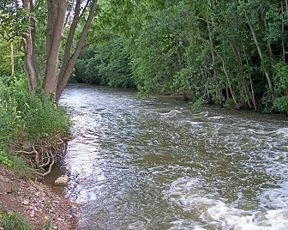 |
|---|---|---|
| Class II: Medium |
Rapids of moderate difficulty with passages clear. Requires experience plus suitable outfit and boat. | 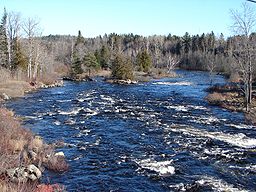 |
| Class III: Difficult |
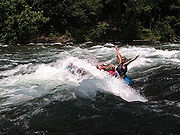
Waves numerous, high, irregular; rocks; eddies; rapids with passages clear though narrow, requiring expertise in maneuvering; scouting Scouting rapids Scouting a rapid is when there is whitewater that you want to take a look at and so plan a route through the rapid. Whitewater is formed in a rapid, when a river's gradient drops enough to disturb its laminar flow and create turbulence, i.e. form a bubbly, or aerated and unstable current; the... usually needed. Requires good operator and boat. |
 |
| Class IV: Very difficult |
Long rapids; waves high, irregular; dangerous rocks; boiling eddies; best passages difficult to scout; scouting mandatory first time; powerful and precise maneuvering required. Demands expert boatman and excellent boat and good quality equipment. | 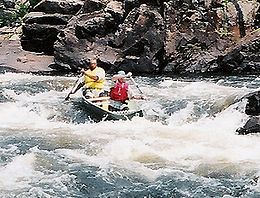 |
| Class V: Extremely difficult |
Exceedingly difficult, long and violent rapids, following each other almost without interruption; riverbed extremely obstructed; big drops; violent current; very steep gradient; close study essential but often difficult. Requires best person, boat, and outfit suited to the situation. All possible precautions must be taken. | 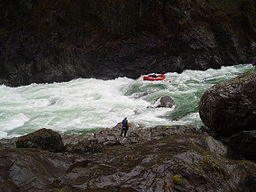 |
| Class VI Class U |
Formerly classified as unrunnable by any craft. This classification has now been redefined as "unraftable" due to people having recently kayaked multiple Class VI around the world. |  |
Caution in application
Classifications can vary enormously, depending on the skill level and experience of the paddlers who rated the river. For example, at the 1999 International Conference on Outdoor Recreation and Education, an author of a paddling guide pointed out that there is too much variation in what is covered by the class I designation, and proposed making further distinctions within the Class I flat water designations and Class I+ moving water designations, with the goal of providing better information for canoeCanoe
A canoe or Canadian canoe is a small narrow boat, typically human-powered, though it may also be powered by sails or small electric or gas motors. Canoes are usually pointed at both bow and stern and are normally open on top, but can be decked over A canoe (North American English) or Canadian...
ists, instructors leading trips, and families with young children.
The grade of a river or rapid is likely to change along with the level of the water. High water usually makes rapids more difficult and dangerous, although some rapids may be easier at high flows because features are covered or "washed-out". At spate/flood stage
Flood stage
Flood stage is the level at which the surface of a river, creek, or other body of water has risen to a sufficient level to cause damage or affects use of man-made structures...
, even rapids which are usually easy can contain lethal and unpredictable hazards. Conversely, some rapids may be easier with lower water levels when dangerous hydraulics
Hydraulics
Hydraulics is a topic in applied science and engineering dealing with the mechanical properties of liquids. Fluid mechanics provides the theoretical foundation for hydraulics, which focuses on the engineering uses of fluid properties. In fluid power, hydraulics is used for the generation, control,...
become easier to manage. Some rivers with high volumes of fast moving water may require little maneuvering, but will pose serious risk of injury or death in the event of a capsize
Capsize
Capsizing is an act of tipping over a boat or ship to disable it. The act of reversing a capsized vessel is called righting.If a capsized vessel has sufficient flotation to prevent sinking, it may recover on its own if the stability is such that it is not stable inverted...
.
Australia and New Zealand
The specific grading system in AustraliaAustralia
Australia , officially the Commonwealth of Australia, is a country in the Southern Hemisphere comprising the mainland of the Australian continent, the island of Tasmania, and numerous smaller islands in the Indian and Pacific Oceans. It is the world's sixth-largest country by total area...
and New Zealand
New Zealand
New Zealand is an island country in the south-western Pacific Ocean comprising two main landmasses and numerous smaller islands. The country is situated some east of Australia across the Tasman Sea, and roughly south of the Pacific island nations of New Caledonia, Fiji, and Tonga...
:
Grade I: Small regular waves. Easy passage, but care may be needed with obstacles.
Grade II: Regular medium sized waves and generally unobstructed passage.
Grade III: Fairly high waves, and the passage may be difficult to recognise from on the river.
Grade IV: High, powerful, irregular waves, with the passage often difficult to recognise.
Grade V: Very difficult rapids; the extreme for commercial operations.
Grade VI: Extremely dangerous, classified as unraftable.
India
The specific grading system in IndiaIndia
India , officially the Republic of India , is a country in South Asia. It is the seventh-largest country by geographical area, the second-most populous country with over 1.2 billion people, and the most populous democracy in the world...
:
Grade I: Small, easy waves; mainly flat water
Grade II: Mainly clear passages; some areas of difficulty
Grade III: Difficult passages; narrow in places and with high waves
Grade IV: Very difficult, narrow and requiring precise maneuvering
Grade V: Extremely difficult. Very fast-flowing waters which can be maneuvered only by experts
Grade VI: For all practical purposes, unmanageable - even suicidal
United States
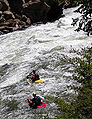
Grade I: Fast moving water with riffles and small waves. Few obstructions, all obvious and easily missed with little training. Risk to swimmers is slight; self-rescue is easy.
Grade II: Straightforward rapids with wide, clear channels which are evident without scouting. Occasional maneuvering may be required, but rocks and medium-sized waves are easily missed by trained paddlers. Swimmers are seldom injured and group assistance, while helpful, is seldom needed. Rapids that are at the upper end of this difficulty range are designated Class II+.
Grade III: Rapids with moderate, irregular waves which may be difficult to avoid and which can swamp an open canoe. Complex maneuvers in fast current and good boat control in tight passages or around ledges are often required; large waves or strainers may be present but are easily avoided. Strong eddies and powerful current effects can be found, particularly on large-volume rivers. scouting is advisable for inexperienced parties. Injuries while swimming are rare; self-rescue is usually easy but group assistance may be required to avoid long swims. Rapids that are at the lower or upper end of this difficulty range are designated Class III- or Class III+ respectively.
Grade IV: Intense, powerful but predictable rapids requiring precise boat handling in turbulent water. Depending on the character of the river, it may feature large, unavoidable waves and holes or constricted passages demanding fast maneuvers under pressure. A fast, reliable eddy turn may be needed to initiate maneuvers, scout rapids, or rest. Rapids may require “must” moves above dangerous hazards. Scouting may be necessary the first time down. Risk of injury to swimmers is moderate to high, and water conditions may make self-rescue difficult. Group assistance for rescue is often essential but requires practiced skills. A strong kayak roll
Kayak roll
The Kayak Roll is the act of righting a capsized kayak by use of body motion and/or a paddle. Typically this is done by lifting the torso towards the surface, flicking the hips to right the kayak halfway up and applying a righting force by means of the paddle while tucking close to the front or...
is highly recommended. Rapids that are at the lower or upper end of this difficulty range are designated Class IV- or Class IV+ respectively.
Grade V: Extremely long, obstructed, or very violent rapids which expose a paddler to added risk. Drops may contain large, unavoidable waves and holes or steep, congested chutes with complex, demanding routes. Rapids may continue for long distances between pools, demanding a high level of fitness. What eddies exist may be small, turbulent, or difficult to reach. At the high end of the scale, several of these factors may be combined. Scouting is recommended but may be difficult. Swims are dangerous, and rescue is often difficult even for experts. A very reliable kayak roll, proper equipment, extensive experience, and practiced rescue skills are essential. Because of the large range of difficulty that exists beyond Class IV, Class 5 is an open-ended, multiple-level scale designated by class 5.0, 5.1, 5.2, etc... each of these levels is an order of magnitude more difficult than the last. Example: increasing difficulty from Class 5.0 to Class 5.1 is a similar order of magnitude as increasing from Class IV to Class 5.0.
Grade VI: These runs have almost never been attempted and often exemplify the extremes of difficulty, unpredictability and danger. The consequences of errors are very severe and rescue may be impossible. For teams of experts only, at favorable water levels, after close personal inspection and taking all precautions. After a Class VI rapids has been run many times, its rating may be changed to an appropriate Class 5.x rating.
External links
- American Whitewater: International Scale of River Difficulty from American Whitewater
- Upgrading the American Version of the International Scale of River Difficulty from American Whitewater