
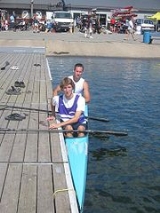
Canoe racing
This article discusses flatwater racing and marathon racing, competitive forms of
canoeing and
kayaking on more or less flat water. Both sports are discussed here together, as equipment and paddling technique are very similar, if not identical. Both sports are governed by the International Canoe Federation .
Flatwater racing , which is referred to by the IOC as "canoe/kayak flatwater", is one of the two forms of the two canoeing disciplines that feature in the
Summer Olympics, the other being canoe/kayak slalom. Marathon racing is not an Olympic sport.
Encyclopedia
- This article is about flatwater canoe racing. Other forms of canoe and kayak racing, such as e.g. whitewater racing, extreme racing, dragon boat racing and outrigger canoe racing, are practised on white water and/or use quite different boats and paddles. See the article on canoeing for a more general overview. For the distinction between the terms canoe and kayak see the article on the canoe.
This article discusses
flatwater racing and
marathon racing, competitive forms of
canoeing and
kayaking on more or less flat water. Both sports are discussed here together, as equipment and paddling technique are very similar, if not identical. Both sports are governed by the International Canoe Federation .
Flatwater racing , which is referred to by the IOC as "
canoe/kayak flatwater", is one of the two forms of the two canoeing disciplines that feature in the
Summer Olympics, the other being canoe/kayak slalom. Marathon racing is not an Olympic sport. In non-Olympic years the main event are the World Championships.
Flatwater racing
Flatwater racing takes place on a straight course divided in lanes, on calm water. The distances recognised by the ICF for international races are 200 m, 500 m, and 1000 m. Each boat has its own designated lane, except for races over more than 1000 m, where there also may be turning points. Men race in canoes and in kayaks, women only in kayaks except for in Canada, where womens canoe is an event raced at both Canada Games and National Championships. For each race a number of heats, semi-finals and a final may be necessary, depending on the number of competitors.
Flatwater racing has been part of the
Olympic Games since
1936 for men, and since
1948 for women. Notable Olympic
gold medal winners are Birgit Fischer-Schmidt and Gert Fredriksson .
List of Olympic events:
- C-1 1000 m Men
- C-1 500 m Men
- C-2 1000 m Men
- C-2 500 m Men
- K-1 1000 m Men
- K-1 500 m Men
- K-1 500 m Women
- K-2 1000 m Men
- K-2 500 m Men
- K-2 500 m Women
- K-4 1000 m Men
- K-4 500 m Women
In World and European Championship competitions, C-4 races are also held, as well as the women's races in all classes. 200 m races are also held although not for juniors. The 2006 World Championships were held in
Szeged, Hungary.
Marathon racing
Marathons are long distance races on rivers, lakes, estuaria or even open sea. The course may include obstacles such as shallows, rocks and
portages.
Under ICF rules, the minimum distances for international races are 20 km for men, and 15 km for women. The races may be divided in several parts and/or several days. World Cup and World Championship races normally are about 35 to 40 km long.
As there are no maximum distances, marathon racing has its extremes, such as the Devizes to Westminster Marathon in England , the Tour de Gudenå in Denmark , the Texas Water Safari , the Weyerhaeuser AuSable River Canoe Marathon , the Berg River Canoe Marathon in South Africa and the longest of them all, the
Red Cross Murray Marathon, 404km down the Murray River in Australia.
Equipment
The official boats recognised by the ICF as 'International Boats' are the following: K-1, K-2, K-4, C-1, C-2 and C-4, where the number indicates the number of paddlers, “K” stands for kayak and “C” for Canadian or Canoe, depending on location. Kayaks have a steering
rudder, which is operated by the paddler with his feet; in a kayak a paddler is sitting, while in a Canoe he is kneeling on one knee. The ICF rules for these boats define among others the maximum length, the minimum weight and the shape of the boats. For example, by ICF rules, a K-1 is at most 520 cm long, and weighs at least 8 kg for marathons, or 12 kg for sprints. In 2000, after the Olympic Games in Sidney, the ICF withdrew width restrictions on all boats, spurring a fury of innovations in boat designs. Modern boats are usually made of
carbon fiber and/or aramid fiber with
epoxy resin.
In Canada, a racing class exists for the C-15 or WC or "
War Canoe", as well as a similarly designed C-4 . An antiquated boat class is the C-7, resembling a large C-4 which was debuted by the ICF with little success.
Paddles for propelling are double-bladed for kayaks, and single-bladed for canoes, and are usually made of carbon fiber with epoxy.
For kayaks so-called wing paddles are generally used, the blades of which are shaped to resemble a
wing. These paddles are more efficient than traditional paddles, presumably because they create extra "lift" in the direction in which the kayak moves. The wing blade has undergone many evolutions in the past two decades, evolving from a flatter blade to one with a more pronounced curve to better catch the water. For racing canoes, the blade will typically be short and broad, with a 'power face' on one side of the blade which is either flat or scalloped out. The shaft will typically be longer than a tripping canoe paddle, because the kneeling position puts the paddler higher above the surface of the water. More recent designs of canoe racing paddles will often have a slight bent-shaft , but not to the degree used in marathon paddles. Many high-performance canoe paddlers prefer the feel of a carbon-fibre shaft mated to a wooden blade, while nearly all high-performance kayak paddlers use paddles made completely of carbon fiber.
See also
- Olympic medalists in canoeing
- List of Canoe/Kayak athletes by Country
External links
- , manufacturer of leading marathon canoes
- , one of the leading sprint and marathon boat manufacturers