


Sea kayak

Encyclopedia
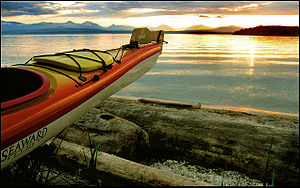
Kayak
A kayak is a small, relatively narrow, human-powered boat primarily designed to be manually propelled by means of a double blade paddle.The traditional kayak has a covered deck and one or more cockpits, each seating one paddler...
developed for the sport of paddling
Watercraft paddling
Paddling with regard to watercraft is the act of manually propelling or navigating a small boat using a blade that is joined to a shaft, known as paddle, in the water. The paddle is also used to steer the vessel and may either be a single bladed or double bladed...
on open waters of lakes, bays, and the ocean. Sea kayaks are seaworthy small boats with a covered deck and the ability to incorporate a spraydeck
Spraydeck
A spraydeck is a flexible cover for a boat, in particular for a kayak or a canoe. It is used in whitewater, inclement weather or sport to prevent water from entering the boat while allowing one or more passengers to sit in the boat and propel the boat by paddling or rowing.A spraydeck is a sheet...
. They trade off the maneuverability of whitewater
Whitewater
Whitewater is formed in a rapid, when a river's gradient increases enough to disturb its laminar flow and create turbulence, i.e. form a bubbly, or aerated and unstable current; the frothy water appears white...
kayaks for higher cruising speed, cargo capacity, ease of straight-line paddling, and comfort for long journeys.
Sea kayaks are used around the world for marine (sea) journeys from a few hours to many weeks, as they can accommodate one to three paddlers together with room for camping gear, food, water, and other supplies. A sea kayak usually ranges anywhere from 10–18 feet (3–5½ meters) for solo craft, and up to 26 feet (8 meters) for tandem craft. Width may be as little as 21" (50 cm), and may be up to 36" (90 cm).
Origins

Alaska
Alaska is the largest state in the United States by area. It is situated in the northwest extremity of the North American continent, with Canada to the east, the Arctic Ocean to the north, and the Pacific Ocean to the west and south, with Russia further west across the Bering Strait...
, northern Canada
Canada
Canada is a North American country consisting of ten provinces and three territories. Located in the northern part of the continent, it extends from the Atlantic Ocean in the east to the Pacific Ocean in the west, and northward into the Arctic Ocean...
, and Southwest Greenland
Greenland
Greenland is an autonomous country within the Kingdom of Denmark, located between the Arctic and Atlantic Oceans, east of the Canadian Arctic Archipelago. Though physiographically a part of the continent of North America, Greenland has been politically and culturally associated with Europe for...
. Eskimo
Eskimo
Eskimos or Inuit–Yupik peoples are indigenous peoples who have traditionally inhabited the circumpolar region from eastern Siberia , across Alaska , Canada, and Greenland....
hunters developed a fast sea going craft to hunt seals
Earless seal
The true seals or earless seals are one of the three main groups of mammals within the seal superfamily, Pinnipedia. All true seals are members of the family Phocidae . They are sometimes called crawling seals to distinguish them from the fur seals and sea lions of the family Otariidae...
and walrus
Walrus
The walrus is a large flippered marine mammal with a discontinuous circumpolar distribution in the Arctic Ocean and sub-Arctic seas of the Northern Hemisphere. The walrus is the only living species in the Odobenidae family and Odobenus genus. It is subdivided into three subspecies: the Atlantic...
. The ancient Aleut name for a sea kayak
Kayak
A kayak is a small, relatively narrow, human-powered boat primarily designed to be manually propelled by means of a double blade paddle.The traditional kayak has a covered deck and one or more cockpits, each seating one paddler...
is Iqyak, and earliest models were constructed from a light wooden frame (tied together with sinew or baleen
Baleen
Baleen or whalebone is a filter-feeder system inside the mouths of baleen whales. The baleen system works when a whale opens its mouth underwater and then water pours into the whale's mouth. The whale then pushes the water out, and animals such as krill are filtered by the baleen and remain as food...
) and covered with sea mammal (sea lion
Sea Lion
Sea lions are pinnipeds characterized by external ear-flaps, long fore-flippers, the ability to walk on all fours, and short thick hair. Together with the fur seal, they comprise the family Otariidae, or eared seals. There are six extant and one extinct species in five genera...
or seal
Pinniped
Pinnipeds or fin-footed mammals are a widely distributed and diverse group of semiaquatic marine mammals comprising the families Odobenidae , Otariidae , and Phocidae .-Overview: Pinnipeds are typically sleek-bodied and barrel-shaped...
) hides. Archaeologists have found evidence indicating that kayaks are at least 4000 years old. Wooden kayaks and fabric kayaks on wooden frames (such as the Klepper
Folding kayak
A folding kayak is a direct descendant of the original Inuit kayak made of animal skins stretched over frames made from wood and bones. A modern folder has a collapsible frame made of some combination of wood, aluminium and plastic, and a skin made of a tough fabric with a waterproof coating...
) were dominating the market up until 1950s, when fiberglass boats were first introduced. Rotomolded plastic
Plastic
A plastic material is any of a wide range of synthetic or semi-synthetic organic solids used in the manufacture of industrial products. Plastics are typically polymers of high molecular mass, and may contain other substances to improve performance and/or reduce production costs...
kayaks first appeared in 1984.
Design

Folding kayak
A folding kayak is a direct descendant of the original Inuit kayak made of animal skins stretched over frames made from wood and bones. A modern folder has a collapsible frame made of some combination of wood, aluminium and plastic, and a skin made of a tough fabric with a waterproof coating...
kayaks. Folding kayaks are in some ways more traditional boats, being similar in design to skin-on-frame kayaks used by native people. Modern folding kayaks use contemporary materials such as aluminum for the frame, and replace the sealskin covering with synthetic waterproof fabrics. Unlike native kayaks, folding kayaks can be easily disassembled and packed for transport. Many folding kayaks include inflatable sponsons that improve the secondary stability of the vessel, helping to prevent capsize. More recently, a class of inflatable folding kayaks has emerged, combining a more limited rigid frame with a tightly inflated skin to produce greater rigidity than an inflatable boat alone.
Most rigid sea kayaks also derive from the external designs of native vessels, especially those from Greenland, but the strength of modern materials such as fiberglass
Fiberglass
Glass fiber is a material consisting of numerous extremely fine fibers of glass.Glassmakers throughout history have experimented with glass fibers, but mass manufacture of glass fiber was only made possible with the invention of finer machine tooling...
, rotomolded plastic and carbon fiber
Carbon fiber
Carbon fiber, alternatively graphite fiber, carbon graphite or CF, is a material consisting of fibers about 5–10 μm in diameter and composed mostly of carbon atoms. The carbon atoms are bonded together in crystals that are more or less aligned parallel to the long axis of the fiber...
eliminate the need for an internal frame, though significantly increasing weight. Modern skin-on-frame sea kayaks constructed with nylon
Nylon
Nylon is a generic designation for a family of synthetic polymers known generically as polyamides, first produced on February 28, 1935, by Wallace Carothers at DuPont's research facility at the DuPont Experimental Station...
skins represent an ultralight niche within the rigid sea kayak spectrum. Some recent design innovations include:
- RecreationalRecreational kayakA Recreational Kayak is a type of kayak that is designed for the casual paddler interested in recreational activities on a lake or flatwater stream; they presently make up the largest segment of kayak sales...
kayaks—shorter sea kayaks with wide beams and large cockpits intended for sheltered waters - Sit-on-top kayaks—rotomolded boats without an enclosed cockpit, but with the basic hull shape of a kayak.
A different class of vessel has also emerged, the Surf ski, a long, narrow boat with low inherent stability that is intended for use in surf and following waves.
Size
Most production sea kayaks are between 12 feet (3.7 m) and 24 feet (7.3 m) in length, the larger kayaks often built for two (or in rare cases, three) paddlers. The width (beamBeam (nautical)
The beam of a ship is its width at the widest point. Generally speaking, the wider the beam of a ship , the more initial stability it has, at expense of reserve stability in the event of a capsize, where more energy is required to right the vessel from its inverted position...
) of typical kayaks varies from 18 inches (457.2 mm) to 32 inches (812.8 mm), though specialized boats such as surf skis
Surf skis
A surf ski is a long, narrow, lightweight kayak with an open cockpit, usually with a foot pedal controlled rudder.- Characteristics :...
may be narrower. The length of a kayak affects not only its cargo capacity (for both gear and paddlers) but may also affect its "tracking" ability—the ease with which the boat travels in a straight line. While other design features also impact tracking, very long kayaks are easier to paddle straight (and harder to turn). The width of a kayak affects the cargo capacity, the maximum size of the cockpit (and thus the size of the paddler in that cockpit), and (to a degree that depends on the design of the hull) the stability
Stability conditions (watercraft)
Stability conditions is the term used to describe the various standard loading configurations to which a ship, boat, or offshore platform may be subjected. They are recognized by classification societies such as Lloyd's Register, American Bureau of Shipping and Det Norske Veritas...
.
Material
Most rigid production kayaks are now made out of fiberglassFiberglass
Glass fiber is a material consisting of numerous extremely fine fibers of glass.Glassmakers throughout history have experimented with glass fibers, but mass manufacture of glass fiber was only made possible with the invention of finer machine tooling...
, rotomolded polyethylene, or carbon
Carbon
Carbon is the chemical element with symbol C and atomic number 6. As a member of group 14 on the periodic table, it is nonmetallic and tetravalent—making four electrons available to form covalent chemical bonds...
-kevlar
Kevlar
Kevlar is the registered trademark for a para-aramid synthetic fiber, related to other aramids such as Nomex and Technora. Developed at DuPont in 1965, this high strength material was first commercially used in the early 1970s as a replacement for steel in racing tires...
. More exotic materials include carbon fiber
Carbon fiber
Carbon fiber, alternatively graphite fiber, carbon graphite or CF, is a material consisting of fibers about 5–10 μm in diameter and composed mostly of carbon atoms. The carbon atoms are bonded together in crystals that are more or less aligned parallel to the long axis of the fiber...
and foam core. Some kayaks are hand-built from plywood
Plywood
Plywood is a type of manufactured timber made from thin sheets of wood veneer. It is one of the most widely used wood products. It is flexible, inexpensive, workable, re-usable, and can usually be locally manufactured...
or wood strips covered with fiberglass
Fiberglass
Glass fiber is a material consisting of numerous extremely fine fibers of glass.Glassmakers throughout history have experimented with glass fibers, but mass manufacture of glass fiber was only made possible with the invention of finer machine tooling...
. Skin-on-frame kayaks are built on wood or aluminum frames covered in canvas
Canvas
Canvas is an extremely heavy-duty plain-woven fabric used for making sails, tents, marquees, backpacks, and other items for which sturdiness is required. It is also popularly used by artists as a painting surface, typically stretched across a wooden frame...
, dacron, or other fabrics, and may include inflatable tubes called sponsons.
Marine Grade plywood available today provides a high strength to weight ratio for kayak construction.
Bow, stern, and deck
There are many design approaches for the bow, stern, and deck of kayaks. Some kayaks have upturned bows, which are meant to provide better performance when paddling into waves, as well as better wave-shedding ability. Other kayaks achieve this through increased buoyancyBuoyancy
In physics, buoyancy is a force exerted by a fluid that opposes an object's weight. In a column of fluid, pressure increases with depth as a result of the weight of the overlying fluid. Thus a column of fluid, or an object submerged in the fluid, experiences greater pressure at the bottom of the...
in the bow. Kayaks with unobstructed stern decks may ease certain types of self-rescue. Waterproof bulkheads in modern kayaks provide flotation in the event of capsize.
Sea kayak decks typically include one or more hatch
Hatch
Hatch may refer to:* Hatching, also called "cross-hatching", an artistic technique used to create tonal or shading effects using closely spaced parallel lines* Hatching, the emergence of a young animal from an egg...
es for easy access to the interior storage space inside. Kayak decks often include attachment points for deck lines of various kinds, which are aids in self-rescue and attachment points for above-deck equipment.
Equipment
Sea Kayaks have a wide range of hull designs, which greatly expands their range of performance. Designs can accommodate a wide range of physical fitness, or usage. Boats come in many lengths, whereby shorter boats are generally more maneuverable, and longer boats generally travel straighter and faster. Width of beam can affect a boat's stability, speed, and ability to bring to an edge. The amount of rocker (the curve from bow to stern) can greatly affect the ability of a boat to turn.Many have steering gear or tracking aids in the form of rudder
Rudder
A rudder is a device used to steer a ship, boat, submarine, hovercraft, aircraft or other conveyance that moves through a medium . On an aircraft the rudder is used primarily to counter adverse yaw and p-factor and is not the primary control used to turn the airplane...
s or skeg
Skeg
A skeg is a sternward extension of the keel of boats and ships which have a rudder mounted on the centre line. The term also applies to the lowest point on an outboard motor or the outdrive of an inboard/outboard...
s. In most cases rudders are attached at the stern and operated by wires from foot pedals in the cockpit. Rudders are typically retractable for beach landings. Skegs are straight blades that drop from a well in the stern of the boat. Both devices assist in paddling when a strong wind is coming from a direction other than directly in front.
Paddles
Sea-kayak paddlePaddle
A paddle is a tool used for pushing against liquids, either as a form of propulsion in a boat or as an implement for mixing.-Materials and designs:...
s, and the associated paddling styles, fall into three basic classifications:
- European
- two roughly spoon-shaped blades at either end of a cylindrical shaft. This paddle style was developed for fast acceleration and sudden maneuvering in Whitewater kayakingWhitewater kayakingWhitewater kayaking is the sport of paddling a kayak on a moving body of water, typically a whitewater river. Whitewater kayaking can range from simple, carefree gently moving water, to demanding, dangerous whitewater. River rapids are graded like ski runs according to the difficulty, danger or...
, and then back-ported to sea-kayaking. Euro paddles can be made of aluminum, plastic or even wood, but the best are usually formed of more expensive materials like carbon-fiber for lightness. Often the two blades are feathered, or set at an angle relative to each other (both for ergonomic efficiency, and so that as one blade moves backwards through the water, the opposite blade moving forward through the air presents its edge, rather than its face).

- Greenland
- Relatively narrow blades which are rounded and full near the loom and blade roots, and becoming oval near the blade tips. Some paddles feature a "shoulder", or abrupt transition between the loom and blade roots. Greenland paddle blades are most often not feathered. Short Greenland paddles (generally one arm-span in length), called storm paddles, are used with a sliding stroke, where the hands are shifted along the blades for each stroke. Storm paddles are often used as spares and in very windy locations, as there is very little outboard blade to catch the wind.

- Wing
- The blade of the paddle is shaped with a profile like a wing. When used with a special stroke, the blade actually produces lift as it moves through the water, enabling the kayaker to produce more forward motion than with any other kind of paddle. The paddling technique is different from both European style paddles and Greenland style. It is most often used in racing, but also sees some limited use in recreational paddling such as touring.
Dimensions
True Sea kayaks, not to be mistaken for wider, more stable recreational kayaks, come in many designs. The length of a solo sea kayak can range anywhere from 14 to 20 feet (3.7m-5.8m) long, and tandem kayaks can range from 18 to 24 feet (4.6m-6.1m) long. Sea kayaks can range in width from 20 inches (508 mm) to 24 inches (57 cm-76 cm). Wider touring kayaks of 23 inches (584.2 mm) to 24 inches (66–76 cm) are better for bigger paddlers, or small/average sized paddlers looking for more initial stability and maneuverability. Narrower beams of 20 inches (508 mm) to 23 inches (56 cm-63.5 cm) are good for small-medium sized paddlers who want more speed and less maneuverability. And lastly, kayak depth (or the height from the hull to the highest area of the deck) can range from 11 inches (279.4 mm) to 13 inches (33 cm-40 cm) high.This design is typical of modern sea kayaks and has a low rear deck for easy rolling, a white water cockpit, compartments that allow the kayaker to reach into them while at sea, and a sloping rear bulkhead that enables the kayak to be emptied by lifting the bow.
Safety

While there are a number of techniques for unassisted righting and re-entry of a kayak after a capsize
Capsize
Capsizing is an act of tipping over a boat or ship to disable it. The act of reversing a capsized vessel is called righting.If a capsized vessel has sufficient flotation to prevent sinking, it may recover on its own if the stability is such that it is not stable inverted...
, most paddlers consider it safest to paddle with one or more others, as assistance is useful if attempting to roll up solo fails. Even if the assistance fails to get you righted, it's a lot easier to climb back into a boat in the open sea if you've got another boat and paddler to help and your boat's been emptied of water first. Nonetheless, experienced paddlers do attempt open water crossings unaccompanied, and several major long-distance kayak expeditions have been carried out solo.
The use of a Paddle float
Paddle float
A Paddle float may be used for reentry into a kayak after a capsize in open water. It may also be used for a reentry and roll, or for training a kayak roll. Paddle floats made of foam usually have less buoyancy, but may be easier to handle in cold conditions....
self rescue device, generally consisting of foam, or inflatable bag, attached to the end of a paddle, allows a paddler to use the paddle as an outrigger, while climbing back into the cockpit. Be sure if you use an inflatable paddle float that you use a dual chambered model, but only train with one chamber inflated. A double chambered device will give you redundancy in case of a failure in one chamber. Training with one chamber inflated won't leave you handicapped if one chamber does fail. In many areas (Canada for instance) this is a coast guard required item. This fairly reliable rescue technique, if well practised, allows one to paddle with confidence when not equipped with a 'bombproof' roll.
There is a strong culture of self-sufficiency amongst sea kayakers and extensive safety equipment such as compass, towing lines, manual pumps, repair kits including wet application repair tape, flares, paddle leash
Paddle leash
A paddle leash may be used for securing a paddle in open water with a sea kayak. Especially on solo tours after capsizing a paddle might drift away through wind or waves and not be recovered. A paddle leash must not be used in whitewater kayaking due to the danger of getting strangled....
, spare paddles, and survival gear are routinely carried; along with supplies of food and a flask of non-caffeinated beverage for non-emergency use. GPS, charts, lights, radios and cell phones, and radar reflectors are also sometimes carried.
Forms of sea kayaking
Kayak Sailing
Developed by kayak enthusiasts, kayak sails enhance the paddling experience. Kayak sails either augment the effort of paddling or effectively eliminate the need for paddling. They are great for touring, and have established a strong following with sensible, recreational sea kayakers, expedition paddlers and adventure racers.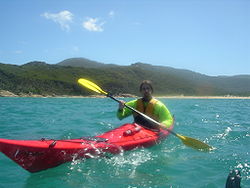
Expedition Trips
Weekend trips with overnight camping are popular amongst recreational kayakers, and many people combine kayaking with watching wildlife. Modern sea kayaks are designed to carry large amounts of equipment, and unsupported expeditions of two weeks or more are conducted in environments from the tropics to the Arctic. Expedition kayaks are designed to handle best when loaded, so it may be necessary to ballast them on shorter trips.Surf Kayaking
Closely related to surf boards and requiring a mix of surfingSurfing
Surfing' is a surface water sport in which the surfer rides a surfboard on the crest and face of a wave which is carrying the surfer towards the shore...
and kayaking skills, a wide range of sea kayaks are specifically designed for the sport of wave surfing.
Sea Fishing
The sea kayakKayak
A kayak is a small, relatively narrow, human-powered boat primarily designed to be manually propelled by means of a double blade paddle.The traditional kayak has a covered deck and one or more cockpits, each seating one paddler...
has long been a means of transportation and a means of accessing fishing grounds and kayak fishing has gained popularity due to the availability of purpose built stable designs. This technological development also solves some ergonomic problems that are associated with sitting for long hours without being able to change positions and special kayaks for fishing are accessorized for this sport, including specially-designed hatches, built-in rod holders, catch bags and equipment mounts.
Many of the techniques used in kayak fishing are the same as those used on other fishing boats. The difference is in the set-up, how each piece of equipment is fitted to the kayak, and how each activity is carried out on such a small craft. Contemporary kayaks can be equipped with fishing aids such as rod holders, electronic fish-finders
Fishfinder
A fishfinder is an instrument used to locate fish underwater by detecting reflected pulses of sound energy, as in SONAR. A modern fishfinder displays measurements of reflected sound on a graphical display, allowing an operator to interpret information to locate schools of fish, underwater debris,...
and live-bait containers. Kayak anglers target highly-prized bottom feeders like halibut
Halibut
Halibut is a flatfish, genus Hippoglossus, from the family of the right-eye flounders . Other flatfish are also called halibut. The name is derived from haly and butt , for its popularity on Catholic holy days...
and cod
Cod
Cod is the common name for genus Gadus, belonging to the family Gadidae, and is also used in the common name for various other fishes. Cod is a popular food with a mild flavor, low fat content and a dense, flaky white flesh. Cod livers are processed to make cod liver oil, an important source of...
and also pelagics
Pelagic zone
Any water in a sea or lake that is not close to the bottom or near to the shore can be said to be in the pelagic zone. The word pelagic comes from the Greek πέλαγος or pélagos, which means "open sea". The pelagic zone can be thought of in terms of an imaginary cylinder or water column that goes...
like amberjack
Amberjack
Amberjack refers to 3 species of Atlantic fish of the Carangidae family , which includes the jacks and the pompanos.Greater amberjacks, Seriola dumerili, are the largest of the jacks. They usually have dark stripes extending from nose to in front of their dorsal fins...
s, tuna
Tuna
Tuna is a salt water fish from the family Scombridae, mostly in the genus Thunnus. Tuna are fast swimmers, and some species are capable of speeds of . Unlike most fish, which have white flesh, the muscle tissue of tuna ranges from pink to dark red. The red coloration derives from myoglobin, an...
, sailfish
Sailfish
'Sailfish' are two species of fish in the genus Istiophorus, living in warmer sections of all the oceans of the world. They are predominately blue to gray in color and have a characteristic erectile dorsal fin known as a sail, which often stretches the entire length of the back...
, wahoo
Wahoo
The wahoo is a scombrid fish found worldwide in tropical and subtropical seas. It is best known to sports fishermen, as its speed and high-quality flesh make it a prize game fish...
, and even marlin
Marlin
Marlin, family Istiophoridae, are fish with an elongated body, a spear-like snout or bill, and a long rigid dorsal fin, which extends forward to form a crest. Its common name is thought to derive from its resemblance to a sailor's marlinspike...
.
Pioneering sea kayak expeditions
Pre-1900- There is controversial evidence to suggest early trans-atlantic kayak journeys from Labrador or Greenland to Scotland by Inuit paddlers. Indeed at the end of the 17th century there were at least three separate kayaks preserved in Scotland. One kayak, with associated equipment, is preserved in Aberdeen's Marischal MuseumMarischal MuseumThe Marischal Museum is the main museum in the city centre of Aberdeen, Scotland. It was established in 1786 and is situated in the architecturally notable Marischal College building, part of the University of Aberdeen....
. It was found, with dying occupant, on a nearby shore. Some suggest the occupants were escaped Inuit from European ships, Inuit storm-driven from Greenland, or from a European source. Many suggest Inuit and their kayaks to be the origin of the Celtic Finnman, or SelkieSelkieSelkies are mythological creatures that are found in Faroese, Icelandic, Irish, and Scottish folklore....
, legends.
1920s
- Franz Romer crossed the Atlantic Ocean solo in a kayak in 1928. His crossing from the Canary Islands and Puerto Rico took 58 days at sea but he was lost in a hurricane trying to get to New York
1930s
- Oskar SpeckOskar SpeckOskar Speck was a German canoeist who paddled by folding kayak from Germany to Australia over the period 1932-1939. A Hamburg electrical contractor made unemployed during the Weimar-period Depression, he left Germany to seek work in the Cypriot copper mines, departing from Ulm and travelling south...
paddled from Germany to Australia in 1932-1939.
1950s
- Hannes LindemannHannes LindemannHannes Lindemann is a German doctor, navigator and sailor. He made two solo transatlantic crossings, one in a sailing dugout canoe made while working in Liberia and the second in a seventeen-foot Klepper Aerius II double folding kayak, modified to carry two masts and an outrigger. His book Alone...
paddled, with the help of a sail, from the Canary Islands to the Caribbean in 1956. Documented in the book "Alone at sea".
1970s
- Derek Hutchinson was the first to cross the North seaNorth SeaIn the southwest, beyond the Straits of Dover, the North Sea becomes the English Channel connecting to the Atlantic Ocean. In the east, it connects to the Baltic Sea via the Skagerrak and Kattegat, narrow straits that separate Denmark from Norway and Sweden respectively...
in 1976. After several near-death failures he finally managed it in 31 hours. - Nigel FosterNigel Foster (kayaker)Nigel Foster is an English sea kayaker, kayak designer, instructor and author. He is the first and youngest paddler to circle Iceland by kayak....
and Geoff Hunter were the first to circumnavigate Iceland in 1977. - Frank Goodman was the first to circumnavigate Cape Horn in 1977.
- Paul CaffynPaul CaffynPaul Caffyn is a well renowned sea kayaker based on the west coast of New Zealand. He has completed a number of supported, unsupported, solo and group expeditions by sea kayak in various locations around the world...
was the first person to circumnavigate the South IslandSouth IslandThe South Island is the larger of the two major islands of New Zealand, the other being the more populous North Island. It is bordered to the north by Cook Strait, to the west by the Tasman Sea, to the south and east by the Pacific Ocean...
of New ZealandNew ZealandNew Zealand is an island country in the south-western Pacific Ocean comprising two main landmasses and numerous smaller islands. The country is situated some east of Australia across the Tasman Sea, and roughly south of the Pacific island nations of New Caledonia, Fiji, and Tonga...
in 1977. He describes it in his book Obscured by Waves.
1980s
- Paul CaffynPaul CaffynPaul Caffyn is a well renowned sea kayaker based on the west coast of New Zealand. He has completed a number of supported, unsupported, solo and group expeditions by sea kayak in various locations around the world...
and Nigel Dennis were the first sea kayakers to circumnavigate Britain in 1980, a distance of 2200 miles (3,540.5 km) in 85 days - Nigel FosterNigel Foster (kayaker)Nigel Foster is an English sea kayaker, kayak designer, instructor and author. He is the first and youngest paddler to circle Iceland by kayak....
solo crossing of Hudson Strait from Baffin Island to Northern Labrador 1981 - Paul CaffynPaul CaffynPaul Caffyn is a well renowned sea kayaker based on the west coast of New Zealand. He has completed a number of supported, unsupported, solo and group expeditions by sea kayak in various locations around the world...
was the first person to circumnavigate AustraliaAustraliaAustralia , officially the Commonwealth of Australia, is a country in the Southern Hemisphere comprising the mainland of the Australian continent, the island of Tasmania, and numerous smaller islands in the Indian and Pacific Oceans. It is the world's sixth-largest country by total area...
in 1981/2 covering a distance of 9,420 miles (17,400 km) - David Taylor and James Moore were the first to circumnavigate The Faroe Islands (mid way between Shetland and Iceland) in 1985.
- Ed Gillet paddled from California to Hawaii in 1987.
- Howard RiceHoward RiceHoward Rice sailed and paddled a sailing canoe solo around Cape Horn, Chile considered by many sailors to be the Mount Everest of sailing challenges...
first solo around Cape HornCape HornCape Horn is the southernmost headland of the Tierra del Fuego archipelago of southern Chile, and is located on the small Hornos Island...
in 1989.
1990s
- Adventurer Chris DuffChris DuffChris Duff is an American expedition sea kayaker, who is most notable for his large scale projects and world-record breaking attempts. Since 1983, he has kayaked over 14,000 miles.-Expeditions:...
has circumnavigated both IrelandIrelandIreland is an island to the northwest of continental Europe. It is the third-largest island in Europe and the twentieth-largest island on Earth...
in 1996 and New ZealandNew ZealandNew Zealand is an island country in the south-western Pacific Ocean comprising two main landmasses and numerous smaller islands. The country is situated some east of Australia across the Tasman Sea, and roughly south of the Pacific island nations of New Caledonia, Fiji, and Tonga...
's South IslandSouth IslandThe South Island is the larger of the two major islands of New Zealand, the other being the more populous North Island. It is bordered to the north by Cook Strait, to the west by the Tasman Sea, to the south and east by the Pacific Ocean...
in 2000. - The crossing of Europe by various rivers in 1998.
- Trys Morris and Bob Timms have attempted to paddle from UK to Australia 1999 & 2000, abandoning the expedition in Athens, Greece due to lack of funds and visas for Arabian countries.
2000s
- Jon Turk and his team was the first to cross the Bering strait as they paddled from Japan to Alaska in 2000.
- In his book Cold Oceans (1999), Jon Turk describes his attempt to solo circumnavigate Cape HornCape HornCape Horn is the southernmost headland of the Tierra del Fuego archipelago of southern Chile, and is located on the small Hornos Island...
. - Peter BrayPeter BrayPeter Bray was, in 2001, the third person known to cross the Atlantic Ocean alone in a kayak but the first one to paddle west to east and also the first one not using sails to help his paddling...
crossed from Canada to Ireland in 2001. - Trys Morris, Gemma Rawlings and Justine Curgenven successfully circumnavigated TasmaniaTasmaniaTasmania is an Australian island and state. It is south of the continent, separated by Bass Strait. The state includes the island of Tasmania—the 26th largest island in the world—and the surrounding islands. The state has a population of 507,626 , of whom almost half reside in the greater Hobart...
in 2004. This journey is featured in This Is The Sea 2 - Harry Whelan, Barry ShawBarry ShawBarry Shaw is a member of Plaid Cymru. He is standing for the Vale of Glamorgan constituency in the National Assembly for Wales election, 2007....
and Phil Clegg are considered to have been the fastest around Britain in 2005, completing the circumnavigation in 80 days - In November 2005 the first kayak circumnavigation of South GeorgiaSouth Georgia and the South Sandwich IslandsSouth Georgia and the South Sandwich Islands is a British overseas territory and overseas territory of the European Union in the southern Atlantic Ocean. It is a remote and inhospitable collection of islands, consisting of South Georgia and a chain of smaller islands, known as the South Sandwich...
in the Southern Atlantic was completed by The Adventure Philosophy team of Graham Charles, Marcus Waters and Mark Jones in 18 days, a distance of 600 km. - Eric StillerEric StillerEric Stiller is an author and kayaker based in New York, USA.Eric Stiller is the co-founder of a Manhattan Kayak Company in 1995 and author of Keep Australia on Your Left , the story of an attempt by Tony Brown and Stiller to kayak all the way around Australia...
and Tony BrownTony BrownTony Brown may refer to:*Tony Brown , known as Tony Brown, Chief Minister of the Isle of Man*Tony Brown , Australian rules footballer...
attempted circumnavigation of AustraliaAustraliaAustralia , officially the Commonwealth of Australia, is a country in the Southern Hemisphere comprising the mainland of the Australian continent, the island of Tasmania, and numerous smaller islands in the Indian and Pacific Oceans. It is the world's sixth-largest country by total area...
. Described in the book Keep Australia on your left (2002). - Solo Kayak Circumnavigation of Iceland - Rotem Ron in the year (2006) Circumnavigation of Iceland.
- Andrew McAuleyAndrew McAuleyAndrew McAuley was an Australian adventurer. He is best known for his mountaineering and sea kayaking in remote parts of the world. He is presumed to have died following his disappearance at sea while attempting to kayak 1600 km across the Tasman Sea in February 2007.-Personal:McAuley was...
, an Australian solo kayaker, was lost at sea in February 2007 only 30 nautical miles (55.6 km) short of his destination of Milford SoundMilford SoundMilford Sound is a fjord in the south west of New Zealand's South Island, within Fiordland National Park, Piopiotahi Marine Reserve, and the Te Wahipounamu World Heritage site...
, New Zealand, during his attempt to cross from Australia to New Zealand.http://www.abc.net.au/news/newsitems/200702/s1844840.htm - Justin Jones and James Castrission made the first crossingCrossing the DitchCrossing the Ditch was the effort of adventurers Justin Jones and James Castrission to become the first to cross the Tasman Sea and travel from Australia to New Zealand by sea kayak....
from Australia to New Zealand, arriving on 13 January 2008, a journey that took 61 days. This is the longest two man kayak expedition ever undertaken. - In 2009 there are 2 separate expeditions attempting to circumnavigate the Falkland IslandsFalkland IslandsThe Falkland Islands are an archipelago in the South Atlantic Ocean, located about from the coast of mainland South America. The archipelago consists of East Falkland, West Falkland and 776 lesser islands. The capital, Stanley, is on East Falkland...
. One British team and Marcus Demuth, a solo American. - Freya HoffmeisterFreya HoffmeisterFreya Hoffmeister is a German woman who holds several sea kayaking endurance records. In 2009 she completed a circumnavigation of Australia solo and unassisted, becoming the first woman and only the second person to do so...
made the "Race Around Australia" and successfully circumnavigate Australia at 2009.
2010s
- Fastest solo circumnavigation of Great Britain in 80 days Marcus Demuth (2010)
- On the turn 2010/2011, polish kayaker Aleksander DobaAleksander DobaAleksander Doba , lives in Police near Szczecin, Poland is the first person who sailed alone using only muscles power directly from continent to continent across the Atlantic ocean for 5394 kilometers in a 7 meter ocean kayak. Doba's effort is believed to be the longest open-water crossing ever...
crossed from DakarDakarDakar is the capital city and largest city of Senegal. It is located on the Cap-Vert Peninsula on the Atlantic coast and is the westernmost city on the African mainland...
(AfricaAfricaAfrica is the world's second largest and second most populous continent, after Asia. At about 30.2 million km² including adjacent islands, it covers 6% of the Earth's total surface area and 20.4% of the total land area...
- SenegalSenegalSenegal , officially the Republic of Senegal , is a country in western Africa. It owes its name to the Sénégal River that borders it to the east and north...
) to FortalezaFortalezaFortaleza is the state capital of Ceará, located in Northeastern Brazil. With a population close to 2.5 million , Fortaleza is the 5th largest city in Brazil. It has an area of and one of the highest demographic densities in the country...
(South AmericaSouth AmericaSouth America is a continent situated in the Western Hemisphere, mostly in the Southern Hemisphere, with a relatively small portion in the Northern Hemisphere. The continent is also considered a subcontinent of the Americas. It is bordered on the west by the Pacific Ocean and on the north and east...
- Brasil) - On August 30, 2011 Freya HoffmeisterFreya HoffmeisterFreya Hoffmeister is a German woman who holds several sea kayaking endurance records. In 2009 she completed a circumnavigation of Australia solo and unassisted, becoming the first woman and only the second person to do so...
began a circumnavigation of South America.
See also
- KayakKayakA kayak is a small, relatively narrow, human-powered boat primarily designed to be manually propelled by means of a double blade paddle.The traditional kayak has a covered deck and one or more cockpits, each seating one paddler...
- Recreational kayakRecreational kayakA Recreational Kayak is a type of kayak that is designed for the casual paddler interested in recreational activities on a lake or flatwater stream; they presently make up the largest segment of kayak sales...
- Whitewater kayakingWhitewater kayakingWhitewater kayaking is the sport of paddling a kayak on a moving body of water, typically a whitewater river. Whitewater kayaking can range from simple, carefree gently moving water, to demanding, dangerous whitewater. River rapids are graded like ski runs according to the difficulty, danger or...
- Surf KayakingSurf KayakingSurf Kayaking is the sport, technique, and equipment, used in surfing ocean waves with kayaks. Surf kayaking has many similarities to surf board surfing, but with boats designed for use in surf zones, and with a paddle...
- Folding kayakFolding kayakA folding kayak is a direct descendant of the original Inuit kayak made of animal skins stretched over frames made from wood and bones. A modern folder has a collapsible frame made of some combination of wood, aluminium and plastic, and a skin made of a tough fabric with a waterproof coating...