


Camera phone

Encyclopedia
Mobile phone
A mobile phone is a device which can make and receive telephone calls over a radio link whilst moving around a wide geographic area. It does so by connecting to a cellular network provided by a mobile network operator...
which is able to capture still photograph
Photograph
A photograph is an image created by light falling on a light-sensitive surface, usually photographic film or an electronic imager such as a CCD or a CMOS chip. Most photographs are created using a camera, which uses a lens to focus the scene's visible wavelengths of light into a reproduction of...
s (and usually video
Video
Video is the technology of electronically capturing, recording, processing, storing, transmitting, and reconstructing a sequence of still images representing scenes in motion.- History :...
). Since early in the 21st century the majority of mobile phones in use are camera phones.
Most camera phones are simpler than separate digital camera
Digital camera
A digital camera is a camera that takes video or still photographs, or both, digitally by recording images via an electronic image sensor. It is the main device used in the field of digital photography...
s. Their usual fixed focus lenses and smaller sensors
Image sensor
An image sensor is a device that converts an optical image into an electronic signal. It is used mostly in digital cameras and other imaging devices...
limit their performance in poor lighting. Having no physical shutter, most have a long shutter lag
Shutter lag
In photography, shutter lag is the delay between triggering the shutter and when the photograph is actually recorded. This is a common problem in the photography of fast-moving objects or people in motion...
. Most have no flash
Flash (photography)
A flash is a device used in photography producing a flash of artificial light at a color temperature of about 5500 K to help illuminate a scene. A major purpose of a flash is to illuminate a dark scene. Other uses are capturing quickly moving objects or changing the quality of light...
or optical zoom
Zoom lens
A zoom lens is a mechanical assembly of lens elements for which the focal length can be varied, as opposed to a fixed focal length lens...
or tripod screw
Tripod (photography)
In photography, a tripod is used to stabilize and elevate a camera, or to support flashes or other photographic equipment. All photographic tripods have three legs and a mounting head to couple with a camera...
. Many lack a USB connection, removable memory card
Memory card
A memory card or flash card is an electronic flash memory data storage device used for storing digital information. They are commonly used in many electronic devices, including digital cameras, mobile phones, laptop computers, MP3 players, and video game consoles...
, or other way of transferring their pictures more quickly than by the phone's inherent communication feature.
Some of the more expensive camera phones have only a few of these technical disadvantages, which apply most acutely in low light conditions and in any case have not inhibited their widespread use. Most model lines improve in these regards every year or two. Some, such as the Droid Incredible
Droid Incredible
The HTC DROID Incredible is a smartphone manufactured by HTC Corporation using the Android operating system. The DROID Incredible was released on April 29, 2010, and is available through Verizon Wireless only. The device is similar to the Sprint HTC Evo 4G...
only have a menu choice to start an application program to activate the camera. Others, such as the BlackBerry Storm2, Droid X, Motorola V980 and Nokia 5800
Nokia 5800
Nokia 5800 XpressMusic is a smartphone and portable entertainment device by Nokia. It was introduced on January 2, 2008 and released on April 27, 2008. Code-named "Tube", it is the first touchscreen-equipped S60 device by Nokia, the version being s60v5. It's part of the XpressMusic series of...
also have a separate camera button for quickness and convenience. Some are designed to resemble separate low-end digital compact cameras in appearance and to some extent in features and picture quality, and are branded as both mobile phones and cameras, including certain Sony phones.
The principal advantages of camera phones are cost and compactness; indeed for a user who carries a mobile phone anyway, the additional size and cost are negligible. Smartphone
Smartphone
A smartphone is a high-end mobile phone built on a mobile computing platform, with more advanced computing ability and connectivity than a contemporary feature phone. The first smartphones were devices that mainly combined the functions of a personal digital assistant and a mobile phone or camera...
s that are camera phones may run mobile applications to add capabilities such as geotagging
GeoTagging
Geotagging is the process of adding geographical identification metadata to various media such as a geotagged photograph or video, websites, SMS messages, QR Codes or RSS feeds and is a form of geospatial metadata...
and image stitching
Image stitching
Image stitching or photo stitching is the process of combining multiple photographic images with overlapping fields of view to produce a segmented panorama or high-resolution image. Commonly performed through the use of computer software, most approaches to image stitching require nearly exact...
. A few high end phones can use their touch screen to direct their camera to focus on a particular object in the field of view, giving even an inexperienced user a degree of focus control exceeded only by seasoned photographers using manual focus.
Technology
Some camera phones use CMOSCMOS
Complementary metal–oxide–semiconductor is a technology for constructing integrated circuits. CMOS technology is used in microprocessors, microcontrollers, static RAM, and other digital logic circuits...
image sensors, due largely to reduced power consumption compared to CCD
Charge-coupled device
A charge-coupled device is a device for the movement of electrical charge, usually from within the device to an area where the charge can be manipulated, for example conversion into a digital value. This is achieved by "shifting" the signals between stages within the device one at a time...
type cameras, which are also used.
Images are usually saved in the JPEG file format, and the wireless infrastructure manages the sharing. The lower power consumption prevents the camera from quickly depleting the phones battery.
History
The camera phone, like many complex systemsComplex systems
Complex systems present problems in mathematical modelling.The equations from which complex system models are developed generally derive from statistical physics, information theory and non-linear dynamics, and represent organized but unpredictable behaviors of systems of nature that are considered...
, is the result of converging and enabling technologies. There are dozens of relevant patents dating back as far as 1956. Compared to digital camera
Digital camera
A digital camera is a camera that takes video or still photographs, or both, digitally by recording images via an electronic image sensor. It is the main device used in the field of digital photography...
s of the 1990s, a consumer-viable camera in a mobile phone would require far less power and a higher level of camera electronics integration to permit the miniaturization.
The CMOS active pixel sensor
Active pixel sensor
An active-pixel sensor is an image sensor consisting of an integrated circuit containing an array of pixel sensors, each pixel containing a photodetector and an active amplifier. There are many types of active pixel sensors including the CMOS APS used most commonly in cell phone cameras, web...
"camera-on-a-chip" developed by Dr. Eric Fossum
Eric Fossum
Eric R. Fossum is an American physicist and engineer, inventor of the CMOS image sensor. He is currently a professor at Thayer School of Engineering in Dartmouth College.- Early years and education :...
and his team in the early 1990s achieved the first step of realizing the modern camera phone as described in a March 1995 Business Week article. While the first camera phones, as successfully marketed by J-Phone in Japan, used CCD
Charge-coupled device
A charge-coupled device is a device for the movement of electrical charge, usually from within the device to an area where the charge can be manipulated, for example conversion into a digital value. This is achieved by "shifting" the signals between stages within the device one at a time...
sensors and not CMOS sensors, more than 90% of camera phones sold today use CMOS image sensor technology.
Over the years there have been many videophone
Videophone
A videophone is a telephone with a video screen, and is capable of full duplex video and audio transmissions for communication between people in real-time...
s and camera
Camera
A camera is a device that records and stores images. These images may be still photographs or moving images such as videos or movies. The term camera comes from the camera obscura , an early mechanism for projecting images...
s that have included communication capability. Some devices experimented with integration of the device to communicate wirelessly with Internet, which would allow instant media sharing with anyone anywhere. For example, in 1995 Apple experimented with the Apple Videophone/PDA. There were several digital cameras with cellular phone transmission capability shown by companies such as Kodak, Olympus
Olympus Corporation
is a Japan-based manufacturer of optics and reprography products. Olympus was established on 12 October 1919, initially specializing in microscope and thermometer businesses. Its global headquarters are in Shinjuku, Tokyo, Japan, while its USA operations are based in Center Valley, Pennsylvania,...
in the early 1990s. There was also a digital camera with cellular phone designed by Shosaku Kawashima of Canon in Japan in May 1997.
On June 11, 1997, Philippe Kahn
Philippe Kahn
Philippe Kahn is a technology innovator and entrepreneur, who is credited with creating the first camera phone solution sharing pictures instantly on public networks. Kahn's first publicly shared picture is unique in that no other teams making the claim have any pictures. Kahn shot the first camera...
shared instantly the first pictures from the maternity ward where his daughter Sophie was born. He wirelessly transmitted his cell phone pictures to more than 2,000 family, friends and associates around the world. Kahn's wireless sharing software and camera integrated into his cell phone augured the birth of instant visual communications. Kahn's cell phone transmission is the first known publicly-shared picture via a cell phone.
In Japan, two competing projects were run by Sharp
Sharp Corporation
is a Japanese multinational corporation that designs and manufactures electronic products. Headquartered in Abeno-ku, Osaka, Japan, Sharp employs more than 55,580 people worldwide as of June 2011. The company was founded in September 1912 and takes its name from one of its founder's first...
and Kyocera
Kyocera
is a multinational manufacturer based in Kyoto, Japan. It was founded as in 1959 by Kazuo Inamori and renamed in 1982. The company has diversified its founding technology in ceramic materials through internal development as well as strategic mergers and acquisitions...
in 1997. Both had cell phones with integrated cameras. However, the Kyocera system was designed as a peer-to-peer video-phone as opposed to the Sharp project which was initially focused on sharing instant pictures. That was made possible when the Sharp devices was coupled to the Sha-mail infrastructure designed in collaboration with American technologist, Kahn. The Kyocera team was led by Mr. Kazumi Saburi.
Cameras on cell phones proved popular right from the start, as indicated that the J-Phone in Japan had more than half of its subscribers using cell phone cameras in two years. The world soon followed. By 2003, more camera phones were sold worldwide than stand-alone digital cameras. In 2005, Nokia became the world's most sold digital camera brand. In 2006, half of the world's mobile phones had a built-in camera.
In 2008, Nokia sold more camera phones than Kodak sells film based simple cameras, thus became the biggest manufacturer of any kind of camera.
In 2010 the worldwide number of camera phones totaled more than a billion, and sales of separate cameras began to decline.
By 2010 most mobile phones, even inexpensive ones, were being sold with a camera. High end camera phones usually have a good lens, high resolution, but a small sensor.
12 megapixel camera phones have been produced by at least two companies. To highlight the capabilities of the Nokia N8
Nokia N8
The Nokia N8 is a Symbian^3 smartphone of the Nokia Nseries and Nokia's flagship device of 2010. It was released on 23 September 2010 at the Nokia Online Store before being released in markets around the world on 1 October 2010. The N8 features a 12 megapixel camera, a pentaband 3.5G radio and...
(Big CMOS Sensor) camera, Nokia created a short film, The Commuter, in October 2010. The seven-minute film was shot entirely on the phone's 720p
720p
720p is the shorthand name for 1280x720, a category of High-definition television video modes having a resolution of 1080 or 720p and a progressive scan...
camera. A 14 megapixel smartphone
Smartphone
A smartphone is a high-end mobile phone built on a mobile computing platform, with more advanced computing ability and connectivity than a contemporary feature phone. The first smartphones were devices that mainly combined the functions of a personal digital assistant and a mobile phone or camera...
with 3x optical zoom was announced in 2010.
In 2006, Thuraya
Thuraya
Thuraya , the Arabic name of the Pleiades, is a regional satellite phone provider. Its coverage area is most of Europe, the Middle East, North, Central and East Africa, Asia and Australia....
released the first satellite phone
Satellite phone
A satellite telephone, satellite phone, or satphone is a type of mobile phone that connects to orbiting satellites instead of terrestrial cell sites...
with an integrated camera. The Thuraya SG-2520 is manufactured by a Korean company called APSI and runs Windows CE
Windows CE
Microsoft Windows CE is an operating system developed by Microsoft for embedded systems. Windows CE is a distinct operating system and kernel, rather than a trimmed-down version of desktop Windows...
.
Multimedia Messaging Service
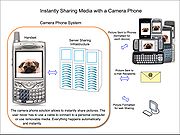
Camera phones can share pictures almost instantly and automatically via a sharing infrastructure integrated with the carrier network. Early developers of camera phones like Philippe Kahn envisioned a technology that would enable service providers to "collect a fee every time anyone snaps a photo." The resulting technologies, Multimedia Messaging ServiceMultimedia Messaging Service
Multimedia Messaging Service, or MMS, is a standard way to send messages that include multimedia content to and from mobile phones. It extends the core SMS capability that allowed exchange of text messages only up to 160 characters in length.The most popular use is to send photographs from...
and Sha-Mail
Sha-Mail
Sha-Mail is a kind of mailing service of J-Phone . This term is made from Sha, which is the front part of a Japanese word Shashin meaning photograph, and Mail...
were developed parallel to and in competition to open Internet
Internet
The Internet is a global system of interconnected computer networks that use the standard Internet protocol suite to serve billions of users worldwide...
based mobile communication provided by GPRS and later 3G
3G
3G or 3rd generation mobile telecommunications is a generation of standards for mobile phones and mobile telecommunication services fulfilling the International Mobile Telecommunications-2000 specifications by the International Telecommunication Union...
networks.
The closed sharing infrastructure was critical and explains the early successes of J-Phone, DoCoMo in Japan, Sprint
Sprint Nextel
Sprint Nextel Corporation is an American telecommunications company based in Overland Park, Kansas. The company owns and operates Sprint, the third largest wireless telecommunications network in the United States, with 53.4 million customers, behind Verizon Wireless and AT&T Mobility...
, and other carriers worldwide.
The first commercial camera phone complete with infrastructure was the J-SH04
J-SH04
The J-SH04 was a mobile phone made by Sharp Corporation and released by J-Phone . It was only available in Japan, and was released in November 2000. It was the world's first ever phone with a built-in camera and color display . The phone weights 74g, and its dimensions are 127 × 39 × 17 mm...
, made by Sharp Corporation
Sharp Corporation
is a Japanese multinational corporation that designs and manufactures electronic products. Headquartered in Abeno-ku, Osaka, Japan, Sharp employs more than 55,580 people worldwide as of June 2011. The company was founded in September 1912 and takes its name from one of its founder's first...
, had an integrated CCD sensor, with the Sha-Mail
Sha-Mail
Sha-Mail is a kind of mailing service of J-Phone . This term is made from Sha, which is the front part of a Japanese word Shashin meaning photograph, and Mail...
(Picture-Mail in Japanese) infrastructure developed in collaboration with Kahn's LightSurf venture, and marketed from 2001 by J-Phone in Japan today owned by Softbank
SoftBank
is a Japanese telecommunications and internet corporation, with operations in broadband, fixed-line telecommunications, e-Commerce, Internet, broadmedia, technology services, finance, media and marketing, and other businesses....
.
The first commercial deployment in North America of camera phones was in 2004. The Sprint wireless carriers deployed over one million camera phone manufactured by Sanyo and launched by the PictureMail infrastructure (Sha-Mail in English) developed and managed by LightSurf.
Users of early camera phones were held captive by the MMS business model. While phones had internet connectivity, working web browsers and email-programs, the phone menu offered no way of including a photo in an email or uploading it to a web site. Connecting cables or removable media that would enable the local transfer of pictures were also usually missing.
Modern smartphones have more connectivity and transfer options with photograph attachment features.
Manufacturers
Major manufacturers include ToshibaToshiba
is a multinational electronics and electrical equipment corporation headquartered in Tokyo, Japan. It is a diversified manufacturer and marketer of electrical products, spanning information & communications equipment and systems, Internet-based solutions and services, electronic components and...
, Sharp
Sharp Corporation
is a Japanese multinational corporation that designs and manufactures electronic products. Headquartered in Abeno-ku, Osaka, Japan, Sharp employs more than 55,580 people worldwide as of June 2011. The company was founded in September 1912 and takes its name from one of its founder's first...
, Nokia
Nokia
Nokia Corporation is a Finnish multinational communications corporation that is headquartered in Keilaniemi, Espoo, a city neighbouring Finland's capital Helsinki...
, Sanyo
Sanyo
is a major electronics company and member of the Fortune 500 whose headquarters is located in Moriguchi, Osaka prefecture, Japan. Sanyo targets the middle of the market and has over 230 Subsidiaries and Affiliates....
, Samsung
Samsung
The Samsung Group is a South Korean multinational conglomerate corporation headquartered in Samsung Town, Seoul, South Korea...
, Motorola
Motorola
Motorola, Inc. was an American multinational telecommunications company based in Schaumburg, Illinois, which was eventually divided into two independent public companies, Motorola Mobility and Motorola Solutions on January 4, 2011, after losing $4.3 billion from 2007 to 2009...
, Siemens
Siemens AG
Siemens AG is a German multinational conglomerate company headquartered in Munich, Germany. It is the largest Europe-based electronics and electrical engineering company....
, Sony Ericsson
Sony Ericsson
Sony Ericsson Mobile Communications AB is a joint venture established on October 1, 2001 by the Japanese consumer electronics company Sony Corporation and the Swedish telecommunications company Ericsson to manufacture mobile phones....
, and LG Electronics
LG Electronics
LG Electronics is a global electronics and telecommunications company headquartered in Yeouido, Seoul, South Korea. The company operates its business through five divisions: mobile communications, home entertainment, home appliance, air conditioning and business solution...
. Resolution is typically in the range of one tenth to one half as many megapixels
Pixel
In digital imaging, a pixel, or pel, is a single point in a raster image, or the smallest addressable screen element in a display device; it is the smallest unit of picture that can be represented or controlled....
as contemporary low end compact digital cameras.
Major manufacturers of cameras for phones include Toshiba
Toshiba
is a multinational electronics and electrical equipment corporation headquartered in Tokyo, Japan. It is a diversified manufacturer and marketer of electrical products, spanning information & communications equipment and systems, Internet-based solutions and services, electronic components and...
, ST Micro, Sharp
Sharp Corporation
is a Japanese multinational corporation that designs and manufactures electronic products. Headquartered in Abeno-ku, Osaka, Japan, Sharp employs more than 55,580 people worldwide as of June 2011. The company was founded in September 1912 and takes its name from one of its founder's first...
, Omnivision, and Aptina
Aptina
Aptina Imaging Corporation provides CMOS imaging technologies and solutions that enable high-quality imaging. Aptina's products can be found in mobile phones, digital, and video cameras, notebook computers, surveillance cameras, and medical, automotive and industrial applications, as well as...
.
External camera
During 2003 as camera phones were gaining popularity in Europe some phones without cameras had support for MMSMultimedia Messaging Service
Multimedia Messaging Service, or MMS, is a standard way to send messages that include multimedia content to and from mobile phones. It extends the core SMS capability that allowed exchange of text messages only up to 160 characters in length.The most popular use is to send photographs from...
and external cameras that could be connected with a small cable or directly to the data port at the base of the phone. The external cameras were comparable in quality to those fitted on regular camera phones at the time, typically offering VGA resolution.
Phones that supported extra cameras include the Siemens SL55 and Nokia Series 40
Nokia Series 40
Series 40 is a software platform and application user interface software on Nokia's broad range of mid-tier feature phones, as well as on the Vertu line of luxury phones. It is the world's most widely used mobile phone platform and found in hundreds of millions of devices....
phones such as the Nokia 6810. Unfortunately these cameras are not compatible with more recent phones.
These external cameras never proved very popular although they were stocked in various shops at the time.
Social impact
Personal photography allows people to capture and construct personal and group memory, maintain social relationships as well as expressing their identity. The hundreds of millionsof camera phones sold every year provide the same opportunities, yet these functions are altered and allow for a different user experience. As mobile phones are constantly carried, camera phones allow for capturing moments at any time. Mobile communication also allows for immediate transmission of content (for example via Multimedia Messaging Service
Multimedia Messaging Service
Multimedia Messaging Service, or MMS, is a standard way to send messages that include multimedia content to and from mobile phones. It extends the core SMS capability that allowed exchange of text messages only up to 160 characters in length.The most popular use is to send photographs from...
s), which cannot be reversed or regulated.
While phones have been found useful by tourists and for other common civilian purposes, as they are cheap, convenient, and portable; they have also posed controversy, as they enable secret photography
Secret photography
Secret photography refers to the use of an image or video recording device to photograph or film a person who is unaware that they are being intentionally photographed or filmed...
. A user may pretend to be simply talking on the phone or browsing the internet, drawing no suspicion while photographing a person or place illegally or against that person's wishes.
As a network-connected device, megapixel camera phones are playing significant roles in crime prevention, journalism and business applications as well as individual uses. They can also be used for activities such as voyeurism
Voyeurism
In clinical psychology, voyeurism is the sexual interest in or practice of spying on people engaged in intimate behaviors, such as undressing, sexual activity, or other activity usually considered to be of a private nature....
, invasion of privacy
Invasion of privacy
United States privacy law embodies several different legal concepts. One is the invasion of privacy, a tort based in common law allowing an aggrieved party to bring a lawsuit against an individual who unlawfully intrudes into his or her private affairs, discloses his or her private information,...
, and copyright infringement
Copyright infringement
Copyright infringement is the unauthorized or prohibited use of works under copyright, infringing the copyright holder's exclusive rights, such as the right to reproduce or perform the copyrighted work, or to make derivative works.- "Piracy" :...
. Because they can be used to share media almost immediately, they are a potent personal content creation tool. On January 17, 2007, New York City Mayor Michael Bloomberg
Michael Bloomberg
Michael Rubens Bloomberg is the current Mayor of New York City. With a net worth of $19.5 billion in 2011, he is also the 12th-richest person in the United States...
announced a plan to encourage people to use their camera-phones to capture crimes happening in progress or dangerous situations and send them to emergency responders. Through the program, people will be able to send their images or video directly to 911.
Enforcing bans on camera phones has proven nearly impossible. They are small and numerous and their use is easy to hide or disguise, making it hard for law enforcement and security personnel to detect or stop use.
From time to time, organizations and places have prohibited or restricted the use of camera phones and other cameras because of the privacy, security, and copyright issues they pose. Such places include the Pentagon
The Pentagon
The Pentagon is the headquarters of the United States Department of Defense, located in Arlington County, Virginia. As a symbol of the U.S. military, "the Pentagon" is often used metonymically to refer to the Department of Defense rather than the building itself.Designed by the American architect...
, federal and state courts, museums, schools, theaters, and local fitness club
Health club
A health club is a place which houses exercise equipment for the purpose of physical exercise.-Main workout area:...
s. Saudi Arabia
Saudi Arabia
The Kingdom of Saudi Arabia , commonly known in British English as Saudi Arabia and in Arabic as as-Sa‘ūdiyyah , is the largest state in Western Asia by land area, constituting the bulk of the Arabian Peninsula, and the second-largest in the Arab World...
, in April 2004, banned the sale of camera phones nationwide for a time before reallowing their sale in December 2004 (although pilgrims on the Hajj
Hajj
The Hajj is the pilgrimage to Mecca, Saudi Arabia. It is one of the largest pilgrimages in the world, and is the fifth pillar of Islam, a religious duty that must be carried out at least once in their lifetime by every able-bodied Muslim who can afford to do so...
were allowed to bring in camera phones). In South Korea
South Korea
The Republic of Korea , , is a sovereign state in East Asia, located on the southern portion of the Korean Peninsula. It is neighbored by the People's Republic of China to the west, Japan to the east, North Korea to the north, and the East China Sea and Republic of China to the south...
and Japan, all camera phones sold in the country must make a clearly audible sound whenever a picture is taken: These laws are intended to reduce the number of up-skirt photo
Voyeurism
In clinical psychology, voyeurism is the sexual interest in or practice of spying on people engaged in intimate behaviors, such as undressing, sexual activity, or other activity usually considered to be of a private nature....
s taken.
There is the occasional anecdote of camera phones linked to industrial espionage and the activities of paparazzi
Paparazzi
Paparazzi is an Italian term used to refer to photojournalists who specialize in candid photography of celebrities, politicians, and other prominent people...
, as well as some hacking into wireless operators' network.
Camera phones have also been used to discreetly take photographs in museums, performance halls, and other places where photography is prohibited. However, as sharing can be instantaneous, even if the action is discovered, it is too late, as the image is already out of reach, unlike a photo taken by a digital camera that only stores images locally for later transfer.
In Ireland
Ireland
Ireland is an island to the northwest of continental Europe. It is the third-largest island in Europe and the twentieth-largest island on Earth...
the annual "RTE
Raidió Teilifís Éireann
Raidió Teilifís Éireann is a semi-state company and the public service broadcaster of Ireland. It both produces programmes and broadcasts them on television, radio and the Internet. The radio service began on January 1, 1926, while regular television broadcasts began on December 31, 1961, making...
60 second short award" was won by 15 year old Laura Gaynor who made her winning cartoon,"Piece of Cake" on her Sony Ericsson
Sony Ericsson
Sony Ericsson Mobile Communications AB is a joint venture established on October 1, 2001 by the Japanese consumer electronics company Sony Corporation and the Swedish telecommunications company Ericsson to manufacture mobile phones....
C510 camera phone.
Notable events involving camera phones
- The 2004 Indian Ocean earthquake2004 Indian Ocean earthquakeThe 2004 Indian Ocean earthquake was an undersea megathrust earthquake that occurred at 00:58:53 UTC on Sunday, December 26, 2004, with an epicentre off the west coast of Sumatra, Indonesia. The quake itself is known by the scientific community as the Sumatra-Andaman earthquake...
was the first global news event where the majority of the first day news footageFootageIn filmmaking and video production, footage is the raw, unedited material as it had been originally filmed by movie camera or recorded by a video camera which usually must be edited to create a motion picture, video clip, television show or similar completed work...
was no longer provided by professional news crews, but rather by citizen journalists, using primarily camera phones. - On November 17, 2006, during a performance at the Laugh Factory comedy club, comedian Michael RichardsMichael RichardsMichael Anthony Richards is an American actor, comedian, writer and television producer, best known for his portrayal of the eccentric Cosmo Kramer on the television sitcom Seinfeld....
was recorded responding to hecklers with racial slurs by a member of the audience using a camera phone. The video was widely circulated in television and internet news broadcasts. - On December 30, 2006, the execution of former Iraqi dictator Saddam HusseinSaddam HusseinSaddam Hussein Abd al-Majid al-Tikriti was the fifth President of Iraq, serving in this capacity from 16 July 1979 until 9 April 2003...
was recorded by a video camera phone, and made widely available on the Internet. A guard was arrested a few days later. - Camera phone video and photographs taken in the immediate aftermath of the 7 July 2005 London bombings7 July 2005 London bombingsThe 7 July 2005 London bombings were a series of co-ordinated suicide attacks in the United Kingdom, targeting civilians using London's public transport system during the morning rush hour....
were featured worldwide. CNNCNNCable News Network is a U.S. cable news channel founded in 1980 by Ted Turner. Upon its launch, CNN was the first channel to provide 24-hour television news coverage, and the first all-news television channel in the United States...
executive Jonathan KleinJonathan Klein (CNN)Jonathan Klein is the former president of CNN/U.S., who was responsible for management oversight of all programming, editorial tone and strategic direction of the network. Klein led CNN during its coverage of the 2008 presidential election, which resulted in the highest ratings in the history of...
predicts camera phone footageFootageIn filmmaking and video production, footage is the raw, unedited material as it had been originally filmed by movie camera or recorded by a video camera which usually must be edited to create a motion picture, video clip, television show or similar completed work...
will be increasingly used by news organizations. - Camera phone digital images helped to spread the 2009 Iranian election protests2009 Iranian election protestsProtests following the 2009 Iranian presidential election against the disputed victory of Iranian President Mahmoud Ahmadinejad and in support of opposition candidates Mir-Hossein Mousavi and Mehdi Karroubi occurred in major cities in Iran and around the world starting June 13, 2009...
. - Camera phones recorded the BART Police shooting of Oscar GrantBART Police shooting of Oscar GrantOscar Grant was fatally shot by BART police officer Johannes Mehserle in Oakland, California, United States, in the early morning hours of New Year's Day 2009. Responding to reports of a fight on a crowded Bay Area Rapid Transit train returning from San Francisco, BART Police officers detained...
.
Camera as an interaction device
The cameras of smartphones are used as input devices in numerous research projects and commercial applications. A commercially successful example is the use of QR CodeQR Code
A QR code is a type of matrix barcode first designed for the automotive industry. More recently, the system has become popular outside of the industry due to its fast readability and comparatively large storage capacity. The code consists of black modules arranged in a square pattern on a white...
s attached to physical objects. QR Codes can be sensed by the phone using its camera and provide an according link to related digital content, usually a URL. Another approach is using camera images to recognize objects. Content based image analysis is used to recognize physical objects such as advertisement posters to provide information about the object. Hybrid approaches use a combination of unobstrusive visual markers and image analysis. An example is to estimate the pose of the camera phone to create a real-time overlay for a 3D paper globe. On recent camera phones it is even feasible to provide an augmented reality
Augmented reality
Augmented reality is a live, direct or indirect, view of a physical, real-world environment whose elements are augmented by computer-generated sensory input such as sound, video, graphics or GPS data. It is related to a more general concept called mediated reality, in which a view of reality is...
overlay for 2D objects and to recognize multiple objects on the phone using a stripped down object recognition algorithm as well as using GPS and compass
Compass
A compass is a navigational instrument that shows directions in a frame of reference that is stationary relative to the surface of the earth. The frame of reference defines the four cardinal directions – north, south, east, and west. Intermediate directions are also defined...
. Auto-geotagging
Auto-geotagging
Real-time geotagging is a name given to the automatic technique of acquiring media , associating a specific location with the media, transferring the media to an online map and publishing the media in real time...
can show where a picture is taken, promoting interactions and allowing a photo to be mapped with others for comparison.