

Complex systems

Encyclopedia
Complex systems present problems in mathematical model
ling.
The equations from which complex system models are developed generally derive from statistical physics
, information theory
and non-linear dynamics, and represent organized but unpredictable behaviors of system
s of nature that are considered fundamentally complex
. The physical manifestations of such systems cannot be defined, so the usual choice is to refer to "the system" as the mathematical information model, without referring to the undefined physical subject the model represents. One of a variety of journals using this approach to complexity is Complex Systems
.
Such systems are used to model processes in computer science
, biology
, economics
, physics
, chemistry
, and many other fields. It is also called complex systems theory, complexity science, study of complex systems, sciences of complexity, non-equilibrium physics, and historical physics. A variety of abstract theoretical complex systems
is studied as a field of mathematics.
The key problems of complex systems are difficulties with their formal modelling
and simulation
. From such a perspective, in different research contexts complex systems are defined on the basis of their different attributes. Since all complex systems have many interconnected components, the science of networks
and network theory
are important aspects of the study of complex systems. A consensus regarding a single universal definition of complex system
does not yet exist.
For systems that are less usefully represented with equations various other kinds of narratives and methods for identifying, exploring, designing and interacting with complex systems are used. A broader view of disciplines and methodologies using the complex systems approach is found on the Encyclopedia of Earth
.
 The study of mathematical complex system models is used for many scientific questions poorly suited to the traditional mechanistic conception provided by science. Complex systems is therefore often used as a broad term encompassing a research approach to problems in many diverse disciplines including anthropology
, artificial intelligence
, artificial life
, chemistry
, computer science
, economics
, evolutionary computation
, earthquake
prediction, meteorology
, molecular biology
, neuroscience
, physics
, psychology
and sociology
.
In these endeavors, scientists often seek simple non-linear coupling rules which lead to complex phenomena (rather than describe; see above), but this need not be the case. Human societies (and probably human brain
s) are complex systems in which neither the components nor the couplings are simple. Nevertheless, they exhibit many of the hallmarks of complex systems.
It is worth remarking that non-linearity is not a necessary feature of complex systems modeling
: macro-analyses that concern unstable equilibrium and evolution processes of certain biological/social/economic systems can usefully be carried out also by sets of linear equations, which do nevertheless entail reciprocal dependence between variable parameters.
Traditionally, engineering has striven to solve the non-linear system problem while bearing in mind that for small perturbations, most non-linear systems can be approximated with linear systems significantly simplifying the analysis. Linear systems represent the main class of systems for which general techniques for stability control and analysis exist. However, many physical systems (for example lasers) are inherently "complex systems" in terms of the definition above, and engineering practice must now include elements of complex systems research.
Information theory
applies well to the complex adaptive systems, CAS, through the concepts of object oriented design, as well as through formalized concepts of organization and disorder that can be associated with any systems evolution process.
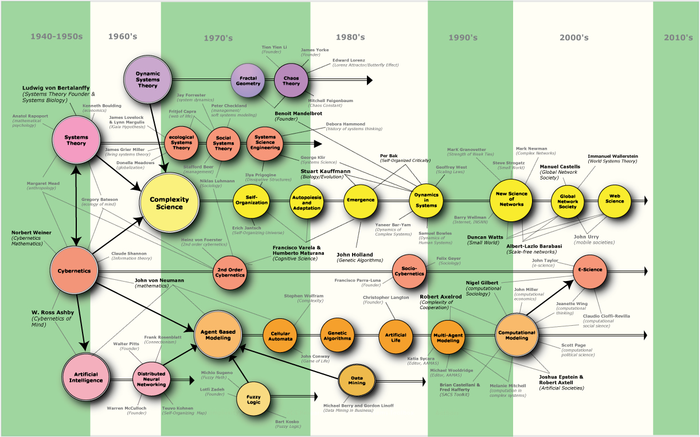 Complex systems is a new approach to science that studies how relationships between parts give rise to the collective behaviors of a system
and how the system interacts and forms relationships with its environment.
The earliest precursor to modern complex systems theory can be found in the classical political economy of the Scottish Enlightenment
, later developed by the Austrian school of economics, which says that order in market systems is spontaneous (or emergent
) in that it is the result of human action, but not the execution of any human design.
Upon this the Austrian school developed from the 19th to the early 20th century the economic calculation problem
, along with the concept of dispersed knowledge
, which were to fuel debates against the then-dominant Keynesian economics
. This debate would notably lead economists, politicians and other parties to explore the question of computational complexity.
A pioneer in the field, and inspired by Karl Popper
's and Warren Weaver
's works, Nobel prize economist and philosopher Friedrich Hayek
dedicated much of his work, from early to the late 20th century, to the study of complex phenomena, not constraining his work to human economies but venturing into other fields such as psychology
, biology
and cybernetics
. Gregory Bateson
played a key role in establishing the connection between anthropology and systems theory; he recognized that the interactive parts of cultures function much like ecosystems.
. Acquisitions such as the FCS
rely on a web of interrelated parts which interact unpredictably. As acquisitions become more network-centric and complex, businesses will be forced to find ways to manage complexity while governments will be challenged to provide effective governance to ensure flexibility and resiliency.
 One of Hayek's main contributions to early complexity theory is his distinction between the human capacity to predict the behaviour of simple systems and its capacity to predict the behaviour of complex systems through modeling
. He believed that economics and the sciences of complex phenomena in general, which in his view included biology, psychology, and so on, could not be modeled after the sciences that deal with essentially simple phenomena like physics. Hayek would notably explain that complex phenomena, through modeling, can only allow pattern predictions, compared with the precise predictions that can be made out of non-complex phenomena.
, which in turn has its origins more than a century ago in the work of the French mathematician Henri Poincaré
. Chaos is sometimes viewed as extremely complicated information, rather than as an absence of order. The point is that chaos remains deterministic. With perfect knowledge of the initial conditions and of the context of an action, the course of this action can be predicted in chaos theory. As argued by Ilya Prigogine
, complexity is non-deterministic, and gives no way whatsoever to precisely predict the future (see also ).
The emergence of complexity theory shows a domain between deterministic order and randomness which is complex. This is referred as the 'edge of chaos
'.
 When one analyzes complex systems, sensitivity to initial conditions, for example, is not an issue as important as within the chaos theory in which it prevails. As stated by Colander, the study of complexity is the opposite of the study of chaos. Complexity is about how a huge number of extremely complicated and dynamic sets of relationships can generate some simple behavioral patterns, whereas chaotic behavior, in the sense of deterministic chaos, is the result of a relatively small number of non-linear interactions.
Therefore, the main difference between Chaotic systems and complex systems is their history. Chaotic systems do not rely on their history as complex ones do. Chaotic behaviour pushes a system in equilibrium into chaotic order, which means, in other words, out of what we traditionally define as 'order'. On the other hand, complex systems evolve far from equilibrium at the edge of chaos. They evolve at a critical state built up by a history of irreversible and unexpected events. In a sense chaotic systems can be regarded as a subset of complex systems distinguished precisely by this absence of historical dependence. Many real complex systems are, in practice and over long but finite time periods, robust. However, they do possess the potential for radical qualitative change of kind whilst retaining systemic integrity. Metamorphosis serves as perhaps more than a metaphor for such transformations.
Journals
Other resources
Mathematical model
A mathematical model is a description of a system using mathematical concepts and language. The process of developing a mathematical model is termed mathematical modeling. Mathematical models are used not only in the natural sciences and engineering disciplines A mathematical model is a...
ling.
The equations from which complex system models are developed generally derive from statistical physics
Statistical physics
Statistical physics is the branch of physics that uses methods of probability theory and statistics, and particularly the mathematical tools for dealing with large populations and approximations, in solving physical problems. It can describe a wide variety of fields with an inherently stochastic...
, information theory
Information theory
Information theory is a branch of applied mathematics and electrical engineering involving the quantification of information. Information theory was developed by Claude E. Shannon to find fundamental limits on signal processing operations such as compressing data and on reliably storing and...
and non-linear dynamics, and represent organized but unpredictable behaviors of system
System
System is a set of interacting or interdependent components forming an integrated whole....
s of nature that are considered fundamentally complex
Complexity
In general usage, complexity tends to be used to characterize something with many parts in intricate arrangement. The study of these complex linkages is the main goal of complex systems theory. In science there are at this time a number of approaches to characterizing complexity, many of which are...
. The physical manifestations of such systems cannot be defined, so the usual choice is to refer to "the system" as the mathematical information model, without referring to the undefined physical subject the model represents. One of a variety of journals using this approach to complexity is Complex Systems
Complex Systems (journal)
Complex Systems is an interdisciplinary scientific journal. Its subject matter of complex systems ranges across a number of more narrow scientific and engineering fields....
.
Such systems are used to model processes in computer science
Computer science
Computer science or computing science is the study of the theoretical foundations of information and computation and of practical techniques for their implementation and application in computer systems...
, biology
Biology
Biology is a natural science concerned with the study of life and living organisms, including their structure, function, growth, origin, evolution, distribution, and taxonomy. Biology is a vast subject containing many subdivisions, topics, and disciplines...
, economics
Complexity economics
Complexity economics is the application of complexity science to the problems of economics. It studies computer simulations to gain insight into economic dynamics, and avoids the assumption that the economy is a system in equilibrium.- Models :...
, physics
Physics
Physics is a natural science that involves the study of matter and its motion through spacetime, along with related concepts such as energy and force. More broadly, it is the general analysis of nature, conducted in order to understand how the universe behaves.Physics is one of the oldest academic...
, chemistry
Chemistry
Chemistry is the science of matter, especially its chemical reactions, but also its composition, structure and properties. Chemistry is concerned with atoms and their interactions with other atoms, and particularly with the properties of chemical bonds....
, and many other fields. It is also called complex systems theory, complexity science, study of complex systems, sciences of complexity, non-equilibrium physics, and historical physics. A variety of abstract theoretical complex systems
Complex system
A complex system is a system composed of interconnected parts that as a whole exhibit one or more properties not obvious from the properties of the individual parts....
is studied as a field of mathematics.
The key problems of complex systems are difficulties with their formal modelling
Scientific modelling
Scientific modelling is the process of generating abstract, conceptual, graphical and/or mathematical models. Science offers a growing collection of methods, techniques and theory about all kinds of specialized scientific modelling...
and simulation
Simulation
Simulation is the imitation of some real thing available, state of affairs, or process. The act of simulating something generally entails representing certain key characteristics or behaviours of a selected physical or abstract system....
. From such a perspective, in different research contexts complex systems are defined on the basis of their different attributes. Since all complex systems have many interconnected components, the science of networks
Network science
Network science is a new and emerging scientific discipline that examines the interconnections among diverse physical or engineered networks, information networks, biological networks, cognitive and semantic networks, and social networks. This field of science seeks to discover common principles,...
and network theory
Network theory
Network theory is an area of computer science and network science and part of graph theory. It has application in many disciplines including statistical physics, particle physics, computer science, biology, economics, operations research, and sociology...
are important aspects of the study of complex systems. A consensus regarding a single universal definition of complex system
Complex system
A complex system is a system composed of interconnected parts that as a whole exhibit one or more properties not obvious from the properties of the individual parts....
does not yet exist.
For systems that are less usefully represented with equations various other kinds of narratives and methods for identifying, exploring, designing and interacting with complex systems are used. A broader view of disciplines and methodologies using the complex systems approach is found on the Encyclopedia of Earth
Encyclopedia of Earth
The Encyclopedia of Earth is an electronic reference about the Earth, its natural environments, and their interaction with society. The Encyclopedia is described as a free, fully searchable collection of articles written by scholars, professionals, educators, and other approved experts, who...
.
Overview
Anthropology
Anthropology is the study of humanity. It has origins in the humanities, the natural sciences, and the social sciences. The term "anthropology" is from the Greek anthrōpos , "man", understood to mean mankind or humanity, and -logia , "discourse" or "study", and was first used in 1501 by German...
, artificial intelligence
Artificial intelligence
Artificial intelligence is the intelligence of machines and the branch of computer science that aims to create it. AI textbooks define the field as "the study and design of intelligent agents" where an intelligent agent is a system that perceives its environment and takes actions that maximize its...
, artificial life
Artificial life
Artificial life is a field of study and an associated art form which examine systems related to life, its processes, and its evolution through simulations using computer models, robotics, and biochemistry. The discipline was named by Christopher Langton, an American computer scientist, in 1986...
, chemistry
Chemistry
Chemistry is the science of matter, especially its chemical reactions, but also its composition, structure and properties. Chemistry is concerned with atoms and their interactions with other atoms, and particularly with the properties of chemical bonds....
, computer science
Computer science
Computer science or computing science is the study of the theoretical foundations of information and computation and of practical techniques for their implementation and application in computer systems...
, economics
Economics
Economics is the social science that analyzes the production, distribution, and consumption of goods and services. The term economics comes from the Ancient Greek from + , hence "rules of the house"...
, evolutionary computation
Evolutionary computation
In computer science, evolutionary computation is a subfield of artificial intelligence that involves combinatorial optimization problems....
, earthquake
Earthquake
An earthquake is the result of a sudden release of energy in the Earth's crust that creates seismic waves. The seismicity, seismism or seismic activity of an area refers to the frequency, type and size of earthquakes experienced over a period of time...
prediction, meteorology
Meteorology
Meteorology is the interdisciplinary scientific study of the atmosphere. Studies in the field stretch back millennia, though significant progress in meteorology did not occur until the 18th century. The 19th century saw breakthroughs occur after observing networks developed across several countries...
, molecular biology
Molecular biology
Molecular biology is the branch of biology that deals with the molecular basis of biological activity. This field overlaps with other areas of biology and chemistry, particularly genetics and biochemistry...
, neuroscience
Neuroscience
Neuroscience is the scientific study of the nervous system. Traditionally, neuroscience has been seen as a branch of biology. However, it is currently an interdisciplinary science that collaborates with other fields such as chemistry, computer science, engineering, linguistics, mathematics,...
, physics
Physics
Physics is a natural science that involves the study of matter and its motion through spacetime, along with related concepts such as energy and force. More broadly, it is the general analysis of nature, conducted in order to understand how the universe behaves.Physics is one of the oldest academic...
, psychology
Psychology
Psychology is the study of the mind and behavior. Its immediate goal is to understand individuals and groups by both establishing general principles and researching specific cases. For many, the ultimate goal of psychology is to benefit society...
and sociology
Sociology
Sociology is the study of society. It is a social science—a term with which it is sometimes synonymous—which uses various methods of empirical investigation and critical analysis to develop a body of knowledge about human social activity...
.
In these endeavors, scientists often seek simple non-linear coupling rules which lead to complex phenomena (rather than describe; see above), but this need not be the case. Human societies (and probably human brain
Human brain
The human brain has the same general structure as the brains of other mammals, but is over three times larger than the brain of a typical mammal with an equivalent body size. Estimates for the number of neurons in the human brain range from 80 to 120 billion...
s) are complex systems in which neither the components nor the couplings are simple. Nevertheless, they exhibit many of the hallmarks of complex systems.
It is worth remarking that non-linearity is not a necessary feature of complex systems modeling
Systems modeling
Systems modeling or systems modelling is the interdisciplinary study of the use of models to conceptualize and construct systems in business and IT development....
: macro-analyses that concern unstable equilibrium and evolution processes of certain biological/social/economic systems can usefully be carried out also by sets of linear equations, which do nevertheless entail reciprocal dependence between variable parameters.
Traditionally, engineering has striven to solve the non-linear system problem while bearing in mind that for small perturbations, most non-linear systems can be approximated with linear systems significantly simplifying the analysis. Linear systems represent the main class of systems for which general techniques for stability control and analysis exist. However, many physical systems (for example lasers) are inherently "complex systems" in terms of the definition above, and engineering practice must now include elements of complex systems research.
Information theory
Information theory
Information theory is a branch of applied mathematics and electrical engineering involving the quantification of information. Information theory was developed by Claude E. Shannon to find fundamental limits on signal processing operations such as compressing data and on reliably storing and...
applies well to the complex adaptive systems, CAS, through the concepts of object oriented design, as well as through formalized concepts of organization and disorder that can be associated with any systems evolution process.
History
System
System is a set of interacting or interdependent components forming an integrated whole....
and how the system interacts and forms relationships with its environment.
The earliest precursor to modern complex systems theory can be found in the classical political economy of the Scottish Enlightenment
Scottish Enlightenment
The Scottish Enlightenment was the period in 18th century Scotland characterised by an outpouring of intellectual and scientific accomplishments. By 1750, Scots were among the most literate citizens of Europe, with an estimated 75% level of literacy...
, later developed by the Austrian school of economics, which says that order in market systems is spontaneous (or emergent
Emergence
In philosophy, systems theory, science, and art, emergence is the way complex systems and patterns arise out of a multiplicity of relatively simple interactions. Emergence is central to the theories of integrative levels and of complex systems....
) in that it is the result of human action, but not the execution of any human design.
Upon this the Austrian school developed from the 19th to the early 20th century the economic calculation problem
Economic calculation problem
The economic calculation problem is a criticism of central economic planning. It was first proposed by Ludwig von Mises in 1920 and later expounded by Friedrich Hayek. The problem referred to is that of how to distribute resources rationally in an economy...
, along with the concept of dispersed knowledge
Dispersed knowledge
In economics, dispersed knowledge is information that is dispersed throughout the marketplace, and is not in the hands of any single agent. All agents in the market have imperfect knowledge; however, they all have a good indicator of everyone else's knowledge and intentions, and that is the...
, which were to fuel debates against the then-dominant Keynesian economics
Keynesian economics
Keynesian economics is a school of macroeconomic thought based on the ideas of 20th-century English economist John Maynard Keynes.Keynesian economics argues that private sector decisions sometimes lead to inefficient macroeconomic outcomes and, therefore, advocates active policy responses by the...
. This debate would notably lead economists, politicians and other parties to explore the question of computational complexity.
A pioneer in the field, and inspired by Karl Popper
Karl Popper
Sir Karl Raimund Popper, CH FRS FBA was an Austro-British philosopher and a professor at the London School of Economics...
's and Warren Weaver
Warren Weaver
Warren Weaver was an American scientist, mathematician, and science administrator...
's works, Nobel prize economist and philosopher Friedrich Hayek
Friedrich Hayek
Friedrich August Hayek CH , born in Austria-Hungary as Friedrich August von Hayek, was an economist and philosopher best known for his defense of classical liberalism and free-market capitalism against socialist and collectivist thought...
dedicated much of his work, from early to the late 20th century, to the study of complex phenomena, not constraining his work to human economies but venturing into other fields such as psychology
Psychology
Psychology is the study of the mind and behavior. Its immediate goal is to understand individuals and groups by both establishing general principles and researching specific cases. For many, the ultimate goal of psychology is to benefit society...
, biology
Biology
Biology is a natural science concerned with the study of life and living organisms, including their structure, function, growth, origin, evolution, distribution, and taxonomy. Biology is a vast subject containing many subdivisions, topics, and disciplines...
and cybernetics
Cybernetics
Cybernetics is the interdisciplinary study of the structure of regulatory systems. Cybernetics is closely related to information theory, control theory and systems theory, at least in its first-order form...
. Gregory Bateson
Gregory Bateson
Gregory Bateson was an English anthropologist, social scientist, linguist, visual anthropologist, semiotician and cyberneticist whose work intersected that of many other fields. He had a natural ability to recognize order and pattern in the universe...
played a key role in establishing the connection between anthropology and systems theory; he recognized that the interactive parts of cultures function much like ecosystems.
Challenges of managing complexity
As projects and acquisitions become increasingly complex, companies and governments are challenged to find effective ways to manage mega-acquisitions such as the Army Future Combat SystemsFuture Combat Systems
Future Combat Systems was the United States Army's principal modernization program from 2003 to early 2009. Formally launched in 2003, FCS was envisioned to create new brigades equipped with new manned and unmanned vehicles linked by an unprecedented fast and flexible battlefield network...
. Acquisitions such as the FCS
Future Combat Systems
Future Combat Systems was the United States Army's principal modernization program from 2003 to early 2009. Formally launched in 2003, FCS was envisioned to create new brigades equipped with new manned and unmanned vehicles linked by an unprecedented fast and flexible battlefield network...
rely on a web of interrelated parts which interact unpredictably. As acquisitions become more network-centric and complex, businesses will be forced to find ways to manage complexity while governments will be challenged to provide effective governance to ensure flexibility and resiliency.
Complexity and modeling
Scientific modelling
Scientific modelling is the process of generating abstract, conceptual, graphical and/or mathematical models. Science offers a growing collection of methods, techniques and theory about all kinds of specialized scientific modelling...
. He believed that economics and the sciences of complex phenomena in general, which in his view included biology, psychology, and so on, could not be modeled after the sciences that deal with essentially simple phenomena like physics. Hayek would notably explain that complex phenomena, through modeling, can only allow pattern predictions, compared with the precise predictions that can be made out of non-complex phenomena.
Complexity and chaos theory
Complexity theory is rooted in chaos theoryChaos theory
Chaos theory is a field of study in mathematics, with applications in several disciplines including physics, economics, biology, and philosophy. Chaos theory studies the behavior of dynamical systems that are highly sensitive to initial conditions, an effect which is popularly referred to as the...
, which in turn has its origins more than a century ago in the work of the French mathematician Henri Poincaré
Henri Poincaré
Jules Henri Poincaré was a French mathematician, theoretical physicist, engineer, and a philosopher of science...
. Chaos is sometimes viewed as extremely complicated information, rather than as an absence of order. The point is that chaos remains deterministic. With perfect knowledge of the initial conditions and of the context of an action, the course of this action can be predicted in chaos theory. As argued by Ilya Prigogine
Ilya Prigogine
Ilya, Viscount Prigogine was a Russian-born naturalized Belgian physical chemist and Nobel Laureate noted for his work on dissipative structures, complex systems, and irreversibility.-Biography :...
, complexity is non-deterministic, and gives no way whatsoever to precisely predict the future (see also ).
The emergence of complexity theory shows a domain between deterministic order and randomness which is complex. This is referred as the 'edge of chaos
Edge of chaos
The phrase edge of chaos was coined by mathematician Doyne Farmer to describe the transition phenomenon discovered by computer scientist Christopher Langton. The phrase originally refers to an area in the range of a variable, λ , which was varied while examining the behavior of a cellular automaton...
'.
Therefore, the main difference between Chaotic systems and complex systems is their history. Chaotic systems do not rely on their history as complex ones do. Chaotic behaviour pushes a system in equilibrium into chaotic order, which means, in other words, out of what we traditionally define as 'order'. On the other hand, complex systems evolve far from equilibrium at the edge of chaos. They evolve at a critical state built up by a history of irreversible and unexpected events. In a sense chaotic systems can be regarded as a subset of complex systems distinguished precisely by this absence of historical dependence. Many real complex systems are, in practice and over long but finite time periods, robust. However, they do possess the potential for radical qualitative change of kind whilst retaining systemic integrity. Metamorphosis serves as perhaps more than a metaphor for such transformations.
Research centers, conferences, and journals
Institutes and research centers- New England Complex Systems InstituteNew England Complex Systems InstituteThe New England Complex Systems Institute is an American research institution dedicated to advancing the study of complex systems. It was founded in 1996 and is located in Cambridge, MA.- Overview :...
- Santa Fe InstituteSanta Fe InstituteThe Santa Fe Institute is an independent, nonprofit theoretical research institute located in Santa Fe and dedicated to the multidisciplinary study of the fundamental principles of complex adaptive systems, including physical, computational, biological, and social systems.The Institute houses a...
- Northwestern Institute on Complex Systems (NICO)
- Centro de Ciencias de la Complejidad, UNAMUnamUNAM or UNaM may refer to:* National University of Misiones, a National University in Posadas, Argentina*National Autonomous University of Mexico , the large public autonomous university based in Mexico City...
- Complexity Complex at the University of Warwick
- Center for Interdisciplinary Research on Complex Systems at Northeastern University
- Center for Social Dynamics & Complexity (CSDC) at Arizona State University
- Center for Complex Networks and Systems Research at Indiana UniversityIndiana UniversityIndiana University is a multi-campus public university system in the state of Indiana, United States. Indiana University has a combined student body of more than 100,000 students, including approximately 42,000 students enrolled at the Indiana University Bloomington campus and approximately 37,000...
- Southampton Institute for Complex Systems Simulation
- Center for the Study of Complex Systems at the University of Michigan
- Center for Complexity in Health at Kent State University
- Center for Complex Systems and Brain Sciences at Florida Atlantic University
- ARC Centre for Complex SystemsARC Centre for Complex SystemsThe ARC Centre for Complex Systems was established in 2004 from a consortium of Australian universities, led by The University of Queensland. The objective of ACCS was to conduct basic and applied research in the field of complex systems. It conducted research into both the science and engineering...
, Australia - Center for Social Complexity at George Mason UniversityGeorge Mason UniversityGeorge Mason University is a public university based in unincorporated Fairfax County, Virginia, United States, south of and adjacent to the city of Fairfax. Additional campuses are located nearby in Arlington County, Prince William County, and Loudoun County...
- York Centre for Complex Systems Analysis at University of YorkUniversity of YorkThe University of York , is an academic institution located in the city of York, England. Established in 1963, the campus university has expanded to more than thirty departments and centres, covering a wide range of subjects...
- The Complexity Science Group at University of CalgaryUniversity of CalgaryThe University of Calgary is a public research university located in Calgary, Alberta, Canada. Founded in 1966 the U of C is composed of 14 faculties and more than 85 research institutes and centres.More than 25,000 undergraduate and 5,500 graduate students are currently...
- Plexus Institute for the study of Complex Change and Innovation
- The Center for Complex Systems Research, Univ. of Illinois at Urbana-Champaign
Journals
- Advances in Complex SystemsAdvances in Complex SystemsAdvances in Complex Systems is a peer-reviewed journal published quarterly by World Scientific providing a multidisciplinary perspective to the study of complex systems...
- ComplexityComplexity (journal)Complexity is a peer-reviewed scientific journal covering research in the field of complex adaptive systems. The journal's scope includes studies on chaos, genetic algorithms, cellular automata, neural networks, and evolutionary game theory...
- Complex SystemsComplex Systems (journal)Complex Systems is an interdisciplinary scientific journal. Its subject matter of complex systems ranges across a number of more narrow scientific and engineering fields....
- Interdisciplinary Description of Complex SystemsInterdisciplinary Description of Complex SystemsInterdisciplinary Description of Complex Systems is a peer-reviewed scientific journal on complex systems, published in Zagreb, Croatia. It is published by a non-governmental organization, the society znanost.org.- External links :*...
Other resources
See also
- CyberneticsCyberneticsCybernetics is the interdisciplinary study of the structure of regulatory systems. Cybernetics is closely related to information theory, control theory and systems theory, at least in its first-order form...
- Cognitive ScienceCognitive scienceCognitive science is the interdisciplinary scientific study of mind and its processes. It examines what cognition is, what it does and how it works. It includes research on how information is processed , represented, and transformed in behaviour, nervous system or machine...
- Complex adaptive systemComplex adaptive systemComplex adaptive systems are special cases of complex systems. They are complex in that they are dynamic networks of interactions and relationships not aggregations of static entities...
- ComplexityComplexityIn general usage, complexity tends to be used to characterize something with many parts in intricate arrangement. The study of these complex linkages is the main goal of complex systems theory. In science there are at this time a number of approaches to characterizing complexity, many of which are...
- Complexity economicsComplexity economicsComplexity economics is the application of complexity science to the problems of economics. It studies computer simulations to gain insight into economic dynamics, and avoids the assumption that the economy is a system in equilibrium.- Models :...
- Decision engineeringDecision engineeringDecision Engineering is a framework that unifies a number of best practices for organizational decision making. It is based on the recognition that, in many organizations, decision making could be improved if a more structured approach were used...
- Dynamical systemDynamical systemA dynamical system is a concept in mathematics where a fixed rule describes the time dependence of a point in a geometrical space. Examples include the mathematical models that describe the swinging of a clock pendulum, the flow of water in a pipe, and the number of fish each springtime in a...
- Dynamical systems theoryDynamical systems theoryDynamical systems theory is an area of applied mathematics used to describe the behavior of complex dynamical systems, usually by employing differential equations or difference equations. When differential equations are employed, the theory is called continuous dynamical systems. When difference...
- EmergenceEmergenceIn philosophy, systems theory, science, and art, emergence is the way complex systems and patterns arise out of a multiplicity of relatively simple interactions. Emergence is central to the theories of integrative levels and of complex systems....
- Enterprise systems engineeringEnterprise systems engineeringEnterprise systems engineering is a emerging discipline of engineering that focuses on integration of many engineering sub-systems and principles into a complete system....
- Generative sciencesGenerative sciencesThe generative science is a interdisciplinary and multidisciplinary science that explores the natural world and its complex behaviours as a generative process...
- Mixed realityMixed realityMixed reality refers to the merging of real and virtual worlds to produce new environments and visualisations where physical and digital objects co-exist and interact in real time...
- Multi-agent systemMulti-agent systemA multi-agent system is a system composed of multiple interacting intelligent agents. Multi-agent systems can be used to solve problems that are difficult or impossible for an individual agent or a monolithic system to solve...
- NonlinearityNonlinearityIn mathematics, a nonlinear system is one that does not satisfy the superposition principle, or one whose output is not directly proportional to its input; a linear system fulfills these conditions. In other words, a nonlinear system is any problem where the variable to be solved for cannot be...
- Pattern oriented modelingPattern oriented modelingPattern-oriented modeling is an approach to bottom-up complex systems analysis that was developed for complex ecological and agent-based systems. A goal of POM is to make ecological modeling more rigorous and comprehensive . A traditional ecosystem model attempts to approximate the real system as...
- Process architectureProcess architectureDualistic Petri nets are a process-class variant of Petri nets.Like Petri nets in general and many related formalisms and notations, they are used to describe and analyze process architecture.-Process Modeling with dPNs :...
- Systems theorySystems theorySystems theory is the transdisciplinary study of systems in general, with the goal of elucidating principles that can be applied to all types of systems at all nesting levels in all fields of research...
- Systems theory in anthropologySystems theory in anthropologySystems Theory in Anthropology is an interdisciplinary, non-representative, non-referential, and non-Cartesian approach that brings together natural and social sciences to understand society in its complexity. The basic idea of a system theory in social science is to solve the classical problem of...
- Self organization
- Sociology and complexity scienceSociology and complexity scienceSociology and complexity science is the term used to describe a growing network of research taking place at the intersection of sociology and complexity science....
- Volatility, uncertainty, complexity and ambiguity
Further reading
- D. Chu, R. Strand and R. Fjelland, "Theories of complexity", Complexity, 8:3, 2003
- L.A.N. Amaral and J.M. Ottino, Complex networks — augmenting the framework for the study of complex system, 2004.
- Murray Gell-MannMurray Gell-MannMurray Gell-Mann is an American physicist and linguist who received the 1969 Nobel Prize in physics for his work on the theory of elementary particles...
, Let's Call It Plectics, 1995/96. - Nigel Goldenfeld and Leo P. Kadanoff, Simple Lessons from Complexity, 1999
- A. Gogolin, A. Nersesyan and A. Tsvelik, Theory of strongly correlated systems , Cambridge University Press, 1999.
- Kelly, K. (1995). Out of Control, Perseus Books Group.
- Graeme Donald Snooks, "A general theory of complex living systems: Exploring the demand side of dynamics", Complexity, vol. 13, no. 6, July/August 2008.
- Sorin Solomon and Eran Shir, Complexity; a science at 30, 2003.
- Preiser-Kapeller, Johannes, "Calculating Byzantium. Social Network Analysis and Complexity Sciences as tools for the exploration of medieval social dynamics". August 2010
External links
- The Open Agent-Based Modeling Consortium
- Complexity Science Focus
- INDECS (Interdisciplinary Description of Complex Systems)
- Center for Complex Systems Research, Univ. of Illinois
- Introduction to complex systems - Short course by Shlomo Havlin