
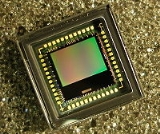
An
active-pixel sensor is an
image sensorAn image sensor is a device that converts an optical image into an electronic signal. It is used mostly in digital cameras and other imaging devices...
consisting of an
integrated circuitAn integrated circuit or monolithic integrated circuit is an electronic circuit manufactured by the patterned diffusion of trace elements into the surface of a thin substrate of semiconductor material...
containing an array of pixel sensors, each pixel containing a
photodetectorPhotosensors or photodetectors are sensors of light or other electromagnetic energy. There are several varieties:*Active pixel sensors are image sensors consisting of an integrated circuit that contains an array of pixel sensors, each pixel containing a both a light sensor and an active amplifier...
and an active amplifier. There are many types of active pixel sensors including the CMOS APS used most commonly in
cell phone camerasA camera phone is a mobile phone which is able to capture still photographs . Since early in the 21st century the majority of mobile phones in use are camera phones....
, web cameras and in some
DSLRMost digital single-lens reflex cameras are digital cameras that use a mechanical mirror system and pentaprism to direct light from the lens to an optical viewfinder on the back of the camera....
s. Such an image sensor is produced by a
CMOSComplementary metal–oxide–semiconductor is a technology for constructing integrated circuits. CMOS technology is used in microprocessors, microcontrollers, static RAM, and other digital logic circuits...
process (and is hence also known as a
CMOS sensor), and has emerged as an alternative to
charge-coupled deviceA charge-coupled device is a device for the movement of electrical charge, usually from within the device to an area where the charge can be manipulated, for example conversion into a digital value. This is achieved by "shifting" the signals between stages within the device one at a time...
(CCD) imager sensors.
The term
active pixel sensor is also used to refer to the individual pixel sensor itself, as opposed to the image sensor; in that case the image sensor is sometimes called an
active pixel sensor imager,
active-pixel image sensor, or
active-pixel-sensor (APS) imager.
History
The term
active pixel sensor was coined by Tsutomu Nakamura who worked on the Charge Modulation Device active pixel sensor at Olympus, and more broadly defined by
Eric FossumEric R. Fossum is an American physicist and engineer, inventor of the CMOS image sensor. He is currently a professor at Thayer School of Engineering in Dartmouth College.- Early years and education :...
in a 1993 paper.
Image sensor elements with in-pixel amplifiers were described by Noble in 1968, by Chamberlain in 1969, and by Weimer
et al. in 1969, at a time when
passive-pixel sensors – that is, pixel sensors without their own amplifiers – were being investigated as a solid-state alternative to vacuum-tube imaging devices. The MOS passive-pixel sensor used just a simple switch in the pixel to read out the
photodiodeA photodiode is a type of photodetector capable of converting light into either current or voltage, depending upon the mode of operation.The common, traditional solar cell used to generateelectric solar power is a large area photodiode....
integrated charge. Pixels were arrayed in a two-dimensional structure, with access enable wire shared by pixels in the same row, and output wire shared by column. At the end of each column was an amplifier. Passive-pixel sensors suffered from many limitations, such as high
noiseImage noise is random variation of brightness or color information in images, and is usually an aspect of electronic noise. It can be produced by the sensor and circuitry of a scanner or digital camera...
, slow readout, and lack of
scalabilityIn electronics scalability is the ability of a system, network, or process, to handle growing amount of work in a graceful manner or its ability to be enlarged to accommodate that growth...
. The addition of an amplifier to each pixel addressed these problems, and resulted in the creation of the active-pixel sensor. Noble in 1968 and Chamberlain in 1969 created sensor arrays with active MOS readout amplifiers per pixel, in essentially the modern three-transistor configuration. The CCD was invented in 1970 at
Bell LabsBell Laboratories is the research and development subsidiary of the French-owned Alcatel-Lucent and previously of the American Telephone & Telegraph Company , half-owned through its Western Electric manufacturing subsidiary.Bell Laboratories operates its...
. Because the MOS process was so variable and MOS transistors had characteristics that changed over time (
VtThe threshold voltage of a MOSFET is usually defined as the gate voltage where an inversion layer forms at the interface between the insulating layer and the substrate of the transistor. The purpose of the inversion layer's forming is to allow the flow of electrons through the gate-source junction...
instability), the CCD's charge-domain operation was more manufacturable and quickly eclipsed MOS passive and active pixel sensors. A low-resolution "mostly digital" N-channel
MOSFETThe metal–oxide–semiconductor field-effect transistor is a transistor used for amplifying or switching electronic signals. The basic principle of this kind of transistor was first patented by Julius Edgar Lilienfeld in 1925...
imager with intra-pixel amplification, for an
optical mouseAn optical computer mouse or "optic mouse" uses a light-emitting diode and photodiodes to detect movement relative to a surface, unlike a mechanical mouse which has a ball which rotates orthogonal shafts which drive chopper wheels for distance measurement.- Early optical mice :Early optical mice,...
application, was demonstrated in 1981.
Another type of active pixel sensor is the hybrid infrared focal plane array (IRFPA) designed to operate at cryogenic temperatures in the infrared spectrum. The devices are two chips that are put together like a sandwich: one chip contains detector elements made in InGaAs or HgCdTe, and the other chip is typically made of silicon and is used to readout the photodetectors. The exact date of origin of these devices is classified, but by the mid-1980s they were in widespread use.
By the late 1980s and early 1990s, the
CMOSComplementary metal–oxide–semiconductor is a technology for constructing integrated circuits. CMOS technology is used in microprocessors, microcontrollers, static RAM, and other digital logic circuits...
process was well established as a well controlled stable process and was the baseline process for almost all logic and
microprocessorA microprocessor incorporates the functions of a computer's central processing unit on a single integrated circuit, or at most a few integrated circuits. It is a multipurpose, programmable device that accepts digital data as input, processes it according to instructions stored in its memory, and...
s. There was a resurgence in the use of passive-pixel sensors for low-end imaging applications, and active-pixel sensors for low-resolution high-function applications such as retina simulation and high energy particle detector.
However, CCDs continued to have much lower temporal noise and fixed-pattern noise and were the dominant technology for consumer applications such as camcorders as well as for broadcast cameras, where they were displacing
video camera tubeIn older video cameras, before the mid to late 1980s, a video camera tube or pickup tube was used instead of a charge-coupled device for converting an optical image into an electrical signal. Several types were in use from the 1930s to the 1980s...
s.
Eric FossumEric R. Fossum is an American physicist and engineer, inventor of the CMOS image sensor. He is currently a professor at Thayer School of Engineering in Dartmouth College.- Early years and education :...
,
et al., invented the image sensor that used intra-pixel charge transfer along with an in-pixel amplifier to achieve true correlated double sampling (CDS) and low temporal noise operation, and on-chip circuits for fixed-pattern noise reduction, and published the first extensive article predicting the emergence of APS imagers as the commercial successor of CCDs. Between 1993 and 1995, the
Jet Propulsion LaboratoryJet Propulsion Laboratory is a federally funded research and development center and NASA field center located in the San Gabriel Valley area of Los Angeles County, California, United States. The facility is headquartered in the city of Pasadena on the border of La Cañada Flintridge and Pasadena...
developed a number of prototype devices, which validated the key features of the technology. Though primitive, these devices demonstrated good image performance with high readout speed and low power consumption.
In 1995, personnel from JPL founded Photobit Corp., who continued to develop and commercialize APS technology for a number of applications, such as web cams, high speed and motion capture cameras, digital radiography, endoscopy (pill) cameras,
DSLRMost digital single-lens reflex cameras are digital cameras that use a mechanical mirror system and pentaprism to direct light from the lens to an optical viewfinder on the back of the camera....
s and of course, camera-phones. Many other small image sensor companies also sprang to life shortly thereafter due to the accessibility of the CMOS process and all quickly adopted the active pixel sensor approach.
Comparison to CCDs
APS pixels solve the speed and scalability issues of the passive-pixel sensor. They generally consume less power than CCDs, have less image lag, and require less specialized manufacturing facilities. Unlike CCDs, APS sensors can combine the image sensor function and image processing functions within the same integrated circuit. APS sensors have found markets in many consumer applications, especially
camera phoneA camera phone is a mobile phone which is able to capture still photographs . Since early in the 21st century the majority of mobile phones in use are camera phones....
s. They have also been used in other fields including digital
radiographyRadiography is the use of X-rays to view a non-uniformly composed material such as the human body. By using the physical properties of the ray an image can be developed which displays areas of different density and composition....
, military ultra high speed image acquisition, security cameras and optical mice. Manufacturers include Aptina Imaging (independent spinout from
Micron TechnologyMicron Technology, Inc. is an American multinational corporation based in Boise, Idaho, USA, best known for producing many forms of semiconductor devices. This includes DRAM, SDRAM, flash memory, SSD and CMOS image sensing chips. Consumers may be more familiar with its consumer brand Crucial...
, who purchased Photobit in 2001), Canon,
SamsungThe Samsung Group is a South Korean multinational conglomerate corporation headquartered in Samsung Town, Seoul, South Korea...
,
STMicroelectronicsSTMicroelectronics is an Italian-French electronics and semiconductor manufacturer headquartered in Geneva, Switzerland.While STMicroelectronics corporate headquarters and the headquarters for EMEA region are based in Geneva, the holding company, STMicroelectronics N.V. is registered in Amsterdam,...
,
Toshibais a multinational electronics and electrical equipment corporation headquartered in Tokyo, Japan. It is a diversified manufacturer and marketer of electrical products, spanning information & communications equipment and systems, Internet-based solutions and services, electronic components and...
,
OmniVision TechnologiesOmniVision Technologies Inc. is a corporation that designs and develops digital imaging products. Headquartered in Santa Clara, California, OmniVision Technologies has offices in the USA, Western Europe and Asia, including a design center and testing facility in Shanghai, China. The company...
,
Sony, commonly referred to as Sony, is a Japanese multinational conglomerate corporation headquartered in Minato, Tokyo, Japan and the world's fifth largest media conglomerate measured by revenues....
, and
FoveonFoveon, Inc., is the company that makes the Foveon X3 sensor, which captures images in digital single-lens reflex cameras such as the Sigma Corporation SD9, SD10, SD14 and SD15 as well as in the compacts DP1, DP2 and Polaroid X530....
, among others. CMOS-type APS sensors are typically suited to applications in which packaging, power management, and on-chip processing are important. CMOS type sensors are widely used, from high-end digital photography down to mobile-phone cameras.
Pixel
The standard
CMOSComplementary metal–oxide–semiconductor is a technology for constructing integrated circuits. CMOS technology is used in microprocessors, microcontrollers, static RAM, and other digital logic circuits...
APS pixel today consists of a photodetector (a pinned
photodiodeA photodiode is a type of photodetector capable of converting light into either current or voltage, depending upon the mode of operation.The common, traditional solar cell used to generateelectric solar power is a large area photodiode....
), a floating diffusion, a transfer gate, reset gate, selection gate and source-follower readout transistor—the so-called 4T cell. The pinned photodiode was originally used in interline transfer CCDs due to its low dark current and good blue response, and when coupled with the transfer gate, allows complete charge transfer from the pinned photo diode to the floating diffusion (which is further connected to the gate of the read-out transistor) eliminating lag. The use of intrapixel charge transfer can offer lower noise by enabling the use of
correlated double samplingCorrelated Double Sampling is a technique for measuring electrical values such as voltages or currents that allows for removal of an undesired offset. It is used quite frequently when measuring sensor outputs. The output of the sensor is measured twice: once in a known condition and once in an...
(CDS). The Noble 3T pixel is still often used since the fabrication requirements are easier. The 3T pixel comprises the same elements as the 4T pixel except the transfer gate and the pinned photo diode. The reset transistor, M
rst, acts as a switch to reset the floating diffusion which acts in this case as the photo diode. When the reset transistor is turned on, the photodiode is effectively connected to the power supply, V
RST, clearing all integrated charge. Since the reset transistor is
n-typeN-type semiconductors are a type of extrinsic semiconductor where the dopant atoms are capable of providing extra conduction electrons to the host material . This creates an excess of negative electron charge carriers....
, the pixel operates in soft reset. The read-out transistor, M
sf, acts as a buffer (specifically, a source follower), an amplifier which allows the pixel voltage to be observed without removing the accumulated charge. Its power supply, V
DD, is typically tied to the power supply of the reset transistor. The select transistor, M
sel, allows a single row of the pixel array to be read by the read-out electronics. Other innovations of the pixels such as 5T and 6T pixels also exist. By adding extra transistors, functions such as global shutter, as opposed to the more common
rolling shutterRolling shutter is a method of image acquisition in which each frame is recorded not from a snapshot of a single point in time, but rather by scanning across the frame either vertically or horizontally...
, are possible. In order to increase the pixel densities, shared-row, four-ways and eight-ways shared read out, and other architectures can be employed. A variant of the 3T active pixel is the
Foveon X3 sensorThe Foveon X3 sensor is a CMOSimage sensor for digital cameras, designed by Foveon, Inc. and manufactured by National Semiconductorand Dongbu Electronics....
invented by Dick Merrill. In this device, three photodiodes are stacked on top of each other using
planar fabrication techniquesThe planar process is a manufacturing process used in the semiconductor industry to build individual components of a transistor, and in turn, connect those transistors together. It is the primary process by which modern integrated circuits are built...
, each photodiode having its own 3T circuit. Each successive layer acts as a filter for the layer below it shifting the spectrum of absorbed light in successive layers. By deconvolving the response of each layered detector, red, green, and blue signals can be reconstructed.
APS using TFTs
For applications such as large area digital
x-rayX-radiation is a form of electromagnetic radiation. X-rays have a wavelength in the range of 0.01 to 10 nanometers, corresponding to frequencies in the range 30 petahertz to 30 exahertz and energies in the range 120 eV to 120 keV. They are shorter in wavelength than UV rays and longer than gamma...
imaging
thin-film transistorA thin-film transistor is a special kind of field-effect transistor made by depositing thin films of a semiconductor active layer as well as the dielectric layer and metallic contacts over a supporting substrate. A common substrate is glass, since the primary application of TFTs is in liquid...
s (TFTs) can also be used in APS architecture. However, because of the larger size and lower transconductance gain of TFTs compared to CMOS transistors, it is necessary to have fewer on-pixel TFTs to maintain image resolution and quality at an acceptable level. A two-transistor APS/PPS architecture has been shown to be promising for APS using
amorphous siliconAmorphous silicon is the non-crystalline allotropic form of silicon. It can be deposited in thin films at low temperatures onto a variety of substrates, offering some unique capabilities for a variety of electronics.-Description:...
TFTs. In the two-transistor APS architecture on the right, T
AMP is used as a switched-amplifer integrating functions of both M
sf and M
sel in the three-transistor APS. This results in reduced transistor counts per pixel, as well as increased pixel transconductance gain. Here, C
pix is the pixel storage capacitance, and it is also used to capacitively couple the addressing pulse of the "Read" to the gate of T
AMP for ON-OFF switching. Such pixel readout circuits work best with low capacitance photoconductor detectors such as amorphous
seleniumSelenium is a chemical element with atomic number 34, chemical symbol Se, and an atomic mass of 78.96. It is a nonmetal, whose properties are intermediate between those of adjacent chalcogen elements sulfur and tellurium...
.
Array
A typical two-dimensional array of pixels is organized into rows and columns. Pixels in a given row share reset lines, so that a whole row is reset at a time. The row select lines of each pixel in a row are tied together as well. The outputs of each pixel in any given column are tied together. Since only one row is selected at a given time, no competition for the output line occurs. Further amplifier circuitry is typically on a column basis.
Size
The size of the pixel sensor is often given in height and width, but also in the
optical formatOptical format is a measure of the maximum diagonal size of an imaged object in the focal plane of an optical system. The diagonal size of the imaging sensor and the optical format of the lens system must be matched....
.
Design variants
Many different pixel designs have been proposed and fabricated. The standard pixel is the most common because it uses the fewest wires and the fewest, most tightly-packed transistors possible for an active pixel. It is important that the active circuitry in a pixel take up as little space as possible to allow more room for the photodetector. High transistor count hurts fill factor, that is, the percentage of the pixel area that is sensitive to light. Pixel size can be traded for desirable qualities such as noise reduction or reduced image lag. Noise is a measure of the accuracy with which the incident light can be measured. Lag occurs when traces of a previous frame remain in future frames, i.e. the pixel is not fully reset. The voltage noise variance in a soft-reset (gate-voltage regulated) pixel is

, but image lag and fixed pattern noise may be problematic. In rms electrons, the noise is

.
Hard reset
Operating the pixel via hard reset results in a
Johnson–Nyquist noiseJohnson–Nyquist noise is the electronic noise generated by the thermal agitation of the charge carriers inside an electrical conductor at equilibrium, which happens regardless of any applied voltage...
on the photodiode of

or

, but prevents image lag, sometimes a desirable tradeoff. One way to use hard reset is replace M
rst with a p-type transistor and invert the polarity of the RST signal. The presence of the p-type device reduces fill factor, as extra space is required between p- and n-devices; it also removes the possibility of using the reset transistor as an overflow anti-blooming drain, which is a commonly-exploited benefit of the n-type reset FET. Another way to achieve hard reset, with the n-type FET, is to lower the voltage of V
RST relative to the on-voltage of RST. This reduction may reduce headroom, or full-well charge capacity, but does not affect fill factor, unless V
DD is then routed on a separate wire with its original voltage.
Combinations of hard and soft reset
Techniques such as flushed reset, pseudo-flash reset, and hard-to-soft reset combine soft and hard reset. The details of these methods differ, but the basic idea is the same. First, a hard reset is done, eliminating image lag. Next, a soft reset is done, causing a low noise reset without adding any lag. Pseudo-flash reset requires separating V
RST from V
DD, while the other two techniques add more complicated column circuitry. Specifically, pseudo-flash reset and hard-to-soft reset both add transistors between the pixel power supplies and the actual V
DD. The result is lower headroom, without affecting fill factor.
Active reset
A more radical pixel design is the active-reset pixel. Active reset can result in much lower noise levels. The tradeoff is a complicated reset scheme, as well as either a much larger pixel or extra column-level circuitry.
External links