


Boy band

Encyclopedia
A boy band is loosely defined as a popular music
act consisting of only male
singers
. The members are expected to dance
as well as sing
, usually giving highly choreographed
performances. More often than not, boy band members do not play musical instrument
s, either in recording sessions or on stage, and only sing and dance, making the term somewhat of a misnomer
. However, exceptions do exist. In many cases boy bands are brought together by a producer through an audition
process, although many of them form on their own.
Some such bands can evolve out of church choral or gospel music
groups, but are often created by talent manager
s or record producer
s who hold auditions. Due to this and their general commercial orientation towards an audience of preteen
s, teenybopper
s, or teens, the term may be used with negative connotations in music journalism
. Boy bands are similar in concept to girl group
s.
music. Doo wop was a predecessor to the previous boy bands and they sung about topics such as love and other themes used in pop music. The earliest traces of boy bands were in the mid 1950s and the term boy band was not used. The Ink Spots was one of the first boy bands. The term boy band was not established until the late 1980s. Before that times they were called male vocal groups or hep harmony singing groups.
, The Jackson 5
, and The Monkees
, which helped form the template for boy bands. While The Monkees
were originally a manufactured act turned real band that featured members with distinct (albeit fictional) personality types, The Jackson 5
were a family group that established many musical conventions that boy bands follow. For instance, their music featured close harmonies
from soul music
and catchy pop hooks influenced as much as they were Motown acts like The Supremes
. All members of the band sang, which is a common convention of boy band, as opposed to having a front man and the rest on instruments. This is effectively so that no one person dominated the stage. Even so, the members conveniently fitted into the convention of having stereotypical personality types (Michael Jackson
being the "cute one", to give an obvious example).
Although not a manufactured band, The Beatles
set a precedent for boy bands to follow both in terms of marketing to young girls and certain aesthetic and musical conventions. The merchandising, whether it was films like A Hard Day's Night
or novelty goods were possibly the first aimed at a certain demographic on a large scale for a group. This made them a proto-type for boy bands, such as The Jackson 5
and The Monkees
. Musical conventions that boy bands adopted from The Beatles were less their technical proficiency as musicians and more the catchy pop hooks, melodies and harmonies combined with their marketability. Their marketability was based the idea that there was something for everyone, whether it is the music or the personality of John Lennon
or Paul McCartney
or their sex appeal.
The Beatles were more directly an influence on boy bands that use rock band instrumentation. The precedent for this was when TV Producers Bert Schneider
and Bob Rafelson
got four members to perform catchy pop tunes while also acting in a television series. The Monkees are often considered as the original pioneers among boy bands. Formed in 1965 under the supervision of Don Kirshner
, the group became dissatisfied with Kirshner's control and became independent two years later, and worked on their own up to 1970.
. The Puerto Rican boy band Menudo
, appealing to young Latina
audiences, was founded in 1977. Menudo had a convention unique among boy bands: when a member turned 16, became too tall, or their voice changed, they were ejected and replaced. Members of Menudo were generally aged 12–14.
The Bay City Rollers
were a Scottish
pop
band
who were most popular in the mid 1970s. The British Hit Singles & Albums noted that they were "tartan
teen sensations from Edinburgh
", and were "the first of many acts heralded as the 'Biggest Group since The Beatles' and one of the most screamed-at teeny-bopper acts of the 1970s". For a relatively brief but fervent period (nicknamed "Rollermania"), they were worldwide teen idol
s. The group were one of the first bands like The Monkees
before them to take the formula shown by The Beatles
and apply it to a teen market. The group achieved the same amount of success but for a limited period of time. At the peak of their popularity in the UK, comparisons were being made to The Beatles
. Also by this time, Bay City Roller fans
had a completely distinctive style of dress, the main elements of which were ankle-length tartan
trousers
and tartan scarves
, the group using the benefit of merchandise and promotion.
In the U.S., the Cleveland-based power pop
group Raspberries
was generally interpreted as a "teen act", although all the band members played their own music. Vocalist Eric Carmen
later commented, "You’d have a thousand screaming girls in the front of the stage and then ten very serious rock critics in the back of the room going, ‘Uh-huh, I think we understand this.’ And unfortunately the great mass of pot-smoking 18 year-olds that bought albums and made you a substantial commodity in the great marketing world of records never took to us. It was not hip for people to like us, because their little sister liked us.
New Edition
were a R&B
group formed in Boston
in 1978. The group reached its height of popularity during the 1980s. They were the progenitors of the boy band movement of the 1980s and 1990s in the US
and led the way for groups like New Kids on the Block
, Boyz II Men
, Backstreet Boys
and 'N Sync
. The group recorded mostly as a quintet.
Formed in 1982, Norwegian
band A-ha
became the first Continental European
boyband to top the US Hot 100 with their single Take on Me
in 1985. Although considered a one hit wonder in that country the group went on to have considerable success worldwide and lasting success.
Bros
(abbreviation of the word "brothers", were a British boy band active in the late 1980s and early 1990s, consisting of twin brothers Matt Goss
and Luke Goss
along with Craig Logan
. Formed in 1986, they scored multiple top 10 hits between 1987 and 1989.
In Britain
Bros
also became the first modern era style boyband to have a multiple platinum selling album with Push in 1988, which is still one of the most successful boyband albums in the UK.
is credited for starting the boy band trend in the 1980s. Maurice Starr
was influenced by New Edition and popularised it with his protégé
New Kids on the Block
, the first commercially successful modern boy band who formed in 1984 and found international success in 1988. Starr's idea was to take the traditional template from the R&B genre (in this case his teenage band New Edition
) and apply it to a pop genre.
Some managers in Europe soon created their own acts after being inspired by New Kids on the Block
. First beginning with Nigel Martin-Smith
's Take That
in the UK who formed in 1990 and followed by Tom Watkins who had success with Bros
in the late eighties and formed East 17
in 1991 who were marketed and pited against Take That
as rivals with a harsher attitude, style and sound. Irish
music manager Louis Walsh
had seen the impact of these two British
boy bands and put out an advert for an 'Irish Take That' creating Boyzone
in 1993. 911
formed in 1995 were another boy band who enjoyed success in Britain, however by the late 1990s all these bands had ran their course and split up. All these artists were very successful on both the singles and albums charts domestically and internationally however with the emergence of britpop
and the commercial co-option of indie rock
, many boy bands were ridiculed by the British music press as having no artistic credibility. The media attention was now placed on the Battle of Britpop and the bands Oasis
and Blur
replaced the importance and rivalry of Take That
and East 17
as the two new biggest bands in Britain.
In 1995 successful German
music manger Frank Farian
who had been manager of Boney M
and Milli Vanilli
put together Latin American band No Mercy
who scored a few worldwide hits during the mid nineties.
One of the most successful boy band managers from the U.S was Lou Pearlman
, who founded commercially successful acts such as the Backstreet Boys
formed in 1993 and 'N Sync
formed in 1995, although he was later convicted of unrelated fraud incidents.
In the late nineties in the UK, producer Simon Cowell
(noted in the U.S. for the American Idol/ X Factor franchise) is also known for having managed British boyband Five
formed in 1997 and Irish Republic boyband Westlife
who formed in 1998 and were created by Irishman Louis Walsh
as a replacement for Boyzone
but were initially promoted by a former member of that band Ronan Keating
. They would go on to become the most successful boyband on the UK Singles Charts.
Cowell is now also currently having international success this decade with a new British
/Irish
boyband called One Direction
formed in 2010 on his show The X Factor
and signed to his label Syco Music
.
In North America boy bands were prominent in the 1990s like internationally after having started the modern concept with New Kids on the Block
. In the mid-1990s, most boy bands were African American and had R&B and gospel elements, such as the group All 4 One
formed in 1993 and Boyz II Men
formed in 1988 and who released their debut album in 1991. Boyz II Men
are also the most successful boy band act on the US Hot 100 as well as the Australian Singles Chart. Although they had success on the Billboard charts, they had been targeted to more of an adult audience and were not marketed for youth. It wasn't however until 1997 and the change to pop orientated groups like Backstreet Boys
, 98 Degrees
, 'N Sync
and Hanson
that boy bands exploded commercially and dominated the market in the United States. This late nineties era marked the height of boy band popularity in North America which hasn't been seen since.
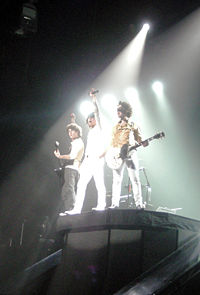 With the continued success of Backstreet Boys
and *NSYNC, American and British
groups like 98 Degrees
, Dream Street
, O-Town
, A1
, Blue, Busted and McFly
gained quick popularity both domestically and internationally. International boy bands would also occasionally spring up, such as the Moldova
n band O-Zone
(better known today as an Internet meme
), Overground and Tokio Hotel
, who are currently the most successful boyband ever on the German Singles Chart.
Since 2001, the dominance of traditional boy bands on pop charts began to fade, although Gil Kaufman of MTV has described "new boy bands" that are "more likely to resemble Good Charlotte
, Simple Plan
. This was shown in boybands such as Busted, McFly
, Tokio Hotel
, Son of Dork
and The Noise Next Door
etc.
The Finnish
rock band HIM have been described by some, and even suggested by vocalist Ville Valo
to be a boy band, despite their slightly darker imagery. This view became increasingly popular around the time of their international breakthrough album, Razorblade Romance
, stemming from the amount of lyrics revolving around romance, as well as the band members' on-stage personas and tendencies to jokingly interact with one another during shows.
Some bands typically labeled as 'boy bands' have achieved larger success because their members create and play their own songs, trying to keep a level of musical performance up to their image. Boston
-based power pop
group The Click Five
is a recent example.
Boybands are still hugely popular especially in the United Kingdom
and the rest of Europe
due to the continued commercial presence and longevity of nineties boybands such as Backstreet Boys
, Take That
, Boyzone
and Westlife
. Some sections of the press have referred to these acts, particularly those who have reformed after a previous split, such as Take That and Boyzone, as 'man bands'. These older generation artists chart alongside US5
, Lexington Bridge
, JLS
, The Wanted
and One Direction
who are examples of new and current successful boy bands in Europe.
Boy bands are still popular in Eastern Asia with successful groups such as South Korea's Super Junior
, 2PM
, TVXQ
, BIGBANG, SHINee
, SS501 and F.T. Island
. Japan's Arashi
, SMAP
, V6, Tokio
, KinKi Kids
, KAT-TUN
, NEWS
, Kanjani 8, and Hey! Say! JUMP
top the Oricon
charts. Taiwan also has notable boy bands like Fahrenheit
and F4
.
In 2001 a new all-male Japanese pop band and dance group boyband hailing from Japan called EXILE, debuted under Avex Group's label Rhythm Zone
with 14 members, putting them on par with Super Junior
as the largest boy bands in the world.
In North America the Jonas Brothers
had popularity helped from promotion on the Disney Channel
enabling them during 2008 to sell over 180,000 copies on albums in a week and hit number one on the American Billboard 200. Other new boyband acts from America include Big Time Rush
, and Mindless Behavior
. However apart from the Jonas Brothers
boybands haven't seen the commercial boom experienced in the genre from the mid to late nineties in North America.
, carefully controlled by managing all aspects of the group's dress, promotional materials (which are frequently supplied to teen magazine
s), and music video
s. Typically, each member of the group will have some distinguishing feature and be portrayed as having a particular personality stereotype, such as "the baby," "the bad boy," or "the nice boy." While managing the portrayal of popular musicians is as old as popular music
, the particular pigeonholing of band members is a defining characteristic of boy and girl bands.
In most cases, their music is written, arranged and produced by a producer who works with the band at all times and controls the group's sound - if necessary, to the point of hiring session singers to record guide vocals for each member of the group to sing individually if the members cannot harmonize well together. However, for clarity of each voice, recording each voice individually is most commonly the norm with most modern vocal groups. In recent years auto-tune
has become a popular tool for boybands who are unable to sing properly.
A typical boy band performance features elaborately choreographed
dancing, with the members taking turns singing and/or rapping. Boy bands generally didn't compose or produce their own material, unless the members lobbied hard enough for creative control (for example, The Monkees
, The Fukui Boys, and 'N Sync
). However some bands were created around the talent of a songwriter within the group like Gary Barlow
of Take That
or Tony Mortimer
of East 17
. Five
were another group who wrote almost all their own songs.
It isn't uncommon to find extra songs on the album written by one or more of the band members, however their producers rarely use these as singles.
Since the 21st Century however boybands have been expected to write or at least contribute in some part lyrically to songs. Apart from the groups mentioned above who all had at least one primary songwriter from their beginning, other groups soon caught up. From the late nineties band members saw the lucrative incentive of songwriting through track royalties and members in bands such as Backstreet Boys
who had previously used writers like Max Martin
or Steve Mac
during their early albums now began co writing.
Modern groups of the last ten years such as Busted
, McFly
, JLS
and Tokio Hotel
etc. have all made a point from early interviews that they write their own songs and hold their own image as this is an important part of marketing. Some bands like The Wanted
have even spent time learning the craft of songwriting.
The key factor of a boy band is being trendy. This means that the band conforms to the most recent fashion and musical trends in the popular music scene. As of 2008, boy bands are more likely to be imitating pop punk
acts like Blink 182, as well as the corresponding "emo
/pop punk
" fashion, as it is the current trend.
or pop
influences, other music genre
s, most notably country music
and folk music
, are also represented. South 65
and Marshall Dyllon
, for example, were both considered country music boy bands, as was to a lesser extent Rascal Flatts
. Il Divo
, created by Simon Cowell
in 2004, are a band that perform Operatic pop
, and in several (mainly Italian) languages. Since then operatic/classical boy bands have become quite popular and common, especially in the UK. Since 2001 there has been some crossover with power pop
and pop punk
from bands that play live instruments. For example, as of 2008, boy bands are often influenced by pop punk, post-grunge
and power pop (a perennial genre). Just recently some boy bands decided to go back to their original doo-wop roots, most notably, The Overtones
.
, *NSYNC, and LFO have disliked the term "boy band" and have preferred to be known as a "Male Vocal Group". Boy bands have been accused by the music press of emphasizing the appearance and marketing of the group above the quality of music, deliberately trying to appeal to a pre-teen audience and for conforming to trends instead of being original. Such criticisms can become extremely scathing. Boy bands are often seen as being short lived, though some acts such as The Jackson 5
, New Kids On The Block
, the Backstreet Boys
, Boyzone
, Hanson
, Human Nature
, Westlife
and Take That
have sustained lasting careers, and in some cases, successful comebacks.
Popular music
Popular music belongs to any of a number of musical genres "having wide appeal" and is typically distributed to large audiences through the music industry. It stands in contrast to both art music and traditional music, which are typically disseminated academically or orally to smaller, local...
act consisting of only male
Male
Male refers to the biological sex of an organism, or part of an organism, which produces small mobile gametes, called spermatozoa. Each spermatozoon can fuse with a larger female gamete or ovum, in the process of fertilization...
singers
Singing
Singing is the act of producing musical sounds with the voice, and augments regular speech by the use of both tonality and rhythm. One who sings is called a singer or vocalist. Singers perform music known as songs that can be sung either with or without accompaniment by musical instruments...
. The members are expected to dance
Dance
Dance is an art form that generally refers to movement of the body, usually rhythmic and to music, used as a form of expression, social interaction or presented in a spiritual or performance setting....
as well as sing
Singing
Singing is the act of producing musical sounds with the voice, and augments regular speech by the use of both tonality and rhythm. One who sings is called a singer or vocalist. Singers perform music known as songs that can be sung either with or without accompaniment by musical instruments...
, usually giving highly choreographed
Choreography
Choreography is the art of designing sequences of movements in which motion, form, or both are specified. Choreography may also refer to the design itself, which is sometimes expressed by means of dance notation. The word choreography literally means "dance-writing" from the Greek words "χορεία" ...
performances. More often than not, boy band members do not play musical instrument
Musical instrument
A musical instrument is a device created or adapted for the purpose of making musical sounds. In principle, any object that produces sound can serve as a musical instrument—it is through purpose that the object becomes a musical instrument. The history of musical instruments dates back to the...
s, either in recording sessions or on stage, and only sing and dance, making the term somewhat of a misnomer
Misnomer
A misnomer is a term which suggests an interpretation that is known to be untrue. Such incorrect terms sometimes derive their names because of the form, action, or origin of the subject becoming named popularly or widely referenced—long before their true natures were known.- Sources of misnomers...
. However, exceptions do exist. In many cases boy bands are brought together by a producer through an audition
Audition
An audition is a sample performance by an actor, singer, musician, dancer or other performing artist.Audition may also refer to:* The sense of hearing* Adobe Audition, audio editing software...
process, although many of them form on their own.
Some such bands can evolve out of church choral or gospel music
Gospel music
Gospel music is music that is written to express either personal, spiritual or a communal belief regarding Christian life, as well as to give a Christian alternative to mainstream secular music....
groups, but are often created by talent manager
Talent manager
A talent manager, also known as an artist manager or band manager, is an individual or company who guides the professional career of artists in the entertainment industry...
s or record producer
Record producer
A record producer is an individual working within the music industry, whose job is to oversee and manage the recording of an artist's music...
s who hold auditions. Due to this and their general commercial orientation towards an audience of preteen
Preteen
Preadolescence is a stage of human development following early childhood and prior to adolescence. It may be defined as ending with the beginning of puberty or with the beginning of the teenage stage, the time frames in which adolescence is considered to begin. In terms of age in years,...
s, teenybopper
Teenybopper
The term teenybopper was invented by marketing professionals and psychologists, later becoming a subculture of its own. The term describes a young teenager, particularly a girl, who follows adolescent trends in music, fashion and culture. The term was introduced in the 1950s to refer to teenagers...
s, or teens, the term may be used with negative connotations in music journalism
Music journalism
Music journalism is criticism and reportage about music. It began in the eighteenth century as comment on what is now thought of as 'classical music'. This aspect of music journalism, today often referred to as music criticism , comprises the study, discussion, evaluation, and interpretation of...
. Boy bands are similar in concept to girl group
Girl group
A girl group is a popular music act featuring several young female singers who generally harmonise together.Girl groups emerged in the late 1950s as groups of young singers teamed up with behind-the-scenes songwriters and music producers to create hit singles, often featuring glossy production...
s.
Early history
The earliest form of boy band music took place in the late 19th century with the use of a capella Barbershop quartets. They were usually a group of males and sing in four part harmonies. The popularity of Barbershop quartets had been prominent into the earlier part of the 20th century. A revival of the male vocal group took place in the late 1940s and 1950s with the use of doo-wopDoo-wop
The name Doo-wop is given to a style of vocal-based rhythm and blues music that developed in African American communities in the 1940s and achieved mainstream popularity in the 1950s and early 1960s. It emerged from New York, Philadelphia, Chicago, Baltimore, Newark, Pittsburgh, Cincinnati and...
music. Doo wop was a predecessor to the previous boy bands and they sung about topics such as love and other themes used in pop music. The earliest traces of boy bands were in the mid 1950s and the term boy band was not used. The Ink Spots was one of the first boy bands. The term boy band was not established until the late 1980s. Before that times they were called male vocal groups or hep harmony singing groups.
1960s
The earliest predecessors of the boy band genre were groups such as The OsmondsThe Osmonds
The Osmonds are an American family music group with a long and varied career—a career that took them from singing barbershop music as children, to achieving success as teen-music idols, to producing a hit television show, and to continued success as solo and group performers...
, The Jackson 5
The Jackson 5
The Jackson 5 , later known as The Jacksons, were an American popular music family group from Gary, Indiana...
, and The Monkees
The Monkees
The Monkees are an American pop rock group. Assembled in Los Angeles in 1966 by Robert "Bob" Rafelson and Bert Schneider for the American television series The Monkees, which aired from 1966 to 1968, the musical acting quartet was composed of Americans Micky Dolenz, Michael Nesmith and Peter Tork,...
, which helped form the template for boy bands. While The Monkees
The Monkees
The Monkees are an American pop rock group. Assembled in Los Angeles in 1966 by Robert "Bob" Rafelson and Bert Schneider for the American television series The Monkees, which aired from 1966 to 1968, the musical acting quartet was composed of Americans Micky Dolenz, Michael Nesmith and Peter Tork,...
were originally a manufactured act turned real band that featured members with distinct (albeit fictional) personality types, The Jackson 5
The Jackson 5
The Jackson 5 , later known as The Jacksons, were an American popular music family group from Gary, Indiana...
were a family group that established many musical conventions that boy bands follow. For instance, their music featured close harmonies
Close harmony
Close harmony is an arrangement of the notes of chords within a narrow range. It is different from open harmony or voicing in that it uses each part on the closest harmonizing note , while the open voicing uses a broader pitch array expanding the harmonic range past the octave...
from soul music
Soul music
Soul music is a music genre originating in the United States combining elements of gospel music and rhythm and blues. According to the Rock and Roll Hall of Fame, soul is "music that arose out of the black experience in America through the transmutation of gospel and rhythm & blues into a form of...
and catchy pop hooks influenced as much as they were Motown acts like The Supremes
The Supremes
The Supremes, an American female singing group, were the premier act of Motown Records during the 1960s.Originally founded as The Primettes in Detroit, Michigan, in 1959, The Supremes' repertoire included doo-wop, pop, soul, Broadway show tunes, psychedelic soul, and disco...
. All members of the band sang, which is a common convention of boy band, as opposed to having a front man and the rest on instruments. This is effectively so that no one person dominated the stage. Even so, the members conveniently fitted into the convention of having stereotypical personality types (Michael Jackson
Michael Jackson
Michael Joseph Jackson was an American recording artist, entertainer, and businessman. Referred to as the King of Pop, or by his initials MJ, Jackson is recognized as the most successful entertainer of all time by Guinness World Records...
being the "cute one", to give an obvious example).
Although not a manufactured band, The Beatles
The Beatles
The Beatles were an English rock band, active throughout the 1960s and one of the most commercially successful and critically acclaimed acts in the history of popular music. Formed in Liverpool, by 1962 the group consisted of John Lennon , Paul McCartney , George Harrison and Ringo Starr...
set a precedent for boy bands to follow both in terms of marketing to young girls and certain aesthetic and musical conventions. The merchandising, whether it was films like A Hard Day's Night
A Hard Day's Night (film)
A Hard Day's Night is a 1964 British black-and-white comedy film directed by Richard Lester and starring The Beatles—John Lennon, Paul McCartney, George Harrison and Ringo Starr—during the height of Beatlemania. It was written by Alun Owen and originally released by United Artists...
or novelty goods were possibly the first aimed at a certain demographic on a large scale for a group. This made them a proto-type for boy bands, such as The Jackson 5
The Jackson 5
The Jackson 5 , later known as The Jacksons, were an American popular music family group from Gary, Indiana...
and The Monkees
The Monkees
The Monkees are an American pop rock group. Assembled in Los Angeles in 1966 by Robert "Bob" Rafelson and Bert Schneider for the American television series The Monkees, which aired from 1966 to 1968, the musical acting quartet was composed of Americans Micky Dolenz, Michael Nesmith and Peter Tork,...
. Musical conventions that boy bands adopted from The Beatles were less their technical proficiency as musicians and more the catchy pop hooks, melodies and harmonies combined with their marketability. Their marketability was based the idea that there was something for everyone, whether it is the music or the personality of John Lennon
John Lennon
John Winston Lennon, MBE was an English musician and singer-songwriter who rose to worldwide fame as one of the founding members of The Beatles, one of the most commercially successful and critically acclaimed acts in the history of popular music...
or Paul McCartney
Paul McCartney
Sir James Paul McCartney, MBE, Hon RAM, FRCM is an English musician, singer-songwriter and composer. Formerly of The Beatles and Wings , McCartney is listed in Guinness World Records as the "most successful musician and composer in popular music history", with 60 gold discs and sales of 100...
or their sex appeal.
The Beatles were more directly an influence on boy bands that use rock band instrumentation. The precedent for this was when TV Producers Bert Schneider
Bert Schneider
Berton "Bert" Schneider is an American movie producer, who was behind a number of important and topical films of the late-1960s and early-1970s. The son of Abraham Schneider, onetime president of Columbia Pictures, the younger Schneider tended toward the rebellious. He briefly attended Cornell...
and Bob Rafelson
Bob Rafelson
Robert "Bob" Rafelson is an Emmy Award winning American film director, writer and producer. He was an early member of the New Hollywood movement in the 1970s and is most famous for directing and co-writing the film Five Easy Pieces, starring Jack Nicholson, as well as being one of the creators of...
got four members to perform catchy pop tunes while also acting in a television series. The Monkees are often considered as the original pioneers among boy bands. Formed in 1965 under the supervision of Don Kirshner
Don Kirshner
Don Kirshner , known as "The Man With the Golden Ear", was an American song publisher and rock producer who is best known for managing songwriting talent as well as successful pop groups, such as The Monkees, Kansas and The Archies.-Early life:Don Kirshner was born to Gilbert Kirshner, a tailor,...
, the group became dissatisfied with Kirshner's control and became independent two years later, and worked on their own up to 1970.
1970s and 1980s
Although the term "boy band" is mostly associated with groups from the 1990s onwards, other antecedents (apart from those already mentioned) exist throughout the history of pop music. The genre has been copied into languages and cultures other than the Anglo-American. There is a popular Russian boy band Ivanushki InternationalIvanushki International
Ivanushki International is a Russian boy band founded in Moscow in 1995.The group was conceived by record producer Igor Matviyenko, and initially consisted of Andrei Grigoriev-Apollonov, Kirill Andreev, and primary vocalist Igor Sorin...
. The Puerto Rican boy band Menudo
Menudo (band)
Menudo was a Puerto Rican boy band that was formed in the 1970s by producer Edgardo Díaz, releasing their first album in 1977. The band achieved much success, especially during the 1980s, becoming the most popular Latin American teen musical group of the era....
, appealing to young Latina
Latina
Latina is the feminine form of the term Latino.Latina may also refer to:*Province of Latina, a province in Latium , Italy**Latina, Lazio, the capital of the province of Latina**Latina Nuclear Power Plant*Latina , a district of Madrid...
audiences, was founded in 1977. Menudo had a convention unique among boy bands: when a member turned 16, became too tall, or their voice changed, they were ejected and replaced. Members of Menudo were generally aged 12–14.
The Bay City Rollers
Bay City Rollers
The Bay City Rollers were a Scottish pop band who were most popular in the 1970s. The British Hit Singles & Albums noted that they were "tartan teen sensations from Edinburgh", and were "the first of many acts heralded as the 'Biggest Group since The Beatles' and one of the most screamed-at...
were a Scottish
Scotland
Scotland is a country that is part of the United Kingdom. Occupying the northern third of the island of Great Britain, it shares a border with England to the south and is bounded by the North Sea to the east, the Atlantic Ocean to the north and west, and the North Channel and Irish Sea to the...
pop
Pop music
Pop music is usually understood to be commercially recorded music, often oriented toward a youth market, usually consisting of relatively short, simple songs utilizing technological innovations to produce new variations on existing themes.- Definitions :David Hatch and Stephen Millward define pop...
band
Musical ensemble
A musical ensemble is a group of people who perform instrumental or vocal music. In classical music, trios or quartets either blend the sounds of musical instrument families or group together instruments from the same instrument family, such as string ensembles or wind ensembles...
who were most popular in the mid 1970s. The British Hit Singles & Albums noted that they were "tartan
Tartan
Tartan is a pattern consisting of criss-crossed horizontal and vertical bands in multiple colours. Tartans originated in woven wool, but now they are made in many other materials. Tartan is particularly associated with Scotland. Scottish kilts almost always have tartan patterns...
teen sensations from Edinburgh
Edinburgh
Edinburgh is the capital city of Scotland, the second largest city in Scotland, and the eighth most populous in the United Kingdom. The City of Edinburgh Council governs one of Scotland's 32 local government council areas. The council area includes urban Edinburgh and a rural area...
", and were "the first of many acts heralded as the 'Biggest Group since The Beatles' and one of the most screamed-at teeny-bopper acts of the 1970s". For a relatively brief but fervent period (nicknamed "Rollermania"), they were worldwide teen idol
Teen idol
A teen idol is a celebrity who is widely idolized by teenagers; he or she is often young but not necessarily teenaged. Often teen idols are actors or pop singers, but some sports figures have an appeal to teenagers. Some teen idols began their careers as child actors...
s. The group were one of the first bands like The Monkees
The Monkees
The Monkees are an American pop rock group. Assembled in Los Angeles in 1966 by Robert "Bob" Rafelson and Bert Schneider for the American television series The Monkees, which aired from 1966 to 1968, the musical acting quartet was composed of Americans Micky Dolenz, Michael Nesmith and Peter Tork,...
before them to take the formula shown by The Beatles
The Beatles
The Beatles were an English rock band, active throughout the 1960s and one of the most commercially successful and critically acclaimed acts in the history of popular music. Formed in Liverpool, by 1962 the group consisted of John Lennon , Paul McCartney , George Harrison and Ringo Starr...
and apply it to a teen market. The group achieved the same amount of success but for a limited period of time. At the peak of their popularity in the UK, comparisons were being made to The Beatles
The Beatles
The Beatles were an English rock band, active throughout the 1960s and one of the most commercially successful and critically acclaimed acts in the history of popular music. Formed in Liverpool, by 1962 the group consisted of John Lennon , Paul McCartney , George Harrison and Ringo Starr...
. Also by this time, Bay City Roller fans
Fan (person)
A Fan, sometimes also called aficionado or supporter, is a person with a liking and enthusiasm for something, such as a band or a sports team. Fans of a particular thing or person constitute its fanbase or fandom...
had a completely distinctive style of dress, the main elements of which were ankle-length tartan
Tartan
Tartan is a pattern consisting of criss-crossed horizontal and vertical bands in multiple colours. Tartans originated in woven wool, but now they are made in many other materials. Tartan is particularly associated with Scotland. Scottish kilts almost always have tartan patterns...
trousers
Trousers
Trousers are an item of clothing worn on the lower part of the body from the waist to the ankles, covering both legs separately...
and tartan scarves
Scarf
A scarf is a piece of fabric worn around the neck, or near the head or around the waist for warmth, cleanliness, fashion or for religious reasons. They can come in a variety of different colours.-History:...
, the group using the benefit of merchandise and promotion.
In the U.S., the Cleveland-based power pop
Power pop
Power pop is a popular musical genre that draws its inspiration from 1960s British and American pop and rock music. It typically incorporates a combination of musical devices such as strong melodies, crisp vocal harmonies, economical arrangements, and prominent guitar riffs. Instrumental solos are...
group Raspberries
Raspberries (band)
Raspberries is an American power pop/pop rock band from Cleveland, Ohio. They had a run of success in the early 1970s music scene with their crisp pop sound, which Allmusic later described as featuring "exquisitely crafted melodies and achingly gorgeous harmonies." The members were known for their...
was generally interpreted as a "teen act", although all the band members played their own music. Vocalist Eric Carmen
Eric Carmen
Eric Howard Carmen is an American singer, songwriter, guitarist and keyboardist.He scored numerous hit songs across the 1970s and 1980s, first as a member of the Raspberries , and then with his solo career, including hits such as "All By Myself", "Never Gonna Fall in Love Again", "She Did It",...
later commented, "You’d have a thousand screaming girls in the front of the stage and then ten very serious rock critics in the back of the room going, ‘Uh-huh, I think we understand this.’ And unfortunately the great mass of pot-smoking 18 year-olds that bought albums and made you a substantial commodity in the great marketing world of records never took to us. It was not hip for people to like us, because their little sister liked us.
New Edition
New Edition
New Edition is an R&B group formed in Boston in 1978. The group reached its height of popularity during the 1980s. They were the progenitors of the boy band movement of the 1980s and 1990s and led the way for groups like New Kids on the Block, Boyz II Men, Backstreet Boys and 'N Sync...
were a R&B
Contemporary R&B
Contemporary R&B is a music genre that combines elements of hip hop, soul, R&B and funk.Although the abbreviation “R&B” originates from traditional rhythm and blues music, today the term R&B is most often used to describe a style of African American music originating after the demise of disco in...
group formed in Boston
Boston
Boston is the capital of and largest city in Massachusetts, and is one of the oldest cities in the United States. The largest city in New England, Boston is regarded as the unofficial "Capital of New England" for its economic and cultural impact on the entire New England region. The city proper had...
in 1978. The group reached its height of popularity during the 1980s. They were the progenitors of the boy band movement of the 1980s and 1990s in the US
United States
The United States of America is a federal constitutional republic comprising fifty states and a federal district...
and led the way for groups like New Kids on the Block
New Kids on the Block
New Kids on the Block are an American boy band from Boston, Massachusetts, assembled in 1984 by producer Maurice Starr. The band currently consists of brothers Jordan and Jonathan Knight, Joey McIntyre, Donnie Wahlberg, and Danny Wood.New Kids on the Block enjoyed success in the late 1980s and...
, Boyz II Men
Boyz II Men
Boyz II Men is an American R&B vocal group best known for emotional ballads and a cappella harmonies. They are the most successful R&B group of all time, having sold more than albums worldwide. In the 1990s, Boyz II Men found fame on Motown Records as a quartet, but original member Michael McCary...
, Backstreet Boys
Backstreet Boys
The Backstreet Boys are an American vocal group, formed in Orlando, Florida in 1993. The band originally consisted of A. J. McLean, Howie Dorough, Brian Littrell, Nick Carter and Kevin Richardson. They rose to fame with their debut international album, Backstreet Boys...
and 'N Sync
'N Sync
N Sync was an American boy band formed in Orlando, Florida, in 1995 and launched in Germany by BMG Ariola Munich, *NSYNC consisted of JC Chasez, Justin Timberlake, Lance Bass, Joey Fatone and Chris Kirkpatrick...
. The group recorded mostly as a quintet.
Formed in 1982, Norwegian
Norwegians
Norwegians constitute both a nation and an ethnic group native to Norway. They share a common culture and speak the Norwegian language. Norwegian people and their descendants are found in migrant communities worldwide, notably in United States, Canada and Brazil.-History:Towards the end of the 3rd...
band A-ha
A-ha
A-ha were a Norwegian pop band formed in Oslo in 1982. The band was founded by Morten Harket , Magne Furuholmen , and Pål Waaktaar...
became the first Continental European
Continental Europe
Continental Europe, also referred to as mainland Europe or simply the Continent, is the continent of Europe, explicitly excluding European islands....
boyband to top the US Hot 100 with their single Take on Me
Take on Me
"Take on Me" is a song by the Norwegian pop band A-ha. Written by the band members, the song was produced by Alan Tarney for the group's first studio album Hunting High and Low, released in 1985...
in 1985. Although considered a one hit wonder in that country the group went on to have considerable success worldwide and lasting success.
Bros
Bros
Bros were a British band active in the late 1980s and early 1990s, consisting of twin brothers Matt Goss and Luke Goss along with Craig Logan...
(abbreviation of the word "brothers", were a British boy band active in the late 1980s and early 1990s, consisting of twin brothers Matt Goss
Matt Goss
Matthew Weston Goss is an English singer and songwriter currently based in Los Angeles. He was the lead singer of 1980s pop group Bros, which also featured his twin brother Luke Goss as drummer and Craig Logan as bass player...
and Luke Goss
Luke Goss
Luke Damon Goss is an English singer and actor. Since 1994, he has been married to backing singer Shirley Lewis, , and has one stepdaughter, Carli. In January 2007, he and wife Shirley moved permanently to Los Angeles, but still maintain a residence in London...
along with Craig Logan
Craig Logan
Craig Logan is a British music manager. He began his career as bassist in the pop band Bros.- Background :After a year of major UK success with Bros during 1988, Logan left the band in early 1989. After this, Logan focused on song-writing and producing and was nominated for an Ivor Novello award...
. Formed in 1986, they scored multiple top 10 hits between 1987 and 1989.
In Britain
United Kingdom
The United Kingdom of Great Britain and Northern IrelandIn the United Kingdom and Dependencies, other languages have been officially recognised as legitimate autochthonous languages under the European Charter for Regional or Minority Languages...
Bros
Bros
Bros were a British band active in the late 1980s and early 1990s, consisting of twin brothers Matt Goss and Luke Goss along with Craig Logan...
also became the first modern era style boyband to have a multiple platinum selling album with Push in 1988, which is still one of the most successful boyband albums in the UK.
1990s
Although the term "boy band" did not exist until the 1990s, Boston group New EditionNew Edition
New Edition is an R&B group formed in Boston in 1978. The group reached its height of popularity during the 1980s. They were the progenitors of the boy band movement of the 1980s and 1990s and led the way for groups like New Kids on the Block, Boyz II Men, Backstreet Boys and 'N Sync...
is credited for starting the boy band trend in the 1980s. Maurice Starr
Maurice Starr
Maurice Starr is an American musician, songwriter, and record producer.-Biography:Starr, originally from Florida, moved to Boston with his brother Michael in the early 1970s. After moving to Boston he recorded two unsuccessful R&B albums, Flaming Starr and Spacey Lady...
was influenced by New Edition and popularised it with his protégé
Mentorship
Mentorship refers to a personal developmental relationship in which a more experienced or more knowledgeable person helps a less experienced or less knowledgeable person....
New Kids on the Block
New Kids on the Block
New Kids on the Block are an American boy band from Boston, Massachusetts, assembled in 1984 by producer Maurice Starr. The band currently consists of brothers Jordan and Jonathan Knight, Joey McIntyre, Donnie Wahlberg, and Danny Wood.New Kids on the Block enjoyed success in the late 1980s and...
, the first commercially successful modern boy band who formed in 1984 and found international success in 1988. Starr's idea was to take the traditional template from the R&B genre (in this case his teenage band New Edition
New Edition
New Edition is an R&B group formed in Boston in 1978. The group reached its height of popularity during the 1980s. They were the progenitors of the boy band movement of the 1980s and 1990s and led the way for groups like New Kids on the Block, Boyz II Men, Backstreet Boys and 'N Sync...
) and apply it to a pop genre.
Some managers in Europe soon created their own acts after being inspired by New Kids on the Block
New Kids on the Block
New Kids on the Block are an American boy band from Boston, Massachusetts, assembled in 1984 by producer Maurice Starr. The band currently consists of brothers Jordan and Jonathan Knight, Joey McIntyre, Donnie Wahlberg, and Danny Wood.New Kids on the Block enjoyed success in the late 1980s and...
. First beginning with Nigel Martin-Smith
Nigel Martin-Smith
Nigel Martin-Smith is a Manchester-based musical band manager who formed 1990s British boy band Take That.-Biography:Martin-Smith entered the entertainment industry in the early 1980s working as a casting agent from offices in Manchester's Royal Exchange...
's Take That
Take That
Take That are a British five-piece vocal pop group comprising Gary Barlow, Howard Donald, Jason Orange, Mark Owen and Robbie Williams. Barlow acts as the lead singer and primary songwriter...
in the UK who formed in 1990 and followed by Tom Watkins who had success with Bros
Bros
Bros were a British band active in the late 1980s and early 1990s, consisting of twin brothers Matt Goss and Luke Goss along with Craig Logan...
in the late eighties and formed East 17
East 17
East 17 are a pop boy band comprising Tony Mortimer, John Hendy and Terry Coldwell. Tony Mortimer is the group's frontman and primary songwriter. Formed in Walthamstow, London in 1991, the group have achieved eighteen Top 20 singles and four Top 10 albums, and were one of the UK's most popular boy...
in 1991 who were marketed and pited against Take That
Take That
Take That are a British five-piece vocal pop group comprising Gary Barlow, Howard Donald, Jason Orange, Mark Owen and Robbie Williams. Barlow acts as the lead singer and primary songwriter...
as rivals with a harsher attitude, style and sound. Irish
Irish people
The Irish people are an ethnic group who originate in Ireland, an island in northwestern Europe. Ireland has been populated for around 9,000 years , with the Irish people's earliest ancestors recorded having legends of being descended from groups such as the Nemedians, Fomorians, Fir Bolg, Tuatha...
music manager Louis Walsh
Louis Walsh
Louis Walsh is an Irish music manager and judge on the British television talent show The X Factor.-Band manager:...
had seen the impact of these two British
British people
The British are citizens of the United Kingdom, of the Isle of Man, any of the Channel Islands, or of any of the British overseas territories, and their descendants...
boy bands and put out an advert for an 'Irish Take That' creating Boyzone
Boyzone
Boyzone are an Irish boy band comprising Keith Duffy, Mikey Graham, Ronan Keating,Shane Lynch, and formerly Stephen Gately. Boyzone have 19 singles in the top 40 UK charts and 21 singles in the Ire charts. The group currently have 6 UK number one singles and 9 number one singles in Ireland with 12...
in 1993. 911
911 (band)
911 is a British boyband that consists of Lee Brennan, Jimmy Constable Spike Dawbarn and for a short period Lee Womack who left the band to study at Huddersfield University. The band were formed in 1995 and released their debut single in May 1996...
formed in 1995 were another boy band who enjoyed success in Britain, however by the late 1990s all these bands had ran their course and split up. All these artists were very successful on both the singles and albums charts domestically and internationally however with the emergence of britpop
Britpop
Britpop is a subgenre of alternative rock that originated in the United Kingdom. Britpop emerged from the British independent music scene of the early 1990s and was characterised by bands influenced by British guitar pop music of the 1960s and 1970s...
and the commercial co-option of indie rock
Indie rock
Indie rock is a genre of alternative rock that originated in the United Kingdom and the United States in the 1980s. Indie rock is extremely diverse, with sub-genres that include lo-fi, post-rock, math rock, indie pop, dream pop, noise rock, space rock, sadcore, riot grrrl and emo, among others...
, many boy bands were ridiculed by the British music press as having no artistic credibility. The media attention was now placed on the Battle of Britpop and the bands Oasis
Oasis (band)
Oasis were an English rock band formed in Manchester in 1991. Originally known as The Rain, the group was formed by Liam Gallagher , Paul "Bonehead" Arthurs , Paul "Guigsy" McGuigan and Tony McCarroll , who were soon joined by Liam's older brother Noel Gallagher...
and Blur
Blur (band)
Blur is an English alternative rock band. Formed in London in 1989 as Seymour, the group consists of singer Damon Albarn, guitarist Graham Coxon, bassist Alex James and drummer Dave Rowntree. Blur's debut album Leisure incorporated the sounds of Madchester and shoegazing...
replaced the importance and rivalry of Take That
Take That
Take That are a British five-piece vocal pop group comprising Gary Barlow, Howard Donald, Jason Orange, Mark Owen and Robbie Williams. Barlow acts as the lead singer and primary songwriter...
and East 17
East 17
East 17 are a pop boy band comprising Tony Mortimer, John Hendy and Terry Coldwell. Tony Mortimer is the group's frontman and primary songwriter. Formed in Walthamstow, London in 1991, the group have achieved eighteen Top 20 singles and four Top 10 albums, and were one of the UK's most popular boy...
as the two new biggest bands in Britain.
In 1995 successful German
Germany
Germany , officially the Federal Republic of Germany , is a federal parliamentary republic in Europe. The country consists of 16 states while the capital and largest city is Berlin. Germany covers an area of 357,021 km2 and has a largely temperate seasonal climate...
music manger Frank Farian
Frank Farian
Frank Farian , is a German record producer and songwriter. He started out as a trained cook before moving into the music industry...
who had been manager of Boney M
Boney M
Boney M. is a Eurodisco group created by German record producer Frank Farian. Originally based in Germany, the four original members of the group's official line-up were Jamaicans Liz Mitchell and Marcia Barrett, Maizie Williams from Montserrat and Bobby Farrell from Aruba...
and Milli Vanilli
Milli Vanilli
Milli Vanilli was a pop/dance music project formed by Frank Farian in Germany in 1988, visually fronted by Fab Morvan and Rob Pilatus. The group's debut album achieved international success and earned them a Grammy Award for Best New Artist on Feb. 21, 1990. Milli Vanilli became one of the most...
put together Latin American band No Mercy
No Mercy (band)
No Mercy is an American pop and dance music group formed by Frank Farian in Florida in 1995, consisting of Marty Cintron , and twin brothers, Ariel and Gabriel Hernández , from Miami, Florida.-Career:In 1996, No Mercy released their debut album titled No Mercy, later re-released in Europe retitled My...
who scored a few worldwide hits during the mid nineties.
One of the most successful boy band managers from the U.S was Lou Pearlman
Lou Pearlman
Louis Jay "Lou" Pearlman is a former impresario of the successful 1990s boy bands such as The Backstreet Boys, *NSYNC, Take 5, O-Town and US5. In 2006, it was discovered that Pearlman had perpetrated one of the largest and longest-running Ponzi schemes in American history, leaving more than $300...
, who founded commercially successful acts such as the Backstreet Boys
Backstreet Boys
The Backstreet Boys are an American vocal group, formed in Orlando, Florida in 1993. The band originally consisted of A. J. McLean, Howie Dorough, Brian Littrell, Nick Carter and Kevin Richardson. They rose to fame with their debut international album, Backstreet Boys...
formed in 1993 and 'N Sync
'N Sync
N Sync was an American boy band formed in Orlando, Florida, in 1995 and launched in Germany by BMG Ariola Munich, *NSYNC consisted of JC Chasez, Justin Timberlake, Lance Bass, Joey Fatone and Chris Kirkpatrick...
formed in 1995, although he was later convicted of unrelated fraud incidents.
In the late nineties in the UK, producer Simon Cowell
Simon Cowell
Simon Phillip Cowell is an English A&R executive, television producer, entrepreneur, and television personality. He is known in the United Kingdom and United States for his role as a talent judge on TV shows such as Pop Idol, The X Factor, Britain's Got Talent and American Idol...
(noted in the U.S. for the American Idol/ X Factor franchise) is also known for having managed British boyband Five
Five (band)
Five were an English boyband put together in 1997 by the same team that managed the Spice Girls before they launched their career. The five members were Scott Robinson, Ritchie Neville, J Brown, Abs Breen and Sean Conlon. Signed by Simon Cowell, they were a manufactured band and held several...
formed in 1997 and Irish Republic boyband Westlife
Westlife
Westlife are an Irish boy band established on 3 July 1998. They are to disband in 2012. The group's line-up was Nicky Byrne, Kian Egan, Mark Feehily, Shane Filan, and Brian McFadden . The group are the only act in British and Irish history to have their first seven singles peak at number one...
who formed in 1998 and were created by Irishman Louis Walsh
Louis Walsh
Louis Walsh is an Irish music manager and judge on the British television talent show The X Factor.-Band manager:...
as a replacement for Boyzone
Boyzone
Boyzone are an Irish boy band comprising Keith Duffy, Mikey Graham, Ronan Keating,Shane Lynch, and formerly Stephen Gately. Boyzone have 19 singles in the top 40 UK charts and 21 singles in the Ire charts. The group currently have 6 UK number one singles and 9 number one singles in Ireland with 12...
but were initially promoted by a former member of that band Ronan Keating
Ronan Keating
Ronan Patrick John Keating is an Irish recording artist, singer-songwriter, musician, and philanthropist. Keating debuted on the professional music scene alongside Keith Duffy, Mikey Graham, Shane Lynch and Stephen Gately, in 1994 as the lead singer of Boyzone. His solo career started in 1999, and...
. They would go on to become the most successful boyband on the UK Singles Charts.
Cowell is now also currently having international success this decade with a new British
United Kingdom
The United Kingdom of Great Britain and Northern IrelandIn the United Kingdom and Dependencies, other languages have been officially recognised as legitimate autochthonous languages under the European Charter for Regional or Minority Languages...
/Irish
Irish people
The Irish people are an ethnic group who originate in Ireland, an island in northwestern Europe. Ireland has been populated for around 9,000 years , with the Irish people's earliest ancestors recorded having legends of being descended from groups such as the Nemedians, Fomorians, Fir Bolg, Tuatha...
boyband called One Direction
One Direction
One Direction are a British-Irish boy band, consisting of members Niall Horan, Zayn Malik, Liam Payne, Harry Styles and Louis Tomlinson. They finished third on the seventh series of The X Factor. Following The X Factor, the group signed a record contract with Syco Music.One Direction's debut single...
formed in 2010 on his show The X Factor
The X Factor (UK series 7)
The X Factor is a British television music competition to find new singing talent; the winner of which receives a £1 million recording contract with the Syco Music record label. The seventh series started on ITV on 21 August 2010 and ended on 12 December 2010. The winner was Matt Cardle and...
and signed to his label Syco Music
Syco
Syco Entertainment, often known as simply Syco , is a global joint venture between Simon Cowell and Sony Music Entertainment focused on the production and exploitation of music, television, film and digital content...
.
In North America boy bands were prominent in the 1990s like internationally after having started the modern concept with New Kids on the Block
New Kids on the Block
New Kids on the Block are an American boy band from Boston, Massachusetts, assembled in 1984 by producer Maurice Starr. The band currently consists of brothers Jordan and Jonathan Knight, Joey McIntyre, Donnie Wahlberg, and Danny Wood.New Kids on the Block enjoyed success in the late 1980s and...
. In the mid-1990s, most boy bands were African American and had R&B and gospel elements, such as the group All 4 One
All-4-One
All-4-One is a male R&B/pop group best known for their cover hit single "I Swear" from their self-titled 1994 debut album. The group comprises Jamie Jones, Delious Kennedy, Alfred Nevarez, and Tony Borowiak, all from the Antelope Valley and Mojave, California areas, but are based in the Los Angeles...
formed in 1993 and Boyz II Men
Boyz II Men
Boyz II Men is an American R&B vocal group best known for emotional ballads and a cappella harmonies. They are the most successful R&B group of all time, having sold more than albums worldwide. In the 1990s, Boyz II Men found fame on Motown Records as a quartet, but original member Michael McCary...
formed in 1988 and who released their debut album in 1991. Boyz II Men
Boyz II Men
Boyz II Men is an American R&B vocal group best known for emotional ballads and a cappella harmonies. They are the most successful R&B group of all time, having sold more than albums worldwide. In the 1990s, Boyz II Men found fame on Motown Records as a quartet, but original member Michael McCary...
are also the most successful boy band act on the US Hot 100 as well as the Australian Singles Chart. Although they had success on the Billboard charts, they had been targeted to more of an adult audience and were not marketed for youth. It wasn't however until 1997 and the change to pop orientated groups like Backstreet Boys
Backstreet Boys
The Backstreet Boys are an American vocal group, formed in Orlando, Florida in 1993. The band originally consisted of A. J. McLean, Howie Dorough, Brian Littrell, Nick Carter and Kevin Richardson. They rose to fame with their debut international album, Backstreet Boys...
, 98 Degrees
98 Degrees
98 Degrees is an American adult contemporary boy band consisting of four vocalists: brothers Nick and Drew Lachey, Justin Jeffre, and Jeff Timmons. The group was formed by Timmons in Los Angeles, California....
, 'N Sync
'N Sync
N Sync was an American boy band formed in Orlando, Florida, in 1995 and launched in Germany by BMG Ariola Munich, *NSYNC consisted of JC Chasez, Justin Timberlake, Lance Bass, Joey Fatone and Chris Kirkpatrick...
and Hanson
Hanson (band)
Hanson are an American pop rock band formed in Tulsa, Oklahoma, by brothers Isaac , Taylor , and Zac Hanson . They are best known for the 1997 hit song "MMMBop" from their major label debut album Middle of Nowhere, which earned three Grammy nominations...
that boy bands exploded commercially and dominated the market in the United States. This late nineties era marked the height of boy band popularity in North America which hasn't been seen since.
21st Century
Backstreet Boys
The Backstreet Boys are an American vocal group, formed in Orlando, Florida in 1993. The band originally consisted of A. J. McLean, Howie Dorough, Brian Littrell, Nick Carter and Kevin Richardson. They rose to fame with their debut international album, Backstreet Boys...
and *NSYNC, American and British
United Kingdom
The United Kingdom of Great Britain and Northern IrelandIn the United Kingdom and Dependencies, other languages have been officially recognised as legitimate autochthonous languages under the European Charter for Regional or Minority Languages...
groups like 98 Degrees
98 Degrees
98 Degrees is an American adult contemporary boy band consisting of four vocalists: brothers Nick and Drew Lachey, Justin Jeffre, and Jeff Timmons. The group was formed by Timmons in Los Angeles, California....
, Dream Street
Dream Street
Dream Street was an American pop boy band that was formed in mid 1999 by Louis Baldonieri and Brian Lukow. Dream Street later disbanded in 2002 after a legal dispute between the parents and the group's managers...
, O-Town
O-Town (band)
O-Town is an American boy band formed from the first season of the MTV-produced reality television series Making The Band in 2000. The original members of the band were Jacob Underwood, Ashley Parker Angel, Erik-Michael Estrada, Trevor Penick, and Dan Miller. After releasing two albums near the end...
, A1
A1 (band)
A1 are a British-Norwegian boyband. They were originally made up of Mark Read, Ben Adams, Christian Ingebrigtsen and Paul Marazzi. Their first single, "Be the First to Believe", entered the UK singles chart at #6 in early 1999. They had a huge amount of success worldwide and charts with two number...
, Blue, Busted and McFly
McFly
McFly are an English pop rock band who first found fame in 2004. The band consists of Tom Fletcher , Danny Jones , Dougie Poynter and Harry Judd . They were signed to the Island Records label from their 2004 launch until December 2007, before creating their own label, Super Records...
gained quick popularity both domestically and internationally. International boy bands would also occasionally spring up, such as the Moldova
Moldova
Moldova , officially the Republic of Moldova is a landlocked state in Eastern Europe, located between Romania to the West and Ukraine to the North, East and South. It declared itself an independent state with the same boundaries as the preceding Moldavian Soviet Socialist Republic in 1991, as part...
n band O-Zone
O-Zone
O-Zone was a Romania/Moldovan pop music trio that was active from 1998 to 2005 and consisted of Dan Bălan, Radu Sîrbu, and Arsenie Todiraş. The group gained global popularity with their song "Dragostea din tei" and their subsequent album DiscO-Zone....
(better known today as an Internet meme
Numa Numa
Numa Numa is an Internet phenomenon based on amateur videos, most notably Numa Numa Song by Gary Brolsma, made for the song "Dragostea din tei" as performed by O-Zone. Brolsma's video, released in December 2004 on the website Newgrounds.com, was the first Numa Numa–themed video to gain widespread...
), Overground and Tokio Hotel
Tokio Hotel
Tokio Hotel is a pop rock band from Germany, founded in 2001 by singer Bill Kaulitz, guitarist Tom Kaulitz, drummer Gustav Schäfer and bassist Georg Listing...
, who are currently the most successful boyband ever on the German Singles Chart.
Since 2001, the dominance of traditional boy bands on pop charts began to fade, although Gil Kaufman of MTV has described "new boy bands" that are "more likely to resemble Good Charlotte
Good Charlotte
Good Charlotte is an American rock band from Waldorf, Maryland that formed in 1996. Since 1998, the band's constant members have been lead vocalist Joel Madden, lead guitarist and back-up vocalist Benji Madden, bass guitarist Paul Thomas and rhythm guitarist and keyboardist Billy Martin...
, Simple Plan
Simple Plan
Simple Plan is a Canadian pop punk band from Montréal, Québec. The band has had no line up changes since its inception in 1999. Members are Pierre Bouvier , Jeff Stinco , Sébastien Lefebvre , David Desrosiers and Chuck Comeau...
. This was shown in boybands such as Busted, McFly
McFly
McFly are an English pop rock band who first found fame in 2004. The band consists of Tom Fletcher , Danny Jones , Dougie Poynter and Harry Judd . They were signed to the Island Records label from their 2004 launch until December 2007, before creating their own label, Super Records...
, Tokio Hotel
Tokio Hotel
Tokio Hotel is a pop rock band from Germany, founded in 2001 by singer Bill Kaulitz, guitarist Tom Kaulitz, drummer Gustav Schäfer and bassist Georg Listing...
, Son of Dork
Son of Dork
Son of Dork were a British pop punk band formed by James Bourne after his previous band, Busted, split in January 2005. The name of the band came from a scene in the movie Problem Child where the chant "Son of Dork" is used. Their debut single, "Ticket Outta Loserville", was released in November...
and The Noise Next Door
The Noise Next Door
The Noise Next Door is a three piece band, made up of triplet brothers from Leigh Park, England. Craig, Scott and Ed Sutton were born on 30 May 1986, to Annette and Barry Sutton. They were the final three of an already large family consisting of four girls...
etc.
The Finnish
Finland
Finland , officially the Republic of Finland, is a Nordic country situated in the Fennoscandian region of Northern Europe. It is bordered by Sweden in the west, Norway in the north and Russia in the east, while Estonia lies to its south across the Gulf of Finland.Around 5.4 million people reside...
rock band HIM have been described by some, and even suggested by vocalist Ville Valo
Ville Valo
Ville Hermanni Valo is a Finnish singer, songwriter and frontman of the Finnish rock band HIM. He has received the "Golden God" award in 2004 by the heavy metal magazine Metal Hammer. Valo has a baritone vocal range. Valo was ranked number 80 in Hit Paraders Top 100 Metal Vocalists of All Time...
to be a boy band, despite their slightly darker imagery. This view became increasingly popular around the time of their international breakthrough album, Razorblade Romance
Razorblade Romance
Razorblade Romance is the second studio album by HIM, released on 19 December 1999 in Finland and 24 January 2000 in the rest of Europe - except for the UK, where it was released 15 May 2000. It was produced by John Fryer and recorded at Rockfield recording studios in Wales by John Fryer and Paul...
, stemming from the amount of lyrics revolving around romance, as well as the band members' on-stage personas and tendencies to jokingly interact with one another during shows.
Some bands typically labeled as 'boy bands' have achieved larger success because their members create and play their own songs, trying to keep a level of musical performance up to their image. Boston
Boston
Boston is the capital of and largest city in Massachusetts, and is one of the oldest cities in the United States. The largest city in New England, Boston is regarded as the unofficial "Capital of New England" for its economic and cultural impact on the entire New England region. The city proper had...
-based power pop
Power pop
Power pop is a popular musical genre that draws its inspiration from 1960s British and American pop and rock music. It typically incorporates a combination of musical devices such as strong melodies, crisp vocal harmonies, economical arrangements, and prominent guitar riffs. Instrumental solos are...
group The Click Five
The Click Five
The Click Five is an American power pop band from Boston, Massachusetts. The original members, most of them students at Berklee College of Music, started on January 1, 2003 and played in various local venues. They then quickly got the attention of talent scout Wayne Sharp...
is a recent example.
Boybands are still hugely popular especially in the United Kingdom
United Kingdom
The United Kingdom of Great Britain and Northern IrelandIn the United Kingdom and Dependencies, other languages have been officially recognised as legitimate autochthonous languages under the European Charter for Regional or Minority Languages...
and the rest of Europe
Europe
Europe is, by convention, one of the world's seven continents. Comprising the westernmost peninsula of Eurasia, Europe is generally 'divided' from Asia to its east by the watershed divides of the Ural and Caucasus Mountains, the Ural River, the Caspian and Black Seas, and the waterways connecting...
due to the continued commercial presence and longevity of nineties boybands such as Backstreet Boys
Backstreet Boys
The Backstreet Boys are an American vocal group, formed in Orlando, Florida in 1993. The band originally consisted of A. J. McLean, Howie Dorough, Brian Littrell, Nick Carter and Kevin Richardson. They rose to fame with their debut international album, Backstreet Boys...
, Take That
Take That
Take That are a British five-piece vocal pop group comprising Gary Barlow, Howard Donald, Jason Orange, Mark Owen and Robbie Williams. Barlow acts as the lead singer and primary songwriter...
, Boyzone
Boyzone
Boyzone are an Irish boy band comprising Keith Duffy, Mikey Graham, Ronan Keating,Shane Lynch, and formerly Stephen Gately. Boyzone have 19 singles in the top 40 UK charts and 21 singles in the Ire charts. The group currently have 6 UK number one singles and 9 number one singles in Ireland with 12...
and Westlife
Westlife
Westlife are an Irish boy band established on 3 July 1998. They are to disband in 2012. The group's line-up was Nicky Byrne, Kian Egan, Mark Feehily, Shane Filan, and Brian McFadden . The group are the only act in British and Irish history to have their first seven singles peak at number one...
. Some sections of the press have referred to these acts, particularly those who have reformed after a previous split, such as Take That and Boyzone, as 'man bands'. These older generation artists chart alongside US5
US5
US5 are a multinational pop boy band. The band originated in 2005 on the German RTL II television reality show Big in America and debuted in June of the same year on Lou Pearlman’s Transcontinental label...
, Lexington Bridge
Lexington Bridge (band)
Lexington Bridge were a British - Dutch - American boyband considered a successful European boyband act from 2006-2009. The group is currently composed of Rob Uncles from the USA, Nye Oakley, Dax O'Callaghan and Jerome Simeon from the UK and Ephraim Beks from the Netherlands.Lexington Bridge are...
, JLS
JLS
- Music :* JLS, an English boyband** JLS , debut album by JLS* JLS a Spanish Rock band based in Zaragoza , Spain formed in Santo Domingo, Dominican Republic by lead Leo Susana.- Organizations :...
, The Wanted
The Wanted
The Wanted are a British-Irish boy band based in London, England. The band consists of Max George, Siva Kaneswaran, Jay McGuiness, Tom Parker and Nathan Sykes. Their debut single, "All Time Low", was released in July 2010 and reached number one in the United Kingdom for one week...
and One Direction
One Direction
One Direction are a British-Irish boy band, consisting of members Niall Horan, Zayn Malik, Liam Payne, Harry Styles and Louis Tomlinson. They finished third on the seventh series of The X Factor. Following The X Factor, the group signed a record contract with Syco Music.One Direction's debut single...
who are examples of new and current successful boy bands in Europe.
Boy bands are still popular in Eastern Asia with successful groups such as South Korea's Super Junior
Super Junior
Super Junior is a South Korean boy band. Formed in 2005 by producer Lee Soo-man of SM Entertainment, the group comprised a total of thirteen members at its peak, and was once claimed to be the world's largest boy band...
, 2PM
2PM
2PM is a South Korean boy band, originally a seven-member group, but currently consisting of six members due to the sudden contract termination of leader Jaebeom following an Internet controversy in September 2009. They are managed by JYP Entertainment...
, TVXQ
TVXQ
TVXQ, an acronym for Tong Vfang Xien Qi , is a South Korean pop group formed in 2003 under SM Entertainment. In South Korea they are known as Dong Bang Shin Ki , often abbreviated by international fans as DBSK; they were later introduced in Japan as Tohoshinki under the Avex sub-label Rhythm Zone...
, BIGBANG, SHINee
SHINee
Shinee is a contemporary R&B South Korean boy band. Formed by SM Entertainment in 2008, they made their debut on May 25, 2008 on SBS's Inkigayo with their promotional single, "Noona Neomu Yeppeo "...
, SS501 and F.T. Island
F.T. Island
F.T. Island , short for Five Treasured Island, is a five-member South Korean band. The members are consist of Choi Jong Hun , Lee Hongki Lee Jae Jin , Song Seung Hyun , and Choi Min Hwan . Their debut album, titled "Cheerful Sensibility", was the sixth best-selling album in 2007...
. Japan's Arashi
Arashi
is a Japanese boy band formed under the Japanese talent agency Johnny & Associates, which announced the formation of the group on November 3, 1999 in Honolulu, Hawaii...
, SMAP
SMAP
SMAP is a Japanese boy band formed by Johnny & Associates. While originally consisting of six members, the current group members are Masahiro Nakai, Takuya Kimura, Goro Inagaki, Tsuyoshi Kusanagi, and Shingo Katori...
, V6, Tokio
Tokio (band)
Tokio is a Japanese rock/pop band formed by Johnny & Associates that debuted in 1994. It is made up of five men who were signed with Sony Music Entertainment from 1994 to 2001, with Universal Music Japan from 2001 to 2008, and are now signed under J Storm, a label owned by Johnny & Associates...
, KinKi Kids
KinKi Kids
is a Japanese duo consisting of Koichi Domoto and Tsuyoshi Domoto under the talent agency Johnny & Associates. Although the members share the same surname, the only relation they have to each other is that they both hail from the Kinki region, hence the duo's name....
, KAT-TUN
KAT-TUN
KAT-TUN is a Japanese boy band formed by Johnny & Associates in 2001. The group's name is an acronym based on the first letter of each member's family name until the departure of Jin Akanishi in 2010. As of 2010, KAT-TUN stands for Kazuya KAmenashi, Junnosuke Taguchi, Koki Tanaka, Tatsuya Ueda,...
, NEWS
NeWS
NeWS was a windowing system developed by Sun Microsystems in the mid 1980s. Originally known as "SunDew", its primary authors were James Gosling and David S. H. Rosenthal...
, Kanjani 8, and Hey! Say! JUMP
Hey! Say! JUMP
Hey! Say! JUMP is a ten-member Japanese boy band under the Japanese talent agency Johnny & Associates. The name Hey! Say! refers to the fact that all the members were born in the Heisei period and JUMP is an acronym for Johnny's Ultra Music Power...
top the Oricon
Oricon
, established in 1999, is the holding company at the head of a Japanese corporate group that supplies statistics and information on music and the music industry in Japan. It started as , which was founded by Sōkō Koike in November 1967 and became known for its music charts. Oricon Inc...
charts. Taiwan also has notable boy bands like Fahrenheit
Fahrenheit (Taiwanese band)
Fahrenheit is a Taiwanese boy band who has been active in Asia since 2005. The group debut with four members: Jiro Wang, Calvin Chen, Aaron Yan and Wu Chun. They are managed by Comic International Productions . The group's music is distributed by HIM International Music in Taiwan, by WOW Music in...
and F4
F4 (band)
F4 is a Taiwanese boy band. The group began in the Taiwanese drama Meteor Garden as F4 with members Jerry Yan, Vanness Wu, Ken Chu, and Vic Chou...
.
In 2001 a new all-male Japanese pop band and dance group boyband hailing from Japan called EXILE, debuted under Avex Group's label Rhythm Zone
Rhythm Zone
is a record label in the Avex Records Group which releases all kinds of urban contemporary Japanese music.-History:The label was founded in 1999 by Max Matsuura to address the need for a new urban music label, signing M-Flo as its first artist, then followed by Exile.In 2000, Koda Kumi was signed...
with 14 members, putting them on par with Super Junior
Super Junior
Super Junior is a South Korean boy band. Formed in 2005 by producer Lee Soo-man of SM Entertainment, the group comprised a total of thirteen members at its peak, and was once claimed to be the world's largest boy band...
as the largest boy bands in the world.
In North America the Jonas Brothers
Jonas Brothers
The Jonas Brothers are an American boy band. The band gained its popularity from the Disney Channel children's television network. From the shore region of New Jersey, the band consists of three brothers: Paul Kevin Jonas II , Joseph Adam Jonas , and Nicholas Jerry Jonas...
had popularity helped from promotion on the Disney Channel
Disney Channel
Disney Channel is an American basic cable and satellite television network, owned by the Disney-ABC Television Group division of The Walt Disney Company. It is under the direction of Disney-ABC Television Group President Anne Sweeney. The channel's headquarters is located on West Alameda Ave. in...
enabling them during 2008 to sell over 180,000 copies on albums in a week and hit number one on the American Billboard 200. Other new boyband acts from America include Big Time Rush
Big Time Rush (band)
Big Time Rush is an American boyband formed in Los Angeles, California, in 2009. The band consists of members Kendall Schmidt, James Maslow, Carlos Pena Jr. and Logan Henderson. Big Time Rush was created through the Nickelodeon television series with the same name. The band released its debut...
, and Mindless Behavior
Mindless Behavior
Mindless Behavior is an American boy band, best known for the singles "My Girl" and "Mrs. Right", produced by Walter Millsap. The band was put together in Los Angeles in 2008, by Keisha Gamble, Walter Millsap and Vincent Herbert , and the band trained in dance and singing for two years before...
. However apart from the Jonas Brothers
Jonas Brothers
The Jonas Brothers are an American boy band. The band gained its popularity from the Disney Channel children's television network. From the shore region of New Jersey, the band consists of three brothers: Paul Kevin Jonas II , Joseph Adam Jonas , and Nicholas Jerry Jonas...
boybands haven't seen the commercial boom experienced in the genre from the mid to late nineties in North America.
Key factors of the concept
Seen as important to a "boy band" group's commercial success is the group's imageReputation
Reputation of a social entity is an opinion about that entity, typically a result of social evaluation on a set of criteria...
, carefully controlled by managing all aspects of the group's dress, promotional materials (which are frequently supplied to teen magazine
Teen magazine
Teen magazines are magazines aimed at female teenage readers. They usually consist of gossip, news, fashion tips and interviews and may include posters, stickers, small samples of cosmetics or other products and inserts. Magazines targeting teenage boys are not often called teen...
s), and music video
Music video
A music video or song video is a short film integrating a song and imagery, produced for promotional or artistic purposes. Modern music videos are primarily made and used as a marketing device intended to promote the sale of music recordings...
s. Typically, each member of the group will have some distinguishing feature and be portrayed as having a particular personality stereotype, such as "the baby," "the bad boy," or "the nice boy." While managing the portrayal of popular musicians is as old as popular music
Popular music
Popular music belongs to any of a number of musical genres "having wide appeal" and is typically distributed to large audiences through the music industry. It stands in contrast to both art music and traditional music, which are typically disseminated academically or orally to smaller, local...
, the particular pigeonholing of band members is a defining characteristic of boy and girl bands.
In most cases, their music is written, arranged and produced by a producer who works with the band at all times and controls the group's sound - if necessary, to the point of hiring session singers to record guide vocals for each member of the group to sing individually if the members cannot harmonize well together. However, for clarity of each voice, recording each voice individually is most commonly the norm with most modern vocal groups. In recent years auto-tune
Auto-Tune
Auto-Tune is a proprietary audio processor created by Antares Audio Technologies. Auto-Tune uses a phase vocoder to correct pitch in vocal and instrumental performances. It is used to disguise off-key inaccuracies and mistakes, and has allowed singers to perform apparently perfectly tuned vocal...
has become a popular tool for boybands who are unable to sing properly.
A typical boy band performance features elaborately choreographed
Choreography
Choreography is the art of designing sequences of movements in which motion, form, or both are specified. Choreography may also refer to the design itself, which is sometimes expressed by means of dance notation. The word choreography literally means "dance-writing" from the Greek words "χορεία" ...
dancing, with the members taking turns singing and/or rapping. Boy bands generally didn't compose or produce their own material, unless the members lobbied hard enough for creative control (for example, The Monkees
The Monkees
The Monkees are an American pop rock group. Assembled in Los Angeles in 1966 by Robert "Bob" Rafelson and Bert Schneider for the American television series The Monkees, which aired from 1966 to 1968, the musical acting quartet was composed of Americans Micky Dolenz, Michael Nesmith and Peter Tork,...
, The Fukui Boys, and 'N Sync
'N Sync
N Sync was an American boy band formed in Orlando, Florida, in 1995 and launched in Germany by BMG Ariola Munich, *NSYNC consisted of JC Chasez, Justin Timberlake, Lance Bass, Joey Fatone and Chris Kirkpatrick...
). However some bands were created around the talent of a songwriter within the group like Gary Barlow
Gary Barlow
Gary Barlow is an English singer-songwriter, pianist and record producer. He is frontman and lead vocalist of pop group Take That and is currently the head judge on the eighth series of The X Factor. Barlow is one of Britain's most successful songwriters...
of Take That
Take That
Take That are a British five-piece vocal pop group comprising Gary Barlow, Howard Donald, Jason Orange, Mark Owen and Robbie Williams. Barlow acts as the lead singer and primary songwriter...
or Tony Mortimer
Tony Mortimer
Anthony Michael "Tony" Mortimer is a British songwriter, composer, singer and rapper.-Career:Mortimer is a member of the 1990s, UK chart-topping boy band, East 17, with who had seven Top 10 singles and four hit albums between 1992 and 1997...
of East 17
East 17
East 17 are a pop boy band comprising Tony Mortimer, John Hendy and Terry Coldwell. Tony Mortimer is the group's frontman and primary songwriter. Formed in Walthamstow, London in 1991, the group have achieved eighteen Top 20 singles and four Top 10 albums, and were one of the UK's most popular boy...
. Five
Five (band)
Five were an English boyband put together in 1997 by the same team that managed the Spice Girls before they launched their career. The five members were Scott Robinson, Ritchie Neville, J Brown, Abs Breen and Sean Conlon. Signed by Simon Cowell, they were a manufactured band and held several...
were another group who wrote almost all their own songs.
It isn't uncommon to find extra songs on the album written by one or more of the band members, however their producers rarely use these as singles.
Since the 21st Century however boybands have been expected to write or at least contribute in some part lyrically to songs. Apart from the groups mentioned above who all had at least one primary songwriter from their beginning, other groups soon caught up. From the late nineties band members saw the lucrative incentive of songwriting through track royalties and members in bands such as Backstreet Boys
Backstreet Boys
The Backstreet Boys are an American vocal group, formed in Orlando, Florida in 1993. The band originally consisted of A. J. McLean, Howie Dorough, Brian Littrell, Nick Carter and Kevin Richardson. They rose to fame with their debut international album, Backstreet Boys...
who had previously used writers like Max Martin
Max Martin
Martin Karl Sandberg, known professionally as Max Martin, is a Swedish music producer and songwriter. Raised in Stenhamra, a suburb of Stockholm, Sweden, he broke through as a producer and songwriter in the mid to late 1990s after crafting a string of hits for pop artists like the Backstreet Boys,...
or Steve Mac
Steve Mac
Steve Mac , is a songwriter, record producer and owner of Rokstone Studios in London.He has produced more than 22 number one singles in the UK and had several multi-million selling albums worldwide...
during their early albums now began co writing.
Modern groups of the last ten years such as Busted
Busted
Busted were an English pop band consisting of members James Bourne and Matt Willis and previously Charlie Simpson who left the band in 2005. Busted split up in January 2005 after Simpson decided to leave to join his own band Fightstar. During their run, they released two studio albums, a...
, McFly
McFly
McFly are an English pop rock band who first found fame in 2004. The band consists of Tom Fletcher , Danny Jones , Dougie Poynter and Harry Judd . They were signed to the Island Records label from their 2004 launch until December 2007, before creating their own label, Super Records...
, JLS
JLS
- Music :* JLS, an English boyband** JLS , debut album by JLS* JLS a Spanish Rock band based in Zaragoza , Spain formed in Santo Domingo, Dominican Republic by lead Leo Susana.- Organizations :...
and Tokio Hotel
Tokio Hotel
Tokio Hotel is a pop rock band from Germany, founded in 2001 by singer Bill Kaulitz, guitarist Tom Kaulitz, drummer Gustav Schäfer and bassist Georg Listing...
etc. have all made a point from early interviews that they write their own songs and hold their own image as this is an important part of marketing. Some bands like The Wanted
The Wanted
The Wanted are a British-Irish boy band based in London, England. The band consists of Max George, Siva Kaneswaran, Jay McGuiness, Tom Parker and Nathan Sykes. Their debut single, "All Time Low", was released in July 2010 and reached number one in the United Kingdom for one week...
have even spent time learning the craft of songwriting.
The key factor of a boy band is being trendy. This means that the band conforms to the most recent fashion and musical trends in the popular music scene. As of 2008, boy bands are more likely to be imitating pop punk
Pop punk
Pop punk is a fusion music genre that combines elements of punk rock with pop music, to varying degrees. Allmusic describes the genre as a strand of alternative rock, which typically merges pop melodies with speedy punk tempos, chord changes and loud guitars...
acts like Blink 182, as well as the corresponding "emo
Emo
Emo is a style of rock music and its associated subcultureEmo may also refer to:- Businesses :* Emo , an Irish oil company and filling station chain* Emo Speedway, a racetrack in Emo, Ontario...
/pop punk
Pop punk
Pop punk is a fusion music genre that combines elements of punk rock with pop music, to varying degrees. Allmusic describes the genre as a strand of alternative rock, which typically merges pop melodies with speedy punk tempos, chord changes and loud guitars...
" fashion, as it is the current trend.
Music genres
Although most boy bands consist of R&BRhythm and blues
Rhythm and blues, often abbreviated to R&B, is a genre of popular African American music that originated in the 1940s. The term was originally used by record companies to describe recordings marketed predominantly to urban African Americans, at a time when "urbane, rocking, jazz based music with a...
or pop
Pop music
Pop music is usually understood to be commercially recorded music, often oriented toward a youth market, usually consisting of relatively short, simple songs utilizing technological innovations to produce new variations on existing themes.- Definitions :David Hatch and Stephen Millward define pop...
influences, other music genre
Music genre
A music genre is a categorical and typological construct that identifies musical sounds as belonging to a particular category and type of music that can be distinguished from other types of music...
s, most notably country music
Country music
Country music is a popular American musical style that began in the rural Southern United States in the 1920s. It takes its roots from Western cowboy and folk music...
and folk music
Folk music
Folk music is an English term encompassing both traditional folk music and contemporary folk music. The term originated in the 19th century. Traditional folk music has been defined in several ways: as music transmitted by mouth, as music of the lower classes, and as music with unknown composers....
, are also represented. South 65
South 65
-Track listing:#"Baby's Got My Number" – 3:00#"Climbing Up Mt. Everest" – 3:03#"I'm There" – 4:12#"Uncle Hickory's General Store" -Track listing:#"Baby's Got My Number" (Roger Cook, Anthony L. Smith) – 3:00#"Climbing Up Mt. Everest" (Tommy Lee James, Robin Lerner) – 3:03#"I'm There" (Kelly...
and Marshall Dyllon
Marshall Dyllon
Marshall Dyllon was an American country music group formed in 2000, comprising vocalists Daniel Cahoon, Jesse Littleton, Michael Martin, Paul Martin, and Todd Michael Sansom...
, for example, were both considered country music boy bands, as was to a lesser extent Rascal Flatts
Rascal Flatts
Rascal Flatts is an American country music band that originated in Columbus, Ohio, United States of America. Since its inception, Rascal Flatts has been composed of three members: Gary LeVox , Jay DeMarcus and Joe Don Rooney...
. Il Divo
Il Divo
Il Divo is a multinational operatic pop vocal group created by music manager, executive, and reality TV star Simon Cowell. Formed in the United Kingdom, they are also signed to Cowell's record label, Syco Music...
, created by Simon Cowell
Simon Cowell
Simon Phillip Cowell is an English A&R executive, television producer, entrepreneur, and television personality. He is known in the United Kingdom and United States for his role as a talent judge on TV shows such as Pop Idol, The X Factor, Britain's Got Talent and American Idol...
in 2004, are a band that perform Operatic pop
Operatic pop
Operatic pop, pop opera or popera is a subgenre of pop music that is performed in an operatic style, or a song, theme or motif from classical music stylized as pop. The term popera and adjectives poperatic and popical are used by some media editors and music reviewers...
, and in several (mainly Italian) languages. Since then operatic/classical boy bands have become quite popular and common, especially in the UK. Since 2001 there has been some crossover with power pop
Power pop
Power pop is a popular musical genre that draws its inspiration from 1960s British and American pop and rock music. It typically incorporates a combination of musical devices such as strong melodies, crisp vocal harmonies, economical arrangements, and prominent guitar riffs. Instrumental solos are...
and pop punk
Pop punk
Pop punk is a fusion music genre that combines elements of punk rock with pop music, to varying degrees. Allmusic describes the genre as a strand of alternative rock, which typically merges pop melodies with speedy punk tempos, chord changes and loud guitars...
from bands that play live instruments. For example, as of 2008, boy bands are often influenced by pop punk, post-grunge
Post-grunge
Post-grunge is a subgenre of alternative rock that emerged in the mid-1990s as a derivative of grunge, using the sounds and aesthetic of grunge, but with a more commercially acceptable tone...
and power pop (a perennial genre). Just recently some boy bands decided to go back to their original doo-wop roots, most notably, The Overtones
The Overtones
The Overtones are a five-piece British-Irish doo-wop boy band from London, formed in 2010. They were discovered by a Warner Brothers talent scout while working as decorators in a shop near Oxford Street, singing during their tea break. Their debut album Good Ol' Fashioned Love entered the UK...
.
Criticism
Since the 1990s, bands such as Backstreet BoysBackstreet Boys
The Backstreet Boys are an American vocal group, formed in Orlando, Florida in 1993. The band originally consisted of A. J. McLean, Howie Dorough, Brian Littrell, Nick Carter and Kevin Richardson. They rose to fame with their debut international album, Backstreet Boys...
, *NSYNC, and LFO have disliked the term "boy band" and have preferred to be known as a "Male Vocal Group". Boy bands have been accused by the music press of emphasizing the appearance and marketing of the group above the quality of music, deliberately trying to appeal to a pre-teen audience and for conforming to trends instead of being original. Such criticisms can become extremely scathing. Boy bands are often seen as being short lived, though some acts such as The Jackson 5
The Jackson 5
The Jackson 5 , later known as The Jacksons, were an American popular music family group from Gary, Indiana...
, New Kids On The Block
New Kids on the Block
New Kids on the Block are an American boy band from Boston, Massachusetts, assembled in 1984 by producer Maurice Starr. The band currently consists of brothers Jordan and Jonathan Knight, Joey McIntyre, Donnie Wahlberg, and Danny Wood.New Kids on the Block enjoyed success in the late 1980s and...
, the Backstreet Boys
Backstreet Boys
The Backstreet Boys are an American vocal group, formed in Orlando, Florida in 1993. The band originally consisted of A. J. McLean, Howie Dorough, Brian Littrell, Nick Carter and Kevin Richardson. They rose to fame with their debut international album, Backstreet Boys...
, Boyzone
Boyzone
Boyzone are an Irish boy band comprising Keith Duffy, Mikey Graham, Ronan Keating,Shane Lynch, and formerly Stephen Gately. Boyzone have 19 singles in the top 40 UK charts and 21 singles in the Ire charts. The group currently have 6 UK number one singles and 9 number one singles in Ireland with 12...
, Hanson
Hanson (band)
Hanson are an American pop rock band formed in Tulsa, Oklahoma, by brothers Isaac , Taylor , and Zac Hanson . They are best known for the 1997 hit song "MMMBop" from their major label debut album Middle of Nowhere, which earned three Grammy nominations...
, Human Nature
Human Nature (band)
Human Nature are an Australian pop vocal group. The group was originally formed as a doo-wop band in 1989 while the current members were at school together in Sydney. So far, the band has had 17 Top 40 hits and five Top 10 hits in Australia since 1996 when their first album Telling Everybody was...
, Westlife
Westlife
Westlife are an Irish boy band established on 3 July 1998. They are to disband in 2012. The group's line-up was Nicky Byrne, Kian Egan, Mark Feehily, Shane Filan, and Brian McFadden . The group are the only act in British and Irish history to have their first seven singles peak at number one...
and Take That
Take That
Take That are a British five-piece vocal pop group comprising Gary Barlow, Howard Donald, Jason Orange, Mark Owen and Robbie Williams. Barlow acts as the lead singer and primary songwriter...
have sustained lasting careers, and in some cases, successful comebacks.