
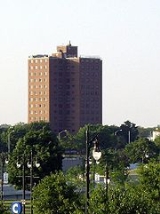
The Supremes, an American
female singing groupA girl group is a popular music act featuring several young female singers who generally harmonise together.Girl groups emerged in the late 1950s as groups of young singers teamed up with behind-the-scenes songwriters and music producers to create hit singles, often featuring glossy production...
, were the premier act of Motown Records during the 1960s.
Originally founded as
The Primettes in Detroit, Michigan, in 1959, The Supremes' repertoire included
doo-wopThe name Doo-wop is given to a style of vocal-based rhythm and blues music that developed in African American communities in the 1940s and achieved mainstream popularity in the 1950s and early 1960s. It emerged from New York, Philadelphia, Chicago, Baltimore, Newark, Pittsburgh, Cincinnati and...
, pop,
soulSoul music is a music genre originating in the United States combining elements of gospel music and rhythm and blues. According to the Rock and Roll Hall of Fame, soul is "music that arose out of the black experience in America through the transmutation of gospel and rhythm & blues into a form of...
, Broadway
show tuneA show tune is a popular song originally written as part of the score of a "show" , especially if the piece in question has become a "standard", more or less detached in most people's minds from the original context...
s,
psychedelic soulPsychedelic soul, sometimes called black rock, is a sub-genre of soul music, which mixes the characteristics of soul with psychedelic rock...
, and
discoDisco is a genre of dance music. Disco acts charted high during the mid-1970s, and the genre's popularity peaked during the late 1970s. It had its roots in clubs that catered to African American, gay, psychedelic, and other communities in New York City and Philadelphia during the late 1960s and...
. They were the most commercially successful of Motown's acts and are, to date, America's most successful
vocal groupA musical ensemble is a group of people who perform instrumental or vocal music. In classical music, trios or quartets either blend the sounds of musical instrument families or group together instruments from the same instrument family, such as string ensembles or wind ensembles...
with 12 number one singles on the
Billboard Hot 100The Billboard Hot 100 is the United States music industry standard singles popularity chart issued weekly by Billboard magazine. Chart rankings are based on radio play and sales; the tracking-week for sales begins on Monday and ends on Sunday, while the radio play tracking-week runs from Wednesday...
. Most of these hits were written and produced by Motown's main songwriting and production team, Holland–Dozier–Holland. At their peak in the mid-1960s, The Supremes rivaled
The BeatlesThe Beatles were an English rock band, active throughout the 1960s and one of the most commercially successful and critically acclaimed acts in the history of popular music. Formed in Liverpool, by 1962 the group consisted of John Lennon , Paul McCartney , George Harrison and Ringo Starr...
in worldwide popularity, and their success made it possible for future African American
R&BRhythm and blues, often abbreviated to R&B, is a genre of popular African American music that originated in the 1940s. The term was originally used by record companies to describe recordings marketed predominantly to urban African Americans, at a time when "urbane, rocking, jazz based music with a...
and soul musicians to find mainstream success.
Founding members
Florence BallardFlorence Glenda Ballard Chapman was an American singer and a founding member of the Motown group The Supremes. From 1963 until 1967, Ballard sang on 16 Top 40 hit Supremes' singles, ten of which hit number-one on the Billboard Hot 100. In 1967, Motown CEO Berry Gordy decided to remove Ballard from...
,
Mary WilsonMary Wilson is an American singer, formerlymember of the Motown female singing group The Supremes during the 1960s and 1970s. Wilson was the only singer to be a consistent member of the group in its eighteen-year tenure...
,
Diana RossDiana Ernestine Earle Ross is an American singer, record producer, and actress. Ross was lead singer of the Motown group The Supremes during the 1960s. After leaving the group in 1970, Ross began a solo career that included successful ventures into film and Broadway...
, and
Betty McGlownBetty McGlown-Travis is an African American singer, a member of The Primettes, later known as The Supremes.In 1959, McGlown started dating future Temptations member Paul Williams who was then singing with the Primes...
, all from the Brewster-Douglass public housing project in Detroit, formed The Primettes as the sister act to The Primes (with
Paul WilliamsPaul Williams was an American baritone singer and choreographer. Williams is noted for being one of the founding members and original lead singer of the Motown group The Temptations...
and
Eddie KendricksEddie Kendricks was an American singer and songwriter. Noted for his distinctive falsetto singing style, Kendricks co-founded the Motown singing group The Temptations, and was one of their lead singers from 1960 until 1971. His was the lead voice on such famous songs as "The Way You Do The Things...
, who went on to form
The TemptationsThe Temptations is an American vocal group having achieved fame as one of the most successful acts to record for Motown Records. The group's repertoire has included, at various times during its five-decade career, R&B, doo-wop, funk, disco, soul, and adult contemporary music.Formed in Detroit,...
).
Barbara MartinBarbara Diane Martin in Detroit, Michigan is an African-American singer; better known for being one of the original founding members of Motown singing group The Supremes. After The Primettes dropped Betty McGlown from their lineup due to McGlown's upcoming nuptials, Martin replaced her in the...
replaced McGlown in 1960, and the group signed with Motown the following year as The Supremes. Martin left the act in early 1962, and Ross, Ballard, and Wilson carried on as a
trioTrio is generally used in any of the following ways:* A group of three musicians playing the same or different musical instrument.* The performance of a piece of music by three people.* The contrasting section of a piece in ternary form...
.
During the mid-1960s, The Supremes achieved mainstream success with Ross as lead singer. In 1967, Motown president
Berry GordyBerry Gordy, Jr. is an American record producer, and the founder of the Motown record label, as well as its many subsidiaries.-Early years:...
renamed the group
Diana Ross & the Supremes, and replaced Ballard with
Cindy BirdsongCynthia Ann "Cindy" Birdsong , better known by her stage name, Cindy Birdsong, is an American singer, most famous for singing with the legendary soul groups Patti LaBelle & the Bluebelles and The Supremes.-Early life:...
. Ross left to pursue a solo career in 1970 and was replaced by
Jean TerrellJean Terrell is an American R&B and jazz singer. She replaced Diana Ross as the lead singer of The Supremes in January 1970.-Early life and career:...
, at which point the group's name reverted to
The Supremes. After 1972, the lineup changed more frequently;
Lynda LaurenceLynda Laurence is an American singer. She is best known for being a part of two Motown acts: Stevie Wonder's backup group Wonderlove, and one of the post-Diana Ross versions of The Supremes...
,
Scherrie PayneScherrie Payne is an American singer. The younger sister of singer/actress Freda Payne, Scherrie Payne was the co-lead singer of The Supremes from 1973 to 1977, after Jean Terrell left the group in the fall of 1973...
, and
Susaye GreeneSusaye Greene , is an African-American singer, best known for being the last official member to join Motown girl group The Supremes, remaining in the group during its final years of existence from 1976 to 1977.-Early life and career:...
all became members of the group during the mid-1970s. The Supremes disbanded in 1977 after an 18-year run.
Origins
In 1958,
Florence BallardFlorence Glenda Ballard Chapman was an American singer and a founding member of the Motown group The Supremes. From 1963 until 1967, Ballard sang on 16 Top 40 hit Supremes' singles, ten of which hit number-one on the Billboard Hot 100. In 1967, Motown CEO Berry Gordy decided to remove Ballard from...
—a junior high school student living in the Brewster-Douglass housing projects in Detroit—met
Paul WilliamsPaul Williams was an American baritone singer and choreographer. Williams is noted for being one of the founding members and original lead singer of the Motown group The Temptations...
and
Eddie KendricksEddie Kendricks was an American singer and songwriter. Noted for his distinctive falsetto singing style, Kendricks co-founded the Motown singing group The Temptations, and was one of their lead singers from 1960 until 1971. His was the lead voice on such famous songs as "The Way You Do The Things...
, two members of a Detroit male singing group known as The Primes. Since Ballard sang, as did Paul Williams' girlfriend
Betty McGlownBetty McGlown-Travis is an African American singer, a member of The Primettes, later known as The Supremes.In 1959, McGlown started dating future Temptations member Paul Williams who was then singing with the Primes...
, The Primes's manager Milton Jenkins decided to create a sister group to The Primes called The Primettes. Ballard recruited her best friend
Mary WilsonMary Wilson is an American singer, formerlymember of the Motown female singing group The Supremes during the 1960s and 1970s. Wilson was the only singer to be a consistent member of the group in its eighteen-year tenure...
, who in turn recruited classmate
Diane RossDiana Ernestine Earle Ross is an American singer, record producer, and actress. Ross was lead singer of the Motown group The Supremes during the 1960s. After leaving the group in 1970, Ross began a solo career that included successful ventures into film and Broadway...
. Mentored and funded by Jenkins, The Primettes began by performing hit songs by artists such as
Ray CharlesRay Charles Robinson , known by his shortened stage name Ray Charles, was an American musician. He was a pioneer in the genre of soul music during the 1950s by fusing rhythm and blues, gospel, and blues styles into his early recordings with Atlantic Records...
and
The DriftersThe Drifters are a long-lived American doo-wop and R&B/soul vocal group with a peak in popularity from 1953 to 1963, though several splinter Drifters continue to perform today. They were originally formed to serve as Clyde McPhatter's backing group in 1953...
at
sock hopThe sock hop was an informal sponsored dance at American high schools, typically held in the high school's own gym or cafeteria. The term sock hop came about because dancers were required to remove their shoes to protect the varnished floor of the gymnasium. These hops were a cultural feature of...
s, social clubs and talent shows around the Detroit area. Receiving additional guidance from group friend and established performer Jesse Greer, the quartet quickly earned a local fan following.
[Wilson et al., 49.] The girls crafted an age-appropriate style that was inspired by the collegiate dress of popular doo-wop group
Frankie Lymon & the TeenagersThe Teenagers are an American integrated doo wop group, most noted for being one of rock music's earliest successes, presented to international audiences by DJ Alan Freed...
;
[Wilson et al., 38.] and, for the most part, Ballard, Ross and Wilson performed equal leads on songs. Within a few months, guitarist
Marvin TarplinMarvin "Marv" Tarplin was an American guitarist and songwriter, best known as the guitarist for The Miracles from the 1950s through the early 1970s. He was one of the group's original members and co-wrote several of their biggest hits, including the 2007 Grammy Hall Of Fame inducted "The Tracks...
was added to The Primettes' lineup – a move that helped distinguish the group from Detroit's many other aspiring acts by allowing the girls to sing live as opposed to lip-synch.
[Wilson et al., 37.]
After winning a prestigious local talent contest, The Primettes' sights were set on making a record. In hopes of getting the group signed to the local upstart Motown label, in 1960 Ross asked an old neighbor,
MiraclesThe Miracles are an American rhythm and blues group from Detroit, Michigan, notable as the first successful group act for Berry Gordy's Motown Record Corporation . Their single "Shop Around" was Motown's first million-selling hit record, and the group went on to become one of Motown's signature...
lead singer
Smokey RobinsonWilliam "Smokey" Robinson, Jr. is an American R&B singer-songwriter, record producer, and former record executive. Robinson is one of the primary figures associated with Motown, second only to the company's founder, Berry Gordy...
, to help the group land an audition for Motown executive
Berry GordyBerry Gordy, Jr. is an American record producer, and the founder of the Motown record label, as well as its many subsidiaries.-Early years:...
, who had already proven himself a capable songwriter.
[Wilson et al., 75.] Robinson liked the girls and agreed to help, but he liked their guitarist even more; with The Primettes' permission he hired Tarplin, who became the guitarist for The Miracles. Robinson arranged for The Primettes to audition
a cappellaA cappella music is specifically solo or group singing without instrumental sound, or a piece intended to be performed in this way. It is the opposite of cantata, which is accompanied singing. A cappella was originally intended to differentiate between Renaissance polyphony and Baroque concertato...
for Gordy – but Gordy, feeling the girls too young and inexperienced to be recording artists, encouraged them to return upon graduating from high school. Undaunted, later that year The Primettes recorded a single for Lu Pine Records (a label created just for them) entitled "
Tears of Sorrow"Tears of Sorrow" is the very first single by The Primettes, later known as The Supremes, released in 1960. This single was their first single from Lu Pine Records, and their last. "Tears of Sorrow," along with "Pretty Baby", are the only known recordings that feature the vocals of Betty McGlown....
", which was backed with "Pretty Baby".
[Wilson et al., 69.] The single, however, failed to find an audience. Shortly thereafter, McGlown became engaged and left the group. Local youth
Barbara MartinBarbara Diane Martin in Detroit, Michigan is an African-American singer; better known for being one of the original founding members of Motown singing group The Supremes. After The Primettes dropped Betty McGlown from their lineup due to McGlown's upcoming nuptials, Martin replaced her in the...
was McGlown's quick replacement.
Determined to leave an impression on Gordy and join the stable of rising Motown stars, The Primettes frequented his Hitsville, U.S.A. recording studio every day after school.
[Wilson et al., 57.] Eventually, they convinced Gordy to allow them to contribute hand claps and background vocals for the songs of other Motown artists including
Marvin GayeMarvin Pentz Gay, Jr. , better known by his stage name Marvin Gaye, was an American singer-songwriter and musician with a three-octave vocal range....
and
Mary WellsMary Esther Wells was an American singer who helped to define the emerging sound of Motown in the early 1960s...
.
[Wilson et al., 58.] In January 1961, Gordy finally relented and agreed to sign the girls to his label – but under the condition that they change the name of their group. The Primes had by this time combined with Otis Williams & the Distants and would soon sign to Motown as
The TemptationsThe Temptations is an American vocal group having achieved fame as one of the most successful acts to record for Motown Records. The group's repertoire has included, at various times during its five-decade career, R&B, doo-wop, funk, disco, soul, and adult contemporary music.Formed in Detroit,...
. Gordy gave Ballard a list of names to choose from that included suggestions such as "The Darleens", "The Sweet Ps", "The Melodees", "The Royaltones" and "The Jewelettes". Ballard chose "The Supremes", a name that Ross initially disliked as she felt it too masculine. Nevertheless, on January 15 the group signed with Motown as The Supremes. In the spring of 1962, Martin left the group to start a family. Thus, the newly named Supremes continued as a trio.
Between 1961 and 1963, The Supremes released eight singles, none of which charted in the Top 40 positions of the
Billboard Hot 100The Billboard Hot 100 is the United States music industry standard singles popularity chart issued weekly by Billboard magazine. Chart rankings are based on radio play and sales; the tracking-week for sales begins on Monday and ends on Sunday, while the radio play tracking-week runs from Wednesday...
. Jokingly referred to as the "no-hit Supremes" around Motown's
Hitsville U.S.A."Hitsville U.S.A." is the nickname given to Motown's first headquarters. A former photographers' studio located at 2648 West Grand Boulevard in Detroit, Michigan, it was purchased by Motown founder Berry Gordy in 1959 and converted into both the record label's administrative building and recording...
offices, the group attempted to compensate for their lack of hits by taking on any work available at the studio, including providing hand claps and singing backup for Motown artists such as
Marvin GayeMarvin Pentz Gay, Jr. , better known by his stage name Marvin Gaye, was an American singer-songwriter and musician with a three-octave vocal range....
and
The TemptationsThe Temptations is an American vocal group having achieved fame as one of the most successful acts to record for Motown Records. The group's repertoire has included, at various times during its five-decade career, R&B, doo-wop, funk, disco, soul, and adult contemporary music.Formed in Detroit,...
. During these years, all three members took turns singing lead: Wilson favored soft ballads; Ballard favored soulful, hard-driving songs; and Ross favored mainstream pop songs. Most of their early material was written and produced by Berry Gordy or
Smokey RobinsonWilliam "Smokey" Robinson, Jr. is an American R&B singer-songwriter, record producer, and former record executive. Robinson is one of the primary figures associated with Motown, second only to the company's founder, Berry Gordy...
. In December 1963, the single "
When the Lovelight Starts Shining Through His Eyes"When the Lovelight Starts Shining Through His Eyes" is a song written by Holland–Dozier–Holland and recorded in 1963 by Motown singing group The Supremes. It is notable as the Supremes' first Billboard Hot 100 Top 40 recording, following seven previous singles between January 1961 and September...
" peaked at number 23 on the
Billboard Hot 100.
"Lovelight" was the first of many Supremes songs written by the Motown songwriting and production team known as Holland–Dozier–Holland. In late 1963, Berry Gordy chose Diana Ross as the official lead singer of the group. Ballard and Wilson were periodically given solos on Supremes albums, and Ballard continued to sing her solo number, "People", in concert for the next two years.
In the spring of 1964, The Supremes recorded the single "
Where Did Our Love Go"Where Did Our Love Go" is a 1964 song recorded by The Supremes for the Motown label.Written and produced by Motown's main production team Holland–Dozier–Holland, "Where Did Our Love Go" was the first single by the Supremes to go to the number-one position on the Billboard Hot 100 pop singles chart...
". The song was originally intended by Holland-Dozier-Holland for
The MarvelettesThe Marvelettes were an American singing girl group on the Tamla label. Motown's first successful female vocal group, the Marvelettes are most notable for recording the company's first #1 Pop hit, "Please Mr...
, who rejected it. Although The Supremes disliked the song, the producers coerced them into recording it. In August 1964, while The Supremes toured as part of Dick Clark's
Caravan of StarsIn 1959, Dick Clark formed the Caravan of Stars, a road show featuring some of the most popular stars and musical groups of the day. Chubby Checker, Duane Eddy, Bobby Darin, Fabian, Buddy Holly, Annette Funicello and Bo Diddley toured with the Caravan...
, "Where Did Our Love Go" reached number one on the US pop charts, much to the surprise and delight of the group. It was also their first song to appear on the UK pop charts, where it reached number three.
"Where Did Our Love Go" was followed by four consecutive US number-one hits: "
Baby Love"Baby Love" is a 1964 song recorded by The Supremes for the Motown label.Written and produced by Motown's main production team Holland–Dozier–Holland ,...
" (which was also a number-one hit in the UK), "
Come See About Me"Come See About Me" is a 1964 song recorded by The Supremes for the Motown label.The song became third of five consecutively released Supremes songs to top the Billboard pop singles chart in the United States...
", "
Stop! In the Name of Love"Stop! In the Name of Love" is a 1965 song recorded by The Supremes for the Motown label.Written and produced by Motown's main production team Holland–Dozier–Holland, "Stop! In the Name of Love" held the number-one position on the Billboard pop singles chart in the United States from March 21, 1965...
" and "
Back in My Arms Again"Back in My Arms Again" is a 1965 song recorded by The Supremes for the Motown label.Written and produced by Motown's main production team Holland–Dozier–Holland, "Back in My Arms Again" was the fifth number-one song for the group on the Billboard Hot 100 pop singles chart in the United States from...
". "Baby Love" was nominated for the 1965
Grammy Award for Best R&B SongThe Grammy Award for Best R&B Song has been awarded since 1959. From 1969 to 2000 it was known as the Grammy Award for Best Rhythm & Blues Song, from 1962 to 1968 it was known as Best Rhythm & Blues Recording, and from 1959-1961 as Best Rhythm & Blues Performance...
.
Impact
The Supremes became the first black female performers of the rock era to embrace a more
feminineFeminine, or femininity, normally refers to qualities positively associated with women.Feminine may also refer to:*Feminine , a grammatical gender*Feminine cadence, a final chord falling in a metrically weak position...
image. Much of this was accomplished at the behest of Motown chief Berry Gordy and Maxine Powell, who ran Motown's in-house finishing school and Artist Development department. Unlike many of her contemporaries, Ross sang in a thin, calm voice, and her vocal styling was matched by having all three women embellish their femininity instead of imitate the qualities of male groups. Eschewing plain appearances and basic dance routines, The Supremes appeared onstage in detailed make-up and high-fashion gowns and wigs, and performed graceful choreography created by Motown choreographer
Cholly AtkinsCharles “Cholly” Atkins was an American dancer and vaudeville performer, who later became noted as the house choreographer for the various artists on the Motown label.-Biography:...
. Powell told the group to "be prepared to perform before kings and queens." Gordy wanted The Supremes, like all of his performers, to be equally appealing to black and white audiences, and he sought to erase the image of black performers as being unrefined or lacking class.
At the time, with the exception of
The BeatlesThe Beatles were an English rock band, active throughout the 1960s and one of the most commercially successful and critically acclaimed acts in the history of popular music. Formed in Liverpool, by 1962 the group consisted of John Lennon , Paul McCartney , George Harrison and Ringo Starr...
, the Supremes were the only popular vocal group being marketed for the individual personalities of each member. Thus, many Supremes fans not only knew the names of each Supreme, but also knew other fan facts such as their own individual hobbies and their favorite singers. On the album,
More Hits by the SupremesMore Hits by The Supremes is a 1965 studio album by Motown singing group The Supremes. The album, their third regular studio LP, includes two number-one hits: "Stop! In the Name of Love" and "Back in My Arms Again", as well as the Top 20 single "Nothing but Heartaches". The album peaked at #6 on...
, each member is pictured separately on the front, with her signature above it.
By 1965, The Supremes were international stars. They toured the world, becoming almost as popular abroad as they were in the US. Almost immediately after their initial number-one hits, they recorded songs for motion picture soundtracks, appeared in the 1965 film
Beach Ball, and endorsed dozens of products, at one point having their own brand of bread. By the end of 1966, their number-one hits included "
I Hear a Symphony"I Hear a Symphony" is a 1965 song recorded by The Supremes for the Motown label.Written and produced by Motown's main production team, Holland–Dozier–Holland, the song became the sixth number-one pop hit on Billboard Hot 100 pop singles chart in the United States for two weeks from November 14,...
", "
You Can't Hurry Love"You Can't Hurry Love" is 1966 song originally released by The Supremes for the Motown label.Written and produced by Motown production team Holland–Dozier–Holland, the song topped the United States Billboard pop singles chart and in the UK in the top 5, released and peaking late summer in 1966...
" and "
You Keep Me Hangin' OnVanilla Fudge's 1967 psychedelic/hard rock remake of "You Keep Me Hangin' On" reached #6 on the Hot 100 chart two years after the release of the Supremes' recording. While the version released on 45 RPM single was under three minutes long, the album version was extended to six minutes and...
". That year the group also released
The Supremes A' Go-Go, which became the first album by an all-female group to reach number one on the US
Billboard 200The Billboard 200 is a ranking of the 200 highest-selling music albums and EPs in the United States, published weekly by Billboard magazine. It is frequently used to convey the popularity of an artist or groups of artists...
, knocking
The BeatlesThe Beatles were an English rock band, active throughout the 1960s and one of the most commercially successful and critically acclaimed acts in the history of popular music. Formed in Liverpool, by 1962 the group consisted of John Lennon , Paul McCartney , George Harrison and Ringo Starr...
'
RevolverRevolver is the seventh studio album by the English rock group The Beatles, released on 5 August 1966 on the Parlophone label and produced by George Martin. Many of the tracks on Revolver are marked by an electric guitar-rock sound, in contrast with their previous LP, the folk rock inspired Rubber...
out of the top spot.
Because The Supremes were popular with white audiences as well as with black ones, Gordy had the group cater to its middle American fan base by grooming the women for performances at renowned
supper clubA supper club, in general, refers to a dining establishment that also functions as a social club. The term may describe different establishments depending on the region, but in general, supper clubs tend to present themselves as having a high-class image, even if the price is affordable to...
s such as the
CopacabanaThe Copacabana is a famous New York City nightclub. Many entertainers, among them Danny Thomas, Pat Cooper and the comedy team of Martin and Lewis, made their debuts at the Copacabana. The 1978 Barry Manilow song "Copacabana" is named after, and is about the nightclub. Part of the 2003 Yerba...
in New York. Broadway and pop standards were incorporated into their repertoire alongside their own hit songs. As a result, The Supremes became one of the first black musical acts to achieve complete and sustained crossover success. Black
rock and rollRock and roll is a genre of popular music that originated and evolved in the United States during the late 1940s and early 1950s, primarily from a combination of African American blues, country, jazz, and gospel music...
musicians of the 1950s had seen many of their original hit tunes covered by white musicians, with these covers usually achieving more fame and sales success than the originals. The Supremes' success, however, counteracted this trend. Featuring three group members who were marketed for their individual personalities (a move unprecedented at the time) and Diana Ross’s pop-friendly voice, The Supremes broke down racial barriers with rock and roll songs underpinned by R&B stylings. The group became extremely popular both domestically and abroad, becoming one of the first black musical acts to appear regularly on television programs such as
Hullabaloo,
The Hollywood PalaceThe Hollywood Palace is an hour-long American television variety show that was broadcast weekly on ABC from January 4, 1964 to February 7, 1970. It began as a mid-season replacement for the short-lived Jerry Lewis Show, another variety show which had lasted only three months...
,
The Della Reese ShowDelloreese Patricia Early, known professionally as Della Reese , is an American actress, singer, game show panelist of the 1970s, one-time talk-show hostess and ordained minister. She started her career in the 1950s as a gospel, pop and jazz singer, scoring a hit with her 1959 single "Don't You...
, and, most notably,
The Ed Sullivan ShowThe Ed Sullivan Show is an American TV variety show that originally ran on CBS from Sunday June 20, 1948 to Sunday June 6, 1971, and was hosted by New York entertainment columnist Ed Sullivan....
, on which they made 17 appearances. The Supremes' cross-cultural success effectively paved the way for the mainstream success of contemporaneous label mates such as The Temptations, The Four Tops and
The Jackson 5The Jackson 5 , later known as The Jacksons, were an American popular music family group from Gary, Indiana...
.
Name and personnel changes
Personnel problems within the group and within Motown Records' stable of performers led to tension among the members of The Supremes. Many of the other Motown performers, particularly
Martha ReevesMartha Rose Reeves is an American R&B and Pop singer and former politician, and was the lead singer of the Motown girl group Martha and the Vandellas. During her tenure with The Vandellas, they scored over a dozen hit singles, including "Jimmy Mack", "Dancing in the Street" and "Nowhere to Run"...
of
Martha and the VandellasMartha and the Vandellas were among the most successful groups of the Motown roster during the period 1963–1967...
, felt that Berry Gordy was lavishing too much attention upon the group—and upon Ross, in particular. As Ross became the focal point of The Supremes, Ballard felt pushed aside in the group. Depression ensued, and Ballard began to drink excessively, gaining weight until she could no longer comfortably wear many of her stage outfits. The friendship, and later the working relationship, between Ross and Ballard became strained. During this turbulent period, Ballard relied heavily upon the advice of group mate Mary Wilson, with whom she had maintained a close friendship. Wilson, while outwardly demure and neutral in hopes of keeping the group stable, privately advised Ballard that Ross and Gordy were eager to oust Ballard. Although The Supremes scored two number-one hits during the first quarter of 1967, "
Love Is Here and Now You're Gone"Love Is Here and Now You're Gone" is a 1967 song recorded by The Supremes for the Motown label.Written and composed by Motown's main production team Holland–Dozier–Holland, it became the second consecutive number-one pop single from the Supremes' album The Supremes Sing Holland–Dozier–Holland and...
" and "
The Happening"The Happening" is a 1967 song recorded by Motown artists The Supremes. The song served as the theme song of the 1967 Columbia film The Happening, and was released as a single by Motown at the time of the film's release that spring...
", the group as a unit began to disintegrate.
Rumors began to circulate in late 1966 that Motown intended to rename the group Diana Ross and the Supremes. However, in early 1967 it was officially announced that the group was to be billed as "The Supremes with Diana Ross". The Miracles had become "Smokey Robinson & the Miracles" two years prior. The fall of 1967 saw Martha & the Vandellas become "Martha Reeves & the Vandellas". Having learned that Ross would receive top billing,
David RuffinDavis Eli "David" Ruffin was an American soul singer and musician most famous for his work as one of the lead singers of the Temptations from 1964 to 1968...
lobbied—unsuccessfully—to have the Temptations renamed as "David Ruffin & the Temptations", although Gordy maintained that the name changes were done so that Motown could demand more money for live bookings (because they would be providing two acts—a lead singer and a group—instead of just one).
The Supremes' name change sparked rumors of a possible solo career for Ross, and contributed to the professional and personal dismantling of the group. According to Mark Ribowsky's 2009 book
The Supremes: A Saga of Motown Dreams, Success, and Betrayal, Gordy intended to replace Ross with
Barbara RandolphBarbara Randolph was an African American singer and actress who recorded for Motown Records in the 1960s.She was born in Detroit, Michigan, and was adopted by the actress Lillian Randolph, who appeared in It's a Wonderful Life and many other movies...
as early as 1966 during a run of live gigs in the autumn of that year, but changed his mind and instead kept Ross in the group for several more years. Gordy's caution however, may have been sparked by an incident in early 1966 as the group prepared to make their second appearance at the Copacabana. Angered by Ballard's erratic behavior, Gordy intended to replace her with Marlene Barrow, a member of the Motown in-house singing group
The AndantesThe Andantes were a prolific female sessions group for the Motown record label during the 1960s. Composed of Jackie Hicks, Marlene Barrow, and Louvain Demps, the group sang background vocals on numerous Motown recordings, including songs by Martha Reeves & the Vandellas, The Temptations, Stevie...
. As a member of the group Barrow had backed the Supremes on some of their in studio recordings and was familiar with their material. Gordy ordered Wilson to teach Barrow the group's dance routines. However, when Copa management heard of this change, they threatened to cancel the group's appearance if Ballard was replaced as the banter she, Wilson, and Ross did through their act was seen as a major part of the group's success. For Gordy this revealed that the group was as a whole still the main attraction as opposed to just Ross herself. Thus Gordy held back in spinning Ross off as a solo act for several more years during which he slowly built up her celebrity away from The Supremes.
By 1967, Ballard would not show up for recording dates, or would arrive at shows too inebriated to perform. For some early 1967 shows, she was replaced by Marlene Barrow. Looking for a more permanent replacement, Gordy once again thought of Barbara Randolph, possibly believing that Randolph could gradually be groomed as lead singer for the group once it was decided to take Ross solo. However, Ross did not receive Randolph well possibly due to the fact that she had been seen as a replacement for Ross herself. Gordy instead contacted
Cindy BirdsongCynthia Ann "Cindy" Birdsong , better known by her stage name, Cindy Birdsong, is an American singer, most famous for singing with the legendary soul groups Patti LaBelle & the Bluebelles and The Supremes.-Early life:...
in April 1967; she was a member of
Patti LaBelle & the BluebellesLabelle is an American all female singing group who were a popular vocal group of the 1960s and 1970s. The group was formed after the disbanding of two rival girl groups in the Philadelphia/Trenton areas, the Ordettes and the Del-Capris, forming as a new version of the former group, later changing...
and superficially resembled Ballard. Gordy began plans to bring her in as Ballard's replacement. Birdsong appeared at a benefit concert at the
Hollywood BowlThe Hollywood Bowl is a modern amphitheater in the Hollywood area of Los Angeles, California, United States that is used primarily for music performances...
on April 29, 1967, but returned to The Bluebelles soon afterward due to prior commitments. In May, Ballard returned for what she believed was a probationary period although it was seen by some as just a stop gap measure until Birdsong's contract was up with the Bluebelles. During May and June, knowing that she was one step away from being dismissed, Ballard made an attempt to tow the line. She slimmed down and showed up for every rehearsal and appearance on time and sober. During this period she appeared with the Supremes at the Copacabana and made appearances on
What's My Line,
The Ed Sullivan ShowThe Ed Sullivan Show is an American TV variety show that originally ran on CBS from Sunday June 20, 1948 to Sunday June 6, 1971, and was hosted by New York entertainment columnist Ed Sullivan....
, and
The Tonight Show with Johnny Carson with the group. Nevertheless, Ballard suspected that Birdsong was waiting in the wings to take her place at the moment's request of Gordy and in fact Birdsong, whose contract was up in June, was secretly traveling with the Supremes, standing by in case Ballard did not show up. On June 29, 1967 the group returned to the Flamingo Hotel in
Las VegasThe Las Vegas Valley is the heart of the Las Vegas-Paradise, NV MSA also known as the Las Vegas–Paradise–Henderson MSA which includes all of Clark County, Nevada, and is a metropolitan area in the southern part of the U.S. state of Nevada. The Valley is defined by the Las Vegas Valley landform, a ...
. What made this appearance significant was the fact that they were being billed as "The Supremes with Diana Ross", the first time in which Ross was billed separately from the group. The first two days of the concert went by smoothly and were even festive as on June 30, Ballard celebrated her 24th birthday, with Mary Wilson and Motown staff throwing her a surprise party. Nevertheless, things took an ominous turn on July 1. When reporting for makeup and wardrobe before their early evening concert, Ballard discovered an extra set of gowns and costumes that had been brought along for Cindy Birdsong. Angered Ballard performed the first concert of the night inebriated, leading to an embarrassing on-stage incident in which her stomach was revealed when she purposely thrust it forward during a dance routine. Enraged Gordy ordered her back to Detroit and permanently dismissed her from the group. Birdsong officially assumed her place during the second July 1 show. One month later, Gordy renamed the group "Diana Ross and the Supremes," putting Ross's name ahead of the group.
Ballard's release from Motown was made final on February 22, 1968, when she received a one-time payment of US$139,804.94 in royalties and earnings. She attempted a solo career with
ABC RecordsABC Records was an American record label, founded in New York City in 1955 as ABC-Paramount Records. It originated as the main popular music label operated the Am-Par Record Corporation, the music subsidiary of the American Broadcasting Company . ABC-Paramount Records' first president was Samuel H....
, and was forced to formally reject a solo contract offered by Motown as part of her settlement. Ballard's two 1968 singles failed to chart and her solo album was shelved. In 1971, Ballard sued Motown for $8.7 million, claiming that Gordy and Diana Ross had conspired to force her out of the group; the judge ruled in favor of Motown. Ballard eventually sank into poverty and died abruptly on February 22, 1976 from
coronary thrombosisCoronary thrombosis is a form of thrombosis affecting the coronary circulation. It is associated with stenosis subsequent to clotting. The condition is considered as a type of ischaemic heart disease.It can lead to a myocardial infarction...
at the age of 32. At the time of her death, she had begun to make financial and personal strides and was planning to reinvigorate her solo career.
Ross' departure
Holland-Dozier-Holland left Motown in early 1968 after a dispute with the label over royalties and profit sharing, and the quality of Motown's output (and Diana Ross & the Supremes' records in particular) began to falter. From "Reflections" in 1967 to "The Weight" in 1969, only six out of the eleven released singles reached the Top 20, and only one of those, 1968's "
Love Child"Love Child" is a 1968 song released by the Motown label for Diana Ross & the Supremes, becoming the Supremes' 11th number-one single in the United States....
", made it to number one. Due to the tension within the group and stringent touring schedules, neither Mary Wilson nor Cindy Birdsong appear on many of these singles; they were replaced on these recordings by session singers such as
The AndantesThe Andantes were a prolific female sessions group for the Motown record label during the 1960s. Composed of Jackie Hicks, Marlene Barrow, and Louvain Demps, the group sang background vocals on numerous Motown recordings, including songs by Martha Reeves & the Vandellas, The Temptations, Stevie...
. The changes within the group and their decreasing sales were signs of changes within the music industry. The
gospelGospel music is music that is written to express either personal, spiritual or a communal belief regarding Christian life, as well as to give a Christian alternative to mainstream secular music....
-based soul of female performers such as
Aretha FranklinAretha Louise Franklin is an American singer, songwriter, and pianist. Although known for her soul recordings and referred to as The Queen of Soul, Franklin is also adept at jazz, blues, R&B, gospel music, and rock. Rolling Stone magazine ranked her atop its list of The Greatest Singers of All...
had eclipsed The Supremes' pop-based sound, which had by now evolved to include more middle-of-the-road material. In a cultural climate now influenced more than ever by
counterculturalCounterculture is a sociological term used to describe the values and norms of behavior of a cultural group, or subculture, that run counter to those of the social mainstream of the day, the cultural equivalent of political opposition. Counterculture can also be described as a group whose behavior...
movements such as the
Black Panther PartyThe Black Panther Party wasan African-American revolutionary leftist organization. It was active in the United States from 1966 until 1982....
, The Supremes found themselves attacked for not being "black enough", and lost ground in the black music market.
In mid-1968, Motown initiated a number of high-profile collaborations for The Supremes with their old colleagues, The Temptations. Besides the fact that both groups had come up together, the pairings made financial sense: The Supremes had a mostly white fanbase, while The Temptations a mostly black fanbase. By 1969, the label began plans for a Diana Ross solo career. A number of candidates—most notably
Syreeta WrightSyreeta Wright , who recorded professionally under the single name Syreeta, was a Grammy-nominated American singer-songwriter most notably known for her work with Stevie Wonder and Billy Preston.-Early life and career:...
—were considered to replace Ross. After seeing 24-year-old
Jean TerrellJean Terrell is an American R&B and jazz singer. She replaced Diana Ross as the lead singer of The Supremes in January 1970.-Early life and career:...
perform with her brother
ErnieErnie Terrell is an American singer, record producer, and former World Boxing Association heavyweight boxing champion. At , he was very tall, by the standards of the day....
, Berry Gordy decided on Ross' replacement. Terrell was signed to Motown and began recording the first post-Ross Supremes songs with Wilson and Birdsong during the day, while Wilson and Birdsong toured with Ross at night. At the same time, Ross began to make her first solo recordings. In November 1969, Ross' solo career was publicly announced.
"
Someday We'll Be Together"Someday We'll Be Together" is a song made popular as the last of twelve number-one singles for Diana Ross & the Supremes on the Motown label. It is the final Supremes song featuring Diana Ross, who left the group for a solo career in January 1970...
" was recorded with the intent of releasing it as the first solo single for Diana Ross. Desiring a final Supremes number-one record, Gordy instead had the song released as a Diana Ross & the Supremes single, despite the fact that neither Wilson nor Birdsong sang on the record. "Someday We'll Be Together" hit number one on the American pop charts, becoming not only the Supremes' 12th and final number-one hit, but also the final number-one hit of the 1960s. This single would also mark The Supremes' final television appearance together with Ross, performing on
The Ed Sullivan ShowThe Ed Sullivan Show is an American TV variety show that originally ran on CBS from Sunday June 20, 1948 to Sunday June 6, 1971, and was hosted by New York entertainment columnist Ed Sullivan....
on December 21, 1969. The Supremes without Ross made their final appearance altogether on
Ed Sullivan on February 15, 1970.
The Supremes in the 1970s
Diana Ross & the Supremes gave their final performance on January 14, 1970 at the Frontier Hotel in Las Vegas. At the final performance, the replacement for Diana Ross, Jean Terrell, was introduced. According to Mary Wilson, after this performance, Berry Gordy wanted to replace Terrell with
Syreeta WrightSyreeta Wright , who recorded professionally under the single name Syreeta, was a Grammy-nominated American singer-songwriter most notably known for her work with Stevie Wonder and Billy Preston.-Early life and career:...
. Wilson refused, leading to Gordy stating that he was washing his hands of the group thereafter. This claim is also made by Mark Ribowsky. After the Frontier Hotel performance, Ross officially began her career as a solo performer. Mary Wilson and Cindy Birdsong continued working with Jean Terrell on the first post-Ross Supremes album,
Right On.
The Terrell-led Supremes—now rebranded as "The Supremes," and known unofficially at first as "The New Supremes", and in later years informally called The '70s Supremes—scored hits including "
Up the Ladder to the Roof"Up the Ladder to the Roof" is a 1970 hit single recorded by The Supremes for the Motown label. It was the first Supremes single to feature new lead singer Jean Terrell in place of Diana Ross, who officially left the group for a solo career two weeks before the recording of this song in January 1970...
" (US number 10, UK number 6), "
Stoned Love"Stoned Love" is a 1970 hit single recorded by The Supremes for the Motown label. It was the last Billboard Pop Top Ten hit for the group, peaking at number seven, and their last Billboard number-one R&B hit as well, although the trio continued to score top ten hits in the UK into 1972...
" (US number 7, UK number 3) and "
Nathan Jones"Nathan Jones" is a hit single recorded by The Supremes, released in spring 1971 on the Motown label. Produced by Frank Wilson and written by Leonard Caston - aka Leonard Caston, Jr...
" (US number 16, UK number 5), all of which were produced by
Frank WilsonFrank Wilson is an African American former songwriter and record producer for Motown Records.-Biography:He was born to James Wilson and Samantha Gibbs...
. These three singles were also R&B Top Ten hits, with "Stoned Love" becoming their last No.1 R&B hit in December 1970. Songwriting/production team
Nickolas Ashford & Valerie SimpsonNickolas Ashford , and Valerie Simpson , were a husband and wife songwriting/production team and recording artists....
produced another Top 20 hit for the group, a Supremes/
Four TopsThe Four Tops are an American vocal quartet, whose repertoire has included doo-wop, jazz, soul music, R&B, disco, adult contemporary, hard rock, and showtunes...
duet version of
Ike & Tina TurnerIke & Tina Turner were an American rock & roll and soul duo, made of the husband-and-wife team of Ike Turner and Tina Turner in the 1960s and 1970s. Spanning sixteen years together as a recording group, the duo's repertoire included rock & roll, soul, blues and funk...
's "River Deep – Mountain High".
In 1972, The Supremes had their last Top 20 hit single release, "
Floy Joy"Floy Joy" is a song written by Smokey Robinson and released as a single in December 1971 by popular Motown female singing group The Supremes....
", written and produced by Smokey Robinson, followed by the final US Top 40 hit for the Jean Terrell-led version of the group, "
Automatically Sunshine"Automatically Sunshine" is a single written by Smokey Robinson and released as a single by Motown singing group The Supremes as the third single off their popular album Floy Joy in 1972....
" (US number 37, UK number 10). "Automatically Sunshine" later became the group's final top 10 single in the UK. On both "Floy Joy" and "Sunshine" Terrell shared lead with Mary Wilson. Motown, by then moving from Detroit to Los Angeles to break into motion pictures, put only limited effort into promoting The Supremes' new material, and their popularity and sales began to wane. Cindy Birdsong left the group in April 1972, after recording the
Floy Joy album, to start a family; her replacement was
Lynda LaurenceLynda Laurence is an American singer. She is best known for being a part of two Motown acts: Stevie Wonder's backup group Wonderlove, and one of the post-Diana Ross versions of The Supremes...
, a former member of
Stevie WonderStevland Hardaway Morris , better known by his stage name Stevie Wonder, is an American singer-songwriter, multi-instrumentalist, record producer and activist...
's backup group, Third Generation a predecessor to Wonderlove.
Jimmy WebbJimmy Webb is an American songwriter, composer, and singer. He wrote numerous platinum selling classics, including "Up, Up and Away", "By the Time I Get to Phoenix", "Wichita Lineman", "Galveston", "The Worst That Could Happen", "All I Know", and "MacArthur Park"...
was hired to produce the group's next LP,
The Supremes Produced and Arranged by Jimmy WebbThe Supremes Produced and Arranged by Jimmy Webb is a 1972 album released by The Supremes on the Motown label. The album was the only Supremes LP produced by a non-Motown producer, successful songwriter and producer Jimmy Webb, and was the last album to feature early-1970s Supremes lead singer...
, but the album and its only single "I Guess I'll Miss the Man" failed to make an impact on the
Billboard pop chart, with the single charting at number 85.
In early 1973, Laurence prevailed upon her old mentor Stevie Wonder to write and produce a hit for The Supremes, but the resulting "
Bad Weather"Bad Weather" is a song recorded and released as a single by Motown vocal group The Supremes in 1973. It was composed and produced by Stevie Wonder The song was then-lead singer Jean Terrell's last charted single as a member of the Supremes and the second and last time brief group member Lynda...
" peaked at number 87 on the US pop charts and number 37 in the UK. Laurence can be heard briefly, shouting several times at the end of the song (the only recording on which Laurence is heard). Laurence left to start a family; her replacement: a returning Cindy Birdsong.
Dismayed by this poor-performing record and the lack of promotional support from Motown, Jean Terrell left the group and was replaced by
Scherrie PayneScherrie Payne is an American singer. The younger sister of singer/actress Freda Payne, Scherrie Payne was the co-lead singer of The Supremes from 1973 to 1977, after Jean Terrell left the group in the fall of 1973...
, the sister of
Invictus RecordsInvictus Records was an American record label based in Detroit, Michigan created by Edward Holland, Jr., Lamont Dozier and Brian Holland...
recording artist
Freda PayneFreda Charcilia Payne Some sources give a birth year of 1945, but this appears to be an error as all sources agree that she is older than her sister Scherrie, born 1944. is an American singer and actress best known for her million selling, 1970 hit single, "Band of Gold". She was also an actress in...
.
Between the 1973 departures of Laurence and Terrell and the first Supremes single with Scherrie Payne, "He's My Man", a disco single on which Payne and Wilson shared lead vocal, Motown was slow in producing contracts for Payne and the returning Birdsong. Before the release of the album in 1975, The Supremes remained a popular live act, and continued touring overseas, particularly in the UK and Japan. The group's new recordings were not as successful as their earlier releases, although "He's My Man" from the album
The Supremes was a popular disco hit in 1975, reaching number one on
Billboard's disco singles chart. In 1976, Birdsong, dissatisfied with the management of The Supremes (handled at the time by Mary Wilson's then-husband Pedro Ferrer), left again and was replaced by
Susaye GreeneSusaye Greene , is an African-American singer, best known for being the last official member to join Motown girl group The Supremes, remaining in the group during its final years of existence from 1976 to 1977.-Early life and career:...
, another former member of Wonderlove.
This final version of The Supremes released two albums, both of which reunited The Supremes with Holland-Dozier-Holland:
High Energy, which includes Birdsong on all of the tracks, and
Mary, Scherrie & SusayeMary, Scherrie & Susaye is the final studio album by The Supremes, released in 1976 on the Motown label.The album featured the final line-up for the Supremes, composed of original Supreme Mary Wilson and latter-day members Scherrie Payne and Susaye Greene. All three Supremes take leads on the...
. During that year, The Supremes released "
I'm Gonna Let My Heart Do the Walking"I'm Gonna Let My Heart Do the Walking" is a disco-styled soul single composed by the Holland brothers Eddie and Brian, members of the former Holland–Dozier–Holland team and was released as a single by Motown vocal group The Supremes in 1976 on the Motown label. It was the first single since "Your...
", their final Top 40 hit on the
Billboard Hot 100 and their third number-one single on the disco singles chart.
On June 12, 1977, The Supremes performed their
farewell concertOn June 12, 1977, The Supremes performed their final concert together at Drury Lane in London, England.-Mary Wilson's departure:In early 1977, sole remaining original group member Mary Wilson announced that she would be leaving The Supremes to embark upon a solo career...
at the
Drury Lane TheaterThe Theatre Royal, Drury Lane is a West End theatre in Covent Garden, in the City of Westminster, a borough of London. The building faces Catherine Street and backs onto Drury Lane. The building standing today is the most recent in a line of four theatres at the same location dating back to 1663,...
in London and disbanded.
Works inspired by The Supremes
Several fictional works have been published that are based in part on the career of the group. The 1976 film
SparkleSparkle is a 1976 American film directed by Sam O'Steen and released by Warner Bros. Pictures. Inspired by The Supremes, Sparkle is a period film set in Harlem, New York during the late 1950s and early 1960s which follows the rough lives and careers of singer Sparkle Williams and her family and...
features the story of a Supremes-like singing trio called "Sister & the Sisters" from
HarlemHarlem is a neighborhood in the New York City borough of Manhattan, which since the 1920s has been a major African-American residential, cultural and business center. Originally a Dutch village, formally organized in 1658, it is named after the city of Haarlem in the Netherlands...
, New York. The film's score was composed by
Curtis MayfieldCurtis Lee Mayfield was an American soul, R&B, and funk singer, songwriter, and record producer.He is best known for his anthemic music with The Impressions during the Civil Rights Movement of the 1960's and for composing the soundtrack to the blaxploitation film Super Fly, Mayfield is highly...
, and the soundtrack album by
Aretha FranklinAretha Louise Franklin is an American singer, songwriter, and pianist. Although known for her soul recordings and referred to as The Queen of Soul, Franklin is also adept at jazz, blues, R&B, gospel music, and rock. Rolling Stone magazine ranked her atop its list of The Greatest Singers of All...
was a commercial success. A remake of
Sparkle was in development in the early 2000s with R&B singer
AaliyahAaliyah Dana Haughton , who performed under the mononym Aaliyah , was an American R&B recording artist, actress and model. She was born in Brooklyn, New York, and was raised in Detroit, Michigan. At the age of 10, she appeared on the television show Star Search and performed in concert alongside...
as the lead, but the project was shelved when Aaliyah died in 2001.A remake of the film is now scheduled to begin filming in Detroit in October 2011. The cast has not yet been announced. The film will be produced and directed by Salim Akil.
On December 21, 1981, the
Tony AwardThe Antoinette Perry Award for Excellence in Theatre, more commonly known as a Tony Award, recognizes achievement in live Broadway theatre. The awards are presented by the American Theatre Wing and The Broadway League at an annual ceremony in New York City. The awards are given for Broadway...
-winning musical
DreamgirlsDreamgirls is a Broadway musical, with music by Henry Krieger and lyrics and book by Tom Eyen. Based upon the show business aspirations and successes of R&B acts such as The Supremes, The Shirelles, James Brown, Jackie Wilson, and others, the musical follows the story of a young female singing trio...
opened at the Imperial Theatre on Broadway and ran for 1,522 performances. The musical, loosely based on the history of The Supremes, follows the story of The Dreams, an all-female singing trio from Chicago who become music superstars. Several of the characters in the play are analogues of real-life Supremes/Motown counterparts, with the story focusing upon the Florence Ballard
doppelgängerIn fiction and folklore, a doppelgänger is a paranormal double of a living person, typically representing evil or misfortune...
Effie White. While influenced by the Supremes' and Motown's music, the songs in the play are a broader mix of R&B/soul and Broadway music. Mary Wilson loved the musical, but Diana Ross was reportedly angered by it and refused to see it.
A film adaptation of
DreamgirlsDreamgirls is a 2006 musical drama film, directed by Bill Condon and jointly produced and released by DreamWorks and Paramount Pictures. The film debuted in three special road show engagements beginning December 15, 2006 before its nationwide release on December 25, 2006...
was released by
DreamWorksDreamWorks Pictures, also known as DreamWorks, LLC, DreamWorks SKG, DreamWorks II Distribution Co., LLC, DreamWorks Studios or DW Studios, LLC, is an American film studio which develops, produces, and distributes films, video games and television programming...
and
Paramount PicturesParamount Pictures Corporation is an American film production and distribution company, located at 5555 Melrose Avenue in Hollywood. Founded in 1912 and currently owned by media conglomerate Viacom, it is America's oldest existing film studio; it is also the last major film studio still...
in December 2006. The film contains more overt references to Motown and The Supremes than does the play that inspired it: for example, in the film, many of the Dreams' album covers are identical in design to Supremes album covers, and the Dreams themselves hail from Detroit – not Chicago, as do their Broadway counterparts.
Awards and followers
The Supremes were twice nominated for a
Grammy AwardA Grammy Award — or Grammy — is an accolade by the National Academy of Recording Arts and Sciences of the United States to recognize outstanding achievement in the music industry...
—for Best Rhythm & Blues Recording ("Baby Love", 1965) and Best Contemporary Rock & Roll Group Vocal Performance ("Stop! In the Name of Love", 1966)—but never won an award in competition. Three of their songs have been named to the
Grammy Hall of FameThe Grammy Hall of Fame Award is a special Grammy award established in 1973 to honor recordings that are at least twenty-five years old and that have "qualitative or historical significance"...
: "Where Did Our Love Go" and "You Keep Me Hangin' On" (both 1999) and "Stop! In the Name of Love" (2001).
The group's songs "Stop! In the Name of Love" and "You Can't Hurry Love" are among The Rock and Roll Hall of Fame's 500 Songs that Shaped Rock and Roll. They were inducted into the
Rock and Roll Hall of FameThe Rock and Roll Hall of Fame and Museum is a museum located on the shore of Lake Erie in downtown Cleveland, Ohio, United States. It is dedicated to archiving the history of some of the best-known and most influential artists, producers, engineers and others who have, in some major way,...
in 1988, received a star on the
Hollywood Walk of FameThe Hollywood Walk of Fame consists of more than 2,400 five-pointed terrazzo and brass stars embedded in the sidewalks along fifteen blocks of Hollywood Boulevard and three blocks of Vine Street in Hollywood, California...
in 1994, and entered into the
Vocal Group Hall of FameThe Vocal Group Hall of Fame was organized to honor outstanding vocal groups throughout the world. It is headquartered in Sharon, Pennsylvania, United States. It includes a theater and a museum....
in 1998. In 2004,
Rolling StoneRolling Stone is a US-based magazine devoted to music, liberal politics, and popular culture that is published every two weeks. Rolling Stone was founded in San Francisco in 1967 by Jann Wenner and music critic Ralph J...
placed the group at number 97 on their list of the "100 Greatest Artists of All Time". In 2005, The Supremes were inducted into the Michigan Rock and Roll Legends Hall of Fame. The Supremes are notable for the influences they have had on the black girl groups who have succeeded them in popular music, such as
The Three DegreesThe Three Degrees are an American female vocal group. Formed in 1963 in Philadelphia, Pennsylvania,, the group has always been a trio though there have been a number of personnel changes and a total of fourteen women have represented the group so far. The original members were Fayette Pinkney,...
,
The EmotionsThe Emotions are an American all female soul and R&B singing group. The group was formed in its current hometown of Chicago, Illinois originally consisting of the three Hutchinson sisters, all the children of Joseph and Lillian Hutchinson....
, The Pointer Sisters,
En VogueEn Vogue is an American female R&B vocal group from Oakland, California assembled by music producers Denzil Foster and Thomas McElroy.The group has won more MTV Video Music Awards than any other female group in MTV history, a total of seven, along with four Soul Train Awards, six American Music...
,
TLCTLC is an American musical trio whose repertoire spanned R&B, hip-hop, soul, funk, and new jack swing. Originally consisting of singer Tionne "T-Boz" Watkins, rapper-singer Lisa "Left Eye" Lopes and singer Rozonda "Chilli" Thomas it found success in the 1990s while also enduring a series of spats...
,
Destiny's ChildDestiny's Child was an American R&B girl group whose final line-up comprised lead singer Beyoncé Knowles alongside Kelly Rowland and Michelle Williams. Formed in 1997 in Houston, Texas, Destiny's Child members began their musical endeavors in their pre-teens under the name Girl's Tyme...
and
CleopatraCleopatra are a platinum-selling, BRIT Awards and MOBO Awards nominated, R&B/pop girl group from the UK whose members are sisters Cleo, Yonah, and Zainam Higgins.The girls were signed to Madonna's Maverick record label...
.
Reunions
Fan interest made the idea of a Supremes reunion tour a very profitable one during the 1980s. In 1982, around the time that Motown reunited all of
The TemptationsThe Temptations is an American vocal group having achieved fame as one of the most successful acts to record for Motown Records. The group's repertoire has included, at various times during its five-decade career, R&B, doo-wop, funk, disco, soul, and adult contemporary music.Formed in Detroit,...
, it was rumored that Motown would reunite The Supremes. The 1974 line-up of The Supremes (Wilson, Birdsong and Payne) was considered for this reunion, which was to include new recordings and a tour. Under advisement from Berry Gordy, Wilson declined to reunite, and the idea was scrapped. Ross briefly reunited with Wilson and Birdsong to perform "Someday We'll Be Together" on the
Motown 25: Yesterday, Today, ForeverMotown 25: Yesterday, Today, Forever is a 1983 television special produced by Suzanne de Passe for Motown Records, to commemorate Motown's twenty-fifth year of existence. Motown 25: Yesterday, Today, Forever is a 1983 television special produced by Suzanne de Passe for Motown Records, to...
television special, taped on March 25, 1983, and broadcast on
NBCThe National Broadcasting Company is an American commercial broadcasting television network and former radio network headquartered in the GE Building in New York City's Rockefeller Center with additional major offices near Los Angeles and in Chicago...
on May 16, 1983.
In 2000, plans were made for Ross to join Wilson and Birdsong for a planned "Diana Ross & the Supremes: Return to Love" reunion tour. However, Wilson passed on the idea, because while the promoters offered Ross $15 million to perform, Wilson was offered $4 million and Birdsong less than $1 million. Ross herself offered to double the amounts both Wilson and Birdsong had originally been offered, but while Birdsong accepted, Wilson remained adamant, and as a result the deal fell through with both former Supremes. Eventually, the "Return to Love" tour went on as scheduled, but with Payne and Laurence joining Ross, although none of the three had ever been in the group at the same time and neither Payne nor Laurence had sung on any of the original hit recordings that they were now singing live. Susaye Greene was also considered for this tour, but refused to audition for it. The music critics cried foul and many fans were disappointed by both this and the shows' high ticket prices. Thus, after playing only half of the dates on the itinerary, the tour was canceled.
Post-Supremes groups
In 1986, Jean Terrell, Scherrie Payne and Lynda Laurence began to perform as "The FLOS":
Former Ladies of the SupremesThe Former Ladies of the Supremes, or FLOS, is a singing group that was formed by former Supremes members Jean Terrell, Lynda Laurence and Scherrie Payne, in 1986...
. When Terrell quit in 1992,
Sundray TuckerSundray Tucker is an American singer. She is the eldest daughter of the late Ira Tucker and Louise Tucker...
, Laurence’s sister, stepped in for a short time, but was replaced by
Freddi PooleFreddi Poole, born September 12th, is an African-American singer, known best for her work with the Former Ladies of the Supremes and The Three Degrees.-Biography:...
in 1996. More recently in September 2009, Poole was replaced by
Joyce VincentJoyce Vincent Wilson is an American singer, most famous for being one-third of the group Tony Orlando and Dawn...
, formerly of
Tony Orlando and DawnTony Orlando and Dawn was a pop music group that was popular in the 1970s. Their signature hits include "Candida", "Knock Three Times", "Tie a Yellow Ribbon Round the Ole Oak Tree", and "He Don't Love You ".-History:...
. The group, now called Former Supremes Scherrie Payne and Lynda Laurence with Joyce Vincent, are working on a new
recordingRecording is the process of capturing data or translating information to a recording format stored on some storage medium, which is often referred to as a record or, if an auditory medium, a recording....
.
Kaaren RaglandKaaren Ragland is the founder of a group called The Sounds of the Supremes.-Biography:Kaaren Ragland was born in Richmond, Virginia. She studied acting at Boston University’s School of Fine Arts...
performed with Mary Wilson from 1978 though the mid-1980s. In 1989 she formed her own group called "The Sounds of the Supremes". She has claimed numerous times that she was a member of the Supremes because of her performances with Wilson, but she was never signed by Motown and performed with Wilson only after The Supremes disbanded in 1977.
Personnel
The Supremes (aka The Primettes and Diana Ross & the Supremes)
- Mary Wilson
Mary Wilson is an American singer, formerlymember of the Motown female singing group The Supremes during the 1960s and 1970s. Wilson was the only singer to be a consistent member of the group in its eighteen-year tenure...
(1959–1977)
- Diana Ross
Diana Ernestine Earle Ross is an American singer, record producer, and actress. Ross was lead singer of the Motown group The Supremes during the 1960s. After leaving the group in 1970, Ross began a solo career that included successful ventures into film and Broadway...
(1959–1970)
- Florence Ballard
Florence Glenda Ballard Chapman was an American singer and a founding member of the Motown group The Supremes. From 1963 until 1967, Ballard sang on 16 Top 40 hit Supremes' singles, ten of which hit number-one on the Billboard Hot 100. In 1967, Motown CEO Berry Gordy decided to remove Ballard from...
(1959–1967)
- Betty McGlown
Betty McGlown-Travis is an African American singer, a member of The Primettes, later known as The Supremes.In 1959, McGlown started dating future Temptations member Paul Williams who was then singing with the Primes...
(1959–1960)
- Barbara Martin
Barbara Diane Martin in Detroit, Michigan is an African-American singer; better known for being one of the original founding members of Motown singing group The Supremes. After The Primettes dropped Betty McGlown from their lineup due to McGlown's upcoming nuptials, Martin replaced her in the...
(1960–1962)
- Cindy Birdsong
Cynthia Ann "Cindy" Birdsong , better known by her stage name, Cindy Birdsong, is an American singer, most famous for singing with the legendary soul groups Patti LaBelle & the Bluebelles and The Supremes.-Early life:...
(1967–1972, 1973–1976)
- Jean Terrell
Jean Terrell is an American R&B and jazz singer. She replaced Diana Ross as the lead singer of The Supremes in January 1970.-Early life and career:...
(1970–1973)
- Lynda Laurence
Lynda Laurence is an American singer. She is best known for being a part of two Motown acts: Stevie Wonder's backup group Wonderlove, and one of the post-Diana Ross versions of The Supremes...
(1972–1973)
- Scherrie Payne
Scherrie Payne is an American singer. The younger sister of singer/actress Freda Payne, Scherrie Payne was the co-lead singer of The Supremes from 1973 to 1977, after Jean Terrell left the group in the fall of 1973...
(1973–1977)
- Susaye Greene
Susaye Greene , is an African-American singer, best known for being the last official member to join Motown girl group The Supremes, remaining in the group during its final years of existence from 1976 to 1977.-Early life and career:...
(1976–1977)
Television
- Tarzan (1968)
- T.C.B. (1968)
- G.I.T. on Broadway
G.I.T. on Broadway was a 1969 live television special produced by Motown Productions and George Schlatter-Ed Friendly Productions. The special, a follow-up to 1968's successful TCB program, was a musical revue starring Motown's two most popular groups at the time, Diana Ross & the Supremes and The...
(1969)
DVDs
- Reflections: The Definitive Performances (1964–1969) (2006)
- Greatest Hits: Live in Amsterdam
Greatest Hits: Live in Amsterdam is a DVD by The Supremes released in 2006.-Background:In 1968 Diana Ross and The Supremes made a lengthy European tour, playing to capacity audiences at prestigious nightclubs and theatres across the continent. Many of these shows were filmed by the local...
(2006)
External links