


Black Indians

Encyclopedia
Black Native Americans is a term that refers to people of African-American descent, usually with significant Native American
ancestry, who also have strong ties to Native American culture, social, and historical traditions.
Certain Native American tribes had close relations with African Americans, especially those in the Southeast, where slavery was prevalent. Members of the Five Civilized Tribes
held enslaved blacks, who migrated with them to the West in 1830 and later. In peace treaties with the US after the American Civil War
, the tribes, which had sided with the Confederacy, were required to emancipate slaves and give them full citizenship rights in their nations. The Black Native Americans were known as tribal Freedmen of the five civilized tribes (Cherokee
, Creek, Seminole
, Choctaw
, and Chickasaw
Freedmen). In addition, some Maroon
communities allied with the Seminole in Florida and intermarried. The Black Seminole included those with and without Native American ancestry. The Cherokee, Creek, and Seminole have created controversy in recent decades as they tightened rules for membership in their nations and excluded Freedmen who did not have at least one Native American ancestor on the early 20th century Dawes Rolls
.
and their descendants have had a history of cultural exchange and intermarriage
with Native Americans
and other slaves who possessed Native American and European ancestry. Most interaction took place in the Southern United States
, where slaves were held in greatest number. Numerous African Americans thus have some Native American ancestry, although not all have current social, cultural or linguistic ties to Native peoples.
Relationships among Native American groups and Africans and African Americans have been varied and complex. Some groups were more accepting of Africans than others and welcomed them as full members of their respective cultures and communities. Native peoples often disagreed about the role of ethnic African people in their communities. Other Native Americans saw uses for slavery and did not oppose it for others.
After the American Civil War
, as members of the US Army, some African Americans fought against Native Americans, especially in the Western frontier states
. Their military units became known as the Buffalo Soldier
s. Black Seminole particularly were recruited and worked as Native American scouts for the Army. On the other hand, many Native Americans and African-descended people fought alongside one another in armed struggles of resistance against U.S. expansion into Native territories, as in the Seminole Wars
in Florida
, as well as resistance against slavery and racism.
. Some escaped inland on Santo Domingo; those who survived and joined with the natives became the first circle of Black Native Americans. In addition, the first example of African slaves' escaping from European colonists and being absorbed by Native Americans was recorded in 1526. In June of that year, Lucas Vasquez de Ayllón established a Spanish colony near the mouth of the Pee Dee River
in what is now eastern South Carolina
. The Spanish settlement was named San Miquel de Guadalupe. Among the inhabitants were 100 enslaved Africans. In 1526, the first African slaves fled the colony and took refuge with local Native Americans.
Intermarriage between African slaves and Native Americans began in the early 17th century in the coastal settlements. In 1622 Native Americans overran the European colony of Jamestown. They killed the Europeans but brought the African slaves as captives back to their communities, gradually integrating them. Interracial relationships occurred between African Americans and members of other tribes in the coastal states. Several colonial advertisements for runaway slaves made direct reference to the connections which Africans had in Native American communities. For example, ...ran off with his Native American wife..., had kin among the Native Americans..., part Native American and speaks their language good.
In South Carolina, colonists were so concerned about the possible threat posed by the mixed African and Native American population that was arising due to runaways, that they passed a new law in 1725. This law stipulated a fine of 200 pounds for persons bringing a slave to the frontier regions. In 1751 South Carolina passed a law against holding Africans in proximity to Native Americans, which was deemed detrimental to the security of the colony.
In 1726 the British governor of colonial New York exacted a promise from the Iroquois
Confederacy to return all runaway slaves. He required the same from the Huron tribe in 1764 and the Delaware
tribe in 1765. Despite their agreements, the tribes never returned any escaped slaves. They continued to provide a safe refuge for escaped slaves. In 1763 during Chief Pontiac
's uprising, a Detroit resident reported that Native Americans killed whites
but were "saving and caressing all the Negroes they take." He worried lest this might "produce an insurrection." Chief Joseph Brant's Mohawk
in New York welcomed runaway slaves and encouraged adoption of them into the tribe and intermarriage. The Native American adoption systems knew no color line. Carter G. Woodson
notion of an escape hatch from slavery proved correct: Native American villages welcomed fugitive slaves and some served as stations on the Underground Railroad
.
During the transitional period of Africans' becoming the primary race enslaved, Native Americans were sometimes enslaved at the same time. Africans and Native Americans worked together, lived together in communal quarters, produced collective recipes for food, and shared herbal remedies, myths and legends. Some intermarried and had mixed-race children. Ads asked for the return of both African American and Native American slaves. Some Native Americans resented the presence of Africans. In one description, the "Catawaba tribe in 1752 showed great anger and bitter resentment when an African American came among them as a trader."
The Cherokee had the strongest color prejudice of all Native Americans. The hostility has been attributed to European fears of a unified revolt of Native Americans and African Americans: "Whites sought to convince Native Americans that African Americans worked against their best interests." Europeans considered both races inferior and made efforts to make Native Americans and Africans enemies. Native Americans were rewarded if they returned escaped slaves, and African Americans were rewarded for fighting in "Native American Wars". European colonists told the Cherokee that the smallpox
epidemic of 1739 was due to disease brought by African slaves, to create tension between the groups. The British tried to restrict contact between Africans and free Native Americans. They feared Native Americans' taking enslaved Africans as spouses and tried to discourage trade between the groups. The British also passed laws prohibiting the carrying of slaves into the frontier of the Cherokee Nation's territory to restrict interactions between the two groups. Some tribes were said to encourage marriage between the two groups, to create stronger children from the unions.
Even among the Cherokee, interracial marriages increased as the number of slaves held by the tribe increased. The Cherokee were noted for having slaves work side by side with their owners. Resisting the Euro-American system of chattel slavery created tensions between the Cherokee and European Americans. The Cherokee tribe began to become divided; as intermarriage between white men and native women increased and there was increased adoption of European culture, so did racial discrimination against those of African-Cherokee blood and African slaves. Cultural assimilation among the tribes, particularly the Cherokee, created pressure to be accepted by European Americans.
In 1758 the governor of South Carolina James Glen stated:
African men due to a major decline in the male population in Native American villages. At the same time, the early African slave population was disproportionately male. Records show that some Native American women bought African men as slaves. Unknown to European sellers, the women freed and married the men into their tribe. Some African men chose Native American women as their partners because their children would be free, as the child's status followed that of the mother. The men could marry into some of the matrilineal tribes and be accepted, as their children were still considered to belong to the mother's people. As European expansion increased in the Southeast, African and Native American marriages became more numerous.
, a term applied to Native American-white, Native American-African, and African-white mixed-race people, as well as tri-racial people.
The Seminole
people of Florida were unusual for forming in the 18th century, mostly from Creek and other Native Americans who migrated from Georgia. They incorporated some Africans who had escaped from slavery. Other maroons
formed separate communities near the Seminole, and were allied with them in military actions. Some intermarriage took place. African Americans living near the Seminole were called Black Seminoles
. Several hundred people of African descent traveled with the Seminole when they were removed to Native American Territory. Others stayed with a few hundred Seminole in Florida.
By contrast, an 1835 census of the Cherokee
showed that 10% were of African descent. In those years, censuses of the tribes classified people of mixed Native American and African descent as Native American. By contrast, during the registration for the Dawes Rolls, generally Cherokee Freedmen were classified separately on a Freedmen roll, even if individuals had Cherokee ancestry and qualified as "Cherokee by blood". This has caused problems for their descendants in the late twentieth and twenty-first century, as the Nation has passed legislation and a constitutional amendment to make membership more restrictive, open only to those with certificates of blood ancestry (CDIB). Western frontier artist George Catlin
described "Negro and North American Native American, mixed, of equal blood" and stated they were "the finest built and most powerful men I have ever yet seen." By 1922 John Swanton's survey of the Five Civilized Tribes noted that half the Cherokee Nation were freedmen and their descendants.
Former slaves and Native Americans intermarried in northern states as well. Massachusetts Vital Records prior to 1850 included notes of "Marriages of 'negroes' to Native Americans". By 1860 in some areas of the South
, Native Americans were believed to have intermarried with African Americans to such an extent that white legislators thought the Native Americans no longer qualified as "Native American", as they were not paying attention to culture but only race. Legislators wanted to revoke their tax exemptions.
Freed African Americans, Black Native Americans and some Native Americans fought in the American Civil War
against the Confederate Army. During November 1861, the Creek and Black Native Americans, led by Creek Chief Opothleyahola
, fought three pitched battles against Confederate whites and allied Native Americans to reach Union
lines in Kansas and offer their services. Some people who were Black Native Americans served in colored regiments with other African-American soldiers.
Black Native Americans were documented in the following regiments: The 1st Kansas Colored Infantry
, the Kansas Colored at Honey Springs, the 79th US Colored Infantry, and the 83rd US Colored Infantry, along with other colored regiments that included men listed as Negro. Civil War battles occurred in Native American Territory. The first in Native American Territory took place July 1–2, 1863, and involved the 1st Kansas Colored Infantry. The first battle against the Confederacy outside Native American Territory occurred at Horse Head Creek, Arkansas on February 17, 1864. The 79th U.S. Colored Infantry participated.
Many Black Native Americans returned to Native American Territory once the Civil War had been won by the Union. When the Confederacy and its Native American allies were defeated, the US required new peace treaties with the Five Civilized Tribes
, including provisions to emancipate slaves and make them full citizens of their nations, with equal rights in annuities and land allotments. The former slaves were called tribal freedmen, as in Cherokee Freedmen and Seminole Freedmen. The pro-Union Cherokee faction had freed their slaves in 1863, before the end of the war, but the pro-Confederacy Cherokee then constituted the majority of the tribe and kept hold of the slaves until later.
before it was introduced by the Europeans, although it was unlike chattel slavery. In oral tradition, for instance, Cherokees recounted people being enslaved as the result of failure in warfare, and as a temporary status pending adoption or release. As the United States Constitution
and the laws of several states permitted slavery
, Native Americans were legally allowed to own slaves, including those brought from Africa by Europeans. Benjamin Hawkins was the federal agent assigned to the southeastern tribes in the in the 1790s and advised the tribes to take up slaveholding. The Cherokee tribe had the most members who held black slaves, more than any other Native American nation.
In colonial North America, the first exposure that Africans and Native Americans had to each other came from Africans being imported as laborers, both indentured servants and as slaves. Records from the slavery period show several cases of brutal Native American treatment of black slaves. However, most Native American masters rejected the worst features of Southern practices. Federal Agent Hawkins considered the form of slavery the tribes were practicing to be inefficient because the majority didn't practice chattel slavery. Travelers reported enslaved Africans "in as good circumstances as their masters." A white Native American Agent, Douglas Cooper, upset by the Native American failure to practice more severe rules, insisted that Native Americans invite white men to live in their villages and "control matters." Though less than 3% of Native Americans owned slaves, racial bondage and pressure from European-American culture created destructive cleavages in their villages. Many had a class hierarchy based on "white blood." Native Americans of mixed white
blood stood at the top, "pure" Native Americans next, and people of African descent were at the bottom. As among mixed-race African Americans, some of the status of white descent may also have been related to the economic and social capital passed on by white relations.
Numerous African-descended people were held as slaves by members of Native groups up until the Civil War. Some later recounted their lives for a WPA
oral history
project during the Great Depression
in the 1930s.
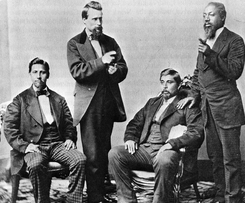 After the Civil War in 1866, the United States government required new treaties with the Five Civilized Tribes, who had mostly allied with the Confederacy. They were required to emancipate their slaves and grant them citizenship and membership in the respective tribes, as the United States freed slaves and granted them citizenship by amendments to the US Constitution. These people were known as tribal freedmen - for instance, Creek or Cherokee Freedmen. Similarly, the Cherokee were required to reinstate membership for the Delaware
, who had earlier been given land on their reservation, but fought for the Union during the war. Many of the Freedmen played active political roles in their tribal nations over the ensuing decades, including roles as interpreters and negotiators with the federal government. African Creek men, such as Harry Island and Silas Jefferson, helped secure land for their people when the government decided to make individual allotments to tribal members under the Dawes Act
.
In the late 20th century, the Cherokee Nation began to make its membership more restrictive, first requiring voters to be descended from Cherokee on the Dawes Rolls, then requiring members to be descended from Cherokee on the same rolls. At the time of registration, US government agents had classified people as Cherokee by blood, intermarried whites, and Cherokee Freedmen, regardless of whether the latter had Cherokee ancestry qualifying them as Cherokee by blood. They also removed the Delaware from the tribal rolls, except for those who had a Cherokee ancestor on the Dawes Roll. A political struggle over this issue has ensued since the 1970s. Cherokee Freedmen have taken cases to the Cherokee Supreme Court. The Cherokee later reinstated the rights of Delaware to be considered members of the Cherokee, but opposed their bid for independent federal recognition.
By the tribal Supreme Court ruling of March 2006, the Cherokee Nation was required to reinstate as members about 1,000 African Americans (and descendants) whom they had dropped from the rolls in the mid-1970s. In response, leaders of the Cherokee Nation organized a referendum to amend their constitution to restrict requirements for citizenship in the tribe. The referendum established direct Cherokee ancestry as a requirement, unlike previous qualifications. Only such members were allowed to vote in the referendum. The measure passed in March 2007, thereby forcing out Cherokee Freedmen and their descendants unless they also had documented, direct Cherokee ancestry. This has caused much controversy. The tribe has determined to limit membership only to those who can demonstrate Native American descent based on listing on the Dawes Rolls.
Similarly, the Seminole nation of Oklahoma moved to exclude Black Seminoles from membership. In 1990 it received $56 million from the US government as reparations for lands taken in Florida. Because the judgment trust was based on tribal membership as of 1823, it excluded Seminole Freedmen, as well as Black Seminoles who held land next to Seminole communities. In 2000 the Seminole chief moved to formally exclude Black Seminoles unless they could prove descent from a Native American ancestor on the Dawes Rolls. Two thousand Black Seminoles were excluded from the nation. Descendants of freedmen and Black Seminoles are working to secure their rights.
An advocacy group representing Descendants of Freedmen of the Five Civilized Tribes claims that members are entitled to be citizens in both the Seminole and Cherokee nations, as many are indeed part Native American by blood, with records to prove it. Because of racial discrimination, their ancestors were classified and listed incorrectly, under only the category of freedmen, at the time of the Dawes Rolls. In addition, the group notes that post-Civil War treaties of these tribes with the US government required they give African Americans full citizenship upon emancipation, regardless of blood quantum. In many cases, Native American descent has been difficult for people to trace from historical records. Twenty-five thousand descendants of freedmen of the Five Civilized Tribes may be affected by the legal controversies.
The Dawes Commission
enrollment records, intended to establish rolls of tribal members for land allocation purposes, were done under rushed conditions by a variety of recorders. Many tended to exclude Freedmen from Cherokee rolls and enter them separately, even when they claimed Cherokee descent, had records of it, and had Cherokee physical features. Descendants of Freedmen see the tribe's contemporary reliance on the Dawes Rolls as a racially based way to exclude them from citizenship.
Before the Dawes Commission was established,
After the Dawes Commission established tribal rolls, in some cases freedmen of the Cherokee and the other Five Civilized Tribes
were treated more harshly. Degrees of continued acceptance into tribal structures were low during the ensuing decades. Some tribes restricted membership to those with a documented Native ancestor on the Dawes Commission listings, and many restricted officeholders to those of direct Native American ancestry. In the later 20th century, it was difficult for Black Native Americans to establish official ties with Native groups to which they genetically belonged. Many of the freedmen descendants believe that their exclusion from tribal membership, and the resistance to their efforts to gain recognition, are racially motivated and based on the tribe's wanting to preserve the new gambling revenues for fewer people.
. Some major slaveholders kept extensive records which historians and genealogists have used to create family trees, but generally researchers find it difficult to trace families before the Civil War. Slaves were forbidden to learn to read and write. A majority of Native Americans did not speak English, let alone read or write it.
In some cases elder family members may withhold information about Native American heritage. However, knowing the family's geographic origins is a key factor in helping individuals unravel Native American ancestry. Many modern African Americans have taken an interest in genealogy
and are learning about Native American heritage within their individual families. Some African Americans may work from oral history
of the family and try to confirm stories of Native ancestry through genealogical research and DNA testing. Because of such findings, some have petitioned to be registered as members of Native American tribes. Each tribe controls the rules for membership. Most do not accept DNA tests as proof, especially since these cannot distinguish among the tribes.
DNA
testing and research has provided more facts about the extent of Native American ancestry among African Americans, which varies in the general population. As Harvard University
historian Henry Louis Gates, Jr.
wrote in 2009,
In contradiction to Gates statement The Indigenous Peoples Council on Biocolonialism (IPCB) notes that:
Geneticists also state:
not all Native Americans have been tested especially with the large number of deaths due to disease such as small pox, it is unlikely that Native Americans only have the genetic markers they have identified, even when their maternal or paternal bloodline does not include a non-Native American.
It should be noted that most statisticians would not necessarily view the IPCB and Geneticists remarks directly above as preventing a sound analysis of genomic contributions from various continents to the make-up of an admixed individual. In general, these analyses are not based on the presence of markers, single nucleotide polymorphisms (SNPs), that the sophisticated analyst would describe as African, Asian, European, or Amerind. Peeking under the hood, one would see that autosomal analysis, as opposed to mtDNA and Y-chromosome analysis discussed below, is based on the relative distribution of the SNPs in these populations coupled with their distribution in the genome being analyzed. Techniques such as maximum likelihood estimation and Bayesian re-estimation provide instruments for assessing ancestry, which also assign a level of confidence to the estimate. Relatively small segments of the genome can be analyzed with these techniques, which are well established, having been applied with great effect in many other areas.
The two common types of tests used are Y-chromosome and mtDNA (mitochondrial DNA) testing. The tests processes for direct-line male and female ancestors. Each follows only one line among many ancestors and thus can fail to identify others. Some critics thought the PBS series did not sufficiently explain the limitations of DNA testing for assessment of heritage. In addition, while full testing may tell an individual if he or she has some Native American ancestry, it cannot distinguish among separate Native American tribes. African Americans are using DNA testing to find out more about all their ancestry. Native American identity has historically been based on culture, not just biology.
Autosomal DNA tests survey all the DNA that has been inherited from the parents of an individual. Autosomal tests focus on SNPs, which might of course be found in Africans, Asians, and people from every other part of the world. DNA testing will not determine an individual's full ancestry with absolute certitude.
Native Americans in the United States
Native Americans in the United States are the indigenous peoples in North America within the boundaries of the present-day continental United States, parts of Alaska, and the island state of Hawaii. They are composed of numerous, distinct tribes, states, and ethnic groups, many of which survive as...
ancestry, who also have strong ties to Native American culture, social, and historical traditions.
Certain Native American tribes had close relations with African Americans, especially those in the Southeast, where slavery was prevalent. Members of the Five Civilized Tribes
Five Civilized Tribes
The Five Civilized Tribes were the five Native American nations—the Cherokee, Chickasaw, Choctaw, Creek, and Seminole—that were considered civilized by Anglo-European settlers during the colonial and early federal period because they adopted many of the colonists' customs and had generally good...
held enslaved blacks, who migrated with them to the West in 1830 and later. In peace treaties with the US after the American Civil War
American Civil War
The American Civil War was a civil war fought in the United States of America. In response to the election of Abraham Lincoln as President of the United States, 11 southern slave states declared their secession from the United States and formed the Confederate States of America ; the other 25...
, the tribes, which had sided with the Confederacy, were required to emancipate slaves and give them full citizenship rights in their nations. The Black Native Americans were known as tribal Freedmen of the five civilized tribes (Cherokee
Cherokee
The Cherokee are a Native American people historically settled in the Southeastern United States . Linguistically, they are part of the Iroquoian language family...
, Creek, Seminole
Seminole
The Seminole are a Native American people originally of Florida, who now reside primarily in that state and Oklahoma. The Seminole nation emerged in a process of ethnogenesis out of groups of Native Americans, most significantly Creeks from what is now Georgia and Alabama, who settled in Florida in...
, Choctaw
Choctaw
The Choctaw are a Native American people originally from the Southeastern United States...
, and Chickasaw
Chickasaw
The Chickasaw are Native American people originally from the region that would become the Southeastern United States...
Freedmen). In addition, some Maroon
Maroon (people)
Maroons were runaway slaves in the West Indies, Central America, South America, and North America, who formed independent settlements together...
communities allied with the Seminole in Florida and intermarried. The Black Seminole included those with and without Native American ancestry. The Cherokee, Creek, and Seminole have created controversy in recent decades as they tightened rules for membership in their nations and excluded Freedmen who did not have at least one Native American ancestor on the early 20th century Dawes Rolls
Dawes Rolls
The Dawes Rolls were created by the Dawes Commission. The Commission, authorized by United States Congress in 1893, was required to negotiate with the Five Civilized Tribes to convince them to agree to an allotment plan and dissolution of the reservation system...
.
Overview
Until recently, historic relations between Native Americans and African Americans were relatively neglected in United States history studies. At various times, Africans had more or less contact with Native Americans, although they did not live together in as great number as with Europeans. African slaves brought to the United StatesUnited States
The United States of America is a federal constitutional republic comprising fifty states and a federal district...
and their descendants have had a history of cultural exchange and intermarriage
Miscegenation
Miscegenation is the mixing of different racial groups through marriage, cohabitation, sexual relations, and procreation....
with Native Americans
Native Americans in the United States
Native Americans in the United States are the indigenous peoples in North America within the boundaries of the present-day continental United States, parts of Alaska, and the island state of Hawaii. They are composed of numerous, distinct tribes, states, and ethnic groups, many of which survive as...
and other slaves who possessed Native American and European ancestry. Most interaction took place in the Southern United States
Southern United States
The Southern United States—commonly referred to as the American South, Dixie, or simply the South—constitutes a large distinctive area in the southeastern and south-central United States...
, where slaves were held in greatest number. Numerous African Americans thus have some Native American ancestry, although not all have current social, cultural or linguistic ties to Native peoples.
Relationships among Native American groups and Africans and African Americans have been varied and complex. Some groups were more accepting of Africans than others and welcomed them as full members of their respective cultures and communities. Native peoples often disagreed about the role of ethnic African people in their communities. Other Native Americans saw uses for slavery and did not oppose it for others.
After the American Civil War
American Civil War
The American Civil War was a civil war fought in the United States of America. In response to the election of Abraham Lincoln as President of the United States, 11 southern slave states declared their secession from the United States and formed the Confederate States of America ; the other 25...
, as members of the US Army, some African Americans fought against Native Americans, especially in the Western frontier states
Western United States
.The Western United States, commonly referred to as the American West or simply "the West," traditionally refers to the region comprising the westernmost states of the United States. Because the U.S. expanded westward after its founding, the meaning of the West has evolved over time...
. Their military units became known as the Buffalo Soldier
Buffalo Soldier
Buffalo Soldiers originally were members of the U.S. 10th Cavalry Regiment of the United States Army, formed on September 21, 1866 at Fort Leavenworth, Kansas....
s. Black Seminole particularly were recruited and worked as Native American scouts for the Army. On the other hand, many Native Americans and African-descended people fought alongside one another in armed struggles of resistance against U.S. expansion into Native territories, as in the Seminole Wars
Seminole Wars
The Seminole Wars, also known as the Florida Wars, were three conflicts in Florida between the Seminole — the collective name given to the amalgamation of various groups of native Americans and Black people who settled in Florida in the early 18th century — and the United States Army...
in Florida
Florida
Florida is a state in the southeastern United States, located on the nation's Atlantic and Gulf coasts. It is bordered to the west by the Gulf of Mexico, to the north by Alabama and Georgia and to the east by the Atlantic Ocean. With a population of 18,801,310 as measured by the 2010 census, it...
, as well as resistance against slavery and racism.
Colonial America
The earliest record of African and Native American contact occurred in April 1502, when the first African slaves arrived in HispaniolaHispaniola
Hispaniola is a major island in the Caribbean, containing the two sovereign states of the Dominican Republic and Haiti. The island is located between the islands of Cuba to the west and Puerto Rico to the east, within the hurricane belt...
. Some escaped inland on Santo Domingo; those who survived and joined with the natives became the first circle of Black Native Americans. In addition, the first example of African slaves' escaping from European colonists and being absorbed by Native Americans was recorded in 1526. In June of that year, Lucas Vasquez de Ayllón established a Spanish colony near the mouth of the Pee Dee River
Pee Dee River
The Pee Dee River, also known as the Great Pee Dee River, is a river in North Carolina and South Carolina. It originates in the Appalachian Mountains in North Carolina, where its upper course above the mouth of the Uwharrie River is known as the Yadkin River. It is extensively dammed for flood...
in what is now eastern South Carolina
South Carolina
South Carolina is a state in the Deep South of the United States that borders Georgia to the south, North Carolina to the north, and the Atlantic Ocean to the east. Originally part of the Province of Carolina, the Province of South Carolina was one of the 13 colonies that declared independence...
. The Spanish settlement was named San Miquel de Guadalupe. Among the inhabitants were 100 enslaved Africans. In 1526, the first African slaves fled the colony and took refuge with local Native Americans.
Intermarriage between African slaves and Native Americans began in the early 17th century in the coastal settlements. In 1622 Native Americans overran the European colony of Jamestown. They killed the Europeans but brought the African slaves as captives back to their communities, gradually integrating them. Interracial relationships occurred between African Americans and members of other tribes in the coastal states. Several colonial advertisements for runaway slaves made direct reference to the connections which Africans had in Native American communities. For example, ...ran off with his Native American wife..., had kin among the Native Americans..., part Native American and speaks their language good.
In South Carolina, colonists were so concerned about the possible threat posed by the mixed African and Native American population that was arising due to runaways, that they passed a new law in 1725. This law stipulated a fine of 200 pounds for persons bringing a slave to the frontier regions. In 1751 South Carolina passed a law against holding Africans in proximity to Native Americans, which was deemed detrimental to the security of the colony.
In 1726 the British governor of colonial New York exacted a promise from the Iroquois
Iroquois
The Iroquois , also known as the Haudenosaunee or the "People of the Longhouse", are an association of several tribes of indigenous people of North America...
Confederacy to return all runaway slaves. He required the same from the Huron tribe in 1764 and the Delaware
Delaware
Delaware is a U.S. state located on the Atlantic Coast in the Mid-Atlantic region of the United States. It is bordered to the south and west by Maryland, and to the north by Pennsylvania...
tribe in 1765. Despite their agreements, the tribes never returned any escaped slaves. They continued to provide a safe refuge for escaped slaves. In 1763 during Chief Pontiac
Pontiac
Pontiac was an automobile brand that was established in 1926 as a companion make for General Motors' Oakland. Quickly overtaking its parent in popularity, it supplanted the Oakland brand entirely by 1933 and, for most of its life, became a companion make for Chevrolet. Pontiac was sold in the...
's uprising, a Detroit resident reported that Native Americans killed whites
White American
White Americans are people of the United States who are considered or consider themselves White. The United States Census Bureau defines White people as those "having origins in any of the original peoples of Europe, the Middle East, or North Africa...
but were "saving and caressing all the Negroes they take." He worried lest this might "produce an insurrection." Chief Joseph Brant's Mohawk
Mohawk nation
Mohawk are the most easterly tribe of the Iroquois confederation. They call themselves Kanien'gehaga, people of the place of the flint...
in New York welcomed runaway slaves and encouraged adoption of them into the tribe and intermarriage. The Native American adoption systems knew no color line. Carter G. Woodson
Carter G. Woodson
Carter Godwin Woodson was an African-American historian, author, journalist and the founder of the Association for the Study of African American Life and History. Woodson was one of the first scholars to study African American history. A founder of Journal of Negro History , Dr...
notion of an escape hatch from slavery proved correct: Native American villages welcomed fugitive slaves and some served as stations on the Underground Railroad
Underground Railroad
The Underground Railroad was an informal network of secret routes and safe houses used by 19th-century black slaves in the United States to escape to free states and Canada with the aid of abolitionists and allies who were sympathetic to their cause. The term is also applied to the abolitionists,...
.
During the transitional period of Africans' becoming the primary race enslaved, Native Americans were sometimes enslaved at the same time. Africans and Native Americans worked together, lived together in communal quarters, produced collective recipes for food, and shared herbal remedies, myths and legends. Some intermarried and had mixed-race children. Ads asked for the return of both African American and Native American slaves. Some Native Americans resented the presence of Africans. In one description, the "Catawaba tribe in 1752 showed great anger and bitter resentment when an African American came among them as a trader."
The Cherokee had the strongest color prejudice of all Native Americans. The hostility has been attributed to European fears of a unified revolt of Native Americans and African Americans: "Whites sought to convince Native Americans that African Americans worked against their best interests." Europeans considered both races inferior and made efforts to make Native Americans and Africans enemies. Native Americans were rewarded if they returned escaped slaves, and African Americans were rewarded for fighting in "Native American Wars". European colonists told the Cherokee that the smallpox
Smallpox
Smallpox was an infectious disease unique to humans, caused by either of two virus variants, Variola major and Variola minor. The disease is also known by the Latin names Variola or Variola vera, which is a derivative of the Latin varius, meaning "spotted", or varus, meaning "pimple"...
epidemic of 1739 was due to disease brought by African slaves, to create tension between the groups. The British tried to restrict contact between Africans and free Native Americans. They feared Native Americans' taking enslaved Africans as spouses and tried to discourage trade between the groups. The British also passed laws prohibiting the carrying of slaves into the frontier of the Cherokee Nation's territory to restrict interactions between the two groups. Some tribes were said to encourage marriage between the two groups, to create stronger children from the unions.
Even among the Cherokee, interracial marriages increased as the number of slaves held by the tribe increased. The Cherokee were noted for having slaves work side by side with their owners. Resisting the Euro-American system of chattel slavery created tensions between the Cherokee and European Americans. The Cherokee tribe began to become divided; as intermarriage between white men and native women increased and there was increased adoption of European culture, so did racial discrimination against those of African-Cherokee blood and African slaves. Cultural assimilation among the tribes, particularly the Cherokee, created pressure to be accepted by European Americans.
In 1758 the governor of South Carolina James Glen stated:
it has always been the policy of this government to create an aversion in them Native Americans to Negroes.In the 18th century, some Native American women turned to freed or runaway
Fugitive slave
In the history of slavery in the United States, "fugitive slaves" were slaves who had escaped from their master to travel to a place where slavery was banned or illegal. Many went to northern territories including Pennsylvania and Massachusetts until the Fugitive Slave Act of 1850 was passed...
African men due to a major decline in the male population in Native American villages. At the same time, the early African slave population was disproportionately male. Records show that some Native American women bought African men as slaves. Unknown to European sellers, the women freed and married the men into their tribe. Some African men chose Native American women as their partners because their children would be free, as the child's status followed that of the mother. The men could marry into some of the matrilineal tribes and be accepted, as their children were still considered to belong to the mother's people. As European expansion increased in the Southeast, African and Native American marriages became more numerous.
1800s through Civil War
In the early 19th century, the US government believed that some tribes had become extinct, especially on the East Coast and those without reservations. It did not have a separate census designation for Native Americans. Those who remained among the European-American communities were frequently listed as mulattoMulatto
Mulatto denotes a person with one white parent and one black parent, or more broadly, a person of mixed black and white ancestry. Contemporary usage of the term varies greatly, and the broader sense of the term makes its application rather subjective, as not all people of mixed white and black...
, a term applied to Native American-white, Native American-African, and African-white mixed-race people, as well as tri-racial people.
The Seminole
Seminole
The Seminole are a Native American people originally of Florida, who now reside primarily in that state and Oklahoma. The Seminole nation emerged in a process of ethnogenesis out of groups of Native Americans, most significantly Creeks from what is now Georgia and Alabama, who settled in Florida in...
people of Florida were unusual for forming in the 18th century, mostly from Creek and other Native Americans who migrated from Georgia. They incorporated some Africans who had escaped from slavery. Other maroons
Maroon (people)
Maroons were runaway slaves in the West Indies, Central America, South America, and North America, who formed independent settlements together...
formed separate communities near the Seminole, and were allied with them in military actions. Some intermarriage took place. African Americans living near the Seminole were called Black Seminoles
Black Seminoles
The Black Seminoles is a term used by modern historians for the descendants of free blacks and some runaway slaves , mostly Gullahs who escaped from coastal South Carolina and Georgia rice plantations into the Spanish Florida wilderness beginning as early as the late 17th century...
. Several hundred people of African descent traveled with the Seminole when they were removed to Native American Territory. Others stayed with a few hundred Seminole in Florida.
By contrast, an 1835 census of the Cherokee
Cherokee
The Cherokee are a Native American people historically settled in the Southeastern United States . Linguistically, they are part of the Iroquoian language family...
showed that 10% were of African descent. In those years, censuses of the tribes classified people of mixed Native American and African descent as Native American. By contrast, during the registration for the Dawes Rolls, generally Cherokee Freedmen were classified separately on a Freedmen roll, even if individuals had Cherokee ancestry and qualified as "Cherokee by blood". This has caused problems for their descendants in the late twentieth and twenty-first century, as the Nation has passed legislation and a constitutional amendment to make membership more restrictive, open only to those with certificates of blood ancestry (CDIB). Western frontier artist George Catlin
George Catlin
George Catlin was an American painter, author and traveler who specialized in portraits of Native Americans in the Old West.-Early years:...
described "Negro and North American Native American, mixed, of equal blood" and stated they were "the finest built and most powerful men I have ever yet seen." By 1922 John Swanton's survey of the Five Civilized Tribes noted that half the Cherokee Nation were freedmen and their descendants.
Former slaves and Native Americans intermarried in northern states as well. Massachusetts Vital Records prior to 1850 included notes of "Marriages of 'negroes' to Native Americans". By 1860 in some areas of the South
Southern United States
The Southern United States—commonly referred to as the American South, Dixie, or simply the South—constitutes a large distinctive area in the southeastern and south-central United States...
, Native Americans were believed to have intermarried with African Americans to such an extent that white legislators thought the Native Americans no longer qualified as "Native American", as they were not paying attention to culture but only race. Legislators wanted to revoke their tax exemptions.
Freed African Americans, Black Native Americans and some Native Americans fought in the American Civil War
American Civil War
The American Civil War was a civil war fought in the United States of America. In response to the election of Abraham Lincoln as President of the United States, 11 southern slave states declared their secession from the United States and formed the Confederate States of America ; the other 25...
against the Confederate Army. During November 1861, the Creek and Black Native Americans, led by Creek Chief Opothleyahola
Opothleyahola
Opothleyahola, also spelled Opothle Yohola, Opothleyoholo, Hu-pui-hilth Yahola, and Hopoeitheyohola, was a Muscogee Creek Indian chief, noted as a brilliant orator. He was a speaker of the Upper Creek Council. He led Creek forces against the United States government during the first two Seminole...
, fought three pitched battles against Confederate whites and allied Native Americans to reach Union
Union (American Civil War)
During the American Civil War, the Union was a name used to refer to the federal government of the United States, which was supported by the twenty free states and five border slave states. It was opposed by 11 southern slave states that had declared a secession to join together to form the...
lines in Kansas and offer their services. Some people who were Black Native Americans served in colored regiments with other African-American soldiers.
Black Native Americans were documented in the following regiments: The 1st Kansas Colored Infantry
1st Regiment Kansas Volunteer Infantry (African Descent)
The 1st Regiment Kansas Volunteer Infantry was an infantry regiment that served in the Union Army during the American Civil War.-Service:...
, the Kansas Colored at Honey Springs, the 79th US Colored Infantry, and the 83rd US Colored Infantry, along with other colored regiments that included men listed as Negro. Civil War battles occurred in Native American Territory. The first in Native American Territory took place July 1–2, 1863, and involved the 1st Kansas Colored Infantry. The first battle against the Confederacy outside Native American Territory occurred at Horse Head Creek, Arkansas on February 17, 1864. The 79th U.S. Colored Infantry participated.
Many Black Native Americans returned to Native American Territory once the Civil War had been won by the Union. When the Confederacy and its Native American allies were defeated, the US required new peace treaties with the Five Civilized Tribes
Five Civilized Tribes
The Five Civilized Tribes were the five Native American nations—the Cherokee, Chickasaw, Choctaw, Creek, and Seminole—that were considered civilized by Anglo-European settlers during the colonial and early federal period because they adopted many of the colonists' customs and had generally good...
, including provisions to emancipate slaves and make them full citizens of their nations, with equal rights in annuities and land allotments. The former slaves were called tribal freedmen, as in Cherokee Freedmen and Seminole Freedmen. The pro-Union Cherokee faction had freed their slaves in 1863, before the end of the war, but the pro-Confederacy Cherokee then constituted the majority of the tribe and kept hold of the slaves until later.
Native American slave ownership
Slavery existed among Native AmericansIndigenous peoples of the Americas
The indigenous peoples of the Americas are the pre-Columbian inhabitants of North and South America, their descendants and other ethnic groups who are identified with those peoples. Indigenous peoples are known in Canada as Aboriginal peoples, and in the United States as Native Americans...
before it was introduced by the Europeans, although it was unlike chattel slavery. In oral tradition, for instance, Cherokees recounted people being enslaved as the result of failure in warfare, and as a temporary status pending adoption or release. As the United States Constitution
United States Constitution
The Constitution of the United States is the supreme law of the United States of America. It is the framework for the organization of the United States government and for the relationship of the federal government with the states, citizens, and all people within the United States.The first three...
and the laws of several states permitted slavery
Slavery
Slavery is a system under which people are treated as property to be bought and sold, and are forced to work. Slaves can be held against their will from the time of their capture, purchase or birth, and deprived of the right to leave, to refuse to work, or to demand compensation...
, Native Americans were legally allowed to own slaves, including those brought from Africa by Europeans. Benjamin Hawkins was the federal agent assigned to the southeastern tribes in the in the 1790s and advised the tribes to take up slaveholding. The Cherokee tribe had the most members who held black slaves, more than any other Native American nation.
In colonial North America, the first exposure that Africans and Native Americans had to each other came from Africans being imported as laborers, both indentured servants and as slaves. Records from the slavery period show several cases of brutal Native American treatment of black slaves. However, most Native American masters rejected the worst features of Southern practices. Federal Agent Hawkins considered the form of slavery the tribes were practicing to be inefficient because the majority didn't practice chattel slavery. Travelers reported enslaved Africans "in as good circumstances as their masters." A white Native American Agent, Douglas Cooper, upset by the Native American failure to practice more severe rules, insisted that Native Americans invite white men to live in their villages and "control matters." Though less than 3% of Native Americans owned slaves, racial bondage and pressure from European-American culture created destructive cleavages in their villages. Many had a class hierarchy based on "white blood." Native Americans of mixed white
White American
White Americans are people of the United States who are considered or consider themselves White. The United States Census Bureau defines White people as those "having origins in any of the original peoples of Europe, the Middle East, or North Africa...
blood stood at the top, "pure" Native Americans next, and people of African descent were at the bottom. As among mixed-race African Americans, some of the status of white descent may also have been related to the economic and social capital passed on by white relations.
Numerous African-descended people were held as slaves by members of Native groups up until the Civil War. Some later recounted their lives for a WPA
Works Progress Administration
The Works Progress Administration was the largest and most ambitious New Deal agency, employing millions of unskilled workers to carry out public works projects, including the construction of public buildings and roads, and operated large arts, drama, media, and literacy projects...
oral history
Oral history
Oral history is the collection and study of historical information about individuals, families, important events, or everyday life using audiotapes, videotapes, or transcriptions of planned interviews...
project during the Great Depression
Great Depression
The Great Depression was a severe worldwide economic depression in the decade preceding World War II. The timing of the Great Depression varied across nations, but in most countries it started in about 1929 and lasted until the late 1930s or early 1940s...
in the 1930s.
Native American Freedmen
Delaware
Delaware is a U.S. state located on the Atlantic Coast in the Mid-Atlantic region of the United States. It is bordered to the south and west by Maryland, and to the north by Pennsylvania...
, who had earlier been given land on their reservation, but fought for the Union during the war. Many of the Freedmen played active political roles in their tribal nations over the ensuing decades, including roles as interpreters and negotiators with the federal government. African Creek men, such as Harry Island and Silas Jefferson, helped secure land for their people when the government decided to make individual allotments to tribal members under the Dawes Act
Dawes Act
The Dawes Act, adopted by Congress in 1887, authorized the President of the United States to survey Indian tribal land and divide the land into allotments for individual Indians. The Act was named for its sponsor, Senator Henry L. Dawes of Massachusetts. The Dawes Act was amended in 1891 and again...
.
In the late 20th century, the Cherokee Nation began to make its membership more restrictive, first requiring voters to be descended from Cherokee on the Dawes Rolls, then requiring members to be descended from Cherokee on the same rolls. At the time of registration, US government agents had classified people as Cherokee by blood, intermarried whites, and Cherokee Freedmen, regardless of whether the latter had Cherokee ancestry qualifying them as Cherokee by blood. They also removed the Delaware from the tribal rolls, except for those who had a Cherokee ancestor on the Dawes Roll. A political struggle over this issue has ensued since the 1970s. Cherokee Freedmen have taken cases to the Cherokee Supreme Court. The Cherokee later reinstated the rights of Delaware to be considered members of the Cherokee, but opposed their bid for independent federal recognition.
By the tribal Supreme Court ruling of March 2006, the Cherokee Nation was required to reinstate as members about 1,000 African Americans (and descendants) whom they had dropped from the rolls in the mid-1970s. In response, leaders of the Cherokee Nation organized a referendum to amend their constitution to restrict requirements for citizenship in the tribe. The referendum established direct Cherokee ancestry as a requirement, unlike previous qualifications. Only such members were allowed to vote in the referendum. The measure passed in March 2007, thereby forcing out Cherokee Freedmen and their descendants unless they also had documented, direct Cherokee ancestry. This has caused much controversy. The tribe has determined to limit membership only to those who can demonstrate Native American descent based on listing on the Dawes Rolls.
Similarly, the Seminole nation of Oklahoma moved to exclude Black Seminoles from membership. In 1990 it received $56 million from the US government as reparations for lands taken in Florida. Because the judgment trust was based on tribal membership as of 1823, it excluded Seminole Freedmen, as well as Black Seminoles who held land next to Seminole communities. In 2000 the Seminole chief moved to formally exclude Black Seminoles unless they could prove descent from a Native American ancestor on the Dawes Rolls. Two thousand Black Seminoles were excluded from the nation. Descendants of freedmen and Black Seminoles are working to secure their rights.
"There's never been any stigma about intermarriage," says Stu Phillips, editor of The Seminole Producer, a local newspaper in central Oklahoma. "You've got Native Americans marrying whites, Native Americans marrying blacks. It was never a problem until they got some money."
An advocacy group representing Descendants of Freedmen of the Five Civilized Tribes claims that members are entitled to be citizens in both the Seminole and Cherokee nations, as many are indeed part Native American by blood, with records to prove it. Because of racial discrimination, their ancestors were classified and listed incorrectly, under only the category of freedmen, at the time of the Dawes Rolls. In addition, the group notes that post-Civil War treaties of these tribes with the US government required they give African Americans full citizenship upon emancipation, regardless of blood quantum. In many cases, Native American descent has been difficult for people to trace from historical records. Twenty-five thousand descendants of freedmen of the Five Civilized Tribes may be affected by the legal controversies.
The Dawes Commission
Dawes Commission
The American Dawes Commission, named for its first chairman Henry L. Dawes, was authorized under a rider to an Indian Office appropriation bill, March 3, 1893...
enrollment records, intended to establish rolls of tribal members for land allocation purposes, were done under rushed conditions by a variety of recorders. Many tended to exclude Freedmen from Cherokee rolls and enter them separately, even when they claimed Cherokee descent, had records of it, and had Cherokee physical features. Descendants of Freedmen see the tribe's contemporary reliance on the Dawes Rolls as a racially based way to exclude them from citizenship.
Before the Dawes Commission was established,
"(t)he majority of the people with African blood living in the Cherokee nation prior to the Civil war lived there as slaves of Cherokee citizens or as free black non-citizens, usually the descendants of Cherokee men and women with African blood...In 1863, the Cherokee government outlawed slavery through acts of the tribal council. In 1866, a treaty was signed with the US government in which the Cherokee government agreed to give citizenship to those people with African blood living in the Cherokee nations who were not already citizens. African Cherokee people participated as full citizens of that nation, holding office, voting, running businesses, etc."
After the Dawes Commission established tribal rolls, in some cases freedmen of the Cherokee and the other Five Civilized Tribes
Five Civilized Tribes
The Five Civilized Tribes were the five Native American nations—the Cherokee, Chickasaw, Choctaw, Creek, and Seminole—that were considered civilized by Anglo-European settlers during the colonial and early federal period because they adopted many of the colonists' customs and had generally good...
were treated more harshly. Degrees of continued acceptance into tribal structures were low during the ensuing decades. Some tribes restricted membership to those with a documented Native ancestor on the Dawes Commission listings, and many restricted officeholders to those of direct Native American ancestry. In the later 20th century, it was difficult for Black Native Americans to establish official ties with Native groups to which they genetically belonged. Many of the freedmen descendants believe that their exclusion from tribal membership, and the resistance to their efforts to gain recognition, are racially motivated and based on the tribe's wanting to preserve the new gambling revenues for fewer people.
Genealogy
Tracing the genealogy of African Americans and Native Americans is a difficult process. Enslaved Africans were renamed by slaveholders and surnames were infrequently used until after the war. Historical records, such as censuses, did not record the names of enslaved blacks before the American Civil WarAmerican Civil War
The American Civil War was a civil war fought in the United States of America. In response to the election of Abraham Lincoln as President of the United States, 11 southern slave states declared their secession from the United States and formed the Confederate States of America ; the other 25...
. Some major slaveholders kept extensive records which historians and genealogists have used to create family trees, but generally researchers find it difficult to trace families before the Civil War. Slaves were forbidden to learn to read and write. A majority of Native Americans did not speak English, let alone read or write it.
In some cases elder family members may withhold information about Native American heritage. However, knowing the family's geographic origins is a key factor in helping individuals unravel Native American ancestry. Many modern African Americans have taken an interest in genealogy
Genealogy
Genealogy is the study of families and the tracing of their lineages and history. Genealogists use oral traditions, historical records, genetic analysis, and other records to obtain information about a family and to demonstrate kinship and pedigrees of its members...
and are learning about Native American heritage within their individual families. Some African Americans may work from oral history
Oral history
Oral history is the collection and study of historical information about individuals, families, important events, or everyday life using audiotapes, videotapes, or transcriptions of planned interviews...
of the family and try to confirm stories of Native ancestry through genealogical research and DNA testing. Because of such findings, some have petitioned to be registered as members of Native American tribes. Each tribe controls the rules for membership. Most do not accept DNA tests as proof, especially since these cannot distinguish among the tribes.
DNA
DNA
Deoxyribonucleic acid is a nucleic acid that contains the genetic instructions used in the development and functioning of all known living organisms . The DNA segments that carry this genetic information are called genes, but other DNA sequences have structural purposes, or are involved in...
testing and research has provided more facts about the extent of Native American ancestry among African Americans, which varies in the general population. As Harvard University
Harvard University
Harvard University is a private Ivy League university located in Cambridge, Massachusetts, United States, established in 1636 by the Massachusetts legislature. Harvard is the oldest institution of higher learning in the United States and the first corporation chartered in the country...
historian Henry Louis Gates, Jr.
Henry Louis Gates, Jr.
Henry Louis “Skip” Gates, Jr., is an American literary critic, educator, scholar, writer, editor, and public intellectual. He was the first African American to receive the Andrew W. Mellon Foundation Fellowship. He has received numerous honorary degrees and awards for his teaching, research, and...
wrote in 2009,
"Here are the facts: Only 5 percent of all black Americans have at least 12.5 percent Native American ancestry, the equivalent of at least one great-grandparent. Those 'high cheek bones' and 'straight black hair' your relatives brag about at every family reunion and holiday meal since you were 2 years old? Where did they come from? To paraphrase a well-known FrenchFrench languageFrench is a Romance language spoken as a first language in France, the Romandy region in Switzerland, Wallonia and Brussels in Belgium, Monaco, the regions of Quebec and Acadia in Canada, and by various communities elsewhere. Second-language speakers of French are distributed throughout many parts...
saying, “Seek the white man.”
African Americans, just like our first ladyMichelle ObamaMichelle LaVaughn Robinson Obama is the wife of the 44th and incumbent President of the United States, Barack Obama, and is the first African-American First Lady of the United States...
, are a racially mixed or mulatto people—deeply and overwhelmingly so. Fact: Fully 58 percent of African-American people, according to geneticist Mark Shriver at Morehouse CollegeMorehouse CollegeMorehouse College is a private, all-male, liberal arts, historically black college located in Atlanta, Georgia. Along with Hampden-Sydney College and Wabash College, Morehouse is one of three remaining traditional men's colleges in the United States....
, possess at least 12.5 percent European ancestry (again, the equivalent of that one great-grandparent).
In contradiction to Gates statement The Indigenous Peoples Council on Biocolonialism (IPCB) notes that:
"Native American markers" are not found solely among Native Americans. While they occur more frequently among Native Americans they are also found in people in other parts of the world.
Geneticists also state:
not all Native Americans have been tested especially with the large number of deaths due to disease such as small pox, it is unlikely that Native Americans only have the genetic markers they have identified, even when their maternal or paternal bloodline does not include a non-Native American.
It should be noted that most statisticians would not necessarily view the IPCB and Geneticists remarks directly above as preventing a sound analysis of genomic contributions from various continents to the make-up of an admixed individual. In general, these analyses are not based on the presence of markers, single nucleotide polymorphisms (SNPs), that the sophisticated analyst would describe as African, Asian, European, or Amerind. Peeking under the hood, one would see that autosomal analysis, as opposed to mtDNA and Y-chromosome analysis discussed below, is based on the relative distribution of the SNPs in these populations coupled with their distribution in the genome being analyzed. Techniques such as maximum likelihood estimation and Bayesian re-estimation provide instruments for assessing ancestry, which also assign a level of confidence to the estimate. Relatively small segments of the genome can be analyzed with these techniques, which are well established, having been applied with great effect in many other areas.
The two common types of tests used are Y-chromosome and mtDNA (mitochondrial DNA) testing. The tests processes for direct-line male and female ancestors. Each follows only one line among many ancestors and thus can fail to identify others. Some critics thought the PBS series did not sufficiently explain the limitations of DNA testing for assessment of heritage. In addition, while full testing may tell an individual if he or she has some Native American ancestry, it cannot distinguish among separate Native American tribes. African Americans are using DNA testing to find out more about all their ancestry. Native American identity has historically been based on culture, not just biology.
Autosomal DNA tests survey all the DNA that has been inherited from the parents of an individual. Autosomal tests focus on SNPs, which might of course be found in Africans, Asians, and people from every other part of the world. DNA testing will not determine an individual's full ancestry with absolute certitude.
Notable Black Native Americans
Historic
- Joseph Louis CookJoseph Louis CookJoseph Louis Cook or Akiatonharónkwen was an Iroquois leader and American soldier. Born to a black father and an Abenaki mother in what is now Quebec, he was adopted as a Mohawk. He became an influential leader in the Iroquois Confederacy and distinguished himself during the French and Indian War...
, a Colonel in the Continental ArmyContinental ArmyThe Continental Army was formed after the outbreak of the American Revolutionary War by the colonies that became the United States of America. Established by a resolution of the Continental Congress on June 14, 1775, it was created to coordinate the military efforts of the Thirteen Colonies in...
during the American Revolutionary WarAmerican Revolutionary WarThe American Revolutionary War , the American War of Independence, or simply the Revolutionary War, began as a war between the Kingdom of Great Britain and thirteen British colonies in North America, and ended in a global war between several European great powers.The war was the result of the...
. - Edmonia LewisEdmonia LewisMary Edmonia Lewis was the first African American and Native American woman to gain fame and recognition as a sculptor in the international fine arts world...
(1845–1911), Ojibwe, African American and HaitiHaitiHaiti , officially the Republic of Haiti , is a Caribbean country. It occupies the western, smaller portion of the island of Hispaniola, in the Greater Antillean archipelago, which it shares with the Dominican Republic. Ayiti was the indigenous Taíno or Amerindian name for the island...
an - Abraham, also called Suwanee Warrior (Sauanaffe Tustunaggee), known as "Prime Minister of the Seminoles", leader during the Seminole Wars
- John Horse (Juan Caballo) (1812–1882), Black Seminole war leader in Florida, also leader of Black Seminole in Mexico
- Charlie PattonCharlie PattonCharlie Patton , better known as Charley Patton, was an American Delta blues musician. He is considered by many to be the "Father of the Delta Blues", and is credited with creating an enduring body of American music and personally inspiring just about every Delta blues man...
(1887–1934), Black Cherokee and founding father of the BluesBluesBlues is the name given to both a musical form and a music genre that originated in African-American communities of primarily the "Deep South" of the United States at the end of the 19th century from spirituals, work songs, field hollers, shouts and chants, and rhymed simple narrative ballads...
in the Mississippi DeltaMississippi DeltaThe Mississippi Delta is the distinctive northwest section of the U.S. state of Mississippi that lies between the Mississippi and Yazoo Rivers. The region has been called "The Most Southern Place on Earth" because of its unique racial, cultural, and economic history... - George BongaGeorge BongaGeorge Bonga was a fur trader of African American and Native American descent who was one of the first African American descent born in what is now Minnesota. He was the son of Pierre Bonga, and an Ojibwe mother....
(1802–1880), fur trader and interpreter in what is now MinnesotaMinnesotaMinnesota is a U.S. state located in the Midwestern United States. The twelfth largest state of the U.S., it is the twenty-first most populous, with 5.3 million residents. Minnesota was carved out of the eastern half of the Minnesota Territory and admitted to the Union as the thirty-second state...
, son of trader and interpreter Pierre BongaPierre BongaPierre Bonga was reportedly the son of Jean and Jeanne Bonga, a freed slave couple who had belonged to the British officer commanding at Mackinac Island in the 1780s. Pierre worked for the North West Company, and later for the American Fur Company...
and an Ojibwe mother
Contemporary
- Jimi HendrixJimi HendrixJames Marshall "Jimi" Hendrix was an American guitarist and singer-songwriter...
, rock musician of partly CherokeeCherokeeThe Cherokee are a Native American people historically settled in the Southeastern United States . Linguistically, they are part of the Iroquoian language family...
and African-American ancestry. - Mance LipscombMance LipscombMance Lipscomb was an American blues singer, guitarist and songster. Born Beau De Glen Lipscomb near Navasota, Texas, United States, he as a youth took the name of 'Mance' from a friend of his oldest brother Charlie .-Biography:Lipscomb was born April 9, 1895 to an ex-slave father from Alabama and...
, blues musician of ChoctawChoctawThe Choctaw are a Native American people originally from the Southeastern United States...
and African-American ancestry - Martha RedboneMartha RedboneMartha Redbone is a musician of part Shawnee, Choctaw and African-American descent. She has won awards for her contemporary Native American music. Her music is a mix of rhythm and blues, and soul music influences, fused with elements of traditional Native American music...
, Native American Music AwardNative American Music AwardsThe Native American Music Awards , commonly known as the Nammys, are an awards program presented annually by The Native American Music Association & Awards, which recognizes outstanding musical achievement among Native Americans...
-winning soul musicSoul musicSoul music is a music genre originating in the United States combining elements of gospel music and rhythm and blues. According to the Rock and Roll Hall of Fame, soul is "music that arose out of the black experience in America through the transmutation of gospel and rhythm & blues into a form of...
of Shawnee, Choctaw and African-American ancestry - Radmilla CodyRadmilla CodyRadmilla A. Cody is a Navajo model, award-winning singer, and anti-domestic violence activist who was the 46th Miss Navajo from 1997 to 1998.As she was the first and thus far only Miss Navajo partially of African-American heritage, her nomination sparked considerable debate over Navajo identity...
, 46th Miss NavajoMiss NavajoMiss Navajo is a pageant that has been held annually on the Navajo Nation, United States, since 1952.The first Miss Navajo was Dr. Beulah Melvin Allen, in 1952...
Nation (1998), traditional Navajo singer of Navajo and African-American ancestry, and advocate against domestic violence in both the Navajo Nation and the state of Arizona. - France Winddance TwineFrance Winddance TwineFrance Winddance Twine is Professor of Sociology and filmmaker at the University of California, Santa Barbara. She is the former Deputy Editor of American Sociological Review, the flagship journal of the American Sociological Association...
(b. 1960) enrolled Muscogee (Creek) NationMuscogee (Creek) NationThe Muscogee Nation is a federally recognized tribe of Muscogee people, also known as the Creek, based in the U.S. state of Oklahoma. They are regarded as one of the historical Five Civilized Tribes and call themselves Este Mvskokvlke...
sociologist - James BrownJames BrownJames Joseph Brown was an American singer, songwriter, musician, and recording artist. He is the originator of Funk and is recognized as a major figure in the 20th century popular music for both his vocals and dancing. He has been referred to as "The Godfather of Soul," "Mr...
, the famous soul musician of the 20th century, and often called the "Godfather of Soul", had both African American and Native American ancestry.
See also
- Brass AnklesBrass AnklesThe Brass Ankles of South Carolina were a "tri-racial isolate" group that lived in the area of Orangeburg County, Berkeley County, and Charleston County in the 18th, 19th and early 20th centuries. They were a mixture of African, Native American, and European descent. Although they were of mixed...
- Chestnut Ridge peopleChestnut Ridge peopleThe Chestnut Ridge people are a mixed-race community residing just northeast of Philippi, Barbour County in north-central West Virginia. They are often called "Mayles" or "Guineas"...
- Louisiana Creole peopleLouisiana Creole peopleLouisiana Creole people refers to those who are descended from the colonial settlers in Louisiana, especially those of French and Spanish descent. The term was first used during colonial times by the settlers to refer to those who were born in the colony, as opposed to those born in the Old World...
- LumbeeLumbeeThe Lumbee belong to a state recognized Native American tribe in North Carolina. The Lumbee are concentrated in Robeson County and named for the primary waterway traversing the county...
- MelungeonMelungeonMelungeon is a term traditionally applied to one of a number of "tri-racial isolate" groups of the Southeastern United States, mainly in the Cumberland Gap area of central Appalachia, which includes portions of East Tennessee, Southwest Virginia, and East Kentucky. Tri-racial describes populations...
- Native American name controversyNative American name controversyThe Native American name controversy is a dispute about the acceptable terminology for the indigenous peoples of the Americas and broad subsets of these peoples, such as those sharing certain cultures and languages by which more discrete groups identify themselves .Many English exonyms have been...
- One-drop ruleOne-drop ruleThe one-drop rule is a historical colloquial term in the United States for the social classification as black of individuals with any African ancestry; meaning any person with "one drop of black blood" was considered black...
- PlaçagePlaçagePlaçage was a recognized extralegal system in which white French and Spanish and later Creole men entered into the equivalent of common-law marriages with women of African, Indian and white Creole descent. The term comes from the French placer meaning "to place with"...
- Redbone (ethnicity)Redbone (ethnicity)Redbone is a term historically used in much of the southern United States, particularly in Louisiana, to refer to a Métis or Mestee ethnic group of mixed racial heritage.-Definition:...
- We-SortsWe-SortsWe-Sorts is a name for a group of Native Americans in Maryland who are from the Piscataway tribe. Piscataways have always claimed to be Native American people. The Piscataway were powerful at the time of European encounter...
External links
- Henry Louis Gates, Jr., "Michelle's Great-Great-Great-Granddaddy - and Yours", The Root.com, 8 Oct 2009
- Aframernative American Slave Narratives, Patrick Minges
- Descendants of Freedmen of the Five Tribes
- Americans.htm "Black Native Americans In American West History", African Americans
- The African-Native American
- Dr. Arthur N. Lewin, "Black Native Americans", review of William Loren Katz, The Black Native Americans, Black Web Portal, 2001
Further reading
- Amir Nashid Ali Muhammad; Muslims in America - Seven Centuries of History ISBN 0-915957-75-2
- Bonnett, A. "Shades of difference: African Native Americans", History Today, December 2008, 58, 12, Pages 40–42
- Sylviane A. Diouf (1998); Servants of Allah - African Muslims Enslaved in the Americas ISBN 0-8147-1905-8
- Allan D. Austin (1997); African Muslims in Antebellum America ISBN 0-415-91270-9
- --
- Tiya Miles (2006); Ties that Bind : the Story of an Afro-Cherokee Family in Slavery and Freedom ISBN 0520241320
- J. Leitch Wright (1999); The Only Land They Knew : American Native Americans in the Old South ISBN 0803298056
- Patrick Minges (2004); Black Native American Slave Narratives ISBN 0895872986
- Jack D. Forbes (1993); Africans and Native Americans: The Language of Race and the Evolution of Red-Black Peoples ISBN 025206321X
- James F. Brooks (2002); Confounding the Color Line: The Native American - Black Experience in North America ISBN 0803261942
- Claudio Saunt (2005); Black, White, and Native American: Race and the Unmaking of an American Family ISBN 0195313100
- Valena Broussard Dismukes (2007); The Red-Black Connection: Contemporary Urban African-Native Americans and their Stories of Dual Identity ISBN 9780979715303