
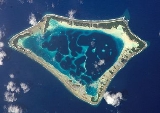
An
atoll is a
coral islandA coral island is the result of an atoll whose lagoon has dried up or been filled in with coral sand and detritus. This state is typically the last in the life cycle of an island, the first being volcanic and the second being an atoll. Most of the world's coral islands are in the Pacific Ocean...
(or islands) that encircles a
lagoonA lagoon is a body of shallow sea water or brackish water separated from the sea by some form of barrier. The EU's habitat directive defines lagoons as "expanses of shallow coastal salt water, of varying salinity or water volume, wholly or partially separated from the sea by sand banks or shingle,...
partially or completely.
Usage
The word
atoll comes from the
DhivehiMaldivian is an Indo-Aryan language predominantly spoken by about 350,000 people in the Maldives where it is the national language. It is also the first language of nearly 10,000 people in the island of Minicoy in the Union territory of Lakshadweep, India where the Mahl dialect of the Maldivian...
(an Indo-Aryan language spoken on the
Maldive IslandsThe Maldives , , officially Republic of Maldives , also referred to as the Maldive Islands, is an island nation in the Indian Ocean formed by a double chain of twenty-six atolls oriented north-south off India's Lakshadweep islands, between Minicoy Island and...
) word
atholhu (
DhivehiMaldivian is an Indo-Aryan language predominantly spoken by about 350,000 people in the Maldives where it is the national language. It is also the first language of nearly 10,000 people in the island of Minicoy in the Union territory of Lakshadweep, India where the Mahl dialect of the Maldivian...
: އަތޮޅު, ˈət̪ɔɭu)
OED. Its first recorded use in
EnglishEnglish is a West Germanic language that arose in the Anglo-Saxon kingdoms of England and spread into what was to become south-east Scotland under the influence of the Anglian medieval kingdom of Northumbria...
was in 1625 as
atollon -
Charles DarwinCharles Robert Darwin FRS was an English naturalist. He established that all species of life have descended over time from common ancestry, and proposed the scientific theory that this branching pattern of evolution resulted from a process that he called natural selection.He published his theory...
recognized its indigenous origin and coined, in his
The Structure and Distribution of Coral ReefsThe Structure and Distribution of Coral Reefs, Being the first part of the geology of the voyage of the Beagle, under the command of Capt. Fitzroy, R.N. during the years 1832 to 1836, was published in 1842 as Charles Darwin's first monograph, and set out his theory of the formation of coral reefs...
, the definition of atolls as "..circular groups of coral islets [...] and [the word] is synonymous with 'lagoon-island'." (1842, p. 2). More modern definitions of
atoll are those of McNeil (1954, p. 396) as "..an annular reef enclosing a lagoon in which there are no promontories other than reefs and
isletAn islet is a very small island.- Types :As suggested by its origin as islette, an Old French diminutive of "isle", use of the term implies small size, but little attention is given to drawing an upper limit on its applicability....
s composed of reef
detritusIn biology, detritus is non-living particulate organic material . It typically includes the bodies or fragments of dead organisms as well as fecal material. Detritus is typically colonized by communities of microorganisms which act to decompose the material...
" and Fairbridge (1950, p. 341) "...in an exclusively morphological sense, [as] ...a ring-shaped ribbon reef enclosing a lagoon."
Distribution and size
The distribution of atolls around the globe is instructive: most of the world's atolls are in the Pacific Ocean (with concentrations in the Tuamotu Islands,
Caroline IslandsThe Caroline Islands are a widely scattered archipelago of tiny islands in the western Pacific Ocean, to the north of New Guinea. Politically they are divided between the Federated States of Micronesia in the eastern part of the group, and Palau at the extreme western end...
,
Marshall IslandsThe Republic of the Marshall Islands , , is a Micronesian nation of atolls and islands in the middle of the Pacific Ocean, just west of the International Date Line and just north of the Equator. As of July 2011 the population was 67,182...
,
Coral Sea IslandsThe Coral Sea Islands Territory includes a group of small and mostly uninhabited tropical islands and reefs in the Coral Sea, northeast of Queensland, Australia. The only inhabited island is Willis Island...
, and the island groups of
KiribatiKiribati , officially the Republic of Kiribati, is an island nation located in the central tropical Pacific Ocean. The permanent population exceeds just over 100,000 , and is composed of 32 atolls and one raised coral island, dispersed over 3.5 million square kilometres, straddling the...
,
TuvaluTuvalu , formerly known as the Ellice Islands, is a Polynesian island nation located in the Pacific Ocean, midway between Hawaii and Australia. Its nearest neighbours are Kiribati, Nauru, Samoa and Fiji. It comprises four reef islands and five true atolls...
and
TokelauTokelau is a territory of New Zealand in the South Pacific Ocean that consists of three tropical coral atolls with a combined land area of 10 km2 and a population of approximately 1,400...
) and
Indian OceanThe Indian Ocean is the third largest of the world's oceanic divisions, covering approximately 20% of the water on the Earth's surface. It is bounded on the north by the Indian Subcontinent and Arabian Peninsula ; on the west by eastern Africa; on the east by Indochina, the Sunda Islands, and...
(the
Atolls of the MaldivesThe Maldives are formed by a number of natural atolls plus atolls in the form of a few islands and isolated reefs today which form a pattern stretching from 7 degrees 10' North to 0 degrees 45' South....
, the Laccadive Islands, the
Chagos ArchipelagoThe Chagos Archipelago , is a group of seven atolls comprising more than 60 individual tropical islands in the Indian Ocean; situated some due south of the Maldives archipelago. This chain of islands are the southernmost archipelago of the Chagos-Laccadive Ridge a long submarine mountain range...
and the
Outer IslandsThe Outer Islands or Coralline Seychelles is a collective term for those islands of the Seychelles that are not on the shallow Seychelles Bank which defines the location of the Inner Islands. They are located at distances of 230 to 1150 km from the main Seychelles island of Mahé, and are all...
of the
SeychellesSeychelles , officially the Republic of Seychelles , is an island country spanning an archipelago of 115 islands in the Indian Ocean, some east of mainland Africa, northeast of the island of Madagascar....
). The
Atlantic OceanThe Atlantic Ocean is the second-largest of the world's oceanic divisions. With a total area of about , it covers approximately 20% of the Earth's surface and about 26% of its water surface area...
has no large groups of atolls, other than eight atolls east of
NicaraguaNicaragua is the largest country in the Central American American isthmus, bordered by Honduras to the north and Costa Rica to the south. The country is situated between 11 and 14 degrees north of the Equator in the Northern Hemisphere, which places it entirely within the tropics. The Pacific Ocean...
that belong to the
ColombiaColombia, officially the Republic of Colombia , is a unitary constitutional republic comprising thirty-two departments. The country is located in northwestern South America, bordered to the east by Venezuela and Brazil; to the south by Ecuador and Peru; to the north by the Caribbean Sea; to the...
n department of San Andres and Providencia in the
Caribbean SeaThe Caribbean Sea is a sea of the Atlantic Ocean located in the tropics of the Western hemisphere. It is bounded by Mexico and Central America to the west and southwest, to the north by the Greater Antilles, and to the east by the Lesser Antilles....
.
Reef-building corals will thrive only in warm
tropicalThe tropics is a region of the Earth surrounding the Equator. It is limited in latitude by the Tropic of Cancer in the northern hemisphere at approximately N and the Tropic of Capricorn in the southern hemisphere at S; these latitudes correspond to the axial tilt of the Earth...
and
subtropicalThe subtropics are the geographical and climatical zone of the Earth immediately north and south of the tropical zone, which is bounded by the Tropic of Cancer and the Tropic of Capricorn, at latitudes 23.5°N and 23.5°S...
waters of oceans and seas, and therefore atolls are only found in the tropics and subtropics. The northernmost atoll of the world is
Kure AtollKure Atoll or Ocean Island is an atoll in the Pacific Ocean beyond Midway Atoll in the Northwestern Hawaiian Islands at . The only land of significant size is called Green Island and is habitat for hundreds of thousands of seabirds...
at 28°24' N, along with other atolls of the
Northwestern Hawaiian IslandsThe Northwestern Hawaiian Islands or the Leeward Islands are the small islands and atolls in the Hawaiian island chain located northwest of the islands of Kauai and Niihau. They are administered by the U.S. state of Hawaii except Midway Atoll, which has temporary residential facilities and is...
. The southernmost atolls of the world are
Elizabeth ReefElizabeth Reef is a coral reef in the Tasman Sea. The reef is separated by a deep oceanic pass, some 45 km wide, from nearby Middleton Reef, both of which are part of the underwater plateau known as the Lord Howe Rise. Elizabeth Reef is around 160 km from Lord Howe Island and...
at 29°58' S, and nearby
Middleton ReefMiddleton Reef is a coral reef in the Tasman Sea. It is separated by a deep oceanic pass some 45 km wide from nearby Elizabeth Reef, forming part of the Lord Howe Rise underwater plateau. Middleton Reef is around 220 km from Lord Howe Island and 555 km from the coast of New South...
at 29°29' S, in the
Tasman SeaThe Tasman Sea is the large body of water between Australia and New Zealand, approximately across. It extends 2,800 km from north to south. It is a south-western segment of the South Pacific Ocean. The sea was named after the Dutch explorer Abel Janszoon Tasman, the first recorded European...
, both of which are part of the
Coral Sea IslandsThe Coral Sea Islands Territory includes a group of small and mostly uninhabited tropical islands and reefs in the Coral Sea, northeast of Queensland, Australia. The only inhabited island is Willis Island...
Territory. The next southerly atoll is
Ducie IslandDucie Island is an uninhabited atoll in the Pitcairn Islands. It lies east of Pitcairn and has a total area of , which includes the lagoon. It is long, measured northeast to southwest, and about wide. The island is composed of four islets: Acadia, Pandora, Westward and Edwards.Despite its...
in the
Pitcairn IslandsThe Pitcairn Islands , officially named the Pitcairn, Henderson, Ducie and Oeno Islands, form a group of four volcanic islands in the southern Pacific Ocean. The islands are a British Overseas Territory and overseas territory of the European Union in the Pacific...
Group, at 24°40' S.
BermudaBermuda is a British overseas territory in the North Atlantic Ocean. Located off the east coast of the United States, its nearest landmass is Cape Hatteras, North Carolina, about to the west-northwest. It is about south of Halifax, Nova Scotia, Canada, and northeast of Miami, Florida...
is sometimes claimed as the "northernmost atoll" at a
latitudeIn geography, the latitude of a location on the Earth is the angular distance of that location south or north of the Equator. The latitude is an angle, and is usually measured in degrees . The equator has a latitude of 0°, the North pole has a latitude of 90° north , and the South pole has a...
of 32°24' N. At this latitude coral reefs would not develop without the warming waters of the
Gulf StreamThe Gulf Stream, together with its northern extension towards Europe, the North Atlantic Drift, is a powerful, warm, and swift Atlantic ocean current that originates at the tip of Florida, and follows the eastern coastlines of the United States and Newfoundland before crossing the Atlantic Ocean...
. However, Bermuda is what is termed a
pseudo-atoll because its general form, while resembling that of an atoll, has a very different mode of formation. While there is no atoll directly on the
EquatorAn equator is the intersection of a sphere's surface with the plane perpendicular to the sphere's axis of rotation and containing the sphere's center of mass....
, the closest atoll to the Equator is
AranukaAranuka is an atoll of Kiribati, located just north of the equator, in the Gilbert Islands...
of Kiribati, with its southern tip just 12 km North of the Equator.
The largest atolls by total area (lagoon plus reef and dry land) are listed below:
- Saya de Malha Bank
The Saya de Malha Bank is the largest submerged bank in the World, part of the vast undersea Mascarene Plateau...
, Western Indian OceanThe Indian Ocean is the third largest of the world's oceanic divisions, covering approximately 20% of the water on the Earth's surface. It is bounded on the north by the Indian Subcontinent and Arabian Peninsula ; on the west by eastern Africa; on the east by Indochina, the Sunda Islands, and...
(35000 km²) (without separate North Bank), submerged, least depth 7 m,
- Lansdowne Bank
Lansdowne Bank, sometimes called Landsdowne Bank, is an extensive submerged bank located between the main island of New Caledonia and the Chesterfield Islands, in the easternmost part of the Coral Sea. It covers an area of 21,000 km², making it one of the largest banks of the world , has general...
, west of New CaledoniaNew Caledonia is a special collectivity of France located in the southwest Pacific Ocean, east of Australia and about from Metropolitan France. The archipelago, part of the Melanesia subregion, includes the main island of Grande Terre, the Loyalty Islands, the Belep archipelago, the Isle of...
(21000 km²), submerged, least depth 3.7 m
- Great Chagos Bank
The Great Chagos Bank, in the Chagos Archipelago, about South of the Maldives, is the largest atoll structure in the world, with a total area of . The Atoll is administered by the UK through the BIOT.-Islands:...
(12642 km², land area only 4.5 km²)
- Reed Bank, Spratly Islands
The Spratly Islands are a group of more than 750 reefs, islets, atolls, cays and islands in the South China Sea. The archipelago lies off the coasts of the Philippines and Malaysia , about one third of the way from there to southern Vietnam. They comprise less than four square kilometers of land...
(8866 km²), submerged, least depth 9 m
- Macclesfield Bank
Macclesfield Bank or Zhongsha Islands is an elongated sunken atoll of underwater reefs and shoals in the South China Sea and part of the disputed South China Sea Islands, centred around , east of the Paracel Islands. Its length exceeds southwest-northeast, with a maximal width of more than...
, South China SeaThe South China Sea is a marginal sea that is part of the Pacific Ocean, encompassing an area from the Singapore and Malacca Straits to the Strait of Taiwan of around...
(6448 km²), submerged, least depth 9.2 m
- North Bank (Ritchie Bank, north of Saya de Malha Bank
The Saya de Malha Bank is the largest submerged bank in the World, part of the vast undersea Mascarene Plateau...
) (5800 km²), submerged, least depth <10 m
- Rosalind Bank
Rosalind Bank, also called Rosalinda or Rosa Linda Bank, is a large, completely submerged atoll that lies with its southern extremity 269 km ENE of Cabo Gracias a Dios, at . It is the culmination of an area of coral reef some 300 km long that is stretching out eastward from Cabo Gracias a Dios...
, Caribbean SeaThe Caribbean Sea is a sea of the Atlantic Ocean located in the tropics of the Western hemisphere. It is bounded by Mexico and Central America to the west and southwest, to the north by the Greater Antilles, and to the east by the Lesser Antilles....
(4500 km²), submerged, least depth 7.3 m
- Boduthiladhunmathi (Thiladhunmathi-Miladhunmadulu) Atoll, Maldives
The Maldives , , officially Republic of Maldives , also referred to as the Maldive Islands, is an island nation in the Indian Ocean formed by a double chain of twenty-six atolls oriented north-south off India's Lakshadweep islands, between Minicoy Island and...
, (two names, but a single atoll structure) (3850 km², land area 51 km²)
- Chesterfield Islands
Chesterfield Islands is a french archipelago of New Caledonia located in the Coral Sea, 550 km northwest of Grande Terre the main island of New Caledonia. Chesterfield Islands are a 120 km long and 70 km broad structure composed with 11 islets and many reefs...
, New CaledoniaNew Caledonia is a special collectivity of France located in the southwest Pacific Ocean, east of Australia and about from Metropolitan France. The archipelago, part of the Melanesia subregion, includes the main island of Grande Terre, the Loyalty Islands, the Belep archipelago, the Isle of...
(3500 km², land area <10 km²)
- Huvadhu Atoll, Maldives
The Maldives , , officially Republic of Maldives , also referred to as the Maldive Islands, is an island nation in the Indian Ocean formed by a double chain of twenty-six atolls oriented north-south off India's Lakshadweep islands, between Minicoy Island and...
(3152 km², land area 38.5 km²)
- Truk Lagoon
Truk Lagoon, also known as Chuuk, is a sheltered body of water in the central Pacific. North of New Guinea, it is located mid-ocean at 7 degrees North latitude. The atoll consists of a protective reef, around, enclosing a natural harbour 79 by 50 kilometres , with an area of . It has a land...
, ChuukChuuk — formerly Truk, Ruk, Hogoleu, Torres, Ugulat, and Lugulus — is an island group in the south western part of the Pacific Ocean. It comprises one of the four states of the Federated States of Micronesia , along with Kosrae, Pohnpei, and Yap. Chuuk is the most populous of the FSM's...
(3130 km²)
- Sabalana Islands
The Sabalana Islands are an Atoll in the Flores Sea in Indonesia, lying just north of the Lesser Sunda Islands, closer to Sumbawa than Sulawesi. They are west of Tanahjampea Island and northeast of the Tengah Islands . Administratively, the atoll belongs to the province of South Sulawesi...
, IndonesiaIndonesia , officially the Republic of Indonesia , is a country in Southeast Asia and Oceania. Indonesia is an archipelago comprising approximately 13,000 islands. It has 33 provinces with over 238 million people, and is the world's fourth most populous country. Indonesia is a republic, with an...
(2694 km²)
- Nukuoro
Nukuoro is an atoll in the Federated States of Micronesia.It is a municipality of the state of Pohnpei, Federated States of Micronesia. Except for Kapingamarangi, it is the southermost atoll of the country. Nukuoro has a population of 372 , though several hundred Nukuorans live on Pohnpei...
atoll, Federated States of MicronesiaThe Federated States of Micronesia or FSM is an independent, sovereign island nation, made up of four states from west to east: Yap, Chuuk, Pohnpei and Kosrae. It comprises approximately 607 islands with c...
, lagoonA lagoon is a body of shallow sea water or brackish water separated from the sea by some form of barrier. The EU's habitat directive defines lagoons as "expanses of shallow coastal salt water, of varying salinity or water volume, wholly or partially separated from the sea by sand banks or shingle,...
, is 40 km², land area of 1.7 km², divided among more than 40 islets that lie on the northern, eastern and southern sides of the lagoon
- Lihou Reef, Coral Sea
The Coral Sea is a marginal sea off the northeast coast of Australia. It is bounded in the west by the east coast of Queensland, thereby including the Great Barrier Reef, in the east by Vanuatu and by New Caledonia, and in the north approximately by the southern extremity of the Solomon Islands...
(2529 km², land area 1 km²)
- Bassas de Pedro
Bassas de Pedro, also known as Munyal Par or Padua Bank, is a submerged bank or sunken atoll belonging to the Amindivi Subgroup of islands of the Union Territory of Lakshadweep, India, at ....
(2474.33 km²), submerged, least depth 16.4 m
- Ardasier Bank, Spratly Islands
The Spratly Islands are a group of more than 750 reefs, islets, atolls, cays and islands in the South China Sea. The archipelago lies off the coasts of the Philippines and Malaysia , about one third of the way from there to southern Vietnam. They comprise less than four square kilometers of land...
(2347 km²), cay on the south side?
- Kwajalein
Kwajalein Atoll , is part of the Republic of the Marshall Islands . The southernmost and largest island in the atoll is named Kwajalein Island. English-speaking residents of the U.S...
, Marshall IslandsThe Republic of the Marshall Islands , , is a Micronesian nation of atolls and islands in the middle of the Pacific Ocean, just west of the International Date Line and just north of the Equator. As of July 2011 the population was 67,182...
(2304 km², land area 16.4 km²)
- Diamond Islets Bank, Coral Sea
The Coral Sea is a marginal sea off the northeast coast of Australia. It is bounded in the west by the east coast of Queensland, thereby including the Great Barrier Reef, in the east by Vanuatu and by New Caledonia, and in the north approximately by the southern extremity of the Solomon Islands...
(2282 km², land area <1 km²)
- Namonuito Atoll
Namonuito Atoll, also called Namonweito, Weito, or Magur Islands, is the largest atoll of the Federated States of Micronesia and of the Caroline Islands, with a total area of 2267 km², unless one considers the still larger Truk Lagoon as a type of atoll in an early stage of development...
, ChuukChuuk — formerly Truk, Ruk, Hogoleu, Torres, Ugulat, and Lugulus — is an island group in the south western part of the Pacific Ocean. It comprises one of the four states of the Federated States of Micronesia , along with Kosrae, Pohnpei, and Yap. Chuuk is the most populous of the FSM's...
(2267 km², land area 4.4 km²)
- Ari Atoll, Maldives
The Maldives , , officially Republic of Maldives , also referred to as the Maldive Islands, is an island nation in the Indian Ocean formed by a double chain of twenty-six atolls oriented north-south off India's Lakshadweep islands, between Minicoy Island and...
(2252 km², land area 69 km²)
- Maro Reef
Maro Reef is a largely submerged coral atoll located in the Northwestern Hawaiian Islands. It was discovered in 1820 by Captain Joseph Allen of the ship Maro, after whose ship the reef was named. With a total area of , it is the largest coral reef in the Northwestern Hawaiian Islands...
, Northwestern Hawaiian IslandsThe Northwestern Hawaiian Islands or the Leeward Islands are the small islands and atolls in the Hawaiian island chain located northwest of the islands of Kauai and Niihau. They are administered by the U.S. state of Hawaii except Midway Atoll, which has temporary residential facilities and is...
, 1934 km²
- Rangiroa
Rangiroa or Te Kokōta , is the largest atoll in the Tuamotus, and one of the largest in the world . It is part of the Palliser group. The nearest atoll is Tikehau, located only 12 km to the West...
, Tuamotu Islands (1762 km², land area 79 km²)
- Kolhumadulhu Atoll
Kolhumadulu Atoll or Thaa is an is an administrative division of the Maldives. It corresponds to the natural atoll of the same name.Traditionally, Maldivians call this atoll simply 'Kolhumadulu', without adding the word 'Atholhu' at the end....
, MaldivesThe Maldives , , officially Republic of Maldives , also referred to as the Maldive Islands, is an island nation in the Indian Ocean formed by a double chain of twenty-six atolls oriented north-south off India's Lakshadweep islands, between Minicoy Island and...
(1617 km², land area 79 km²)
- North Malé Atoll
Kaafu Atoll is an administrative division of the Maldives. It consists of Kaashidhoo Island, Gahaafaru Atoll, and Malé Atoll...
, MaldivesThe Maldives , , officially Republic of Maldives , also referred to as the Maldive Islands, is an island nation in the Indian Ocean formed by a double chain of twenty-six atolls oriented north-south off India's Lakshadweep islands, between Minicoy Island and...
(1565 km², land area 69 km²)
- Ontong Java, Solomon Islands
Solomon Islands is a sovereign state in Oceania, east of Papua New Guinea, consisting of nearly one thousand islands. It covers a land mass of . The capital, Honiara, is located on the island of Guadalcanal...
(1500 km², land area 12 km²)
In most cases, the land area of an atoll is very small in comparison to the total area. According to,
LifouLifou is a commune in the Loyalty Islands Province of New Caledonia in the Pacific Ocean.-Geography:Lifou is made up of Lifou Island, the largest and most heavily populated of the Loyalty Islands, its smaller neighbour Tiga Island, and several uninhabited islets in between these two...
(land area 1146 km²) is the largest
raised coral atollA raised coral atoll is a typical atoll which has been lifted high enough above sea level by tectonic forces to protect it from scouring by storms and enable soils and diverse – often endemic – species of flora and fauna to develop...
of the world, followed by
Rennell IslandRennell Island, locally known as Mungava, is the main island of two inhabited islands that make up the Rennell and Bellona Province in the Solomon Islands. Rennell Island has a land area of that is about long and wide. It is the second largest raised coral atoll in the world with the largest lake...
(660 km²). More sources however list as the largest atoll in the world in terms of land area
KiritimatiKiritimati or Christmas Island is a Pacific Ocean raised coral atoll in the northern Line Islands, and part of the Republic of Kiribati....
, which is also a raised coral atoll (321.37 km² land area; according to other sources even 575 km²), 160 km² main lagoon, 168 km² other lagoons (according to other sources 319 km² total lagoon size). The remains of an ancient atoll as a hill in a limestone area is called a
reef knollA reef knoll is an immense pile of calcareous material on land that accumulated on the ancient sea floor. At the time of its accumulation it must have had enough structure from organisms such as sponges to have been free-standing and to withstand the sea currents as material accumulated, and was...
. The second largest atoll by dry land area is
AldabraAldabra, the world's second largest coral atoll, is in the Aldabra Group of islands in the Indian Ocean that form part of the Seychelles. Uninhabited and extremely isolated, Aldabra is virtually untouched by humans, has distinctive island fauna including the Aldabra Giant Tortoise, and is...
with 155 km². The largest atoll in terms of island numbers is Huvadhu Atoll in the south of the Maldives with 255 islands.
Formation
In 1842 Darwin explained the creation of coral atolls in the southern
Pacific OceanThe Pacific Ocean is the largest of the Earth's oceanic divisions. It extends from the Arctic in the north to the Southern Ocean in the south, bounded by Asia and Australia in the west, and the Americas in the east.At 165.2 million square kilometres in area, this largest division of the World...
based upon observations made during a five-year voyage aboard the
HMS BeagleHMS Beagle was a Cherokee-class 10-gun brig-sloop of the Royal Navy. She was launched on 11 May 1820 from the Woolwich Dockyard on the River Thames, at a cost of £7,803. In July of that year she took part in a fleet review celebrating the coronation of King George IV of the United Kingdom in which...
from 1831 to 1836. Accepted as basically correct, his explanation involved considering that several tropical island types—from high volcanic island, through barrier reef island, to atoll—represented a sequence of gradual
subsidenceSubsidence is the motion of a surface as it shifts downward relative to a datum such as sea-level. The opposite of subsidence is uplift, which results in an increase in elevation...
of what started as an oceanic
volcano2. Bedrock3. Conduit 4. Base5. Sill6. Dike7. Layers of ash emitted by the volcano8. Flank| 9. Layers of lava emitted by the volcano10. Throat11. Parasitic cone12. Lava flow13. Vent14. Crater15...
. He reasoned that a
fringing coral reefA fringing reef is one of the three main types of coral reefs recognized by most coral reef scientists. It is distinguished from the other two main types in that it has either an entirely shallow backreef zone or none at all...
surrounding a volcanic island in the tropical sea will grow upwards as the island subsides (sinks), becoming an "almost atoll", or barrier reef island, as typified by an island such as
AitutakiAitutaki, also traditionally known as Araura, Ararau and Utataki, is one of the Cook Islands, north of Rarotonga. It has a population of approximately 2,000. Aitutaki is the second most visited island of the Cook Islands. The capital is Arutanga on the west side.-Geography:Aitutaki is an "almost...
in the Cook Islands,
Bora BoraThe commune of Bora-Bora is made up of the island of Bora Bora proper with its surrounding islets emerging from the coral reef, 29.3 km² in total, and of the atoll of Tupai , located north of Bora Bora...
and others in the
Society IslandsThe Society Islands are a group of islands in the South Pacific Ocean. They are politically part of French Polynesia. The archipelago is generally believed to have been named by Captain James Cook in honor of the Royal Society, the sponsor of the first British scientific survey of the islands;...
. The fringing reef becomes a barrier reef for the reason that the outer part of the reef maintains itself near
sea levelMean sea level is a measure of the average height of the ocean's surface ; used as a standard in reckoning land elevation...
through
bioticBiotic potential is the maximum reproductive capacity of a population if resources are unlimited. Full expression of the biotic potential of an organism is restricted by environmental resistance, any condition that inhibits the increase in number of the population. It is generally only reached...
growth, while the inner part of the reef falls behind, becoming a lagoon because conditions are less favorable for the coral and calcareous
algaeAlgae are a large and diverse group of simple, typically autotrophic organisms, ranging from unicellular to multicellular forms, such as the giant kelps that grow to 65 meters in length. They are photosynthetic like plants, and "simple" because their tissues are not organized into the many...
responsible for most reef growth. In time, subsidence carries the old volcano below the ocean surface and the barrier reef remains. At this point, the island has become an atoll.
Atolls are the product of the growth of tropical marine organisms, and so these islands are only found in warm tropical waters. Volcanic islands located beyond the warm water temperature requirements of reef building, or hermatypic, organisms become
seamountA seamount is a mountain rising from the ocean seafloor that does not reach to the water's surface , and thus is not an island. These are typically formed from extinct volcanoes, that rise abruptly and are usually found rising from a seafloor of depth. They are defined by oceanographers as...
s as they subside and are eroded away at the surface. An island that is located where the ocean water temperatures are just sufficiently warm for upward reef growth to keep pace with the rate of subsidence is said to be at the
Darwin Point. Islands in colder, more polar regions evolve towards seamounts or
guyotA guyot , also known as a tablemount, is an isolated underwater volcanic mountain , with a flat top over 200 meters below the surface of the sea. The diameters of these flat summits can exceed ....
s; warmer, more equatorial islands evolve towards atolls, for example
Kure AtollKure Atoll or Ocean Island is an atoll in the Pacific Ocean beyond Midway Atoll in the Northwestern Hawaiian Islands at . The only land of significant size is called Green Island and is habitat for hundreds of thousands of seabirds...
.
Reginald Aldworth Daly-External links:* Daly′s Biography, American Geophysical Union* GSA Today, vol. 16, no. 2, 2006* National Academy of Sciences, Washington, DC, 36 pp., 1960...
offered a somewhat different explanation for atoll formation: islands worn away by
erosionErosion is when materials are removed from the surface and changed into something else. It only works by hydraulic actions and transport of solids in the natural environment, and leads to the deposition of these materials elsewhere...
, by ocean waves and streams, during the last
glacial standAn ice age or, more precisely, glacial age, is a generic geological period of long-term reduction in the temperature of the Earth's surface and atmosphere, resulting in the presence or expansion of continental ice sheets, polar ice sheets and alpine glaciers...
of the sea of some 900 feet (274.3 m) below present sea level developed as coral islands (atolls), or barrier reefs on a platform surrounding a volcanic island not completely worn away, as sea level gradually rose from melting of the
glacierA glacier is a large persistent body of ice that forms where the accumulation of snow exceeds its ablation over many years, often centuries. At least 0.1 km² in area and 50 m thick, but often much larger, a glacier slowly deforms and flows due to stresses induced by its weight...
s. Discovery of the great depth of the volcanic remnant beneath many atolls such as at
Midway AtollMidway Atoll is a atoll in the North Pacific Ocean, near the northwestern end of the Hawaiian archipelago, about one-third of the way between Honolulu, Hawaii, and Tokyo, Japan. Unique among the Hawaiian islands, Midway observes UTC-11 , eleven hours behind Coordinated Universal Time and one hour...
favors the Darwin explanation, although there can be little doubt that fluctuating sea level has had considerable influence on atolls and other reefs.
Coral atolls are also an important place where
dolomitizationDolomitization is a process by which dolomite is formed when magnesium ions replace calcium ions in calcite. It is common for this alteration into dolomite to take place due to evaporation of water in the sabkha area. Dolomitization involves substantial amount of recrystallization...
of
calciteCalcite is a carbonate mineral and the most stable polymorph of calcium carbonate . The other polymorphs are the minerals aragonite and vaterite. Aragonite will change to calcite at 380-470°C, and vaterite is even less stable.-Properties:...
occurs. At certain depths water is undersaturated in
calcium carbonateCalcium carbonate is a chemical compound with the formula CaCO3. It is a common substance found in rocks in all parts of the world, and is the main component of shells of marine organisms, snails, coal balls, pearls, and eggshells. Calcium carbonate is the active ingredient in agricultural lime,...
but saturated in
dolomiteDolomite is a carbonate mineral composed of calcium magnesium carbonate CaMg2. The term is also used to describe the sedimentary carbonate rock dolostone....
. Convection created by tides and sea currents enhance this change. Hydrothermal currents created by volcanoes under the atoll may also play an important role.
United States national monuments
As of January 6, 2009
U.S. President BushGeorge Walker Bush is an American politician who served as the 43rd President of the United States, from 2001 to 2009. Before that, he was the 46th Governor of Texas, having served from 1995 to 2000....
announced that several remote Pacific islands under U.S. jurisdiction are now national monuments, protecting coral reefs.
See also
- Continent
A continent is one of several very large landmasses on Earth. They are generally identified by convention rather than any strict criteria, with seven regions commonly regarded as continents—they are : Asia, Africa, North America, South America, Antarctica, Europe, and Australia.Plate tectonics is...
- Coral Reef
Coral reefs are underwater structures made from calcium carbonate secreted by corals. Coral reefs are colonies of tiny living animals found in marine waters that contain few nutrients. Most coral reefs are built from stony corals, which in turn consist of polyps that cluster in groups. The polyps...
- Guyot
A guyot , also known as a tablemount, is an isolated underwater volcanic mountain , with a flat top over 200 meters below the surface of the sea. The diameters of these flat summits can exceed ....
- Islomania
Islomania is a craze for or a strong attraction to islands. The condition was first identified by British writer Lawrence Durrell in his book Reflections on a Marine Venus :...
- Low island
A low island is, in geology , an island of coral origin. The term applies whether the island was formed as a result of sedimentation upon a coral reef or of the uplifting of such islands...
- Peninsula
A peninsula is a piece of land that is bordered by water on three sides but connected to mainland. In many Germanic and Celtic languages and also in Baltic, Slavic and Hungarian, peninsulas are called "half-islands"....
- Pseudo-atoll
A pseudo-atoll, like an atoll, is an island of coral that encircles a lagoon partially or completely. A pseudo-atoll differs from an atoll as established by several authorities.-Definitions:...
Further reading
- Darwin, C. 1842. The structure and distribution of coral reefs. London.
- Dobbs, David. 2005. Reef Madness : Charles Darwin, Alexander Agassiz, and the Meaning of Coral. Pantheon. ISBN 0-375-42161-0
- Fairbridge, R. W. 1950. Recent and Pleistocene coral reefs of Australia. J. Geol., 58(4): 330–401.
- McNeil, F. S. 1954. Organic reefs and banks and associated detrital sediments. Amer. J. Sci., 252(7): 385–401.
External links