
All Topics  
Battle of Long Island

 
Battle of Long Island

   Email Print
   Bookmark   Link


Battle of Long Island


} |- | |- ||}

The Battle of Long Island, also known as the Battle of Brooklyn or the Battle of Brooklyn Heights, fought on August 27, 1776, was the first major battle
Battle

Generally, a battle is a conceptual component in the hierarchy of combat in warfare between two or more armed forces, wherein each group will seek to defeat the others within the scope of a military campaign, and are well defined in duration, area and force commitment....
 in the American Revolutionary War
American Revolutionary War

The American Revolutionary War , also known as the American War of Independence, began as a war between the Kingdom of Great Britain and Thirteen Colonies on the North America, and ended in a global war between several European great powers....
 following the United States Declaration of Independence
United States Declaration of Independence

The United States Declaration of Independence is a statement adopted by the Second Continental Congress on July 4, 1776, which announced that the Thirteen Colonies then at war with Kingdom of Great Britain were now independent states, and thus no longer a part of the British Empire....
, the largest battle of the entire conflict, and the first battle in which an army of the United States
United States

The United States of America is a Federal government constitutional republic comprising U.S. state and a federal district. The country is situated mostly in central North America, where its Contiguous United States and Washington, D.C., the Capital districts and territories, lie between the Pacific Ocean and Atlantic Oceans, Borders of the U...
 engaged.

After defeating the British in a siege
Siege of Boston

}|-||}The Siege of Boston was the opening phase of the American Revolutionary War, in which New England militiamen?who later became part of the Continental Army?surrounded the town of Boston, Massachusetts, to prevent movement by the British Army garrisoned within....
 in March 1776, General George Washington
George Washington

George Washington was the leader of the Continental Army in the American Revolutionary War and served as the List of Presidents of the United States President of the United States of the United States of Americas ....
, Commander-in-Chief of the Continental Army, brought his army to defend New York City
New York City

The City of New York is the List of United States cities by population in the United States, while the New York metropolitan area ranks among the List of urban areas by population....
.


Discussion
Ask a question about 'Battle of Long Island'
Start a new discussion about 'Battle of Long Island'
Answer questions from other users
Full Discussion Forum


Encyclopedia


} |- | |- |
Battle Pass 1792
|}

The Battle of Long Island, also known as the Battle of Brooklyn or the Battle of Brooklyn Heights, fought on August 27, 1776, was the first major battle
Battle

Generally, a battle is a conceptual component in the hierarchy of combat in warfare between two or more armed forces, wherein each group will seek to defeat the others within the scope of a military campaign, and are well defined in duration, area and force commitment....
 in the American Revolutionary War
American Revolutionary War

The American Revolutionary War , also known as the American War of Independence, began as a war between the Kingdom of Great Britain and Thirteen Colonies on the North America, and ended in a global war between several European great powers....
 following the United States Declaration of Independence
United States Declaration of Independence

The United States Declaration of Independence is a statement adopted by the Second Continental Congress on July 4, 1776, which announced that the Thirteen Colonies then at war with Kingdom of Great Britain were now independent states, and thus no longer a part of the British Empire....
, the largest battle of the entire conflict, and the first battle in which an army of the United States
United States

The United States of America is a Federal government constitutional republic comprising U.S. state and a federal district. The country is situated mostly in central North America, where its Contiguous United States and Washington, D.C., the Capital districts and territories, lie between the Pacific Ocean and Atlantic Oceans, Borders of the U...
 engaged.

After defeating the British in a siege
Siege of Boston

}|-||}The Siege of Boston was the opening phase of the American Revolutionary War, in which New England militiamen?who later became part of the Continental Army?surrounded the town of Boston, Massachusetts, to prevent movement by the British Army garrisoned within....
 in March 1776, General George Washington
George Washington

George Washington was the leader of the Continental Army in the American Revolutionary War and served as the List of Presidents of the United States President of the United States of the United States of Americas ....
, Commander-in-Chief of the Continental Army, brought his army to defend New York City
New York City

The City of New York is the List of United States cities by population in the United States, while the New York metropolitan area ranks among the List of urban areas by population....
. There he established defenses and waited for the British to attack. In July, the British, under the command of General William Howe
William Howe, 5th Viscount Howe

William Howe, 5th Viscount Howe, Order of the Bath, Privy Council of Great Britain was a United Kingdom General who was Commander-in-Chief of British forces during the American Revolutionary War, one of the three Howe brothers....
, landed on Staten Island
Staten Island

Staten Island is a borough of New York City, situated almost entirely on the island of the same name in the extreme southwest part of the city....
, where they were slowly reinforced over the next month and a half, eventually bringing their total force to 32,000 men. With the British fleet in control of the waters, Washington knew the difficulty in holding the city. Believing Manhattan
Manhattan

Manhattan is one of the five borough of New York City, located primarily on Manhattan Island at the mouth of the Hudson River.With a United States Census of 1,620,867 living in a land area of 22.96 square miles , Manhattan, coextensive with New York County, is the most population density county in the United States, w...
 would be the first target, he moved the bulk of his forces there.

On August 22, the British landed on Long Island
Long Island

Long Island is an island located in southeastern New York, United States, just east of Manhattan. Stretching northeast into the Atlantic Ocean, Long Island contains four counties, two of which are Borough s of New York City, and two of which are mainly suburban....
. After five days of waiting, the British attacked American defenses on the Guana Heights. However, unknown to the Americans, Howe had brought his main army around their rear and attacked their flank soon after. The Americans panicked although a stand by 250 Maryland troops prevented most of the army from being captured. The remainder of the army fled to the main defenses on Brooklyn Heights. The British dug in for a siege
Siege

A siege is a military blockade of a city or fortress with the intent of conquering by Battle of attrition and/or assault. The term derives from sedere, Latin for "to sit." A siege occurs when an attacker encounters a city or fortress that cannot be easily taken by a coup de main and refuses to surrender ....
 but on the night of August 29, Washington evacuated the entire army to Manhattan without the loss of a single life. After several more defeats, Washington and the Continental Army
Continental Army

The American Continental Army was an army formed after the outbreak of the American Revolutionary War by the colonies that became the United States. Established by a resolution of the Continental Congress on June 15, 1775, the army was created to coordinate the military efforts of the Thirteen Colonies in their struggle against the rule of Kingdom...
 were driven out of New York entirely and forced to retreat through New Jersey
New Jersey

New Jersey is a state in the Mid-Atlantic States and Northeastern United States regions of the United States. It is bordered on the north by New York, on the east by the Hudson River and the Atlantic Ocean, on the southwest by Delaware, and on the west by Pennsylvania....
 and into Pennsylvania
Pennsylvania

The Commonwealth of Pennsylvania , often colloquially referred to as PA by natives and Northeasterners, is a U.S. state located in the Northeastern United States and Mid-Atlantic States regions of the United States....
.

Background


Boston to New York

Following the Battles of Lexington and Concord
Battles of Lexington and Concord

The Battles of Lexington and Concord were the first military engagements of the American Revolutionary War. They were fought on April 19, 1775, in Middlesex County, Massachusetts, Province of Massachusetts Bay, within the towns of Lexington, Massachusetts, Concord, Massachusetts, Lincoln, Massachusetts, Arlington, Massachusetts, and Cambridge...
 in April 1775, the British Army was trapped
Siege of Boston

}|-||}The Siege of Boston was the opening phase of the American Revolutionary War, in which New England militiamen?who later became part of the Continental Army?surrounded the town of Boston, Massachusetts, to prevent movement by the British Army garrisoned within....
 in Boston. On March 5, 1776, General George Washington
George Washington

George Washington was the leader of the Continental Army in the American Revolutionary War and served as the List of Presidents of the United States President of the United States of the United States of Americas ....
, Commander-in-Chief of the Continental Army
Continental Army

The American Continental Army was an army formed after the outbreak of the American Revolutionary War by the colonies that became the United States. Established by a resolution of the Continental Congress on June 15, 1775, the army was created to coordinate the military efforts of the Thirteen Colonies in their struggle against the rule of Kingdom...
, had artillery placed on Dorchester Heights
Dorchester Heights

Dorchester Heights is the central area of South Boston. It is the highest area in the neighborhood and commands a view of both Boston Harbor and downtown....
. The British Commander, William Howe
William Howe, 5th Viscount Howe

William Howe, 5th Viscount Howe, Order of the Bath, Privy Council of Great Britain was a United Kingdom General who was Commander-in-Chief of British forces during the American Revolutionary War, one of the three Howe brothers....
, knew that he could not hold the city with the artillery on the heights which would threaten the British Fleet in Boston Harbor
Boston Harbor

Boston Harbor is a natural harbor located adjacent ot the city of Boston, Massachusetts. It is home to the Port of Boston, a major shipping facility in the northeast....
. Two weeks later, on March 17, Howe had the army evacuate the city and they headed for Halifax, Nova Scotia.

After the British abandoned Boston, Washington began to sent regiments to New York City
New York City

The City of New York is the List of United States cities by population in the United States, while the New York metropolitan area ranks among the List of urban areas by population....
 where he believed that the British would attack next because of its strategic importance. Washington left on April 4. The army took a route through Rhode Island
Rhode Island

Rhode Island and Providence Plantations, more commonly referred to as Rhode Island , is a U.S. state in the New England region of the United States....
 and Connecticut
Connecticut

Connecticut is a U.S. state located in the New England region of the northeastern United States. The state borders New York to the west and south , Massachusetts to the north, and Rhode Island to the east....
, and civilians came out to cheer and offer food and drinks to the soldiers. On April 5, the army paraded into Providence
Providence, Rhode Island

Providence is the Capital and the most populous city of the U.S. state of Rhode Island, and one of the first cities established in the United States....
 and thousands of civilians came out to see Washington and the army. Eight days later, on April 13, Washington arrived in New York. Washington took up headquarters on Broadway
Broadway (New York City)

Broadway, as the name implies, is a wide avenue in New York City. While New York has several other Broadways, in the context of the city it usually refers to the Manhattan street....
 and quickly set to work. In February, Washington had sent his second in command, Charles Lee
Charles Lee (general)

Charles Lee was a British Army turned Virginia planter who was a major general of the Continental Army in the American Revolutionary War....
, to New York to build the defenses for the city. Lee remained in control of the city's defenses until Congress
Second Continental Congress

The Second Continental Congress was a convention of delegates from the Thirteen Colonies that met beginning in May 10, 1775, in Philadelphia, Pennsylvania, soon after shooting in the American Revolutionary War had begun....
 sent him to South Carolina
South Carolina

South Carolina is a U.S. state in the Southern United States of the United States. It borders Georgia to the south and North Carolina to the north....
 in March, and the job of preparing the defenses was left to General William Alexander (Lord Stirling). Because Lee and Stirling had too few troops to do the job, Washington found the defenses only half done. Lee had concluded that if the British commanded the sea it would be impossible to hold the city, so he built his defenses so as to force the British to pay with heavy casualties if they were to take any ground from the Americans. Lee had barricade
Barricade

A barricade is any object or structure that creates a barrier or obstacle to control, block passage or force the flow of traffic in the desired direction....
s and redoubt
Redoubt

A redoubt is a fort or fort system usually consisting of an enclosed defensive emplacement outside a larger fort, usually relying on Earthworks s, though others are constructed of stone or brick....
s established in and around the city along with a bastion
Bastion

A 'bastion' is a structure projecting outward from the main enclosure of a fortification, situated in both corners of a straight wall , with the shape of a sharp point, facilitating active defense against assaulting troops....
, called Fort Stirling, on Brooklyn Heights. While in New York, Lee sent out troops to clear Long Island of Loyalists.

Defenses and Discipline

Washington began moving troops to Long Island in early May. Within a short time, there were a few thousand men on Long Island. On the eastern side of the hamlet of Brooklyn, three more forts were under construction to support Fort Stirling, which was to the west of the hamlet. The three forts were named Fort Putnam (for Rufus Putnam
Rufus Putnam

Rufus Putnam was a colonial military officer during the French and Indian War, and a general in the Continental Army during the American Revolutionary War....
), Fort Greene (for Nathaneal Greene) and Fort Box (for Major Daniel Box). Fort Putnam was furthest to the north, with Greene slightly to the southwest and Box slightly further southwest. All of these forts were surrounded by a large ditch and they were all connected by a line of entrenchments. The forts had 36 cannon total, mostly 18-pounders. Fort Defiance was also being built at this time, located further southwest, past Fort Box, near present day Red Hook
Red Hook, Brooklyn

Red Hook is a neighborhood in the New York City borough of Brooklyn, United States. The neighborhood is part of Brooklyn Community Board 6....
. In addition to these new forts, a mounted battery was established on Governor's Island, cannon were placed at Fort George
Fort Amsterdam

Fort Amsterdam was a fort on the southern tip of Manhattan that was the administrative headquarters for the Dutch and then British rule of New York from 1625 until being torn down in 1790 after the American Revolution....
 and more cannon placed at the Whitehall Dock, which sat on the East River
East River

The East River is a tidal strait in New York City. It connects Upper New York Bay on its south end to Long Island Sound on its north end. It separates Long Island from the island of Manhattan and the Bronx on the North American mainland....
.

Washington had been authorized by Congress to recruit an army of up to 28,500 men; however, he had only 19,000 troops when he arrived in New York. There was almost no discipline in the army and simple orders had to be repeated constantly. Men fired their muskets off in camp, ruined their flints, used their bayonets as knives to cut food, and often did not bother to clean their muskets. As this was the first time most men had seen others from different colonies, there were occasional differences that caused conflict.

Due to a shortage of artillerymen, the commander of the artillery, Henry Knox
Henry Knox

Henry Knox was an United States bookseller from Boston, Massachusetts who became the chief artillery officer of the Continental Army and later the nation's first United States Secretary of War....
, convinced Washington to transfer 500 or 600 men who lacked muskets to the artillery. In early June, Knox and Greene inspected the land at the north end of Manhattan
Manhattan

Manhattan is one of the five borough of New York City, located primarily on Manhattan Island at the mouth of the Hudson River.With a United States Census of 1,620,867 living in a land area of 22.96 square miles , Manhattan, coextensive with New York County, is the most population density county in the United States, w...
 and decided to establish Fort Washington
Fort Washington

Fort Washington may refer to:In the United States:* Fort Washington , former American Revolutionary War-era fort in Manhattan, New York City...
 there. Another fort, Fort Constitution
Fort Lee, New Jersey

Fort Lee is a Borough in Bergen County, New Jersey, New Jersey, United States. As of the United States 2000 Census, the borough population was 35,461....
, later named Fort Lee, was planned for the other side of the Hudson River
Hudson River

The Hudson River, called Muh-he-kun-ne-tuk , the Great Mohegan by the Iroquois, or as the Lenape Native Americans called it in Unami, Muhheakantuck, is a river that flows from north to south through eastern New York....
 from Fort Washington. The purpose of these forts was to stop British ships from sailing up the Hudson.

British Arrival

On June 28, Washington learned that the British fleet had set sail from Halifax on June 9, and were heading toward New York. On June 29, signals were sent from men stationed on Staten Island
Staten Island

Staten Island is a borough of New York City, situated almost entirely on the island of the same name in the extreme southwest part of the city....
 that the British fleet had appeared. Within a few hours 45 British ships dropped anchor in Lower New York Bay
Lower New York Bay

Lower New York Bay is the section of New York Bay outside of The Narrows that flows directly into the Atlantic Ocean via Hudson Canyon, an underwater channel that flows southeast from Lower New York Bay for hundreds of miles into the Atlantic Ocean....
. Less than a week later, there were 130 ships in the harbor under the command of Richard Howe, the brother of the General. The population of New York went into panic at the sight of the British ships, alarms went off and troops immediately rushed to their posts. On July 2, British troops began to land on Staten Island. The Continental regulars on the island took a few shots at the British before fleeing and the citizen's militia
Militia

The term militia is commonly used today to refer to a military force composed of ordinary citizens to provide defense, emergency law enforcement, or paramilitary service, in times of emergency without being paid a regular salary or committed to a fixed term of service....
 switched over to the British side.

On July 6, news reached New York that Congress had voted for independence four days earlier. On July 9, Washington had several brigades march onto the Commons of the City to hear the Declaration of Independence
United States Declaration of Independence

The United States Declaration of Independence is a statement adopted by the Second Continental Congress on July 4, 1776, which announced that the Thirteen Colonies then at war with Kingdom of Great Britain were now independent states, and thus no longer a part of the British Empire....
 read. After the end of the reading, a mob ran down to Bowling Green
Bowling Green (New York City)

Bowling Green is a small public park in Lower Manhattan at the foot of Broadway next to the site of the original Dutch fort of New Amsterdam. It is the oldest public park in New York City and the location of the Charging Bull bronze sculpture....
 and tore down a statue of King George III on his horse. The mob cut of the head of the statue and the rest of the statue was melted down into bullets.

On July 12, two British ships, the Phoenix and the Rose, sailed up the harbor toward the mouth of the Hudson. The American cannon stationed at Fort George, Red Hook and Governor's Island opened fire, but the British returned fire into the city. The ships sailed along the New Jersey shore and continued up the Hudson, sailing past Fort Washington and arriving at Tarrytown
Tarrytown, New York

Tarrytown is a Political subdivisions of New York State#Village in the Political subdivisions of New York State#Town of Greenburgh, New York in Westchester County, New York, New York, United States....
, the widest part of the Hudson, by night. The goal of the British ships was to cut off American supplies and encourage Loyalist support. The only deaths of the day were six Americans who were killed when their own cannon blew up.

The next day, July 13, General Howe attempted to open negotiations with the Americans. Howe sent a letter to Washington delivered by Lieutenant Philip Brown
Philip Brown

Philip Brown is an United States actor probably best known for his performances on television.He first played Billy Martin, the son of Doris Day on The Doris Day Show, from 1968-1971....
, who arrived under the flag of truce. The letter was addressed George Washington, Esq. Washington consulted his officers as to whether it should be received or not, as it did not recognize his rank as General, and they unanimously said no. Brown was told by Joseph Reed
Joseph Reed (jurist)

Joseph Reed was a Pennsylvania lawyer, military aide, and statesman of the American Revolution Era. He served as a delegate to the Continental Congress and while in Congress signed the Articles of Confederation....
  that there was no one in the army with that address. Three days later Howe tried again, this time with the address George Washington, Esq., etc., etc. but it was once again declined. The next day Howe sent Captain Nisbet Balfour to ask if Washington would meet with Howe's adjutant
Adjutant

Adjutant is a military rank or appointment. In some armies it is an Officer who assists a more senior officer, while in other armies it is a rank, which normally corresponds roughly to a Commonwealth Staff Sergeant or Warrant Officer....
 face to face, and a meeting was scheduled for July 20. Howe's adjutant was Colonel James Patterson. Patterson told Washington that Howe had come with powers to grant pardons but Washington said, "Those who have committed no fault want no pardon." Patterson departed soon after. Washington's performance during the meeting was praised throughout the colonies.

Meanwhile, British ships continued to arrive. On August 1, 45 ships with Generals Henry Clinton
Henry Clinton

Henry Clinton may refer to:* Henry Clinton who fought during the American Revolutionary War* Henry Clinton , son of General Sir Henry Clinton...
 and Charles Cornwallis arrived, along with 3,000 troops. By August 12, 3,000 more British troops and another 8,000 Hessians had arrived. At this point the British fleet numbered over 400 ships, including 73 war ships, and 32,000 troops were camped on Staten Island. Faced with this large force, Washington was unsure as to where the British would attack. Both Greene and Reed thought that the British would attack Long Island, but Washington felt that a British attack on Long Island might be a diversion for the main attack on Manhattan. Washington broke his army in half, stationing half of it on Manhattan, and the other half on Long Island; the army on Long Island was commanded by Greene. However, on August 20 Greene became very sick and was forced to move to a house in Manhattan where he rested in order to recover. John Sullivan
John Sullivan

John Sullivan was an United States general in the American Revolutionary War and a delegate in the Continental Congress.Sullivan served as a major general in the Continental Army and as Governor of New Hampshire....
 was placed in command until Greene was healthy enough to take command.

Invasion of Long Island

At 5:00 am, on August 22, an advance guard of 4,000 British troops, under the command of Clinton and Cornwallis, left Staten Island to land on Long Island. At 8:00 am, all 4,000 troops landed on the shore of Gravesend Bay, unopposed. Colonel Edward Hand
Edward Hand

Edward Hand was a physician, farmer, congressman, and a general officer in the Continental Army during the American Revolutionary War. He commanded troops in some of the key battles of the war, including Battle of Long Island and Battle of Trenton....
's Pennsylvanian riflemen had been stationed on the shore, but they did not oppose the landings and fell back, killing cattle and burning farmhouses on the way. By noon, 15,000 troops had landed on shore along with 40 pieces of artillery. As hundreds of Loyalists came to greet the British troops, Cornwallis pushed on with the advance guard, advancing six miles on to the island and establishing camp at the village of Flatbush; Cornwallis was given orders to advance no further.

Washington received word of the landings the same day they occurred, but was informed that the number was 8,000 to 9,000 troops. This convinced Washington that it was the feint he had predicted and therefore he only sent 1,500 more troops to Brooklyn, bringing the total troops on Long Island to 6,000. On August 24, Washington replaced Sullivan with Israel Putnam
Israel Putnam

Israel Putnam was an American army general who fought with distinction at the Battle of Bunker Hill during the American Revolutionary War . Although Putnam never quite attained the national renown of more famous heroes such as Davy Crockett or Daniel Boone, in his own time his reckless courage and fighting spirit were known far beyond Con...
 who commanded the troops on Long Island. Putnam arrived on Long Island the next day along with six battalions. Also that day the British troops on Long Island received 5,000 Hessian reinforcements, bringing their total to 20,000. Although there was little fighting on the days immediately after the landing, some small skirmishes did take place with American riflemen picking off British troops from time to time.

The American plan was that Putnam would direct the defenses from Brooklyn Heights while Sullivan and Stirling and their troops would be stationed on the Guana Heights. The heights were up to 150 feet high and blocked the most direct route to Brooklyn Heights. Washington believed by stationing men on the heights that heavy casualties could be inflicted on the British before the troops fell back to the main defenses at Brooklyn Heights. There were three main passes through the heights; the Gowanus Road furthest to the west, the Flatbush Road slightly farther to the east, in the center of the American line where it was expected the British would attack, and the Bedford Road
Bedford Avenue (Brooklyn)

Bedford Avenue is the longest street in Brooklyn, New York City, stretching and 132 blocks from Greenpoint, Brooklyn south to Sheepshead Bay, Brooklyn, and passing through the neighborhoods of Williamsburg, Brooklyn, Bedford-Stuyvesant, Brooklyn, Crown Heights, Brooklyn, Flatbush, Brooklyn and Midwood, Brooklyn....
 farthest to the east. Stirling was responsible to defend the Gowanus Road with 500 men, and Sullivan was to defend the Flatbush and Bedford Roads where there were 1,000 and 800 men respectively. 6,000 troops would remain behind at Brooklyn Heights. However, there was one lesser-known pass through the heights farther to the east, called the Jamaica Pass. This pass was defended by just five militia officers on horses.

On the British side, General Clinton learned of the almost undefended Jamaica Pass from local Loyalists. Clinton drew up a plan and gave it to William Erskine
Sir William Erskine, 1st Baronet

Lieutenant-General Sir William Erskine was the 1st baronet of the Erskine Baronets creation. He was the son of Colonel the Hon. William Erskine, deputy governor of Blackness Castle, Linlithgowshire, and grandson of David Erskine, second Lord Cardross....
 to propose to Howe. Clinton's plan had the main army making a night march and going through the Jamaica Pass to turn the American flank while other troops would keep the Americans busy in front. On August 26, Clinton received word from Howe that the plan would be used, and that Clinton was to command the advance guard of the main army of 10,000 men on the march through the Jamaica Pass. While they made the night march, General James Grant
James Grant

James, Jim or Jimmy Grant may refer to:*James Grant , British General in Revolutionary War*James Grant , British Naval Officer, Australian explorer...
's British troops along with some Hessians, a total of 4,000 men, would attack the Americans in front to distract them from the main army coming on their flank. Howe told Clinton to be ready to move out that night, August 26.

Battle


Night March

Battle of Long Island Map Sml
At 9:00 pm the British moved out. No one except the commanders — not even the officers — knew of the plan. Clinton led a crack brigade of light infantry with fixed bayonets in front, followed by Cornwallis who had eight battalions and 14 artillery pieces. Cornwallis was, in turn, followed by Howe and Hugh Percy
Hugh Percy, 2nd Duke of Northumberland

Lieutenant-General Hugh Percy, 2nd Duke of Northumberland, Fellow of the Royal Society , born Hugh Smithson, was the eldest son of the Hugh Percy, 1st Duke of Northumberland....
 with six battalions, more artillery, and baggage. The column consisted of 10,000 men who stretched out over two miles. Three Loyalist farmers led the column toward the Jamaica Pass. The British had left their campfires burning in order to deceive the Americans into thinking that nothing was happening. The column headed northeast until it reached the village of New Lots
New Lots, Brooklyn

New Lots is a sub-section of the East New York neighborhood in the eastern part of the New York City borough of Brooklyn. It was known as the Town of New Lots from 1852 when the area seceded from the Town of Flatbush until it was annexed in 1886 as the 26th Ward....
 when it headed directly north, toward the Heights. The column had yet to run into any American troops when they reached Howard's Tavern, just a few hundred yards from the Jamaica Pass. The tavern keeper and his son were taken in as additional guides and they told the British that they did not believe that the pass was guarded. Five minutes after leaving the tavern, the five American militia officers stationed at the Pass were captured without a shot fired, as they thought the British were Americans. Clinton interrogated the men and they informed him that they were the only troops guarding the pass. By dawn the British were through the pass and the troops were told to lie down in tall grass and rest. At 9:00 am, they heard the blast of two heavy cannon, the signal for continuing the attack, and Howe moved the army on.

Opening Engagements

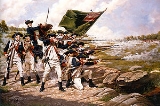
At 3:00 am, Putnam was awakened by a guard and told that the British were attacking through the Gowanus Pass. Grant had stormed the Gowanus Pass with 300 men, scattering the Militia. Putnam lit signals to Washington who was on Manhattan and then rode south to warn Stirling of the attack. Stirling led two regiments of Delaware and Maryland Continentals, a total of 1,600 troops, taking them to establish line to stop the British advance. The British and the Americans engaged each other from about 200 yards apart, both sides under cannon fire, and the British twice assaulted Stirling's troops on the high ground, but each time they were repulsed. The Americans were, however, unaware that this was not the main British attack.

In the center, the Hessians, under the command of General von Heister, began to bombard the American lines. However, the Hessian brigades did not attack, and Sullivan sent some of his regiments to assist Stirling. At 9:00 am, Howe fired his signal guns and the Hessians began to advance in front while the main army came at Sullivan from the rear. Sullivan left his advance guard to hold off the Hessians while he turned the rest of his force around to fight the British. Heavy casualties mounted up between the Americans and the British and men on both sides fled out of fear. Sullivan attempted to calm his men and tried to lead a retreat. By this point, the Hessians had overrun the advance guard on the heights and the American left had completely collapsed. Hand-to-hand fighting followed with the Americans swinging their muskets and rifles like clubs in order to save their lives. Many of the Americans who surrendered were bayoneted by the Hessians. Despite the chaos, Sullivan managed to evacuate most of his men to Brooklyn Heights, but Sullivan himself was captured.

Collapse

At 9:00 am, Washington arrived from Manhattan. Around this time five British ships attempted to sail up the East River to cut off any possible American evacuation but the wind had shifted and they were unable to do so. Washington realized that he had been wrong about a feint on Long Island and he ordered more troops to Brooklyn from Manhattan. Washington's location on the battlefield is not known for sure, because accounts differ, but most likely he was at Brooklyn Heights where he could view the battle. On the American right, to the west, Stirling still held the line against Grant. Stirling held on for four hours, still unaware of the British flanking maneuver, and some of his own troops thought they were winning the day because the British had been unable to take their position. However, by 11:00 am, Grant, reinforced by 2,000 marines, hit Stirling's center and Stirling was attacked on his left by the Hessians. Stirling pulled back but British troops were, at this point, coming at him in his rear too. The only escape route left was across a marsh and a creek which was 80 yards wide, on the other side of which was Brooklyn Heights. Stirling ordered all of his troops, except 250 Maryland troops, to cross the creek. The 250 Maryland troops attacked the British, trying to buy time for the others to withdraw. Stirling led the 250 men in six consecutive attacks against the British, until the detachment was annihilated. Washington, on seeing this, was to have said, "Good God, what brave fellows I must this day lose!" Stirling ordered the rest of his men to get back to the Brooklyn lines any way they could. Some of the men who tried to cross the marsh were bogged down in the mud under musket fire and others who could not swim were captured. Stirling was surrounded and, unwilling to surrender to the British, broke through the British lines to Von Heister's Hessians and surrendered to them. Although the troops did not want to stop advancing, Howe ordered all of his troops to halt, against the wishes of many of his officers. Many of his officers believed that they should push on to Brooklyn Heights but Howe disagreed, and the battle ended.

Aftermath


Casualties

At the time of the battle, it had been by far the largest battle ever fought in North America
North America

North America is the northern continent of the Americas, situated in the Earth's northern hemisphere and almost totally in the western hemisphere....
. If the Royal Navy
Royal Navy

The Royal Navy of the United Kingdom is the oldest of the British Armed Forces . From the mid-18th century until well into the 20th century, it was the most powerful navy in the world, playing a key part in establishing the British Empire as the dominant world power from 1815 until the early 1940s....
 is included, over 40,000 men took part in the battle. Howe reported his losses as 59 killed, 267 wounded and 31 missing. The Hessian casualties were 5 killed and 26 wounded. The Americans suffered much heavier losses. About 300 had been killed and over 1,000 captured.

Evacuation

Washington and the army were surrounded on Brooklyn Heights with the East River to their backs. If a change in wind occurred the British ships would have been able to sail up the East River and entirely surround the Americans. As the day went on, the British began to dig trenches, slowly coming closer and closer to the American defenses. By doing this, the British would not have to cross over open ground to assault the American defenses. Despite this perilous situation, Washington ordered 1,200 more men over from Manhattan in to Brooklyn on August 28. The men that came over were two Pennsylvania regiments and Colonel John Glover
John Glover (general)

John Glover was an United States fisherman, merchant, and military leader from Marblehead, Massachusetts, who served as a Brigadier General in the Continental Army during the American Revolutionary War....
's Massachusetts troops. In command of the Pennsylvania troops was Thomas Mifflin
Thomas Mifflin

Thomas Mifflin was an United States merchant and politician from Philadelphia, Pennsylvania, Pennsylvania. He was a major general in the Continental Army during the American Revolution, a member of the Pennsylvania Provincial Assembly, a Continental Congressman from Pennsylvania, fifth President of the U.S....
 who, after arriving, volunteered to inspect the outer defenses and report back to Washington. In these outer defenses, small skirmishes were still taking place. On the afternoon of August 28, it began to rain and Washington had his cannon bombard the British well into the night.

As the rain continued, Washington sent a letter to General William Heath
William Heath

William Heath was an American farmer, soldier, and political leader from Massachusetts who served as a major general in the Continental Army during the American Revolutionary War....
 who was at Kings Bridge
Kingsbridge, Bronx

Kingsbridge is a working class residential neighborhood geographically located in the northwest Bronx, New York. The neighborhood is part of Bronx Community Board 8....
, to send every flat bottomed boat or sloop without delay for the reason that battalions of infantry from New Jersey might come to reinforce their position. At 4:00 pm, on August 29, Washington held a meeting with his generals. Mifflin advised Washington to retreat to Manhattan while Mifflin and his Pennsylvania Regiments made up the rear guard, holding the line until the rest of the army had been evacuated. The Generals agreed unanimously with Mifflin that retreat was the best option and Washington had orders go out by the evening.

The troops were told that they were to gather up all their ammunition and baggage and prepare for a night attack. By 9:00 pm, the sick and wounded began to move to the Brooklyn Ferry in preparation for being evacuated. At 11:00 pm Glover and his Massachusetts troops, who were sailors and fishermen, began to evacuate the troops. As more troops were evacuated, more troops were ordered to withdraw from the lines and march to the ferry landing. Wagon wheels were muffled, and men were forbidden to talk. Mifflin's rear guard was tending campfires in order to deceive the British and convince them that nothing was going on. At 4:00 am, on August 30, Mifflin was informed that it was his unit's turn to evacuate. Mifflin told the man who had been sent to order him to leave, Major Alexander Scammell, that he must be mistaken, but Scammell insisted that he was not and Mifflin ordered his troops to move out. However, when Mifflin's troops were within a half mile of the ferry landing Washington rode up and demanded to know why they were not at their defenses. Edward Hand
Edward Hand

Edward Hand was a physician, farmer, congressman, and a general officer in the Continental Army during the American Revolutionary War. He commanded troops in some of the key battles of the war, including Battle of Long Island and Battle of Trenton....
, who was leading the troops, tried to explain what had happened, but Mifflin arrived shortly. Washington exclaimed "Good God! General Mifflin, I am afraid you have ruined us!" Mifflin explained that he had been told that it was his turn to evacuate by Scammell; Washington told him it had been a mistake. Mifflin then led his troops back to the outer defenses.

Artillery, supplies and troops were all being evacuated across the river at this time but it was not going as fast as Washington had anticipated and daybreak soon came. A fog settled in and concealed the evacuation from the British. British patrols noticed that there did not seem to be any American pickets and thus began to search the area. While they were doing this, Washington, the last man left, stepped onto the last boat and headed for Manhattan. At 7:00 am, the last American troops landed in New York. All 9,000 troops had been evacuated without a single life lost.

Conclusion of the Campaign

The British were stunned to find that Washington and the army had escaped. The next day, August 30, the British troops occupied the American fortifications. When news of the battle reached London, it caused many festivities to take place. Bells were rung across the city, candles were lit in windows and King George III gave General Howe the Order of Bath.

General Howe would remain inactive for the next half month, not attacking until September 15 when he landed a force at Kip's Bay. The British quickly occupied the city, however, on September 21, a fire
Great Fire of New York (1776)

The Great Fire was a devastating fire that burned through the night of September 21 ? September 22, 1776 on the west side of what then constituted New York City at the southern end of the island of Manhattan....
 broke out, devastating much of Manhattan. Howe would defeat Washington in battle again at White Plains
Battle of White Plains

}|-||}The Battle of White Plains was a battle in the New York and New Jersey campaign of the American Revolutionary War fought on October 28, 1776, in the area surrounding White Plains, New York, New York....
 and then again at Fort Washington
Battle of Fort Washington

}|-||}The Battle of Fort Washington was a battle fought in the American Revolutionary War between the United States and Kingdom of Great Britain....
. With these defeats, Washington and the army retreated across New Jersey and into Pennsylvania.

Commemorations

Commemorations of the battle include:
  • The Minerva Statue: The battle is commemorated with a statue of Minerva
    Minerva

    Minerva was the Roman mythology name of Greek goddess Athena. She was considered to be the virgin goddess of warriors, poetry, medicine, wisdom, commerce, weaving,crafts, and the inventor of music....
     near the top of Battle Hill, the highest point of Brooklyn, in Green-wood Cemetery
    Green-Wood Cemetery

    Green-Wood Cemetery was founded in 1838 as a rural cemetery in Kings County, New York, now in Brooklyn. It was granted National Historic Landmark status in 2006 by the U.S....
    . The statue on the northwest corner of the cemetery looks toward the Statue of Liberty
    Statue of Liberty

    The Statue of Liberty , or, more formally, Liberty Enlightening the World , was presented to the United States by the people of France in 1886....
    . In 2006, the statue was evoked in a successful defense to prevent a building from blocking the Manhattan view from the cemetery.
  • The Prison Ship Martyrs' Monument
    Prison Ship Martyrs' Monument

    The Prison Ship Martyrs' Monument is erected in Fort Greene Park, in the New York City borough of Brooklyn, consisting of a -wide granite staircase and a central Doric column in height....
    : A freestanding Doric column in Fort Greene memorializing all those who died while kept prisoner on the British ships just off the shore of Brooklyn, in Wallabout Bay
    Wallabout Bay

    Wallabout Bay is small body of water in Upper New York Bay along the northwest shore of the New York City borough of Brooklyn, between the present Williamsburg Bridge and Manhattan Bridge, opposite Corlear's Hook on Manhattan to the west, across the East River....
    .
  • The Old Stone House: A re-constructed farmhouse (c.1699) serves as a museum of the Battle of Long Island, also known as the "Battle of Brooklyn". It is located in J.J. Byrne Park, at 3rd Street and 5th Avenue, Brooklyn, situated within the boundaries of the original battle, and features models and maps.
  • Prospect Park
    Prospect Park (Brooklyn)

    Prospect Park is a 585-acre public park in the New York City borough of Brooklyn located between Park Slope, Brooklyn, Prospect-Lefferts Gardens, Brooklyn, Kensington, Brooklyn, Windsor Terrace, Brooklyn and Flatbush Avenue, Grand Army Plaza and the Brooklyn Botanic Garden....
    , Brooklyn, Battle Pass: Along the Eastern Side of Center Drive in Prospect Park, Brooklyn is a large granite boulder with a brass plaque affixed.


See also

  • Long Island order of battle
    Long Island order of battle

    The following units and commanders of the British and American armies fought in the Battle of Long Island of the American Revolution....
  • New York and New Jersey campaign
    New York and New Jersey campaign

    The New York and New Jersey campaign was a series of battles in the American Revolutionary War between Kingdom of Great Britain forces under William Howe, 5th Viscount Howe and an American army under General George Washington....
  • Landing at Kip's Bay
    Landing at Kip's Bay

    }|-||}The Landing at Kip's Bay was a Great Britain maneuver during the New York Campaign in the American Revolutionary War on September 15, 1776, occurring on the eastern shore of present-day Manhattan....


External links