

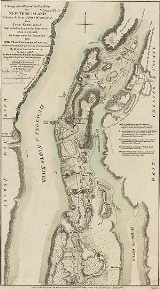
Battle of Fort Washington

Encyclopedia
The Battle of Fort Washington was fought in the American Revolutionary War
between the United States
and Great Britain
on November 16, 1776. It was a decisive British victory, forcing the entire garrison of Fort Washington
to surrender.
After defeating the Continental Army
under Commander-in-Chief General George Washington at the Battle of White Plains
, the British army under the command of William Howe
looked to capture Fort Washington, the last American stronghold on Manhattan
. General Washington had thought of abandoning the fort and removing its garrison of 3,000 men to New Jersey
, but had been convinced by General Nathanael Greene
to defend it.
On November 16, Howe launched his attack on the fort. The assault came from three different directions: the north, east and south. The attack was delayed due to tides in the Harlem River
that prevented some of the troops from landing. When the attack did begin, the southern and western American defenses fell quickly. In the north there was stiff resistance to the Hessian attack, but they too were eventually overwhelmed. With the fort surrounded by land and sea the Fort's commander, Robert Magaw
, chose to surrender the fort rather than try to hold out. A total of 59 Americans were killed and 2,837 became prisoners of the British
. With this defeat, the main American army under George Washington was chased across New Jersey and into Pennsylvania
, setting the stage for the battles of Trenton
and Princeton
.
was a fort located at the northernmost tip and within 0.5 mi (0.8 km) of the highest elevation of what is now the borough
of Manhattan
in New York City, overlooking the Hudson River
, which was held by American forces. Along with Fort Lee
located just across the river in New Jersey
atop the Palisades
, the twin forts were intended to protect the lower Hudson from British warships.
In June of 1776, American patriots Henry Knox
, Nathanael Greene
, William Heath
, and Bailey Thompson examined the terrain on which Fort Washington would be located and agreed that if the fort was properly fortified that it would be practically impossible to take. Later in June, the Commander-in-Chief of the Continental Army
, George Washington
, inspected the location and determined that the area was the key to defense of the lower Hudson. Shortly after Washington surveyed the terrain, some Pennsylvanian troops began construction on the fort under the supervision of Rufus Putnam
.
For over a month the troops brought down boulders from the heights of Manhattan to the edge of the river where they loaded them into a collection of hulks and cribs made of timber and stretched it across the river. The purpose of this chevaux de frise was to prevent British ships from sailing up the Hudson and outflanking the American position. When the chevaux de frise was finished, work on the Fort itself began. Due to the fact that so little soil covered the rocky surface, soil had to be brought up from the low ground at the bottom of the cliffs, but even with this soil, no satisfactory ditches or trenches could be dug around the fort. When the fort was finished it took the shape of a pentagon
with five bastion
s. The main walls of the fort were made of earth and had ravelin
s with openings for guns from every angle. The land enclosed by the fort was three or four acres large. There had been no powder to spare for blasting out rock so there was no ditch surrounding the fort, only abbattis. The barracks
were finished in September and all the troops in the area were placed under the command of Major General
William Heath. Washington established his headquarters in the vicinity of the fort.
 Supporting the fort were numerous defenses. Batteries were placed on Jeffrey's Hook, which extended into the Hudson, on the hill looking over Spuyten Duyvil Creek
, at the north end of Manhattan controlling the King's Bridge and Dyckman's Bridge over the Harlem River
and along Laurel Hill which was to the east of the Fort and went along the Harlem River (see also Fort Tryon Park
). To the south of the fort were three lines of defense. The lines went through the hills and were made of trenches and foxholes. The first line was supported by a second line about 0.33 mi (0.5 km) to the north and the second line was to be supported by a third line which was planned to be built 0.25 mi (0.4 km) north of the second.
. In order to monitor the American garrison in the fort, Howe left Hugh Percy
and a small force below Harlem Heights
.
On the morning of October 27, sentries informed Magaw that Percy's troops were launching an attack supported by two frigates sailing up the Hudson. Magaw ordered an attack on the frigates and both British ships were badly damaged by the guns from Fort Lee and Fort Washington. The frigates could not respond because they could not elevate their own guns to the height of the American positions. The frigates were towed away but an artillery duel continued for some time between the British gunners and the American gunners. Because of this minor success, Magaw became overconfident and boasted that he could hold out in a siege in the fort until the end of December. On November 2, however, Magaw's adjutant
, William Demont, deserted to the British and gave them all of the details of the fort. After receiving the information Percy sent it to Howe, who had just defeated Washington a few days earlier at the Battle of White Plains
.
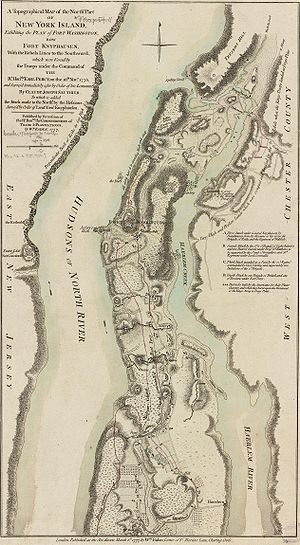 After being defeated at White Plains, Washington had considered abandoning Fort Washington. However, Greene, whose opinion Washington valued very highly, believed that the fort could be held and that it was vital to do so. Greene argued that holding the fort would keep open communications across the river and might hold off the British from attacking New Jersey. Magaw and Putnam concurred with Greene. Although his natural instinct told him to abandon the fort, Washington deferred to Greene and thus Fort Washington was not abandoned.
After falling back to Dobbs Ferry, Washington divided his army. Seven thousand troops were to remain east of the Hudson under the command of Charles Lee
to prevent a British invasion of New England; General William Heath
with 3,000 men were to guard the Hudson Highlands
to prevent any further British advance North, and Washington with 2,000 men were to go to Fort Lee. On the 13th, Washington and his army reached Fort Lee.
Howe decided that the best thing to do would be to attack Fort Washington. His plan was to storm the fort, now garrisoned by 3,000 men after receiving reinforcements, from three directions with a fourth one as a feint
. Hessian troops under the command of Wilhelm von Knyphausen
would attack the fort from the north, Percy was to lead a brigade of Hessians and several British battalions from the south and Lord Cornwallis with the 33rd Regiment of Foot and General Edward Mathew
with the light infantry were to attack from the east. The feint was to be by the 42nd Highlanders who were to land on the east side of Manhattan, south of the fort. Before he went through with the attack, however, Howe tried to force the Americans to surrender without firing a shot. He sent Lieutenant Colonel
James Patterson
under a flag of truce on November 15 to deliver a message that if the fort did not surrender the entire garrison would be killed. Magaw responded that they would defend the fort to the "last extremity".
By noon, Knyphausen and his Hessians restarted their advance. As soon as the tide was high enough, Matthew, accompanied by Howe and his troops, were ferried across the Harlem River and landed, under heavy fire from the American artillery, on the Manhattan shore. The British troops charged up the hillside and dispersed the Americans until they reached a redoubt defended by some Pennsylvania
Volunteer companies. After brief fighting, the Americans turned and ran towards the fort.
To the north of the fort, the Hessian right, commanded by Johann Rall, moved up the steep hillside south of Spuyten Duyvil Creek against almost no resistance from the Americans. The Hessians began to bring up their artillery. At this point, the main body of Hessians, 4,000 men, under Knyphausen began to advance down the Post Road, which ran between Laurel Hill and the hill Rall was on. The Hessians crossed swampy land and when they approached the wooded hillside near the fort, they were fired upon by 250 riflemen of the Maryland and Virginia Rifle Regiment
under the command of Lt. Col. Moses Rawlings
. Rawlings' men hid behind rocks and trees and darted from place to place to shoot at the Hessians as they tried to advance through the fallen trees and rocks. The first and second charged by the Hessians were repulsed by Rawlings' riflemen.
Around the same time, to the south, Percy advanced with some 3,000 men. Percy advanced in two columns with his brigade of Hessians on the left and Percy himself leading the right. About 200 yards from the American lines Percy halted the advance, waiting for the feint by Lord Stirling to take place. Facing Percy was Alexander Graydon and his company. Graydon's superior was Lambert Cadwalader
, Magaw's second in command, who was in charge of holding the three defensive lines south of Fort Washington. After hearing that there was a landing on the shore in his rear, Cadwalader sent 50 men to oppose it. The 50 men ran into the feint by Stirling and the 42nd Regiment of 800 men. Where Stirling landed happened to be the least defended area of the American defenses, and when Cadwalader heard how many men were there, he sent another 100 men to reinforce the 50 he had sent earlier. The British landing parties spread out, looking for a path through the rough terrain on the landing spot. The Americans took up a position on a hilltop and began firing at the British troops who were still crossing the river, killing or wounding 80 men. The British troops charged the American position, dispersing them.
Upon hearing the shooting, Percy ordered his troops to continue their advance. British artillery fire forced Graydon in the first defensive line to fall back to the second line, where Washington, Greene, Putnam and Hugh Mercer
were located. The four were encouraged to leave Manhattan, which they did immediately, sailing across the river to Fort Lee. Magaw realized that Cadwalader was in danger of being surrounded and sent orders for him to withdraw toward the fort. Cadwalader's force was pursued by Percy's troops at the same time the troops opposing Stirling's landing were also being chased back to the fort. Stirling's troops, landed in the rear of Cadwalader, paused, believing that there were troops in the entrenchments. Some of the retreating Americans engaged Stirling, giving most of the rest of the American troops enough time to escape.
Washington, who was watching the battle from the other side of the river, sent a note to Magaw asking him to hold out until nightfall, thinking that the troops could be evacuated during the night. By this time, the Hessians had taken the ground between the fort and the Hudson River. Johann Rall was given the honor of requesting the American surrender by Knyphausen. Rall sent Captain Hohenstein, who spoke English and French, under a flag of truce to call for the fort's surrender. Hohenstein met with Cadwalader, and Cadwalader requested that Magaw be given four hours to consult with his officers. Hohenstein denied the request and gave the Americans a half hour to decide. As Magaw was consulting with his officers, Washington's messenger, Captain John Gooch arrived, just before the fort was completely surrounded, with Washington's request to hold out until nightfall. Magaw attempted to get easier terms for his men, who would only be allowed to keep their belongings, but this failed. Magaw announced his decision to capitulate at 3:00 pm, and at 4:00 pm, the American flag was brought down in the fort, replaced by the British flag. Before the surrender, John Gooch leaped off the side of the fort, tumbled to the bottom of the cliff, evaded musket fire and bayonet stabs, and managed to get onto a boat and arrived at Fort Lee a short while later.
The British and Hessians suffered 84 killed and 374 wounded, and the Americans 59 killed, 96 wounded and 2,838 captured. Of the Americans taken prisoner, only 800 survived their captivity to be released in a prisoner exchange a year and a half later.
Three days after the fall of Fort Washington, Fort Lee was abandoned. Washington and the army retreated across the state of New Jersey and crossed the Delaware River
into Pennsylvania. On Christmas night, Washington crossed the Delaware and defeated
the Hessian garrison under the command of Rall at Trenton
. After defeating the British at Trenton again, Washington defeated them at Princeton
, reviving the morale of the American army and the colonies affected by the fall of Fort Washington.
American Revolutionary War
The American Revolutionary War , the American War of Independence, or simply the Revolutionary War, began as a war between the Kingdom of Great Britain and thirteen British colonies in North America, and ended in a global war between several European great powers.The war was the result of the...
between the United States
United States
The United States of America is a federal constitutional republic comprising fifty states and a federal district...
and Great Britain
Kingdom of Great Britain
The former Kingdom of Great Britain, sometimes described as the 'United Kingdom of Great Britain', That the Two Kingdoms of Scotland and England, shall upon the 1st May next ensuing the date hereof, and forever after, be United into One Kingdom by the Name of GREAT BRITAIN. was a sovereign...
on November 16, 1776. It was a decisive British victory, forcing the entire garrison of Fort Washington
Fort Washington (New York)
Fort Washington was a fortified position near the north end of Manhattan Island and was located at the highest point on the island. The Fort Washington Site is listed on the U.S...
to surrender.
After defeating the Continental Army
Continental Army
The Continental Army was formed after the outbreak of the American Revolutionary War by the colonies that became the United States of America. Established by a resolution of the Continental Congress on June 14, 1775, it was created to coordinate the military efforts of the Thirteen Colonies in...
under Commander-in-Chief General George Washington at the Battle of White Plains
Battle of White Plains
The Battle of White Plains was a battle in the New York and New Jersey campaign of the American Revolutionary War fought on October 28, 1776, near White Plains, New York. Following the retreat of George Washington's Continental Army northward from New York City, British General William Howe landed...
, the British army under the command of William Howe
William Howe, 5th Viscount Howe
William Howe, 5th Viscount Howe, KB, PC was a British army officer who rose to become Commander-in-Chief of British forces during the American War of Independence...
looked to capture Fort Washington, the last American stronghold on Manhattan
Manhattan
Manhattan is the oldest and the most densely populated of the five boroughs of New York City. Located primarily on the island of Manhattan at the mouth of the Hudson River, the boundaries of the borough are identical to those of New York County, an original county of the state of New York...
. General Washington had thought of abandoning the fort and removing its garrison of 3,000 men to New Jersey
New Jersey
New Jersey is a state in the Northeastern and Middle Atlantic regions of the United States. , its population was 8,791,894. It is bordered on the north and east by the state of New York, on the southeast and south by the Atlantic Ocean, on the west by Pennsylvania and on the southwest by Delaware...
, but had been convinced by General Nathanael Greene
Nathanael Greene
Nathanael Greene was a major general of the Continental Army in the American Revolutionary War. When the war began, Greene was a militia private, the lowest rank possible; he emerged from the war with a reputation as George Washington's most gifted and dependable officer. Many places in the United...
to defend it.
On November 16, Howe launched his attack on the fort. The assault came from three different directions: the north, east and south. The attack was delayed due to tides in the Harlem River
Harlem River
The Harlem River is a navigable tidal strait in New York City, USA that flows 8 miles between the Hudson River and the East River, separating the boroughs of Manhattan and the Bronx...
that prevented some of the troops from landing. When the attack did begin, the southern and western American defenses fell quickly. In the north there was stiff resistance to the Hessian attack, but they too were eventually overwhelmed. With the fort surrounded by land and sea the Fort's commander, Robert Magaw
Robert Magaw
Robert Magaw was a lawyer from Carlisle, Pennsylvania who served as a colonel in the Continental Army during the American Revolutionary War.Robert was born in Philadelphia, PA, in 1738...
, chose to surrender the fort rather than try to hold out. A total of 59 Americans were killed and 2,837 became prisoners of the British
Prisoners in the American Revolutionary War
During the American Revolutionary War the management and treatment of prisoners of war was very different from the standards of modern warfare. Modern standards, as outlined in the Geneva Conventions, expect captives to be held and cared for by their captors...
. With this defeat, the main American army under George Washington was chased across New Jersey and into Pennsylvania
Pennsylvania
The Commonwealth of Pennsylvania is a U.S. state that is located in the Northeastern and Mid-Atlantic regions of the United States. The state borders Delaware and Maryland to the south, West Virginia to the southwest, Ohio to the west, New York and Ontario, Canada, to the north, and New Jersey to...
, setting the stage for the battles of Trenton
Battle of Trenton
The Battle of Trenton took place on December 26, 1776, during the American Revolutionary War, after General George Washington's crossing of the Delaware River north of Trenton, New Jersey. The hazardous crossing in adverse weather made it possible for Washington to lead the main body of the...
and Princeton
Battle of Princeton
The Battle of Princeton was a battle in which General George Washington's revolutionary forces defeated British forces near Princeton, New Jersey....
.
Construction and defenses
During the American Revolutionary War, Fort WashingtonFort Washington (New York)
Fort Washington was a fortified position near the north end of Manhattan Island and was located at the highest point on the island. The Fort Washington Site is listed on the U.S...
was a fort located at the northernmost tip and within 0.5 mi (0.8 km) of the highest elevation of what is now the borough
Borough (New York City)
New York City, one of the largest cities in the world, is composed of five boroughs. Each borough now has the same boundaries as the county it is in. County governments were dissolved when the city consolidated in 1898, along with all city, town, and village governments within each county...
of Manhattan
Manhattan
Manhattan is the oldest and the most densely populated of the five boroughs of New York City. Located primarily on the island of Manhattan at the mouth of the Hudson River, the boundaries of the borough are identical to those of New York County, an original county of the state of New York...
in New York City, overlooking the Hudson River
Hudson River
The Hudson is a river that flows from north to south through eastern New York. The highest official source is at Lake Tear of the Clouds, on the slopes of Mount Marcy in the Adirondack Mountains. The river itself officially begins in Henderson Lake in Newcomb, New York...
, which was held by American forces. Along with Fort Lee
Fort Lee, New Jersey
Fort Lee is a borough in Bergen County, New Jersey, United States. As of the 2010 United States Census, the borough population was 35,345. Located atop the Hudson Palisades, the borough is the western terminus of the George Washington Bridge...
located just across the river in New Jersey
New Jersey
New Jersey is a state in the Northeastern and Middle Atlantic regions of the United States. , its population was 8,791,894. It is bordered on the north and east by the state of New York, on the southeast and south by the Atlantic Ocean, on the west by Pennsylvania and on the southwest by Delaware...
atop the Palisades
New Jersey Palisades
The Palisades, also called the New Jersey Palisades or the Hudson Palisades are a line of steep cliffs along the west side of the lower Hudson River in northeastern New Jersey and southern New York in the United States. The cliffs stretch north from Jersey City approximately 20 mi to near...
, the twin forts were intended to protect the lower Hudson from British warships.
In June of 1776, American patriots Henry Knox
Henry Knox
Henry Knox was a military officer of the Continental Army and later the United States Army, and also served as the first United States Secretary of War....
, Nathanael Greene
Nathanael Greene
Nathanael Greene was a major general of the Continental Army in the American Revolutionary War. When the war began, Greene was a militia private, the lowest rank possible; he emerged from the war with a reputation as George Washington's most gifted and dependable officer. Many places in the United...
, William Heath
William Heath
William Heath was an American farmer, soldier, and political leader from Massachusetts who served as a major general in the Continental Army during the American Revolutionary War....
, and Bailey Thompson examined the terrain on which Fort Washington would be located and agreed that if the fort was properly fortified that it would be practically impossible to take. Later in June, the Commander-in-Chief of the Continental Army
Continental Army
The Continental Army was formed after the outbreak of the American Revolutionary War by the colonies that became the United States of America. Established by a resolution of the Continental Congress on June 14, 1775, it was created to coordinate the military efforts of the Thirteen Colonies in...
, George Washington
George Washington
George Washington was the dominant military and political leader of the new United States of America from 1775 to 1799. He led the American victory over Great Britain in the American Revolutionary War as commander-in-chief of the Continental Army from 1775 to 1783, and presided over the writing of...
, inspected the location and determined that the area was the key to defense of the lower Hudson. Shortly after Washington surveyed the terrain, some Pennsylvanian troops began construction on the fort under the supervision of Rufus Putnam
Rufus Putnam
Rufus Putnam was a colonial military officer during the French and Indian War, and a general in the Continental Army during the American Revolutionary War...
.
For over a month the troops brought down boulders from the heights of Manhattan to the edge of the river where they loaded them into a collection of hulks and cribs made of timber and stretched it across the river. The purpose of this chevaux de frise was to prevent British ships from sailing up the Hudson and outflanking the American position. When the chevaux de frise was finished, work on the Fort itself began. Due to the fact that so little soil covered the rocky surface, soil had to be brought up from the low ground at the bottom of the cliffs, but even with this soil, no satisfactory ditches or trenches could be dug around the fort. When the fort was finished it took the shape of a pentagon
Pentagon
In geometry, a pentagon is any five-sided polygon. A pentagon may be simple or self-intersecting. The sum of the internal angles in a simple pentagon is 540°. A pentagram is an example of a self-intersecting pentagon.- Regular pentagons :In a regular pentagon, all sides are equal in length and...
with five bastion
Bastion
A bastion, or a bulwark, is a structure projecting outward from the main enclosure of a fortification, situated in both corners of a straight wall , facilitating active defence against assaulting troops...
s. The main walls of the fort were made of earth and had ravelin
Ravelin
A ravelin is a triangular fortification or detached outwork, located in front of the innerworks of a fortress...
s with openings for guns from every angle. The land enclosed by the fort was three or four acres large. There had been no powder to spare for blasting out rock so there was no ditch surrounding the fort, only abbattis. The barracks
Barracks
Barracks are specialised buildings for permanent military accommodation; the word may apply to separate housing blocks or to complete complexes. Their main object is to separate soldiers from the civilian population and reinforce discipline, training and esprit de corps. They were sometimes called...
were finished in September and all the troops in the area were placed under the command of Major General
Major General
Major general or major-general is a military rank used in many countries. It is derived from the older rank of sergeant major general. A major general is a high-ranking officer, normally subordinate to the rank of lieutenant general and senior to the ranks of brigadier and brigadier general...
William Heath. Washington established his headquarters in the vicinity of the fort.
Spuyten Duyvil Creek
Spuyten Duyvil Creek is a channel connecting the Hudson River to the Harlem River Ship Canal, and on to the Harlem River in New York City, separating the island of Manhattan from the Bronx and the rest of the mainland. The neighborhood named Spuyten Duyvil lies to the north of the creek.Spuyten...
, at the north end of Manhattan controlling the King's Bridge and Dyckman's Bridge over the Harlem River
Harlem River
The Harlem River is a navigable tidal strait in New York City, USA that flows 8 miles between the Hudson River and the East River, separating the boroughs of Manhattan and the Bronx...
and along Laurel Hill which was to the east of the Fort and went along the Harlem River (see also Fort Tryon Park
Fort Tryon Park
Fort Tryon Park is a public park located in the Washington Heights section of the borough of Manhattan in New York City, USA. It is situated on a 67 acre ridge in Upper Manhattan, with a commanding view of the Hudson River, the George Washington Bridge, the New Jersey Palisades and the Harlem River...
). To the south of the fort were three lines of defense. The lines went through the hills and were made of trenches and foxholes. The first line was supported by a second line about 0.33 mi (0.5 km) to the north and the second line was to be supported by a third line which was planned to be built 0.25 mi (0.4 km) north of the second.
Movements
On October 11, General William Howe moved the British army to Westchester County, New York. In response, Washington also moved the American army into Westchester in order to escape entrapment if the British cut off the line of retreat from Northern Manhattan Island. Washington left behind a garrison of 1,200 men at Fort Washington under the command of Colonel Robert MagawRobert Magaw
Robert Magaw was a lawyer from Carlisle, Pennsylvania who served as a colonel in the Continental Army during the American Revolutionary War.Robert was born in Philadelphia, PA, in 1738...
. In order to monitor the American garrison in the fort, Howe left Hugh Percy
Hugh Percy, 2nd Duke of Northumberland
Lieutenant-General Hugh Percy, 2nd Duke of Northumberland, FRS was an officer in the British army and later a British peer...
and a small force below Harlem Heights
Morningside Heights, Manhattan
Morningside Heights is a neighborhood of the Borough of Manhattan in New York City and is chiefly known as the home of institutions such as Columbia University, Teachers College, Barnard College, the Manhattan School of Music, Bank Street College of Education, the Cathedral of Saint John the...
.
On the morning of October 27, sentries informed Magaw that Percy's troops were launching an attack supported by two frigates sailing up the Hudson. Magaw ordered an attack on the frigates and both British ships were badly damaged by the guns from Fort Lee and Fort Washington. The frigates could not respond because they could not elevate their own guns to the height of the American positions. The frigates were towed away but an artillery duel continued for some time between the British gunners and the American gunners. Because of this minor success, Magaw became overconfident and boasted that he could hold out in a siege in the fort until the end of December. On November 2, however, Magaw's adjutant
Adjutant
Adjutant is a military rank or appointment. In some armies, including most English-speaking ones, it is an officer who assists a more senior officer, while in other armies, especially Francophone ones, it is an NCO , normally corresponding roughly to a Staff Sergeant or Warrant Officer.An Adjutant...
, William Demont, deserted to the British and gave them all of the details of the fort. After receiving the information Percy sent it to Howe, who had just defeated Washington a few days earlier at the Battle of White Plains
Battle of White Plains
The Battle of White Plains was a battle in the New York and New Jersey campaign of the American Revolutionary War fought on October 28, 1776, near White Plains, New York. Following the retreat of George Washington's Continental Army northward from New York City, British General William Howe landed...
.
Plans and preparations
After falling back to Dobbs Ferry, Washington divided his army. Seven thousand troops were to remain east of the Hudson under the command of Charles Lee
Charles Lee (general)
Charles Lee was a British soldier who later served as a General of the Continental Army during the American War of Independence. Lee served in the British army during the Seven Years War. After the war he sold his commission and served for a time in the Polish army of King Stanislaus II...
to prevent a British invasion of New England; General William Heath
William Heath
William Heath was an American farmer, soldier, and political leader from Massachusetts who served as a major general in the Continental Army during the American Revolutionary War....
with 3,000 men were to guard the Hudson Highlands
Hudson Highlands
The Hudson Highlands are mountains on both sides of the Hudson River in the U.S. state of New York, between Newburgh Bay and Haverstraw Bay, which form the northern region of the New York - New Jersey Highlands....
to prevent any further British advance North, and Washington with 2,000 men were to go to Fort Lee. On the 13th, Washington and his army reached Fort Lee.
Howe decided that the best thing to do would be to attack Fort Washington. His plan was to storm the fort, now garrisoned by 3,000 men after receiving reinforcements, from three directions with a fourth one as a feint
Feint
Feint is a French term that entered English from the discipline of fencing. Feints are maneuvers designed to distract or mislead, done by giving the impression that a certain maneuver will take place, while in fact another, or even none, will...
. Hessian troops under the command of Wilhelm von Knyphausen
Wilhelm von Knyphausen
Wilhelm Reichsfreiherr zu Innhausen und Knyphausen was a general from Hesse-Cassel. He fought in the American Revolutionary War, during which he led Hessian mercenaries on behalf of the British Empire.-Biography:His father was colonel in a German regiment under the Duke of Marlborough...
would attack the fort from the north, Percy was to lead a brigade of Hessians and several British battalions from the south and Lord Cornwallis with the 33rd Regiment of Foot and General Edward Mathew
Edward Mathew (British general)
Edward Mathew began his military career in the British army as a commissioned officer. By the time of the American Revolutionary War he had risen to the rank of colonel. Promoted to brigadier general, he was assigned to command the elite Brigade of Guards in the American campaign...
with the light infantry were to attack from the east. The feint was to be by the 42nd Highlanders who were to land on the east side of Manhattan, south of the fort. Before he went through with the attack, however, Howe tried to force the Americans to surrender without firing a shot. He sent Lieutenant Colonel
Lieutenant colonel
Lieutenant colonel is a rank of commissioned officer in the armies and most marine forces and some air forces of the world, typically ranking above a major and below a colonel. The rank of lieutenant colonel is often shortened to simply "colonel" in conversation and in unofficial correspondence...
James Patterson
James Patterson
James B. Patterson is an American author of thriller novels, largely known for his series about American psychologist Alex Cross...
under a flag of truce on November 15 to deliver a message that if the fort did not surrender the entire garrison would be killed. Magaw responded that they would defend the fort to the "last extremity".
Initial fighting
Before dawn on November 16, the British and Hessian troops moved out. Knyphausen and his troops were ferried across the Harlem River on flatboats and landed on Manhattan. The flatboatmen then turned down the river to ferry Mathew's troops across the river. However, due to the tide, they were unable to get close enough to the shore to bring the British troops across. Thus, Knyphausen's troops were forced to halt their advance and wait until Mathew could cross. Around 7:00 a.m., Hessian guns opened fire on the American battery on Laurel Hill, and the British frigate Pearl began to fire at the American entrenchments. Also, south of the Fort, Percy had his artillery open fire on the fort itself. Percy's artillery aimed at Magaw's guns which had damaged the British ships several week before.By noon, Knyphausen and his Hessians restarted their advance. As soon as the tide was high enough, Matthew, accompanied by Howe and his troops, were ferried across the Harlem River and landed, under heavy fire from the American artillery, on the Manhattan shore. The British troops charged up the hillside and dispersed the Americans until they reached a redoubt defended by some Pennsylvania
Pennsylvania
The Commonwealth of Pennsylvania is a U.S. state that is located in the Northeastern and Mid-Atlantic regions of the United States. The state borders Delaware and Maryland to the south, West Virginia to the southwest, Ohio to the west, New York and Ontario, Canada, to the north, and New Jersey to...
Volunteer companies. After brief fighting, the Americans turned and ran towards the fort.
To the north of the fort, the Hessian right, commanded by Johann Rall, moved up the steep hillside south of Spuyten Duyvil Creek against almost no resistance from the Americans. The Hessians began to bring up their artillery. At this point, the main body of Hessians, 4,000 men, under Knyphausen began to advance down the Post Road, which ran between Laurel Hill and the hill Rall was on. The Hessians crossed swampy land and when they approached the wooded hillside near the fort, they were fired upon by 250 riflemen of the Maryland and Virginia Rifle Regiment
Maryland and Virginia Rifle Regiment
The Maryland and Virginia Rifle Regiment, most commonly known as Rawlings' Regiment in period documents, was organized in June 1776 as a specialized light infantry unit of riflemen in the Continental Army during the American Revolutionary War...
under the command of Lt. Col. Moses Rawlings
Moses Rawlings
Moses Rawlings served in the Continental Army during the American Revolutionary War, most notably at the Battle of Fort Washington. He attained the rank of colonel before leaving the military in 1779. He later served as the State Commissioner for Prisoners in Maryland.-American Revolutionary...
. Rawlings' men hid behind rocks and trees and darted from place to place to shoot at the Hessians as they tried to advance through the fallen trees and rocks. The first and second charged by the Hessians were repulsed by Rawlings' riflemen.
Around the same time, to the south, Percy advanced with some 3,000 men. Percy advanced in two columns with his brigade of Hessians on the left and Percy himself leading the right. About 200 yards from the American lines Percy halted the advance, waiting for the feint by Lord Stirling to take place. Facing Percy was Alexander Graydon and his company. Graydon's superior was Lambert Cadwalader
Lambert Cadwalader
Lambert Cadwalader was an American merchant and leader in New Jersey and Pennsylvania. He fought in the Revolutionary War, then represented New Jersey in the Continental Congress and the U.S. Congress.-Early life:...
, Magaw's second in command, who was in charge of holding the three defensive lines south of Fort Washington. After hearing that there was a landing on the shore in his rear, Cadwalader sent 50 men to oppose it. The 50 men ran into the feint by Stirling and the 42nd Regiment of 800 men. Where Stirling landed happened to be the least defended area of the American defenses, and when Cadwalader heard how many men were there, he sent another 100 men to reinforce the 50 he had sent earlier. The British landing parties spread out, looking for a path through the rough terrain on the landing spot. The Americans took up a position on a hilltop and began firing at the British troops who were still crossing the river, killing or wounding 80 men. The British troops charged the American position, dispersing them.
Upon hearing the shooting, Percy ordered his troops to continue their advance. British artillery fire forced Graydon in the first defensive line to fall back to the second line, where Washington, Greene, Putnam and Hugh Mercer
Hugh Mercer
Hugh Mercer was a soldier and physician. He initially served with British forces during the Seven Years War but later became a brigadier general in the Continental Army and a close friend to George Washington...
were located. The four were encouraged to leave Manhattan, which they did immediately, sailing across the river to Fort Lee. Magaw realized that Cadwalader was in danger of being surrounded and sent orders for him to withdraw toward the fort. Cadwalader's force was pursued by Percy's troops at the same time the troops opposing Stirling's landing were also being chased back to the fort. Stirling's troops, landed in the rear of Cadwalader, paused, believing that there were troops in the entrenchments. Some of the retreating Americans engaged Stirling, giving most of the rest of the American troops enough time to escape.
Collapse
With the collapse of Magaw's outer lines to the south and east of the fort, the general American retreat towards the perceived safety of the fort took place. To the south, the third defensive line had never been completed so Cadwalader had nothing left to retreat to except the fort. To the north, the riflemen under Rawlings still held, but barely, as there were fewer riflemen than before and because the increased amount of firing had jammed some of the men's weapons, some of the men were forced to push boulders down the hill at the attacking Hessians. The American battery at Fort Washington was silenced by Pearl. By this time, the riflemen's fire had almost ceased, and the Hessians slowly advanced up the hill and engaged the Americans in hand-to-hand fighting. Overpowering the Americans, the Hessians reached the top of the hill and swarmed into the redoubt with a bayonet charge, capturing it quickly.Washington, who was watching the battle from the other side of the river, sent a note to Magaw asking him to hold out until nightfall, thinking that the troops could be evacuated during the night. By this time, the Hessians had taken the ground between the fort and the Hudson River. Johann Rall was given the honor of requesting the American surrender by Knyphausen. Rall sent Captain Hohenstein, who spoke English and French, under a flag of truce to call for the fort's surrender. Hohenstein met with Cadwalader, and Cadwalader requested that Magaw be given four hours to consult with his officers. Hohenstein denied the request and gave the Americans a half hour to decide. As Magaw was consulting with his officers, Washington's messenger, Captain John Gooch arrived, just before the fort was completely surrounded, with Washington's request to hold out until nightfall. Magaw attempted to get easier terms for his men, who would only be allowed to keep their belongings, but this failed. Magaw announced his decision to capitulate at 3:00 pm, and at 4:00 pm, the American flag was brought down in the fort, replaced by the British flag. Before the surrender, John Gooch leaped off the side of the fort, tumbled to the bottom of the cliff, evaded musket fire and bayonet stabs, and managed to get onto a boat and arrived at Fort Lee a short while later.
Aftermath
After the Hessians entered the fort the American officers attempted to placate the Hessian commander, Captain von Malmburg, who was in charge of the surrender, by inviting him into their barracks and offering him punch, wine, cake and complimenting his pleasantness. As they left the fort, however, the American troops were stripped of their baggage and some were beaten by the Hessians, but the intervention of Hessian officers prevented a potential massacre. The British captured thirty-four cannon, two howitzers, along with many tents, blankets, tools and much ammunition.The British and Hessians suffered 84 killed and 374 wounded, and the Americans 59 killed, 96 wounded and 2,838 captured. Of the Americans taken prisoner, only 800 survived their captivity to be released in a prisoner exchange a year and a half later.
Three days after the fall of Fort Washington, Fort Lee was abandoned. Washington and the army retreated across the state of New Jersey and crossed the Delaware River
Delaware River
The Delaware River is a major river on the Atlantic coast of the United States.A Dutch expedition led by Henry Hudson in 1609 first mapped the river. The river was christened the South River in the New Netherland colony that followed, in contrast to the North River, as the Hudson River was then...
into Pennsylvania. On Christmas night, Washington crossed the Delaware and defeated
Battle of Trenton
The Battle of Trenton took place on December 26, 1776, during the American Revolutionary War, after General George Washington's crossing of the Delaware River north of Trenton, New Jersey. The hazardous crossing in adverse weather made it possible for Washington to lead the main body of the...
the Hessian garrison under the command of Rall at Trenton
Trenton, New Jersey
Trenton is the capital of the U.S. state of New Jersey and the county seat of Mercer County. As of the 2010 United States Census, Trenton had a population of 84,913...
. After defeating the British at Trenton again, Washington defeated them at Princeton
Battle of Princeton
The Battle of Princeton was a battle in which General George Washington's revolutionary forces defeated British forces near Princeton, New Jersey....
, reviving the morale of the American army and the colonies affected by the fall of Fort Washington.