
All Topics  
Battle of Trenton

 
Battle of Trenton

   Email Print
   Bookmark   Link


Battle of Trenton


} |- | |} The Battle of Trenton took place on December 26, 1776, during the American Revolutionary War
American Revolutionary War

The American Revolutionary War , also known as the American War of Independence, began as a war between the Kingdom of Great Britain and Thirteen Colonies on the North America, and ended in a global war between several European great powers....
 after General George Washington
George Washington

George Washington was the leader of the Continental Army in the American Revolutionary War and served as the List of Presidents of the United States President of the United States of the United States of Americas ....
's crossing of the Delaware River north of Trenton, New Jersey
Trenton, New Jersey

Trenton is the Capital of the U.S. state of New Jersey and the county seat of Mercer County, New Jersey. As of 2007, the United States Census Bureau estimated that the City of Trenton had a population of 82,804....
. The hazardous crossing in adverse weather allowed Washington to lead the main body of the Continental Army
Continental Army

The American Continental Army was an army formed after the outbreak of the American Revolutionary War by the colonies that became the United States. Established by a resolution of the Continental Congress on June 15, 1775, the army was created to coordinate the military efforts of the Thirteen Colonies in their struggle against the rule of Kingdom...
 against Hessian soldiers garrisoned at Trenton. After a brief struggle, nearly the entire Hessian force was captured, with negligible losses to the Americans.


Discussion
Ask a question about 'Battle of Trenton'
Start a new discussion about 'Battle of Trenton'
Answer questions from other users
Full Discussion Forum


Recent Posts


Encyclopedia


} |- | |} The Battle of Trenton took place on December 26, 1776, during the American Revolutionary War
American Revolutionary War

The American Revolutionary War , also known as the American War of Independence, began as a war between the Kingdom of Great Britain and Thirteen Colonies on the North America, and ended in a global war between several European great powers....
 after General George Washington
George Washington

George Washington was the leader of the Continental Army in the American Revolutionary War and served as the List of Presidents of the United States President of the United States of the United States of Americas ....
's crossing of the Delaware River north of Trenton, New Jersey
Trenton, New Jersey

Trenton is the Capital of the U.S. state of New Jersey and the county seat of Mercer County, New Jersey. As of 2007, the United States Census Bureau estimated that the City of Trenton had a population of 82,804....
. The hazardous crossing in adverse weather allowed Washington to lead the main body of the Continental Army
Continental Army

The American Continental Army was an army formed after the outbreak of the American Revolutionary War by the colonies that became the United States. Established by a resolution of the Continental Congress on June 15, 1775, the army was created to coordinate the military efforts of the Thirteen Colonies in their struggle against the rule of Kingdom...
 against Hessian soldiers garrisoned at Trenton. After a brief struggle, nearly the entire Hessian force was captured, with negligible losses to the Americans. The battle boosted the Continental Army's flagging morale, and inspired re-enlistments.

The Continental Army had previously suffered several defeats in New York
New York

The State of New York is a U.S. state in the Mid-Atlantic States and Northeastern United States regions of the United States and is the nation's List of U.S....
 and had been forced to retreat across to Pennsylvania
Pennsylvania

The Commonwealth of Pennsylvania , often colloquially referred to as PA by natives and Northeasterners, is a U.S. state located in the Northeastern United States and Mid-Atlantic States regions of the United States....
 via New Jersey
New Jersey

New Jersey is a state in the Mid-Atlantic States and Northeastern United States regions of the United States. It is bordered on the north by New York, on the east by the Hudson River and the Atlantic Ocean, on the southwest by Delaware, and on the west by Pennsylvania....
. Morale in the army was low; in an attempt to save the army and end the year on a positive note, George Washington—Commander-in-Chief of the Continental Army—devised a plan to cross the Delaware River
Delaware River

The Delaware River is a river on the Atlantic Ocean coast of the United States.The Delaware was explored by Adriaen Block as part of the New Netherlands Colony, and was named the South River to mark the southernmost reach of that colony....
 on Christmas night and surround the Hessian garrison.

Because the river was icy, the crossing proved dangerous. Two of the offensive groups were unable to cross the river, leaving Washington and his 2,400 men alone in the assault. The army marched south to Trenton. When the Hessians spotted the Americans approaching, they formed lines and began an organized retreat. However, when the Hessians had been pushed back to the city, the American artillery broke their lines and the Hessian resistance collapsed. Almost two thirds of the 1,500 man garrison was captured, with the exception of a few who escaped across Assunpink Creek
Assunpink Creek

Assunpink Creek is a tributary of the Delaware River in western New Jersey in the United States.Assunpink Creek is born in rural Monmouth County, New Jersey, about a mile north of Clarksburg, New Jersey....
.

Despite the battle's small numbers, its effect was enormous throughout the colonies. The revolution itself had been in doubt only a week earlier, and the army seemed on the verge of collapse. However, with this victory, soldiers agreed to stay and new recruits came and joined the ranks.

Background

In the time before the battle, American
United States

The United States of America is a Federal government constitutional republic comprising U.S. state and a federal district. The country is situated mostly in central North America, where its Contiguous United States and Washington, D.C., the Capital districts and territories, lie between the Pacific Ocean and Atlantic Oceans, Borders of the U...
 morale was very low. The Americans had been ousted from New York
Battle of Long Island

}|-||-||}The Battle of Long Island, also known as the Battle of Brooklyn or the Battle of Brooklyn Heights, fought on August 27, 1776, was the first major battle in the American Revolutionary War following the United States Declaration of Independence, the largest battle of the entire conflict, and the first battle in which...
 by the British and Hessian allies, and the Continental Army was forced to retreat across New Jersey. Ninety percent of the Continental Army that had been at Long Island was gone. Men had deserted, feeling that the cause for independence was lost. Washington, Commander-in-Chief of the Continental Army, expressed some doubts. He wrote to his cousin in Virginia, "I think the game is pretty near up."

At the time a small town in western New Jersey, Trenton
Trenton, New Jersey

Trenton is the Capital of the U.S. state of New Jersey and the county seat of Mercer County, New Jersey. As of 2007, the United States Census Bureau estimated that the City of Trenton had a population of 82,804....
 was occupied by three regiments of Hessian soldiers commanded by Colonel Johann Rall, which totaled about 1,400 men, while Washington's force comprised 2,400 men. He was aided by Major General Nathanael Greene
Nathanael Greene

Nathanael Greene was a major general of the Continental Army in the American Revolutionary War. When the war began, Greene was a militia private , the lowest rank possible; he emerged from the war with a reputation as George Washington's most gifted and dependable officer....
, Brigadier General Henry Knox
Henry Knox

Henry Knox was an United States bookseller from Boston, Massachusetts who became the chief artillery officer of the Continental Army and later the nation's first United States Secretary of War....
 and Major General John Sullivan
John Sullivan

John Sullivan was an United States general in the American Revolutionary War and a delegate in the Continental Congress.Sullivan served as a major general in the Continental Army and as Governor of New Hampshire....
.

Prelude


American plan

The American plan relied on launching coordinated attacks from three directions. General John Cadwalader
John Cadwalader (general)

John Cadwalader was a merchant and soldier from Philadelphia, Pennsylvania. He was a brigadier general of the Pennsylvania militia during the American Revolutionary War....
 would launch a diversionary attack against the British garrison at Bordentown, New Jersey
Bordentown, New Jersey

Bordentown City is in Burlington County, New Jersey, New Jersey, United States. As of the United States 2000 Census, the city population was 3,969; which had fallen to 3,953 as of the 2006 census estimate....
, to block off reinforcements. General James Ewing would take 700 militia across the river at Trenton Ferry, seize the bridge over the Assunpink Creek
Assunpink Creek

Assunpink Creek is a tributary of the Delaware River in western New Jersey in the United States.Assunpink Creek is born in rural Monmouth County, New Jersey, about a mile north of Clarksburg, New Jersey....
 and prevent enemy troops from escaping. The main assault force of 2,400 men would cross the river north of Trenton and split into two groups – one under Greene and one under Sullivan – to launch a pre-dawn attack. Sullivan would attack the town from the south and Greene from the north. Depending on the success of the operation, the Americans would possibly follow up with separate attacks on Princeton
Princeton, New Jersey

Princeton, New Jersey is located in Mercer County, New Jersey, New Jersey, United States. Princeton University has been sited in the town since 1756....
 and New Brunswick
New Brunswick, New Jersey

New Brunswick, also known as "the Healthcare City" or "Hub City", is a city and the county seat of Middlesex County, New Jersey, New Jersey, USA....
.

During the week before Christmas
Christmas

Christmas , also referred to as Christmas Day, is an annual holiday celebrated on December 25 that commemorates the birth of Jesus. The day marks the beginning of the larger season of Christmastide, which lasts Twelve Days of Christmas....
, American advanced parties had begun to ambush enemy cavalry patrols, capturing dispatch riders and attacking Hessian pickets. This became so effective that the Hessian commander was forced to send 100 infantry and an artillery detachment to protect his letter to the British commander at Princeton. Washington ordered that Ewing and his Pennsylvania militia try to gain information on Hessian movements and designs. Instead of doing this, Ewing launched three successful raids across the river. On December 17 and 18th they attacked a Jagers outpost and on the 21st, set fire to several houses. Washington also ordered that all possible crossings near their encampment on the Delaware were to be watched day and night, as he believed that Howe would launch an attack on Philadelphia if the river froze over.

On December 20, 2,000 men arrived to join Washington's army. They were under the command of Charles Lee
Charles Lee (general)

Charles Lee was a British Army turned Virginia planter who was a major general of the Continental Army in the American Revolutionary War....
 and had been retreating across northern New Jersey when Lee was captured. That same day, an additional 800 troops arrived from Fort Ticonderoga
Fort Ticonderoga

Fort Ticonderoga is a large eighteenth-century fort built at a narrows at the south end of Lake Champlain where a short traverse gives access to the north end of Lake George in the state of New York....
 under the command of Horatio Gates
Horatio Gates

Horatio Lloyd Gates was a United Kingdom soldier turned United States general during the American Revolutionary War. He took credit for the American victory at the Battle of Saratoga and was blamed for the defeat at the Battle of Camden....
.

Hessian moves

On December 14, the Hessians arrived in Trenton. Trenton had two main streets, King (now Warren) Street and Queen (now Broad) Street, and the town consisted of about 100 houses. Carl von Donop
Carl von Donop

Count Carl Emilius von Donop was a Hesse Colonel who fought in the American Revolutionary War. The son of a noble family of Hesse-Kassel , Donop was well connected in the European courts and served as personal adjutant to the Landgrave....
, Rall's superior, had marched south to Mount Holly on December 22 to deal with the resistance in New Jersey, and clashed
Battle of Iron Works Hill

The Battle of Iron Works Hill took place from December 23 to 26, 1776 during the American War of Independence, which took place just beyond the Delaware River at Mount Holly Township, New Jersey between a decoy American force under Colonel Samuel Griffin and a force of Hessian under Carl von Donop, who were fighting for the British Empire....
 with the New Jersey militia there on December 23.

Donop, who despised Rall, was reluctant to give command of Trenton to him. Rall was known to be loud, and a drunk, and was unacquainted with the language, but he was also a 56-year soldier with a great deal of battle experience. He had requested reinforcements and been turned down by British commander General James Grant. Grant regarded the Americans with great disdain and sent no reinforcements. Despite his experience, the Hessians at Trenton were not fond of their commander. They believed that he was too nice, and was not ruthless enough to be a successful military commander. His officers complained saying "His love of life was too great, a thought came to him, then another, so he could not settle on a firm decision ..." Rall avoided hard work and had little concern for his troops' comfort.

Trenton had no walls or fortifications, which was common with American settlements. Some of the Hessian officers advised Rall to fortify the town, and two of the engineers and advised that a redoubt
Redoubt

A redoubt is a fort or fort system usually consisting of an enclosed defensive emplacement outside a larger fort, usually relying on Earthworks s, though others are constructed of stone or brick....
 be constructed at the upper end of town, and that fortifications should be built along the river. The engineers went as far as to draw up plans, but Rall disagreed with them. When Rall was once again urged to fortify the town, he replied by saying "Shit upon shit! Let them come ... We will go at them with the bayonet."

As Christmas approached, Loyalists
Loyalist (American Revolution)

Loyalists were Thirteen Colonies who remained loyal to the Kingdom of Great Britain during and after the American Revolutionary War. They were often referred to as Tories, Royalists, or King's Men by the Patriot , those that supported the American cause....
 came to the town with reports that the Americans were planning something. Even some American deserters told the Hessians that rations were being prepared to cross the river. Rall publicly dismissed all of this talk as nonsense, but privately in letters to his superiors, he expressed that he was worried of an imminent attack. He wrote to Donop that he was "liable to be attacked an any moment". Rall said that Trenton was "indefensible" and asked that British troops establish a garrison in Maidenhead
Lawrenceville, New Jersey

Lawrenceville is a census-designated place and unincorporated area#New Jersey located within Lawrence Township, Mercer County, New Jersey in Mercer County, New Jersey, New Jersey....
, which was closer to Trenton and would help keep the roads open from Americans. His request was declined. As the Americans began to disrupt the Hessian supply lines, the officers started to share Rall's fears. One wrote "We have not slept one night in peace since we came to this place." On December 22, a spy reported to Grant that Washington had called a council of war; Grant told Rall to "be on your guard".

The main Hessian force of 1,500 men was divided into three regiments: Knyphausen, Lossberg and Rall. That night, they had not sent out any patrols because of the severe weather.

Crossing and march

Before Washington and his troops left, Benjamin Rush
Benjamin Rush

Benjamin Rush was a Founding Fathers of the United States of the United States. Rush lived in the U.S. state of Pennsylvania and was a physician, writer, Education in the United States, Humanitarianism and a devout Christian, as well as the founder of Dickinson College in Carlisle, Pennsylvania....
 had come in an attempt to cheer up the General. While he was there, he saw a note Washington had written, which said "Victory or Death
Victory or death

Victory or death is a phrase, a motto, and sometimes given as the translation of several mottoes.*The motto is used by the 32nd Armored Regiment of the United States Army....
". Those words would be the password for the surprise attack. Each soldier carried 60 rounds of ammunition, and three days of rations. When the army arrived at the shores of the Delaware, they were already behind schedule and clouds began to form above them. It began to rain, then it hailed, and then it snowed. Nevertheless, the Americans began to cross the river, of which Henry Knox
Henry Knox

Henry Knox was an United States bookseller from Boston, Massachusetts who became the chief artillery officer of the Continental Army and later the nation's first United States Secretary of War....
 had overall command. The men went across in Durham boat
Durham Boat

The Durham boat was a large wooden boat produced by the Durham Boat Company of Durham Township, Pennsylvania, Pennsylvania, starting in 1750. They were designed by company owner Robert Durham to navigate the Delaware River and thus transport the products produced by the Durham Forges and Durham Mills to Trenton, New Jersey and Philadelphia, P...
s, while the horses and artillery went across on large ferries. The 14th Continental Regiment
14th Continental Regiment

The 14th Continental Regiment, also known as the Marblehead Regiment, was raised as a Massachusetts militia regiment and formerly designated on January 1, 1776....
 of John Glover
John Glover

John Glover may refer to:*John Glover , American general*John Glover , English-Australian painter*John Montgomery Glover , U.S. Representative from Missouri...
 manned the boats. During the crossing, several men fell overboard, including Colonel John Haslet
John Haslet

John Haslet was an United States clergyman and soldier from Milford, Delaware, in Kent County, Delaware, Delaware. He was a veteran of the French and Indian War and an officer of the Continental Army in the American Revolution, serving as the first Colonel of the 1st Delaware Regiment....
. Haslet was quickly pulled out of the water. No one died during the crossing, and all the artillery pieces made it over in good condition.

Two small detachments of infantry, of about 40 men, each were ordered ahead of main columns. Their job was to set roadblocks ahead of the main army, and take prisoner whoever came in to or left the town. One of the groups was sent north of Trenton, and the other was sent to block River Road, which ran along the Delaware River to Trenton.

The terrible weather conditions delayed the landing in New Jersey
New Jersey

New Jersey is a state in the Mid-Atlantic States and Northeastern United States regions of the United States. It is bordered on the north by New York, on the east by the Hudson River and the Atlantic Ocean, on the southwest by Delaware, and on the west by Pennsylvania....
, which were supposed to be completed by 12:00 am until 3:00 am, and Washington realized it would be impossible to launch a pre-dawn attack. Another setback also occurred for the Americans, as both General Cadwalader and Ewing were unable to join in the attack due to the weather conditions.

At 4:00 am, they began to march towards Trenton. Along the way, several civilians joined as volunteers, and led as guides because of their knowledge of the terrain. After marching through windy roads into the wind, they reached Bear Tavern where they turned right. The ground was slippery, but it was level, making it easier for the horses and artillery and they made better time. They soon reached Jacob's Creek
Jacob's Creek

Jacob's Creek is a small stream that runs through the wine-producing region of the Barossa Valley, 80km north of Adelaide, South Australia. The creek itself is only several kilometers long and flows westwards from its beginning in the Barossa Ranges, eventually meeting the North Para River....
, where, after a difficult process, the Americans made it across. The two groups stayed together until they reached Birmingham, where they split apart. Soon after, they reached the house of Benjamin Moore
Benjamin Moore

Benjamin Moore was the second bishop of the Episcopal Diocese of New York. He was the father of Clement Clarke Moore by his marriage to Charity Clarke....
, and the family offered food and drink to Washington. At this point, the first signs of daylight began to appear. Many of the troops did not have boots, so they were forced to wear rags around their feet. Some of the men's feet bled, turning the snow to a dark red. Two men died on the trip.

As they continued their march, Washington rode up and down their line, encouraging the men to continue on. While they were marching, General Sullivan had a courier tell Washington that the weather was making it difficult to fire. Washington responded, "Tell General Sullivan to use the bayonet. I am resolved to take Trenton."

About outside the town, the main columns reunited with the advance parties. However, 50 armed men suddenly appeared, but it turned out that they were American. Led by Adam Stephen
Adam Stephen

Adam Stephen was a Revolutionary War Major general , who was cashiered and court-martial as a result of a friendly fire incident after the Battle of Germantown on October 4, 1777, in which Stephen's men fired on General Anthony Wayne's troops causing their withdrawal....
, they did not know of the plan to attack Trenton, and therefore had attacked a Hessian outpost. Washington feared that this would have put all the Hessian on guard, and he angrily shouted at Stephen, saying "You sir! You Sir, may have ruined all my plans by having them put on their guard." Despite this, Washington ordered that they continue to advance towards Trenton. The raid turned out to favor the Americans, as Rall believed this was the attack that Grant had warned him about, and believed that there would be no further action that day.

Battle


American attack

An outpost was set up by the Hessians at a copper shop on Pennington Road about one mile north-west of Trenton. George Washington himself led the assault, riding in front of his soldiers. The Hessian commander of the outpost, Lieutenant Andreas von Wiederholdt, came out of the shop to get some fresh air, and an American fired at him. Wiederholdt shouted "The Enemy!" and other Hessians came out. The Americans fired three volleys at them and the Hessians returned one of their own. Washington ordered Edward Hand
Edward Hand

Edward Hand was a physician, farmer, congressman, and a general officer in the Continental Army during the American Revolutionary War. He commanded troops in some of the key battles of the war, including Battle of Long Island and Battle of Trenton....
's Pennsylvania Riflemen and a battalion of German-speaking infantry to block the road that led to Princeton, and they did attack the Hessian outpost there. Wiederholdt soon realized it was more than just a raiding party, and he saw the other Hessians retreating from the outpost on the Princeton Road, and decided to do the same. Both of the Hessian detachments led an organized retreat, firing as they fell back. They fell back to the high ground at the north end of Trenton, where they were joined by a duty company from the Lossberg Regiment. They engaged the Americans, retreating slowly, keeping up continuous fire and using houses and other buildings for cover. Once in Trenton, they began to receive support from other Hessian guard companies on the outskirts of the town. Another guard company nearer to the Delaware River
Delaware River

The Delaware River is a river on the Atlantic Ocean coast of the United States.The Delaware was explored by Adriaen Block as part of the New Netherlands Colony, and was named the South River to mark the southernmost reach of that colony....
 rushed east to their aid, leaving open the River Road into Trenton. Washington ordered that the escape route to Princeton be cut off, sending infantry in battle formation to block it off, while artillery formed at the head of King and Queen streets.

General John Sullivan, leading the southern American column entered Trenton on the abandoned river road, and blocked the only crossing over the Assunpink Creek. This was the only way out of Trenton to the south, and he hoped to cut off the Hessian escape. Sullivan briefly held up his advance to order to make sure that Greene's division had time to drive the Hessians from their outposts in the north. Soon after, they continued their advance, attacking the Hermitage, home of Philemon Dickinson
Philemon Dickinson

Philemon Dickinson was an United States lawyer and politician from Trenton, New Jersey, New Jersey. As a brigadier general of the New Jersey militia, he was one of the most effective militia officers of the American Revolutionary War....
, where 50 Jägers
Jäger (military)

J?ger Literally, J?ger is a German language word for "hunter". In English language it is often written with the plural J?gers, or as jaeger or incorrectly jager to avoid the Umlaut ....
 under the command of Lieutenant von Grothausen were stationed. Lieutenant von Grothausen brought 12 of his Jägers into action against the advanced guard, but had only advanced a few hundred yards when he saw a column of Americans advancing to the Hermitage. He pulled back to the Hessian barracks, and was joined by the rest of the Jägers, who had evacuated the Hermitage. After one volley, they turned and ran, some trying to swim across the creek, while others escaped over the bridge, which had not yet been cut off. The 20 British Dragoons present also fled at this time. As Greene and Sullivan's columns pushed into the town, Washington moved to high ground north of King and Queens streets so he could see the action, and direct his troops. At this time, artillery from the other side of the Delaware River came into action, devastating the Hessian positions.

The alarm soon sounded and the three Hessian regiments began to prepare for battle. The Rall regiment formed on lower King Street along with the Lossberg Regiment, while the Knyphausen Regiment formed at the lower end of Queen Street. Lieutenant Piel, Rall's brigade adjutant, finally awoke his commander, who found that the rebels had taken the "V" of the main streets of the town where earlier that month the engineers would have constructed the redoubt. Rall ordered his own regiment to form up at the lower end of King Street, the Lossberg regiment to prepare for an advance up Queen Street, and the Knyphausen regiment to stand by as a reserve for Rall's advance up King Street.

The American cannon that had been stationed at the head of the two main streets soon came into action. In reply, Rall directed his regiment, supported by a few companies of the Lossberg regiment, to clear the guns. The Hessians formed into their ranks, and began to advance up the street, but their formations were quickly broken by the Americans guns, and fire from Mercer's men who had taken the houses on the left side of the street. Their ranks broke, and the Hessians fled. Rall then ordered two three-pound cannon into action. The cannon managed to get off six rounds each, but within just a few minutes, half of the Hessians manning their guns were killed by the American cannon. The remaining men fled to cover behind houses and fences, and their cannon were taken by the Americans. At once following the capture on the cannon, men under the command of George Weedon
George Weedon

George Weedon was an American soldier during the American Revolutionary War from Fredericksburg, Virginia.He served as a Brigadier General in the Continental Army and later in the Virginia militia....
 advanced down King Street.

On Queen Street, all Hessian attempts to advance up the street by the Lossberg and the Rall regiments were repulsed by guns under the command of Thomas Forrest. Two more Hessian guns were silenced, after they had only fired four rounds each. One of Forrest's Howitzers was put out of action with a broken axle. At this point, the Knyphausen Regiment became separated from the Lossberg and the Rall Regiments. The Lossberg and the Rall fell back to a field outside the town, taking heavy losses from grapeshot and musket fire. In the southern part of the town, under the command of Sullivan, the Americans began to overwhelm the Hessians. John Stark
John Stark

John Stark was a general who served in the American Continental Army during the American Revolutionary War. He became widely known as the "Hero of Bennington" for his exemplary service at the Battle of Bennington in 1777....
 led a bayonet charge at the Knyphausen regiment, breaking down most resistance as most of the Hessian weapons could not fire, and Sullivan personally led a column of men to block off any more troops from escaping across the creek.

Hessian resistance collapses

The Hessians in the field attempted to reorganize, and make one last attempt to retake the town so they could make a breakout. Rall decided to attack the American flank on the heights north of the town. Rall yelled "Forward! Advance! Advance!", and the Hessians began to move, with the brigade's band playing fifes, bugles and drums to help the Hessians spirit.

Washington, who was still on the high ground, saw the Hessians approaching the American flank and moved his troops so they could be in battle formation where the Hessians approached. The two Hessian Regiments began marched toward King Street, but were caught in American fire that came at them in three directions. Some Americans had taken up positions inside houses, making it difficult to be hit. Even some civilians joined the fight against the Hessians. Despite this, they continued to push, recapturing their cannon. Knox, at the head of King Street, saw that the Hessians had retaken the cannon and ordered that they be taken. Six men ran, and after a brief struggle, seized the cannon, turning them on the Hessians. Most of the Hessians were unable to fire their guns and the attack stalled. The Hessians formations broke, and they began to scatter. At this point, Rall was mortally wounded. Washington came down from the high ground and led his troops, yelling, "March on, my brave fellows, after me!" Most of the Hessians retreated into an orchard, with the Americans in close pursuit, and they quickly surrounded them. A German-speaking American offered the Hessians surrender terms, and they agreed.

The remains of the Knyphausen Regiment had been ordered to join Rall, but due to a misunderstanding they marched in the opposite direction. They tried to escape across the bridge, but found it had been taken. The Americans quickly swept in, and a Hessian attempt to break through their lines failed. They were cut off from the bridge, surrounded by Sullivan's men, and forced to surrender. The regiment surrendered just minutes after the rest of the brigade.

Casualties

The Hessian forces suffered 22 fatalities, 83 serious injuries and 896 captures. The Americans suffered only two fatalities and five injuries, although the total fatalities may have been higher than the Hessians if the soldiers who died of exhaustion, exposure, and illness the following days are included. The captured Hessians were sent to Philadelphia and later Lancaster
Lancaster, Pennsylvania

Lancaster is a city in the South Central Pennsylvania part of the U.S. state of Pennsylvania and is the county seat of Lancaster County, Pennsylvania....
, only to be moved once again in 1777 to Virginia. Rall was mortally wounded and died later that day at his headquarters. All four Hessian colonels in Trenton were killed in the battle. The Lossberg regiment was effectively removed from the British forces. Parts of the Knyphausen regiment escaped to the south, but Sullivan captured some 200 men along with the regiment's cannons and supplies. Also captured were approximately 1,000 arms and some much-needed ammunition.

Myths

The Hessians were surprised and shocked by the sudden attack of the Americans, and it is commonly believed that they were intoxicated as a result of Christmas celebrations. Military Historian Edward G. Lengel
Edward G. Lengel

Edward G. Lengel is a Military Historian. He has written several books, including General George Washington: A Military Life , and To Conquer Hell: The Meuse-Argonne, 1918 ....
 said "there is no truth to the legend claiming that they were helplessly drunk." Historian David Hackett Fischer
David Hackett Fischer

David Hackett Fischer is University Professor and Earl Warren Professor of History at Brandeis University. His major works have tackled everything from large macroeconomic and cultural trends to narrative histories of significant events to explorations of historiography ....
 said "It wasn't so," and points out that even an American Soldier, John Greenwood, who fought in the battle and looked after the Hessians after the battle said "I am certain not a drop of liquor was drunk during the whole night, nor, as I could see, even a piece of bread eaten."

Effects

Following the surrender of the Hessians, Washington is reported to have grabbed the hand of a young officer and said "This is a glorious day for our country." However, he soon learned that Cadwalader and Ewing had been unable to make the crossing, leaving his worn-out army of 2,400 men alone. Without their 2,600 men, Washington realized that he would not be able to push onto Princeton and New Brunswick at that time.

This small but decisive battle, as with the later Battle of Cowpens
Battle of Cowpens

}|-||}The Battle of Cowpens was an decisive victory by American Revolutionary forces under Brigadier General Daniel Morgan, in the Southern theater of the American Revolutionary War of the American Revolutionary War....
, had an effect disproportionate to its size. The colonial effort across the colonies was galvanized, and the psychological dominance achieved by the British Government troops in the previous months was overturned. Howe was stunned that such a substantial Hessian garrison could be surprised and overwhelmed so easily without much resistance. However, Fischer argues this was more due to the efforts of Thomas Paine
Thomas Paine

Thomas Paine was a UK pamphleteer, revolutionary, Radicalism , inventor, and intellectual. He lived and worked in Britain until age 37, when he emigrated to the British American colonies, in time to participate in the American Revolution....
 and the New Jersey Militia than it was to the battle itself.

Aftermath and legacy

By noon, Washington's force had moved to recross the Delaware back into Pennsylvania
Pennsylvania

The Commonwealth of Pennsylvania , often colloquially referred to as PA by natives and Northeasterners, is a U.S. state located in the Northeastern United States and Mid-Atlantic States regions of the United States....
, taking their prisoners and captured supplies with them. This battle gave the Continental Congress
Continental Congress

The Continental Congress was a convention of delegates from the Thirteen Colonies that became the governing body of the United States during the American Revolution....
 a new confidence, as it proved Colonial forces could defeat regulars. It also increased the re-enlistments in the Continental Army forces. The colonials had now proved themselves against a European army, and the fear the Hessians inspired earlier that year in New York was broken.

Two notable officers were wounded; William Washington
William Washington

William Washington , was a patriotic Southern cavalry officer during the American Revolutionary War, who held a final rank of Brigadier General in the newly created United States after the war....
, cousin hola of the General, and Lieutenant James Monroe
James Monroe

James Monroe was the List of Presidents of the United States President of the United States . His administration was marked by the acquisition of Florida ; the Missouri Compromise , in which Missouri was declared a slave state; the admission of Maine in 1820 as a free state; and the profession of the Monroe Doctrine , declaring U.S....
, the future President of the United States
President of the United States

The President of the United States is the head of state and head of government of the United States and is the highest political official in the United States by influence and recognition....
. Monroe was carried from the field bleeding badly after he was struck in the left shoulder by a musket
Musket

A musket is a Muzzle -loaded, smoothbore long gun, which is intended to be fired from the shoulder.Usually, the musket is thought to be the weapon that replaced the arquebus, and was in turn replaced by the rifle....
 ball, which severed an artery. Doctor John Riker clamped the artery, preventing him from bleeding to death.

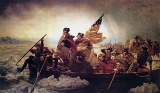
The hours before the battle served as the inspiration for the painting Washington Crossing the Delaware
Washington Crossing the Delaware

Washington Crossing the Delaware is an 1851 oil-on-canvas painting by German American Artist Emanuel Leutze. It is in commemoration of Washington's crossing of the Delaware on December 25, 1776, during the American Revolutionary War, the first move in a surprise attack against the Hessians forces at Trenton, New Jersey in the Battle of Tr...
 by German American
German American

German Americans are citizens of the United States of Germans ancestry, with traditions and self-identity based on German language and culture....
 artist Emanuel Leutze
Emanuel Leutze

Emanuel Gottlieb Leutze was a German American History painting best-known for his painting Washington Crossing the Delaware.Leutze was born to a Jewish family in Schw?bisch Gm?nd, W?rttemberg , was brought to America as a child, and then returned to Germany as an adult....
. The image in the painting, in which Washington stands majestic in his boat as it is crossing the Delaware River, is believed by some to be more symbolic than historically accurate, because the waters of the river were icy and treacherous, and the flag Monroe holds was not created until six months after the battle. In addition, contrary to the painting, the crossing occurred before dawn. Fischer argues that because the crossing took place in a storm, anyone who sat down in the boats would have been sitting in ice water and thus they would have stood. Despite the disputed accuracy, the image has become an icon of American history.

The Trenton Battle Monument
Trenton Battle Monument

The Trenton Battle Monument, located at , is a column-type monument commemorating the Battle of Trenton, one of the most famous insurgencies in American history, and the pivotal victory for the Continental forces, before their Battle of Princeton, during the American Revolutionary War....
, erected at "Five Points" in Trenton, stands as a tribute to this crucial American victory. The crossing and battle is reenacted every year.

See also

  • New Jersey during the American Revolution
    New Jersey during the American Revolution

    As the location of many major battles, New Jersey was pivotal in the American Revolution and the ultimate victory of the United States of America colonists....
  • Battle of Princeton
    Battle of Princeton

    }|-||}The Battle of Princeton was a battle in which George Washington's revolutionary forces defeated Great Britain forces near Princeton, New Jersey, New Jersey....
  • Trenton order of Battle
    Trenton order of Battle

    The following is the order of battle during the Battle of Trenton during the American Revolutionary War....
  • The Crossing (film)
    The Crossing (film)

    The Crossing is a 2000 A&E Network film based on the novel of the same name by Howard Fast starring Jeff Daniels as George Washington. Also appearing in the film are Roger Rees as Hugh Mercer, Sebastian Roche as John Glover and Steven McCarthy as Alexander Hamilton....


Footnotes