

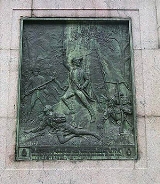
Battle of Harlem Heights

Encyclopedia
The Battle of Harlem Heights was fought during the New York and New Jersey campaign
of the American Revolutionary War
. The action took place in what is now the Morningside Heights and west Harlem neighborhoods of Manhattan
in New York City
on September 16, 1776.
The Continental Army
, under General
George Washington
, Major General
Nathanael Greene
, and Major General Israel Putnam
, totaling around 1,800 men, held a series of high ground
positions in upper Manhattan against an attacking British
division totaling around 5,000 men under the command of Major General Alexander Leslie
. British troops made a tactical error by having their light infantry buglers sound a fox hunting
call, "gone away," while in pursuit. This was intended to insult Washington, himself a keen fox hunter, having learned the sport from Lord Fairfax during the French and Indian War
. "Gone away" means that a fox is in full flight from the hounds on its trail. The Continentals, who were in orderly retreat, were infuriated by this and galvanized to hold their ground. After flanking the British attackers, the Americans slowly pushed the British back. After the British withdrawal, Washington had his troops end the pursuit. The battle went a long way to restoring the confidence of the Continental Army after suffering several defeats. It was Washington's first battlefield victory of the war.
After a month without any major fighting between the armies, Washington was forced to withdraw his army to White Plains
when the British moved into Westchester County and threatened to trap Washington in Manhattan. Washington suffered two more defeats, at White Plains
and Fort Washington
. After these two defeats, Washington and the army retreated across New Jersey
to Pennsylvania
. The New York and New Jersey campaign ended after the American victories at Trenton
and Princeton
.
flanked
and defeated the American army at the Battle of Long Island
. Howe moved his forces and pinned the Americans down at Brooklyn Heights, with the East River
to the American rear
. On the night of August 29, General George Washington
, Commander-in-Chief of the Continental Army
, evacuated his entire army of 9,000 men and their equipment across the water to Manhattan.
On September 15, Howe landed his army at Kip's Bay, Manhattan
. After a bombardment of the American positions on the shore, 4,000 British and Hessian troops landed at Battle of Kip's Bay. The American troops began to flee at the sight of the enemy, and even with Washington's arrival on the scene they refused to obey orders and continued to flee.
After scattering the Americans at Kip's Bay, Howe landed 9,000 more troops, but did not cut off the American retreat from New York City
. Washington had all of his troops in the City on their way to Harlem Heights
by 4:00 pm and they all reached the Heights by nightfall.
Thomas Knowlton
to probe the British lines. At daybreak, Knowlton's troops were spotted by the picket
s of the British light infantry
. The British sent two or three companies to attack the enemy. For more than half an hour the skirmish continued, with fighting in the woods between two farmfields. When Knowlton realized that the numerically superior British forces were trying to turn his flank, he ordered a retreat. The retreat was organized and conducted with no confusion or loss of life.
The British quickly pursued the Americans and were reinforced with the 2nd and 3rd Battalions of Light Infantry, along with the 42nd Highlanders
. During the retreat, the British light troops played their bugle horns signaling a fox hunt, which infuriated the Americans. Colonel
Joseph Reed
, who had accompanied Knowlton, rode to Washington to tell him what was going on and encouraged him to reinforce the rangers. Instead of retreating, Washington, in what Edward G. Lengel
calls "an early glimmer of the courage and resolve that would rally the Continentals from many a tight spot later on", devised a plan to entrap the British light troops. Washington would have some troops make a feint
, in order to draw the British into a hollow way, and then send a detachment of troops around to trap the British inside.
The feint party was composed of 150 volunteers who ran into the hollow way and began to engage the British. After the British were in the hollow way, the 150 volunteers were reinforced by 900 more men. All of the troops were stationed too far away from one another to do much damage.
The flanking party consisted of Knowlton's Rangers
, which had been reinforced by three companies of riflemen, in total about 200 men. As they approached, an officer accidentally misled the men, and the firing broke out on the British flank, not their rear. The British troops, realizing that they had almost been surrounded, retreated to a field, where there was a fence. The Americans soon pursued and, during the attack, Knowlton was killed. Despite this, the American troops pushed on; driving the British troops beyond the fence to the top of a hill. When they reached the hill, the British forces received reinforcements; including some artillery. For two hours, the British troops held their ground at the top of the hill until the Americans once again forced them to retreat into a buckwheat field.
 Washington was originally reluctant to pursue the British troops, but after seeing that his men were slowly pushing the British back, he sent in reinforcements and permitted the troops to engage in a direct attack. By the time that all of the reinforcements arrived, nearly 1,800 Americans were engaged in the buckwheat field. To direct the battle, members of Washington's
staff, including Nathanael Greene
, were sent in. By this time, the British troops had also been reinforced; bringing their strength up to about 5,000 men.
For an hour-and-a-half, the battle continued in the field and in the surrounding hills until, "having fired away their ammunition", the British withdrew. The Americans kept up a close pursuit until it was heard that British reserves were coming, and Washington, fearing a British trap, ordered a withdrawal. Upon hearing Washington's orders to withdraw, the troops gave a loud "huzzah
" and left the field in good order.
Andrew Leitch. The American victory raised morale in the ranks, even among those who had not been engaged. It also marked the first victory of the war for the army directly under George Washington's command.
There was little fighting for the next month of the campaign, but Washington moved his army to White Plains
in October after hearing that the British were attempting to trap him on Manhattan. After being defeated at the Battle of White Plains
and later at Fort Washington
, Washington and his army retreated across New Jersey
, pursued by the British, into Pennsylvania
.
The loss of Knowlton was a blow to the fledgling American intelligence
operations, as he had created and led the first such unit
of the Continental Army, at the direction of Washington.
New York and New Jersey campaign
The New York and New Jersey campaign was a series of battles for control of New York City and the state of New Jersey in the American Revolutionary War between British forces under General Sir William Howe and the Continental Army under General George Washington in 1776 and the winter months of 1777...
of the American Revolutionary War
American Revolutionary War
The American Revolutionary War , the American War of Independence, or simply the Revolutionary War, began as a war between the Kingdom of Great Britain and thirteen British colonies in North America, and ended in a global war between several European great powers.The war was the result of the...
. The action took place in what is now the Morningside Heights and west Harlem neighborhoods of Manhattan
Manhattan
Manhattan is the oldest and the most densely populated of the five boroughs of New York City. Located primarily on the island of Manhattan at the mouth of the Hudson River, the boundaries of the borough are identical to those of New York County, an original county of the state of New York...
in New York City
New York City
New York is the most populous city in the United States and the center of the New York Metropolitan Area, one of the most populous metropolitan areas in the world. New York exerts a significant impact upon global commerce, finance, media, art, fashion, research, technology, education, and...
on September 16, 1776.
The Continental Army
Continental Army
The Continental Army was formed after the outbreak of the American Revolutionary War by the colonies that became the United States of America. Established by a resolution of the Continental Congress on June 14, 1775, it was created to coordinate the military efforts of the Thirteen Colonies in...
, under General
General
A general officer is an officer of high military rank, usually in the army, and in some nations, the air force. The term is widely used by many nations of the world, and when a country uses a different term, there is an equivalent title given....
George Washington
George Washington
George Washington was the dominant military and political leader of the new United States of America from 1775 to 1799. He led the American victory over Great Britain in the American Revolutionary War as commander-in-chief of the Continental Army from 1775 to 1783, and presided over the writing of...
, Major General
Major General
Major general or major-general is a military rank used in many countries. It is derived from the older rank of sergeant major general. A major general is a high-ranking officer, normally subordinate to the rank of lieutenant general and senior to the ranks of brigadier and brigadier general...
Nathanael Greene
Nathanael Greene
Nathanael Greene was a major general of the Continental Army in the American Revolutionary War. When the war began, Greene was a militia private, the lowest rank possible; he emerged from the war with a reputation as George Washington's most gifted and dependable officer. Many places in the United...
, and Major General Israel Putnam
Israel Putnam
Israel Putnam was an American army general and Freemason who fought with distinction at the Battle of Bunker Hill during the American Revolutionary War...
, totaling around 1,800 men, held a series of high ground
High ground
High ground is a spot of elevated terrain which can be useful in military tactics. Fighting from an elevated position is easier for a number of reasons. Soldiers will tire more quickly when fighting uphill, will move more slowly, and if fighting in formation will have little ability to see beyond...
positions in upper Manhattan against an attacking British
Great Britain
Great Britain or Britain is an island situated to the northwest of Continental Europe. It is the ninth largest island in the world, and the largest European island, as well as the largest of the British Isles...
division totaling around 5,000 men under the command of Major General Alexander Leslie
Alexander Leslie (General)
The Honourable Major General Alexander Leslie was a Major General in the British Army during the American Revolutionary War. He was the commander of the British troops at the Battle of Harlem Heights. He replaced Cornwallis as commander in the South in 1782 and won an easy victory near Combahee...
. British troops made a tactical error by having their light infantry buglers sound a fox hunting
Fox hunting
Fox hunting is an activity involving the tracking, chase, and sometimes killing of a fox, traditionally a red fox, by trained foxhounds or other scent hounds, and a group of followers led by a master of foxhounds, who follow the hounds on foot or on horseback.Fox hunting originated in its current...
call, "gone away," while in pursuit. This was intended to insult Washington, himself a keen fox hunter, having learned the sport from Lord Fairfax during the French and Indian War
French and Indian War
The French and Indian War is the common American name for the war between Great Britain and France in North America from 1754 to 1763. In 1756, the war erupted into the world-wide conflict known as the Seven Years' War and thus came to be regarded as the North American theater of that war...
. "Gone away" means that a fox is in full flight from the hounds on its trail. The Continentals, who were in orderly retreat, were infuriated by this and galvanized to hold their ground. After flanking the British attackers, the Americans slowly pushed the British back. After the British withdrawal, Washington had his troops end the pursuit. The battle went a long way to restoring the confidence of the Continental Army after suffering several defeats. It was Washington's first battlefield victory of the war.
After a month without any major fighting between the armies, Washington was forced to withdraw his army to White Plains
White Plains, New York
White Plains is a city and the county seat of Westchester County, New York, United States. It is located in south-central Westchester, about east of the Hudson River and northwest of Long Island Sound...
when the British moved into Westchester County and threatened to trap Washington in Manhattan. Washington suffered two more defeats, at White Plains
Battle of White Plains
The Battle of White Plains was a battle in the New York and New Jersey campaign of the American Revolutionary War fought on October 28, 1776, near White Plains, New York. Following the retreat of George Washington's Continental Army northward from New York City, British General William Howe landed...
and Fort Washington
Battle of Fort Washington
The Battle of Fort Washington was fought in the American Revolutionary War between the United States and Great Britain on November 16, 1776. It was a decisive British victory, forcing the entire garrison of Fort Washington to surrender....
. After these two defeats, Washington and the army retreated across New Jersey
New Jersey
New Jersey is a state in the Northeastern and Middle Atlantic regions of the United States. , its population was 8,791,894. It is bordered on the north and east by the state of New York, on the southeast and south by the Atlantic Ocean, on the west by Pennsylvania and on the southwest by Delaware...
to Pennsylvania
Pennsylvania
The Commonwealth of Pennsylvania is a U.S. state that is located in the Northeastern and Mid-Atlantic regions of the United States. The state borders Delaware and Maryland to the south, West Virginia to the southwest, Ohio to the west, New York and Ontario, Canada, to the north, and New Jersey to...
. The New York and New Jersey campaign ended after the American victories at Trenton
Battle of Trenton
The Battle of Trenton took place on December 26, 1776, during the American Revolutionary War, after General George Washington's crossing of the Delaware River north of Trenton, New Jersey. The hazardous crossing in adverse weather made it possible for Washington to lead the main body of the...
and Princeton
Battle of Princeton
The Battle of Princeton was a battle in which General George Washington's revolutionary forces defeated British forces near Princeton, New Jersey....
.
Background
On August 27, 1776, British troops under the command of General William HoweWilliam Howe, 5th Viscount Howe
William Howe, 5th Viscount Howe, KB, PC was a British army officer who rose to become Commander-in-Chief of British forces during the American War of Independence...
flanked
Flanking maneuver
In military tactics, a flanking maneuver, also called a flank attack, is an attack on the sides of an opposing force. If a flanking maneuver succeeds, the opposing force would be surrounded from two or more directions, which significantly reduces the maneuverability of the outflanked force and its...
and defeated the American army at the Battle of Long Island
Battle of Long Island
The Battle of Long Island, also known as the Battle of Brooklyn or the Battle of Brooklyn Heights, fought on August 27, 1776, was the first major battle in the American Revolutionary War following the United States Declaration of Independence, the largest battle of the entire conflict, and the...
. Howe moved his forces and pinned the Americans down at Brooklyn Heights, with the East River
East River
The East River is a tidal strait in New York City. It connects Upper New York Bay on its south end to Long Island Sound on its north end. It separates Long Island from the island of Manhattan and the Bronx on the North American mainland...
to the American rear
Rear (military)
In military parlance, the rear is the part of concentration of military forces that is farthest from the enemy . The rear typically contains all elements of the force necessary to support combat forces - food, medical supplies and substantial shelters, planners and command headquarters....
. On the night of August 29, General George Washington
George Washington
George Washington was the dominant military and political leader of the new United States of America from 1775 to 1799. He led the American victory over Great Britain in the American Revolutionary War as commander-in-chief of the Continental Army from 1775 to 1783, and presided over the writing of...
, Commander-in-Chief of the Continental Army
Continental Army
The Continental Army was formed after the outbreak of the American Revolutionary War by the colonies that became the United States of America. Established by a resolution of the Continental Congress on June 14, 1775, it was created to coordinate the military efforts of the Thirteen Colonies in...
, evacuated his entire army of 9,000 men and their equipment across the water to Manhattan.
On September 15, Howe landed his army at Kip's Bay, Manhattan
Manhattan
Manhattan is the oldest and the most densely populated of the five boroughs of New York City. Located primarily on the island of Manhattan at the mouth of the Hudson River, the boundaries of the borough are identical to those of New York County, an original county of the state of New York...
. After a bombardment of the American positions on the shore, 4,000 British and Hessian troops landed at Battle of Kip's Bay. The American troops began to flee at the sight of the enemy, and even with Washington's arrival on the scene they refused to obey orders and continued to flee.
After scattering the Americans at Kip's Bay, Howe landed 9,000 more troops, but did not cut off the American retreat from New York City
New York City
New York is the most populous city in the United States and the center of the New York Metropolitan Area, one of the most populous metropolitan areas in the world. New York exerts a significant impact upon global commerce, finance, media, art, fashion, research, technology, education, and...
. Washington had all of his troops in the City on their way to Harlem Heights
Morningside Heights, Manhattan
Morningside Heights is a neighborhood of the Borough of Manhattan in New York City and is chiefly known as the home of institutions such as Columbia University, Teachers College, Barnard College, the Manhattan School of Music, Bank Street College of Education, the Cathedral of Saint John the...
by 4:00 pm and they all reached the Heights by nightfall.
Battle
On the morning of September 16, Washington received word that the British were advancing. Washington, who had been expecting an attack, sent a reconnoitering party of 150 men under the command of Lieutenant ColonelLieutenant colonel
Lieutenant colonel is a rank of commissioned officer in the armies and most marine forces and some air forces of the world, typically ranking above a major and below a colonel. The rank of lieutenant colonel is often shortened to simply "colonel" in conversation and in unofficial correspondence...
Thomas Knowlton
Thomas Knowlton
Thomas Knowlton was an American patriot who served in the French and Indian War and was a Colonel during the American Revolution. Knowlton is considered America's first Intelligence professional, and his unit, Knowlton's Rangers, made a significant contribution to intelligence gathering during...
to probe the British lines. At daybreak, Knowlton's troops were spotted by the picket
Picket (military)
In military terminology, a picket refers to soldiers or troops placed on a line forward of a position to warn against an enemy advance. It can also refer to any unit performing a similar function...
s of the British light infantry
Light infantry
Traditionally light infantry were soldiers whose job was to provide a skirmishing screen ahead of the main body of infantry, harassing and delaying the enemy advance. Light infantry was distinct from medium, heavy or line infantry. Heavy infantry were dedicated primarily to fighting in tight...
. The British sent two or three companies to attack the enemy. For more than half an hour the skirmish continued, with fighting in the woods between two farmfields. When Knowlton realized that the numerically superior British forces were trying to turn his flank, he ordered a retreat. The retreat was organized and conducted with no confusion or loss of life.
The British quickly pursued the Americans and were reinforced with the 2nd and 3rd Battalions of Light Infantry, along with the 42nd Highlanders
42nd Regiment of Foot
The 42nd Regiment of Foot was an infantry regiment of the British Army. Originally the 43rd Highlanders they were renumbered the 42nd in 1748.- Early history :...
. During the retreat, the British light troops played their bugle horns signaling a fox hunt, which infuriated the Americans. Colonel
Colonel
Colonel , abbreviated Col or COL, is a military rank of a senior commissioned officer. It or a corresponding rank exists in most armies and in many air forces; the naval equivalent rank is generally "Captain". It is also used in some police forces and other paramilitary rank structures...
Joseph Reed
Joseph Reed (jurist)
Joseph Reed was a Pennsylvania lawyer, military officer, and statesman of the Revolutionary Era. He served as a delegate to the Continental Congress and, while in Congress, signed the Articles of Confederation...
, who had accompanied Knowlton, rode to Washington to tell him what was going on and encouraged him to reinforce the rangers. Instead of retreating, Washington, in what Edward G. Lengel
Edward G. Lengel
Edward G. Lengel is an American military historian and professor at the University of Virginia.Lengel is the editor-in-chief of The Papers of George Washington documentary editing project in Charlottesville, Virginia...
calls "an early glimmer of the courage and resolve that would rally the Continentals from many a tight spot later on", devised a plan to entrap the British light troops. Washington would have some troops make a feint
Feint
Feint is a French term that entered English from the discipline of fencing. Feints are maneuvers designed to distract or mislead, done by giving the impression that a certain maneuver will take place, while in fact another, or even none, will...
, in order to draw the British into a hollow way, and then send a detachment of troops around to trap the British inside.
The feint party was composed of 150 volunteers who ran into the hollow way and began to engage the British. After the British were in the hollow way, the 150 volunteers were reinforced by 900 more men. All of the troops were stationed too far away from one another to do much damage.
The flanking party consisted of Knowlton's Rangers
Knowlton's Rangers
Knowlton's Rangers were the United States of America's first organized espionage organization, as well as the first American Ranger unit formed after America declared its independence from the United Kingdom. Named after their commander, Thomas Knowlton, they were formed in 1776.-Formation:On...
, which had been reinforced by three companies of riflemen, in total about 200 men. As they approached, an officer accidentally misled the men, and the firing broke out on the British flank, not their rear. The British troops, realizing that they had almost been surrounded, retreated to a field, where there was a fence. The Americans soon pursued and, during the attack, Knowlton was killed. Despite this, the American troops pushed on; driving the British troops beyond the fence to the top of a hill. When they reached the hill, the British forces received reinforcements; including some artillery. For two hours, the British troops held their ground at the top of the hill until the Americans once again forced them to retreat into a buckwheat field.
staff, including Nathanael Greene
Nathanael Greene
Nathanael Greene was a major general of the Continental Army in the American Revolutionary War. When the war began, Greene was a militia private, the lowest rank possible; he emerged from the war with a reputation as George Washington's most gifted and dependable officer. Many places in the United...
, were sent in. By this time, the British troops had also been reinforced; bringing their strength up to about 5,000 men.
For an hour-and-a-half, the battle continued in the field and in the surrounding hills until, "having fired away their ammunition", the British withdrew. The Americans kept up a close pursuit until it was heard that British reserves were coming, and Washington, fearing a British trap, ordered a withdrawal. Upon hearing Washington's orders to withdraw, the troops gave a loud "huzzah
Huzzah
Huzzah is an archaic English interjection of joy or approbation. According to the Oxford English Dictionary it is "apparently a mere exclamation". The dictionary does not mention any specific derivation...
" and left the field in good order.
Aftermath
The British casualties were officially reported by General Howe at 14 killed and 78 wounded. However, a member of Howe's staff wrote in his diary that the loss was 14 killed and 154 wounded. David McCullough gives much higher figures of 90 killed and 300 wounded. The Americans had about 30 killed and 100 wounded, including among the dead Lieutenant Colonel Knowlton and MajorMajor
Major is a rank of commissioned officer, with corresponding ranks existing in almost every military in the world.When used unhyphenated, in conjunction with no other indicator of rank, the term refers to the rank just senior to that of an Army captain and just below the rank of lieutenant colonel. ...
Andrew Leitch. The American victory raised morale in the ranks, even among those who had not been engaged. It also marked the first victory of the war for the army directly under George Washington's command.
There was little fighting for the next month of the campaign, but Washington moved his army to White Plains
White Plains, New York
White Plains is a city and the county seat of Westchester County, New York, United States. It is located in south-central Westchester, about east of the Hudson River and northwest of Long Island Sound...
in October after hearing that the British were attempting to trap him on Manhattan. After being defeated at the Battle of White Plains
Battle of White Plains
The Battle of White Plains was a battle in the New York and New Jersey campaign of the American Revolutionary War fought on October 28, 1776, near White Plains, New York. Following the retreat of George Washington's Continental Army northward from New York City, British General William Howe landed...
and later at Fort Washington
Battle of Fort Washington
The Battle of Fort Washington was fought in the American Revolutionary War between the United States and Great Britain on November 16, 1776. It was a decisive British victory, forcing the entire garrison of Fort Washington to surrender....
, Washington and his army retreated across New Jersey
New Jersey
New Jersey is a state in the Northeastern and Middle Atlantic regions of the United States. , its population was 8,791,894. It is bordered on the north and east by the state of New York, on the southeast and south by the Atlantic Ocean, on the west by Pennsylvania and on the southwest by Delaware...
, pursued by the British, into Pennsylvania
Pennsylvania
The Commonwealth of Pennsylvania is a U.S. state that is located in the Northeastern and Mid-Atlantic regions of the United States. The state borders Delaware and Maryland to the south, West Virginia to the southwest, Ohio to the west, New York and Ontario, Canada, to the north, and New Jersey to...
.
The loss of Knowlton was a blow to the fledgling American intelligence
Military intelligence
Military intelligence is a military discipline that exploits a number of information collection and analysis approaches to provide guidance and direction to commanders in support of their decisions....
operations, as he had created and led the first such unit
Intelligence in the American Revolutionary War
Intelligence in the American Revolutionary War was essentially monitored and sanctioned by the Continental Congress to provide military intelligence to the Continental Army to aid them in fighting the British during the American Revolutionary War...
of the Continental Army, at the direction of Washington.