

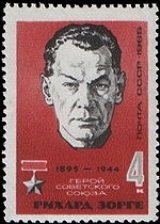
Richard Sorge

Encyclopedia
Richard Sorge was a German
communist and spy
who worked for the Soviet Union
. He has gained great fame among espionage
enthusiasts for his intelligence gathering during World War II
. He worked as a journalist
in both Germany and Japan
, where he was imprisoned for spying and eventually hanged. His GRU
codename was "Ramsay" . He is widely regarded as one of the best-known Soviet intelligence officers of the Second World War, according to Phillip Knightley, the author of The Second Oldest Profession (1986).
 Sorge was born in the settlement of Sabunchi
, suburb of Baku
, Azerbaijan
, which was part of Imperial Russia at the time. He was the youngest of the nine children of Wilhelm Richard Sorge (d. 1907) a German mining engineer and his Russia
n wife Nina Semionovna Kobieleva. His father's lucrative contract with the Caucasian Oil Company having expired, Richard Sorge's family moved back to Germany: in Sorge's own words,
The cosmopolitan Sorge household was "very different from the average bourgeois home in Berlin."
Although Sorge considered Friedrich Adolf Sorge, an associate of Karl Marx
and Friedrich Engels
, to be his grandfather, he was in fact his great-uncle.
In October 1914 Sorge volunteered to serve during World War I
. He joined a student battalion
of the 3rd Guards, Field Artillery
. During his service in the Western Front
he was severely wounded in March 1916 when shrapnel cut off three of his fingers and broke both his legs, causing a lifelong limp. He was promoted to corporal
, received an Iron Cross
and later medically discharged.
During his convalescence he read Marx and adopted communist ideology, mainly due to the influence of the father of a nurse with whom he had developed a relationship. He spent the rest of the war studying economics
at the universities of Berlin, Kiel
and Hamburg
. Sorge received a Ph.D.
in political science
at the University of Hamburg
in August 1919. He also joined the Communist Party of Germany
. His political views, however, got him fired from both a teaching job and coal mining
work. He fled to Moscow
where he became a junior agent for Comintern
.
and using the cover of being a journalist he was sent to various European countries to assess the possibility of communist uprisings taking place.
From 1920 to 1922, Sorge lived in Solingen
, in present-day North Rhine-Westphalia
, Germany. He was joined there by Christiane Gerlach who had been the wife of Dr Kurt Albert Gerlach
, a wealthy communist who had also been Sorge's professor of political science in Kiel. Sorge and Christiane married in May 1921. In 1922, he was relocated to Frankfurt
, where he gathered intelligence about the business community. In the summer of 1923, he took part in the "Erste Marxistische Arbeitswoche" (First Marxist Work Week) in Ilmenau
, Thuringia
, an event subsidized by Felix Weil
. After an attempted communist coup in October 1923, Sorge continued his work as a journalist. At the same time, he helped with organizing the library of the Institute for Social Research
, of which Kurt Albert Gerlach was meant to be the first director.
In 1924, he and Christiane moved to Moscow where he officially joined the International Liaison Department of the Comintern, also an OGPU intelligence gathering body. Apparently, his dedication to duty led to his divorce. In 1929, Sorge became part of the Red Army
's Fourth Department (the GRU
, or military intelligence) He remained with the Department for the rest of his life.
In 1929 Sorge arrived in England to study the labour movement
s then prevalent in the region, the status of the Communist Party of Great Britain
, and the country's political and economic conditions. He was instructed to remain undercover
and not to become involved in politics while living in England.
In November 1929 Sorge returned to Germany where he was instructed to join the Nazi Party and not to associate with left-wing activists. To help develop a cover for his spying activities he obtained a post working for the agricultural newspaper, Deutsche Getreide-Zeitung.
in 1930 to gather intelligence and foment revolution. Officially, he worked as the editor of a German news service and for the Frankfurter Zeitung
. He contacted another spy, Max Clausen. Sorge also met German Soviet spy Ursula Kuczynski
and American journalist Agnes Smedley
, both his lovers. Smedley, a well-known left-wing journalist, worked for the Frankfurter Zeitung
. She introduced Sorge to Hotsumi Ozaki
, who was employed by the Japanese newspaper, Asahi Shimbun
. Later Ozaki agreed to join Sorge's spy network, as well as Hanako Ishii, Sorge's next lover.
As a journalist, Sorge established himself as an expert on Chinese agriculture. This gave him the freedom to travel around the country making contacts with members of the Chinese Communist Party. In January 1932, Sorge reported on fighting between Chinese and Japanese troops
in the streets of Shanghai
. In December he was recalled to Moscow.
's Mein Kampf, and attended so many beer halls with his new acquaintances that he gave up drinking lest his tongue be loosened by alcohol.
His total abstinence does not appear to have made his Nazi companions suspicious and was an example of his devotion to and absorption in his mission. He later explained to Hede Massing
, "That was the bravest thing I ever did. Never will I be able to drink enough to make up for this time." Sorge was a heavy drinker and, later, his drinking came to undermine his work. While in Germany, he was able to get commissions from two newspapers, the Börsen Zeitung and the Tägliche Rundschau. He also got support from the Nazi theoretical journal, Geopolitik
. Later he was to get work from the Frankfurter Zeitung.
Sorge arrived in Yokohama
on September 6, 1933. He was warned by his spymaster not to have contact with the underground Japanese Communist Party or with the Soviet Embassy in Tokyo
. His spy network in Japan included Red Army officer and radio operator Max Gottfried Friedrich Clausen, Hotsumi Ozaki
, and two other Comintern agents, Branko Vukelic
, a journalist working for the French magazine, Vu and a Japanese journalist, Miyagi Yotoku, who was employed by the English-language newspaper, the Japan Advertiser. Max Clausen's wife Anna acted as ring courier from time to time. From summer 1937, Clausen the spy operated under cover of his firm set up with Soviet funds but which in time became a commercial success, M Clausen Shokai suppliers of blueprint machinery and reproduction services.
Sorge built a network in 1933 and 1934 to collect intelligence for the GRU in Japan. His agents had contacts with senior politicians and through that, to information of Japan's foreign policy
. He also recontacted Hotsumi Ozaki
who developed a close contact with the prime minister Fumimaro Konoe
. Ozaki copied secret documents for Sorge.
Collecting intelligence from inside Germany was more dangerous and difficult at the time, so Sorge was sent to Japan to collect information on Germany's plans. This was a similar tactic with the other soviet rings spying on Germany. The evidence of his communist past in German security files was overlooked, or hidden, according to Prange
.
Officially, Sorge joined the Nazi
party and became a German journalist in Tokyo, where he came to work closely with the German embassy and ambassador Eugen Ott. He used the embassy for double-checking his information, having access to telegrams in Ott's office. He even had an affair with Ott's wife, proof that he was entirely trusted at the embassy, but the stress also increased his drinking.
, the German-Japanese Pact and warned of the Pearl Harbor attack
. In 1941, Sorge is said to have informed them of the exact launch date of Operation Barbarossa
. Moscow answered with thanks but Joseph Stalin
largely ignored it, as was also the case with information supplied by the other networks, including Leiba Domb's Red Orchestra spy network on the German Borders. Stalin was reportedly so angry with Domb's information that he ordered that Domb be 'punished for spreading such lies'. (The order was not followed).
Gordon Prange's analysis (1984) was that the closest Sorge came to predicting the launch date of Operation Barbarossa
was 20 June 1941 and Prange comments that Sorge himself never claimed to have discovered the correct date (22 June) in advance. The date of 20 June had been given to Sorge by Lt-Col Friedrich von Schol who was assistant military attache at the German embassy in Tokyo. As Sorge took pride in and sought the credit for the spy ring's work, Professor Prange may have taken Sorge's failure to claim that he had discovered the correct date as conclusive evidence that Sorge in fact did fail to discover it. Kim Philby's recruiter A. Deutsch was also the spymaster of Gestapo officer Willi Lehmann
, who on June 19 cabled the Barbarossa launch date to NKVD in Moscow. Stalin considered this as disinformation, too.
The Soviet press reported in 1964 that on June 15, 1941, Sorge had broadcast a dispatch saying that, "The war will begin on June 22." Writing before previously-embargoed material was released by the Russian authorities in the 1990s, Prange and those writing with him appear not to have accepted the veracity of this report. More recently, Stalin was quoted as having ridiculed Sorge and his intelligence prior to the launch of Operation Barbarossa
:
Sorge advised the Red Army on September 14, 1941, that the Japanese were not going to attack the Soviet Union until:
Sorge transmitted information toward the end of September 1941 that Japan was not going to attack the Soviet Union in the East.
, where the German army suffered its first tactical defeat in the war. To this end, Sorge's information might have been the most important spy work in World War II. At Khimki
, a place at the Moscow city border en route to Sheremetyevo International Airport
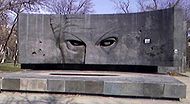
, there is still a memorial plaque reminding visitors of this defining point of modern history.
The second most important piece of information he allegedly passed along concerned the Battle of Stalingrad
- the turning point in the war which is considered one of the bloodiest and largest battles in history. Richard Sorge alerted Moscow that Japan would attack the Soviet Union from the East as soon as the German army captured any city on the Volga, thus effectively disrupting oil supplies from Baku
and also ammunition and food supplies sent by the allies from the Persian Gulf
through Iran, Soviet Azerbaijan and up the Volga river. However, by mid-1941 the Japanese had made their strategic decision to go south and east, instead of north, so the information (if given) seems to have been speculative at best.
s (used by the Soviets), the Japanese began to suspect a spy ring operating. The Japanese secret service had already intercepted many of his messages and begun to close in. Ozaki was arrested on October 14, 1941, and interrogated.
Sorge was arrested on October 18, 1941, in Tokyo. German ambassador Eugen Ott heard of Sorge's arrest the next day from a brief memo notifying him that Sorge had been arrested "on suspicion of espionage" together with another German, Max Clausen. Ott was both surprised and outraged, and assumed it was a case of "Japanese espionage hysteria". He thought that Sorge had been discovered passing secret information on the Japan-US negotiations to the German embassy, and also that the arrest could be due to anti-German elements in the Japanese government. It was not until a few months later that Japanese authorities announced that Sorge had in fact been indicted as a Soviet spy.
Initially, the Japanese believed that, due to his Nazi party membership and German ties, Sorge was an Abwehr
agent. However, the Abwehr denied that he was one of their agents. Even under torture, he denied all ties with the Soviets. The Japanese made three overtures to the Soviets, offering to trade Sorge for one of their own spies. However, the Soviets declined all the offers, maintaining that Sorge was unknown to them. He was incarcerated in Sugamo Prison
.
on November 7, 1944, at 10:20 a.m. Tokyo time in Sugamo Prison
; Hotsumi Ozaki was hanged earlier in the same day. The Soviet Union did not officially acknowledge Sorge until 1964. It was argued that Sorge's biggest coup led to his undoing, because Stalin could not afford to let it become known that he had rejected his intelligence data about the German attack in 1941. However, it should also be mentioned that nations seldom officially recognize their own spies.
Sorge was survived by his mother, then living in Germany, and he left his estate to Anna Clausen. He was buried in the Sugamo Prison (Zhogaya) graveyard, but his remains were later relocated to Tama Cemetery in Fuchū, Tokyo
. His lover Hanako Ishii continued to visit his grave until her death in 2000.
 In 1954 the German film director Veit Harlan
wrote and directed the film Betrayal of Germany (Verrat an Deutschland) about Sorge's espionage in Japan. In Nazi Germany Harlan was the favourite filmmaker of propaganda minister Joseph Goebbels and director of numerous propaganda films, including the antisemitic reel Jud Süss. Harlan's film about Sorge is a romantic drama, with Harlan's wife Kristina Söderbaum
, also known for numerous propaganda pieces in Nazi Germany, as the main protagonist of Sorge. The film was prohibited in Germany only two days after its release in 1955 and only released again after re-editing.
In 1961 a movie called Qui êtes-vous, Monsieur Sorge? (Who Are You, Mr. Sorge?) was produced in France in collaboration with West Germany
, Italy
and Japan
. This movie was very popular in the Soviet Union
as well. The part of Sorge was played by Thomas Holtzmann. In 1964, Soviet premier Nikita Khrushchev
saw the film and asked the KGB whether the story was true. When it was confirmed that it was indeed true, Khrushchev posthumously awarded Sorge with the title of Hero of the Soviet Union
on 5 November 1964. Sorge's widow Hanako Ishii received a Soviet pension. She eventually died in July 2000 in Tokyo.
Three East German journalists wrote Dr. Sorge funkt aus Tokyo in 1965 in celebration of the half-Russian, half-German hero who had acted against fascism (East Germany and the Soviet Union were then allied in the Warsaw Pact
). In the lead up to the award, Sorge's claim that Friedrich Adolf Sorge was his grandfather was gladly repeated in the Soviet press. In a strange cold war oddity, these authors stirred up a free speech scandal with patriotic letters to former Nazis in West Germany, causing the Verfassungsschutz to issue a stern warning in early 1967: "If you receive mail from a certain Julius Mader, do not reply to him and pass on the letter to the respective security authorities."
A comic book based on Sorge's life, titled "Wywiadowca XX wieku" ("20th Century Spy"), was published in 1971 in Poland
to familiarize younger readers with Sorge.
Sorge also appears in Osamu Tezuka
's Adolf
manga
.
Author Chapman Pincher
, in his 1981 book Their Trade is Treachery, asserted that Sorge, a GRU spy himself, recruited Englishman Roger Hollis
in China
in the early 1930s to spy for the GRU. Hollis later returned to England, joined MI5
just before World War II
began, and eventually became Director-General of MI5 from 1956 to 1965. As detailed by former MI5 staffer Peter Wright
in his 1988 book Spycatcher, Hollis was accused of being a Soviet spy, but despite several lengthy and seemingly thorough investigations, no conclusive proof of this was ever obtained.
One of Aleksandar Hemon
's first stories in English is "The Sorge Spy Ring" (Triquarterly
, 1997).
The 2003 Japanese film Spy Sorge
, directed by Masahiro Shinoda, details his exploits in Shanghai and Japan. In the film he is portrayed by Scottish actor Iain Glen
.
, published in English as The Last Card (New York: Pyramid Publications, Inc., 1967) and Death Plays the Last Card (London: Fontana, 1968).By Morgan Sportes a novel in franche L'Insensé, Grasset 2002 with a translation in Japanese: Sorge hametsu no fuga, Iwanami Shoten 2005.
The 2000 short story collection The Question of Bruno by Aleksandar Hemon
also extensively features Sorge.
Sorge makes yet another appearance in the later chapters of Osamu Tezuka
's manga Adolf
.
Germans
The Germans are a Germanic ethnic group native to Central Europe. The English term Germans has referred to the German-speaking population of the Holy Roman Empire since the Late Middle Ages....
communist and spy
SPY
SPY is a three-letter acronym that may refer to:* SPY , ticker symbol for Standard & Poor's Depositary Receipts* SPY , a satirical monthly, trademarked all-caps* SPY , airport code for San Pédro, Côte d'Ivoire...
who worked for the Soviet Union
Soviet Union
The Soviet Union , officially the Union of Soviet Socialist Republics , was a constitutionally socialist state that existed in Eurasia between 1922 and 1991....
. He has gained great fame among espionage
Espionage
Espionage or spying involves an individual obtaining information that is considered secret or confidential without the permission of the holder of the information. Espionage is inherently clandestine, lest the legitimate holder of the information change plans or take other countermeasures once it...
enthusiasts for his intelligence gathering during World War II
World War II
World War II, or the Second World War , was a global conflict lasting from 1939 to 1945, involving most of the world's nations—including all of the great powers—eventually forming two opposing military alliances: the Allies and the Axis...
. He worked as a journalist
Journalist
A journalist collects and distributes news and other information. A journalist's work is referred to as journalism.A reporter is a type of journalist who researchs, writes, and reports on information to be presented in mass media, including print media , electronic media , and digital media A...
in both Germany and Japan
Japan
Japan is an island nation in East Asia. Located in the Pacific Ocean, it lies to the east of the Sea of Japan, China, North Korea, South Korea and Russia, stretching from the Sea of Okhotsk in the north to the East China Sea and Taiwan in the south...
, where he was imprisoned for spying and eventually hanged. His GRU
GRU
GRU or Glavnoye Razvedyvatel'noye Upravleniye is the foreign military intelligence directorate of the General Staff of the Armed Forces of the Russian Federation...
codename was "Ramsay" . He is widely regarded as one of the best-known Soviet intelligence officers of the Second World War, according to Phillip Knightley, the author of The Second Oldest Profession (1986).
Early life
Sabunçu, Baku
Sabunçu is a settlement and municipality in Baku, Azerbaijan. It has a population of 22,344.Until the beginning of the 20th century, the Sabunçu region was producing 35 percent of Baku's oil...
, suburb of Baku
Baku
Baku , sometimes spelled as Baki or Bakou, is the capital and largest city of Azerbaijan, as well as the largest city on the Caspian Sea and of the Caucasus region. It is located on the southern shore of the Absheron Peninsula, which projects into the Caspian Sea. The city consists of two principal...
, Azerbaijan
Azerbaijan
Azerbaijan , officially the Republic of Azerbaijan is the largest country in the Caucasus region of Eurasia. Located at the crossroads of Western Asia and Eastern Europe, it is bounded by the Caspian Sea to the east, Russia to the north, Georgia to the northwest, Armenia to the west, and Iran to...
, which was part of Imperial Russia at the time. He was the youngest of the nine children of Wilhelm Richard Sorge (d. 1907) a German mining engineer and his Russia
Russia
Russia or , officially known as both Russia and the Russian Federation , is a country in northern Eurasia. It is a federal semi-presidential republic, comprising 83 federal subjects...
n wife Nina Semionovna Kobieleva. His father's lucrative contract with the Caucasian Oil Company having expired, Richard Sorge's family moved back to Germany: in Sorge's own words,
"The one thing that made my life a little different from the average was a strong awareness of the fact that I had been born in the southern Caucasus and that we had moved to Berlin when I was very small."
The cosmopolitan Sorge household was "very different from the average bourgeois home in Berlin."
Although Sorge considered Friedrich Adolf Sorge, an associate of Karl Marx
Karl Marx
Karl Heinrich Marx was a German philosopher, economist, sociologist, historian, journalist, and revolutionary socialist. His ideas played a significant role in the development of social science and the socialist political movement...
and Friedrich Engels
Friedrich Engels
Friedrich Engels was a German industrialist, social scientist, author, political theorist, philosopher, and father of Marxist theory, alongside Karl Marx. In 1845 he published The Condition of the Working Class in England, based on personal observations and research...
, to be his grandfather, he was in fact his great-uncle.
In October 1914 Sorge volunteered to serve during World War I
World War I
World War I , which was predominantly called the World War or the Great War from its occurrence until 1939, and the First World War or World War I thereafter, was a major war centred in Europe that began on 28 July 1914 and lasted until 11 November 1918...
. He joined a student battalion
Battalion
A battalion is a military unit of around 300–1,200 soldiers usually consisting of between two and seven companies and typically commanded by either a Lieutenant Colonel or a Colonel...
of the 3rd Guards, Field Artillery
Field artillery
Field artillery is a category of mobile artillery used to support armies in the field. These weapons are specialized for mobility, tactical proficiency, long range, short range and extremely long range target engagement....
. During his service in the Western Front
Western Front (World War I)
Following the outbreak of World War I in 1914, the German Army opened the Western Front by first invading Luxembourg and Belgium, then gaining military control of important industrial regions in France. The tide of the advance was dramatically turned with the Battle of the Marne...
he was severely wounded in March 1916 when shrapnel cut off three of his fingers and broke both his legs, causing a lifelong limp. He was promoted to corporal
Corporal
Corporal is a rank in use in some form by most militaries and by some police forces or other uniformed organizations. It is usually equivalent to NATO Rank Code OR-4....
, received an Iron Cross
Iron Cross
The Iron Cross is a cross symbol typically in black with a white or silver outline that originated after 1219 when the Kingdom of Jerusalem granted the Teutonic Order the right to combine the Teutonic Black Cross placed above a silver Cross of Jerusalem....
and later medically discharged.
During his convalescence he read Marx and adopted communist ideology, mainly due to the influence of the father of a nurse with whom he had developed a relationship. He spent the rest of the war studying economics
Economics
Economics is the social science that analyzes the production, distribution, and consumption of goods and services. The term economics comes from the Ancient Greek from + , hence "rules of the house"...
at the universities of Berlin, Kiel
University of Kiel
The University of Kiel is a university in the city of Kiel, Germany. It was founded in 1665 as the Academia Holsatorum Chiloniensis by Christian Albert, Duke of Holstein-Gottorp and has approximately 23,000 students today...
and Hamburg
University of Hamburg
The University of Hamburg is a university in Hamburg, Germany. It was founded on 28 March 1919 by Wilhelm Stern and others. It grew out of the previous Allgemeines Vorlesungswesen and the Kolonialinstitut as well as the Akademisches Gymnasium. There are around 38,000 students as of the start of...
. Sorge received a Ph.D.
Ph.D.
A Ph.D. is a Doctor of Philosophy, an academic degree.Ph.D. may also refer to:* Ph.D. , a 1980s British group*Piled Higher and Deeper, a web comic strip*PhD: Phantasy Degree, a Korean comic series* PhD Docbook renderer, an XML renderer...
in political science
Political science
Political Science is a social science discipline concerned with the study of the state, government and politics. Aristotle defined it as the study of the state. It deals extensively with the theory and practice of politics, and the analysis of political systems and political behavior...
at the University of Hamburg
University of Hamburg
The University of Hamburg is a university in Hamburg, Germany. It was founded on 28 March 1919 by Wilhelm Stern and others. It grew out of the previous Allgemeines Vorlesungswesen and the Kolonialinstitut as well as the Akademisches Gymnasium. There are around 38,000 students as of the start of...
in August 1919. He also joined the Communist Party of Germany
Communist Party of Germany
The Communist Party of Germany was a major political party in Germany between 1918 and 1933, and a minor party in West Germany in the postwar period until it was banned in 1956...
. His political views, however, got him fired from both a teaching job and coal mining
Coal mining
The goal of coal mining is to obtain coal from the ground. Coal is valued for its energy content, and since the 1880s has been widely used to generate electricity. Steel and cement industries use coal as a fuel for extraction of iron from iron ore and for cement production. In the United States,...
work. He fled to Moscow
Moscow
Moscow is the capital, the most populous city, and the most populous federal subject of Russia. The city is a major political, economic, cultural, scientific, religious, financial, educational, and transportation centre of Russia and the continent...
where he became a junior agent for Comintern
Comintern
The Communist International, abbreviated as Comintern, also known as the Third International, was an international communist organization initiated in Moscow during March 1919...
.
Red Army spy
Sorge was recruited as a spy for the Soviet UnionSoviet Union
The Soviet Union , officially the Union of Soviet Socialist Republics , was a constitutionally socialist state that existed in Eurasia between 1922 and 1991....
and using the cover of being a journalist he was sent to various European countries to assess the possibility of communist uprisings taking place.
From 1920 to 1922, Sorge lived in Solingen
Solingen
Solingen is a city in North Rhine-Westphalia, Germany. It is located on the northern edge of the region called Bergisches Land, south of the Ruhr area, and with a 2009 population of 161,366 is the second largest city in the Bergisches Land...
, in present-day North Rhine-Westphalia
North Rhine-Westphalia
North Rhine-Westphalia is the most populous state of Germany, with four of the country's ten largest cities. The state was formed in 1946 as a merger of the northern Rhineland and Westphalia, both formerly part of Prussia. Its capital is Düsseldorf. The state is currently run by a coalition of the...
, Germany. He was joined there by Christiane Gerlach who had been the wife of Dr Kurt Albert Gerlach
Kurt Albert Gerlach
- Life :Gerlach was the son of a German factory owner. He had studied at the university of Kiel under Ferdinand Tönnies and received his doctorate in 1911 with a work on the role of Denmark in global economy. He then studied at the University of Leipzig. In 1911 and 1912 he went to England and...
, a wealthy communist who had also been Sorge's professor of political science in Kiel. Sorge and Christiane married in May 1921. In 1922, he was relocated to Frankfurt
Frankfurt
Frankfurt am Main , commonly known simply as Frankfurt, is the largest city in the German state of Hesse and the fifth-largest city in Germany, with a 2010 population of 688,249. The urban area had an estimated population of 2,300,000 in 2010...
, where he gathered intelligence about the business community. In the summer of 1923, he took part in the "Erste Marxistische Arbeitswoche" (First Marxist Work Week) in Ilmenau
Ilmenau
Ilmenau is a town located in the district of Ilm-Kreis, Thuringia, Germany.Ilmenau is situated in the valley of the Ilm river, at an altitude of 431 metres above sea level, and is the biggest town in Ilm-Kreis district, with 6,200 students studying at the Technische Universität Ilmenau. The...
, Thuringia
Thuringia
The Free State of Thuringia is a state of Germany, located in the central part of the country.It has an area of and 2.29 million inhabitants, making it the sixth smallest by area and the fifth smallest by population of Germany's sixteen states....
, an event subsidized by Felix Weil
Felix Weil
Felix Weil was a Marxist and the original financial provider for the Institute for Social Research in Frankfurt am Main, Germany....
. After an attempted communist coup in October 1923, Sorge continued his work as a journalist. At the same time, he helped with organizing the library of the Institute for Social Research
Institute for Social Research
The Institute for Social Research is a research organization for sociology and continental philosophy, best known as the institutional home of the Frankfurt School and critical theory....
, of which Kurt Albert Gerlach was meant to be the first director.
In 1924, he and Christiane moved to Moscow where he officially joined the International Liaison Department of the Comintern, also an OGPU intelligence gathering body. Apparently, his dedication to duty led to his divorce. In 1929, Sorge became part of the Red Army
Red Army
The Workers' and Peasants' Red Army started out as the Soviet Union's revolutionary communist combat groups during the Russian Civil War of 1918-1922. It grew into the national army of the Soviet Union. By the 1930s the Red Army was among the largest armies in history.The "Red Army" name refers to...
's Fourth Department (the GRU
GRU
GRU or Glavnoye Razvedyvatel'noye Upravleniye is the foreign military intelligence directorate of the General Staff of the Armed Forces of the Russian Federation...
, or military intelligence) He remained with the Department for the rest of his life.
In 1929 Sorge arrived in England to study the labour movement
Labour movement
The term labour movement or labor movement is a broad term for the development of a collective organization of working people, to campaign in their own interest for better treatment from their employers and governments, in particular through the implementation of specific laws governing labour...
s then prevalent in the region, the status of the Communist Party of Great Britain
Communist Party of Great Britain
The Communist Party of Great Britain was the largest communist party in Great Britain, although it never became a mass party like those in France and Italy. It existed from 1920 to 1991.-Formation:...
, and the country's political and economic conditions. He was instructed to remain undercover
Undercover
Being undercover is disguising one's own identity or using an assumed identity for the purposes of gaining the trust of an individual or organization to learn secret information or to gain the trust of targeted individuals in order to gain information or evidence...
and not to become involved in politics while living in England.
In November 1929 Sorge returned to Germany where he was instructed to join the Nazi Party and not to associate with left-wing activists. To help develop a cover for his spying activities he obtained a post working for the agricultural newspaper, Deutsche Getreide-Zeitung.
China 1930
Sorge moved to ShanghaiShanghai
Shanghai is the largest city by population in China and the largest city proper in the world. It is one of the four province-level municipalities in the People's Republic of China, with a total population of over 23 million as of 2010...
in 1930 to gather intelligence and foment revolution. Officially, he worked as the editor of a German news service and for the Frankfurter Zeitung
Frankfurter Zeitung
The Frankfurter Zeitung was a German language newspaper that appeared from 1856 to 1943. It emerged from a market letter that was published in Frankfurt...
. He contacted another spy, Max Clausen. Sorge also met German Soviet spy Ursula Kuczynski
Ursula Kuczynski
Ursula Maria Kuczynski was a German author and spy for the Soviet Union. A daughter of Robert René Kuczynski, she joined the Communist party at an early age...
and American journalist Agnes Smedley
Agnes Smedley
Agnes Smedley was an American journalist and writer best known for her semi-autobiographical novelDaughter of Earth. She was also known for her sympathetic chronicling of the Chinese revolution...
, both his lovers. Smedley, a well-known left-wing journalist, worked for the Frankfurter Zeitung
Frankfurter Zeitung
The Frankfurter Zeitung was a German language newspaper that appeared from 1856 to 1943. It emerged from a market letter that was published in Frankfurt...
. She introduced Sorge to Hotsumi Ozaki
Hotsumi Ozaki
was a Japanese journalist working for the Asahi Shinbun newspaper, communist, spy, and an advisor to Prime Minister Fumimaro Konoe. The only Japanese person to be hanged for treason by the Japanese government during World War II, Ozaki is well known as an informant of the spy Richard Sorge...
, who was employed by the Japanese newspaper, Asahi Shimbun
Asahi Shimbun
The is the second most circulated out of the five national newspapers in Japan. Its circulation, which was 7.96 million for its morning edition and 3.1 million for its evening edition as of June 2010, was second behind that of Yomiuri Shimbun...
. Later Ozaki agreed to join Sorge's spy network, as well as Hanako Ishii, Sorge's next lover.
As a journalist, Sorge established himself as an expert on Chinese agriculture. This gave him the freedom to travel around the country making contacts with members of the Chinese Communist Party. In January 1932, Sorge reported on fighting between Chinese and Japanese troops
January 28 Incident
The January 28 Incident was a short war between the armies of the Republic of China and the Empire of Japan, before official hostilities of the Second Sino-Japanese War commenced in 1937.- Naming :...
in the streets of Shanghai
Shanghai
Shanghai is the largest city by population in China and the largest city proper in the world. It is one of the four province-level municipalities in the People's Republic of China, with a total population of over 23 million as of 2010...
. In December he was recalled to Moscow.
Japan 1933
In May 1933, the Soviet Union decided to have Sorge organize a spy network in Japan. As a cover, he was sent to Berlin with the code name "Ramsay" ("Рамзай" (Ramzai, Ramzay)), to renew contacts in Germany so he could pass as a German journalist in Japan. In Berlin, he insinuated himself into Nazi ranks, read much Nazi propaganda, in particular Adolf HitlerAdolf Hitler
Adolf Hitler was an Austrian-born German politician and the leader of the National Socialist German Workers Party , commonly referred to as the Nazi Party). He was Chancellor of Germany from 1933 to 1945, and head of state from 1934 to 1945...
's Mein Kampf, and attended so many beer halls with his new acquaintances that he gave up drinking lest his tongue be loosened by alcohol.
His total abstinence does not appear to have made his Nazi companions suspicious and was an example of his devotion to and absorption in his mission. He later explained to Hede Massing
Hede Massing
Hede Massing, née "Hedwig Tune" was an Austrian actress in Vienna and Berlin, communist, and Soviet intelligence operative in Europe and the United States during the 1930s and 1940s. After the World War II, she defected from the Soviet underground...
, "That was the bravest thing I ever did. Never will I be able to drink enough to make up for this time." Sorge was a heavy drinker and, later, his drinking came to undermine his work. While in Germany, he was able to get commissions from two newspapers, the Börsen Zeitung and the Tägliche Rundschau. He also got support from the Nazi theoretical journal, Geopolitik
Geopolitik
Geopolitik is the branch of uniquely German geostrategy. It developed as a distinct strain of thought after Otto von Bismarck's unification of the German states but began its development in earnest only under Emperor Wilhelm II...
. Later he was to get work from the Frankfurter Zeitung.
Sorge arrived in Yokohama
Yokohama
is the capital city of Kanagawa Prefecture and the second largest city in Japan by population after Tokyo and most populous municipality of Japan. It lies on Tokyo Bay, south of Tokyo, in the Kantō region of the main island of Honshu...
on September 6, 1933. He was warned by his spymaster not to have contact with the underground Japanese Communist Party or with the Soviet Embassy in Tokyo
Tokyo
, ; officially , is one of the 47 prefectures of Japan. Tokyo is the capital of Japan, the center of the Greater Tokyo Area, and the largest metropolitan area of Japan. It is the seat of the Japanese government and the Imperial Palace, and the home of the Japanese Imperial Family...
. His spy network in Japan included Red Army officer and radio operator Max Gottfried Friedrich Clausen, Hotsumi Ozaki
Hotsumi Ozaki
was a Japanese journalist working for the Asahi Shinbun newspaper, communist, spy, and an advisor to Prime Minister Fumimaro Konoe. The only Japanese person to be hanged for treason by the Japanese government during World War II, Ozaki is well known as an informant of the spy Richard Sorge...
, and two other Comintern agents, Branko Vukelic
Branko Vukelic (spy)
Branko Vukelić was a Yugoslav spy working for Richard Sorge's spy ring in Japan.-Birth and early life:Vukelić was born in Osijek in 1904...
, a journalist working for the French magazine, Vu and a Japanese journalist, Miyagi Yotoku, who was employed by the English-language newspaper, the Japan Advertiser. Max Clausen's wife Anna acted as ring courier from time to time. From summer 1937, Clausen the spy operated under cover of his firm set up with Soviet funds but which in time became a commercial success, M Clausen Shokai suppliers of blueprint machinery and reproduction services.
Sorge built a network in 1933 and 1934 to collect intelligence for the GRU in Japan. His agents had contacts with senior politicians and through that, to information of Japan's foreign policy
Foreign policy
A country's foreign policy, also called the foreign relations policy, consists of self-interest strategies chosen by the state to safeguard its national interests and to achieve its goals within international relations milieu. The approaches are strategically employed to interact with other countries...
. He also recontacted Hotsumi Ozaki
Hotsumi Ozaki
was a Japanese journalist working for the Asahi Shinbun newspaper, communist, spy, and an advisor to Prime Minister Fumimaro Konoe. The only Japanese person to be hanged for treason by the Japanese government during World War II, Ozaki is well known as an informant of the spy Richard Sorge...
who developed a close contact with the prime minister Fumimaro Konoe
Fumimaro Konoe
Prince was a politician in the Empire of Japan who served as the 34th, 38th and 39th Prime Minister of Japan and founder/leader of the Taisei Yokusankai.- Early life :...
. Ozaki copied secret documents for Sorge.
Collecting intelligence from inside Germany was more dangerous and difficult at the time, so Sorge was sent to Japan to collect information on Germany's plans. This was a similar tactic with the other soviet rings spying on Germany. The evidence of his communist past in German security files was overlooked, or hidden, according to Prange
Gordon Prange
Gordon William Prange was the author of several World War II-historical manuscripts which were published by his co-workers after his death in 1980. Dr...
.
Officially, Sorge joined the Nazi
Nazism
Nazism, the common short form name of National Socialism was the ideology and practice of the Nazi Party and of Nazi Germany...
party and became a German journalist in Tokyo, where he came to work closely with the German embassy and ambassador Eugen Ott. He used the embassy for double-checking his information, having access to telegrams in Ott's office. He even had an affair with Ott's wife, proof that he was entirely trusted at the embassy, but the stress also increased his drinking.
Wartime intelligence supplied by the Sorge Ring
Sorge supplied the Soviet Red Army with information about the Anti-Comintern PactAnti-Comintern Pact
The Anti-Comintern Pact was an Anti-Communist pact concluded between Nazi Germany and the Empire of Japan on November 25, 1936 and was directed against the Communist International ....
, the German-Japanese Pact and warned of the Pearl Harbor attack
Attack on Pearl Harbor
The attack on Pearl Harbor was a surprise military strike conducted by the Imperial Japanese Navy against the United States naval base at Pearl Harbor, Hawaii, on the morning of December 7, 1941...
. In 1941, Sorge is said to have informed them of the exact launch date of Operation Barbarossa
Operation Barbarossa
Operation Barbarossa was the code name for Germany's invasion of the Soviet Union during World War II that began on 22 June 1941. Over 4.5 million troops of the Axis powers invaded the USSR along a front., the largest invasion in the history of warfare...
. Moscow answered with thanks but Joseph Stalin
Joseph Stalin
Joseph Vissarionovich Stalin was the Premier of the Soviet Union from 6 May 1941 to 5 March 1953. He was among the Bolshevik revolutionaries who brought about the October Revolution and had held the position of first General Secretary of the Communist Party of the Soviet Union's Central Committee...
largely ignored it, as was also the case with information supplied by the other networks, including Leiba Domb's Red Orchestra spy network on the German Borders. Stalin was reportedly so angry with Domb's information that he ordered that Domb be 'punished for spreading such lies'. (The order was not followed).
Gordon Prange's analysis (1984) was that the closest Sorge came to predicting the launch date of Operation Barbarossa
Operation Barbarossa
Operation Barbarossa was the code name for Germany's invasion of the Soviet Union during World War II that began on 22 June 1941. Over 4.5 million troops of the Axis powers invaded the USSR along a front., the largest invasion in the history of warfare...
was 20 June 1941 and Prange comments that Sorge himself never claimed to have discovered the correct date (22 June) in advance. The date of 20 June had been given to Sorge by Lt-Col Friedrich von Schol who was assistant military attache at the German embassy in Tokyo. As Sorge took pride in and sought the credit for the spy ring's work, Professor Prange may have taken Sorge's failure to claim that he had discovered the correct date as conclusive evidence that Sorge in fact did fail to discover it. Kim Philby's recruiter A. Deutsch was also the spymaster of Gestapo officer Willi Lehmann
Willi Lehmann
Willi Lehmann was a police official and Soviet agent in Nazi Germany.Lehmann was a criminal inspector and SS-Hauptsturmführer , alias Agent A-201/Breitenbach. During World War II Lehmann was one of the most valuable sources for the NKVD in Germany.Lehrmann joined the Berlin police force in 1911...
, who on June 19 cabled the Barbarossa launch date to NKVD in Moscow. Stalin considered this as disinformation, too.
The Soviet press reported in 1964 that on June 15, 1941, Sorge had broadcast a dispatch saying that, "The war will begin on June 22." Writing before previously-embargoed material was released by the Russian authorities in the 1990s, Prange and those writing with him appear not to have accepted the veracity of this report. More recently, Stalin was quoted as having ridiculed Sorge and his intelligence prior to the launch of Operation Barbarossa
Operation Barbarossa
Operation Barbarossa was the code name for Germany's invasion of the Soviet Union during World War II that began on 22 June 1941. Over 4.5 million troops of the Axis powers invaded the USSR along a front., the largest invasion in the history of warfare...
:
"There's this bastard who's set up factories and brothels in Japan and even deigned to report the date of the German attack as 22 June. Are you suggesting I should believe him too?"
Sorge advised the Red Army on September 14, 1941, that the Japanese were not going to attack the Soviet Union until:
- Moscow was captured
- the size of the Kwantung Army was three times that of the Soviet Union's Far Eastern forces
- a civil war had started in Siberia.
Sorge transmitted information toward the end of September 1941 that Japan was not going to attack the Soviet Union in the East.
Various writers have speculated that this information allowed the release of Siberian divisions for the Battle of Moscow
"This information made possible the transfer of Soviet divisions from the Far East, although the presence of the Kwantung Army in ManchuriaManchuriaManchuria is a historical name given to a large geographic region in northeast Asia. Depending on the definition of its extent, Manchuria usually falls entirely within the People's Republic of China, or is sometimes divided between China and Russia. The region is commonly referred to as Northeast...
necessitated the Soviet Union's keeping a large number of troops on the eastern borders..."
Battle of Moscow
The Battle of Moscow is the name given by Soviet historians to two periods of strategically significant fighting on a sector of the Eastern Front during World War II. It took place between October 1941 and January 1942. The Soviet defensive effort frustrated Hitler's attack on Moscow, capital of...
, where the German army suffered its first tactical defeat in the war. To this end, Sorge's information might have been the most important spy work in World War II. At Khimki
Khimki
Khimki is a city in Moscow Oblast, Russia, situated just northwest of Moscow, at the west bank of the Moscow Canal. Population: 207,125 ; 141,000 ; 106,000 ; 23,000 .-History:...
, a place at the Moscow city border en route to Sheremetyevo International Airport
Sheremetyevo International Airport
Sheremetyevo International Airport , is an international airport located in the Moscow Oblast, Russia, north-west of central Moscow. It is a hub for the passenger operations of the Russian international airline Aeroflot, and one of the three major airports serving Moscow along with Domodedovo...
, there is still a memorial plaque reminding visitors of this defining point of modern history.
The second most important piece of information he allegedly passed along concerned the Battle of Stalingrad
Battle of Stalingrad
The Battle of Stalingrad was a major battle of World War II in which Nazi Germany and its allies fought the Soviet Union for control of the city of Stalingrad in southwestern Russia. The battle took place between 23 August 1942 and 2 February 1943...
- the turning point in the war which is considered one of the bloodiest and largest battles in history. Richard Sorge alerted Moscow that Japan would attack the Soviet Union from the East as soon as the German army captured any city on the Volga, thus effectively disrupting oil supplies from Baku
Baku
Baku , sometimes spelled as Baki or Bakou, is the capital and largest city of Azerbaijan, as well as the largest city on the Caspian Sea and of the Caucasus region. It is located on the southern shore of the Absheron Peninsula, which projects into the Caspian Sea. The city consists of two principal...
and also ammunition and food supplies sent by the allies from the Persian Gulf
Persian Gulf
The Persian Gulf, in Southwest Asia, is an extension of the Indian Ocean located between Iran and the Arabian Peninsula.The Persian Gulf was the focus of the 1980–1988 Iran-Iraq War, in which each side attacked the other's oil tankers...
through Iran, Soviet Azerbaijan and up the Volga river. However, by mid-1941 the Japanese had made their strategic decision to go south and east, instead of north, so the information (if given) seems to have been speculative at best.
Arrests and trials
As the war progressed, it was becoming increasingly dangerous for Sorge to continue his spying work. Nevertheless, in view of the critical juncture of the war, he continued spying. However, due to the increasing volume of radio traffic from one-time padOne-time pad
In cryptography, the one-time pad is a type of encryption, which has been proven to be impossible to crack if used correctly. Each bit or character from the plaintext is encrypted by a modular addition with a bit or character from a secret random key of the same length as the plaintext, resulting...
s (used by the Soviets), the Japanese began to suspect a spy ring operating. The Japanese secret service had already intercepted many of his messages and begun to close in. Ozaki was arrested on October 14, 1941, and interrogated.
Sorge was arrested on October 18, 1941, in Tokyo. German ambassador Eugen Ott heard of Sorge's arrest the next day from a brief memo notifying him that Sorge had been arrested "on suspicion of espionage" together with another German, Max Clausen. Ott was both surprised and outraged, and assumed it was a case of "Japanese espionage hysteria". He thought that Sorge had been discovered passing secret information on the Japan-US negotiations to the German embassy, and also that the arrest could be due to anti-German elements in the Japanese government. It was not until a few months later that Japanese authorities announced that Sorge had in fact been indicted as a Soviet spy.
Initially, the Japanese believed that, due to his Nazi party membership and German ties, Sorge was an Abwehr
Abwehr
The Abwehr was a German military intelligence organisation from 1921 to 1944. The term Abwehr was used as a concession to Allied demands that Germany's post-World War I intelligence activities be for "defensive" purposes only...
agent. However, the Abwehr denied that he was one of their agents. Even under torture, he denied all ties with the Soviets. The Japanese made three overtures to the Soviets, offering to trade Sorge for one of their own spies. However, the Soviets declined all the offers, maintaining that Sorge was unknown to them. He was incarcerated in Sugamo Prison
Sugamo Prison
Sugamo Prison was located in the district of Ikebukuro, which is now part of the Toshima ward of Tokyo, Japan-History:...
.
Execution
Richard Sorge was hangedHanging
Hanging is the lethal suspension of a person by a ligature. The Oxford English Dictionary states that hanging in this sense is "specifically to put to death by suspension by the neck", though it formerly also referred to crucifixion and death by impalement in which the body would remain...
on November 7, 1944, at 10:20 a.m. Tokyo time in Sugamo Prison
Sugamo Prison
Sugamo Prison was located in the district of Ikebukuro, which is now part of the Toshima ward of Tokyo, Japan-History:...
; Hotsumi Ozaki was hanged earlier in the same day. The Soviet Union did not officially acknowledge Sorge until 1964. It was argued that Sorge's biggest coup led to his undoing, because Stalin could not afford to let it become known that he had rejected his intelligence data about the German attack in 1941. However, it should also be mentioned that nations seldom officially recognize their own spies.
Sorge was survived by his mother, then living in Germany, and he left his estate to Anna Clausen. He was buried in the Sugamo Prison (Zhogaya) graveyard, but his remains were later relocated to Tama Cemetery in Fuchū, Tokyo
Fuchu, Tokyo
is a city located in western Tokyo Metropolis, Japan. As of 2010, the city has an estimated population of 255,394 and a population density of 8,700 persons per km². The total area was 29.34 km²...
. His lover Hanako Ishii continued to visit his grave until her death in 2000.
Posthumous recognition
Veit Harlan
Veit Harlan was a German film director and actor.-Life and career:Harlan was born in Berlin. After studying under Max Reinhardt, he first appeared on the stage in 1915 and, after World War I, worked in the Berlin stage. In 1922 he married Jewish actress and cabaret singer Dora Gerson; the couple...
wrote and directed the film Betrayal of Germany (Verrat an Deutschland) about Sorge's espionage in Japan. In Nazi Germany Harlan was the favourite filmmaker of propaganda minister Joseph Goebbels and director of numerous propaganda films, including the antisemitic reel Jud Süss. Harlan's film about Sorge is a romantic drama, with Harlan's wife Kristina Söderbaum
Kristina Söderbaum
Kristina Söderbaum was a Swedish-born German film actress, producer and photographer.Her father, Professor Henrik Gustaf Söderbaum , was the permanent secretary of the Royal Swedish Academy of Sciences....
, also known for numerous propaganda pieces in Nazi Germany, as the main protagonist of Sorge. The film was prohibited in Germany only two days after its release in 1955 and only released again after re-editing.
In 1961 a movie called Qui êtes-vous, Monsieur Sorge? (Who Are You, Mr. Sorge?) was produced in France in collaboration with West Germany
West Germany
West Germany is the common English, but not official, name for the Federal Republic of Germany or FRG in the period between its creation in May 1949 to German reunification on 3 October 1990....
, Italy
Italy
Italy , officially the Italian Republic languages]] under the European Charter for Regional or Minority Languages. In each of these, Italy's official name is as follows:;;;;;;;;), is a unitary parliamentary republic in South-Central Europe. To the north it borders France, Switzerland, Austria and...
and Japan
Japan
Japan is an island nation in East Asia. Located in the Pacific Ocean, it lies to the east of the Sea of Japan, China, North Korea, South Korea and Russia, stretching from the Sea of Okhotsk in the north to the East China Sea and Taiwan in the south...
. This movie was very popular in the Soviet Union
Soviet Union
The Soviet Union , officially the Union of Soviet Socialist Republics , was a constitutionally socialist state that existed in Eurasia between 1922 and 1991....
as well. The part of Sorge was played by Thomas Holtzmann. In 1964, Soviet premier Nikita Khrushchev
Nikita Khrushchev
Nikita Sergeyevich Khrushchev led the Soviet Union during part of the Cold War. He served as First Secretary of the Communist Party of the Soviet Union from 1953 to 1964, and as Chairman of the Council of Ministers, or Premier, from 1958 to 1964...
saw the film and asked the KGB whether the story was true. When it was confirmed that it was indeed true, Khrushchev posthumously awarded Sorge with the title of Hero of the Soviet Union
Hero of the Soviet Union
The title Hero of the Soviet Union was the highest distinction in the Soviet Union, awarded personally or collectively for heroic feats in service to the Soviet state and society.-Overview:...
on 5 November 1964. Sorge's widow Hanako Ishii received a Soviet pension. She eventually died in July 2000 in Tokyo.
Three East German journalists wrote Dr. Sorge funkt aus Tokyo in 1965 in celebration of the half-Russian, half-German hero who had acted against fascism (East Germany and the Soviet Union were then allied in the Warsaw Pact
Warsaw Pact
The Warsaw Treaty Organization of Friendship, Cooperation, and Mutual Assistance , or more commonly referred to as the Warsaw Pact, was a mutual defense treaty subscribed to by eight communist states in Eastern Europe...
). In the lead up to the award, Sorge's claim that Friedrich Adolf Sorge was his grandfather was gladly repeated in the Soviet press. In a strange cold war oddity, these authors stirred up a free speech scandal with patriotic letters to former Nazis in West Germany, causing the Verfassungsschutz to issue a stern warning in early 1967: "If you receive mail from a certain Julius Mader, do not reply to him and pass on the letter to the respective security authorities."
A comic book based on Sorge's life, titled "Wywiadowca XX wieku" ("20th Century Spy"), was published in 1971 in Poland
Poland
Poland , officially the Republic of Poland , is a country in Central Europe bordered by Germany to the west; the Czech Republic and Slovakia to the south; Ukraine, Belarus and Lithuania to the east; and the Baltic Sea and Kaliningrad Oblast, a Russian exclave, to the north...
to familiarize younger readers with Sorge.
Sorge also appears in Osamu Tezuka
Osamu Tezuka
was a Japanese cartoonist, manga artist, animator, producer, activist and medical doctor, although he never practiced medicine. Born in Osaka Prefecture, he is best known as the creator of Astro Boy, Kimba the White Lion and Black Jack...
's Adolf
Adolf (manga)
Adolf, known in Japan as is a manga series made by Dr. Osamu Tezuka.Adolf was published in English by Cadence Books and VIZ Media. The English manga is flipped to read left to right to conform to Western practice....
manga
Manga
Manga is the Japanese word for "comics" and consists of comics and print cartoons . In the West, the term "manga" has been appropriated to refer specifically to comics created in Japan, or by Japanese authors, in the Japanese language and conforming to the style developed in Japan in the late 19th...
.
Author Chapman Pincher
Chapman Pincher
Harry Chapman Pincher is an Indian born British journalist and novelist whose writing mainly focuses on espionage and related matters, after some early books on scientific subjects.-Family and education:...
, in his 1981 book Their Trade is Treachery, asserted that Sorge, a GRU spy himself, recruited Englishman Roger Hollis
Roger Hollis
Sir Roger Henry Hollis, KBE, CB was a British journalist and secret-service agent, who was Director General of MI5 from 1956 to 1965.-Early years:...
in China
China
Chinese civilization may refer to:* China for more general discussion of the country.* Chinese culture* Greater China, the transnational community of ethnic Chinese.* History of China* Sinosphere, the area historically affected by Chinese culture...
in the early 1930s to spy for the GRU. Hollis later returned to England, joined MI5
MI5
The Security Service, commonly known as MI5 , is the United Kingdom's internal counter-intelligence and security agency and is part of its core intelligence machinery alongside the Secret Intelligence Service focused on foreign threats, Government Communications Headquarters and the Defence...
just before World War II
World War II
World War II, or the Second World War , was a global conflict lasting from 1939 to 1945, involving most of the world's nations—including all of the great powers—eventually forming two opposing military alliances: the Allies and the Axis...
began, and eventually became Director-General of MI5 from 1956 to 1965. As detailed by former MI5 staffer Peter Wright
Peter Wright
Peter Maurice Wright was an English scientist and former MI5 counterintelligence officer, noted for writing the controversial book Spycatcher, which became an international bestseller with sales of over two million copies...
in his 1988 book Spycatcher, Hollis was accused of being a Soviet spy, but despite several lengthy and seemingly thorough investigations, no conclusive proof of this was ever obtained.
One of Aleksandar Hemon
Aleksandar Hemon
Aleksandar Hemon is a Bosnian-American fiction writer. He is the winner of a MacArthur Foundation grant. He has written four acclaimed books: Love and Obstacles: Stories , The Lazarus Project: A Novel , which was a finalist for the National Book Award and the National Book Critics Circle...
's first stories in English is "The Sorge Spy Ring" (Triquarterly
TriQuarterly
TriQuarterly Online is a not-for-profit American literary magazine published twice a year at Northwestern University that features fiction, nonfiction, poetry, drama, literary essays, reviews, a blog, and graphic art....
, 1997).
The 2003 Japanese film Spy Sorge
Spy Sorge
Spy Sorge is a Japanese film directed by Masahiro Shinoda in 2003, about the Soviet spy Richard Sorge.-Technical details:*Writers: Robert Mandy & Masahiro Shinoda...
, directed by Masahiro Shinoda, details his exploits in Shanghai and Japan. In the film he is portrayed by Scottish actor Iain Glen
Iain Glen
Iain Glen is a Scottish film and stage actor.Iain Glen was born in Edinburgh, Scotland and trained at RADA where he won the Bancroft Gold Medal. He was married to Susannah Harker from 1993 to 2004; they have one son, Finlay...
.
Quotes
- "A devastating example of a brilliant success of espionage." - Douglas MacArthurDouglas MacArthurGeneral of the Army Douglas MacArthur was an American general and field marshal of the Philippine Army. He was a Chief of Staff of the United States Army during the 1930s and played a prominent role in the Pacific theater during World War II. He received the Medal of Honor for his service in the...
, General of the Army
- "His work was impeccable." - Kim PhilbyKim PhilbyHarold Adrian Russell "Kim" Philby was a high-ranking member of British intelligence who worked as a spy for and later defected to the Soviet Union...
- "In my whole life, I have never met anyone as great as he was." - Mitsusada Yoshikawa, Chief Prosecutor in the Sorge trials who obtained Sorge's death sentence.
- "Sorge was the man whom I regard as the most formidable spy in history." - Ian FlemingIan FlemingIan Lancaster Fleming was a British author, journalist and Naval Intelligence Officer.Fleming is best known for creating the fictional British spy James Bond and for a series of twelve novels and nine short stories about the character, one of the biggest-selling series of fictional books of...
- "Richard Sorge was the best spy of all time." - Tom ClancyTom ClancyThomas Leo "Tom" Clancy, Jr. is an American author, best known for his technically detailed espionage, military science, and techno thriller storylines set during and in the aftermath of the Cold War, along with video games on which he did not work, but which bear his name for licensing and...
- "The spy who changed the world." - Lance MorrowLance MorrowLance Morrow is professor of journalism and Fellow of the University Professors at Boston University, a writer for Time Magazine, and author of several books. He won the 1981 National Magazine Award for Essay and Criticism and was a finalist for the same award in 1991.Morrow joined Time in 1965...
- "Somehow, amidst the Bonds and Smiley's PeopleSmiley's PeopleSmiley's People is a spy novel by John le Carré, published in 1979. Featuring British master-spy George Smiley, it is the third and final novel of the "Karla Trilogy", following Tinker, Tailor, Soldier, Spy and The Honourable Schoolboy...
, we have ignored the greatest of 20th century spy stories - that of Stalin's Sorge, whose exploits helped change history." - Carl BernsteinCarl BernsteinCarl Bernstein is an American investigative journalist who, at The Washington Post, teamed up with Bob Woodward; the two did the majority of the most important news reporting on the Watergate scandal. These scandals led to numerous government investigations, the indictment of a vast number of...
- "Richard Sorge's brilliant espionage work saved Stalin and the Soviet Union from defeat in the fall of 1941, probably prevented a Nazi victory in World War Two and thereby assured the dimensions of the world we live in today." - Larry CollinsLarry Collins (writer)Larry Collins, born John Lawrence Collins Jr., , was an American writer.-Life:...
- "The spies in history who can say from their graves, the information I supplied to my masters, for better or worse, altered the history of our planet, can be counted on the fingers of one hand. Richard Sorge was in that group." - Frederick ForsythFrederick ForsythFrederick Forsyth, CBE is an English author and occasional political commentator. He is best known for thrillers such as The Day of the Jackal, The Odessa File, The Fourth Protocol, The Dogs of War, The Devil's Alternative, The Fist of God, Icon, The Veteran, Avenger, The Afghan and The Cobra.-...
- "Stalin's James Bond." - Le FigaroLe FigaroLe Figaro is a French daily newspaper founded in 1826 and published in Paris. It is one of three French newspapers of record, with Le Monde and Libération, and is the oldest newspaper in France. It is also the second-largest national newspaper in France after Le Parisien and before Le Monde, but...
Further reading
- Johnson, Chalmers An Instance of Treason: Ozaki Hotsumi and the Sorge Spy Ring. Stanford University Press, 1964. (paperback, ISBN 0-80471-766-4)
- Whymant, RobertRobert WhymantRobert Whymant was a British writer and reporter. During his time as a reporter he worked for The Guardian, The Times and The Daily Telegraph....
. Stalin's Spy: Richard Sorge and the Tokyo Espionage Ring. London: I.B. Tauris Publishers, 1996 (hardcover, ISBN 1-86064-044-3); New York: Palgrave MacMillan, 2006 (paperback, ISBN 1-84511-310-1); referred to in the Notes below as "Whymant". - Prange, Gordon W. Gordon PrangeGordon PrangeGordon William Prange was the author of several World War II-historical manuscripts which were published by his co-workers after his death in 1980. Dr...
with Donald M. Goldstein and Katherine V. Dillon Target Tokyo The Story of the Sorge Spy Ring. New York: McGraw-Hill 1984. ISBN 0-07-050677-9; referred to in the Notes below as "Prange". - Deakin, F.W. and Storry, G.R. The case of Richard Sorge. London: Chatto & Windus 1966 is an early, but sensitive and beautifully written account by two leading British historians of the time. It is informed by their differing perspectives, Deakin being an authority on 20th century European history and Storry an authority on 20th century Japan.
- Meissner, Hans-Otto. The Man with Three Faces: Sorge, Russia's Master Spy. London: Pan # GP88, 1957, 1st Printing Mass Market Paperback.
- Rimer, J. Thomas. (ed.) Patriots and Traitors, Sorge and Ozaki: A Japanese Cultural Casebook. MerwinAsia, 2009. (paperback, ISBN 978-1-878282-90-3). Contains several essays on the spy ring, a translation of selected letters Hotsumi OzakiHotsumi Ozakiwas a Japanese journalist working for the Asahi Shinbun newspaper, communist, spy, and an advisor to Prime Minister Fumimaro Konoe. The only Japanese person to be hanged for treason by the Japanese government during World War II, Ozaki is well known as an informant of the spy Richard Sorge...
wrote in prison, and the translation of Junji KinoshitaJunji Kinoshitawas perhaps the foremost playwright of modern drama in postwar Japan. He was also a translator and scholar of the plays of Shakespeare.-Life and Career:...
's 1962 play A Japanese Called Otto. - Kirst,Hans Helmut "Death Plays The Last Card" :The tense,brilliant novel of Richard Sorge-World War II's most daring spy.Translated From The German By J.Maxwell Brownjohn.Collins Fontana Paperback 1968.
See also
A fictional account of Sorge's activities is Letzte Karte spielt der Tod by Hans Hellmut KirstHans Hellmut Kirst
Hans Hellmut Kirst was a distinguished German novelist and the author of 46 books, many of which were translated into English...
, published in English as The Last Card (New York: Pyramid Publications, Inc., 1967) and Death Plays the Last Card (London: Fontana, 1968).By Morgan Sportes a novel in franche L'Insensé, Grasset 2002 with a translation in Japanese: Sorge hametsu no fuga, Iwanami Shoten 2005.
The 2000 short story collection The Question of Bruno by Aleksandar Hemon
Aleksandar Hemon
Aleksandar Hemon is a Bosnian-American fiction writer. He is the winner of a MacArthur Foundation grant. He has written four acclaimed books: Love and Obstacles: Stories , The Lazarus Project: A Novel , which was a finalist for the National Book Award and the National Book Critics Circle...
also extensively features Sorge.
Sorge makes yet another appearance in the later chapters of Osamu Tezuka
Osamu Tezuka
was a Japanese cartoonist, manga artist, animator, producer, activist and medical doctor, although he never practiced medicine. Born in Osaka Prefecture, he is best known as the creator of Astro Boy, Kimba the White Lion and Black Jack...
's manga Adolf
Adolf (manga)
Adolf, known in Japan as is a manga series made by Dr. Osamu Tezuka.Adolf was published in English by Cadence Books and VIZ Media. The English manga is flipped to read left to right to conform to Western practice....
.
External links
- The 2003 Japanese movie Spy Sorge about Richard Sorge's life includes some scenes shot in Kitakyushu, including one at the West Japan Industrial ClubWest Japan Industrial ClubThe West Japan Industrial Club is in Tobata ward, Kitakyushu. It was designed by Tatsuno Kingo and is his only surviving private house...
in Tobata ward, and another (a press conference) at the Mitsui club in Moji-ko. - Sorge: A chronology, edited by Michael Yudell.
- Facebook group about Richard Sorge.