

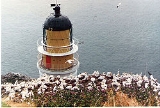
Bass Rock

Encyclopedia
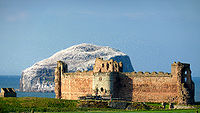
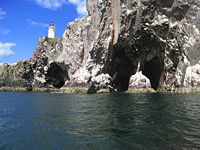
The Bass Rock, or simply The Bass, (icon), is an island in the outer part of the Firth of Forth
in the east of Scotland
. It is approximately 2 kilometres (1.2 mi) offshore, and 5 kilometres (3.1 mi) north-east of North Berwick
. It is a steep-sided volcanic rock, 107 metres (351 ft) at its highest point, and is home to a large colony of gannet
s. The rock is currently uninhabited, but historically has been settled by an early Christian hermit, and later was the site of an important castle, which was, after the Commonwealth, used as a prison. The island was in the ownership of the Lauder family for almost six centuries, and now belongs to Sir Hew Fleetwood Hamilton-Dalrymple. A lighthouse was constructed on the rock in 1902, and the remains of a chapel are located there. The Bass Rock features in numerous works of fiction, including Robert Stevenson
's Catriona and The Lion is Rampant by contemporary Scottish novelist Ross Laidlaw
.
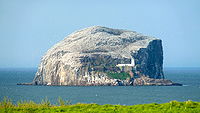
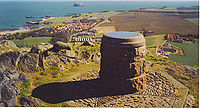 The island is a volcanic plug
of phonolitic
trachyte
rock of Carboniferous
(Dinantian
) age. The rock was first recognised as an igneous intrusion
by James Hutton
, while Hugh Miller
visited in 1847 and wrote about the Rock's geology in his book Edinburgh and its Neighbourhood, Geological and Historical: with The Geology of the Bass Rock.
The island has been privately owned by the Hamilton-Dalrymple family for 300 years. It stands over 100 m high in the Firth of Forth Islands Special Protection Area
which covers some, but not all of the islands in the inner and outer Firth. The Bass Rock is a Site of Special Scientific Interest
in its own right, due to its gannet
colony. It is sometimes called "the Ailsa Craig
of the East". It is of a similar geological form to nearby North Berwick Law
, a hill on the mainland. There are a couple of related volcanic formations within nearby Edinburgh
, namely Arthur's Seat
and Castle Rock.
Much of the island is surrounded by steep cliffs and rocks, with a slope facing south south west which inclines at a steep angle.
The Bass does not occupy the skyline of the Firth quite as much as its equivalent in the Clyde, Ailsa Craig, but it can be seen from much of southern and eastern Fife
, most of East Lothian, and high points in the Lothians and Borders, such as Arthur's Seat
, and the Lammermuir.
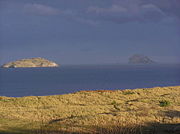 The Bass is one of a small string of islands off part of the East Lothian
coast, which in turn are considered some of the Islands of the Forth
. To the west are Craigleith
, and the Lamb
, Fidra
and finally to the west of Fidra, the low lying island of Eyebroughy
. These are also mainly the result of volcanic activity.
To the north east, the Isle of May
on the coast of the East Neuk
of Fife, can be seen.
is said to have lived there in 600 A.D.
of The Bass family (from whom Sir Harry Lauder
is descended), who are the earliest recorded proprietors. According to legend, the island is said to have been a gift from King Malcolm III of Scotland. Their crest is, appropriately, a Gannet standing upon a rock.
The family had from an early date a castle on the island. Sir Robert de Lawedre is mentioned by Blind Harry
in The Actes and Deidis of the Illustre and Vallyeant Campioun Schir William Wallace
as a compatriot of William Wallace
, and Alexander Nisbet
recorded his tombstone in 1718, in the floor of the old kirk in North Berwick
: "here lies Sir Robert de Lawedre, great laird of The Bass, who died May 1311". Five years later his son received that part of the island which until then had been retained by The Church because it contained the holy cell of Saint Baldred
. A century on Wyntown
's Cronykil relates: "In 1406 King Robert III
, apprehensive of danger to his son James (afterwards James I
) from the Duke of Albany, placed the youthful prince in the safe-custody of Sir Robert Lauder in his secure castle on The Bass prior to an embarkation for safer parts on the continent." Subsequently, says Tytler
, "Sir Robert Lauder of The Bass was one of the few people whom King James I admitted to his confidence." In 1424 Sir Robert Lauder of The Bass, with 18 men, had a safe-conduct with a host of other noblemen, as a hostage for James I at Durham
. J J Reid also mentions that "in 1424 when King James I returned from his long captivity in England, he at once consigned to the castle of The Bass, Walter Stewart, the eldest son of Murdoch Stewart, Duke of Albany, his cousin. The person who received the payments for the prisoner's support was Sir Robert Lauder", whom Tytler further describes as "a firm friend of the King".
 Hector Boece
offers the following description (original spelling):
visited the Bass and stayed in the castle with a later Sir Robert Lauder of The Bass
(d.bef Feb 1508). The boatmen who conveyed the King from Dunbar
were paid 14 shillings. George Lauder of The Bass
entertained King James VI of Scotland when he visited The Bass in 1581 and was so enamoured that he offered to buy the island, a proposition which did not commend itself to George Lauder. The King appears to have accepted the situation with good grace. George was a Privy Counsellor - described as the King's "familiar councillor" - and tutor to the young Prince Henry
.
consigned several of his political enemies, including Walter Stewart to The Bass. In this period, many members of Clan MacKay
ended up here, including, Neil Bhass MacKay (Niall "Bhas" MacAoidh), who gained his epithet from being imprisoned there as a fourteen year old in 1428. He was kept there as a hostage, after his father, Aonghas Dubh (Angus Dhu) of Strathnaver
in Sutherland
was released, as security. According to one Website
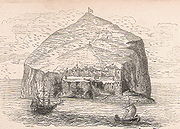 After almost 600 years, the Lauders lost The Bass during Cromwell's invasion, and the castle subsequently (in 1671) became a notorious gaol for many decades where many religious and political prisoners including Prophet Peden
were sent. John Blackadder, the best known of the Covenanting martyrs, died on the Bass in 1686. He is buried at North Berwick, where a United Free Church was named after him.
Charles Maitland, 3rd Earl of Lauderdale
held the Bass for James VII
for a brief period after the Scottish parliament declared his abdication. The fortress was destroyed by the government in 1701.
, built in 1902 by David Stevenson
, who demolished the 13th century keep, or governor's house, and some other buildings within the castle for the stone. The Commissioners of the Northern Lighthouse Board
decided that a lighthouse should be erected on the Bass Rock in July 1897 along with another light at Barns Ness near Dunbar
. The cost of constructing the Bass Rock light was £8,087, a light first being shone from the rock on the evening of 1 November 1902. It has been unmanned since 1988 and is remotely monitored from the Board’s headquarters in Edinburgh
. Until the automation the lighthouse was lit by incandescent gas obtained from vaporised paraffin oil
converted into a bunsen gas for heating a mantle. Since that time a new Biform ML300 synchronised bifilament 20 watt electric lamp has been used.
, which naturally follows the lie of the ground, having sundry projections and round bastions where a rocky projection offers a suitable foundation. The parapet
s are battlemented, with the usual walk along the top of the walls. Another curtain wall at right-angles runs down to the sea close to the landing-place, ending in a ruined round tower, whose vaulted base has poorly splayed and apparently rather unskillfully constructed embrasure
s. The entrance passes through this outwork wall close to where it joins the other.
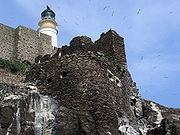 The main defences are entered a little farther on in the same line, through a projecting two-story building which has some fireplaces with very simple and late mouldings. The buildings are of the local basalt
, and the masonry is rough rubble; there are, as is so frequently the case, no very clear indications for dating the different parts, which were in all probability erected at different times.
A little beyond the entrance there is a tower that formed a simple bastion and to which has been added a gabled chamber in the 17th century, which, though of restricted dimensions, must have been comfortable enough, with blue Dutch tiles round its moulded fireplace, now very much decayed.
well
was right at the top of the island, where today the foghorn
is situated.
Half-way up the island stands the ruin of St Baldred's Chapel, which is sited upon a cell or cave in which this Scottish Saint spent some time. Although the Lauders held most of the Bass Rock, this part of it had remained in the ownership of The Church until 1316 when it was granted to the family. The chapel appears to have been rebuilt by the Lauder family several times. A Papal Bull
dated 6 May 1493, refers to the Parish Church
of the Bass, or the Chapel of St Baldred, being "noviter erecta" at that time. On the 5 January 1542 we find John Lauder
, son of Sir Robert Lauder of The Bass
, Knt., as "the Cardinal's Secretary" representing Cardinal David Beaton
at a reconsecration of the restored and ancient St. Baldred's chapel on The Bass. In 1576 it is recorded that the Church on the Bass, and that at Auldhame (on the mainland), required no readers, doubtless something to do with the Reformation
.
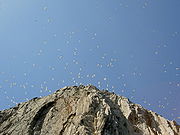 The island plays host to more than 150,000 Gannets and is the largest single rock gannetry in the world, described famously by Sir David Attenborough as "one of the wildlife wonders of the world". When viewed from the mainland, large regions of the surface appear white due to the sheer number of birds (and their droppings, which give off 152,000 kg of ammonia
per year, equivalent to the achievements of 10 million broiler
s). In fact the scientific name for the Northern Gannet
, Sula bassana or Morus bassanus, derives its name from the rock. They were traditionally known locally as 'Solan Goose'. In common with other gannetries, such as St Kilda
, the birds were harvested for their eggs and flesh which were considered delicacies. It is estimated that in 1850 almost 2,000 birds were harvested from the rock. Other bird species that frequent the rock include Guillemot
, Razorbill
, Cormorant
, Puffin
, Eider Duck
and numerous gulls.
The natural history of the rock was written about almost five hundred years ago in John Mair
's De Gestis Scotorum ("The deeds of the Scots") published in 1521. Today, the Scottish Seabird Centre
at North Berwick has solar powered cameras located on the island which beam back live close up images of the seabirds to large screens on the mainland, just over a mile away. The images are sharp enough for visitors at the Scottish Seabird Centre to read the ID rings on birds' feet. The Seabird Centre has 10 cameras located on the islands of the Forth and also broadcasts the images live on the internet. The Centre also has exclusive landing rights to the island from the owner Sir Hew Hamilton-Dalrymple and operates a limited number of photographic boat trips to the islands throughout the year, weather permitting.
and Steep Holm
.
 Due to its imposing nature, prison and connection with Scottish history, the Bass has been featured in several fictional works.
had at least one strong connection with the Bass, as his cousin, David Stevenson
, designed the lighthouse there. Amongst his earliest memories were holidays in North Berwick
. He often stayed at Scoughall Farm
, whence the Bass can be seen, and some local folklore gave him the inspiration for his short story The Wreckers.
Catriona
is Stevenson's
1893 sequel to Kidnapped
. Both novels are set in the aftermath of the Jacobite Risings, in the mid-18th century. The first part of the Catriona recounts the attempts of the hero - David Balfour - to gain justice for James Stewart - James of the Glens - who has been arrested and charged with complicity in the Appin Murder
. David makes a statement to a lawyer, and goes on to meet Lord Prestongrange
- the Lord Advocate
- to press the case for James' innocence. However his attempts fail as he is once again kidnapped and confined on the Bass Rock, until the trial is over, and James condemned to death.
The book begins with a dedication to Charles Baxter, a friend of Stevenson, written in his home in Western Samoa and says:
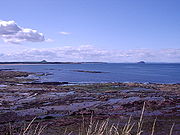 Chapter XIV is entitled simply, The Bass, and gives a long description of the island, which is described as "just the one crag of rock, as everybody knows, but great enough to carve a city from."
used Bass Rock as the miraculous destination of the "Garden of Eden", a dance hall of dubious reputation in Father Malachy's Miracle
a 1938 novel.
During an argument with a Protestant minister, Father Malachy, claims that God could miraculously remove the "Garden of Eden." The Protestant scoffs and Father Malachy inadvertently predicts that God will indeed remove the "Garden of Eden" on a specific date.
The date comes and the building and all people inside vanish and reappear on Bass Rock. This apparent miracle
draws the attention of the media, politicians and scientists, all trying to find rational explanations. The Catholic Church is reluctant to officially recognize this occurrence as a miracle, both fearing a loss of control in matters of faith, or a loss of face if the disappearance of the "Garden of Eden" would turn out to be a fabrication.
The novel was the basis for the German
film Das Wunder des Malachias a 1961 black-and-white film directed by Bernhard Wicki and starring Horst Bollmann
. The film did not specify Bass Rock as the destination of the offending dance hall.
This meant to do something impossible.
Firth of Forth
The Firth of Forth is the estuary or firth of Scotland's River Forth, where it flows into the North Sea, between Fife to the north, and West Lothian, the City of Edinburgh and East Lothian to the south...
in the east of Scotland
Scotland
Scotland is a country that is part of the United Kingdom. Occupying the northern third of the island of Great Britain, it shares a border with England to the south and is bounded by the North Sea to the east, the Atlantic Ocean to the north and west, and the North Channel and Irish Sea to the...
. It is approximately 2 kilometres (1.2 mi) offshore, and 5 kilometres (3.1 mi) north-east of North Berwick
North Berwick
The Royal Burgh of North Berwick is a seaside town in East Lothian, Scotland. It is situated on the south shore of the Firth of Forth, approximately 25 miles east of Edinburgh. North Berwick became a fashionable holiday resort in the 19th century because of its two sandy bays, the East Bay and the...
. It is a steep-sided volcanic rock, 107 metres (351 ft) at its highest point, and is home to a large colony of gannet
Gannet
Gannets are seabirds comprising the genus Morus, in the family Sulidae, closely related to the boobies.The gannets are large black and white birds with yellow heads. They have long pointed wings and long bills. Northern gannets are the largest seabirds in the North Atlantic, with a wingspan of up...
s. The rock is currently uninhabited, but historically has been settled by an early Christian hermit, and later was the site of an important castle, which was, after the Commonwealth, used as a prison. The island was in the ownership of the Lauder family for almost six centuries, and now belongs to Sir Hew Fleetwood Hamilton-Dalrymple. A lighthouse was constructed on the rock in 1902, and the remains of a chapel are located there. The Bass Rock features in numerous works of fiction, including Robert Stevenson
Robert Louis Stevenson
Robert Louis Balfour Stevenson was a Scottish novelist, poet, essayist and travel writer. His best-known books include Treasure Island, Kidnapped, and Strange Case of Dr Jekyll and Mr Hyde....
's Catriona and The Lion is Rampant by contemporary Scottish novelist Ross Laidlaw
Ross Laidlaw
Ross Laidlaw is a Scottish writer of historical, thriller and spy fiction.-Biography:Laidlaw was born in Aberdeen and now lives in East Lothian. He attended the University of Cambridge and has spent time working and traveling in southern Africa...
.
Geography and geology
Volcanic plug
A volcanic plug, also called a volcanic neck or lava neck, is a volcanic landform created when magma hardens within a vent on an active volcano. When forming, a plug can cause an extreme build-up of pressure if volatile-charged magma is trapped beneath it, and this can sometimes lead to an...
of phonolitic
Phonolite
Phonolite is a rare igneous, volcanic rock of intermediate composition, with aphanitic to porphyritic texture....
trachyte
Trachyte
Trachyte is an igneous volcanic rock with an aphanitic to porphyritic texture. The mineral assemblage consists of essential alkali feldspar; relatively minor plagioclase and quartz or a feldspathoid such as nepheline may also be present....
rock of Carboniferous
Carboniferous
The Carboniferous is a geologic period and system that extends from the end of the Devonian Period, about 359.2 ± 2.5 Mya , to the beginning of the Permian Period, about 299.0 ± 0.8 Mya . The name is derived from the Latin word for coal, carbo. Carboniferous means "coal-bearing"...
(Dinantian
Dinantian
Dinantian is the name of a series or epoch from the Lower Carboniferous system in Europe. It can stand for a series of rocks in Europe or the time span in which they were deposited....
) age. The rock was first recognised as an igneous intrusion
Intrusion
An intrusion is liquid rock that forms under Earth's surface. Magma from under the surface is slowly pushed up from deep within the earth into any cracks or spaces it can find, sometimes pushing existing country rock out of the way, a process that can take millions of years. As the rock slowly...
by James Hutton
James Hutton
James Hutton was a Scottish physician, geologist, naturalist, chemical manufacturer and experimental agriculturalist. He is considered the father of modern geology...
, while Hugh Miller
Hugh Miller
Hugh Miller was a self-taught Scottish geologist and writer, folklorist and an evangelical Christian.- Life and work :Born in Cromarty, he was educated in a parish school where he reportedly showed a love of reading. At 17 he was apprenticed to a stonemason, and his work in quarries, together with...
visited in 1847 and wrote about the Rock's geology in his book Edinburgh and its Neighbourhood, Geological and Historical: with The Geology of the Bass Rock.
The island has been privately owned by the Hamilton-Dalrymple family for 300 years. It stands over 100 m high in the Firth of Forth Islands Special Protection Area
Special Protection Area
A Special Protection Area or SPA is a designation under the European Union Directive on the Conservation of Wild Birds.Under the Directive, Member States of the European Union have a duty to safeguard the habitats of migratory birds and certain particularly threatened birds.Together with Special...
which covers some, but not all of the islands in the inner and outer Firth. The Bass Rock is a Site of Special Scientific Interest
Site of Special Scientific Interest
A Site of Special Scientific Interest is a conservation designation denoting a protected area in the United Kingdom. SSSIs are the basic building block of site-based nature conservation legislation and most other legal nature/geological conservation designations in Great Britain are based upon...
in its own right, due to its gannet
Gannet
Gannets are seabirds comprising the genus Morus, in the family Sulidae, closely related to the boobies.The gannets are large black and white birds with yellow heads. They have long pointed wings and long bills. Northern gannets are the largest seabirds in the North Atlantic, with a wingspan of up...
colony. It is sometimes called "the Ailsa Craig
Ailsa Craig
Ailsa Craig is an island of 219.69 acres in the outer Firth of Clyde, Scotland where blue hone granite was quarried to make curling stones. "Ailsa" is pronounced "ale-sa", with the first syllable stressed...
of the East". It is of a similar geological form to nearby North Berwick Law
North Berwick Law
North Berwick Law is a conical hill which rises incongruously from the surrounding landscape . It overlooks the East Lothian town of North Berwick and stands at 613 ft above sea level.Geologically, the law is a volcanic plug of hard phonolitic trachyte rock of Carboniferous age...
, a hill on the mainland. There are a couple of related volcanic formations within nearby Edinburgh
Edinburgh
Edinburgh is the capital city of Scotland, the second largest city in Scotland, and the eighth most populous in the United Kingdom. The City of Edinburgh Council governs one of Scotland's 32 local government council areas. The council area includes urban Edinburgh and a rural area...
, namely Arthur's Seat
Arthur's Seat, Edinburgh
Arthur's Seat is the main peak of the group of hills which form most of Holyrood Park, described by Robert Louis Stevenson as "a hill for magnitude, a mountain in virtue of its bold design". It is situated in the centre of the city of Edinburgh, about a mile to the east of Edinburgh Castle...
and Castle Rock.
Much of the island is surrounded by steep cliffs and rocks, with a slope facing south south west which inclines at a steep angle.
The Bass does not occupy the skyline of the Firth quite as much as its equivalent in the Clyde, Ailsa Craig, but it can be seen from much of southern and eastern Fife
Fife
Fife is a council area and former county of Scotland. It is situated between the Firth of Tay and the Firth of Forth, with inland boundaries to Perth and Kinross and Clackmannanshire...
, most of East Lothian, and high points in the Lothians and Borders, such as Arthur's Seat
Arthur's Seat, Edinburgh
Arthur's Seat is the main peak of the group of hills which form most of Holyrood Park, described by Robert Louis Stevenson as "a hill for magnitude, a mountain in virtue of its bold design". It is situated in the centre of the city of Edinburgh, about a mile to the east of Edinburgh Castle...
, and the Lammermuir.
Surrounding Islands
East Lothian
East Lothian is one of the 32 council areas of Scotland, and a lieutenancy Area. It borders the City of Edinburgh, Scottish Borders and Midlothian. Its administrative centre is Haddington, although its largest town is Musselburgh....
coast, which in turn are considered some of the Islands of the Forth
Islands of the Forth
The Islands of the Forth are a minor island group to the east of Scotland. The open waters of the Firth of Forth lie between Fife and the Lothians and contain most of the islands. The majority lie east of city of Edinburgh although two are to the west and two more lie in the estuary of the River...
. To the west are Craigleith
Craigleith
Craigleith is a small island in the Firth of Forth off North Berwick in East Lothian, Scotland. Its name comes from the Scottish Gaelic Creag Lìte meaning "rock of Leith". It is 24 m at its highest point.-Geography and geology:...
, and the Lamb
The Lamb (island)
The Lamb, sometimes called Lamb Island or just Lamb, is a small , uninhabited island between the islands of Fidra and Craigleith in the Firth of Forth, off the south-east coast of Scotland...
, Fidra
Fidra
Fidra is an uninhabited island in the Firth of Forth, north-west of North Berwick, on the east coast of Scotland.-Geography:...
and finally to the west of Fidra, the low lying island of Eyebroughy
Eyebroughy
Eyebroughy is an islet in the Firth of Forth, 200 m off East Lothian, Scotland. It is not far from Gullane and 3 miles from North Berwick, and forms part of the parish of Dirleton ....
. These are also mainly the result of volcanic activity.
To the north east, the Isle of May
Isle of May
The Isle of May is located in the north of the outer Firth of Forth, approximately off the coast of mainland Scotland. It is 1.8 km long and less than half a kilometre wide...
on the coast of the East Neuk
East Neuk
The East Neuk or East Neuk of Fife is an area of the coast of Fife, Scotland, which is geographically ill-defined but nonetheless stirs local passions....
of Fife, can be seen.
History
The island was a retreat for early Christian hermits; St BaldredBaldred of Tyninghame
Balthere of Tyninghame was a Northumbrian hermit and abbot, resident in East Lothian during the 8th century.-Dating:According to Hovendeus the date of Baldred's death is given as 756. Symeon of Durham says "the twentieth year of King Eadberht of Northumbria " and Turgot of Durham "the...
is said to have lived there in 600 A.D.
The Lauder Family
Historically the home of the LauderLauder
The Royal Burgh of Lauder is a town in the Scottish Borders 27 miles south east of Edinburgh. It is also a royal burgh in the county of Berwickshire. It lies on the edge of the Lammermuir Hills, on the Southern Upland Way.-Medieval history:...
of The Bass family (from whom Sir Harry Lauder
Harry Lauder
Sir Henry Lauder , known professionally as Harry Lauder, was an international Scottish entertainer, described by Sir Winston Churchill as "Scotland's greatest ever ambassador!"-Early life:...
is descended), who are the earliest recorded proprietors. According to legend, the island is said to have been a gift from King Malcolm III of Scotland. Their crest is, appropriately, a Gannet standing upon a rock.
The family had from an early date a castle on the island. Sir Robert de Lawedre is mentioned by Blind Harry
Blind Harry
Blind Harry , also known as Harry, Hary or Henry the Minstrel, is renowned as the author of The Actes and Deidis of the Illustre and Vallyeant Campioun Schir William Wallace, also known as The Wallace...
in The Actes and Deidis of the Illustre and Vallyeant Campioun Schir William Wallace
The Actes and Deidis of the Illustre and Vallyeant Campioun Schir William Wallace
The Actes and Deidis of the Illustre and Vallyeant Campioun Schir William Wallace, also known as The Wallace, is a long "romantic biographical" poem by the fifteenth century Scottish makar of the name Blind Harry probably at some time in the decade before 1488...
as a compatriot of William Wallace
William Wallace
Sir William Wallace was a Scottish knight and landowner who became one of the main leaders during the Wars of Scottish Independence....
, and Alexander Nisbet
Alexander Nisbet
Alexander Nisbet is one of the most important authors on Scottish heraldry. He is still much-cited, and his publications are still in print after nearly 300 years....
recorded his tombstone in 1718, in the floor of the old kirk in North Berwick
North Berwick
The Royal Burgh of North Berwick is a seaside town in East Lothian, Scotland. It is situated on the south shore of the Firth of Forth, approximately 25 miles east of Edinburgh. North Berwick became a fashionable holiday resort in the 19th century because of its two sandy bays, the East Bay and the...
: "here lies Sir Robert de Lawedre, great laird of The Bass, who died May 1311". Five years later his son received that part of the island which until then had been retained by The Church because it contained the holy cell of Saint Baldred
Baldred of Tyninghame
Balthere of Tyninghame was a Northumbrian hermit and abbot, resident in East Lothian during the 8th century.-Dating:According to Hovendeus the date of Baldred's death is given as 756. Symeon of Durham says "the twentieth year of King Eadberht of Northumbria " and Turgot of Durham "the...
. A century on Wyntown
Andrew of Wyntoun
Andrew Wyntoun, known as Andrew of Wyntoun was a Scottish poet, a canon and prior of Loch Leven on St Serf's Inch and later, a canon of St...
's Cronykil relates: "In 1406 King Robert III
Robert III of Scotland
Robert III was King of Scots from 1390 to his death. His given name was John Stewart, and he was known primarily as the Earl of Carrick before ascending the throne at age 53...
, apprehensive of danger to his son James (afterwards James I
James I of Scotland
James I, King of Scots , was the son of Robert III and Annabella Drummond. He was probably born in late July 1394 in Dunfermline as youngest of three sons...
) from the Duke of Albany, placed the youthful prince in the safe-custody of Sir Robert Lauder in his secure castle on The Bass prior to an embarkation for safer parts on the continent." Subsequently, says Tytler
Patrick Fraser Tytler
Patrick Fraser Tytler was a Scottish historian.-Life:The son of Lord Woodhouselee, he was born in Edinburgh, where he attended the Royal High School. He was called to the bar in 1813; in 1816 he became King's counsel in the Exchequer, and practised as an advocate until 1832...
, "Sir Robert Lauder of The Bass was one of the few people whom King James I admitted to his confidence." In 1424 Sir Robert Lauder of The Bass, with 18 men, had a safe-conduct with a host of other noblemen, as a hostage for James I at Durham
Durham
Durham is a city in north east England. It is within the County Durham local government district, and is the county town of the larger ceremonial county...
. J J Reid also mentions that "in 1424 when King James I returned from his long captivity in England, he at once consigned to the castle of The Bass, Walter Stewart, the eldest son of Murdoch Stewart, Duke of Albany, his cousin. The person who received the payments for the prisoner's support was Sir Robert Lauder", whom Tytler further describes as "a firm friend of the King".
Hector Boece
Hector Boece
Hector Boece , known in Latin as Hector Boecius or Boethius, was a Scottish philosopher and first Principal of King's College in Aberdeen, a predecessor of the University of Aberdeen.-Biography:He was born in Dundee where he attended school...
offers the following description (original spelling):
- "ane wounderful crag, risand within the sea, with so narrow and strait hals [passage] that na schip nor boit bot allanerlie at ane part of it. This crag is callet the Bas; unwinnabil by ingine [ingenuity] of man. In it are coves, als profitable for defence of men as [if] thay were biggit be crafty industry. Every thing that is in that crag is ful of admiration and wounder."
Royal visits
In 1497 King James IVJames IV of Scotland
James IV was King of Scots from 11 June 1488 to his death. He is generally regarded as the most successful of the Stewart monarchs of Scotland, but his reign ended with the disastrous defeat at the Battle of Flodden Field, where he became the last monarch from not only Scotland, but also from all...
visited the Bass and stayed in the castle with a later Sir Robert Lauder of The Bass
Robert Lauder of The Bass
Sir Robert Lauder of The Bass, was a Scottish knight, armiger, and Governor of the Castle at Berwick-upon-Tweed. He was also a member of the old Scottish Parliament...
(d.bef Feb 1508). The boatmen who conveyed the King from Dunbar
Dunbar
Dunbar is a town in East Lothian on the southeast coast of Scotland, approximately 28 miles east of Edinburgh and 28 miles from the English Border at Berwick-upon-Tweed....
were paid 14 shillings. George Lauder of The Bass
George Lauder of The Bass
Sir George Lauder of The Bass, Knt., , was a cleric, Privy Counsellor, and Member of the Scottish Parliament. He was also Tutor to Henry Frederick, Prince of Wales.-Family:...
entertained King James VI of Scotland when he visited The Bass in 1581 and was so enamoured that he offered to buy the island, a proposition which did not commend itself to George Lauder. The King appears to have accepted the situation with good grace. George was a Privy Counsellor - described as the King's "familiar councillor" - and tutor to the young Prince Henry
Henry Frederick, Prince of Wales
Henry Frederick Stuart, Prince of Wales was the elder son of King James I & VI and Anne of Denmark. His name derives from his grandfathers: Henry Stuart, Lord Darnley and Frederick II of Denmark. Prince Henry was widely seen as a bright and promising heir to his father's throne...
.
Famous prisoners
During the 15th century James IJames I of Scotland
James I, King of Scots , was the son of Robert III and Annabella Drummond. He was probably born in late July 1394 in Dunfermline as youngest of three sons...
consigned several of his political enemies, including Walter Stewart to The Bass. In this period, many members of Clan MacKay
Clan MacKay
Clan Mackay is an ancient and once powerful Scottish clan from the far north of the Scottish Highlands, but with roots in the old kingdom of Moray. They were a powerful force in politics beginning in the 14th century, supporting Robert the Bruce. In the centuries that followed they were...
ended up here, including, Neil Bhass MacKay (Niall "Bhas" MacAoidh), who gained his epithet from being imprisoned there as a fourteen year old in 1428. He was kept there as a hostage, after his father, Aonghas Dubh (Angus Dhu) of Strathnaver
Strathnaver
Strathnaver or Strath Naver is the fertile strath of the River Naver, a famous salmon river that flows from Loch Naver to the north coast of Scotland...
in Sutherland
Sutherland
Sutherland is a registration county, lieutenancy area and historic administrative county of Scotland. It is now within the Highland local government area. In Gaelic the area is referred to according to its traditional areas: Dùthaich 'IcAoidh , Asainte , and Cataibh...
was released, as security. According to one Website
- " Following the murder of King James at PerthPerth, ScotlandPerth is a town and former city and royal burgh in central Scotland. Located on the banks of the River Tay, it is the administrative centre of Perth and Kinross council area and the historic county town of Perthshire...
in 1437 Neil escaped from the Bass and was proclaimed 8th Chief of the Clan Mackay."
Cromwellian invasion and after
Alexander Peden
Alexander Peden , also known as Prophet Peden, was one of the leading forces in the Covenanter movement, was born at Auchincloich Farm near Sorn, Ayrshire, about 1626, and was educated at the University of Glasgow...
were sent. John Blackadder, the best known of the Covenanting martyrs, died on the Bass in 1686. He is buried at North Berwick, where a United Free Church was named after him.
Charles Maitland, 3rd Earl of Lauderdale
Charles Maitland, 3rd Earl of Lauderdale
Charles Maitland, 3rd Earl of Lauderdale , was the second son of John Maitland, 1st Earl of Lauderdale ....
held the Bass for James VII
James II of England
James II & VII was King of England and King of Ireland as James II and King of Scotland as James VII, from 6 February 1685. He was the last Catholic monarch to reign over the Kingdoms of England, Scotland, and Ireland...
for a brief period after the Scottish parliament declared his abdication. The fortress was destroyed by the government in 1701.
Lighthouse
The island is home to a 20 metre lighthouseLighthouse
A lighthouse is a tower, building, or other type of structure designed to emit light from a system of lamps and lenses or, in older times, from a fire, and used as an aid to navigation for maritime pilots at sea or on inland waterways....
, built in 1902 by David Stevenson
David Alan Stevenson
David Alan Stevenson was a lighthouse engineer who built twenty six lighthouses in and around Scotland.Born into the famous Stevenson family of lighthouse engineers, son of David Stevenson, brother of Charles Stevenson, and nephew of Thomas Stevenson, he was educated at Edinburgh University...
, who demolished the 13th century keep, or governor's house, and some other buildings within the castle for the stone. The Commissioners of the Northern Lighthouse Board
Northern Lighthouse Board
The Northern Lighthouse Board is the General Lighthouse Authority for Scotland and the Isle of Man. It is a non-departmental public body responsible for marine navigation aids around coastal areas.-History:...
decided that a lighthouse should be erected on the Bass Rock in July 1897 along with another light at Barns Ness near Dunbar
Dunbar
Dunbar is a town in East Lothian on the southeast coast of Scotland, approximately 28 miles east of Edinburgh and 28 miles from the English Border at Berwick-upon-Tweed....
. The cost of constructing the Bass Rock light was £8,087, a light first being shone from the rock on the evening of 1 November 1902. It has been unmanned since 1988 and is remotely monitored from the Board’s headquarters in Edinburgh
Edinburgh
Edinburgh is the capital city of Scotland, the second largest city in Scotland, and the eighth most populous in the United Kingdom. The City of Edinburgh Council governs one of Scotland's 32 local government council areas. The council area includes urban Edinburgh and a rural area...
. Until the automation the lighthouse was lit by incandescent gas obtained from vaporised paraffin oil
Paraffin
In chemistry, paraffin is a term that can be used synonymously with "alkane", indicating hydrocarbons with the general formula CnH2n+2. Paraffin wax refers to a mixture of alkanes that falls within the 20 ≤ n ≤ 40 range; they are found in the solid state at room temperature and begin to enter the...
converted into a bunsen gas for heating a mantle. Since that time a new Biform ML300 synchronised bifilament 20 watt electric lamp has been used.
Castle
Not far above the landing-place the slope is crossed by a curtain wallCurtain wall (fortification)
A curtain wall is a defensive wall between two bastions of a castle or fortress.In earlier designs of castle the curtain walls were often built to a considerable height and were fronted by a ditch or moat to make assault difficult....
, which naturally follows the lie of the ground, having sundry projections and round bastions where a rocky projection offers a suitable foundation. The parapet
Parapet
A parapet is a wall-like barrier at the edge of a roof, terrace, balcony or other structure. Where extending above a roof, it may simply be the portion of an exterior wall that continues above the line of the roof surface, or may be a continuation of a vertical feature beneath the roof such as a...
s are battlemented, with the usual walk along the top of the walls. Another curtain wall at right-angles runs down to the sea close to the landing-place, ending in a ruined round tower, whose vaulted base has poorly splayed and apparently rather unskillfully constructed embrasure
Embrasure
In military architecture, an embrasure is the opening in a crenellation or battlement between the two raised solid portions or merlons, sometimes called a crenel or crenelle...
s. The entrance passes through this outwork wall close to where it joins the other.
Basalt
Basalt is a common extrusive volcanic rock. It is usually grey to black and fine-grained due to rapid cooling of lava at the surface of a planet. It may be porphyritic containing larger crystals in a fine matrix, or vesicular, or frothy scoria. Unweathered basalt is black or grey...
, and the masonry is rough rubble; there are, as is so frequently the case, no very clear indications for dating the different parts, which were in all probability erected at different times.
A little beyond the entrance there is a tower that formed a simple bastion and to which has been added a gabled chamber in the 17th century, which, though of restricted dimensions, must have been comfortable enough, with blue Dutch tiles round its moulded fireplace, now very much decayed.
Well and chapel
During the 16th and 17th centuries there was sufficient grass present for 100 sheep to graze. The freshwaterFreshwater
Fresh water is naturally occurring water on the Earth's surface in ice sheets, ice caps, glaciers, bogs, ponds, lakes, rivers and streams, and underground as groundwater in aquifers and underground streams. Fresh water is generally characterized by having low concentrations of dissolved salts and...
well
Water well
A water well is an excavation or structure created in the ground by digging, driving, boring or drilling to access groundwater in underground aquifers. The well water is drawn by an electric submersible pump, a trash pump, a vertical turbine pump, a handpump or a mechanical pump...
was right at the top of the island, where today the foghorn
Foghorn
A foghorn or fog signal or fog bell is a device that uses sound to warn vehicles of hazards or boats of the presence of other vehicles in foggy conditions. The term is most often used in relation to marine transport...
is situated.
Half-way up the island stands the ruin of St Baldred's Chapel, which is sited upon a cell or cave in which this Scottish Saint spent some time. Although the Lauders held most of the Bass Rock, this part of it had remained in the ownership of The Church until 1316 when it was granted to the family. The chapel appears to have been rebuilt by the Lauder family several times. A Papal Bull
Papal bull
A Papal bull is a particular type of letters patent or charter issued by a Pope of the Catholic Church. It is named after the bulla that was appended to the end in order to authenticate it....
dated 6 May 1493, refers to the Parish Church
Parish church
A parish church , in Christianity, is the church which acts as the religious centre of a parish, the basic administrative unit of episcopal churches....
of the Bass, or the Chapel of St Baldred, being "noviter erecta" at that time. On the 5 January 1542 we find John Lauder
John Lauder
John Lauder was Scotland's Public Accuser of Heretics.- Family :In the Great Seal of Scotland, - "the King grants Letters of legitimate for John Lauder, bastard son of Sir Robert Lauder of The Bass", knight,...
, son of Sir Robert Lauder of The Bass
Robert Lauder of The Bass
Sir Robert Lauder of The Bass, was a Scottish knight, armiger, and Governor of the Castle at Berwick-upon-Tweed. He was also a member of the old Scottish Parliament...
, Knt., as "the Cardinal's Secretary" representing Cardinal David Beaton
David Beaton
The Most Rev. Dr. David Cardinal Beaton was Archbishop of St Andrews and the last Scottish Cardinal prior to the Reformation.-Career:...
at a reconsecration of the restored and ancient St. Baldred's chapel on The Bass. In 1576 it is recorded that the Church on the Bass, and that at Auldhame (on the mainland), required no readers, doubtless something to do with the Reformation
Protestant Reformation
The Protestant Reformation was a 16th-century split within Western Christianity initiated by Martin Luther, John Calvin and other early Protestants. The efforts of the self-described "reformers", who objected to the doctrines, rituals and ecclesiastical structure of the Roman Catholic Church, led...
.
Wildlife
Ammonia
Ammonia is a compound of nitrogen and hydrogen with the formula . It is a colourless gas with a characteristic pungent odour. Ammonia contributes significantly to the nutritional needs of terrestrial organisms by serving as a precursor to food and fertilizers. Ammonia, either directly or...
per year, equivalent to the achievements of 10 million broiler
Broiler
A broiler is a type of chicken raised specifically for meat production. Modern commercial broilers, typically known as Cornish crosses or Cornish-Rocks are specially bred for large scale, efficient meat production and grow much faster than egg or traditional dual purpose breeds...
s). In fact the scientific name for the Northern Gannet
Northern Gannet
The Northern Gannet is a seabird and is the largest member of the gannet family, Sulidae.- Description :Young birds are dark brown in their first year, and gradually acquire more white in subsequent seasons until they reach maturity after five years.Adults are long, weigh and have a wingspan...
, Sula bassana or Morus bassanus, derives its name from the rock. They were traditionally known locally as 'Solan Goose'. In common with other gannetries, such as St Kilda
St Kilda, Scotland
St Kilda is an isolated archipelago west-northwest of North Uist in the North Atlantic Ocean. It contains the westernmost islands of the Outer Hebrides of Scotland. The largest island is Hirta, whose sea cliffs are the highest in the United Kingdom and three other islands , were also used for...
, the birds were harvested for their eggs and flesh which were considered delicacies. It is estimated that in 1850 almost 2,000 birds were harvested from the rock. Other bird species that frequent the rock include Guillemot
Common Guillemot
The Common Murre or Common Guillemot is a large auk. It is also known as the Thin-billed Murre in North America. It has a circumpolar distribution, occurring in low-Arctic and boreal waters in the North-Atlantic and North Pacific...
, Razorbill
Razorbill
The Razorbill is colonial seabird that will only come to land in order to breed. It is the largest living member of the Auk family. This agile bird will choose only one partner for life and females will lay one egg per year. Razorbills will nest along coastal cliffs in enclosed or slightly exposed...
, Cormorant
Great Cormorant
The Great Cormorant , known as the Great Black Cormorant across the Northern Hemisphere, the Black Cormorant in Australia and the Black Shag further south in New Zealand, is a widespread member of the cormorant family of seabirds...
, Puffin
Atlantic Puffin
The Atlantic Puffin is a seabird species in the auk family. It is a pelagic bird that feeds primarily by diving for fish, but also eats other sea creatures, such as squid and crustaceans. Its most obvious characteristic during the breeding season is its brightly coloured bill...
, Eider Duck
Common Eider
The Common Eider, Somateria mollissima, is a large sea-duck that is distributed over the northern coasts of Europe, North America and eastern Siberia. It breeds in Arctic and some northern temperate regions, but winters somewhat farther south in temperate zones, when it can form large flocks on...
and numerous gulls.
The natural history of the rock was written about almost five hundred years ago in John Mair
John Mair
John Mair was a Scottish philosopher, much admired in his day and an acknowledged influence on all the great thinkers of the time. He was a very renowned teacher and his works much collected and frequently republished across Europe...
's De Gestis Scotorum ("The deeds of the Scots") published in 1521. Today, the Scottish Seabird Centre
Scottish Seabird Centre
The Scottish Seabird Centre is a visitor attraction in North Berwick, East Lothian, Scotland. Opened by HRH The Prince of Wales in 2000 and funded by the Millennium Commission, the showpiece of the centre is the network of cameras which beam back live pictures from the bird colonies on islands such...
at North Berwick has solar powered cameras located on the island which beam back live close up images of the seabirds to large screens on the mainland, just over a mile away. The images are sharp enough for visitors at the Scottish Seabird Centre to read the ID rings on birds' feet. The Seabird Centre has 10 cameras located on the islands of the Forth and also broadcasts the images live on the internet. The Centre also has exclusive landing rights to the island from the owner Sir Hew Hamilton-Dalrymple and operates a limited number of photographic boat trips to the islands throughout the year, weather permitting.
Plants
The soil is fertile and supports a wide variety of plants. These include the Bass mallow which is otherwise only found on a few other islands, including Ailsa CraigAilsa Craig
Ailsa Craig is an island of 219.69 acres in the outer Firth of Clyde, Scotland where blue hone granite was quarried to make curling stones. "Ailsa" is pronounced "ale-sa", with the first syllable stressed...
and Steep Holm
Steep Holm
Steep Holm is an English island lying in the Bristol Channel. The island covers at high tide, expanding to at mean low water. At its highest point it is above mean sea level. It lies within the historic boundaries of Somerset and administratively, it forms part of North Somerset...
.
Cultural references
Robert Louis Stevenson and Catriona
Robert Louis StevensonRobert Louis Stevenson
Robert Louis Balfour Stevenson was a Scottish novelist, poet, essayist and travel writer. His best-known books include Treasure Island, Kidnapped, and Strange Case of Dr Jekyll and Mr Hyde....
had at least one strong connection with the Bass, as his cousin, David Stevenson
David Alan Stevenson
David Alan Stevenson was a lighthouse engineer who built twenty six lighthouses in and around Scotland.Born into the famous Stevenson family of lighthouse engineers, son of David Stevenson, brother of Charles Stevenson, and nephew of Thomas Stevenson, he was educated at Edinburgh University...
, designed the lighthouse there. Amongst his earliest memories were holidays in North Berwick
North Berwick
The Royal Burgh of North Berwick is a seaside town in East Lothian, Scotland. It is situated on the south shore of the Firth of Forth, approximately 25 miles east of Edinburgh. North Berwick became a fashionable holiday resort in the 19th century because of its two sandy bays, the East Bay and the...
. He often stayed at Scoughall Farm
Auldhame & Scoughall
Auldhame and Scoughall are hamlets in East Lothian, Scotland. They are close to the town of North Berwick and the village of Whitekirk, and are approximately 25 miles east of Edinburgh.- Saint Baldred's legacy :...
, whence the Bass can be seen, and some local folklore gave him the inspiration for his short story The Wreckers.
Catriona
Catriona (novel)
Catriona is a novel written in 1893 by Robert Louis Stevenson as a sequel to his earlier novel Kidnapped...
is Stevenson's
Robert Louis Stevenson
Robert Louis Balfour Stevenson was a Scottish novelist, poet, essayist and travel writer. His best-known books include Treasure Island, Kidnapped, and Strange Case of Dr Jekyll and Mr Hyde....
1893 sequel to Kidnapped
Kidnapped (novel)
Kidnapped is a historical fiction adventure novel by the Scottish author Robert Louis Stevenson. Written as a "boys' novel" and first published in the magazine Young Folks from May to July 1886, the novel has attracted the praise and admiration of writers as diverse as Henry James, Jorge Luis...
. Both novels are set in the aftermath of the Jacobite Risings, in the mid-18th century. The first part of the Catriona recounts the attempts of the hero - David Balfour - to gain justice for James Stewart - James of the Glens - who has been arrested and charged with complicity in the Appin Murder
Appin Murder
The Appin Murder occurred on May 14, 1752 near Appin in the north-west of Scotland, and it resulted in what is often held to be a notorious miscarriage of justice...
. David makes a statement to a lawyer, and goes on to meet Lord Prestongrange
William Grant, Lord Prestongrange
William Grant , Lord Prestongrange, was a Scottish politician and judge.The second son of Sir Francis Grant, Lord Cullen, he was admitted as an advocate in 1722, was procurator for the Church of Scotland and Clerk to the General Assembly in 1731. He campaigned against patronage in the Church...
- the Lord Advocate
Lord Advocate
Her Majesty's Advocate , known as the Lord Advocate , is the chief legal officer of the Scottish Government and the Crown in Scotland for both civil and criminal matters that fall within the devolved powers of the Scottish Parliament...
- to press the case for James' innocence. However his attempts fail as he is once again kidnapped and confined on the Bass Rock, until the trial is over, and James condemned to death.
The book begins with a dedication to Charles Baxter, a friend of Stevenson, written in his home in Western Samoa and says:
- There should be left in our native city some seed of the elect; some long-legged, hot-headed youth must repeat to-day our dreams and wanderings of so many years ago; he will relish the pleasure, which should have been ours, to follow among named streets and numbered houses the country walks of David Balfour, to identify DeanDean VillageDean Village is a former village immediately northwest of Edinburgh, Scotland city centre. It was known as the "Water of Leith Village" and was a successful grain milling hamlet for more than 800 years. At one time there were no fewer than eleven working mills there, driven by the strong currents...
, and Silvermills, and BroughtonBroughton, EdinburghBroughton is an ancient feudal barony today within the City of Edinburgh, Scotland that was once known for its witchcraft. Its borders are defined, approximately, as being Leith Walk in the south east, Broughton Street in the south west, Broughton Road in the north west and McDonald Road in the...
, and Hope Park, and Pilrig, and poor old Lochend - if it still be standing, and the Figgate Whins [the area near PortobelloPortobello, EdinburghPortobello is a beach resort located three miles to the east of the city centre of Edinburgh, along the coast of the Firth of Forth, in Scotland. It is now a suburb of Edinburgh, with a promenade fronting on to the wide sand beach....
] - if there be any of them left; or to push (on a long holiday) so far afield as GillaneGullaneGullane is a town on the southern shore of the Firth of Forth in East Lothian on the east coast of Scotland. There has been a church in the village since the 9th century. The ruins of the Old Church of St...
or the Bass. So, perhaps, his eye shall be opened to behold the series of the generations, and he shall weigh with surprise his momentous and nugatory gift of life.
- " "It was an unco place by night, unco by day; and there were unco sounds; of the calling of the solans [gannets], and the plash [splash] of the sea, and the rock echoes that hung continually in our ears. It was chiefly so in moderate weather. When the waves were anyway great they roared about the rock like thunder and the drums of armies, dreadful, but merry to hear, and it was in the calm days when a man could daunt himself with listening; so many still, hollow noises haunted and reverberated in the porches of the rock."
Bruce Marshall and Father Malachy's Miracle
Scottish writer Bruce MarshallBruce Marshall
Lieutenant-Colonel Claude Cunningham Bruce Marshall, known as Bruce Marshall was a prolific Scottish writer who wrote fiction and non-fiction books on a wide range of topics and genres. His first book, A Thief in the Night came out in 1918, possibly self-published...
used Bass Rock as the miraculous destination of the "Garden of Eden", a dance hall of dubious reputation in Father Malachy's Miracle
Father Malachy's Miracle
-Plot summary:Next to a church in a prosperous Scottish industrial town is the "Garden of Eden", a dance hall of dubious reputation. The "Garden of Eden" is a thorn in the side of the innocent and unworldly Catholic priest Father Malachy, who is praying to God that He will close the dance...
a 1938 novel.
During an argument with a Protestant minister, Father Malachy, claims that God could miraculously remove the "Garden of Eden." The Protestant scoffs and Father Malachy inadvertently predicts that God will indeed remove the "Garden of Eden" on a specific date.
The date comes and the building and all people inside vanish and reappear on Bass Rock. This apparent miracle
Miracle
A miracle often denotes an event attributed to divine intervention. Alternatively, it may be an event attributed to a miracle worker, saint, or religious leader. A miracle is sometimes thought of as a perceptible interruption of the laws of nature. Others suggest that a god may work with the laws...
draws the attention of the media, politicians and scientists, all trying to find rational explanations. The Catholic Church is reluctant to officially recognize this occurrence as a miracle, both fearing a loss of control in matters of faith, or a loss of face if the disappearance of the "Garden of Eden" would turn out to be a fabrication.
The novel was the basis for the German
Germans
The Germans are a Germanic ethnic group native to Central Europe. The English term Germans has referred to the German-speaking population of the Holy Roman Empire since the Late Middle Ages....
film Das Wunder des Malachias a 1961 black-and-white film directed by Bernhard Wicki and starring Horst Bollmann
Horst Bollmann
Horst Bollmann is a German film and television actor.-External links:*...
. The film did not specify Bass Rock as the destination of the offending dance hall.
Music
A pibroch was written by Iain Dall MacAoidh (MacKay), commemorating Neil Bhass' imprisonment and escape from the island, entitled The Unjust Incarceration"Proverb
An old saying has the following:- "Ding doun TantallonTantallon CastleTantallon Castle is a mid-14th-century fortress, located east of North Berwick, in East Lothian, Scotland. It sits atop a promontory opposite the Bass Rock, looking out onto the Firth of Forth...
,—
This meant to do something impossible.