

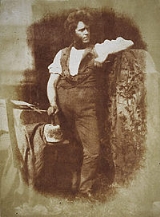
Hugh Miller

Encyclopedia
Hugh Miller was a self-taught Scottish geologist
and writer, folklorist and an evangelical Christian.
, he was educated in a parish school where he reportedly showed a love of reading. At 17 he was apprenticed to a stonemason, and his work in quarries, together with walks along the local shoreline, led him to the study of geology. In 1829 he published a volume of poems, and soon afterwards became involved in political and religious controversies, first connected to the Reform Bill, and then with the division in the Church of Scotland
which led to the Disruption of 1843
.
In 1834 he became accountant in one of the local banks, and in the next year brought out his Scenes and Legends in the North of Scotland. In 1840 the popular party in the Church, with which he had been associated, started a newspaper, the Witness
, and Miller was called to be editor in Edinburgh, a position which he retained till the end of his life.
Among his geological works are The Old Red Sandstone (1841), Footprints of the Creator (1850), The Testimony of the Rocks (1856), Sketch-book of Popular Geology. Of these books, perhaps The Old Red Sandstone was the best-known. The Old Red Sandstone
is still an expression used to describe sedimentary rock deposited after the Caledonian Orogeny
in the late Silurian
, and before the Carboniferous Period.
Miller held that the Earth was of great age, and that it had been inhabited by many species which had come into being and gone extinct, and that these species were homologous; although that species were progressing with time. He denied the Epicurean theory that new species occasionally budded from the soil, and the Lamarckian theory of development of species, as lacking evidence. He argued that all this showed the direct action of a benevolent Creator, as attested in the Bible - the similarities of species are manifestations of type
s in the Divine Mind; he accepted the view of Thomas Chalmers
that Genesis begins with an account of geological periods, and does not mean that each of them is a day; Noah's Flood was a limited subsidence of the Middle East. Geology, to Miller, offers a better version of the argument from design than William Paley
could provide, and answers the objections of skeptics, by showing that living species did not arise by chance or by impersonal law.
For most of 1856, Miller suffered severe headaches and the most probable diagnosis is of psychotic depression. Victorian-era medicine did not help. He feared that he might harm his wife or children because of persecutory delusions. Miller committed suicide on the night he had finished checking printers' proofs for his book on Scottish fossil plants and vertebrates, The Testimony of the Rocks. Before his death, he wrote a poem called Strange but True
A shocked Western world mourned him, and his funeral procession was among the largest in the memory of Edinburgh residents.
Miller's death was very tragic, and his life brief, but he left a heritage of new discoveries of several Silurian sea scorpions (the eurypterid
genus
Hughmilleria
was named in his honor), and many Devonian fishes, including several placoderms (the arthrodire Millerosteus also honored him), intriguingly described in his popular books. Though he had no academic credentials, he is today considered one of Scotland's premier paleontologists.
His home in Cromarty is open as a geological museum, with specimens collected in the immediate area; a week-end event at the site in 2008 was part of celebrations marking the bicentenary of the Geological Society of London
. Miller was mentioned in the song "Idea Track" by Scottish band Idlewild
.
There is a bust of Hugh Miller in the Hall of Heroes at the Wallace Monument
in Stirling. His birthplace in Cromarty is open to the public.
Geologist
A geologist is a scientist who studies the solid and liquid matter that constitutes the Earth as well as the processes and history that has shaped it. Geologists usually engage in studying geology. Geologists, studying more of an applied science than a theoretical one, must approach Geology using...
and writer, folklorist and an evangelical Christian.
Life and work
Born in CromartyCromarty
The Royal Burgh of Cromarty is a burgh in Ross and Cromarty, Highland, Scotland.-History:It was previously the county town of the former county of Cromartyshire...
, he was educated in a parish school where he reportedly showed a love of reading. At 17 he was apprenticed to a stonemason, and his work in quarries, together with walks along the local shoreline, led him to the study of geology. In 1829 he published a volume of poems, and soon afterwards became involved in political and religious controversies, first connected to the Reform Bill, and then with the division in the Church of Scotland
Church of Scotland
The Church of Scotland, known informally by its Scots language name, the Kirk, is a Presbyterian church, decisively shaped by the Scottish Reformation....
which led to the Disruption of 1843
Disruption of 1843
The Disruption of 1843 was a schism within the established Church of Scotland, in which 450 ministers of the Church broke away, over the issue of the Church's relationship with the State, to form the Free Church of Scotland...
.
In 1834 he became accountant in one of the local banks, and in the next year brought out his Scenes and Legends in the North of Scotland. In 1840 the popular party in the Church, with which he had been associated, started a newspaper, the Witness
Witness (religious newspaper)
Witness was the name of an evangelical newspaper established in 1840 by the Scottish geologist and writer, Hugh Miller. He continued to edit the paper at an office on the Royal Mile in Edinburgh until his suicide in December 1856. He was the principal contributor to the publication, averaging over...
, and Miller was called to be editor in Edinburgh, a position which he retained till the end of his life.
Among his geological works are The Old Red Sandstone (1841), Footprints of the Creator (1850), The Testimony of the Rocks (1856), Sketch-book of Popular Geology. Of these books, perhaps The Old Red Sandstone was the best-known. The Old Red Sandstone
Old Red Sandstone
The Old Red Sandstone is a British rock formation of considerable importance to early paleontology. For convenience the short version of the term, 'ORS' is often used in literature on the subject.-Sedimentology:...
is still an expression used to describe sedimentary rock deposited after the Caledonian Orogeny
Caledonian orogeny
The Caledonian orogeny is a mountain building era recorded in the northern parts of the British Isles, the Scandinavian Mountains, Svalbard, eastern Greenland and parts of north-central Europe. The Caledonian orogeny encompasses events that occurred from the Ordovician to Early Devonian, roughly...
in the late Silurian
Silurian
The Silurian is a geologic period and system that extends from the end of the Ordovician Period, about 443.7 ± 1.5 Mya , to the beginning of the Devonian Period, about 416.0 ± 2.8 Mya . As with other geologic periods, the rock beds that define the period's start and end are well identified, but the...
, and before the Carboniferous Period.
Miller held that the Earth was of great age, and that it had been inhabited by many species which had come into being and gone extinct, and that these species were homologous; although that species were progressing with time. He denied the Epicurean theory that new species occasionally budded from the soil, and the Lamarckian theory of development of species, as lacking evidence. He argued that all this showed the direct action of a benevolent Creator, as attested in the Bible - the similarities of species are manifestations of type
Type
Type may refer to:In philosophy:*Type–token distinctionIn mathematics:*Type *Type theory, basis for the study of type systems*Type or arity, the number of operands a function takes...
s in the Divine Mind; he accepted the view of Thomas Chalmers
Thomas Chalmers
Thomas Chalmers , Scottish mathematician, political economist, divine and a leader of the Free Church of Scotland, was born at Anstruther in Fife.-Overview:...
that Genesis begins with an account of geological periods, and does not mean that each of them is a day; Noah's Flood was a limited subsidence of the Middle East. Geology, to Miller, offers a better version of the argument from design than William Paley
William Paley
William Paley was a British Christian apologist, philosopher, and utilitarian. He is best known for his exposition of the teleological argument for the existence of God in his work Natural Theology, which made use of the watchmaker analogy .-Life:Paley was Born in Peterborough, England, and was...
could provide, and answers the objections of skeptics, by showing that living species did not arise by chance or by impersonal law.
For most of 1856, Miller suffered severe headaches and the most probable diagnosis is of psychotic depression. Victorian-era medicine did not help. He feared that he might harm his wife or children because of persecutory delusions. Miller committed suicide on the night he had finished checking printers' proofs for his book on Scottish fossil plants and vertebrates, The Testimony of the Rocks. Before his death, he wrote a poem called Strange but True
A shocked Western world mourned him, and his funeral procession was among the largest in the memory of Edinburgh residents.
Miller's death was very tragic, and his life brief, but he left a heritage of new discoveries of several Silurian sea scorpions (the eurypterid
Eurypterid
Eurypterids are an extinct group of arthropods related to arachnids which include the largest known arthropods that ever lived. They are members of the extinct order Eurypterida ; which is the most diverse Paleozoic chelicerate order in terms of species...
genus
Genus
In biology, a genus is a low-level taxonomic rank used in the biological classification of living and fossil organisms, which is an example of definition by genus and differentia...
Hughmilleria
Hughmilleria
Hughmilleria is a genus of Silurian eurypterid. The genus name commemorates the Scottish geologist Hugh Miller.-Stratigraphy and ecology:Fossils of Hughmilleria have been found in Silurian deposits from the Llandovery and Ludlow epochs...
was named in his honor), and many Devonian fishes, including several placoderms (the arthrodire Millerosteus also honored him), intriguingly described in his popular books. Though he had no academic credentials, he is today considered one of Scotland's premier paleontologists.
His home in Cromarty is open as a geological museum, with specimens collected in the immediate area; a week-end event at the site in 2008 was part of celebrations marking the bicentenary of the Geological Society of London
Geological Society of London
The Geological Society of London is a learned society based in the United Kingdom with the aim of "investigating the mineral structure of the Earth"...
. Miller was mentioned in the song "Idea Track" by Scottish band Idlewild
Idlewild (band)
Idlewild are a Scottish rock band, formed in Edinburgh, in 1995, comprising Roddy Woomble , Rod Jones , Colin Newton , Allan Stewart and Gareth Russell...
.
There is a bust of Hugh Miller in the Hall of Heroes at the Wallace Monument
Wallace Monument
The National Wallace Monument is a tower standing on the summit of Abbey Craig, a hilltop near Stirling in Scotland. It commemorates Sir William Wallace, the 13th century Scottish hero....
in Stirling. His birthplace in Cromarty is open to the public.
Main works
- Scenes and legends of the north of Scotland : or, The traditional history of Cromarty (1834)
- The old red sandstone : or, New walks in an old field (1841)
- First impressions of England and its people (1847)
- The foot-prints of the Creator: or, The Asterolepis of Stromness (1849)
- My schools and schoolmasters; or, The story of my education (1854)
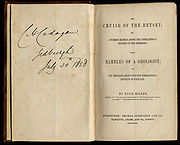
- The cruise of the Betsey : or, a summer ramble among the fossiliferous deposits of the Hebrides ; with Rambles of a geologist ; or, Ten thousand miles over the fossiliferous deposits of Scotland (1857)
- The testimony of the rocks; or, Geology in its bearings on the two theologies, natural and revealed (1857)
- The old red sandstone; or, New walks in an old field. To which is appended a series of geological papers, read before the Royal Physical Society of Edinburgh (1858)
- Sketch-book of popular geology being a series of lectures delivered before the Philosophical Institution of Edinburgh (1859)
- Popular geology: a series of lectures read before the Philosophical Institution of Edinburgh, with Descriptive sketches from a geologist's portfolio (1859)
- The headship of Christ and The rights of the Christian people (1860)
- Tales and sketches (1862)
- Edinburgh and its neighbourhood, geological and historical; with the geology of the Bass rock (1863)
- Essays, historical and biographical, political, social, literary and scientific (1865)
- Sketch-book of popular geology (1869)
- Hugh Miller's memoir : from stonemason to geologist by Hugh Miller (1995)
- Hugh Miller and the controversies of Victorian science (1996)