

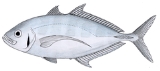
Barcheek trevally

Encyclopedia
The barcheek trevally, Carangoides plagiotaenia (also known as the barcheek kingfish, shortridge trevally and oblique-banded trevally), is a species
of moderately large marine
fish
of the jack family Carangidae
. The barcheek trevally is distributed throughout the tropical waters of the Indo-west Pacific
region, ranging from South Africa
in the west to Japan
, Australia
and a number of small central Pacific islands in the east. The species inhabits inshore and offshore waters, found along the slopes of lagoon
s and out to deeper reef
s on the continental shelf
, where it preys on small fish and benthic crustacean
s. It is a moderately large fish, growing to a maximum recorded length of 50 cm, and can be distinguished from similar species by its somewhat protruding lower jaw and the dark banding on its operculum
. It is of minor importance to fisheries throughout its range, taken by trawling
, hook and line methods and various inshore fish netting methods.
, a group of fish commonly called jacks and trevallies. Carangoides falls into the jack and horse mackerel family Carangidae
, itself part the order Perciformes
, in the suborder Percoidei
.
The species was first scientifically described by the Dutch ichthyologist Pieter Bleeker
in 1857 based on a specimen taken from Ambon Island
in Indonesia
, which was designated to be the holotype
. Bleeker named this new species Carangoides plagiotaenia, placing the species in what is still considered to be the correct genus, while later revisions transferred it to the genus Caranx
which was later considered to be an invalid move. The species was renamed three times after its initial correct naming, with all these subsequent names considered to be invalid junior synonyms under ICZN
nomenclature rules. The specific epithet plagiotaenia means 'oblique band' in Greek
, and this reflects in one of the species common name
s, which is also applied to the coachwhip trevally
. The names 'barcheek trevally' and 'shortridge trevally' refer to distinctive aspects of the species appearance.
body, with the dorsal and ventral profiles equally convex, although in large specimens, the dorsal profile of the head is nearly straight. The dorsal fin
is in two parts, the first with 8 spines and the second with 1 spine and 22 to 24 soft rays, with the lobe of this second fin shorter than the head length. The anal fin has 2 anteriorly detached spines followed by 1 spine and 18 to 20 soft rays. The lateral line
has a low anterior arch, with this curved section being longer than the posterior straight section. The straight section contains 20 to 26 scales
followed by 11 to 18 small scute
s. The breast is completely scaled. The lower jaw
is enlarged and slightly protrudes beyond the upper jaw, with both jaws having bands of small teeth present. There are 27 to 40 gill raker
s in total and 24 vertebrae.
The barcheek trevally is a silvery colour, being more grey above and becoming paler below, with 6 or 7 dusky oblique
bands occasionally present above the midline. The species common name is due to a black margin on the preopercle, giving a 'barred cheek' appearance, with no dusky spot further back on the operculum
. Large adults are also known to occasionally have small yellow spots scattered on their sides. The caudal, second dorsal and anal fins are dusky to dark, with the leading edge of the pelvic fins and distal margin of the anal fin white. The pectoral fins are pale.
and west Pacific Ocean
s. It ranges from South Africa
north to the Red Sea
, but is absent from the Persian Gulf
, extending east to India
and South East Asia. Its range extends south to Cape York
in Queensland
, Australia, and extends into the Pacific Ocean as far as the Marshall Islands
, Fiji
and Samoa
. The northernmost capture of the barcheek trevally was reported off southern Japan
.
The barcheek trevally appears to be largely confined to lagoon
and outer reef
environments, often found in the shallow water adjacent to deep drop-offs in these settings. It also inhabits deeper offshore coral
and rocky reef environments.
s, and is a fast swimming predator, taking small fish and benthic crustaceans as a main source of prey. Nothing is known of its reproduction or growth patterns.
The barcheek trevally is of very little importance to fisheries throughout its range, occasionally taken as bycatch in other fisheries or taken in small artisanal catches. It is caught on hook and line gear as well as trawls and various inshore fish traps. It is occasionally caught by recreational fishermen
while bottom fishing on reefs.
Species
In biology, a species is one of the basic units of biological classification and a taxonomic rank. A species is often defined as a group of organisms capable of interbreeding and producing fertile offspring. While in many cases this definition is adequate, more precise or differing measures are...
of moderately large marine
Marine (ocean)
Marine is an umbrella term. As an adjective it is usually applicable to things relating to the sea or ocean, such as marine biology, marine ecology and marine geology...
fish
Fish
Fish are a paraphyletic group of organisms that consist of all gill-bearing aquatic vertebrate animals that lack limbs with digits. Included in this definition are the living hagfish, lampreys, and cartilaginous and bony fish, as well as various extinct related groups...
of the jack family Carangidae
Carangidae
Carangidae is a family of fish which includes the jacks, pompanos, jack mackerels, and scads.They are marine fish found in the Atlantic, Indian and Pacific Oceans...
. The barcheek trevally is distributed throughout the tropical waters of the Indo-west Pacific
Indo-Pacific
The Indo-Pacific is a biogeographic region of the Earth's seas, comprising the tropical waters of the Indian Ocean, the western and central Pacific Ocean, and the seas connecting the two in the general area of Indonesia...
region, ranging from South Africa
South Africa
The Republic of South Africa is a country in southern Africa. Located at the southern tip of Africa, it is divided into nine provinces, with of coastline on the Atlantic and Indian oceans...
in the west to Japan
Japan
Japan is an island nation in East Asia. Located in the Pacific Ocean, it lies to the east of the Sea of Japan, China, North Korea, South Korea and Russia, stretching from the Sea of Okhotsk in the north to the East China Sea and Taiwan in the south...
, Australia
Australia
Australia , officially the Commonwealth of Australia, is a country in the Southern Hemisphere comprising the mainland of the Australian continent, the island of Tasmania, and numerous smaller islands in the Indian and Pacific Oceans. It is the world's sixth-largest country by total area...
and a number of small central Pacific islands in the east. The species inhabits inshore and offshore waters, found along the slopes of lagoon
Lagoon
A lagoon is a body of shallow sea water or brackish water separated from the sea by some form of barrier. The EU's habitat directive defines lagoons as "expanses of shallow coastal salt water, of varying salinity or water volume, wholly or partially separated from the sea by sand banks or shingle,...
s and out to deeper reef
Reef
In nautical terminology, a reef is a rock, sandbar, or other feature lying beneath the surface of the water ....
s on the continental shelf
Continental shelf
The continental shelf is the extended perimeter of each continent and associated coastal plain. Much of the shelf was exposed during glacial periods, but is now submerged under relatively shallow seas and gulfs, and was similarly submerged during other interglacial periods. The continental margin,...
, where it preys on small fish and benthic crustacean
Crustacean
Crustaceans form a very large group of arthropods, usually treated as a subphylum, which includes such familiar animals as crabs, lobsters, crayfish, shrimp, krill and barnacles. The 50,000 described species range in size from Stygotantulus stocki at , to the Japanese spider crab with a leg span...
s. It is a moderately large fish, growing to a maximum recorded length of 50 cm, and can be distinguished from similar species by its somewhat protruding lower jaw and the dark banding on its operculum
Operculum (fish)
The operculum of a bony fish is the hard bony flap covering and protecting the gills. In most fish, the rear edge of the operculum roughly marks the division between the head and the body....
. It is of minor importance to fisheries throughout its range, taken by trawling
Trawling
Trawling is a method of fishing that involves pulling a fishing net through the water behind one or more boats. The net that is used for trawling is called a trawl....
, hook and line methods and various inshore fish netting methods.
Taxonomy and naming
The barcheek trevally is classified within the genus CarangoidesCarangoides
Carangoides is a genus of tropical to subtropical marine fishes in the jack family, Carangidae. They are small to large sized, deep bodied fish characterised by a certain gill raker and jaw morphology, often appearing very similar to jacks in the genus Caranx...
, a group of fish commonly called jacks and trevallies. Carangoides falls into the jack and horse mackerel family Carangidae
Carangidae
Carangidae is a family of fish which includes the jacks, pompanos, jack mackerels, and scads.They are marine fish found in the Atlantic, Indian and Pacific Oceans...
, itself part the order Perciformes
Perciformes
The Perciformes, also called the Percomorphi or Acanthopteri, is one of the largest orders of vertebrates, containing about 40% of all bony fish. Perciformes means perch-like. They belong to the class of ray-finned fish and comprise over 7,000 species found in almost all aquatic environments...
, in the suborder Percoidei
Percoidei
Percoidei is one of eighteen suborders of bony fish in the order Perciformes. Many commercially harvested fish species are contained in this suborder, including the snappers, jacks, whitings, groupers, bass, perches and porgies.-Divisions:...
.
The species was first scientifically described by the Dutch ichthyologist Pieter Bleeker
Pieter Bleeker
Pieter Bleeker was a Dutch medical doctor and ichthyologist, famous for his work on the fishes of East Asia – Atlas Ichthyologique des Orientales Neerlandaises – which was published 1862–1877....
in 1857 based on a specimen taken from Ambon Island
Ambon Island
Ambon Island is part of the Maluku Islands of Indonesia. The island has an area of , and is mountainous, well watered, and fertile. Ambon Island consists of 2 territories: The main city and seaport is Ambon , which is also the capital of Maluku province and Maluku Tengah Ambon Island is part of the...
in Indonesia
Indonesia
Indonesia , officially the Republic of Indonesia , is a country in Southeast Asia and Oceania. Indonesia is an archipelago comprising approximately 13,000 islands. It has 33 provinces with over 238 million people, and is the world's fourth most populous country. Indonesia is a republic, with an...
, which was designated to be the holotype
Holotype
A holotype is a single physical example of an organism, known to have been used when the species was formally described. It is either the single such physical example or one of several such, but explicitly designated as the holotype...
. Bleeker named this new species Carangoides plagiotaenia, placing the species in what is still considered to be the correct genus, while later revisions transferred it to the genus Caranx
Caranx
Caranx is a genus of tropical to subtropical marine fish in the jack family Carangidae, commonly known as jacks, trevallies and kingfishes. They are moderate to large sized, deep bodied fishes which are distinguished from other carangid genera by specific gill raker, fin ray and dentition...
which was later considered to be an invalid move. The species was renamed three times after its initial correct naming, with all these subsequent names considered to be invalid junior synonyms under ICZN
International Code of Zoological Nomenclature
The International Code of Zoological Nomenclature is a widely accepted convention in zoology that rules the formal scientific naming of organisms treated as animals...
nomenclature rules. The specific epithet plagiotaenia means 'oblique band' in Greek
Greek language
Greek is an independent branch of the Indo-European family of languages. Native to the southern Balkans, it has the longest documented history of any Indo-European language, spanning 34 centuries of written records. Its writing system has been the Greek alphabet for the majority of its history;...
, and this reflects in one of the species common name
Common name
A common name of a taxon or organism is a name in general use within a community; it is often contrasted with the scientific name for the same organism...
s, which is also applied to the coachwhip trevally
Coachwhip trevally
The coachwhip trevally, Carangoides oblongus is a species of inshore marine fish classified in the jack family Carangidae. The coachwhip trevally is distributed through the Indo-west Pacific region, ranging from South Africa in the west to Fiji and Japan in the east...
. The names 'barcheek trevally' and 'shortridge trevally' refer to distinctive aspects of the species appearance.
Description
The barcheek trevally is a moderately large fish, growing to a maximum recorded length of 50 cm. It is one of the more easily recognized members of Carangoides due to its slightly protruding lower jaw and 'barred cheek' colouration. Its general shape is similar to most other species, having a compressed oblongRectangle
In Euclidean plane geometry, a rectangle is any quadrilateral with four right angles. The term "oblong" is occasionally used to refer to a non-square rectangle...
body, with the dorsal and ventral profiles equally convex, although in large specimens, the dorsal profile of the head is nearly straight. The dorsal fin
Dorsal fin
A dorsal fin is a fin located on the backs of various unrelated marine and freshwater vertebrates, including most fishes, marine mammals , and the ichthyosaurs...
is in two parts, the first with 8 spines and the second with 1 spine and 22 to 24 soft rays, with the lobe of this second fin shorter than the head length. The anal fin has 2 anteriorly detached spines followed by 1 spine and 18 to 20 soft rays. The lateral line
Lateral line
The lateral line is a sense organ in aquatic organisms , used to detect movement and vibration in the surrounding water. Lateral lines are usually visible as faint lines running lengthwise down each side, from the vicinity of the gill covers to the base of the tail...
has a low anterior arch, with this curved section being longer than the posterior straight section. The straight section contains 20 to 26 scales
Scale (zoology)
In most biological nomenclature, a scale is a small rigid plate that grows out of an animal's skin to provide protection. In lepidopteran species, scales are plates on the surface of the insect wing, and provide coloration...
followed by 11 to 18 small scute
Scute
A scute or scutum is a bony external plate or scale, as on the shell of a turtle, the skin of crocodilians, the feet of some birds or the anterior portion of the mesonotum in insects.-Properties:...
s. The breast is completely scaled. The lower jaw
Jaw
The jaw is any opposable articulated structure at the entrance of the mouth, typically used for grasping and manipulating food. The term jaws is also broadly applied to the whole of the structures constituting the vault of the mouth and serving to open and close it and is part of the body plan of...
is enlarged and slightly protrudes beyond the upper jaw, with both jaws having bands of small teeth present. There are 27 to 40 gill raker
Gill raker
Gill rakers in fish are bony or cartilaginous processes that project from the branchial arch and are involved with filter feeding tiny prey. They are not to be confused with the gill filaments that compose the bony part of the gill. Rakers are usually present in two rows, projecting from both the...
s in total and 24 vertebrae.
The barcheek trevally is a silvery colour, being more grey above and becoming paler below, with 6 or 7 dusky oblique
Oblique
Oblique may refer to:*Oblique angle, in geometry, an angle that is not a multiple of 90 degrees*Oblique angle, synonym for Dutch angle, a cinematographic technique*Oblique , by jazz vibraphonist Bobby Hutcherson...
bands occasionally present above the midline. The species common name is due to a black margin on the preopercle, giving a 'barred cheek' appearance, with no dusky spot further back on the operculum
Operculum (fish)
The operculum of a bony fish is the hard bony flap covering and protecting the gills. In most fish, the rear edge of the operculum roughly marks the division between the head and the body....
. Large adults are also known to occasionally have small yellow spots scattered on their sides. The caudal, second dorsal and anal fins are dusky to dark, with the leading edge of the pelvic fins and distal margin of the anal fin white. The pectoral fins are pale.
Distribution and habitat
The barcheek trevally is distributed throughout the tropical and subtropical waters of the IndianIndian Ocean
The Indian Ocean is the third largest of the world's oceanic divisions, covering approximately 20% of the water on the Earth's surface. It is bounded on the north by the Indian Subcontinent and Arabian Peninsula ; on the west by eastern Africa; on the east by Indochina, the Sunda Islands, and...
and west Pacific Ocean
Pacific Ocean
The Pacific Ocean is the largest of the Earth's oceanic divisions. It extends from the Arctic in the north to the Southern Ocean in the south, bounded by Asia and Australia in the west, and the Americas in the east.At 165.2 million square kilometres in area, this largest division of the World...
s. It ranges from South Africa
South Africa
The Republic of South Africa is a country in southern Africa. Located at the southern tip of Africa, it is divided into nine provinces, with of coastline on the Atlantic and Indian oceans...
north to the Red Sea
Red Sea
The Red Sea is a seawater inlet of the Indian Ocean, lying between Africa and Asia. The connection to the ocean is in the south through the Bab el Mandeb strait and the Gulf of Aden. In the north, there is the Sinai Peninsula, the Gulf of Aqaba, and the Gulf of Suez...
, but is absent from the Persian Gulf
Persian Gulf
The Persian Gulf, in Southwest Asia, is an extension of the Indian Ocean located between Iran and the Arabian Peninsula.The Persian Gulf was the focus of the 1980–1988 Iran-Iraq War, in which each side attacked the other's oil tankers...
, extending east to India
India
India , officially the Republic of India , is a country in South Asia. It is the seventh-largest country by geographical area, the second-most populous country with over 1.2 billion people, and the most populous democracy in the world...
and South East Asia. Its range extends south to Cape York
Cape York Peninsula
Cape York Peninsula is a large remote peninsula located in Far North Queensland at the tip of the state of Queensland, Australia, the largest unspoilt wilderness in northern Australia and one of the last remaining wilderness areas on Earth...
in Queensland
Queensland
Queensland is a state of Australia, occupying the north-eastern section of the mainland continent. It is bordered by the Northern Territory, South Australia and New South Wales to the west, south-west and south respectively. To the east, Queensland is bordered by the Coral Sea and Pacific Ocean...
, Australia, and extends into the Pacific Ocean as far as the Marshall Islands
Marshall Islands
The Republic of the Marshall Islands , , is a Micronesian nation of atolls and islands in the middle of the Pacific Ocean, just west of the International Date Line and just north of the Equator. As of July 2011 the population was 67,182...
, Fiji
Fiji
Fiji , officially the Republic of Fiji , is an island nation in Melanesia in the South Pacific Ocean about northeast of New Zealand's North Island...
and Samoa
Samoa
Samoa , officially the Independent State of Samoa, formerly known as Western Samoa is a country encompassing the western part of the Samoan Islands in the South Pacific Ocean. It became independent from New Zealand in 1962. The two main islands of Samoa are Upolu and one of the biggest islands in...
. The northernmost capture of the barcheek trevally was reported off southern Japan
Japan
Japan is an island nation in East Asia. Located in the Pacific Ocean, it lies to the east of the Sea of Japan, China, North Korea, South Korea and Russia, stretching from the Sea of Okhotsk in the north to the East China Sea and Taiwan in the south...
.
The barcheek trevally appears to be largely confined to lagoon
Lagoon
A lagoon is a body of shallow sea water or brackish water separated from the sea by some form of barrier. The EU's habitat directive defines lagoons as "expanses of shallow coastal salt water, of varying salinity or water volume, wholly or partially separated from the sea by sand banks or shingle,...
and outer reef
Reef
In nautical terminology, a reef is a rock, sandbar, or other feature lying beneath the surface of the water ....
environments, often found in the shallow water adjacent to deep drop-offs in these settings. It also inhabits deeper offshore coral
Coral
Corals are marine animals in class Anthozoa of phylum Cnidaria typically living in compact colonies of many identical individual "polyps". The group includes the important reef builders that inhabit tropical oceans and secrete calcium carbonate to form a hard skeleton.A coral "head" is a colony of...
and rocky reef environments.
Biology and fishery
The barcheek trevally travels either singularly or in small shoalShoal
Shoal, shoals or shoaling may mean:* Shoal, a sandbank or reef creating shallow water, especially where it forms a hazard to shipping* Shoal draught , of a boat with shallow draught which can pass over some shoals: see Draft...
s, and is a fast swimming predator, taking small fish and benthic crustaceans as a main source of prey. Nothing is known of its reproduction or growth patterns.
The barcheek trevally is of very little importance to fisheries throughout its range, occasionally taken as bycatch in other fisheries or taken in small artisanal catches. It is caught on hook and line gear as well as trawls and various inshore fish traps. It is occasionally caught by recreational fishermen
Angling
Angling is a method of fishing by means of an "angle" . The hook is usually attached to a fishing line and the line is often attached to a fishing rod. Fishing rods are usually fitted with a fishing reel that functions as a mechanism for storing, retrieving and paying out the line. The hook itself...
while bottom fishing on reefs.