
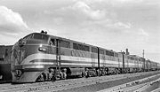
The
EMD FT was a 1350 hp diesel-electric locomotive produced between November 1939, and November 1945, by General Motors' Electro-Motive Division (the "F" stood for "freight" and the "T" for 2700 hp with a two-unit set). All told 555 cab-equipped
A unitAn A unit, in railroad terminology, is a locomotive equipped with a driving cab, or crew compartment, and the control system to control other locomotives in a multiple unit, and therefore able to be the lead unit in a consist of several locomotives controlled from a single position...
s were built, along with 541 cabless booster
B unitA "B" unit, in railroad terminology, is a locomotive unit which does not have a driving cab, or crew compartment, and must therefore be controlled from another, coupled locomotive with a driving cab . The term booster unit is also used. The concept was largely confined to North America...
s, for a grand total of 1,096 units. The locomotives were all sold to customers in the
United StatesThe United States of America is a federal constitutional republic comprising fifty states and a federal district...
. It was the first model in EMD's very successful
F-unitEMD F-units were a line of Diesel-electric locomotives produced between November 1939 and November 1960 by General Motors Electro-Motive Division and General Motors-Diesel Division. Final assembly for all F-units was at the GM-EMD plant at La Grange, Illinois and the GMDD plant in London, Ontario...
series of
cab unitA cab unit and a carbody unit are body styles of locomotives in railroad terminology. While closely related, they are not exactly the same....
freight diesels, and was the locomotive that convinced many U.S. railroads that the diesel-electric freight locomotive was the future. Many rail historians consider the FT one of the most important locomotive models of all time.
FTs were generally marketed as semi-permanently coupled A-B sets (a lead unit and a cabless booster connected by a solid drawbar) making a single locomotive of 2700 hp. Many railroads used pairs of these sets back to back to make up a four-unit A-B-B-A locomotive rated at 5400 hp. Some railroads purchased semi-permanently coupled A-B-A three-unit sets of 4050 hp, while a few, like the
Santa FeThe Atchison, Topeka and Santa Fe Railway , often abbreviated as Santa Fe, was one of the larger railroads in the United States. The company was first chartered in February 1859...
, ordered all their FTs with regular couplers on both ends of each unit for added flexibility. All units in a consist could be run from one cab;
multiple unitThe term multiple unit or MU is used to describe a self-propelled carriages capable of coupling with other units of the same or similar type and still being controlled from one driving cab. The term is commonly used to denote passenger trainsets consisting of more than one carriage...
(MU) control systems linked the units together.
Recognition and appearance
The FT is very similar to the later F-units in appearance, but there are some differences which render it distinguishable from later EMD freight cab units. The side panels of the FT were different, but it was fairly common for railroads to alter them to make an earlier unit appear later. As built, FT units had four porthole windows spaced closely together along their sides, and B units with
couplerA coupling is a mechanism for connecting rolling stock in a train. The design of the coupler is standard, and is almost as important as the railway gauge, since flexibility and convenience are maximised if all rolling stock can be coupled together.The equipment that connects the couplings to the...
s on both ends had a fifth window on one side for the
hostlerAn hostler or ostler in the horse industry is a groom or stableman, who is employed in a stable to take care of horses...
position.
The roof is a more reliable indication; FTs had four exhaust stacks along the centerline (flanked by boxy structures if dynamic brakes were included). The radiator fans were recessed within the carbody, and arranged in two pairs, one near each end of the locomotive. Later units have the fans grouped together, and their shrouding extended atop the roof.
The overhangs of the body past the
trucksA bogie is a wheeled wagon or trolley. In mechanics terms, a bogie is a chassis or framework carrying wheels, attached to a vehicle. It can be fixed in place, as on a cargo truck, mounted on a swivel, as on a railway carriage/car or locomotive, or sprung as in the suspension of a caterpillar...
differ in the FT compared to later units. The B-units of FTs ordered in semi-permanently coupled A-B sets, and those with couplers on both ends, have a large overhang on one end (the coupler-equipped end on the paired units) featured on no other EMD B-units. This is not present on the B-units in semi-permanently coupled A-B-A sets, which were called
FTSB units (for
Short Booster). At other locations, except the cab front, the FT units have less of an overhang than later units; the trucks appear to be right at the ends of the car bodies.
Wartime restrictions
During
World War IIWorld War II, or the Second World War , was a global conflict lasting from 1939 to 1945, involving most of the world's nations—including all of the great powers—eventually forming two opposing military alliances: the Allies and the Axis...
, locomotive production was regulated by the
War Production BoardThe War Production Board was established as a government agency on January 16, 1942 by executive order of Franklin D. Roosevelt.The purpose of the board was to regulate the production and allocation of materials and fuel during World War II in the United States...
. The traditional locomotive builders were prohibited from building diesel road locomotives until early 1945. There were a few dual-service
ALCO DL-109The ALCO DL-109 is one of six models of A1A-A1A diesel locomotives built to haul passenger trains by the American Locomotive Company between December, 1939 and April, 1945...
s for the
New HavenThe New York, New Haven and Hartford Railroad , was a railroad that operated in the northeast United States from 1872 to 1968 which served the states of Connecticut, New York, Rhode Island, and Massachusetts...
. Steam locomotives could be built with fewer precious materials, and were the proven type of motive power at the time.
EMD however, was purely a diesel builder, and therefore was allowed to continue building diesel freight locomotives. The WPB assigned the FT's built to the railroads it deemed most able to benefit from the new locomotives. The Santa Fe received by far the largest allocation of them, given its heavy war traffic and the difficulty and expense of providing water for steam locomotives on its long desert stretches. The original A-B-B-A demonstrator set was sold to the Southern Railway.
Were it not for the wartime restrictions, many more FTs would have been built. Most railroads wanted diesels, but often had to settle for steam locomotives.
These wartime restrictions on other manufacturers' diesel programs helped ensure EMD's dominance of the postwar diesel market.
Subsequent models
The FT was discontinued in late 1945, replaced in production by the
F2The EMD F2 was a freight-hauling diesel locomotive built by General Motors Electro-Motive Division between July 1946 and November 1946. It succeeded the FT model in GM-EMD's F-unit sequence, and was replaced in turn by the F3...
, which retained the 1350 hp rating of the FT, but with upgraded electrical and control equipment. The F2 was produced only in 1946, after which in turn it was replaced by updated models in the
EMD F-unitEMD F-units were a line of Diesel-electric locomotives produced between November 1939 and November 1960 by General Motors Electro-Motive Division and General Motors-Diesel Division. Final assembly for all F-units was at the GM-EMD plant at La Grange, Illinois and the GMDD plant in London, Ontario...
series, such as the F3, F7, and F9.
Original buyers
| Railroad | Quantity A unitAn A unit, in railroad terminology, is a locomotive equipped with a driving cab, or crew compartment, and the control system to control other locomotives in a multiple unit, and therefore able to be the lead unit in a consist of several locomotives controlled from a single position... s | Quantity B unitA "B" unit, in railroad terminology, is a locomotive unit which does not have a driving cab, or crew compartment, and must therefore be controlled from another, coupled locomotive with a driving cab . The term booster unit is also used. The concept was largely confined to North America... s | Road numbers A units | Road numbers B units | Notes |
| Electro-Motive Division (demonstrator) |
2 |
2 |
103,A |
103(b),A |
to Southern Railway 6100ABCD renumbered 6100, 6150, 6151, 6105 |
Atchison, Topeka and Santa Fe RailwayThe Atchison, Topeka and Santa Fe Railway , often abbreviated as Santa Fe, was one of the larger railroads in the United States. The company was first chartered in February 1859... |
155 |
165 |
100-104, 105,C–179,C |
100A,B,C-104A,B,C, 105A,B–179B,C |
160-168, 415 renumbered |
Atlantic Coast Line RailroadThe Atlantic Coast Line Railroad was an American railroad that existed between 1900 and 1967, when it merged with the Seaboard Air Line Railroad, its long-time rival, to form the Seaboard Coast Line Railroad... |
24 |
24 |
300–323 |
300B–323B |
|
Baltimore and Ohio RailroadThe Baltimore and Ohio Railroad was one of the oldest railroads in the United States and the first common carrier railroad. It came into being mostly because the city of Baltimore wanted to compete with the newly constructed Erie Canal and another canal being proposed by Pennsylvania, which... |
12 |
12 |
1,A–11,A (odd) |
1X,AX–11X,AX (odd) |
Renumbered 101,A–111,A odd (A) and 101X, AX–111X, AX odd (B); later 4400–4411 (A) and 5400–5411 (B) |
Boston and Maine RailroadThe Boston and Maine Corporation , known as the Boston and Maine Railroad until 1964, was the dominant railroad of the northern New England region of the United States for a century... |
24 |
24 |
4200A–4223A |
4200B–4223B |
|
Chicago and North Western RailwayThe Chicago and North Western Transportation Company was a Class I railroad in the Midwest United States. It was also known as the North Western. The railroad operated more than of track as of the turn of the 20th century, and over of track in seven states before retrenchment in the late 1970s... |
4 |
4 |
5400A,D–5401A,D |
5400B,C–5401B,C |
Renumbered 4051A–4054A (A) and 4051B–4504B (B) |
| Chicago, Burlington and Quincy Railroad The Chicago, Burlington and Quincy Railroad was a railroad that operated in the Midwestern United States. Commonly referred to as the Burlington or as the Q, the Burlington Route served a large area, including extensive trackage in the states of Colorado, Illinois, Iowa, Kentucky, Missouri,... |
32 |
32 |
100A,D–115A,D |
100B,C–115B,C |
100–104 renumbered 150A,B-154A,B, 155B,C-159B,C |
Chicago, Milwaukee, St. Paul and Pacific RailroadThe Milwaukee Road, officially the Chicago, Milwaukee, St. Paul and Pacific Railroad , was a Class I railroad that operated in the Midwest and Northwest of the United States from 1847 until its merger into the Soo Line Railroad on January 1, 1986. The company went through several official names... |
26 |
26 |
35A,D–47A,D |
35B,C–47B,C |
|
| Chicago, Rock Island and Pacific Railroad The Chicago, Rock Island and Pacific Railroad was a Class I railroad in the United States. It was also known as the Rock Island Line, or, in its final years, The Rock.-Incorporation:... |
20 |
16 |
70,A–73,A 88–99 |
70B–73B, 88A–99A |
70B–73B short B units 88A-99A resuffixed 88B–99B |
Delaware, Lackawanna and Western RailroadThe Delaware, Lackawanna and Western Railroad Company was a railroad connecting Pennsylvania's Lackawanna Valley, rich in anthracite coal, to Hoboken, New Jersey, , Buffalo and Oswego, New York... |
12 |
8 |
601A,C–603A,C 651A–654A |
601B–604B 651B–654B |
601B–604B short B units. To Erie Lackawanna |
Denver and Rio Grande Western RailroadThe Denver & Rio Grande Western Railroad , often shortened to Rio Grande or D&RGW, formerly the Denver & Rio Grande Railroad, is a defunct U.S. railroad company. The railroad started as a narrow gauge line running south from Denver, Colorado in 1870; however, served mainly as a transcontinental... |
24 |
24 |
540A,D–551A,D |
540B,C–551B,C |
Renumbered 5401/2/3/4–5511/2/3/4 (ABBA) |
Erie RailroadThe Erie Railroad was a railroad that operated in New York State, New Jersey, Pennsylvania, Ohio, Indiana, and Illinois, originally connecting New York City with Lake Erie... |
12 |
12 |
700A,D–705A,D |
700B,C–705B,C |
to Erie Lackawanna |
| Great Northern Railway |
51 |
45 |
250A-258A, 300A,C-305A,C, 400A,D-428A,D even |
250B-258B, 300B-305B, 400B,C-428B,C even |
300B-305B short B nits, 5600AB, 5700AB, 5701AB, 5900AB renumbered |
| Lehigh Valley Railroad The Lehigh Valley Railroad was one of a number of railroads built in the northeastern United States primarily to haul anthracite coal.It was authorized April 21, 1846 in the U.S. state of Pennsylvania and incorporated September 20, 1847 as the Delaware, Lehigh, Schuylkill and Susquehanna Railroad... |
4 |
4 |
500–503 |
500B–503B |
Renumbered 500–507 (A even, B odd) |
Minneapolis and St. Louis RailwayThe Minneapolis and St. Louis Railway was an American Class I railroad that built and operated lines radiating south and west from Minneapolis, Minnesota which existed for 90 years from 1870 to 1960.... |
4 |
2 |
445A,C, 454A,C |
445B, 454B |
Short B units |
| Missouri Pacific Railroad The Missouri Pacific Railroad , also known as the MoPac, was one of the first railroads in the United States west of the Mississippi River. MoPac was a Class I railroad growing from dozens of predecessors and mergers, including the St. Louis, Iron Mountain and Southern Railway , Texas and Pacific... |
12 |
12 |
501–512 |
501B–512B |
|
New York Central RailroadThe New York Central Railroad , known simply as the New York Central in its publicity, was a railroad operating in the Northeastern United States... |
4 |
4 |
1600–1603 |
2400–2403 |
|
| New York, Ontario and Western Railway The New York, Ontario and Western Railway, more commonly known as the O&W or NYO&W, was a regional railroad with origins in 1868, lasting until March 29, 1957 when it was ordered liquidated by a US bankruptcy judge. The O&W holds the distinction of being the first major U.S... |
9 |
9 |
601, 801–808 |
601B, 801B–808B |
|
Northern Pacific RailwayThe Northern Pacific Railway was a railway that operated in the west along the Canadian border of the United States. Construction began in 1870 and the main line opened all the way from the Great Lakes to the Pacific when former president Ulysses S. Grant drove in the final "golden spike" in... |
22 |
22 |
6000A,D-6010A,D |
6000B,C-6010B,C |
Renumbered 5400ABCD–5410ABCD (ABBA) |
Reading RailroadThe Reading Company , usually called the Reading Railroad, officially the Philadelphia and Reading Rail Road and then the Philadelphia and Reading Railway until 1924, operated in southeast Pennsylvania and neighboring states... |
10 |
10 |
250A–259A |
250B–259B |
|
St. Louis Southwestern RailwayThe St. Louis Southwestern Railway , known by its nickname of "The Cotton Belt Route" or simply Cotton Belt, was organized on January 15, 1891, although it had its origins in a series of short lines founded in Tyler, Texas, in 1870 that connected northeastern Texas to Arkansas and southeastern... |
10 |
10 |
900A,D, 905A,D, 910A,D, 915A,D, 920A,D |
900B,C, 905B,C, 910B,C, 915B,C, 920B,C |
Renumbered 901–924 (A odd, B even) |
| Seaboard Air Line Railway |
22 |
22 |
4000–4021 |
4100–4121 |
|
| Southern Railway |
36 |
28 |
4100–4127, 6101-6104, 6800–6803 |
4100–4119, 6152-6155, 6825-6828 |
6825-6828 short B units. Many renumbered. |
Western Pacific RailroadThe Western Pacific Railroad was a Class I railroad in the United States. It was formed in 1903 as an attempt to break the near-monopoly the Southern Pacific Railroad had on rail service into northern California... |
24 |
24 |
901,C–906,C 907A,D–912A,D |
901A,B–906A,B 907B,C–912B,C |
901,A,B,C–906,B,C,D resuffixed 901ABCD–906ABCD |
| Totals | 555 | 541 | | | |
Surviving units
Multiple EMD FT units survive today. They include the lead A-unit from demonstrator No. 103 as well as a B-unit displayed at the
Museum of TransportationThe Museum of Transportation of the St. Louis County, Missouri, United States Parks Department is a museum located in the Greater St. Louis area. It was first founded in 1944 by a group of individuals dedicated to preserving the past and has a wide variety of vehicles from American history...
in
St. Louis, MissouriSt. Louis is an independent city on the eastern border of Missouri, United States. With a population of 319,294, it was the 58th-largest U.S. city at the 2010 U.S. Census. The Greater St...
An FT A unit, on display in
MexicoThe United Mexican States , commonly known as Mexico , is a federal constitutional republic in North America. It is bordered on the north by the United States; on the south and west by the Pacific Ocean; on the southeast by Guatemala, Belize, and the Caribbean Sea; and on the east by the Gulf of...
, which was originally built for the
Northern Pacific RailwayThe Northern Pacific Railway was a railway that operated in the west along the Canadian border of the United States. Construction began in 1870 and the main line opened all the way from the Great Lakes to the Pacific when former president Ulysses S. Grant drove in the final "golden spike" in...
Three B-units from the Southern Railway, #960604 is at the Southeastern Railway Museum in
Duluth, GeorgiaDuluth is a city in Gwinnett County, Georgia and an increasingly more affluent and developed suburb of Atlanta. Unincorporated portions of Forsyth County also have Duluth as a mailing address, though this area is outside city limits...
, #960602 is in
Conway, South CarolinaConway is a city in Horry County, South Carolina, United States. The population was 16,317 at the 2010 census. It is the county seat of Horry County and is part of the Myrtle Beach metropolitan area. It is the home of Coastal Carolina University....
One of the two original FT B-units from the EMD 103 demonstrator set, at the
Virginia Museum of TransportationThe Virginia Museum of Transportation is a museum devoted to the topic of transportation located in Downtown Roanoke, Virginia, U.S.A..- History :...
.