

Ayrshire

Encyclopedia
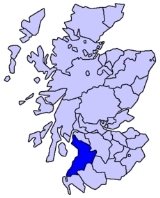
Ayrshire is a registration county
, and former administrative county
in south-west Scotland
, United Kingdom
, located on the shores of the Firth of Clyde
. Its principal towns include Ayr
, Kilmarnock
and Irvine
. The town of Troon
on the coast has hosted the British Open Golf Championship
twice in the last seven years and eight times in total. Approximately 200,000 visitors came to Troon during the 2004 Open. It was the members of Prestwick Golf Club
who first created the British Open Championship in 1860 with the club hosting the event twenty-four times up until 1925.
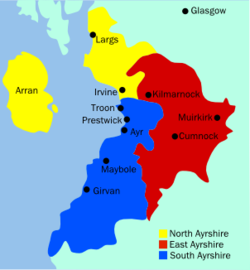
Ayrshire, under the name the County of Ayr, is a registration county. The electoral and valuation area named Ayrshire covers the three council areas of South Ayrshire
, East Ayrshire
and North Ayrshire
, therefore including the Isle of Arran
, Great Cumbrae
and Little Cumbrae
. The three islands were part of the County of Bute
until 1975 and are not always included when the term Ayrshire is applied to the region. The same area is known as Ayrshire and Arran
in other contexts.
Ayrshire is one of the most agriculturally fertile regions of Scotland. Potatoes are grown in fields near the coast, using seaweed-based fertiliser, and in addition the region produces pork products, other root vegetables, cattle (see below) and summer berries such as strawberries are grown abundantly.
Ayrshire shares with Dumfries and Galloway
some wonderful rugged hill country known as the Galloway Hills
. These hill lie to the west of the A713 (Ayr to Castle Douglas
road) and they run south from the Loch Doon
area almost to the Solway Firth
. To the east of this route through the hills lie the Carsphairn and Scaur Hills
which lie to the south east of Dalmellington and south of New Cumnock
. Glen Afton runs deep into these hills.
The area used to be heavily industrialised, with steel making, coal mining
and in Kilmarnock numerous examples of production-line manufacturing, most famously Johnnie Walker
whisky. In more recent history, Digital Equipment had a large manufacturing plant near Ayr from about 1976 until the company was taken over by Compaq
in 1998. Some supplier companies grew up to service this site and the more distant IBM
plant at Greenock
in Renfrewshire
. Scotland's aviation industry has long been based in and around Prestwick
and its international airport, and although aircraft manufacture ceased at the former British Aerospace
plant in 1998, a significant number of aviation companies are still based on the Prestwick site. However, unemployment in the region (excluding the more rural South Ayrshire) remains high, above the national average.
The area became part of the kingdom of Scotland
during the 11th century. In 1263, the Scots successfully drove off of the Norwegian
leidang
-army in a skirmish known as the Battle of Largs
.
A notable historic building in Ayrshire is Turnberry Castle
, which dates from the 13th century or earlier, and which may have been the birthplace of Robert the Bruce
.
The historic shire
or sheriffdom
of Ayr was divided into three districts or bailieries which later made up the county
of Ayrshire. The three districts were:
The Local Government (Scotland) Act 1889
established a uniform system of county council
s in Scotland and realigned the boundaries of many of Scotland’s counties.
Glasgow Prestwick International Airport
, serving Glasgow
, is located in Ayrshire. It has a niche in rock history as the only place in Britain visited by Elvis Presley, on his way home from Army service in Germany in 1960.

 Ayr county council
was created in 1890, under the Local Government (Scotland) Act 1889
. In 1930 the Local Government (Scotland) Act 1929
was implemented. This re-designated the Burghs into large burghs and Small Burghs. This new categorisation influenced the level of autonomy that the Burghs enjoyed from the county council. The act also abolished the parish
as a unit of local government in Scotland. In Ayrshire in excess of 30 parishes were consolidated into ten district councils.
In May 1975 the county council was abolished and its functions transferred to Strathclyde Regional Council. The county area was divided between four new districts within the two-tier Strathclyde
region: Cumnock and Doon Valley
, Cunninghame
, Kilmarnock and Loudoun
and Kyle and Carrick
. The Cunninghame district included the Isle of Arran
, Great Cumbrae
and Little Cumbrae
, which had until then been administered as part of the County of Bute
.
In 1996 the two-tier system of regions and districts was abolished and Ayrshire was divided between the unitary council areas of East Ayrshire
(covering the area of the former Kilmarnock & Loudon District and Cumnock & Doon Valley District), North Ayrshire
(covering the area of the former Cunninghame District Council) and South Ayrshire
(covering the area of the former Kyle and Carrick District).
of the House of Commons
of the Parliament of Great Britain
from 1708 to 1801 and of the Parliament of the United Kingdom
from 1801 until 1868, when the constituency was divided into Ayrshire North and Ayrshire South.
During the whole of the 1708 to 1868 period, and until 1950, the burgh
s of Ayr and Irvine were parliamentary burghs, represented as components of Ayr Burghs
. In 1832 Kilmarnock
became a parliamentary burgh, to be represented as a component of Kilmarnock Burghs
until 1918. Ayr Burghs and Kilmarnock Burghs were districts of burghs, and quite different in character from later Ayr and Kilmarnock constituencies.
From 1918 to 1983 Ayrshire and Buteshire were treated as if a single area for purposes of parliamentary representation, with their combined area being divided into different constituencies at different times. Scottish local government counties were abolished in 1975, in favour of regions and districts
, but the next reform of constituency boundaries was not until 1983.
Constituencies covering Ayrshire may be listed by periods as below, but the story is somewhat more complicated than the lists may imply: until 1918, Ayr Burghs and Kilmarnock Burghs included burghs lying outside both Ayrshire and Buteshire; a particular constituency name may represent different boundaries in different periods; in 1974, there were boundary changes without the creation of any new constituency names.
Registration county
A registration county was, in Great Britain and Ireland, a statistical unit used for the registration of births, deaths and marriages and for the output of census information. In Scotland registration counties are used for land registration purposes....
, and former administrative county
Counties of Scotland
The counties of Scotland were the principal local government divisions of Scotland until 1975. Scotland's current lieutenancy areas and registration counties are largely based on them. They are often referred to as historic counties....
in south-west Scotland
Scotland
Scotland is a country that is part of the United Kingdom. Occupying the northern third of the island of Great Britain, it shares a border with England to the south and is bounded by the North Sea to the east, the Atlantic Ocean to the north and west, and the North Channel and Irish Sea to the...
, United Kingdom
United Kingdom
The United Kingdom of Great Britain and Northern IrelandIn the United Kingdom and Dependencies, other languages have been officially recognised as legitimate autochthonous languages under the European Charter for Regional or Minority Languages...
, located on the shores of the Firth of Clyde
Firth of Clyde
The Firth of Clyde forms a large area of coastal water, sheltered from the Atlantic Ocean by the Kintyre peninsula which encloses the outer firth in Argyll and Ayrshire, Scotland. The Kilbrannan Sound is a large arm of the Firth of Clyde, separating the Kintyre Peninsula from the Isle of Arran.At...
. Its principal towns include Ayr
Ayr
Ayr is a town and port situated on the Firth of Clyde in south-west Scotland. With a population of around 46,000, Ayr is the largest settlement in Ayrshire, of which it is the county town, and has held royal burgh status since 1205...
, Kilmarnock
Kilmarnock
Kilmarnock is a large burgh in East Ayrshire, Scotland, with a population of 44,734. It is the second largest town in Ayrshire. The River Irvine runs through its eastern section, and the Kilmarnock Water passes through it, giving rise to the name 'Bank Street'...
and Irvine
Irvine, North Ayrshire
Irvine is a new town on the coast of the Firth of Clyde in North Ayrshire, Scotland. According to 2007 population estimates, the town is home to 39,527 inhabitants, making it the biggest settlement in North Ayrshire....
. The town of Troon
Troon
Troon is a town in South Ayrshire. It is situated on the west coast of Scotland, about eight miles north of Ayr and three miles northwest of Glasgow Prestwick International Airport. Lying across the Firth of Clyde, the Isle of Arran can be seen. Troon is also a port with freight and ferry services...
on the coast has hosted the British Open Golf Championship
The Open Championship
The Open Championship, or simply The Open , is the oldest of the four major championships in professional golf. It is the only "major" held outside the USA and is administered by The R&A, which is the governing body of golf outside the USA and Mexico...
twice in the last seven years and eight times in total. Approximately 200,000 visitors came to Troon during the 2004 Open. It was the members of Prestwick Golf Club
Prestwick Golf Club
Prestwick Golf Club is located in the town of Prestwick, South Ayrshire, Scotland. It is approximately southwest of Scotland's largest city, Glasgow. Prestwick is a classic links golf course, being built on the rolling sandy land that "links" the beach and the land further inland...
who first created the British Open Championship in 1860 with the club hosting the event twenty-four times up until 1925.
Ayrshire, under the name the County of Ayr, is a registration county. The electoral and valuation area named Ayrshire covers the three council areas of South Ayrshire
South Ayrshire
South Ayrshire is one of 32 council areas of Scotland, covering the southern part of Ayrshire. It borders onto East Ayrshire, North Ayrshire and Dumfries and Galloway....
, East Ayrshire
East Ayrshire
East Ayrshire is one of 32 council areas of Scotland. It borders on to North Ayrshire, East Renfrewshire, South Lanarkshire, South Ayrshire and Dumfries and Galloway...
and North Ayrshire
North Ayrshire
North Ayrshire is one of 32 council areas in Scotland with a population of roughly 136,000 people. It is located in the south-west region of Scotland, and borders the areas of Inverclyde to the north, Renfrewshire to the north-east and East Ayrshire and South Ayrshire to the East and South...
, therefore including the Isle of Arran
Isle of Arran
Arran or the Isle of Arran is the largest island in the Firth of Clyde, Scotland, and with an area of is the seventh largest Scottish island. It is in the unitary council area of North Ayrshire and the 2001 census had a resident population of 5,058...
, Great Cumbrae
Great Cumbrae
Great Cumbrae is the larger of the two islands known as The Cumbraes in the lower Firth of Clyde in western Scotland...
and Little Cumbrae
Little Cumbrae
Little Cumbrae is an island in the Firth of Clyde, in North Ayrshire, Scotland. The island is known locally as Wee Cumbrae.-Etymology:...
. The three islands were part of the County of Bute
County of Bute
The County of Bute is one of the registration counties of Scotland. In 2001 its usually resident population was 13,720.-Local government county:...
until 1975 and are not always included when the term Ayrshire is applied to the region. The same area is known as Ayrshire and Arran
Ayrshire and Arran
Ayrshire and Arranis a lieutenancy area of Scotland. It consists of the Scottish council areas of East Ayrshire, North Ayrshire and South Ayrshire....
in other contexts.
Ayrshire is one of the most agriculturally fertile regions of Scotland. Potatoes are grown in fields near the coast, using seaweed-based fertiliser, and in addition the region produces pork products, other root vegetables, cattle (see below) and summer berries such as strawberries are grown abundantly.
Ayrshire shares with Dumfries and Galloway
Dumfries and Galloway
Dumfries and Galloway is one of 32 unitary council areas of Scotland. It was one of the nine administrative 'regions' of mainland Scotland created in 1975 by the Local Government etc. Act 1973...
some wonderful rugged hill country known as the Galloway Hills
Galloway Hills
The Galloway hills are part of the Southern Uplands of Scotland, and form the northern boundary of western Galloway. They lie within the bounds of Galloway Forest Park, an area of some of largely uninhabited wild land, managed by the Forestry Commission...
. These hill lie to the west of the A713 (Ayr to Castle Douglas
Castle Douglas
Castle Douglas , a town in the south of Scotland in Dumfries and Galloway, lies in the eastern part of Galloway known as the Stewartry, between the towns of Dalbeattie and Gatehouse of Fleet.-History:...
road) and they run south from the Loch Doon
Loch Doon
Loch Doon is a body of water, in Carrick, Scotland. The River Doon issues from its northern end, while the loch itself receives waters from Loch Enoch via Eglin Lane....
area almost to the Solway Firth
Solway Firth
The Solway Firth is a firth that forms part of the border between England and Scotland, between Cumbria and Dumfries and Galloway. It stretches from St Bees Head, just south of Whitehaven in Cumbria, to the Mull of Galloway, on the western end of Dumfries and Galloway. The Isle of Man is also very...
. To the east of this route through the hills lie the Carsphairn and Scaur Hills
Carsphairn and Scaur Hills
The Carsphairn and Scaur hills are the western and eastern hills respectively of a hill range in the Southern Uplands of Scotland. Ordnance Survey maps don't have a general name for the hill area as a whole. Also, Ordnance Survey use "Scar" rather than the local spelling of "Scaur" - the word is...
which lie to the south east of Dalmellington and south of New Cumnock
New Cumnock
New Cumnock is a place in East Ayrshire, Scotland. It expanded during the coal mining era but, like so many others, suffered after the deep shaft pits closed in the 1980's...
. Glen Afton runs deep into these hills.
The area used to be heavily industrialised, with steel making, coal mining
Coal mining
The goal of coal mining is to obtain coal from the ground. Coal is valued for its energy content, and since the 1880s has been widely used to generate electricity. Steel and cement industries use coal as a fuel for extraction of iron from iron ore and for cement production. In the United States,...
and in Kilmarnock numerous examples of production-line manufacturing, most famously Johnnie Walker
Johnnie Walker
Johnnie Walker is a brand of Scotch Whisky owned by Diageo and originated in Kilmarnock, Ayrshire, Scotland.It is the most widely distributed brand of blended Scotch whisky in the world, sold in almost every country with yearly sales of over 130 million bottles.-History:Originally known as Walker's...
whisky. In more recent history, Digital Equipment had a large manufacturing plant near Ayr from about 1976 until the company was taken over by Compaq
Compaq
Compaq Computer Corporation is a personal computer company founded in 1982. Once the largest supplier of personal computing systems in the world, Compaq existed as an independent corporation until 2002, when it was acquired for US$25 billion by Hewlett-Packard....
in 1998. Some supplier companies grew up to service this site and the more distant IBM
IBM
International Business Machines Corporation or IBM is an American multinational technology and consulting corporation headquartered in Armonk, New York, United States. IBM manufactures and sells computer hardware and software, and it offers infrastructure, hosting and consulting services in areas...
plant at Greenock
Greenock
Greenock is a town and administrative centre in the Inverclyde council area in United Kingdom, and a former burgh within the historic county of Renfrewshire, located in the west central Lowlands of Scotland...
in Renfrewshire
Renfrewshire (historic)
Renfrewshire or the County of Renfrew is a registration county, the Lieutenancy area of the Lord Lieutenant of Renfrewshire, and one of the counties of Scotland used for local government until 1975. Renfrewshire is located in the West Central Lowlands of Scotland, south of the River Clyde,...
. Scotland's aviation industry has long been based in and around Prestwick
Prestwick
Prestwick is a town in South Ayrshire on the south-west coast of Scotland, about south-west of Glasgow. It adjoins the larger town of Ayr, the centre of which is about south...
and its international airport, and although aircraft manufacture ceased at the former British Aerospace
British Aerospace
British Aerospace plc was a UK aircraft, munitions and defence-systems manufacturer. Its head office was in the Warwick House in the Farnborough Aerospace Centre in Farnborough, Hampshire...
plant in 1998, a significant number of aviation companies are still based on the Prestwick site. However, unemployment in the region (excluding the more rural South Ayrshire) remains high, above the national average.
The area became part of the kingdom of Scotland
Kingdom of Scotland
The Kingdom of Scotland was a Sovereign state in North-West Europe that existed from 843 until 1707. It occupied the northern third of the island of Great Britain and shared a land border to the south with the Kingdom of England...
during the 11th century. In 1263, the Scots successfully drove off of the Norwegian
Norway
Norway , officially the Kingdom of Norway, is a Nordic unitary constitutional monarchy whose territory comprises the western portion of the Scandinavian Peninsula, Jan Mayen, and the Arctic archipelago of Svalbard and Bouvet Island. Norway has a total area of and a population of about 4.9 million...
leidang
Leidang
The institution known as leiðangr , leidang , leding, , ledung , expeditio or sometimes lething , was a public levy of free farmers typical for medieval Scandinavians. It was a form of conscription to organise coastal fleets for seasonal excursions and in defence of the realm...
-army in a skirmish known as the Battle of Largs
Battle of Largs
The Battle of Largs was an engagement fought between the armies of Norway and Scotland near the present-day town of Largs in North Ayrshire on the Firth of Clyde in Scotland on 2 October 1263. It was the most important military engagement of the Scottish-Norwegian War. The Norwegian forces were...
.
A notable historic building in Ayrshire is Turnberry Castle
Turnberry Castle
Turnberry Castle is a fragmentary ruin on the coast of Kirkoswald parish, north of Girvan in Ayrshire, Scotland. It is situated on a rock at the extremity of the lower peninsula within the parish.-History:...
, which dates from the 13th century or earlier, and which may have been the birthplace of Robert the Bruce
Robert I of Scotland
Robert I , popularly known as Robert the Bruce , was King of Scots from March 25, 1306, until his death in 1329.His paternal ancestors were of Scoto-Norman heritage , and...
.
The historic shire
Shire
A shire is a traditional term for a division of land, found in the United Kingdom and in Australia. In parts of Australia, a shire is an administrative unit, but it is not synonymous with "county" there, which is a land registration unit. Individually, or as a suffix in Scotland and in the far...
or sheriffdom
Sheriffdom
A sheriffdom is a judicial district in Scotland.Since 1 January 1975 there have been six sheriffdoms. Previously sheriffdoms were composed of groupings of counties...
of Ayr was divided into three districts or bailieries which later made up the county
Counties of Scotland
The counties of Scotland were the principal local government divisions of Scotland until 1975. Scotland's current lieutenancy areas and registration counties are largely based on them. They are often referred to as historic counties....
of Ayrshire. The three districts were:
- CarrickCarrick, ScotlandCarrick is a former comital district of Scotland which today forms part of South Ayrshire.-History:The word Carrick comes from the Gaelic word Carraig, meaning rock or rocky place. Maybole was the historic capital of Carrick. The county was eventually combined into Ayrshire which was divided...
in the south. It was situated between the Doon and the wild district of Galloway in the adjoining Stewartries, an area that was little else than a vast tract of hills and mosses. - KyleKyle, AyrshireKyle is a former comital district of Scotland which stretched across parts of modern day East Ayrshire and South Ayrshire...
in the centre, which included the royal burghRoyal burghA royal burgh was a type of Scottish burgh which had been founded by, or subsequently granted, a royal charter. Although abolished in 1975, the term is still used in many of the former burghs....
of Ayr, occupied the central district between the Irwine on the north, and the Doon on the south and south-west, an area that is partly mountainous. It was subdivided into "Kyle Stewart", (sometimes called "Stewart Kyle" or "Walter's Kyle") and "King's Kyle," the former embracing the country between the Irvine and the Ayr; and the latter, the triangular portion between the Ayr and the Doon, which is honoured as the birth-place and youthful home of Robert BurnsRobert BurnsRobert Burns was a Scottish poet and a lyricist. He is widely regarded as the national poet of Scotland, and is celebrated worldwide...
. - CunninghameCunninghameCunninghame is a former comital district of Scotland and also a district of the Strathclyde Region from 1975–1996.-Historic Cunninghame:The historic district of Cunninghame was bordered by the districts of Renfrew and Clydesdale to the north and east respectively, by the district of Kyle to the...
in the north which included the royal burgh of Irvine was that part of the county which lay north of the Irvine water, and was in an area that is generally level and fertile.
The Local Government (Scotland) Act 1889
Local Government (Scotland) Act 1889
The Local Government Act 1889 is an Act of the Parliament of the United Kingdom which was passed on 26 August 1889. The main effect of the Act was to establish elected county councils in Scotland...
established a uniform system of county council
County council
A county council is the elected administrative body governing an area known as a county. This term has slightly different meanings in different countries.-United Kingdom:...
s in Scotland and realigned the boundaries of many of Scotland’s counties.
Glasgow Prestwick International Airport
Glasgow Prestwick International Airport
Glasgow Prestwick Airport is an international airport serving the Greater Glasgow urban area, situated northeast of the town of Prestwick in South Ayrshire and 32 miles from the city centre of Glasgow....
, serving Glasgow
Glasgow
Glasgow is the largest city in Scotland and third most populous in the United Kingdom. The city is situated on the River Clyde in the country's west central lowlands...
, is located in Ayrshire. It has a niche in rock history as the only place in Britain visited by Elvis Presley, on his way home from Army service in Germany in 1960.
History
County council
A county council is the elected administrative body governing an area known as a county. This term has slightly different meanings in different countries.-United Kingdom:...
was created in 1890, under the Local Government (Scotland) Act 1889
Local Government (Scotland) Act 1889
The Local Government Act 1889 is an Act of the Parliament of the United Kingdom which was passed on 26 August 1889. The main effect of the Act was to establish elected county councils in Scotland...
. In 1930 the Local Government (Scotland) Act 1929
Local Government (Scotland) Act 1929
The Local Government Act 1929 reorganised local government in Scotland from 1930, introducing joint county councils, large and small burghs and district councils...
was implemented. This re-designated the Burghs into large burghs and Small Burghs. This new categorisation influenced the level of autonomy that the Burghs enjoyed from the county council. The act also abolished the parish
Parish
A parish is a territorial unit historically under the pastoral care and clerical jurisdiction of one parish priest, who might be assisted in his pastoral duties by a curate or curates - also priests but not the parish priest - from a more or less central parish church with its associated organization...
as a unit of local government in Scotland. In Ayrshire in excess of 30 parishes were consolidated into ten district councils.
In May 1975 the county council was abolished and its functions transferred to Strathclyde Regional Council. The county area was divided between four new districts within the two-tier Strathclyde
Strathclyde
right|thumb|the former Strathclyde regionStrathclyde was one of nine former local government regions of Scotland created by the Local Government Act 1973 and abolished in 1996 by the Local Government etc Act 1994...
region: Cumnock and Doon Valley
Cumnock and Doon Valley
Cumnock and Doon Valley was one of nineteen local government districts in the Strathclyde region of Scotland from 1973 to 1996....
, Cunninghame
Cunninghame
Cunninghame is a former comital district of Scotland and also a district of the Strathclyde Region from 1975–1996.-Historic Cunninghame:The historic district of Cunninghame was bordered by the districts of Renfrew and Clydesdale to the north and east respectively, by the district of Kyle to the...
, Kilmarnock and Loudoun
Kilmarnock and Loudoun (district)
Kilmarnock and Loudoun was one of nineteen local government districts in the Strathclyde region of Scotland from 1975 to 1996....
and Kyle and Carrick
Kyle and Carrick
Kyle and Carrick was one of nineteen local government districts in the Strathclyde region of Scotland from 1975 to 1996....
. The Cunninghame district included the Isle of Arran
Isle of Arran
Arran or the Isle of Arran is the largest island in the Firth of Clyde, Scotland, and with an area of is the seventh largest Scottish island. It is in the unitary council area of North Ayrshire and the 2001 census had a resident population of 5,058...
, Great Cumbrae
Great Cumbrae
Great Cumbrae is the larger of the two islands known as The Cumbraes in the lower Firth of Clyde in western Scotland...
and Little Cumbrae
Little Cumbrae
Little Cumbrae is an island in the Firth of Clyde, in North Ayrshire, Scotland. The island is known locally as Wee Cumbrae.-Etymology:...
, which had until then been administered as part of the County of Bute
County of Bute
The County of Bute is one of the registration counties of Scotland. In 2001 its usually resident population was 13,720.-Local government county:...
.
In 1996 the two-tier system of regions and districts was abolished and Ayrshire was divided between the unitary council areas of East Ayrshire
East Ayrshire
East Ayrshire is one of 32 council areas of Scotland. It borders on to North Ayrshire, East Renfrewshire, South Lanarkshire, South Ayrshire and Dumfries and Galloway...
(covering the area of the former Kilmarnock & Loudon District and Cumnock & Doon Valley District), North Ayrshire
North Ayrshire
North Ayrshire is one of 32 council areas in Scotland with a population of roughly 136,000 people. It is located in the south-west region of Scotland, and borders the areas of Inverclyde to the north, Renfrewshire to the north-east and East Ayrshire and South Ayrshire to the East and South...
(covering the area of the former Cunninghame District Council) and South Ayrshire
South Ayrshire
South Ayrshire is one of 32 council areas of Scotland, covering the southern part of Ayrshire. It borders onto East Ayrshire, North Ayrshire and Dumfries and Galloway....
(covering the area of the former Kyle and Carrick District).
Parliamentary constituencies
There was an Ayrshire constituencyAyrshire (UK Parliament constituency)
Ayrshire was a county constituency of the House of Commons of the Parliament of Great Britain from 1708 to 1800 and of the House of Commons of the Parliament of the United Kingdom from 1801 until 1868, when it was divided into North Ayrshire and South Ayrshire....
of the House of Commons
British House of Commons
The House of Commons is the lower house of the Parliament of the United Kingdom, which also comprises the Sovereign and the House of Lords . Both Commons and Lords meet in the Palace of Westminster. The Commons is a democratically elected body, consisting of 650 members , who are known as Members...
of the Parliament of Great Britain
Parliament of Great Britain
The Parliament of Great Britain was formed in 1707 following the ratification of the Acts of Union by both the Parliament of England and Parliament of Scotland...
from 1708 to 1801 and of the Parliament of the United Kingdom
Parliament of the United Kingdom
The Parliament of the United Kingdom of Great Britain and Northern Ireland is the supreme legislative body in the United Kingdom, British Crown dependencies and British overseas territories, located in London...
from 1801 until 1868, when the constituency was divided into Ayrshire North and Ayrshire South.
During the whole of the 1708 to 1868 period, and until 1950, the burgh
Burgh
A burgh was an autonomous corporate entity in Scotland and Northern England, usually a town. This type of administrative division existed from the 12th century, when King David I created the first royal burghs. Burgh status was broadly analogous to borough status, found in the rest of the United...
s of Ayr and Irvine were parliamentary burghs, represented as components of Ayr Burghs
Ayr Burghs (UK Parliament constituency)
Ayr Burghs was a district of burghs constituency of the House of Commons of the Parliament of Great Britain from 1708 to 1800 and of the House of Commons of the Parliament of the United Kingdom from 1801 to 1950...
. In 1832 Kilmarnock
Kilmarnock
Kilmarnock is a large burgh in East Ayrshire, Scotland, with a population of 44,734. It is the second largest town in Ayrshire. The River Irvine runs through its eastern section, and the Kilmarnock Water passes through it, giving rise to the name 'Bank Street'...
became a parliamentary burgh, to be represented as a component of Kilmarnock Burghs
Kilmarnock Burghs (UK Parliament constituency)
Kilmarnock Burghs was a district of burghs constituency of the House of Commons of the Parliament of the United Kingdom from 1832 to 1918. It elected one Member of Parliament by the first-past-the-post voting system....
until 1918. Ayr Burghs and Kilmarnock Burghs were districts of burghs, and quite different in character from later Ayr and Kilmarnock constituencies.
From 1918 to 1983 Ayrshire and Buteshire were treated as if a single area for purposes of parliamentary representation, with their combined area being divided into different constituencies at different times. Scottish local government counties were abolished in 1975, in favour of regions and districts
Regions and districts of Scotland
The local government areas of Scotland were redefined by the Local Government Act 1973 and redefined again by the Local Government etc Act 1994....
, but the next reform of constituency boundaries was not until 1983.
Constituencies covering Ayrshire may be listed by periods as below, but the story is somewhat more complicated than the lists may imply: until 1918, Ayr Burghs and Kilmarnock Burghs included burghs lying outside both Ayrshire and Buteshire; a particular constituency name may represent different boundaries in different periods; in 1974, there were boundary changes without the creation of any new constituency names.
| Period | Constituencies |
|---|---|
| 1708 to 1832 | Ayrshire Ayrshire (UK Parliament constituency) Ayrshire was a county constituency of the House of Commons of the Parliament of Great Britain from 1708 to 1800 and of the House of Commons of the Parliament of the United Kingdom from 1801 until 1868, when it was divided into North Ayrshire and South Ayrshire.... and Ayr Burghs Ayr Burghs (UK Parliament constituency) Ayr Burghs was a district of burghs constituency of the House of Commons of the Parliament of Great Britain from 1708 to 1800 and of the House of Commons of the Parliament of the United Kingdom from 1801 to 1950... |
| 1832 to 1868 | Ayrshire, Kilmarnock Burghs Kilmarnock Burghs (UK Parliament constituency) Kilmarnock Burghs was a district of burghs constituency of the House of Commons of the Parliament of the United Kingdom from 1832 to 1918. It elected one Member of Parliament by the first-past-the-post voting system.... and Ayr Burghs |
| 1868 to 1918 | North Ayrshire North Ayrshire (UK Parliament constituency) North Ayrshire was a county constituency of the House of Commons of the Parliament of the United Kingdom from 1868 until 1918. It returned one Member of Parliament , using the first-past-the-post voting system.-Boundaries:... , Kilmarnock Burghs, Ayr Burghs and South Ayrshire South Ayrshire (UK Parliament constituency) South Ayrshire was a county constituency of the House of Commons of the Parliament of the United Kingdom from 1868 until 1983, when it was abolished... |
| 1918 to 1950 | Bute and Northern Ayrshire Bute and Northern Ayrshire (UK Parliament constituency) Bute and Northern Ayrshire was a county constituency of the House of Commons of the Parliament of the United Kingdom from 1918 to 1983. It elected one Member of Parliament by the first past the post voting system.-History:... , Kilmarnock Kilmarnock (UK Parliament constituency) Kilmarnock was a county constituency of the House of Commons of the Parliament of the United Kingdom from 1918 to 1983. It elected one Member of Parliament by the first past the post system of election.... , Ayr Burghs and South Ayrshire |
| 1950 to 1983 | Bute and Northern Ayrshire, Central Ayrshire Central Ayrshire (UK Parliament constituency) Central Ayrshire is a constituency of the British House of Commons, located in the south-west of Scotland within the North Ayrshire and South Ayrshire council areas... , Kilmarnock, Ayr Ayr (UK Parliament constituency) Ayr was a county constituency of the House of Commons of the Parliament of the United Kingdom from 1950 to 2005. It elected one Member of Parliament by the first-past-the-post system of election.- History :... and South Ayrshire |
Towns and villages in Ayrshire
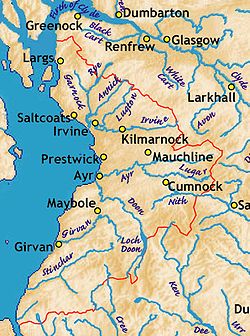
Rivers in Ayrshire
The main rivers flowing to the Clyde coast are, from north to south, the following:Some notable people born in Ayrshire
- Hew Ainslie (1792-1878), poet
- Sir Thomas Brisbane (1773-1860), Scottish soldier and colonial administrator, after whom the city of Brisbane is named.
- John Boyd Orr (1880-1971), Nobel Peace PrizeNobel Peace PrizeThe Nobel Peace Prize is one of the five Nobel Prizes bequeathed by the Swedish industrialist and inventor Alfred Nobel.-Background:According to Nobel's will, the Peace Prize shall be awarded to the person who...
winner - Robert the BruceRobert I of ScotlandRobert I , popularly known as Robert the Bruce , was King of Scots from March 25, 1306, until his death in 1329.His paternal ancestors were of Scoto-Norman heritage , and...
(1274-1329), possibly at Turnberry CastleTurnberry CastleTurnberry Castle is a fragmentary ruin on the coast of Kirkoswald parish, north of Girvan in Ayrshire, Scotland. It is situated on a rock at the extremity of the lower peninsula within the parish.-History:...
. - Robert BurnsRobert BurnsRobert Burns was a Scottish poet and a lyricist. He is widely regarded as the national poet of Scotland, and is celebrated worldwide...
(1759-1796), poet, in Alloway; - Kenneth CampbellKenneth CampbellKenneth Campbell VC was a Scottish recipient of the Victoria Cross, the highest and most prestigious award for gallantry in the face of the enemy that can be awarded to British and Commonwealth forces.-Details:...
(1917-1941), RAF pilot, posthumous recipient of the Victoria CrossVictoria CrossThe Victoria Cross is the highest military decoration awarded for valour "in the face of the enemy" to members of the armed forces of various Commonwealth countries, and previous British Empire territories....
, born in Ardrossan. - Robert CraufurdRobert CraufurdMajor-General Robert Craufurd was a Scottish soldier and Member of Parliament . After a military career which took him from India to the Netherlands, he was given command of the Light Division in the Napoleonic Peninsular War under the Duke of Wellington...
(1764-1812), British Major-General; - Thomas Craig (1855-1900), noted professor of mathematics, editor, and author.
- John DunlopJohn Boyd DunlopJohn Boyd Dunlop was a Scottish inventor. He was one of the founders of the rubber company that bore his name, Dunlop Pneumatic Tyre Company....
(1840-1921), Scottish inventor of the pneumatic tire, in Dreghorn. - Andrew FisherAndrew FisherAndrew Fisher was an Australian politician who served as the fifth Prime Minister on three separate occasions. Fisher's 1910-13 Labor ministry completed a vast legislative programme which made him, along with Protectionist Alfred Deakin, the founder of the statutory structure of the new nation...
(1862-1928), 5th Prime Minister of Australia 1908-1909, 1910-1913, 1914-1915; - Sir Alexander FlemingAlexander FlemingSir Alexander Fleming was a Scottish biologist and pharmacologist. He wrote many articles on bacteriology, immunology, and chemotherapy...
(1881-1955), inventor/discoverer of penicillin, in Darvel; - John Galt (1779-1839), author.
- Drew Galloway (1985-), professional wrestler on WWE's RawWWE RAWWWE Raw ) is a sports entertainment television program for WWE that currently airs on the USA Network in the United States...
brand as Drew McIntyre. - Air Chief MarshalAir Chief Marshal (Australia)Air chief marshal is the highest active rank of the Royal Australian Air Force and was created as a direct equivalent of the British Royal Air Force rank of air chief marshal. It is also considered a four-star rank...
Angus HoustonAngus HoustonAir Chief Marshal Allan Grant "Angus" Houston AC, AFC is a retired senior commander of the Royal Australian Air Force and was the Chief of the Defence Force from 4 July 2005 until his retirement on 3 July 2011...
, current Australian Chief of Defence ForceChief of the Defence Force (Australia)Chief of the Defence Force is the most senior appointment in the Australian Defence Force . The CDF commands the ADF under the direction of the Minister of Defence, in a coequal arrangement with the Secretary of Defence, the most senior public servant in the Department of Defence.The position is a...
Emigrated to Australia in 1968 - George Houston (painter) (1869-1947), landscape painter of Scottish locales;
- Tom HunterTom HunterSir Thomas Blane Hunter is a Scottish businessman, entrepreneur, and philanthropist.In April 2007, Hunter was reported in the Sunday Times Rich List as the first ever home-grown billionaire in Scotland, with an estimated wealth of £1.05 billion...
, entrepreneur and philanthropist - Macdonald Brothers, recording artists and contestants on The X FactorThe X Factor (TV series)The X Factor is a television talent show franchise originating in the United Kingdom, where it was devised as a replacement for Pop Idol. It is a singing competition, now held in various countries, which pits contestants against each other. These contestants are aspiring pop singers drawn from...
- John McAdamJohn Loudon McAdamJohn Loudon McAdam was a Scottish engineer and road-builder. He invented a new process, "macadamisation", for building roads with a smooth hard surface that would be more durable and less muddy than soil-based tracks....
(1756-1836), engineer, responsible for a system of road design; - James McCoshJames McCoshJames McCosh was a prominent philosopher of the Scottish School of Common Sense. He was president of Princeton University 1868-1888.-Biography:...
(1811-1894), noted philosopher of the Scottish School of Common Sense and president of what would be Princeton UniversityPrinceton UniversityPrinceton University is a private research university located in Princeton, New Jersey, United States. The school is one of the eight universities of the Ivy League, and is one of the nine Colonial Colleges founded before the American Revolution....
. - James McCosh ClarkJames Clark (New Zealand)James McCosh Clark was Mayor of Auckland in the 1880s. He was a successful businessman until many of his ventures failed during the depression of the 1880s, which caused him to return to England for the last decade of his life...
(1833–1898), Mayor of Auckland - Jai McDowallJai McDowallJai McDowall is a Scottish singer who won the fifth series of Britain's Got Talent in June 2011. As the winner, he received £100,000 and will perform at the 2011 Royal Variety Performance...
(1986-), winner of Britain's Got TalentBritain's Got TalentBritain's Got Talent is a British television talent show competition which started in June 2007 and originated from the Got Talent series. The show is produced by FremantleMedia's TalkbackThames and Simon Cowell's production company SYCOtv. The show is broadcast on ITV in Britain and TV3 in Ireland...
in 2011 - William McIlvanneyWilliam McIlvanneyWilliam McIlvanney is a writer of crime stories, novels, and poetry. McIlvanney is a champion of gritty yet poetic literature; his works Laidlaw, The Papers of Tony Veitch, and Walking Wounded are all known for their portrayal of Glasgow in the 1970s.- Life and career :McIlvanney was born in the...
, writer. - Sir Thomas McKillopTom McKillopSir Thomas Fulton Wilson McKillop, born 19 March 1943, is a chemist, pharmaceutical company CEO and former chairman of RBS Group.McKillop was born in Dreghorn, a small village near the town of Irvine in Ayrshire, Scotland and educated at Irvine Royal Academy and then Glasgow University, where he...
, (1943-) CEO of AstraZeneca, born in Dreghorn - James Henry McLeanJames Henry McLeanJames Henry Mclean was a U.S. Representative from Missouri.Born in Ayrshire, Scotland, McleanReared in Nova Scotia, Canada.Immigrated to the United States in 1842 and settled in Philadelphia, Pennsylvania....
(1806-1886), born in Ayrshire, physician and United States Congressman from Missouri. - Colin MochrieColin MochrieColin Andrew Mochrie is a Scottish Canadian actor and improvisational comedian, most famous for his appearances on the British and US versions of television improvisation show Whose Line Is It Anyway?.-Early life:...
(born 1957) Scottish /Canadian Improvisational Comedian and Actor (Best known for being in Whose Line Is It Anyway?Whose Line Is It Anyway?Whose Line Is It Anyway? is a short-form improvisational comedy TV show. Originally a British radio programme, it moved to television in 1988 as a series made for the UK's Channel 4, for a 10 series run...
) - William MurdochWilliam MurdochWilliam Murdoch was a Scottish engineer and long-term inventor.Murdoch was employed by the firm of Boulton and Watt and worked for them in Cornwall, as a steam engine erector for ten years, spending most of the rest of his life in Birmingham, England.He was the inventor of the oscillating steam...
(1754 - 1839), Inventor of gas lighting and Engineer. - Simon NeilSimon NeilSimon Alexander Neil is a Scottish vocalist, guitarist, and songwriter, known for his work in the bands Biffy Clyro and Marmaduke Duke.-Biffy Clyro:...
(1979-), James JohnstonJames JohnstonJames Johnston may refer to:*James Johnston , Scottish Secretary of State*James William Johnston , Canadian politician and judge*James Finlay Weir Johnston , chemist...
, and Ben JohnstonBen JohnstonBenjamin Burwell Johnston, Jr. is a composer of contemporary music in the just intonation system.-Johnston's music:...
of Biffy ClyroBiffy ClyroBiffy Clyro are a Scottish rock band from Kilmarnock, comprising Simon Neil , James Johnston and Ben Johnston...
. - Bill ShanklyBill ShanklyWilliam "Bill" Shankly, OBE was a Scottish football player and manager, most noted for managing Liverpool between 1959 and 1974. One of Britain's most successful and respected football managers, Shankly was also a fine player whose career was interrupted by the Second World War...
(1913-1981), successful footballFootball (soccer)Association football, more commonly known as football or soccer, is a sport played between two teams of eleven players with a spherical ball...
manager - Robert SimsonRobert SimsonRobert Simson was a Scottish mathematician and professor of mathematics at the University of Glasgow. The pedal line of a triangle is sometimes called the "Simson line" after him.-Life:...
(1687-1768), noted mathematician and professor of mathematics for 50 years - David ThomsonDavid ThomsonDavid Thomson may refer to:* David Coupar Thomson , Scottish publisher, founder of D. C. Thomson & Co. Ltd* David Thomson, 3rd Baron Thomson of Fleet , Canadian businessman and currently the wealthiest individual in Canada...
(1955- ), philosopher - Sam TorranceSam TorranceSam Torrance OBE is a Scottish professional golfer and sports commentator. He was one of the leading players on the European Tour from the mid 1970s to the late 1990s, with 21 Tour wins. Torrance was a member of European Ryder Cup teams on eight occasions, from 1981 to 1995 consecutively; he was...
(1953- ), professional golfer born in Largs. - Malcolm Wallace, Father of William WallaceWilliam WallaceSir William Wallace was a Scottish knight and landowner who became one of the main leaders during the Wars of Scottish Independence....
one of Scotland's greatest national heroes, in Riccarton, Kilmarnock.
External links
- South Ayrshire Council
- Ayrshire & Arran Tourist Board
- Visit Ayrshire & Arran Guide A to Z and Picture Gallery