Augmented sixth chord

Encyclopedia
Music theory
Music theory is the study of how music works. It examines the language and notation of music. It seeks to identify patterns and structures in composers' techniques across or within genres, styles, or historical periods...
, an augmented sixth chord contains the interval
Interval (music)
In music theory, an interval is a combination of two notes, or the ratio between their frequencies. Two-note combinations are also called dyads...
of an augmented sixth
Augmented sixth
In classical music from Western culture, an augmented sixth is an interval produced by widening a major sixth by a chromatic semitone. For instance, the interval from C to A is a major sixth, nine semitones wide, and both the intervals from C to A, and from C to A are augmented sixths, spanning...
above its "root
Root (chord)
In music theory, the root of a chord is the note or pitch upon which a triadic chord is built. For example, the root of the major triad C-E-G is C....
" or bass tone
Bass note
In music theory, the bass note of a chord or sonority is the lowest note played or notated. If there are multiple voices it is the note played or notated in the lowest voice. While the bass note is often the root or fundamental of the chord, it does not have to be, and sometimes one of the other...
(see below). This chord
Chord (music)
A chord in music is any harmonic set of two–three or more notes that is heard as if sounding simultaneously. These need not actually be played together: arpeggios and broken chords may for many practical and theoretical purposes be understood as chords...
has its origins in the Renaissance
Renaissance music
Renaissance music is European music written during the Renaissance. Defining the beginning of the musical era is difficult, given that its defining characteristics were adopted only gradually; musicologists have placed its beginnings from as early as 1300 to as late as the 1470s.Literally meaning...
, further developed in the Baroque
Baroque music
Baroque music describes a style of Western Classical music approximately extending from 1600 to 1760. This era follows the Renaissance and was followed in turn by the Classical era...
, and became a distinctive part of the musical style of the Classical
Classical period (music)
The dates of the Classical Period in Western music are generally accepted as being between about 1750 and 1830. However, the term classical music is used colloquially to describe a variety of Western musical styles from the ninth century to the present, and especially from the sixteenth or...
and Romantic periods.
Resolution and chord construction
The augmented sixth interval is typically between the sixth degree of the minor scale (henceforth 6) and the raised fourth degree (henceforth 4). With standard voice leadingVoice leading
In musical composition, voice leading is the term used to refer to a decision-making consideration when arranging voices , namely, how each voice should move in advancing from each chord to the next.- Details :...
, the chord is followed directly or indirectly by some form of the dominant
Dominant (music)
In music, the dominant is the fifth scale degree of the diatonic scale, called "dominant" because it is next in importance to the tonic,and a dominant chord is any chord built upon that pitch, using the notes of the same diatonic scale...
chord, in which both 6 and 4 have resolved
Resolution (music)
Resolution in western tonal music theory is the move of a note or chord from dissonance to a consonance .Dissonance, resolution, and suspense can be used to create musical interest...
to the fifth scale degree (henceforth 5). This tendency to resolve outwards to 5 is why the interval is spelled as an augmented sixth, rather than enharmonic
Enharmonic
In modern musical notation and tuning, an enharmonic equivalent is a note , interval , or key signature which is equivalent to some other note, interval, or key signature, but "spelled", or named, differently...
ally as a minor seventh
Minor seventh
In classical music from Western culture, a seventh is a musical interval encompassing seven staff positions , and the minor seventh is one of two commonly occurring sevenths. The minor quality specification identifies it as being the smallest of the two: the minor seventh spans ten semitones, the...
(6 and 5). Although augmented sixth chords are more common in the minor mode
Major and minor
In Western music, the adjectives major and minor can describe a musical composition, movement, section, scale, key, chord, or interval.Major and minor are frequently referred to in the titles of classical compositions, especially in reference to the key of a piece.-Intervals and chords:With regard...
, they are also used in the major mode by borrowing
Borrowed chord
A borrowed chord is a chord borrowed from the parallel key . Borrowed chords are typically used as "color chords", providing variety through contrasting scale forms, major and the three forms of minor...
6 of the parallel minor scale.
Double-diminished triad
In music theoryMusic theory
Music theory is the study of how music works. It examines the language and notation of music. It seeks to identify patterns and structures in composers' techniques across or within genres, styles, or historical periods...
, the double-diminished triad is an archaic concept and term referring to a triad
Triad (music)
In music and music theory, a triad is a three-note chord that can be stacked in thirds. Its members, when actually stacked in thirds, from lowest pitched tone to highest, are called:* the Root...
, or three note chord
Chord (music)
A chord in music is any harmonic set of two–three or more notes that is heard as if sounding simultaneously. These need not actually be played together: arpeggios and broken chords may for many practical and theoretical purposes be understood as chords...
, which, already being minor, has its root raised a semitone, making it doubly diminished. However, this may be used as the derivation of the augmented sixth chord.
For example, F-A-C is a minor triad. F-A-C is a doubly diminished triad. Note that it is enharmonic
Enharmonic
In modern musical notation and tuning, an enharmonic equivalent is a note , interval , or key signature which is equivalent to some other note, interval, or key signature, but "spelled", or named, differently...
ally equivalent to G-A-C (incomplete dominant seventh, missing E). A-C-F is an Italian augmented sixth chord.
Standard harmonic function
From the Baroque to the Romantic period, augmented sixth chords have had the same harmonic function: as a chromatically altered predominantPredominant
In music theory, a predominant chord is any chord which normally resolves to a dominant chord. Examples of predominant chords are the subdominant , supertonic , Neapolitan sixth and German sixth. Other examples are the submediant , secondary dominant , iv and ii°...
chord (typically, an alteration of ii

Supertonic
In music or music theory, the supertonic is the second degree or note of a diatonic scale, one step above the tonic. In music theory, the supertonic chord is symbolized by the Roman numeral ii in a major scale, indicating that the chord is a minor chord , or ii in a natural minor scale, indicating...
, IV

Subdominant
In music, the subdominant is the technical name for the fourth tonal degree of the diatonic scale. It is so called because it is the same distance "below" the tonic as the dominant is above the tonic - in other words, the tonic is the dominant of the subdominant. It is also the note immediately...
, vi7
Submediant
In music, the submediant is the sixth scale degree of the diatonic scale, the 'lower mediant' halfway between the tonic and the subdominant or 'lower dominant'...
or their parallel
Parallel key
In music, parallel keys are the major and minor scales that have the same tonic. A major and minor scale sharing the same tonic are said to be in a parallel relationship...
equivalents in the minor mode) leading to a dominant
Dominant (music)
In music, the dominant is the fifth scale degree of the diatonic scale, called "dominant" because it is next in importance to the tonic,and a dominant chord is any chord built upon that pitch, using the notes of the same diatonic scale...
chord. This movement to the dominant is heightened by the semitonal
Semitone
A semitone, also called a half step or a half tone, is the smallest musical interval commonly used in Western tonal music, and it is considered the most dissonant when sounded harmonically....
resolution of both 6 to 5 and 4 to 5; essentially, these two notes act as leading-tone
Leading-tone
In music theory, a leading-note is a note or pitch which resolves or "leads" to a note one semitone higher or lower, being a lower and upper leading-tone, respectively....
s. This characteristic has led many analysts to compare the voice leading of augmented sixth chords to the secondary dominant
Secondary dominant
Secondary dominant is an analytical label for a specific harmonic device, prevalent in the tonal idiom of Western music beginning in the common practice period...
V of V because of the presence of 4, the leading-tone of V, in both chords. In the major mode, the chromatic voice
leading is more pronounced because of the presence of two chromatically altered notes, 6, as well as 4, rather than just 4 in the minor mode.
During the Romantic period
Romantic music
Romantic music or music in the Romantic Period is a musicological and artistic term referring to a particular period, theory, compositional practice, and canon in Western music history, from 1810 to 1900....
, the augmented sixth harmony
Harmony
In music, harmony is the use of simultaneous pitches , or chords. The study of harmony involves chords and their construction and chord progressions and the principles of connection that govern them. Harmony is often said to refer to the "vertical" aspect of music, as distinguished from melodic...
increased in ambiguity as composers explored other functional possibilities outside of its role as a predominant. See #Extended functions.
Variants
There are several variants of the augmented sixth chord. Though each is named after a European nationality, theorists disagree on their precise origins and have struggled for centuries to define their roots, and fit them into conventional harmonic theory.Italian sixth
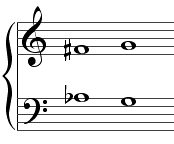
 or It
or It ) is derived from iv
 with an altered fourth scale degree, 4: 6—1—4; A—C—F in C major. This is the only augmented sixth chord comprising just three distinct notes; in four-part writing, the tonic pitch is doubled.
Examples
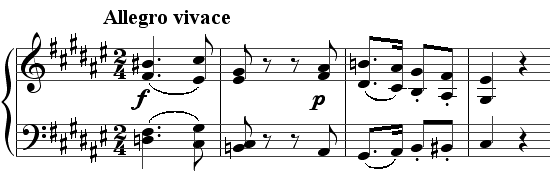
- The second movement of Beethoven's piano sonata in F-sharp majorPiano Sonata No. 24 (Beethoven)The Piano Sonata No. 24 in F-sharp major, Op. 78, nicknamed "À Thérèse" was written by Ludwig van Beethoven in 1809. It consists of two movements:#Adagio cantabile - Allegro ma non troppo...
, op. 78, begins with an Italian sixth chord:
French sixth
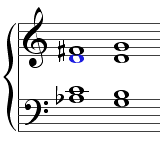
 or Fr
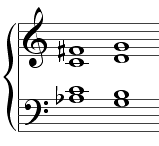
or Fr ) is similar to the Italian, but with an additional tone, 2: 6—1—2—4; A—C—D—F in C major. The notes of the French sixth chord are all contained within the same whole tone scale
Whole tone scale
In music, a whole tone scale is a scale in which each note is separated from its neighbors by the interval of a whole step. There are only two complementary whole tone scales, both six-note or hexatonic scales:...
, lending a sonority common to French music in the 19th century (especially associated with Impressionist music
Impressionist music
Impressionism in music was a tendency in European classical music, mainly in France, which appeared in the late nineteenth century and continued into the middle of the twentieth century. Similarly to its precursor in the visual arts, musical impressionism focuses on a suggestion and an atmosphere...
).
Examples
- Richard WagnerRichard WagnerWilhelm Richard Wagner was a German composer, conductor, theatre director, philosopher, music theorist, poet, essayist and writer primarily known for his operas...
's famous Tristan chordTristan chordThe Tristan chord is a chord made up of the notes F, B, D and G. More generally, it can be any chord that consists of these same intervals: augmented fourth, augmented sixth, and augmented ninth above a root...
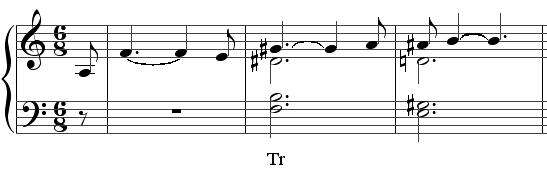
(indicated below with Tr) from the opening of his opera, Tristan und IsoldeTristan und IsoldeTristan und Isolde is an opera, or music drama, in three acts by Richard Wagner to a German libretto by the composer, based largely on the romance by Gottfried von Straßburg. It was composed between 1857 and 1859 and premiered in Munich on 10 June 1865 with Hans von Bülow conducting...
, can be interpreted as a French sixth in the keyKey (music)In music theory, the term key is used in many different and sometimes contradictory ways. A common use is to speak of music as being "in" a specific key, such as in the key of C major or in the key of F-sharp. Sometimes the terms "major" or "minor" are appended, as in the key of A minor or in the...
of A minor (F-A-B-D) with an upwardly resolving appoggiatura in the upper voice. Note that the D resolves downwards to D instead of E:
German sixth
 or Ger
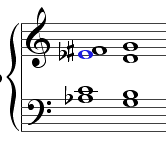
 ) is also like the Italian, but with an added tone 3: 6—1—3—4; A—C—E—F in C major. In Classical music, however, it appears in much the same places as the other variants, though perhaps less used because of the contrapuntal
Counterpoint
In music, counterpoint is the relationship between two or more voices that are independent in contour and rhythm and are harmonically interdependent . It has been most commonly identified in classical music, developing strongly during the Renaissance and in much of the common practice period,...
difficulties outlined below. It appears frequently in the works of Beethoven
Ludwig van Beethoven
Ludwig van Beethoven was a German composer and pianist. A crucial figure in the transition between the Classical and Romantic eras in Western art music, he remains one of the most famous and influential composers of all time.Born in Bonn, then the capital of the Electorate of Cologne and part of...
. The German sixth chord contains the same notes as a dominant seventh chord, though it functions differently.
It is more difficult to avoid parallel fifths when resolving a German sixth chord to the dominant, V. These parallel fifths, referred to as Mozart fifths, were occasionally accepted by common practice
Common practice period
The common practice period, in the history of Western art music , spanning the Baroque, Classical, and Romantic periods, lasted from c. 1600 to c. 1900.-General characteristics:...
composers. There are two ways they can be avoided:
- The 3 can move to either 1 or 2, thereby generating an Italian or French sixth, respectively, and eliminating the perfect fifth between 6 and 3.
- The chord can resolve to a "six-four" chord, functionally either as a cadential six-four intensification of V, or as the second inversion of I; the cadential six-four, in turn, resolves to a root-position V. This progressionChord progressionA chord progression is a series of musical chords, or chord changes that "aims for a definite goal" of establishing a tonality founded on a key, root or tonic chord. In other words, the succession of root relationships...
ensures that, in its voice leading, each pair of voices moves either by oblique motion or contrary motionContrary motionIn music theory, contrapuntal motion is the general movement of two melodic lines with respect to each other. In traditional four-part harmony, it is important that lines maintain their independence, an effect which can be achieved by the judicious use of the four types of contrapuntal motion:...
and avoids parallel motionParallel motionThe parallel motion is a mechanical linkage invented by the Scottish engineer James Watt in 1784 for his double-acting steam engine.In previous engines built by Newcomen and Watt, the piston pulled one end of the walking beam downwards during the power stroke using a chain, and the weight of the...
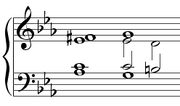
altogether. In minor modes, both 1 and 3 do not move during the resolution of the German sixth to the cadential six-four. In major modes, 3 can be enharmonicEnharmonicIn modern musical notation and tuning, an enharmonic equivalent is a note , interval , or key signature which is equivalent to some other note, interval, or key signature, but "spelled", or named, differently...
ally respelled as 2 if it resolves upwards to 3, similar in voice leading to the resolution of French sixth to the cadential six-four. This respelled chord is sometimes referred to as the English, Swiss or Alsatian sixth chord. (The respelled chord is sometimes ambiguously labeled a "doubly augmented sixth chord"; however, the interval of a fourth between 6 and 2 (i.e., A to D in C major) is doubly augmented, not the sixth.)
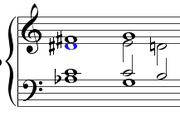
Examples
- A German sixth can be found in the high passage heard twice in the "Passepied" from Debussy's Suite BergamasqueSuite bergamasqueThe Suite bergamasque is one of the most famous piano suites by Claude Debussy. Debussy commenced the suite in 1890 at age 28, but he did not finish or publish it until 1905.-History:...
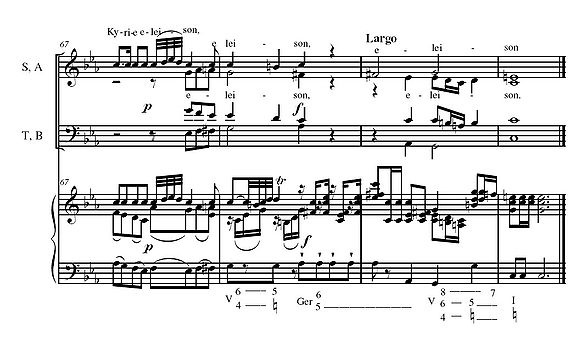
. - A German sixth chord from Michael HaydnMichael HaydnJohann Michael Haydn was an Austrian composer of the classical period, the younger brother of Joseph Haydn.-Life:...
's RequiemRequiem (Michael Haydn)Michael Haydn wrote the Missa pro defuncto Archiepiscopo Sigismondo, or more generally Missa pro Defunctis, Klatzmann I:8, MH 155, following the death of the Count Archbishop Sigismund von Schrattenbach in Salzburg on December 1771...
in C minor, first movement:
Other variants
Other variants of augmented sixth chords are sometimes found in the repertoire, and are sometimes given whimsical geographical names. For example: 4—6—7—2; (F—A—B—D) is called by one source an Australian sixth. Such anomalies usually have alternative interpretations."Inverted" augmented sixth chords
Augmented sixth chords are occasionally used with a different chord member in the bass. Since there is no consensus among theorists that they are in root position in their normal form, the word "inversion" isn't necessarily accurate, but is found in some textbooks, nonetheless. Sometimes, "inverted" augmented sixth chords occur as a product of voice leading.The French philosopher composer, Jean-Jacques Rousseau
Jean-Jacques Rousseau
Jean-Jacques Rousseau was a Genevan philosopher, writer, and composer of 18th-century Romanticism. His political philosophy influenced the French Revolution as well as the overall development of modern political, sociological and educational thought.His novel Émile: or, On Education is a treatise...
considered that the chord could not be inverted (Dictionnaire de Musique). Seventeenth-century instances of the augmented sixth with the sharp note in the bass are generally limited to German sources.
Examples
- Tchaikovsky's, Symphony no. 5 (op. 64, I), Allegro con anima (bars 3–4).
- The following excerpt shows an augmented sixth chord in inversion used by BachJohann Sebastian BachJohann Sebastian Bach was a German composer, organist, harpsichordist, violist, and violinist whose sacred and secular works for choir, orchestra, and solo instruments drew together the strands of the Baroque period and brought it to its ultimate maturity...
. At the end of the second measure, the augmented sixth is inverted to create a diminished thirdDiminished thirdIn classical music from Western culture, a diminished third is the musical interval produced by narrowing a minor third by a chromatic semitone. For instance, the interval from A to C is a minor third, three semitones wide, and both the intervals from A to C, and from A to C are diminished thirds,...
or tenth between the bass and the soprano (C—E); these two voices resolve inward to an octave:
"Roots" of augmented sixth chords
Simon Sechter, in 'Die Grundsätze der musicalischen Komposition', explains the chord of the French Sixth A—C—D—F in the key of C as being a chromatically altered version of a seventh chordSeventh chord
A seventh chord is a chord consisting of a triad plus a note forming an interval of a seventh above the chord's root. When not otherwise specified, a "seventh chord" usually means a major triad with an added minor seventh...
on the second degree of the scale, and therefore gives the root as 'D'. The German Sixth A—C—E—F is explained as a chromatically altered ninth chord
Ninth chord
A ninth chord is a chord that encompasses the interval of a ninth when arranged in close position with the root in the bass.A dominant ninth is a dominant chord with a ninth. A ninth chord, as an extended chord, typically includes the seventh along with the basic triad structure. Thus, a Cmaj9...
on the same root, but with the root omitted. (In Sechter's theory, the diminished seventh chord F—A—C—E is invariably described in the same way, i.e. a ninth chord on D with the root omitted, hence its equivalence to the augmented sixth.)
The tendency of the interval of the augmented sixth to resolve outwards is therefore explained by the fact that the A, being a dissonant note, a diminished fifth above the root (D), and flatted, must fall, whilst the F - being chromatically raised - must rise.
On the contrary, Tchaikovsky considers the augmented sixth chords, rather than being built on the minor sixth degree
Degree (music)
In music theory, a scale degree or scale step is the name of a particular note of a scale in relation to the tonic...
(A in C), as being altered dominants. In his Guide to the practical study of harmony considers the augmented sixth chords to be inversions of the diminished triad and of dominant and diminished seventh chords with the second degree chromatically lowered, and accordingly resolving into the tonic. He notes that, "some theorists insist upon [augmented sixth chord's] resolution not into the tonic but into the dominant triad, and regard them as being erected not on the altered 2-nd degree, but on the altered 6-th degree in major and on the natural 6-th degree in minor", yet calls this view, "fallacious", insisting that a, "chord of the augmented sixth on the 6-th degree is nothing else than a modulatory degression into the key of the dominant". This would make the chord of the augmented sixth a member of a large group of chords with an altered second degree (which includes the Neapolitan chord). For an exhaustive discussion of the possibility of augmented sixth chords resolving to tonic (or other scale degrees), see Daniel Harrison's article, "A Supplement to the Theory of Augmented-Sixth Chords."
Extended functions
In the late Romantic period and other musical genres, especially jazzJazz
Jazz is a musical style that originated at the beginning of the 20th century in African American communities in the Southern United States. It was born out of a mix of African and European music traditions. From its early development until the present, jazz has incorporated music from 19th and 20th...
, other harmonic possibilities of augmented sixth variants and sonorities outside its function as a predominant
Predominant
In music theory, a predominant chord is any chord which normally resolves to a dominant chord. Examples of predominant chords are the subdominant , supertonic , Neapolitan sixth and German sixth. Other examples are the submediant , secondary dominant , iv and ii°...
were explored, exploiting their particular properties. An example of this is through the "reinterpretation" of the harmonic function of a chord: Since a chord could simultaneously have more than one enharmonic spelling with different functions (i.e., both predominant as a German sixth and dominant as a dominant seventh), its function could be reinterpreted mid-phrase. This heightens both chromaticism
Chromaticism
Chromaticism is a compositional technique interspersing the primary diatonic pitches and chords with other pitches of the chromatic scale. Chromaticism is in contrast or addition to tonality or diatonicism...
by making possible the tonicization
Tonicization
In music, tonicization is the treatment of a pitch other than the overall tonic as a temporary tonic in a composition. Tonicization is achieved through the use of the scale and harmonies of the tonicized key. The most common method of tonicization uses leading tones, dominant-tonic chord...
of remote keys, and possible dissonances with the juxtaposition of remotely related keys.
Enharmonic equivalency of the French sixth
The French sixth has two characteristics in common with the diminished seventh chordDiminished seventh chord
A diminished seventh chord is a four note chord that comprises a diminished triad plus the interval of a diminished seventh above the root. Thus it is , or enharmonically , of any major scale; for example, C diminished-seventh would be , or enharmonically...
:
- Both chords are constructed of two superimposed tritones; in the French sixth, between 6—2 (A—D) and 1—4 (C—F). Thus, both have inversional symmetry;
- Both are enharmonicEnharmonicIn modern musical notation and tuning, an enharmonic equivalent is a note , interval , or key signature which is equivalent to some other note, interval, or key signature, but "spelled", or named, differently...
ally equivalent at the tritoneTritoneIn classical music from Western culture, the tritone |tone]]) is traditionally defined as a musical interval composed of three whole tones. In a chromatic scale, each whole tone can be further divided into two semitones...
; i.e., both chords transposed up or down a tritone will result in the same pitches as the original.
As with the diminished seventh chord, the latter property allows the chord to be used in modulating
Modulation (music)
In music, modulation is most commonly the act or process of changing from one key to another. This may or may not be accompanied by a change in key signature. Modulations articulate or create the structure or form of many pieces, as well as add interest...
to very remote keys. For instance: 6—1—2—4; (A—C—D—F in C), could be interpreted identically in F if reordered and respelled as D—F—G—B, i.e., the French sixth of the IV key area, displaced an interval of a tritone relative to the tonic key, I.
Dominant functions
All variants of augmented sixth chords are closely related to the applied dominant V7 of II; both Italian and German variants are enharmonically identical to dominant seventh chords. For example, in the key of C (I), the German sixth chord, A—C—E—F, could be reinterpreted as A—C—E—G, the applied dominant of D (V/D).Classical harmonic theory would notate the "tritone substitute" as an augmented sixth chord on 2. The Augmented sixth chord can either be the It+6 enharmonic to a dominant 7th chord without the 5th, Gr+6, enharmonically equivalent to a dominant 7th chord with the 5th, or Fr+6 enharmonically equivalent to the Lydian dominant without the 5th, all of which serve in a classical context as a substitute for the secondary dominant
Secondary dominant
Secondary dominant is an analytical label for a specific harmonic device, prevalent in the tonal idiom of Western music beginning in the common practice period...
of V.
Below is the original dominant-tonic progression, that progression with the tritone substitution, and the same progression with the substitution notated as an Italian augmented sixth chord:

French sixth sonority as dominant
In jazz, the French sixth sonority functions as a dominantDominant (music)
In music, the dominant is the fifth scale degree of the diatonic scale, called "dominant" because it is next in importance to the tonic,and a dominant chord is any chord built upon that pitch, using the notes of the same diatonic scale...
instead of a predominant chord; exploiting the enharmonically equivalent property of the French sixth is a common technique is referred to as tritone substitution
Tritone substitution
In classical music, a substitute dominant is "a chord sufficiently akin to the dominant to be reasonably set against the tonic, and yet remote enough to give a chromatically expressive, large-scale dissonance to the structure"...
.
The French sixth sonority, for example A—C—D—F in the key of C, is interpreted as a specific variation of a dominant seventh chord in the following keys:
- V7 of D with 4; A as the root: A—C—D—G; or
- V7 of G with 4; D as the root: D—F—G—C.
This chord is called the Lydian dominant (A711—D711), see jazz chord.
These functions could also be spelled as a dominant seventh with a flatted fifth:
- V7 of D, with 5; A as the root: A—C—E—G; or
- V7 of G, with 5; D as the root: D—F—A—C.
and could be notated A75 and D75. This spelling does not suggest the Lydian-dominant mode, but it does suggest a dominant function. Also, C—E and F—A are inverted augmented sixths (diminished thirds), where C—D and F—G are inverted minor sevenths (major second
Major second
In Western music theory, a major second is a musical interval spanning two semitones, and encompassing two adjacent staff positions . For example, the interval from C to D is a major second, as the note D lies two semitones above C, and the two notes are notated on adjacent staff postions...
s).
Augmented sixths built on scale degrees other than 6
The augmented sixth chord may be built on notes other than 6. Often, this is the result of a temporary tonicizationTonicization
In music, tonicization is the treatment of a pitch other than the overall tonic as a temporary tonic in a composition. Tonicization is achieved through the use of the scale and harmonies of the tonicized key. The most common method of tonicization uses leading tones, dominant-tonic chord...
, and the resulting augmented sixth chord is borrowed from the key of the secondary dominant which follows it. However, there are examples in the literature of these chords appearing without such a context. Schubert used it in some of his last compositions in dramatic final cadences
Cadence (music)
In Western musical theory, a cadence is, "a melodic or harmonic configuration that creates a sense of repose or resolution [finality or pause]." A harmonic cadence is a progression of two chords that concludes a phrase, section, or piece of music...
.
Examples
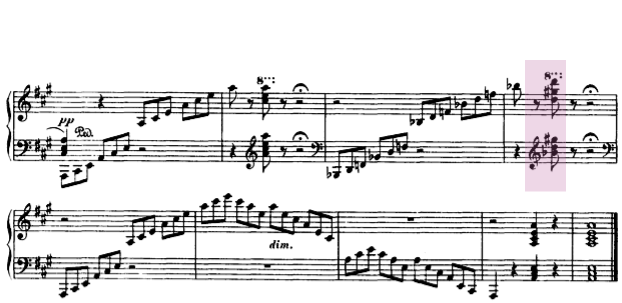
- An Italian sixth chord built on scale degree 2 in Schubert's piano sonata D. 959Schubert's last sonatasFranz Schubert's last three piano sonatas, numbered 958, 959 and 960 in Deutsch's catalogue of Schubert's complete works, are the composer's last major compositions for the piano. They were written during the last months of Schubert's life, between the spring and autumn of 1828, but were not...
, preceded by a II chord in root position (B—D—F). Instead of functioning as a predominant, here, both the II and the Italian sixth chord serve in a sort of "neighbour motion," or "plagal cadence" (usually I—IV—I) in the codaCoda (music)Coda is a term used in music in a number of different senses, primarily to designate a passage that brings a piece to an end. Technically, it is an expanded cadence...
. I—II—(It+6)—I: