
All Topics  
Tritone substitution


   Email Print
   Bookmark   Link


Tritone substitution


In jazz
Jazz

Jazz is a primarily American musical art form which originated at the beginning of the 20th century in African American communities in the Southern United States from a confluence of African and European music traditions....
 music
Music

Music is an art form whose media is sound organized in time. Common elements of music are pitch , rhythm , dynamics , and the sonic qualities of timbre and texture ....
, a tritone substitution is the use in a chord progression
Chord progression

A chord progression is series of chord s played in order. Chord progressions are central to most modern music and the principal study of harmony....
 of a dominant seventh chord
Seventh chord

A seventh chord is a chord consisting of a triad plus a note forming an interval of a seventh above the chord's root . When not otherwise specified, a "seventh chord" usually means a major triad with a flat seventh ....
 (major/minor seventh chord) that is three whole steps (a tritone
Tritone

The tritone is a musical interval that spans three major second. The tritone is the same as an augmented fourth, which in equal temperament is enharmonic to a diminished fifth....
: 6 semitone
Semitone

A semitone, also called a half step or a half tone,Aaron Copland, Leonard Bernstein, and others use "half tone".One source says that step is "chiefly US", and that half-tone is "chiefly N....
s) away from the original dominant seventh chord. For example, D7 would be the tritone substitution for G7 while F would substitute for B, and G for C. Tritone substitutions are also used in improvisation and are commonly used to create tension during a solo.

The reason these dominant seventh chords may be substituted for each other is that they share the two pitches that form a tritone in each chord (the third and seventh, albeit reversed).


Discussion
Ask a question about 'Tritone substitution'
Start a new discussion about 'Tritone substitution'
Answer questions from other users
Full Discussion Forum


Recent Posts


Encyclopedia


In jazz
Jazz

Jazz is a primarily American musical art form which originated at the beginning of the 20th century in African American communities in the Southern United States from a confluence of African and European music traditions....
 music
Music

Music is an art form whose media is sound organized in time. Common elements of music are pitch , rhythm , dynamics , and the sonic qualities of timbre and texture ....
, a tritone substitution is the use in a chord progression
Chord progression

A chord progression is series of chord s played in order. Chord progressions are central to most modern music and the principal study of harmony....
 of a dominant seventh chord
Seventh chord

A seventh chord is a chord consisting of a triad plus a note forming an interval of a seventh above the chord's root . When not otherwise specified, a "seventh chord" usually means a major triad with a flat seventh ....
 (major/minor seventh chord) that is three whole steps (a tritone
Tritone

The tritone is a musical interval that spans three major second. The tritone is the same as an augmented fourth, which in equal temperament is enharmonic to a diminished fifth....
: 6 semitone
Semitone

A semitone, also called a half step or a half tone,Aaron Copland, Leonard Bernstein, and others use "half tone".One source says that step is "chiefly US", and that half-tone is "chiefly N....
s) away from the original dominant seventh chord. For example, D7 would be the tritone substitution for G7 while F would substitute for B, and G for C. Tritone substitutions are also used in improvisation and are commonly used to create tension during a solo.

The reason these dominant seventh chords may be substituted for each other is that they share the two pitches that form a tritone in each chord (the third and seventh, albeit reversed). In a G7 chord, the third is B and the seventh is F. In the D7 chord, the third is an F and the seventh is C (enharmonic
Enharmonic

In modern music and musical notation, an enharmonic equivalent is a note , interval , or key signature which is equivalence to some other note, interval, or key signature, but "spelled", or named, differently....
ally B). Note that the interval between the third and seventh of a dominant seventh chord is itself a tritone.

One of the most common usages of the tritone substitution is in the 12 bar blues. Two 12 bar blues patterns appear below. The first is one of the more simple forms of 12 bar blues. The second shows the chord progression with a tritone substitution in measure 4. The tritone substitution is one of the most common substitutions found in jazz and was the precursor to more complex substitution patterns like Coltrane changes
Coltrane changes

In jazz harmony, the Coltrane changes are a chord progression variation using substitute chords over common jazz chord progressions. These substitution patterns were first demonstrated by jazz musician John Coltrane on the album Blue Train_ on the tunes Lazy Bird and Moment's Notice....
.

The 12-bar Blues and The Tritone Substitution


This is a representation of a simple 12-bar blues pattern in 4/4 time:

I IV I I IV IV I I V IV I I | C | F | C | C | F | F | C | C | G | F | C | C |

The following is the same 12-bars incorporating a tritone substitution (sub V) in measure 4; that is, the Gb7, which is three whole tones away the root, C:

I IV I I bV7 IV IV I I V IV I I | C | F | C | C Gb7 | F | F | C | C | G | F | C | C |

The second common usage of the tritone substitution is in ii V I progressions. This substitution is particularly suitable for jazz because it produces chromatic root movement when applied to the ii-V-I
II-V-I

The ii-V-I turnaround or progression, also known as the dominant cadence, is a common cadence chord progression used in a wide variety of music genres, especially jazz harmony....
 progression that forms a basis of jazz harmony
Jazz harmony

Jazz harmony is the harmony idiom or harmonies used in jazz. It is a part of Western harmonic practice and similarities between jazz harmony and traditional harmony include; notational techniques , many chord progressions, and the incorporation of many musical scale ....
. For example, in the progression Dm7 - G7 - Cmaj7, substituting D7 for G7 produces the downward movement D - D - C in the roots of the chords, typically played by the bass. This also reinforces the downward movement of the thirds and sevenths of the chords in the progression (in this case, F/C to F/B to E/B).

Tritone substitutions are also closely related to the alt chord used commonly in jazz. The alt chord is a heavily altered dominant seventh chord, built on the alt scale that includes a flat ninth, sharp ninth, flat fifth, sharp fifth, and flat seventh. For example, C7alt is built from the scale C, D, D, E, G, G, B. Enharmonically, this is almost the same as the scale for G7, which is the tritone substitute of C7: G (=F), A, B, C, D, E (=D), F (=E). The only difference is C, which is the sharp eleventh of the G7 chord. Thus, the alt chord is equivalent to the tritone substitution with a sharp eleven alteration.

The Tritone substitution primarily implies a Lydian 7, or Lydian Dominant Scale. In the Case of C7 to Bmaj7, the implied scale behind C7 would be C D E F G A B. Because of this, the extensions of 9, 11 and 13 are all available while the 11 is where it shares with the Altered Scale.

Classical harmonic theory would notate the "substitute" as an augmented sixth chord
Augmented sixth chord

An augmented sixth chord contains the interval of an augmented sixth above its "root." This chord has its origins in the Renaissance, further developed in the Baroque music, and became a distinctive part of the musical style of the Classical period and Romantic period periods....
 on 2. The Augmented sixth chord
Augmented sixth chord

An augmented sixth chord contains the interval of an augmented sixth above its "root." This chord has its origins in the Renaissance, further developed in the Baroque music, and became a distinctive part of the musical style of the Classical period and Romantic period periods....
 can either be the It+6
Augmented sixth chord

An augmented sixth chord contains the interval of an augmented sixth above its "root." This chord has its origins in the Renaissance, further developed in the Baroque music, and became a distinctive part of the musical style of the Classical period and Romantic period periods....
 enharmonic to a dominant 7th chord without the 5th, Gr+6
Augmented sixth chord

An augmented sixth chord contains the interval of an augmented sixth above its "root." This chord has its origins in the Renaissance, further developed in the Baroque music, and became a distinctive part of the musical style of the Classical period and Romantic period periods....
, enharmonically equivalent to a dominant 7th chord with the 5th, or Fr+6
Augmented sixth chord

An augmented sixth chord contains the interval of an augmented sixth above its "root." This chord has its origins in the Renaissance, further developed in the Baroque music, and became a distinctive part of the musical style of the Classical period and Romantic period periods....
 enharmonically equivalent to the Lydian Dominant without the 5th, all of which serve in a classical context as a substitute for the secondary dominant
Secondary dominant

Secondary dominant is a type of chord used in musical harmony. It refers to a Dominant of a degree other than the Tonic , with V7/V, the dominant of the dominant, "being the most frequently encountered"....
 of V (Satyendra 2005, p.55).

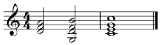
Below is the original dominant-tonic progression, that progression with the tritone substitution, and the same progression with the substitution notated as an Italian augmented sixth chord:

Tritone Substitution
Tritone substitutions are a common technique (see wikt:technique) in jazz and were first used by musicians such as Duke Ellington
Duke Ellington

Edward Kennedy "Duke" Ellington was an American composer, pianist, and bandleader.Duke Ellington was recognized during his life as one of the most influential Jazz royalty, if not in all American music and he is of only four jazz musicians ever to have been featured on the cover of Time magazine ....
, Art Tatum
Art Tatum

Arthur Tatum Jr. was an American jazz pianist and virtuoso.With an exuberant style that combined dazzling technique and sophisticated use of harmony, Art Tatum is widely acknowledged as one of the greatest jazz pianists of all time....
, Coleman Hawkins
Coleman Hawkins

Coleman Randolph Hawkins , nicknamed "Hawk" and sometimes "Bean", was a prominent jazz Tenor saxophone.He is commonly regarded as the first important and influential jazz musician to use the instrument: Joachim E....
, Roy Eldridge
Roy Eldridge

Roy David Eldridge , nicknamed "Little Jazz" was an United States jazz trumpet player. His sophisticated use of harmony, including the use of tritone substitutions, his virtuosic solos and his strong influence on Dizzy Gillespie mark him as one of the most exciting musicians of the Swing Era and a precursor of bebop....
 and Benny Goodman
Benny Goodman

Benjamin David Goodman, was an United States jazz musician, clarinetist and bandleader, known as "King of Swing ", "Patriarch of the Clarinet", "The Professor", and "Swing's Senior Statesman"....
.

Tritone subtitutions are also known as substitute dominants, or Sub-V (Sub-five) chords.

See also

  • Coltrane changes
    Coltrane changes

    In jazz harmony, the Coltrane changes are a chord progression variation using substitute chords over common jazz chord progressions. These substitution patterns were first demonstrated by jazz musician John Coltrane on the album Blue Train_ on the tunes Lazy Bird and Moment's Notice....


Sources

  • Stein, Deborah (2005). Engaging Music: Essays in Music Analysis. New York: Oxford University Press. ISBN 0-19-517010-5.
  • Satyendra, Ramon. "Analyzing the Unity within Contrast: Chick Corea's Starlight". Cited in Stein (2005).